


 |
市場調查報告書
商品編碼
2072484
雲端整合軟體:市場佔有率分析、產業趨勢與統計、成長預測(2026-2031)Cloud Integration Software - Market Share Analysis, Industry Trends & Statistics, Growth Forecasts (2026 - 2031) |
||||||

※ 本網頁內容可能與最新版本有所差異。詳細情況請與我們聯繫。
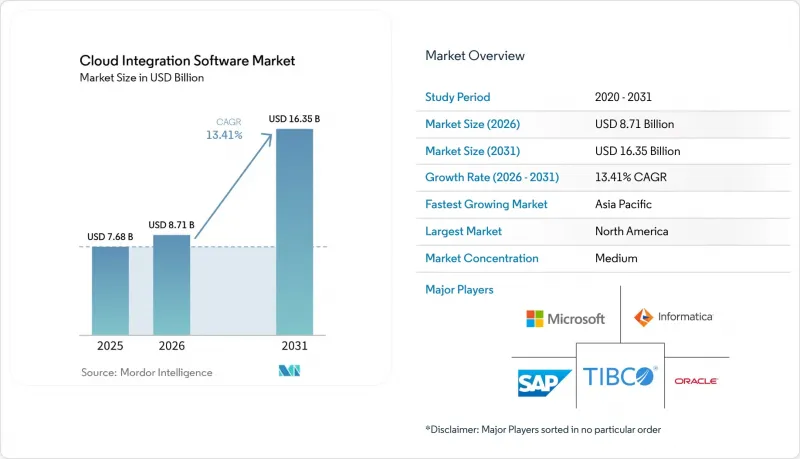
據 Mordor Intelligence 稱,2025 年雲端整合軟體市場價值為 76.8 億美元,預計到 2031 年將達到 163.5 億美元,而 2026 年為 87.1 億美元,預測期(2026-2031 年)的複合年成長率為 13.41%。
本報告按類型(PaaS、IaaS、SaaS)、整合類型(應用程式整合、資料整合等)、企業規模(大型企業和中小企業 (SME))、服務類型(專業服務和託管服務)、最終用戶業(銀行、金融服務和保險 (BFSI)、IT 和電信等)以及地區進行分類。
全球雲端整合軟體市場趨勢與洞察
多重雲端採用的擴充
企業不僅將多重雲端視為一種安全保障,更將其視為取得競爭優勢的手段。他們會將高密度 GPU 節點分配給 AI 訓練,同時將受監管的資料儲存在自身主權範圍內。超大規模資料中心業者正積極回應,提供跨雲端資料庫和網路服務,以降低延遲並消除出口流量費用,從而推動對跨供應商抽象化策略執行的控制平面的需求。統一管治能夠加快合作夥伴的入駐速度,因為無論工作負載位於何處,加密和日誌記錄都將保持一致。
需要統一整合的SaaS應用程式的激增
目前,平均每家公司運作超過 360 個 SaaS 應用,而點對點連接無法應對這種擴展性,導致資料碎片化和合違規。現代整合平台即服務 (iPaaS) 整合了預先建置的連接器、模式映射和版本控制功能,使團隊無需編寫腳本即可即時同步記錄。此外,供應商正在建立 API 市場,客戶可以在此銷售精心挑選的連接器,從而將整合從後勤部門成本轉變為額外的收入來源。
資料主權和合規性的複雜性
由於隱私法規因地區而異,團隊必須建立特定於地區的管道,以實現全球分析,同時將受監管的資料保留在各自的區域內。供應商正透過主權雲端區域和基於策略的路由來解決這個問題,但合規性審計卻延長了部署時間並增加了營運成本。
細分市場分析
即使到了2025年,平台即服務(PaaS)仍維持著57.95%的市場佔有率,這主要歸功於大型企業對高度客製化的需求。然而,軟體即服務(SaaS)整合預計將以每年15.12%的速度成長,這得益於其即時擴展性、內建可觀測性以及顯著降低資本支出(CapEx)的訂閱定價模式。供應商正在將基於人工智慧的資料映射和異常檢測功能整合到SaaS層,使非專業開發者無需編寫程式碼即可建立流程,同時安全團隊仍能保留管理控制權。
在受監管行業中,基礎設施即服務 (IaaS) 整合仍然發揮著至關重要的作用,它在嚴格的審計環境下,在專用主機上運行工作負載。這些部署通常利用 Kubernetes Operator 來強制執行策略模板,並在叢集間複製金鑰。
到 2025 年,應用整合將佔總收入的 36.45%,為 ERP 和 CRM 系統的整合提供支援。同時,隨著企業實現數位資產貨幣化並採用微服務,API 管理預計將以 14.02% 的複合年成長率成長。如今,閘道器標配自助式開發者入口網站、配額執行和模式自省功能,將合作夥伴的進駐時間從數月縮短至數天。
EDI現代化進程也在加速。製造商正用即時事件流取代平面文件的批量處理,從而提高存貨周轉並減少缺貨情況。
區域分析
預計到2025年,北美將佔據36.02%的市場。這主要得益於其深厚的雲端運算專業知識、寬鬆的資料流監管以及由於接近性廠商總部而能夠更早地獲取尖端功能。該地區的企業正在採用人工智慧驅動的整合式可觀測性,將API呼叫、訊息佇列和資料管道關聯到一個統一的管理介面。
預計亞太地區將維持最高的成長率,到2031年複合年成長率將達到14.25%。主權雲端計畫需要一個混合平台,該平台能夠在滿足資料居住需求的同時,同步全球研發工作負載。中國、日本和韓國5G的快速部署以及物聯網的普及,導致遙測資料激增,這些資料需要在邊緣進行清洗,然後才能歸檔到中央資料湖中。
由於歐洲嚴格的隱私法規強調審計日誌、使用者同意流程和不可篡改的資料處理歷程,因此歐洲仍保持相當大的市場佔有率。即將訂定的《數位營運彈性法案》將強制金融機構採用能夠抵禦單點故障的事件流架構。
其他好處:
- Excel格式的市場預測(ME)表
- 3個月的分析師支持
目錄
第1章:引言
- 研究假設和市場定義
- 調查範圍
第2章:調查方法
第3章執行摘要
第4章 市場狀況
- 市場概覽
- 市場促進因素
- 多重雲端採用的擴充
- 需要統一整合的SaaS應用程式的激增
- 對即時數據分析和API主導連接的需求
- 微服務中的事件驅動架構
- 面向工業4.0的邊緣到雲編配
- 市場連結器(iPaaS)的貨幣化
- 市場限制因素
- 資料主權和合規性的複雜性
- 整合傳統本地系統的複雜性
- 超大規模資料中心業者的外呼費用不斷上漲
- 雲端原生整合人才短缺
- 價值鏈分析
- 監理情勢
- 技術展望
- 波特五力分析
- 投資分析
- 評估宏觀經濟趨勢對市場的影響
第5章 市場規模與成長預測
- 按類型
- PaaS
- IaaS
- SaaS
- 透過整合
- 應用整合
- 資料整合
- API管理
- 流程整合與編配
- B2B/EDI整合
- 按公司規模
- 大公司
- 中小企業
- 按服務類型
- 專業服務
- 託管服務
- 按最終用戶行業分類
- BFSI
- 資訊科技/通訊
- 零售與電子商務
- 教育
- 醫療保健和生命科學
- 製造業
- 政府/公共部門
- 其他
- 按地區
- 北美洲
- 美國
- 加拿大
- 墨西哥
- 歐洲
- 德國
- 英國
- 法國
- 義大利
- 西班牙
- 俄羅斯
- 其他歐洲國家
- 亞太地區
- 中國
- 日本
- 印度
- 韓國
- 澳洲和紐西蘭
- 其他亞太國家
- 南美洲
- 巴西
- 阿根廷
- 其他南美國家
- 中東和非洲
- 中東
- 沙烏地阿拉伯
- 阿拉伯聯合大公國
- 土耳其
- 其他中東國家
- 非洲
- 南非
- 奈及利亞
- 其他非洲國家
- 中東
- 北美洲
第6章 競爭情勢
- 市場集中度
- 策略趨勢
- 市佔率分析
- 公司簡介
- Microsoft
- Salesforce(MuleSoft)
- IBM
- Boomi
- Informatica
- SAP
- Oracle
- TIBCO
- SnapLogic
- Software AG
- Workato
- Celigo
- Jitterbit
- Talend
- WSO2
- Red Hat
- Axway
- Kong Inc.
- Accenture
- Deloitte
第7章 市場機會與未來展望
According to Mordor Intelligence, the cloud integration software market size was valued at USD 7.68 billion in 2025 and estimated to grow from USD 8.71 billion in 2026 to reach USD 16.35 billion by 2031, at a CAGR of 13.41% during the forecast period (2026-2031).
This report is Segmented by Type (PaaS, IaaS, and SaaS), Integration (Application Integration, Data Integration, and More), Enterprise Size (Large Enterprises and Small and Medium Enterprises (SMEs)), Service Type (Professional Service and Managed Services), End-User Industry (BFSI, IT and Telecom, and More), and Geography.
Global Cloud Integration Software Market Trends and Insights
Proliferation of Multi-Cloud Adoption
Enterprises treat multi-cloud as a competitive lever rather than an insurance policy, matching GPU-dense nodes to AI training while housing regulated data in sovereign regions. Hyperscalers respond with cross-cloud database and networking services that trim latency and erase egress fees, spurring demand for control planes that abstract policy enforcement across providers. Unified governance hastens partner onboarding because encryption and logging remain consistent no matter where workloads land.
SaaS Application Sprawl Requiring Unified Integration
With the average enterprise now running more than 360 SaaS apps, point-to-point links crack under scale, fragmenting data and harming compliance. Modern iPaaS bundles pre-built connectors, schema mapping, and version control so teams can sync records instantly without scripting. Vendors further add API marketplaces that let customers sell curated connectors, turning integration from back-office cost into incremental revenue.
Data-Sovereignty and Compliance Complexity
Fragmented privacy laws force teams to build region-specific pipelines that keep regulated data resident while still enabling global analytics. Vendors answer with sovereign cloud zones and policy-based routing, but compliance audits prolong rollouts and inflate operating costs.
Other drivers and restraints analyzed in the detailed report include:
- Need for Real-Time Data Analytics and API-Led Connectivity
- Event-Driven Architectures in Microservices
- Legacy On-Premises Integration Complexity
For complete list of drivers and restraints, kindly check the Table Of Contents.
Segment Analysis
Platform-as-a-Service kept 57.95% share in 2025 because large enterprises need advanced customisation. Yet SaaS integration will grow 15.12% annually, thanks to instant scaling, built-in observability, and subscription pricing that slashes CapEx. Vendors weave AI-based data mapping and anomaly detection into their SaaS layers, letting citizen developers build flows without code while security teams remain in control.
For regulated sectors, Infrastructure-as-a-Service integration maintains relevance by anchoring workloads on dedicated hosts under strict audit. These deployments often rely on Kubernetes operators that enforce policy templates and replicate secrets across clusters.
Application Integration dominated revenue at 36.45% in 2025, underpinning ERP and CRM linkages. API Management, however, will post a 14.02% CAGR as firms monetise digital assets and adopt microservices. Gateways now ship with self-service developer portals, quota enforcement, and schema introspection, shrinking partner onboarding windows from months to days.
EDI modernisation also gains steam: manufacturers replace batch flat-file exchanges with real-time event streams that improve inventory turns and reduce stock-outs.
Complete Report Scope:
- By Type
- PaaS
- IaaS
- SaaS
- By Integration
- Application Integration
- Data Integration
- API Management
- Process Integration and Orchestration
- B2B/EDI Integration
- By Enterprise Size
- Large Enterprises
- Small and Medium Enterprises (SMEs)
- By Service Type
- Professional Services
- Managed Services
- By End-user Industry
- BFSI
- IT and Telecom
- Retail and E-commerce
- Education
- Healthcare and Life Sciences
- Manufacturing
- Government and Public Sector
- Others
- By Geography
- North America
- United States
- Canada
- Mexico
- Europe
- Germany
- United Kingdom
- France
- Italy
- Spain
- Russia
- Rest of Europe
- Asia-Pacific
- China
- Japan
- India
- South Korea
- Australia and New Zealand
- Rest of Asia-Pacific
- South America
- Brazil
- Argentina
- Rest of South America
- Middle East and Africa
- Middle East
- Saudi Arabia
- United Arab Emirates
- Turkey
- Rest of Middle East
- Africa
- South Africa
- Nigeria
- Rest of Africa
- Middle East
- North America
Geography Analysis
North America held 36.02% market share in 2025, buoyed by deep cloud expertise, permissive data-flow regimes, and proximity to vendor headquarters that grants early access to bleeding-edge features. Enterprises here adopt AI-driven integration observability that correlates API calls, message queues, and data pipelines under one pane of glass.
Asia-Pacific is forecast for the fastest 14.25% CAGR through 2031. Sovereign cloud programs require hybrid platforms able to enforce data-residency while still syncing R and D workloads globally. Rapid 5G deployment and IoT proliferation in China, Japan, and South Korea generate telemetry bursts that must be cleansed at the edge before archive to central data lakes.
Europe keeps sizable share due to strict privacy mandates that emphasise audit logs, consent workflows, and immutable data lineage. The upcoming Digital Operational Resilience Act will push financial institutions to adopt event-streaming architectures that survive single-point failures.
- Microsoft
- Salesforce (MuleSoft)
- IBM
- Boomi
- Informatica
- SAP
- Oracle
- TIBCO
- SnapLogic
- Software AG
- Workato
- Celigo
- Jitterbit
- Talend
- WSO2
- Red Hat
- Axway
- Kong Inc.
- Accenture
- Deloitte
Additional Benefits:
- The market estimate (ME) sheet in Excel format
- 3 months of analyst support
TABLE OF CONTENTS
1 INTRODUCTION
- 1.1 Study Assumptions and Market Definition
- 1.2 Scope of the Study
2 RESEARCH METHODOLOGY
3 EXECUTIVE SUMMARY
4 MARKET LANDSCAPE
- 4.1 Market Overview
- 4.2 Market Drivers
- 4.2.1 Proliferation of multi-cloud adoption
- 4.2.2 SaaS application sprawl requiring unified integration
- 4.2.3 Need for real-time data analytics and API-led connectivity
- 4.2.4 Event-driven architectures in micro-services
- 4.2.5 Edge-to-cloud orchestration for Industry 4.0
- 4.2.6 Monetisation of marketplace connectors (iPaaS)
- 4.3 Market Restraints
- 4.3.1 Data-sovereignty and compliance complexity
- 4.3.2 Legacy on-prem integration complexity
- 4.3.3 Rising hyperscaler egress charges
- 4.3.4 Scarcity of cloud-native integration talent
- 4.4 Value Chain Analysis
- 4.5 Regulatory Landscape
- 4.6 Technological Outlook
- 4.7 Porter's Five Forces Analysis
- 4.7.1 Bargaining Power of Buyers
- 4.7.2 Bargaining Power of Suppliers
- 4.7.3 Threat of New Entrants
- 4.7.4 Threat of Substitutes
- 4.7.5 Intensity of Competitive Rivalry
- 4.8 Investment Analysis
- 4.9 Assessment of the Impact of Macroeconomic Trends on the Market
5 MARKET SIZE AND GROWTH FORECASTS (VALUE)
- 5.1 By Type
- 5.1.1 PaaS
- 5.1.2 IaaS
- 5.1.3 SaaS
- 5.2 By Integration
- 5.2.1 Application Integration
- 5.2.2 Data Integration
- 5.2.3 API Management
- 5.2.4 Process Integration and Orchestration
- 5.2.5 B2B/EDI Integration
- 5.3 By Enterprise Size
- 5.3.1 Large Enterprises
- 5.3.2 Small and Medium Enterprises (SMEs)
- 5.4 By Service Type
- 5.4.1 Professional Services
- 5.4.2 Managed Services
- 5.5 By End-user Industry
- 5.5.1 BFSI
- 5.5.2 IT and Telecom
- 5.5.3 Retail and E-commerce
- 5.5.4 Education
- 5.5.5 Healthcare and Life Sciences
- 5.5.6 Manufacturing
- 5.5.7 Government and Public Sector
- 5.5.8 Others
- 5.6 By Geography
- 5.6.1 North America
- 5.6.1.1 United States
- 5.6.1.2 Canada
- 5.6.1.3 Mexico
- 5.6.2 Europe
- 5.6.2.1 Germany
- 5.6.2.2 United Kingdom
- 5.6.2.3 France
- 5.6.2.4 Italy
- 5.6.2.5 Spain
- 5.6.2.6 Russia
- 5.6.2.7 Rest of Europe
- 5.6.3 Asia-Pacific
- 5.6.3.1 China
- 5.6.3.2 Japan
- 5.6.3.3 India
- 5.6.3.4 South Korea
- 5.6.3.5 Australia and New Zealand
- 5.6.3.6 Rest of Asia-Pacific
- 5.6.4 South America
- 5.6.4.1 Brazil
- 5.6.4.2 Argentina
- 5.6.4.3 Rest of South America
- 5.6.5 Middle East and Africa
- 5.6.5.1 Middle East
- 5.6.5.1.1 Saudi Arabia
- 5.6.5.1.2 United Arab Emirates
- 5.6.5.1.3 Turkey
- 5.6.5.1.4 Rest of Middle East
- 5.6.5.2 Africa
- 5.6.5.2.1 South Africa
- 5.6.5.2.2 Nigeria
- 5.6.5.2.3 Rest of Africa
- 5.6.5.1 Middle East
- 5.6.1 North America
6 COMPETITIVE LANDSCAPE
- 6.1 Market Concentration
- 6.2 Strategic Moves
- 6.3 Market Share Analysis
- 6.4 Company Profiles (includes Global level Overview, Market level overview, Core Segments, Financials as available, Strategic Information, Market Rank/Share for key companies, Products and Services, and Recent Developments)
- 6.4.1 Microsoft
- 6.4.2 Salesforce (MuleSoft)
- 6.4.3 IBM
- 6.4.4 Boomi
- 6.4.5 Informatica
- 6.4.6 SAP
- 6.4.7 Oracle
- 6.4.8 TIBCO
- 6.4.9 SnapLogic
- 6.4.10 Software AG
- 6.4.11 Workato
- 6.4.12 Celigo
- 6.4.13 Jitterbit
- 6.4.14 Talend
- 6.4.15 WSO2
- 6.4.16 Red Hat
- 6.4.17 Axway
- 6.4.18 Kong Inc.
- 6.4.19 Accenture
- 6.4.20 Deloitte
7 MARKET OPPORTUNITIES AND FUTURE OUTLOOK
- 7.1 White-space and Unmet-need Assessment

 雲端自動化:市場佔有率分析、產業趨勢與統計、成長預測(2026-2031)
 雲端整合軟體市場-2026-2032年全球市場預測
 社區關係管理市場預測至2034年—按解決方案類型、部署模式、技術、應用、最終用戶和地區分類的全球分析雲端自動化市場預測至 2034 年—按組件、部署模型、組織規模、功能、最終用戶和地區分類的全球分析
 協會管理軟體市場規模、佔有率和成長分析:按部署類型、組織類型、應用、企業規模、提供的服務、最終用戶和地區分類-2026-2033年產業預測零售和酒店業的薪資核算軟體:市場佔有率分析、行業趨勢和統計數據以及成長預測(2026-2031 年)
 雲端整合軟體市場規模、佔有率和趨勢分析報告:按類型、企業規模、應用、地區和細分市場預測(2026-2033 年)社群管理應用市場預測至2034年-全球分析(按組件、部署模式、組織規模、技術、應用、最終用戶和地區分類)
 2026年全球雲端整合軟體市場報告2026年全球雲端目錄服務軟體市場報告