


 |
市場調查報告書
商品編碼
2117225
眼動追蹤解決方案:市場佔有率分析、產業趨勢與統計數據、成長預測(2026-2031 年)Eye Tracking Solutions - Market Share Analysis, Industry Trends & Statistics, Growth Forecasts (2026 - 2031) |
||||||

※ 本網頁內容可能與最新版本有所差異。詳細情況請與我們聯繫。
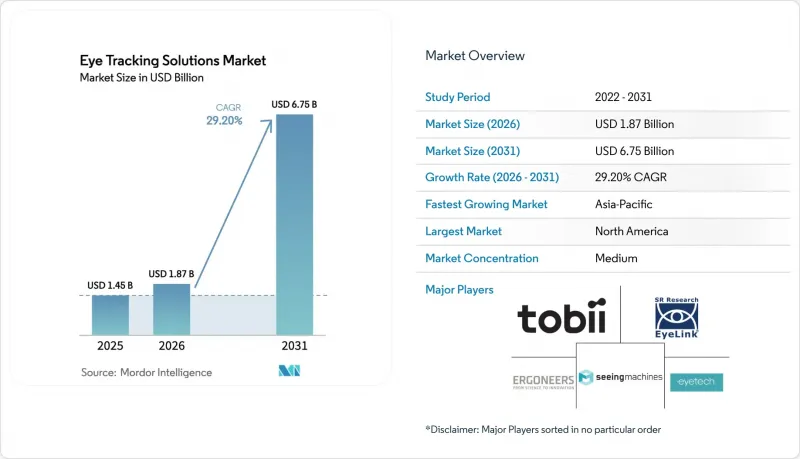
根據 Mordor Intelligence 預測,眼動追蹤解決方案市場規模將從 2025 年的 14.5 億美元成長到 2026 年的 18.7 億美元,到 2031 年將達到 67.5 億美元,2026 年至 2031 年的複合年成長率為 29.2%。
本報告按解決方案(硬體、軟體)、追蹤類型(遠端/桌面、頭戴式、眼部配戴式、行動裝置/嵌入式)、應用程式(輔助通訊、駕駛監控、AR/VR遊戲、研究)、終端用戶產業(汽車、消費性電子、醫療保健、零售、航太、媒體)和地區進行細分。市場預測以美元計價。
全球眼動追蹤解決方案市場趨勢與洞察
根據歐盟通用安全法規(EU-GSR),強制安裝駕駛員監視器
歐盟通用安全法規規定,2024年7月之後銷售的所有新車都必須配備基於攝影機的駕駛員疲勞和注意力分散預警系統,而從2026年7月起,更高級的注意力分散預警系統將成為標配。因此,汽車製造商正將眼動追蹤技術定位為一項基礎技術,並致力於在不同地區推廣統一的駕駛員監控平台,以實現規模經濟。歐洲新車安全評鑑協會(Euro NCAP)的「2030願景」藍圖正在將合規性轉化為競爭優勢,鼓勵企業在最低標準之外進行更多投資。市場對汽車用VCSEL陣列(例如歐司朗的TARA2000-AUT)的硬體需求激增,推動了人眼安全紅外線發送器的量產。
VR/AR頭顯OEM廠商對「中心凹渲染」效率的需求
頭戴式裝置製造商正利用眼動追蹤技術將GPU資源集中於中心視野,從而在不影響感知影像品質的前提下顯著降低像素成本。學術研究表明,在射線追蹤場景中,速度提升可達25倍。蘋果的Vision Pro普及了基於眼動追蹤的導航技術,並因此催生了Meta和HTC等廠商的競爭。同時,OEM廠商需要應對GDPR及類似法律規定的生物識別限制,這促使設備內部眼動向量預處理和加密技術不斷進步。與兆赫感測和從眼動攝影機提取心率相關的專利申請預示著基於眼動互動將與更廣泛的生理監測技術融合。
深色虹膜人群的準確率降低,限制了該技術在亞太地區的部署。
對照研究報告顯示,亞洲受試者的測量準確率下降。這是因為,除了虹膜顏色較深導致對比度降低外,平均瞳孔大小的差異也會使紅外線成像的閾值變得複雜。基於智慧型手機的瞳孔測量技術透過切換到遠紅外線波段來緩解這種對比度差異,但仍需要針對不同種族進行適配的模型才能實現完全一致。 ISO/IEC 19795-10 標準要求供應商公佈每個人口統計群體的效能數據,從而提高演算法的透明度。在演算法和光學技術成熟之前,東亞地區的大規模部署速度可能會低於相關法規所預期的速度。
細分市場分析
預計到2025年,硬體將佔據眼動追蹤解決方案市場9.8億美元的佔有率,達到67.40%,並顯著超越軟體。在車輛安全認證和VR延遲限制方面,攝影機、光學元件和專用推理ASIC晶片仍然至關重要,因為這些方面不容妥協。照明器是硬體產品系列中成長最快的組件,尤其是在豪華車領域,因為駕駛監控系統採用雙VCSEL陣列來確保冗餘。供應商優先考慮長期供貨保障,以降低OEM生產週期中的風險,這為新進入者設定了很高的進入門檻。
軟體產業正以29.7%的複合年成長率快速擴張。 SDK訂閱模式能夠帶來持續的收入,並使小規模開發者無需自行建立光學系統即可將眼動追蹤功能整合到他們的應用程式中。 Tobii的Nexus框架標誌著從獨立銷售模式向平台經濟模式的轉變,它在同一許可證下提供分析儀表板和A/B測試模組。隨著硬體組件的商品化,複雜的演算法、資料管道和雲端安全控制成為在眼動追蹤解決方案市場保持定價權的關鍵因素。
到2025年,隨著遠端或桌面配置在學術研究實驗室和消費者調查中的廣泛應用,眼動追蹤解決方案的市場佔有率將達到51.30%。這些系統具有許多優勢,例如可控照明和固定頭部位置,從而降低了演算法的複雜性,並降低了初次使用者的整體擁有成本。雖然頭戴式追蹤器對於虛擬實境沉浸式體驗和車載應用仍然至關重要,但人體工學方面的限制和電池續航力的不足阻礙了其在小眾領域之外的普及。
穿戴式眼電圖(EOG)是一項值得關注的新興技術。例如,ElectraSight 的 7.75 mW 原型機就證明了使用智慧型手錶等級的電池即可實現全天運作(arxiv.org)。結合神經形態事件相機,這些感測器可實現微秒延遲,從而支援即時混合實境(MR)疊加。原始設備製造商(ODM)預計,將健康指標疊加到眼動追蹤數據上的服務將獲得高價,這表明穿戴式式 EOG 未來可能會挑戰以相機為中心的眼動追蹤解決方案市場。
區域分析
北美保持主導地位,預計到2025年將佔全球銷售額的47.50%。這得歸功於矽谷的投資、蓬勃發展的VR遊戲生態系統以及零售業對先進商品行銷分析技術的投入。美國仍然至關重要,一級汽車零件供應商正在底特律和其他西海岸科技中心附近聯合建立研發中心。加拿大正利用公共研究津貼將臨床眼動追蹤技術商業化,而墨西哥的OEM工廠正在為出口市場整合駕駛員監控模組。
歐洲的發展趨勢深受監管法規的影響。 2026年高級駕駛分心警報系統)的實施期限,鞏固了對攝影機製造商和軟體供應商的需求。德國汽車製造商正承擔高昂的初始零件成本,以確保獲得五星安全評級;北歐醫療保健系統則在試驗眼動追蹤復健計畫。隨著GDPR法規的日益嚴格,歐洲供應商正率先開發邊緣資料最小化架構,影響全球隱私藍圖。
亞太地區正經歷最快的成長,複合年成長率高達30.4%。中國強制要求駕駛注意力力感應準確率達到95%,加速了車輛的改進並規範了性能標準。日本一級汽車供應商正與人工智慧新創公司合作,將眼動追蹤功能整合到L3級自動駕駛平台中,例如BLUESKEYE AI部署的模擬器。韓國正利用其智慧型手機和顯示器製造基礎設施,探索將眼動追蹤技術應用於折疊式設備。同時,印度的大規模部署機會依賴低成本的光學堆疊和雲端補貼。這些趨勢凸顯了區域策略差異,但總體而言,它們正在推動全球眼動追蹤解決方案市場的收入成長。
其他好處:
- Excel格式的市場預測(ME)表
- 3個月的分析師支持
目錄
第1章:引言
- 研究假設和市場定義
- 調查範圍
第2章:調查方法
第3章執行摘要
第4章 市場狀況
- 市場概覽
- 市場促進因素
- 歐洲已強制要求將駕駛員監視錄影機整合到歐盟車輛安全報告(EU-GSR)中。
- VR/AR頭顯OEM廠商對中心凹渲染效率的需求
- 在北美,眼動追蹤正逐漸成為零售業貨架測試的實際標準。
- 中國的安全法規推動了駕駛座危險管理系統(DMS)的改裝。
- 低負載SDK,加速應用開發者(全球)採用
- 美國大型科技公司在基於神經科學的使用者體驗測試方面的支出
- 市場限制因素
- 由於存在黑瞳,精度降低,這限制了其在亞太地區的部署。
- 汽車模組中主動照明的高物料清單成本
- GDPR對眼動追蹤資料儲存的限制(歐盟)
- 移動式眼動追蹤眼鏡電池續航時間短。
- 價值供應鏈分析
- 監管和技術展望
- 一項新的 ISO 標準? / TR 21965,涉及隱蔽式眼部監測設備。
- 用於邊緣人工智慧的注視估計晶片(16 TOPS 等級)
- 波特五力模型
第5章 市場規模與成長預測
- 透過解決方案
- 硬體
- 相機和光學儀器
- 處理器和專用積體電路
- 照明設備(紅外線LED/雷射)
- 軟體
- 軟體 SDK 和分析
- 硬體
- 按類型追蹤
- 遠端桌面
- 頭戴式
- 眼部安裝式(眼電圖)
- 行動/嵌入式
- 透過使用
- 溝通支援和輔助溝通
- 駕駛員監控和車輛安全
- AR/VR 和遊戲
- 消費者研究與神經行銷研究
- 學術和臨床研究
- 按最終用戶行業分類
- 汽車和運輸業
- 家用電子產品
- 醫療和研究機構
- 零售和廣告
- 航太/國防
- 媒體與娛樂
- 其他
- 按地區
- 北美洲
- 美國
- 加拿大
- 墨西哥
- 南美洲
- 巴西
- 阿根廷
- 其他南美國家
- 歐洲
- 德國
- 英國
- 法國
- 義大利
- 西班牙
- 其他歐洲國家
- 亞太地區
- 中國
- 日本
- 印度
- 韓國
- ASEAN
- 澳洲
- 其他亞太國家
- 中東和非洲
- 中東
- GCC
- 土耳其
- 以色列
- 其他中東國家
- 非洲
- 南非
- 奈及利亞
- 埃及
- 其他非洲國家
- 中東
- 北美洲
第6章 競爭情勢
- 市場集中度
- 策略趨勢
- 市佔率分析
- 公司簡介
- Tobii AB
- Seeing Machines Ltd.
- SR Research Ltd.
- iMotions A/S
- EyeTech Digital Systems Inc.
- Ergoneers GmbH
- FOVE Inc.
- Gazepoint Research Inc.
- Eyegaze Inc.
- Noldus Information Technology BV
- Pupil Labs GmbH
- SmartEye AB
- AdHawk Microsystems Inc.
- SMI SensoMotoric Instruments
- LC Technologies Inc.
- BrainCo Inc.
- EyeSquare GmbH
- Emotiv Inc.
- Optalert Australia
- Tobii Dynavox LLC
- EyeTracking Inc.
第7章 市場機會與未來展望
According to Mordor Intelligence, the eye-tracking solutions market size is expected to grow from USD 1.45 billion in 2025 to USD 1.87 billion in 2026 and is forecast to reach USD 6.75 billion by 2031 at 29.2% CAGR over 2026-2031.
This report is Segmented by Solution (Hardware, Software), Tracking Type (Remote/Desktop, Head-Mounted, Eye-Attached, Mobile/Embedded), Application (Assistive Communication, Driver Monitoring, AR/VR Gaming, Research), End-User Industry (Automotive, Consumer Electronics, Healthcare, Retail, Aerospace, Media), and by Geography. The Market Forecasts are Provided in Terms of Value (USD).
Global Eye Tracking Solutions Market Trends and Insights
Mandatory EU-GSR Integration of Driver-Monitoring Cameras
The EU General Safety Regulation requires all new vehicles sold from July 2024 to include camera-based driver drowsiness and attention warning, followed by advanced distraction warning from July 2026 . Automakers therefore treat eye tracking as foundational, standardizing a single driver monitoring platform across regions to achieve scale benefits. Euro NCAP's Vision 2030 roadmap turns compliance into a competitive metric, compelling additional investment beyond minimum thresholds.Hardware demand spikes for automotive-grade VCSEL arrays such as ams OSRAM's TARA2000-AUT, driving volume production of eye-safe infrared emitters.
VR/AR Headset OEM Demand for Foveated Rendering Efficiency
Headset makers deploy eye tracking to concentrate GPU resources on the foveal region, slashing pixel budgets without perceptible quality loss; academic work shows up to 25x acceleration in ray-traced scenes. Apple's Vision Pro mainstreamed gaze-based navigation, triggering competitive responses from Meta and HTC. Concurrently, OEMs must address biometric privacy constraints under GDPR and similar laws, leading to on-device preprocessing and encryption of gaze vectors. Patent filings covering terahertz sensing and heart-rate extraction from eye cameras foreshadow convergence between gaze interaction and broader physiological monitoring.
Accuracy Loss from Dark-Iris Populations Limiting APAC Roll-Outs
Controlled studies report lower precision for Asian participants because darker irises reduce contrast, while average pupil size variations complicate thresholding in infrared imagery. Smartphone-based pupillometry mitigates the contrast gap by shifting to far-red wavelengths, but full parity still demands ethnicity-adaptive models. Compliance with ISO/IEC 19795-10 forces vendors to publish performance by demographic cohort, elevating algorithm transparency. Until algorithms and optics mature, large-scale deployments in East Asia may progress more slowly than regulatory momentum would otherwise imply.
Other drivers and restraints analyzed in the detailed report include:
- Retail Eye-Tracking Becoming De-Facto Standard for Shelf Testing
- In-Cockpit DMS Retrofits Driven by Chinese Safety Regulations
- High BOM Cost of Active Illumination in Automotive-Grade Modules
For complete list of drivers and restraints, kindly check the Table Of Contents.
Segment Analysis
Hardware contributed USD 0.98 billion to the eye-tracking solutions market size in 2025 and retained a 67.40% share in 2025, well ahead of software. Cameras, optics, and dedicated inference ASICs remain indispensable when vehicle safety certifications or VR latency budgets leave no room for compromise. Illuminators are the fastest-growing hardware line as driver monitoring systems adopt dual-VCSEL arrays for redundancy, especially in premium vehicle trims. Suppliers emphasize long-term supply guarantees to de-risk OEM production cycles, deepening entry barriers for new entrants.
The software segment is scaling faster at 29.7% CAGR. SDK subscription models generate recurring revenue and let smaller developers extend gaze interaction to apps without building custom optics. Tobii's Nexus framework typifies the shift from unit sales to platform economics, offering analytics dashboards and A/B testing modules within the same licence. As hardware components head toward commoditisation, refined algorithms, data pipelines, and cloud security controls become decisive levers in sustaining pricing power inside the eye-tracking solutions market.
Remote or desktop configurations captured 51.30% of the eye tracking solutions market share in 2025, owing to entrenched use in academic labs and consumer research. These systems benefit from controlled lighting and fixed head positions, reducing algorithmic complexity and total cost of ownership for first-time adopters. Head-mounted trackers remain pivotal for VR immersion and in-cabin automotive functions, but ergonomic limits and battery constraints temper growth outside niche segments.
Eye-attached electrooculography is the emerging wildcard. Demonstrations such as ElectraSight's 7.75 mW prototype underscore the viability of day-long operation on a smartwatch-class battery arxiv.org. When paired with neuromorphic event cameras, these sensors deliver microsecond latency, unlocking real-time mixed-reality overlays. ODMs foresee premium pricing for wellness metrics layered onto gaze data, suggesting that wearable EOG could challenge camera-centric architectures in future iterations of the eye tracking solutions market.
Complete Report Scope:
- By Solution
- Hardware
- Cameras and Optics
- Processors and ASICs
- Illuminators (IR LEDs/Laser)
- Software
- Software SDK and Analytics
- Hardware
- By Tracking Type
- Remote/Desktop
- Head-Mounted
- Eye-Attached (Electro-oculography)
- Mobile/Embedded
- By Application
- Assistive Communication and AAC
- Driver Monitoring and Automotive Safety
- AR/VR and Gaming
- Consumer and Neuromarketing Research
- Academic and Clinical Research
- By End-User Industry
- Automotive and Transportation
- Consumer Electronics
- Healthcare and Research Labs
- Retail and Advertisement
- Aerospace and Defense
- Media and Entertainment
- Others
- By Geography
- North America
- United States
- Canada
- Mexico
- South America
- Brazil
- Argentina
- Rest of South America
- Europe
- Germany
- United Kingdom
- France
- Italy
- Spain
- Rest of Europe
- Asia-Pacific
- China
- Japan
- India
- South Korea
- ASEAN
- Australia
- Rest of Asia-Pacific
- Middle East and Africa
- Middle East
- GCC
- Turkey
- Israel
- Rest of Middle East
- Africa
- South Africa
- Nigeria
- Egypt
- Rest of Africa
- Middle East
- North America
Geography Analysis
North America maintained 47.50% revenue dominance in 2025, driven by Silicon Valley investment, an expansive VR gaming ecosystem, and a retail sector willing to fund advanced merchandising analytics. The United States remains pivotal as Tier-1 automotive suppliers co-locate R&D centers near Detroit and West Coast tech hubs. Canada leverages public research grants to commercialize clinical eye-tracking protocols, while Mexico's OEM plants integrate driver monitoring modules destined for export markets.
Europe's trajectory rests heavily on regulation. The impending 2026 deadline for advanced distraction warning cements volume for camera makers and software vendors. Germany's carmakers absorb early component premiums to secure five-star safety ratings, while Nordic healthcare systems pilot gaze-driven rehabilitation programs. As GDPR restrictions sharpen, European providers pioneer on-edge data minimization architectures, influencing global privacy blueprints.
Asia-Pacific is the fastest riser at 30.4% CAGR. China's 95% driver-attention accuracy mandate accelerates fleet retrofits and standardizes performance benchmarks . Japan's automotive Tier-1s collaborate with AI start-ups to embed gaze analytics into Level-3 autonomous platforms, evidenced by BLUESKEYE AI's simulator rollout. South Korea taps its smartphone and display manufacturing base to explore eye tracking in foldable devices, whereas India's volume opportunity depends on low-cost optical stacks and cloud subsidies. These dynamics underscore divergent regional strategies yet collectively reinforce global revenue expansion for the eye tracking solutions market.
- Tobii AB
- Seeing Machines Ltd.
- SR Research Ltd.
- iMotions A/S
- EyeTech Digital Systems Inc.
- Ergoneers GmbH
- FOVE Inc.
- Gazepoint Research Inc.
- Eyegaze Inc.
- Noldus Information Technology BV
- Pupil Labs GmbH
- SmartEye AB
- AdHawk Microsystems Inc.
- SMI SensoMotoric Instruments
- LC Technologies Inc.
- BrainCo Inc.
- EyeSquare GmbH
- Emotiv Inc.
- Optalert Australia
- Tobii Dynavox LLC
- EyeTracking Inc.
Additional Benefits:
- The market estimate (ME) sheet in Excel format
- 3 months of analyst support
TABLE OF CONTENTS
1 INTRODUCTION
- 1.1 Study Assumptions and Market Definition
- 1.2 Scope of the Study
2 RESEARCH METHODOLOGY
3 EXECUTIVE SUMMARY
4 MARKET LANDSCAPE
- 4.1 Market Overview
- 4.2 Market Drivers
- 4.2.1 Mandatory EU-GSR integration of driver-monitoring cameras (Europe)
- 4.2.2 VR/AR headset OEM demand for foveated rendering efficiency
- 4.2.3 Retail eye-tracking becoming de-facto standard for shelf testing in North America
- 4.2.4 In-cockpit DMS retrofits driven by Chinese safety regulations
- 4.2.5 Low-friction SDKs accelerating app developer adoption (global)
- 4.2.6 Neuroscience-based UX testing spend by Big Tech firms (U.S.)
- 4.3 Market Restraints
- 4.3.1 Accuracy loss from dark-iris populations limiting APAC roll-outs
- 4.3.2 High BOM cost of active illumination in automotive-grade modules
- 4.3.3 GDPR constraints on gaze-data retention (EU)
- 4.3.4 Limited battery life for mobile eye-tracking glasses
- 4.4 Value / Supply-Chain Analysis
- 4.5 Regulatory and Technological Outlook
- 4.5.1 Emerging ISO?/TR 21965 for unobtrusive eye-monitoring devices
- 4.5.2 AI-on-edge gaze-estimation chips (16-TOPS class)
- 4.6 Porter's Five Forces
- 4.6.1 Bargaining Power of Suppliers
- 4.6.2 Bargaining Power of Buyers
- 4.6.3 Threat of New Entrants
- 4.6.4 Threat of Substitutes
- 4.6.5 Intensity of Competitive Rivalry
5 MARKET SIZE AND GROWTH FORECASTS (VALUE)
- 5.1 By Solution
- 5.1.1 Hardware
- 5.1.1.1 Cameras and Optics
- 5.1.1.2 Processors and ASICs
- 5.1.1.3 Illuminators (IR LEDs/Laser)
- 5.1.2 Software
- 5.1.2.1 Software SDK and Analytics
- 5.1.1 Hardware
- 5.2 By Tracking Type
- 5.2.1 Remote/Desktop
- 5.2.2 Head-Mounted
- 5.2.3 Eye-Attached (Electro-oculography)
- 5.2.4 Mobile/Embedded
- 5.3 By Application
- 5.3.1 Assistive Communication and AAC
- 5.3.2 Driver Monitoring and Automotive Safety
- 5.3.3 AR/VR and Gaming
- 5.3.4 Consumer and Neuromarketing Research
- 5.3.5 Academic and Clinical Research
- 5.4 By End-User Industry
- 5.4.1 Automotive and Transportation
- 5.4.2 Consumer Electronics
- 5.4.3 Healthcare and Research Labs
- 5.4.4 Retail and Advertisement
- 5.4.5 Aerospace and Defense
- 5.4.6 Media and Entertainment
- 5.4.7 Others
- 5.5 By Geography
- 5.5.1 North America
- 5.5.1.1 United States
- 5.5.1.2 Canada
- 5.5.1.3 Mexico
- 5.5.2 South America
- 5.5.2.1 Brazil
- 5.5.2.2 Argentina
- 5.5.2.3 Rest of South America
- 5.5.3 Europe
- 5.5.3.1 Germany
- 5.5.3.2 United Kingdom
- 5.5.3.3 France
- 5.5.3.4 Italy
- 5.5.3.5 Spain
- 5.5.3.6 Rest of Europe
- 5.5.4 Asia-Pacific
- 5.5.4.1 China
- 5.5.4.2 Japan
- 5.5.4.3 India
- 5.5.4.4 South Korea
- 5.5.4.5 ASEAN
- 5.5.4.6 Australia
- 5.5.4.7 Rest of Asia-Pacific
- 5.5.5 Middle East and Africa
- 5.5.5.1 Middle East
- 5.5.5.1.1 GCC
- 5.5.5.1.2 Turkey
- 5.5.5.1.3 Israel
- 5.5.5.1.4 Rest of Middle East
- 5.5.5.2 Africa
- 5.5.5.2.1 South Africa
- 5.5.5.2.2 Nigeria
- 5.5.5.2.3 Egypt
- 5.5.5.2.4 Rest of Africa
- 5.5.5.1 Middle East
- 5.5.1 North America
6 COMPETITIVE LANDSCAPE
- 6.1 Market Concentration
- 6.2 Strategic Moves
- 6.3 Market Share Analysis
- 6.4 Company Profiles {(includes Global level Overview, Market level overview, Core Segments, Financials as available, Strategic Information, Market Rank/Share for key companies, Products and Services, and Recent Developments)}
- 6.4.1 Tobii AB
- 6.4.2 Seeing Machines Ltd.
- 6.4.3 SR Research Ltd.
- 6.4.4 iMotions A/S
- 6.4.5 EyeTech Digital Systems Inc.
- 6.4.6 Ergoneers GmbH
- 6.4.7 FOVE Inc.
- 6.4.8 Gazepoint Research Inc.
- 6.4.9 Eyegaze Inc.
- 6.4.10 Noldus Information Technology BV
- 6.4.11 Pupil Labs GmbH
- 6.4.12 SmartEye AB
- 6.4.13 AdHawk Microsystems Inc.
- 6.4.14 SMI SensoMotoric Instruments
- 6.4.15 LC Technologies Inc.
- 6.4.16 BrainCo Inc.
- 6.4.17 EyeSquare GmbH
- 6.4.18 Emotiv Inc.
- 6.4.19 Optalert Australia
- 6.4.20 Tobii Dynavox LLC
- 6.4.21 EyeTracking Inc.
7 MARKET OPPORTUNITIES AND FUTURE OUTLOOK
- 7.1 White-space and Unmet-Need Assessment

 眼動追蹤市場-2026-2032年全球市場預測
 2026年全球3D眼動追蹤軟體市場報告
 眼動追蹤系統市場分析及預測(至2035年):依類型、產品類型、服務、技術、組件、應用、最終用戶、功能及安裝類型分類
 眼動追蹤全球市場規模、佔有率、趨勢和成長分析報告(2026-2034)
 眼動追蹤市場規模、佔有率、趨勢及預測(按類型、組件、位置、應用和地區分類),2026-2034年日本眼動追蹤市場報告:按類型、組件、位置、應用和地區分類(2026-2034 年)
 眼動追蹤市場規模、佔有率和成長分析(按產品、地點、應用、垂直產業、追蹤方法和地區分類)—產業預測(2026-2033 年)2025年全球眼動追蹤解決方案市場報告2025年眼動追蹤全球市場報告全球眼動追蹤市場規模(按類型、應用、區域範圍和預測):