


 |
市場調查報告書
商品編碼
2116602
圓針織機:市佔率分析、產業趨勢與統計、成長預測(2026-2031)Circular Knitting Machine - Market Share Analysis, Industry Trends & Statistics, Growth Forecasts (2026 - 2031) |
||||||

※ 本網頁內容可能與最新版本有所差異。詳細情況請與我們聯繫。
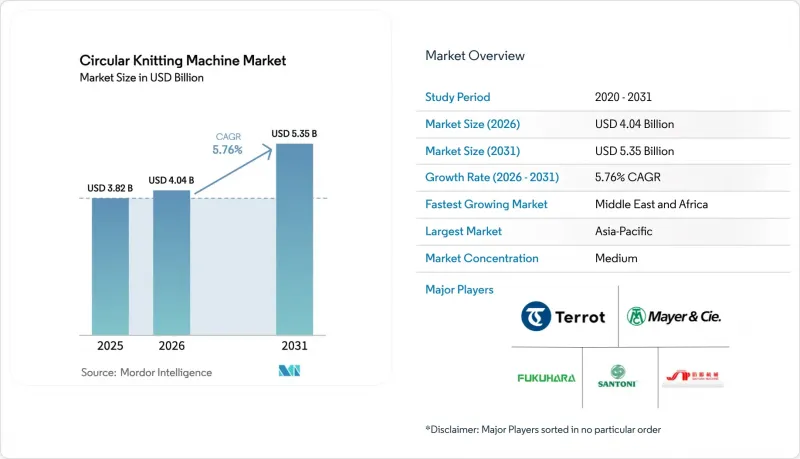
根據 Mordor Intelligence 預測,圓針織機市場規模將從 2025 年的 38.2 億美元成長到 2026 年的 40.4 億美元,然後在 2031 年達到 53.5 億美元,2026 年至 2031 年的複合年成長率為 5.76%。
本報告按機器類型(混合式/可轉換式機器等)、針距(細針距(24針或以上)等)、直徑(小直徑(小於15英寸)等)、自動化程度(機器控制等)、應用領域(服裝/紡織品等)、紗線類型(棉紗等)和地區(北美等)進行細分。市場預測以美元計價。
全球圓針織機機市場趨勢及洞察
對無縫/休閒服的需求不斷成長
休閒市場的結構性擴張正在推動新設備的採購。這是因為無縫技術省去了裁剪和縫紉工序,從而避免了成本增加和合身度下降的問題。 Santoni 的高針距平台一次即可完成壓縮區和人體工學區域的編織,打造出柔軟而耐用的服飾,並可定價較高。運動服飾品牌正擴大採用電子提花機頭,將品牌標誌和透氣區域直接織入織物管中,從而縮短款式更新的前置作業時間。隨著舒適性和功能性在日常穿著中日益融合,布料製造商正在現有生產線中引入多針距圓筒,以適應超細紗線。無縫時尚還能減少布料廢棄物,並有助於提升零售商在合規報告中密切關注的永續發展指標。
針織過程的自動化和數位化
工業4.0的整合徹底革新了現場管理系統。百隆的製造執行系統(MES)記錄每一次凸輪調整,從而實現全球工廠布料的精準複製。物聯網感測器將紗線張力、溫度和振動數據傳輸到雲端分析系統,在生產線停工前數小時預測缺陷。數位孿生技術使技術人員能夠虛擬測試新的針跡密度,顯著減少成本高昂的樣品製作。電腦視覺技術以全速檢測缺陷,確保只有完美的捲筒布料才能進入染色工序。由於多個地區勞動力短缺問題日益嚴重,自主配方控制已不再是可選項,而是確保運作和降低勞動力風險的關鍵。
大量初始資本投資
一條完全符合「工業4.0」標準的圓形針織生產線造價在1500萬美元到5000萬美元之間,其中包括高速圓筒、捲繞機、檢測設備和數位化後端系統。中小企業難以資金籌措這筆費用,尤其是在基礎設施租賃體係不完善的地區。快速的技術迭代意味著設備可能在五年內就顯得過時,這增加了風險。因此,一些買家推遲了升級計劃,或選擇功能最少的機型,市場擴張速度可能會放緩,直到靈活的「付費使用制」模式得到更廣泛的應用。
細分市場分析
到2025年,單筒圓針織機將佔據53.00%的市場。這是因為其簡單的凸輪機構使其在T卹、內衣和床單的生產中能夠實現高碼/分鐘(YPM)的生產效率。雖然目前用於特殊提花平台的圓針織機市場規模較小,但隨著時尚品牌追求能夠推高平均售價的複雜圖案,這一細分市場正以6.92%的複合年成長率快速成長。最新的提花機頭為每根針配備了微步電機,使得圖案可以透過軟體而非硬體板進行更改,從而將設定時間縮短至幾分鐘。 Wellknit的雙電腦控制提花機採用三聯式針織技術,使工廠能夠在上午生產平紋針織布料,並在中午前後切換到3D立體印花布料的生產。
其次,雙面針織機對於羅紋和雙面針織產品仍然至關重要,因為這些產品需要保持彈性。儘管其成長速度落後於提花針織機,但在內衣和運動服袖口等領域,需求依然強勁。混合平台現在配備了可拆卸針床,操作人員無需更換整個機架即可在單面針織和雙面針織之間進行選擇。這種柔軟性對在同一工廠同時處理多個品牌訂單的契約製造製造商極具吸引力。因此,未來十年,市場主導的單面針織機與新興的提花針織機之間的競爭差距將會縮小。
到2025年,中等針距(12-24針/英吋)的針織機將佔出貨量的47.40%。這是因為它們在可用紗線範圍、生產速度和織物質地方面實現了良好的平衡,使其適用於服裝的大規模生產。細針距針織機價格較高,但預計到2031年,其複合年成長率將達到6.02%,這主要得益於女用貼身內衣和休閒產品對超細旦紗線的需求,以實現貼身穿著的效果。推動圓針織機市場擴張的技術進步也功不可沒,例如Pylon公司重新設計的沉降環,該沉降環可最大限度地減少28針/英寸針距下的磨損。超細針筒的出現使得使用200針筒生產無縫襪成為可能,而此前這種針筒只能用於平針編織。
粗針距系統在保暖內衣和工業袖套領域仍然十分重要,但創新卻十分匱乏。由於紗線粗細帶來的價格差異很小,因此很難證明提高粗針距織物價格的合理性,阻礙了銷售成長。因此,供應商正將研發重點放在高精度雷射拋光凸輪、陶瓷導紗器和油霧潤滑等方面,以期在不影響針頭壽命的前提下提高織造速度。
區域分析
亞太地區預計在2025年仍將佔全球出貨量的47.90%,這主要得益於從紗線到服飾的完整產業鏈、出口退稅政策的支持以及支撐機械需求的大量熟練技術人員。儘管中國仍是主導者,但由於國內人事費用上升以及RCEP取消跨境機械銷售關稅,銷售額正逐漸轉移至越南和印尼。印度的「生產連結獎勵計畫計畫」正在促進新訂單成長,但電力供應不穩定和區域規劃限制正在減緩生產擴張的步伐。日本製造商佔據高階細分市場,為醫療植入提供超細直徑生產線,即使產量不高,也能確保高利潤率。
北美製造業的復甦得益於近岸外包。在美國,各大品牌紛紛增加資本投資,優先考慮規避關稅和減少碳足跡。 Chaumott位於北卡羅來納州的工廠便是本地投資的合理性,該工廠生產的特種纖維能夠支撐高工資,同時透過引入智慧圓筒顯著降低對勞動力的依賴。少數加拿大紡紗廠也順應了這個趨勢,為電商品牌提供交貨週期短的針織產品。在美墨加協定(USMCA)原產地規則的支持下,墨西哥正在消化汽車和防護紡織品的過剩產能。
歐洲擁有技術優勢。德國和義大利的原始設備製造商在自動化和維護完善的服務網路方面處於領先地位。綠色新政強制使用再生材料,促使葡萄牙和西班牙的紡織廠對用於再生纖維的張力自適應機械的需求增加。中東和非洲地區的複合年成長率最高,達5.48%。這主要歸功於海灣國家的主權財富基金將石油資金投入多元化的工業園區,以及土耳其升級現有織布機以確保從歐盟獲得短期交貨訂單。埃及受益於歐盟的關稅豁免,但需要發展港口設施和能源基礎設施以最大限度地發揮其潛力。
其他好處:
- Excel格式的市場預測(ME)表
- 3個月的分析師支持
目錄
第1章:引言
- 研究假設和市場定義
- 調查範圍
第2章:調查方法
第3章執行摘要
第4章 市場狀況
- 市場概覽
- 市場促進因素
- 對無縫/休閒服的需求不斷成長
- 針織過程的自動化和數位化
- 拓展技術紡織品和醫用紡織品的應用領域。
- 將製造地轉移到成本效益高的亞洲叢集
- 近岸外包給柔軟性的小批量生產所需的機械設備帶來了壓力。
- 再生紗線的兼容性吸引了對永續發展相關設備的投資。
- 市場限制因素
- 大筆初始投資
- 原料(紗線)價格波動
- 熟練機械操作員短缺
- 二手市場中的蠶食現象
- 價值供應鏈分析
- 監理情勢
- 技術展望
- 產業吸引力—五力分析
- 供應商的議價能力
- 買方的議價能力
- 新進入者的威脅
- 替代品的威脅
- 競爭公司之間的競爭
第5章 市場規模與成長預測
- 按機器類型
- 單一單元圓針織機
- 雙圓針織機
- 混合/可轉換機械
- 特殊提花織機
- 儀表類型
- 細規格(24 或更大)
- 中號(12-24)
- 厚規格(小於12)
- 依直徑
- 小直徑(小於15吋)
- 中等直徑(15-30吋)
- 大直徑(30吋或以上)
- 按自動化級別
- 機器控制
- 電子控制
- 電腦控制
- 工業4.0整合
- 透過使用
- 服裝纖維
- 家用紡織品
- 技術紡織品
- 醫用纖維
- 汽車紡織品
- 其他
- 按線型分類
- 棉布
- 合成纖維(聚酯纖維、尼龍)
- 混紡紗線
- 高性能纖維
- 再生紗線
- 按地區
- 北美洲
- 美國
- 加拿大
- 墨西哥
- 南美洲
- 巴西
- 阿根廷
- 其他南美國家
- 歐洲
- 英國
- 德國
- 法國
- 義大利
- 西班牙
- 比荷盧經濟聯盟(比利時、荷蘭、盧森堡)
- 北歐國家(丹麥、芬蘭、冰島、挪威、瑞典)
- 其他歐洲國家
- 亞太地區
- 中國
- 印度
- 日本
- 澳洲
- 韓國
- 東協(印尼、泰國、菲律賓、馬來西亞、越南)
- 其他亞太國家
- 中東和非洲
- 沙烏地阿拉伯
- 阿拉伯聯合大公國
- 卡達
- 科威特
- 土耳其
- 埃及
- 南非
- 奈及利亞
- 其他中東和非洲國家
- 北美洲
第6章 競爭情勢
- 市場集中度
- 策略趨勢
- 市佔率分析
- 公司簡介
- Baiyuan Machine
- Mayer & Cie
- Terrot
- Santoni
- Fukuhara
- Pailung
- Fukuhama
- Wellknit
- Santec Precision Machinery
- Trutzschler
- Senher
- Orizio Srl
- Monarch Knitting Machinery
- Hangzhou Zhongde Machinery
- Quanzhou Jingmei
- Zhejiang Canworld Machinery
- Nan Sing Machinery
- Jingmen Hongda
- Unitex
- Zhongyi Knitting Machine
- 其他公司(概述/關鍵資訊)
第7章 市場機會與未來展望
第8章附錄
According to Mordor Intelligence, the circular knitting machines market size is expected to grow from USD 3.82 billion in 2025 to USD 4.04 billion in 2026 and is forecast to reach USD 5.35 billion by 2031 at 5.76% CAGR over 2026-2031.
This report is Segmented by Machine Type (Hybrid / Convertible Machines, and More), by Gauge (Fine Gauge (Over 24), and More), by Diameter (Small (Under 15"), and More), by Automation Level (Mechanical Control, and More), by Application (Apparel Textiles, and More), by Yarn Type (Cotton, and More), and by Geography (North America, and More). The Market Forecasts are Provided in Terms of Value (USD).
Global Circular Knitting Machine Market Trends and Insights
Growing Demand for Seamless/Athleisure Garments
Athleisure's structural rise is propelling new machinery purchases because seamless technology eliminates cut-and-sew steps that add cost and compromise fit. Santoni's high-gauge platforms knit compression and ergonomic zones in one pass, creating soft yet durable garments that support premium pricing. Sportswear brands increasingly specify electronic jacquard heads to weave logos and ventilation zones directly into fabric tubes, shrinking lead times for style refreshes. As comfort and performance converge in everyday apparel, fabricators are retrofitting existing bays with multi-gauge cylinders to handle ultrafine yarns. Seamless fashions also trim material waste, bolstering sustainability metrics that retailers track closely in compliance reports.
Automation & Digitization of Knitting Operations
Industry 4.0 integration is rewriting shop-floor management. Pailung's Manufacturing Execution System records every cam adjustment, enabling exact fabric replication across global plants. IoT sensors feed yarn tension, temperature, and vibration data into cloud analytics that predict faults hours before they stop the line. Digital twins let technicians trial new stitch densities virtually, slashing costly sample loops. Computer vision now flags defects at full speed, so only perfect rolls reach dyeing. With worker shortages in several hubs, autonomous recipe control is no longer optional; it guards uptime and cushions labor risk.
High Upfront Capital Expenditure
A full Industry 4.0 circular knitting line costs USD 15-50 million, covering high-speed cylinders, winding, inspection, and digital backend. Small firms struggle to source that financing, especially where leasing infrastructure lags. Rapid tech cycles magnify risk because equipment can feel dated within five years. Consequently, some buyers postpone upgrades or choose stripped-down models, which slows market acceleration until flexible pay-per-use packages gain traction.
Other drivers and restraints analyzed in the detailed report include:
- Expansion of Technical- & Medical-Textile Applications
- Manufacturing Migration to Cost-Efficient Asian Clusters
- Raw-Material (Yarn) Price Volatility
For complete list of drivers and restraints, kindly check the Table Of Contents.
Segment Analysis
Single-cylinder units generated 53.00% of the circular knitting machines market share in 2025 because their straightforward cam architecture delivers high yards per minute for T-shirts, underwear, and sheets. The circular knitting machines market size for specialty jacquard platforms is smaller today, but this niche is on a 6.92% CAGR track as fashion labels chase intricate motifs that lift average selling prices. Modern jacquard heads use micro-step motors for every needle, so patterns change via software rather than hardware plates, trimming setup to minutes. Wellknit's double computerized jacquard model showcases triple-action knitting, letting mills pivot from plain jerseys at dawn to sculpted relief fabrics by lunch.
Second, double-jersey machinery remains crucial for rib and interlock pieces that demand stretch retention. Although its growth rate trails jacquard, demand holds steady in underwear and sports cuffs. Hybrid platforms now embed removable needle beds, giving operators the choice of single or double knitting without swapping the entire frame. This flexibility appeals to contract manufacturers juggling diverse brand orders under one roof. As a result, the competitive gap between dominant single machines and rising jacquard contenders will narrow through the decade.
Medium gauges (12-24 NPI) owned 47.40% of shipments in 2025 because they balance yarn range, speed, and fabric hand suitable for mass apparel. Fine-gauge models, although costlier, promise a 6.02% CAGR by 2031 as lingerie and athleisure require micro-denier yarns for a second-skin feel. Here, the circular knitting machines market size benefits from technological leaps such as Pailung's redesigned sinker rings that minimize abrasion at 28 NPI. Ultra-fine cylinders allow seamless hosiery with 200-needle barrels, once exclusive to flat knitting.
Coarse-gauge systems still matter for thermal wear and industrial sleeves, yet face little innovation. The premium differential in yarn weight means coarse fabrics struggle to justify price hikes, capping revenue growth. Consequently, suppliers channel R&D into fine tolerances laser-ground cams, ceramic yarn guides, and oil-mist lubrication to boost speed without compromising needle life.
Complete Report Scope:
- By Machine Type
- Single Circular Knitting Machines
- Double Circular Knitting Machines
- Hybrid / Convertible Machines
- Specialty Jacquard Machines
- By Gauge
- Fine Gauge (Over 24)
- Medium Gauge (12-24)
- Coarse Gauge (less than 12)
- By Diameter
- Small (less than 15")
- Mid (15"-30")
- Large (more than 30")
- By Automation Level
- Mechanical Control
- Electronic Control
- Computerized Control
- Industry-4.0 Integrated
- By Application
- Apparel Textiles
- Home Textiles
- Technical Textiles
- Medical Textiles
- Automotive Textiles
- Others
- By Yarn Type
- Cotton
- Synthetic (Polyester, Nylon)
- Blends
- High-Performance Fibers
- Recycled Yarns
- By Geography
- North America
- United States
- Canada
- Mexico
- South America
- Brazil
- Argentina
- Rest of South America
- Europe
- United Kingdom
- Germany
- France
- Italy
- Spain
- BENELUX (Belgium, Netherlands, and Luxembourg)
- NORDICS (Denmark, Finland, Iceland, Norway, and Sweden)
- Rest of Europe
- Asia-Pacific
- China
- India
- Japan
- Australia
- South Korea
- ASEAN (Indonesia, Thailand, Philippines, Malaysia, Vietnam)
- Rest of Asia-Pacific
- Middle East and Africa
- Saudi Arabia
- United Arab Emirates
- Qatar
- Kuwait
- Turkey
- Egypt
- South Africa
- Nigeria
- Rest of Middle East and Africa
- North America
Geography Analysis
Asia-Pacific retained 47.90% of 2025 shipments because integrated yarn-to-garment ecosystems, supportive export rebates, and abundant technician pools anchor machinery demand. China leads, yet unit sales migrate to Vietnam and Indonesia as labor costs rise at home and RCEP waives duties on cross-border equipment sales. India's Production-Linked Incentive scheme fuels fresh orders, though patchy power and zoning rules temper ramp-up speed. Japan's makers occupy premium niches, supplying micro-diameter lines for medical implants that secure high margins despite modest volume.
North America's resurgence rests on near-shoring. The United States sees fresh capex as brands value tariff avoidance and carbon-footprint cuts. Shawmut's North Carolina site demonstrates local investment logic: smart cylinders slash labor reliance while producing specialty fabrics that justify higher wages. Canadian mills, smaller in number, ride the same wave, offering quick-turn knits to e-commerce labels. Mexico absorbs overflow for automotive and protective textiles, helped by USMCA rules of origin.
Europe commands the technology high ground. German and Italian OEMs steer automation breakthroughs and maintain dense service networks. EU Green Deal mandates recycled content, prompting mills in Portugal and Spain to order tension-adaptive machines compatible with reclaimed fibers. The Middle East and Africa register the fastest 5.48% CAGR because Gulf sovereign funds deploy petro-dollars into diversification parks, while Turkey upgrades existing looms to capture EU quick-response orders. Egypt leverages duty-free EU access, yet requires port and energy upgrades to exploit its full potential.
- Baiyuan Machine
- Mayer & Cie
- Terrot
- Santoni
- Fukuhara
- Pailung
- Fukuhama
- Wellknit
- Santec Precision Machinery
- Trutzschler
- Senher
- Orizio Srl
- Monarch Knitting Machinery
- Hangzhou Zhongde Machinery
- Quanzhou Jingmei
- Zhejiang Canworld Machinery
- Nan Sing Machinery
- Jingmen Hongda
- Unitex
- Zhongyi Knitting Machine
Additional Benefits:
- The market estimate (ME) sheet in Excel format
- 3 months of analyst support
TABLE OF CONTENTS
1 Introduction
- 1.1 Study Assumptions & Market Definition
- 1.2 Scope of the Study
2 Research Methodology
3 Executive Summary
4 Market Landscape
- 4.1 Market Overview
- 4.2 Market Drivers
- 4.2.1 Growing demand for seamless/athleisure garments
- 4.2.2 Automation & digitization of knitting operations
- 4.2.3 Expansion of technical- & medical-textile applications
- 4.2.4 Manufacturing migration to cost-efficient Asian clusters
- 4.2.5 Near-shoring pressuring flexible, small-lot machinery
- 4.2.6 Recycled-yarn compatibility attracting sustainability capex
- 4.3 Market Restraints
- 4.3.1 High upfront capital expenditure
- 4.3.2 Raw-material (yarn) price volatility
- 4.3.3 Skilled machine-operator shortage
- 4.3.4 Secondary (used-machine) market cannibalization
- 4.4 Value / Supply-Chain Analysis
- 4.5 Regulatory Landscape
- 4.6 Technological Outlook
- 4.7 Industry Attractiveness - Porter's Five Forces Analysis
- 4.7.1 Bargaining Power of Suppliers
- 4.7.2 Bargaining Power of Buyers
- 4.7.3 Threat of New Entrants
- 4.7.4 Threat of Substitutes
- 4.7.5 Intensity of Competitive Rivalry
5 Market Size & Growth Forecasts(Value, In USD Billion)
- 5.1 By Machine Type
- 5.1.1 Single Circular Knitting Machines
- 5.1.2 Double Circular Knitting Machines
- 5.1.3 Hybrid / Convertible Machines
- 5.1.4 Specialty Jacquard Machines
- 5.2 By Gauge
- 5.2.1 Fine Gauge (Over 24)
- 5.2.2 Medium Gauge (12-24)
- 5.2.3 Coarse Gauge (less than 12)
- 5.3 By Diameter
- 5.3.1 Small (less than 15")
- 5.3.2 Mid (15"-30")
- 5.3.3 Large (more than 30")
- 5.4 By Automation Level
- 5.4.1 Mechanical Control
- 5.4.2 Electronic Control
- 5.4.3 Computerized Control
- 5.4.4 Industry-4.0 Integrated
- 5.5 By Application
- 5.5.1 Apparel Textiles
- 5.5.2 Home Textiles
- 5.5.3 Technical Textiles
- 5.5.4 Medical Textiles
- 5.5.5 Automotive Textiles
- 5.5.6 Others
- 5.6 By Yarn Type
- 5.6.1 Cotton
- 5.6.2 Synthetic (Polyester, Nylon)
- 5.6.3 Blends
- 5.6.4 High-Performance Fibers
- 5.6.5 Recycled Yarns
- 5.7 By Geography
- 5.7.1 North America
- 5.7.1.1 United States
- 5.7.1.2 Canada
- 5.7.1.3 Mexico
- 5.7.2 South America
- 5.7.2.1 Brazil
- 5.7.2.2 Argentina
- 5.7.2.3 Rest of South America
- 5.7.3 Europe
- 5.7.3.1 United Kingdom
- 5.7.3.2 Germany
- 5.7.3.3 France
- 5.7.3.4 Italy
- 5.7.3.5 Spain
- 5.7.3.6 BENELUX (Belgium, Netherlands, and Luxembourg)
- 5.7.3.7 NORDICS (Denmark, Finland, Iceland, Norway, and Sweden)
- 5.7.3.8 Rest of Europe
- 5.7.4 Asia-Pacific
- 5.7.4.1 China
- 5.7.4.2 India
- 5.7.4.3 Japan
- 5.7.4.4 Australia
- 5.7.4.5 South Korea
- 5.7.4.6 ASEAN (Indonesia, Thailand, Philippines, Malaysia, Vietnam)
- 5.7.4.7 Rest of Asia-Pacific
- 5.7.5 Middle East and Africa
- 5.7.5.1 Saudi Arabia
- 5.7.5.2 United Arab Emirates
- 5.7.5.3 Qatar
- 5.7.5.4 Kuwait
- 5.7.5.5 Turkey
- 5.7.5.6 Egypt
- 5.7.5.7 South Africa
- 5.7.5.8 Nigeria
- 5.7.5.9 Rest of Middle East and Africa
- 5.7.1 North America
6 Competitive Landscape
- 6.1 Market Concentration
- 6.2 Strategic Moves
- 6.3 Market Share Analysis
- 6.4 Company Profiles (includes Global level Overview, Market level overview, Core Segments, Financials as available, Strategic Information, Products & Services, and Recent Developments)
- 6.4.1 Baiyuan Machine
- 6.4.2 Mayer & Cie
- 6.4.3 Terrot
- 6.4.4 Santoni
- 6.4.5 Fukuhara
- 6.4.6 Pailung
- 6.4.7 Fukuhama
- 6.4.8 Wellknit
- 6.4.9 Santec Precision Machinery
- 6.4.10 Trutzschler
- 6.4.11 Senher
- 6.4.12 Orizio Srl
- 6.4.13 Monarch Knitting Machinery
- 6.4.14 Hangzhou Zhongde Machinery
- 6.4.15 Quanzhou Jingmei
- 6.4.16 Zhejiang Canworld Machinery
- 6.4.17 Nan Sing Machinery
- 6.4.18 Jingmen Hongda
- 6.4.19 Unitex
- 6.4.20 Zhongyi Knitting Machine
- 6.5 Other Companies (Overview/Key Information)
7 Market Opportunities & Future Outlook
- 7.1 White-space & Unmet-Need Assessment
8 Appendix

 2026年全球織物鋪展機市場報告
 2035年亞麻紡織機械市場分析與預測:按類型、產品、服務、技術、組件、應用、材料類型、製程及最終用戶分類棉紡織機械市場分析及預測(至2035年):按類型、產品、技術、組件、應用、過程、最終用戶、功能、安裝類型紡織機械市場到 2035 年的分析和預測:按類型、產品、技術、組件、應用、材料類型、工藝、最終用戶、功能和安裝類型。紡織機械軸承市場分析及預測(至2035年):依類型、產品、技術、組件、應用、材料類型、製程、最終用戶及功能性別分類羊毛紡織機械市場到 2035 年的分析和預測:按類型、產品、技術、組件、應用、材料類型、工藝、最終用戶、功能和安裝配置。2026年全球彈珠化機市場報告
 高速編織機市場規模:依機器類型、材料類型、終端用戶產業、地區和預測分類。
 紡織機械市場機會、成長促進因素、產業趨勢分析及2026-2035年預測針織機市場機會、成長要素、產業趨勢分析及2026-2035年預測。