


 |
市場調查報告書
商品編碼
2071367
紡織機械市場機會、成長促進因素、產業趨勢分析及2026-2035年預測Textile Machinery Market Opportunity, Growth Drivers, Industry Trend Analysis, and Forecast 2026 - 2035 |
||||||

預計到 2025 年,全球紡織機械市場規模將達到 340 億美元,年複合成長率為 5.3%,到 2035 年將達到 568 億美元。
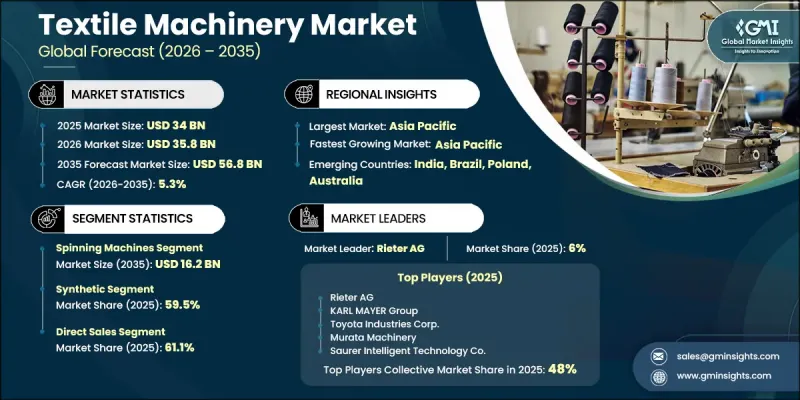
全球紡織製造業正大力推動自動化、數位化和高效生產系統的轉型,這大大推動了市場成長。製造商正日益採用先進的機械設備來提高生產效率、精度和營運效率,同時減少對人工的依賴。這項轉型也有助於最大限度地減少生產誤差,提升整體產品品質,使生產商能夠滿足產業和消費者不斷變化的需求。同時,物聯網系統和工業4.0技術的融合,正透過即時效能追蹤、預測性維護和數據驅動的流程最佳化,革新紡織製造營運。這些進步顯著提高了生產效率,並建構了更智慧的生產生態系統。此外,防護布料、醫用紡織品和地工織物等應用領域對功能性和工程性紡織品的需求不斷成長,也帶動了對不織布和針織系統等專用機械的需求。持續的工業現代化、新興地區產能的擴張以及全球紡織生產網路的不斷創新,都進一步推動了這一成長。
| 市場範圍 | |
|---|---|
| 開始年份 | 2025 |
| 預測期 | 2026-2035 |
| 初始市場規模 | 340億美元 |
| 預計金額 | 568億美元 |
| 複合年成長率 | 5.3% |
預計2025年,紡紗機械市場規模將達到104億美元,到2035年將達到162億美元。由於紡織製造商致力於生產適用於各種用途的穩定、高品質的紗線,因此對紡紗機械的需求仍然強勁。現代系統擴大採用自動落紗功能、整合品管機制和節能驅動技術。這些特性支援大規模、連續的紗線生產,同時提高了運作可靠性。在全球紡織品產量不斷成長以及對提高生產效率的製造設備持續投資的推動下,該市場預計將保持穩定成長。
到2025年,銷售管道將佔據61.1%的市場佔有率,並保持主導地位,這主要得益於紡織機械採購的高技術性和高資本投入。採購決策通常需要定製配置、技術諮詢和全面的安裝後支持,而這些最好透過與製造商的直接溝通來實現。這種模式也有助於更好地匹配機器規格和最終用戶的生產需求。買家通常需要詳細的演示、安裝協助和培訓支持,這進一步凸顯了直銷關係在確保機器最佳性能和整合方面的重要性。
至2025年,美國紡織機械市場將佔全球市場的74.2%。美國市場需求的驅動力主要來自國內紡織生產的持續現代化以及近岸外包活動的擴張,這些都促進了對新產能的投資。儘管與亞洲主要紡織中心相比規模較小,但美國生產商高度重視產業用紡織品、高價值特種產品和自動化製造系統。這種對生產力、永續性和品質提升的重視,持續推動全部區域對先進紡織機械解決方案的需求。
目錄
第1章:調查方法
第2章執行摘要
第3章 行業洞察
- 產業生態系分析
- 影響價值鏈的因素
- 利潤率分析
- 中斷
- 前景
- 製造商
- 中斷
- 供應商情況
- 主要新聞和舉措
- 技術與創新展望
- 監理情勢
- 影響因素
- 促進因素
- 產業潛在風險與挑戰
- 機會
- 2025年價格分析
- 2022-2025年歷史價格趨勢分析
- 依球員類型分類的定價策略(高級球員、超值球員、成本加成球員)
- 區域價格波動分析
- 原物料成本對價格的影響
- 成長潛力分析
- 波特的分析
- PESTLE分析
- 貿易數據分析
- 進出口量及進口額趨勢
- 主要貿易路線及關稅的影響
- 人工智慧和生成式人工智慧對市場的影響
- 利用人工智慧改造現有經營模式
- 按細分市場分類的生成式人工智慧用例和部署藍圖
- 風險、限制和監管考量
- 生產能力和生產情況
- 設備產能:按地區和主要生產商分類
- 運轉率和擴張計劃
第4章 競爭情勢
- 介紹
- 企業市佔率分析
- 競爭定位矩陣
- 戰略展望矩陣
- 主要市場公司的競爭分析
- 主要進展
- 併購
- 夥伴關係和聯盟
- 新產品發布
- 業務拓展計劃
第5章 市場估計與預測:依類型分類,2022-2035年
- 主要趨勢
- 紡紗機
- 織布機
- 染色和整理機械
- 針織機
- 印刷機
- 其他
第6章 市場估計與預測:依材料分類,2022-2035年
- 主要趨勢
- 合成
- 自然的
第7章 市場估計與預測:依營運區分,2022-2035年
- 主要趨勢
- 自動的
- 半自動
第8章 市場估計與預測:依應用領域分類,2022-2035年
- 主要趨勢
- 服飾和服飾
- 居家及室內裝潢紡織品
- 技術紡織品
- 其他
第9章 市場估價與預測:依通路分類,2022-2035年
- 主要趨勢
- 直銷
- 間接銷售
第10章及預測:區域細分,2022-2035年
- 北美洲
- 美國
- 加拿大
- 歐洲
- 德國
- 英國
- 法國
- 義大利
- 西班牙
- 亞太地區
- 中國
- 印度
- 日本
- 韓國
- 澳洲
- 拉丁美洲
- 巴西
- 墨西哥
- 阿根廷
- 中東和非洲
- UAE
- 沙烏地阿拉伯
- 南非
第11章:公司簡介
- 世界公司
- Rieter AG
- KARL MAYER Group
- Picanol NV
- Trutzschler Group SE
- Itema Group
- Shima Seiki MFG., Ltd.
- Staubli International AG
- 當地公司
- CHTC Fong's International
- Bruckner Textile Technologies
- Toyota Industries Corp.
- Murata Machinery
- Kornit Digital Ltd.
- Mimaki Engineering Co., Ltd.
- LMW Limited
- Saurer Intelligent Technology Co.
- 新興企業
- Vandewiele Group
- Benninger AG
- Thies GmbH & Co. KG
- Tsudakoma Corp.
- Mayer & Cie. Global
- SPGPrints BV
The Global Textile Machinery Market was valued at USD 34 billion in 2025 and is estimated to grow at a CAGR of 5.3% to reach USD 56.8 billion by 2035.
Market growth is being shaped by a strong shift toward automation, digitalization, and high-efficiency production systems across global textile manufacturing. Manufacturers are increasingly adopting advanced machinery to improve productivity, precision, and operational efficiency while reducing reliance on manual labor. This transition is also helping minimize production errors and improve overall product quality, enabling producers to meet evolving industrial and consumer expectations. In parallel, the integration of IoT-enabled systems and Industry 4.0 technologies is transforming textile operations through real-time performance tracking, predictive maintenance capabilities, and data-driven process optimization. These developments are significantly improving manufacturing efficiency and supporting smarter production ecosystems. Additionally, demand for functional and engineered textiles is rising across applications such as protective fabrics, medical textiles, and geotextiles, which is driving the need for specialized machinery such as non-woven and knitting systems. Growth is further reinforced by ongoing industrial modernization, capacity expansion in emerging regions, and continuous technological innovation across textile production networks worldwide.
| Market Scope | |
|---|---|
| Start Year | 2025 |
| Forecast Year | 2026-2035 |
| Start Value | $34 Billion |
| Forecast Value | $56.8 Billion |
| CAGR | 5.3% |
The spinning machines segment generated USD 10.4 billion in 2025 and is anticipated to reach USD 16.2 billion by 2035. Demand for spinning machinery remains strong as textile manufacturers focus on producing consistent, high-quality yarn across a wide range of applications. Modern systems are increasingly equipped with automated doffing functions, integrated quality control mechanisms, and energy-efficient drive technologies. These capabilities support large-scale continuous yarn production while enhancing operational reliability. The segment is expected to maintain steady expansion, supported by rising global textile output and continued investment in productivity-focused manufacturing equipment.
The direct sales channel accounted for 61.1% share in 2025, maintaining its leading position due to the highly technical and capital-intensive nature of textile machinery procurement. Purchasing decisions often require customized configurations, technical consultation, and comprehensive post-installation support, which are best managed through direct manufacturer engagement. This model also enables better alignment between machine specifications and end-user production requirements. Buyers typically rely on detailed demonstrations, installation assistance, and training support, further reinforcing the importance of direct sales relationships in ensuring optimal machine performance and integration.
United States Textile Machinery Market accounted for 74.2% share in 2025. Market demand in the country is supported by ongoing modernization of domestic textile production and increasing nearshoring activities that encourage new capacity investments. Although manufacturing scale is smaller compared to major Asian hubs, U.S. producers are strongly focused on technical textiles, high-value specialty products, and automated manufacturing systems. This emphasis on productivity, sustainability, and quality enhancement continues to drive demand for advanced textile machinery solutions across the region.
Key companies operating in the global textile machinery industry include Rieter AG, Picanol NV, Toyota Industries Corp., KARL MAYER Group, Itema Group, Trutzschler Group SE, Saurer Intelligent Technology Co., Murata Machinery, Shima Seiki MFG., Ltd., Vandewiele Group, Bruckner Textile Technologies, Benninger AG, Tsudakoma Corp., Thies GmbH & Co. KG, Mayer & Cie. Global, CHTC Fong's International, Kornit Digital Ltd., SPGPrints B.V., LMW Limited, Mimaki Engineering Co., Ltd., and Staubli International AG. Companies in the textile machinery market are increasingly focusing on digital transformation by integrating automation, IoT systems, and Industry 4.0 solutions into their product portfolios to enhance efficiency and precision. Many manufacturers are strengthening R&D investments to develop energy-efficient, high-performance machines capable of supporting advanced textile applications. Strategic collaborations with textile producers are being used to customize machinery solutions and improve long-term customer relationships. Firms are also expanding after-sales services, including training, maintenance, and technical support, to improve customer retention.
Table of Contents
Chapter 1 Research Methodology
- 1.1 Research approach
- 1.2 Quality Commitments
- 1.2.1 GMI AI policy & data integrity commitment
- 1.2.1.1 Source consistency protocol
- 1.2.1 GMI AI policy & data integrity commitment
- 1.3 Research Trail & Confidence Scoring
- 1.3.1 Research Trail Components
- 1.3.2 Scoring Components
- 1.4 Data Collection
- 1.4.1 Partial list of primary sources
- 1.5 Data mining sources
- 1.5.1 Paid sources
- 1.5.1.1 Sources, by region
- 1.5.1 Paid sources
- 1.6 Base estimates and calculations
- 1.6.1 Base year calculation for any one approach
- 1.7 Forecast model
- 1.7.1 Quantified market impact analysis
- 1.7.1.1 Mathematical impact of growth parameters on forecast
- 1.7.1 Quantified market impact analysis
- 1.8 Research transparency addendum
- 1.8.1 Source attribution framework
- 1.8.2 Quality assurance metrics
- 1.8.3 Our commitment to trust
Chapter 2 Executive Summary
- 2.1 Industry 360° synopsis, 2022 - 2035
- 2.2 Key market trends
- 2.2.1 Regional
- 2.2.2 Type
- 2.2.3 Material
- 2.2.4 Operation
- 2.2.5 Application
- 2.2.6 Distribution Channel
Chapter 3 Industry Insights
- 3.1 Industry ecosystem analysis
- 3.1.1 Factor affecting the value chain
- 3.1.2 Profit margin analysis
- 3.1.3 Disruptions
- 3.1.4 Future outlook
- 3.1.5 Manufacturers
- 3.1.6 Distributors
- 3.2 Supplier landscape
- 3.3 Key news & initiatives
- 3.4 Technology & Innovation Landscape
- 3.5 Regulatory landscape
- 3.6 Impact on forces
- 3.6.1 Growth drivers
- 3.6.2 Industry pitfalls & challenges
- 3.6.3 Opportunities
- 3.7 Pricing analysis, 2025 (driven by primary research)
- 3.7.1 Historical price trend analysis (2022-2025)
- 3.7.2 Pricing strategy by player type (premium/value/cost-plus)
- 3.7.3 Regional price variation analysis
- 3.7.4 Impact of raw material costs on pricing
- 3.8 Growth potential analysis
- 3.9 Porter's analysis
- 3.10 PESTEL analysis
- 3.11 Trade data analysis (driven by paid database)
- 3.11.1 Import/export volume & value trends (Driven by Primary Research)
- 3.11.2 Key trade corridors & tariff impact (Driven by Primary Research)
- 3.12 Impact of AI & generative AI on the market
- 3.12.1 AI-driven disruption of existing business models
- 3.12.2 GenAI use cases & adoption roadmap by segment
- 3.12.3 Risks, limitations & regulatory considerations
- 3.13 Capacity & Production Landscape (Driven by Primary Research)
- 3.13.1 Installed Capacity by Region & Key Producer (Driven by Primary Research)
- 3.13.2 Capacity Utilization Rates & Expansion Pipelines (Driven by Primary Research)
Chapter 4 Competitive Landscape, 2025
- 4.1 Introduction
- 4.2 Company market share analysis
- 4.3 Competitive positioning matrix
- 4.4 Strategic outlook matrix
- 4.5 Competitive analysis of major market players
- 4.6 Key developments
- 4.6.1 Mergers & acquisitions
- 4.6.2 Partnerships & collaborations
- 4.6.3 New product launches
- 4.6.4 Expansion plans
Chapter 5 Market Estimates & Forecast, By Type, 2022-2035 (USD Billion) (Thousand Units)
- 5.1 Key Trends
- 5.2 Spinning Machines
- 5.3 Weaving Machines
- 5.4 Dyeing & finishing machines
- 5.5 Knitting Machines
- 5.6 Printing Machines
- 5.7 Others
Chapter 6 Market Estimates & Forecast, By Material, 2022-2035 (USD Billion) (Thousand Units)
- 6.1 Key Trends
- 6.2 Synthetic
- 6.3 Natural
Chapter 7 Market Estimates & Forecast, By Operation, 2022-2035 (USD Billion) (Thousand Units)
- 7.1 Key Trends
- 7.2 Automatic
- 7.3 Semi-automatic
Chapter 8 Market Estimates & Forecast, By Application, 2022 - 2035, (USD Billion) (Thousand Units)
- 8.1 Key Trends
- 8.2 Garments and apparel
- 8.3 Household and home textiles
- 8.4 Technical textiles
- 8.5 Others
Chapter 9 Market Estimates & Forecast, By Distribution Channel, 2022 - 2035, (USD Billion) (Thousand Units)
- 9.1 Key Trends
- 9.2 Direct Sales
- 9.3 Indirect Sales
Chapter 10 & Forecast, By Region, 2022 - 2035, (USD Billion) (Thousand Units)
- 10.1 Key trends
- 10.2 North America
- 10.2.1 U.S.
- 10.2.2 Canada
- 10.3 Europe
- 10.3.1 Germany
- 10.3.2 U.K.
- 10.3.3 France
- 10.3.4 Italy
- 10.3.5 Spain
- 10.4 Asia Pacific
- 10.4.1 China
- 10.4.2 India
- 10.4.3 Japan
- 10.4.4 South Korea
- 10.4.5 Australia
- 10.5 Latin America
- 10.5.1 Brazil
- 10.5.2 Mexico
- 10.5.3 Argentina
- 10.6 MEA
- 10.6.1 UAE
- 10.6.2 Saudi Arabia
- 10.6.3 South Africa
Chapter 11 Company Profiles (Business Overview, Financial Data, Product Landscape, Strategic Outlook, SWOT Analysis)
- 11.1 Global players
- 11.1.1 Rieter AG
- 11.1.2 KARL MAYER Group
- 11.1.3 Picanol NV
- 11.1.4 Trutzschler Group SE
- 11.1.5 Itema Group
- 11.1.6 Shima Seiki MFG., Ltd.
- 11.1.7 Staubli International AG
- 11.2 Regional players
- 11.2.1 CHTC Fong's International
- 11.2.2 Bruckner Textile Technologies
- 11.2.3 Toyota Industries Corp.
- 11.2.4 Murata Machinery
- 11.2.5 Kornit Digital Ltd.
- 11.2.6 Mimaki Engineering Co., Ltd.
- 11.2.7 LMW Limited
- 11.2.8 Saurer Intelligent Technology Co.
- 11.3 Emerging players
- 11.3.1 Vandewiele Group
- 11.3.2 Benninger AG
- 11.3.3 Thies GmbH & Co. KG
- 11.3.4 Tsudakoma Corp.
- 11.3.5 Mayer & Cie. Global
- 11.3.6 SPGPrints B.V.

 2026年全球織物鋪展機市場報告
 圓針織機:市佔率分析、產業趨勢與統計、成長預測(2026-2031)
 2035年亞麻紡織機械市場分析與預測:按類型、產品、服務、技術、組件、應用、材料類型、製程及最終用戶分類棉紡織機械市場分析及預測(至2035年):按類型、產品、技術、組件、應用、過程、最終用戶、功能、安裝類型紡織機械市場到 2035 年的分析和預測:按類型、產品、技術、組件、應用、材料類型、工藝、最終用戶、功能和安裝類型。紡織機械軸承市場分析及預測(至2035年):依類型、產品、技術、組件、應用、材料類型、製程、最終用戶及功能性別分類羊毛紡織機械市場到 2035 年的分析和預測:按類型、產品、技術、組件、應用、材料類型、工藝、最終用戶、功能和安裝配置。2026年全球彈珠化機市場報告
 高速編織機市場規模:依機器類型、材料類型、終端用戶產業、地區和預測分類。
 針織機市場機會、成長要素、產業趨勢分析及2026-2035年預測。