


 |
市場調查報告書
商品編碼
2027666
針織機市場機會、成長要素、產業趨勢分析及2026-2035年預測。Knitting Machines Market Opportunity, Growth Drivers, Industry Trend Analysis, and Forecast 2026 - 2035 |
||||||

預計到 2025 年,全球針織機市場規模將達到 54 億美元,並有望以 5.7% 的複合年成長率成長,到 2035 年達到 94 億美元。
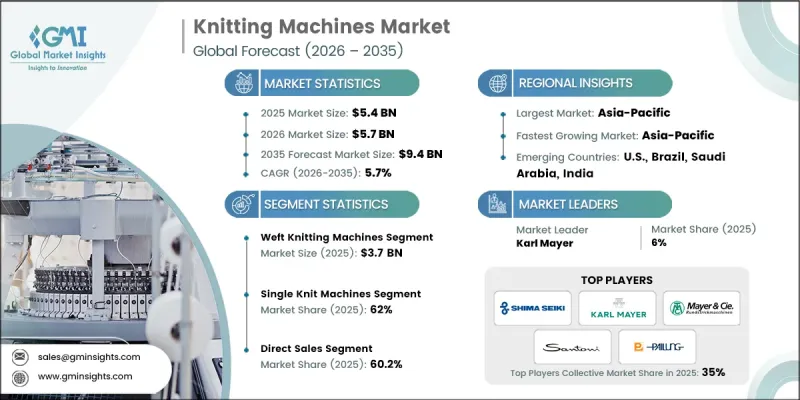
紡織業日益重視提高生產效率和布料品質,推動了市場擴張。製造商優先採用先進機械設備,以在保持布料標準一致性的同時加快生產速度。主要產業相關人員之間不斷擴大的合作活動,包括夥伴關係和收購,正在加速創新並增強產品開發能力。這些趨勢正在重塑競爭格局,並加速現代化生產系統的應用。傳統的布料製造方法由於在處理複雜設計和滿足大規模生產需求方面存在局限性,正逐漸失去其重要性。相較之下,配備電腦控制和多路進料系統的先進針織機能夠顯著縮短生產時間和減少材料浪費。其精準性、擴充性和成本效益正推動著紡織製造業的廣泛應用。隨著對高性能布料的需求持續成長,針織機市場正在朝著以自動化、柔軟性和提高生產效率為核心的技術主導產業發展。
| 市場範圍 | |
|---|---|
| 開始年份 | 2025 |
| 預測期 | 2026-2035 |
| 上市時的市場規模 | 54億美元 |
| 預測金額 | 94億美元 |
| 複合年成長率 | 5.7% |
到2025年,橫織機市佔率將達到67.9%,市場規模將達37億美元。這主要得益於其強大的適應性,能夠處理從簡單到複雜的各種設計,並生產出結構多樣的織物。高效滿足多樣化生產需求的能力持續推動市場需求。在這一細分市場中,圓緯針織機預計到2025年將佔52.1%的市場。這主要歸功於其高效的連續織物生產能力以及在整個批量生產過程中保持品質一致性的能力。
預計到2025年,直銷通路將佔據60.2%的市場佔有率,達到33億美元。這主要歸因於機械採購的高價值和客製化特性,買家傾向於直接與製造商互動以獲得客製化解決方案。直接參與不僅能提高技術要求的符合性,還能獲得安裝支援、培訓和長期服務合約。這一趨勢反映了服務模式向整合化服務的轉變,供應商提供的不再只是單一設備,而是全面的生產解決方案。
預計到2025年,美國針織機市佔率將達到82.7%。這一區域成長主要得益於對先進紡織品生產投資的增加以及自動化製造技術的日益普及。在地化生產的趨勢以及對高性能紡織解決方案的需求正在加速尖端針織機系統的推廣應用。此外,對永續製造實踐和營運效率的關注也持續推動市場擴張。
目錄
第1章:調查方法和範圍
第2章執行摘要
第3章業界考察
- 生態系分析
- 供應商情況
- 利潤率
- 每個階段增加的價值
- 影響價值鏈的因素
- 影響產業的因素
- 促進因素
- 休閒和運動服飾需求激增
- 自動化及與工業4.0的整合
- 回流製造和智慧製造
- 產業潛在風險與挑戰
- 大量資金投入先進機械設備
- 原物料價格波動
- 機會
- 永續的「零浪費」生產
- 技術紡織品的擴張
- 促進因素
- 成長潛力分析
- 未來市場趨勢
- 科技與創新趨勢
- 當前技術趨勢
- 新興技術
- 價格分析(基於初步調查)
- 對過去價格趨勢的分析
- 按業務類型分類的定價策略(溢價/價值/成本加成)
- 不同機器類型和規格的價格波動
- 總擁有成本 (TCO) 分析
- 監理情勢
- 標準和合規要求
- 區域法規結構
- 認證標準
- 波特五力分析
- PESTEL 分析
- 貿易數據分析(基於付費資料庫)
- 按地區分類的進出口數量和價值趨勢
- 主要貿易路線及關稅的影響
- 貿易流量趨勢(中國、德國、義大利、日本)
- 人工智慧和生成式人工智慧對市場的影響
- 人工智慧改變了傳統的編織工藝。
- 針對特定領域的生成式人工智慧應用案例和實施藍圖
- 自動化圖案設計和客製化
- 預測性維護和減少停機時間
- 品管和缺陷檢測
- 風險、限制和監管考量
第4章 競爭情勢
- 介紹
- 企業市佔率分析
- 按地區
- 企業矩陣分析
- 主要市場公司的競爭分析
- 競爭定位矩陣
- 主要進展
- 併購
- 夥伴關係與合作
- 新產品發布
- 業務拓展計劃
第5章 市場估計與預測:依類型分類,2022-2035年
- 經編機
- 拉舍爾垂直針織
- 經編垂直針織
- 其他(鉤針編織等)
- 橫織機
- 環形編織
- 直桿
- 其他(例如,環形輪)
第6章 市場估價與預測:依針織類型分類,2022-2035年
- 單股針織
- 雙面針織
第7章 市場估計與預測:依營運模式分類,2022-2035年
- 手動的
- 半自動
- 全自動
第8章 市場估算與預測:依最終用途產業分類,2022-2035年
- 汽車紡織品
- 運動紡織品
- 服裝用紡織品
- 家用紡織品
- 其他(鞋類行業等)
第9章 市場估價與預測:依通路分類,2022-2035年
- 直銷
- 間接銷售
第10章 市場估價與預測:依地區分類,2022-2035年
- 北美洲
- 美國
- 加拿大
- 歐洲
- 德國
- 英國
- 法國
- 義大利
- 西班牙
- 亞太地區
- 中國
- 日本
- 印度
- 澳洲
- 韓國
- 拉丁美洲
- 巴西
- 墨西哥
- 阿根廷
- 中東和非洲
- 南非
- 沙烏地阿拉伯
- 阿拉伯聯合大公國
第11章:公司簡介
- Flying Tiger
- Fukuhara
- Hanma(Zhenfu)
- Jingwei Textile Machinery
- Karl Mayer
- Lamb
- Lisky
- Lonati
- Mayer & Cie
- Orizio
- Pai Lung
- Santoni
- Shima Seiki
- Terrot
- Tompkins
The Global Knitting Machines Market was valued at USD 5.4 billion in 2025 and is estimated to grow at a CAGR of 5.7% to reach USD 9.4 billion by 2035.
Market expansion is driven by increasing emphasis on improving production efficiency and enhancing fabric quality across the textile industry. Manufacturers are prioritizing advanced machinery that enables faster output while maintaining consistent fabric standards. Growing collaboration activities, including partnerships and acquisitions among key industry participants, are accelerating innovation and strengthening product development capabilities. These developments are reshaping the competitive landscape and encouraging the adoption of modernized production systems. Traditional fabric manufacturing methods are gradually losing relevance due to their limitations in handling complex designs and large-scale production requirements. In contrast, advanced knitting machines equipped with computerized controls and multi-feed systems significantly reduce production time and material waste. The ability to deliver precision, scalability, and cost efficiency is driving widespread adoption across textile manufacturing operations. As demand for high-performance fabrics continues to grow, the knitting machines market is evolving into a technology-driven sector focused on automation, flexibility, and productivity improvements.
| Market Scope | |
|---|---|
| Start Year | 2025 |
| Forecast Year | 2026-2035 |
| Start Value | $5.4 Billion |
| Forecast Value | $9.4 Billion |
| CAGR | 5.7% |
The weft knitting machines segment accounted for 67.9% share in 2025, generating USD 3.7 billion owing to its adaptability in producing a broad range of fabric structures, supporting both simple and complex designs. Its capability to handle diverse production requirements efficiently continues to drive demand. Within this segment, circular weft knitting machines represented 52.1% of the market in 2025, supported by their efficiency in continuous fabric production and ability to maintain consistency across high-volume manufacturing processes.
The direct sales segment held a 60.2% share in 2025, accounting for USD 3.3 billion, owing to the high-value and customized nature of machinery procurement, where buyers prefer direct interaction with manufacturers for tailored solutions. Direct engagement enables better alignment with technical requirements, as well as access to installation support, training, and long-term service agreements. This trend reflects a shift toward integrated offerings where suppliers provide comprehensive production solutions rather than standalone equipment.
United States Knitting Machines Market accounted for 82.7% share in 2025. Growth in this region is supported by increasing investments in advanced textile production and the rising adoption of automated manufacturing technologies. The shift toward localized production and the demand for high-performance textile solutions are encouraging the use of modern knitting systems. Additionally, the focus on sustainable manufacturing practices and operational efficiency continues to support market expansion.
Key companies operating in the Global Knitting Machines Market include Karl Mayer, Mayer & Cie, Shima Seiki, Lonati, Santoni, Terrot, Orizio, Pai Lung, Fukuhara, Jingwei Textile Machinery, Flying Tiger, Lisky, Hanma (Zhenfu), Lamb, and Tompkins. Companies in the Global Knitting Machines Market are strengthening their competitive position through continuous technological advancement and product innovation. Manufacturers are investing in automation, digital controls, and software integration to enhance machine efficiency and flexibility. Expanding service offerings, including training and maintenance, helps build long-term customer relationships. Strategic collaborations and global distribution expansion are improving market reach. Firms are also focusing on developing energy-efficient and sustainable machinery to meet evolving industry standards. Customization capabilities and integrated production solutions are further enabling companies to address diverse customer needs and maintain a strong foothold in the competitive landscape.
Table of Contents
Chapter 1 Methodology and Scope
- 1.1 Market scope and definition
- 1.2 Research design
- 1.2.1 Research approach
- 1.2.2 Data collection methods
- 1.3 Data mining sources
- 1.3.1 Global
- 1.3.2 Regional/Country
- 1.4 Base estimates and calculations
- 1.4.1 Base year calculation
- 1.4.2 Key trends for market estimation
- 1.5 Primary research and validation
- 1.5.1 Primary sources
- 1.6 Forecast model
- 1.7 Research assumptions and limitations
Chapter 2 Executive Summary
- 2.1 Industry 360° synopsis
- 2.2 Key market trends
- 2.2.1 Regional
- 2.2.2 Type
- 2.2.3 Knit type
- 2.2.4 Mode of operation
- 2.2.5 End use industry
- 2.2.6 Distribution channel
Chapter 3 Industry Insights
- 3.1 Industry ecosystem analysis
- 3.1.1 Supplier landscape
- 3.1.2 Profit margin
- 3.1.3 Value addition at each stage
- 3.1.4 Factor affecting the value chain
- 3.2 Industry impact forces
- 3.2.1 Growth drivers
- 3.2.1.1 Surge in athleisure & sportswear demand
- 3.2.1.2 Automation & industry 4.0 integration
- 3.2.1.3 Reshoring & smart manufacturing
- 3.2.2 Industry pitfalls & challenges
- 3.2.2.1 High CAPEX for advanced machinery
- 3.2.2.2 Volatility in raw material prices
- 3.2.3 Opportunities
- 3.2.3.1 Sustainable "zero-waste" production
- 3.2.3.2 Technical textiles expansion
- 3.2.1 Growth drivers
- 3.3 Growth potential analysis
- 3.4 Future market trends
- 3.5 Technology and innovation landscape
- 3.5.1 Current technological trends
- 3.5.2 Emerging technologies
- 3.6 Price analysis (driven by primary research)
- 3.6.1 Historical price trend analysis
- 3.6.2 Pricing strategy by player type (premium / value / cost-plus)
- 3.6.3 Price variance by machine type & gauge
- 3.6.4 Total cost of ownership analysis
- 3.7 Regulatory landscape
- 3.7.1 Standards and compliance requirements
- 3.7.2 Regional regulatory frameworks
- 3.7.3 Certification standards
- 3.8 Porter's analysis
- 3.9 PESTEL analysis
- 3.10 Trade Data Analysis (Driven by paid database)
- 3.10.1 Import/export volume & value trends by region
- 3.10.2 Key trade corridors & tariff impact
- 3.10.3 Trade flow dynamics (China, Germany, Italy, Japan)
- 3.11 Impact of AI & generative AI on the market
- 3.11.1 AI-driven disruption of traditional knitting operations
- 3.11.2 GenAI use cases & adoption roadmap by segment
- 3.11.2.1 Automated pattern design & customization
- 3.11.2.2 Predictive maintenance & downtime reduction
- 3.11.2.3 Quality control & defect detection
- 3.11.3 Risks, limitations & regulatory considerations
Chapter 4 Competitive Landscape, 2025
- 4.1 Introduction
- 4.2 Company market share analysis
- 4.2.1 By region
- 4.2.1.1 North America
- 4.2.1.2 Europe
- 4.2.1.3 Asia Pacific
- 4.2.1.4 Latin America
- 4.2.1.5 Middle East and Africa
- 4.2.1 By region
- 4.3 Company matrix analysis
- 4.4 Competitive analysis of major market players
- 4.5 Competitive positioning matrix
- 4.6 Key developments
- 4.6.1 Mergers & acquisitions
- 4.6.2 Partnerships & collaborations
- 4.6.3 New product launches
- 4.6.4 Expansion plans
Chapter 5 Market Estimates & Forecast, By Type, 2022 - 2035 (USD Billion) (Thousand Units)
- 5.1 Key trends
- 5.2 Warp knitting machines
- 5.2.1 Raschel warp
- 5.2.2 Tricot warp
- 5.2.3 Others (crochet etc.)
- 5.3 Weft knitting machines
- 5.3.1 Circular
- 5.3.2 Straight bar
- 5.3.3 Others (loop wheel etc.)
Chapter 6 Market Estimates & Forecast, By Knit Type, 2022 - 2035 (USD Billion) (Thousand Units)
- 6.1 Key trends
- 6.2 Single knit
- 6.3 Double knit
Chapter 7 Market Estimates & Forecast, By Mode of Operation, 2022 - 2035 (USD Billion) (Thousand Units)
- 7.1 Key trends
- 7.2 Manual
- 7.3 Semi-automatic
- 7.4 Fully automatic
Chapter 8 Market Estimates & Forecast, By End Use Industry, 2022 - 2035 (USD Billion) (Thousand Units)
- 8.1 Key trends
- 8.2 Automotive textiles
- 8.3 Sports textiles
- 8.4 Apparel textiles
- 8.5 Home textiles
- 8.6 Others (footwear industry etc.)
Chapter 9 Market Estimates & Forecast, By Distribution Channel, 2022 - 2035 (USD Billion) (Thousand Units)
- 9.1 Key trends
- 9.2 Direct sales
- 9.3 Indirect sales
Chapter 10 Market Estimates and Forecast, By Region, 2022 - 2035 (USD Billion) (Thousand Units)
- 10.1 Key trends
- 10.2 North America
- 10.2.1 U.S.
- 10.2.2 Canada
- 10.3 Europe
- 10.3.1 Germany
- 10.3.2 UK
- 10.3.3 France
- 10.3.4 Italy
- 10.3.5 Spain
- 10.4 Asia Pacific
- 10.4.1 China
- 10.4.2 Japan
- 10.4.3 India
- 10.4.4 Australia
- 10.4.5 South Korea
- 10.5 Latin America
- 10.5.1 Brazil
- 10.5.2 Mexico
- 10.5.3 Argentina
- 10.6 Middle East and Africa
- 10.6.1 South Africa
- 10.6.2 Saudi Arabia
- 10.6.3 UAE
Chapter 11 Company Profiles
- 11.1 Flying Tiger
- 11.2 Fukuhara
- 11.3 Hanma (Zhenfu)
- 11.4 Jingwei Textile Machinery
- 11.5 Karl Mayer
- 11.6 Lamb
- 11.7 Lisky
- 11.8 Lonati
- 11.9 Mayer & Cie
- 11.10 Orizio
- 11.11 Pai Lung
- 11.12 Santoni
- 11.13 Shima Seiki
- 11.14 Terrot
- 11.15 Tompkins

 2026年全球織物鋪展機市場報告
 圓針織機:市佔率分析、產業趨勢與統計、成長預測(2026-2031)
 2035年亞麻紡織機械市場分析與預測:按類型、產品、服務、技術、組件、應用、材料類型、製程及最終用戶分類棉紡織機械市場分析及預測(至2035年):按類型、產品、技術、組件、應用、過程、最終用戶、功能、安裝類型紡織機械市場到 2035 年的分析和預測:按類型、產品、技術、組件、應用、材料類型、工藝、最終用戶、功能和安裝類型。紡織機械軸承市場分析及預測(至2035年):依類型、產品、技術、組件、應用、材料類型、製程、最終用戶及功能性別分類羊毛紡織機械市場到 2035 年的分析和預測:按類型、產品、技術、組件、應用、材料類型、工藝、最終用戶、功能和安裝配置。2026年全球彈珠化機市場報告
 高速編織機市場規模:依機器類型、材料類型、終端用戶產業、地區和預測分類。
 紡織機械市場機會、成長促進因素、產業趨勢分析及2026-2035年預測