


 |
市場調查報告書
商品編碼
2116596
印度汽車ADAS(先進駕駛輔助系統):市佔率分析、產業趨勢與統計及成長預測(2026-2031年)India Automotive Advanced Driver Assistance Systems - Market Share Analysis, Industry Trends & Statistics, Growth Forecasts (2026 - 2031) |
||||||

※ 本網頁內容可能與最新版本有所差異。詳細情況請與我們聯繫。
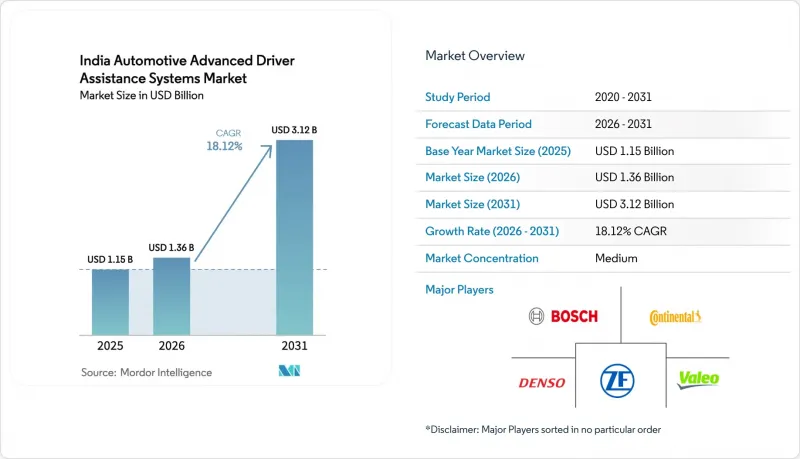
據 Mordor Intelligence 稱,2025 年印度汽車 ADAS(高級駕駛輔助系統)市場價值為 11.5 億美元,預計到 2031 年將從 2026 年的 13.6 億美元成長至 31.2 億美元,預測期(2026-2031 年)的複合成長率為 18.12%。
本報告按系統類型(泊車輔助系統、自我調整頭燈等)、感測器技術(雷達、LiDAR、攝影機、超音波等)、車輛類型(摩托車、乘用車等)、自動駕駛等級(L1、L2、L3等)和銷售管道(原廠配套和售後改裝)進行分類。市場預測以美元計價。
印度汽車ADAS(高級駕駛輔助系統)市場趨勢及洞察。
Bharat-NCAP 安全標準正在加速採用 OEM 標準配備。
新的印度新車安全評估協會(Bharat NCAP)協議正在將高級駕駛輔助系統(ADAS)從高階車型的差異化優勢轉變為所有乘用車和商用車平台的強制性要求,迫使汽車製造商將碰撞預警和自動煞車作為標準配備。本田已在印度道路上部署了多款配備ADAS的車型,顯示汽車產業已做好滿足更嚴格的星級評定標準的準備。隨著安全評級成為消費者購車決策的關鍵因素,汽車製造商正在重新調整研發預算,更加重視主動安全功能而非被動安全硬體。印度公路運輸和公路部也提案將ADAS的強制要求擴展到巴士和重型卡車,將市場機會拓展到個人出行之外。儘早遵守監管規定將降低監管方面的不確定性,並使供應商能夠確保未來幾年的產量。
與 ADAS(高級駕駛輔助系統)的引入相關的里程保險折扣。
利用遠端資訊處理技術的保險計劃,例如“按里程付費”和“按駕駛方式付費”,目前可為駕駛員提供高達15-25%的保費折扣,從而為配備高級駕駛輔助系統(ADAS)的車輛帶來直接的經濟效益。塔塔AIG、伯蒂安盛和ICICI Lombard等大型保險公司正在將即時駕駛行為評分納入其承保流程,以降低保險索賠的頻率和金額,同時鼓勵更安全的駕駛習慣。汽車製造商正在展示室促銷中利用這些成本節約訊息,以此來證明配備ADAS車輛價格上漲的合理性,尤其對於那些關注每月支出的首次購車者而言。對於車隊營運商而言,更低的事故率意味著更少的意外維修和更少的車輛運作,從而提供了一種提高利潤率的新途徑。此外,保險公司和汽車製造商之間的數據共用協議正在創建匿名化的事故資料庫,這將有助於提高未來ADAS演算法的準確性。這形成了一個良性循環,進一步加速了這些功能的普及。
車輛價格大幅上漲(70,000 至 90,000 印度盧比)。
加裝ADAS硬體將使展示室售價增加7萬至9萬印度盧比(約789至1015美元),相當於普通車型價格上漲7%至9%。這足以促使優先考慮成本績效的A級和B級消費者轉向價格較低的車型。車隊營運商同樣持謹慎態度,因為遠端資訊處理技術尚未證明能夠直接降低事故成本。為了維持展示室客流量,汽車製造商要么僅將ADAS與頂級車型捆綁銷售,要么提供功能有限的選裝包,這減緩了ADAS在大都會圈以外地區的普及速度。未來,規模經濟和二手車殘值的成長可望消除價格壁壘。
細分市場分析
2025年,主動式車距維持定速系統(ACC)仍將是印度汽車ADAS市場的主導驅動力,佔據28.62%的市場佔有率,尤其受到德里-孟買和海得拉巴-班加羅爾高速公路駕駛員的青睞。在碰撞警報系統的推動下,印度汽車ADAS市場規模的成長速度超過了以舒適性為中心的模組,反映出政府政策正朝著強調主動干預的方向發展。駕駛疲勞預警、停車輔助和夜視等輔助功能共用相同感測器堆疊,這使得OEM廠商提升銷售功能的銷售。空中下載(OTA)更新為功能藍圖的更新提供了靈活性,使製造商能夠在獲得監管部門批准後,售後服務升級來實現盈利。
預計到2031年,自動緊急煞車(AEB)將以20.10%的複合年成長率成長,因為監管機構和保險公司正在就前向碰撞警報指標達成協議。基於攝影機的車道偏離預警系統在新鋪設的道路上表現最佳,但在維修區域較多的郊區表現較差,因此,融合短程雷達以確保橫向覆蓋的雙感測器系統正在被廣泛採用。交通標誌識別(TSR)技術在近期發表於ICTACT期刊的一項研究中,對印度交通標誌的識別準確率高達98%,因此在測速攝影機密集的地區,該技術正被廣泛應用,以幫助人們遵守交通規則,避免罰款。隨著人們對避免碰撞的關注度不斷提高,擁有本地交通狀況獨特資料集的供應商正在獲得優勢,進一步鞏固了先發優勢。
得益於堪比智慧型手機的大規模生產能力,相機模組預計在2025年佔據印度汽車ADAS市場42.70%的佔有率。雷達的全天候性能正在鞏固其在感測器融合堆疊中的地位,這對於季風季節的可靠性至關重要。LiDAR(LiDAR)曾因單價高達四位數而受阻,但隨著固態架構的價格降至500美元以下,預計到2031年將以20.55%的複合年成長率成長。在印度汽車ADAS市場,雷射雷達的高密度點雲具有重要價值,即使在光線昏暗和障礙物較多的情況下,也能識別車道邊緣和弱勢道路使用者。本田正與印度理工學院德里分校和孟買分校合作進行一個項目,將LiDAR與攝影機和雷達結合,繪製交通狀況圖,其中包括人力車、自行車和無視交通號誌的行人。超音波感測器在近距離泊車輔助中繼續發揮至關重要的作用,因為厘米級解析度比遠距離檢測更重要。
不斷發展的ECU設計整合了一個專用AI加速器,可實現車載感知器融合。該加速器會在將資料上傳至雲端之前濾除冗餘訊號,從而節省頻寬。供應商正透過提供針對印度高溫環境最佳化的節能型ASIC晶片來脫穎而出,這些晶片無需主動冷卻,而主動冷卻在緊湊型引擎室中是一項主要的成本因素。
其他好處:
- Excel格式的市場預測(ME)表
- 3個月的分析師支持
目錄
第1章:引言
- 研究假設和市場定義
- 調查範圍
第2章:調查方法
第3章執行摘要
第4章 市場狀況
- 市場概覽
- 市場促進因素
- Bharat-NCAP 安全標準正在加速 OEM 廠商採用相關設備。
- 由於引入了ADAS(高級駕駛輔助系統),因此按里程計費的保險可享折扣。
- 區域ADAS組件製造的PLI獎勵
- 雷達和攝影機的成本已經下降,每台價格降至 20 美元以下。
- 二級及以上級別的ADAS(高級駕駛輔助系統)在中型車中逐漸變得越來越普遍。
- 一款以雷達為基礎的摩托車騎乘輔助系統已經問世。
- 市場限制因素
- 車輛價格大幅上漲(70,000 至 90,000 印度盧比)。
- ADAS認證校準車間短缺
- 道路標線不足和基礎設施噪音感測器
- AIS-189 網路安全合規性會增加 ECU 的成本。
- 價值供應鏈分析
- 監理情勢
- 技術展望
- 波特五力模型
第5章 市場規模與成長預測
- 依系統類型
- 停車輔助系統
- 自我調整頭燈
- 夜視系統
- 盲點偵測
- 自動緊急制動
- 前方碰撞警報
- 駕駛員疲勞警報系統
- 交通標誌識別
- 車道偏離警示
- 主動式車距維持定速系統
- 感測器技術
- 雷達
- LiDAR
- 相機
- 超音波
- 紅外線的
- 按車輛類型
- 摩托車
- 搭乘用車
- 中型和重型商用車輛
- 按自動駕駛級別
- L1
- L2
- L3
- L4
- L5
- 按銷售管道
- 原廠正品零件
- 改裝
第6章 競爭情勢
- 市場集中度
- 策略趨勢
- 市佔率分析
- 公司簡介
- Robert Bosch GmbH
- Continental AG
- DENSO Corporation
- ZF Friedrichshafen AG
- Aptiv PLC
- Magna International Inc.
- Hella GmbH & Co. KGaA(FORVIA Hella)
- HL Mando Corporation
- Valeo SA
- Autoliv Inc.
- Mobileye(Intel Corporation)
- KPIT Technologies
- LeddarTech
第7章 市場機會與未來展望
According to Mordor Intelligence, the indian automotive advanced driver assistance systems market size was valued at USD 1.15 billion in 2025 and estimated to grow from USD 1.36 billion in 2026 to reach USD 3.12 billion by 2031, at a CAGR of 18.12% during the forecast period (2026-2031).
This report is Segmented by System Type (Parking Assist Systems, Adaptive Front-Lighting, and More), Sensor Technology (Radar, Lidar, Camera, Ultrasonic, and More), Vehicle Type (Two-Wheelers, Passenger Cars, and More), Level of Autonomy (L1, L2, L3, and More), and Sales Channel (OEM-Fitted and Aftermarket Retrofit). The Market Forecasts are Provided in Terms of Value (USD).
India Automotive Advanced Driver Assistance Systems Market Trends and Insights
Bharat-NCAP Safety Mandate Accelerates OEM Fitment
The new Bharat NCAP protocol converts ADAS from a premium differentiator into a legal requirement across passenger and commercial platforms, forcing automakers to embed collision warning and automatic braking as standard equipment. Honda has already placed several ADAS-equipped vehicles on Indian roads, signaling industry readiness to meet stricter star-rating thresholds. Because safety scores now figure prominently in consumer purchase decisions, OEMs re-prioritize R&D budgets toward active-safety content rather than passive hardware. Parallel proposals from the Ministry of Road Transport and Highways to broaden ADAS obligations to buses and heavy trucks extend the addressable opportunity beyond personal mobility. Early compliance also mitigates regulatory uncertainty, allowing suppliers to lock in multi-year production volumes.
Usage-Based-Insurance Discounts Tied to ADAS Adoption
Telematics-enabled "Pay As You Drive" and "Pay How You Drive" policies now offer motorists premium reductions that can reach 15-25%, providing a direct financial return on ADAS-equipped vehicles. Leading insurers such as Tata AIG, Bharti AXA, and ICICI Lombard embed real-time driving-behavior scores into underwriting, which lowers claim frequency and severity while motivating safer habits. OEMs leverage these savings in showroom messaging to justify the ADAS price uplift, particularly for first-time buyers focused on monthly outlay. Fleet operators gain an additional margin lever because lower accident ratios translate into fewer unplanned repairs and reduced downtime for delivery vehicles. Data-sharing agreements between insurers and automakers also build anonymized crash databases that refine future ADAS algorithms, creating a virtuous circle that further accelerates feature penetration.
High Incremental Vehicle Price (INR 70-90k)
Adding ADAS hardware inflates ex-showroom prices by INR 70,000-90,000 (~USD 789-1,015) or roughly 7-9% on a typical car, enough to push EMI-focused buyers toward lower trims. Consumers in value-driven A- and B-segment categories remain skeptical that insurance savings will offset the upfront outlay. Fleet operators display similar caution unless telematics proves direct accident-cost reductions. OEMs bundle ADAS only on top grades or offer limited-function packs to maintain showroom traffic, slowing penetration outside metro clusters. Over time, scale economies and stronger used-car residuals are expected to neutralize the sticker-shock barrier.
Other drivers and restraints analyzed in the detailed report include:
- PLI Incentives for Local ADAS Component Manufacturing
- Falling Radar and Camera Costs Reach Sub-USD 20/Vehicle
- Shortage of Certified ADAS-Calibration Workshops
For complete list of drivers and restraints, kindly check the Table Of Contents.
Segment Analysis
Adaptive Cruise Control still held the largest slice of the Indian automotive ADAS market share at 28.62% in 2025, favored by motorists traveling the Delhi-Mumbai and Hyderabad-Bangalore expressways. The Indian automotive ADAS market size attributable to collision-warning suites is expanding faster than comfort-oriented modules, underscoring a policy tilt toward active intervention. Secondary functions-Driver Drowsiness Alerts, Parking Assist, and Night Vision-ride on the same sensor stack, enabling OEMs to upsell via software toggles. Over-the-air updates keep feature roadmaps fluid, allowing manufacturers to monetize after-sales upgrades once regulatory approvals are secured.
Automatic Emergency Braking is on course for a 20.10% CAGR to 2031 as regulators and insurers converge on forward-collision mitigation metrics. Camera-centric lane departure warnings perform best on newly resurfaced corridors but struggle in patchy suburban stretches, prompting dual-sensor approaches that fuse short-range radar for lateral coverage. Traffic Sign Recognition, validated at 98% accuracy on Indian signage in a recent ICTACT Journal study, gains traction in speed-camera-dense zones where compliance avoids fines . The heightened emphasis on crash avoidance favors suppliers with proprietary datasets of local traffic idiosyncrasies, reinforcing first-mover advantages.
Camera modules benefited from smartphone-scale production, grabbing 42.70% of the Indian automotive ADAS market size in 2025. Radar's all-weather capability secures its place in sensor fusion stacks indispensable for monsoon-season reliability. LiDAR shipments, once hampered by four-figure unit pricing, now pursue a 20.55% CAGR to 2031 as solid-state architectures drop below USD 500. The Indian automotive ADAS market finds value in LiDAR's dense point clouds that resolve lane edges and vulnerable road users even in low-light or debris-laden conditions. Honda's joint project with IIT Delhi and IIT Bombay pairs LiDAR with cameras and radar to map mixed-traffic layers involving rickshaws, cyclists, and jaywalkers. Ultrasonic sensors remain essential for close-range parking assistance where centimeter-level resolution trumps long-range reach.
Evolving ECU designs integrate dedicated AI accelerators, enabling in-vehicle sensor fusion. This filter redundant signals before cloud upload, conserving bandwidth. Suppliers differentiate through power-optimized ASICs that meet India's high-temperature thresholds without active cooling, a key spend driver in compact engine bays.
Complete Report Scope:
- By System Type
- Parking Assist Systems
- Adaptive Front-Lighting
- Night Vision Systems
- Blind-Spot Detection
- Automatic Emergency Braking
- Forward Collision Warning
- Driver Drowsiness Alert
- Traffic Sign Recognition
- Lane Departure Warning
- Adaptive Cruise Control
- By Sensor Technology
- Radar
- LiDAR
- Camera
- Ultrasonic
- Infra-red
- By Vehicle Type
- Two-Wheelers
- Passenger Cars
- Medium and Heavy Commercial Vehicles
- By Level of Autonomy
- L1
- L2
- L3
- L4
- L5
- By Sales Channel
- OEM-Fitted
- Aftermarket Retrofit
List of Companies Covered in this Report:
- Robert Bosch GmbH
- Continental AG
- DENSO Corporation
- ZF Friedrichshafen AG
- Aptiv PLC
- Magna International Inc.
- Hella GmbH & Co. KGaA (FORVIA Hella)
- HL Mando Corporation
- Valeo SA
- Autoliv Inc.
- Mobileye (Intel Corporation)
- KPIT Technologies
- LeddarTech
Additional Benefits:
- The market estimate (ME) sheet in Excel format
- 3 months of analyst support
TABLE OF CONTENTS
1 Introduction
- 1.1 Study Assumptions & Market Definition
- 1.2 Scope of the Study
2 Research Methodology
3 Executive Summary
4 Market Landscape
- 4.1 Market Overview
- 4.2 Market Drivers
- 4.2.1 Bharat-NCAP Safety Mandate Accelerates OEM Fitment
- 4.2.2 Usage-Based-Insurance Discounts Tied to ADAS Adoption
- 4.2.3 PLI Incentives for Local ADAS Component Manufacturing
- 4.2.4 Falling Radar and Camera Costs Reach Sub-USD 20/Vehicle
- 4.2.5 Level 2+ ADAS Trickles to Mid-Segment Cars
- 4.2.6 Radar-Based Rider-Assistance for 2-Wheelers Emerges
- 4.3 Market Restraints
- 4.3.1 High Incremental Vehicle Price (INR 70-90k)
- 4.3.2 Shortage of Certified ADAS-Calibration Workshops
- 4.3.3 Poor Road Markings and Infrastructure Noise Sensors
- 4.3.4 AIS-189 Cybersecurity Compliance Adds ECU Cost
- 4.4 Value / Supply-Chain Analysis
- 4.5 Regulatory Landscape
- 4.6 Technological Outlook
- 4.7 Porter's Five Forces
- 4.7.1 Threat of New Entrants
- 4.7.2 Bargaining Power of Buyers
- 4.7.3 Bargaining Power of Suppliers
- 4.7.4 Threat of Substitutes
- 4.7.5 Competitive Rivalry
5 Market Size & Growth Forecasts (Value (USD))
- 5.1 By System Type
- 5.1.1 Parking Assist Systems
- 5.1.2 Adaptive Front-Lighting
- 5.1.3 Night Vision Systems
- 5.1.4 Blind-Spot Detection
- 5.1.5 Automatic Emergency Braking
- 5.1.6 Forward Collision Warning
- 5.1.7 Driver Drowsiness Alert
- 5.1.8 Traffic Sign Recognition
- 5.1.9 Lane Departure Warning
- 5.1.10 Adaptive Cruise Control
- 5.2 By Sensor Technology
- 5.2.1 Radar
- 5.2.2 LiDAR
- 5.2.3 Camera
- 5.2.4 Ultrasonic
- 5.2.5 Infra-red
- 5.3 By Vehicle Type
- 5.3.1 Two-Wheelers
- 5.3.2 Passenger Cars
- 5.3.3 Medium and Heavy Commercial Vehicles
- 5.4 By Level of Autonomy
- 5.4.1 L1
- 5.4.2 L2
- 5.4.3 L3
- 5.4.4 L4
- 5.4.5 L5
- 5.5 By Sales Channel
- 5.5.1 OEM-Fitted
- 5.5.2 Aftermarket Retrofit
6 Competitive Landscape
- 6.1 Market Concentration
- 6.2 Strategic Moves
- 6.3 Market Share Analysis
- 6.4 Company Profiles (Includes Global Level Overview, Market Level Overview, Core Segments, Financials as Available, Strategic Information, Market Rank/Share for Key Companies, Products and Services, SWOT Analysis, and Recent Developments)
- 6.4.1 Robert Bosch GmbH
- 6.4.2 Continental AG
- 6.4.3 DENSO Corporation
- 6.4.4 ZF Friedrichshafen AG
- 6.4.5 Aptiv PLC
- 6.4.6 Magna International Inc.
- 6.4.7 Hella GmbH & Co. KGaA (FORVIA Hella)
- 6.4.8 HL Mando Corporation
- 6.4.9 Valeo SA
- 6.4.10 Autoliv Inc.
- 6.4.11 Mobileye (Intel Corporation)
- 6.4.12 KPIT Technologies
- 6.4.13 LeddarTech
7 Market Opportunities & Future Outlook
- 7.1 White-space & Unmet-need Assessment

 2026-2030年全球汽車高級駕駛輔助系統(ADAS)感測器市場
 2026-2034年全球高級駕駛輔助系統(ADAS)市場規模、佔有率、趨勢和成長分析報告
 中東和非洲高級駕駛輔助系統 (ADAS):市場佔有率分析、行業趨勢和統計數據以及成長預測 (2026-2031)歐洲高級駕駛輔助系統:市場佔有率分析、行業趨勢和統計數據、成長預測(2026-2031 年)汽車短程雷達系統市場規模、佔有率、成長、全球產業分析、區域趨勢及2026年至2034年預測
 攝影機和感測器清潔系統市場規模及預測(2021-2034 年)、全球及區域佔有率、趨勢和成長機會分析報告:按車輛類型、感測器類型、自動駕駛等級和地區分類
 青少年駕駛技術市場-2026-2032年全球市場預測
 ADAS模擬市場:按組件、模擬類型、應用、車輛類型、最終用戶、國家及地區分類-行業分析、市場規模、市場佔有率及2026年至2033年預測ADAS訂閱市場:按訂閱模式、車輛類型、通路、自動駕駛等級、驅動系統、最終用戶、國家和地區分類-全球產業分析、市場規模、市場佔有率和預測(2026-2033)
 共享自動駕駛出行市場預測至2034年-按服務類型、車輛類型、動力系統、自動化程度、應用、最終用戶和地區分類的全球分析