


 |
市場調查報告書
商品編碼
2115831
中東和非洲高級駕駛輔助系統 (ADAS):市場佔有率分析、行業趨勢和統計數據以及成長預測 (2026-2031)Middle East And Africa ADAS - Market Share Analysis, Industry Trends & Statistics, Growth Forecasts (2026 - 2031) |
||||||

※ 本網頁內容可能與最新版本有所差異。詳細情況請與我們聯繫。
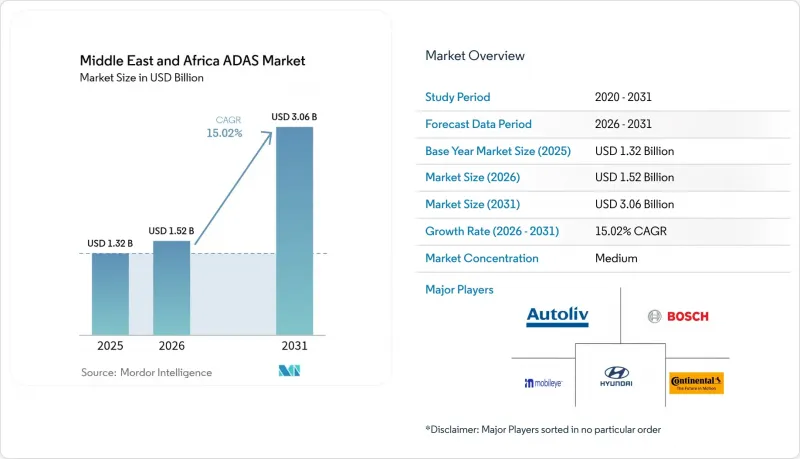
根據 Mordor Intelligence 預測,中東和非洲地區高級駕駛輔助系統 (ADAS) 的市場規模預計將從 2025 年的 13.2 億美元成長到 2026 年的 15.2 億美元,然後從 2026 年到 2031 年以 15.02% 的複合成長率 3031 年達到 300.300 億美元。
本報告按系統類型(例如,泊車輔助系統)、感測器技術(例如,雷達、攝影機、雷射雷達)、車輛類型(例如,乘用車、輕型商用車)、自動駕駛等級(L1、L2、L2+)、產品(例如,硬體)、銷售管道(OEM、售後市場)和國家進行細分。市場預測以貨幣價值(美元)和銷售(單位)兩種形式呈現。
中東和非洲ADAS市場趨勢與洞察
強制執行 NCAP 安全法規,強制車隊安裝 NCAP 系統。
區域運輸部目前正將與歐洲新車安全評估協會(Euro NCAP)同等水準的安全功能集納入其車款認證架構。杜拜道路交通管理局(RTA)已開始強制要求重型卡車安裝遠端資訊處理系統,而聯合國歐洲經濟委員會(UN ECE)關於駕駛輔助系統的法規則提供了一套統一的技術規則。由於獲得營運許可越來越依賴合規性,車隊營運商正在加快高級駕駛輔助系統(ADAS)的部署進度,為一級供應商創造了可預測的收入來源。
豪華汽車的普及推動了 L2+ 功能的應用。
海灣國家的富裕消費者將碰撞預防和高速公路輔助駕駛功能視為其生活方式的象徵。現代IONIQ系列和長安等中國品牌如今已將高速公路駕駛輔助和自動變換車道功能作為其高階車型的標準配備。這種示範效應縮短了這些功能的普及週期,中階汽車製造商現在也開始以更低的價格提供功能有限的L2級配置套件。
非洲高昂的系統成本與可支配所得之間的平衡
在撒哈拉以南非洲市場,ADAS(高級駕駛輔助系統)的價格上漲幅度可能高達新車價格的5%至10%,這在汽車擁有成本已經給家庭預算帶來巨大壓力的情況下,無疑是一個巨大的障礙。雖然售後市場套件曾經彌補了這個缺口,但Mobileye將於2024年退出售後市場,導致一個至關重要的低成本銷售管道的喪失。如果沒有本地信貸補貼和進一步的關稅減免,ADAS在非洲的普及程度將落後於海灣國家。
細分市場分析
隨著監管機構將前向碰撞緩解功能納入車輛檢驗要求,自動緊急煞車系統正以18.74%的複合年成長率快速成長,並成為附加價值最高的功能。泊車輔助技術雖然已成為主流,但仍佔29.12%的市場佔有率,因為在杜拜和利雅德等人口稠密的城市地區,人們對低速碰撞的擔憂日益加劇。一級供應商正在將這些功能捆綁銷售,以提高普及率,從而進一步推動高級駕駛輔助系統(ADAS)市場的發展勢頭。
整合安全系統擴大將盲點偵測、自我調整頭燈和駕駛員監視錄影機功能結合起來。博世等一級供應商正在將人工智慧感知演算法整合到模組化硬體中,使原始設備製造商 (OEM) 能夠部署客製化方案,而無需進行成本高昂的重新設計。
攝影機仍是經濟效益最顯著的產品,預計到2025年將佔總銷售量的42.75%。然而,沿岸地區的汽車製造商正面臨眩光和灰塵問題,而固態攝影機的價格已降至每通道500美元以下,推動LiDAR的複合年成長率達到18.96%。雖然雷達正在升級到4D成像配置,從而實現不受天氣影響的物體分類,但超音波感測器對於低速都市區駕駛仍然至關重要。
軟體定義架構使原始設備製造商 (OEM) 能夠無線最佳化演算法,並根據本地駕駛特性最佳化感測器融合。這種能力將差異化因素從硬體成本曲線轉移到更新頻率和資料科學專業知識,而這正是高階駕駛輔助系統 (ADAS) 產業的特徵。
其他好處:
- Excel格式的市場預測(ME)表
- 3個月的分析師支持
目錄
第1章:引言
- 研究假設和市場定義
- 調查範圍
第2章:調查方法
第3章執行摘要
第4章 市場狀況
- 市場概覽
- 市場促進因素
- NCAP安全法規和所有車輛的強制性設備
- 豪華汽車的普及正在推動 L2+ 功能的採用率不斷提高。
- 降低感測器成本並優先考慮現場組裝
- 智慧城市走廊:實現支援ADAS的V2X基礎設施
- 共享出行和租賃車輛安全設備的標準化
- 「2030願景」的多元化基金將投資於行動出行技術領域。
- 市場限制因素
- 非洲系統成本高昂,可支配所得有限
- 稀疏校準和維護網路
- 惡劣的粉塵和高溫環境會縮短感測器的運作時間。
- 關稅波動和在地採購規則正在擾亂供應鏈。
- 價值供應鏈分析
- 監理情勢
- 技術展望
- 波特五力分析
第5章 市場規模與成長預測
- 依系統類型
- 停車輔助系統
- 自我調整頭燈
- 夜視
- 盲點偵測
- 車道偏離警示
- 自動緊急制動
- 駕駛員監控和疲勞檢測
- 感測器技術
- 雷達(24/77/79 GHz)
- 攝影機(單聲道、立體聲、環繞音效)
- LiDAR(固態、機械式)
- 超音波和紅外線
- 按車輛類型
- 搭乘用車
- 輕型商用車
- 中型及大型商用車輛及巴士
- 按自動駕駛級別
- L1(駕駛輔助)
- L2(部分自動駕駛)
- L2+(高級部分自動駕駛)
- 報價
- 硬體(ECU、感知器)
- 軟體演算法
- 整合和校準服務
- 按銷售管道
- 原廠正品零件
- 售後市場
- 國家
- 沙烏地阿拉伯
- 阿拉伯聯合大公國
- 卡達
- 科威特
- 南非
- 埃及
- 摩洛哥
- 奈及利亞
- 其他中東和非洲國家
第6章 競爭情勢
- 市場集中度
- 策略趨勢
- 市佔率分析
- 公司簡介
- Autoliv AB
- Robert Bosch GmbH
- Continental AG
- Hyundai Mobis Co.
- Aptiv PLC
- Mobileye(Intel)
- ZF Friedrichshafen AG
- DENSO Corporation
- Valeo SA
- Magna International
- HELLA GmbH & Co. KGaA
- Veoneer
第7章 市場機會與未來展望
According to Mordor Intelligence, the Middle East and Africa Advanced Driver Assistance Systems market size is expected to grow from USD 1.32 billion in 2025 to USD 1.52 billion in 2026 and is forecast to reach USD 3.06 billion by 2031 at 15.02% CAGR over 2026-2031.
This report is Segmented by System Type (Parking Assist System, and More), Sensor Technology (Radar, Camera, Li-Dar, and More), Vehicle Type (Passenger Cars, Light Commercial Vehicles and More), Level of Autonomy (L1, L2 and L2+), Offering (Hardware, and More), Distribution Channel ( OEM-Fit and Aftermarket), and Country. The Market Forecasts are Provided in Terms of Value (USD) and Volume (Units).
Middle East And Africa ADAS Market Trends and Insights
Mandatory NCAP-style Safety Regulations & Fleet-fit Mandates
Regional transport ministries now embed Euro-NCAP-equivalent safety suites into type-approval frameworks. Dubai's Roads and Transport Authority began requiring telematics in heavy trucks, and UN ECE's Driver Control Assistance Systems regulation offers a harmonized technical rulebook . Because operating licences increasingly hinge on compliance, fleet operators accelerate ADAS installation schedules, creating a predictable revenue stream for Tier 1 suppliers.
Premium-vehicle Uptake Boosting L2+ Feature Penetration
Affluent Gulf consumers value collision-avoidance and highway-pilot functions as lifestyle statements. Hyundai's IONIQ range and Chinese brands like Changan now bundle Highway Driving Assist and automated lane-change features as standard on top trims. The demonstration effect shortens diffusion cycles, prompting mid-segment OEMs to offer stripped-down L2 packages at lower price points.
High System Cost Versus Disposable Income in Africa
In Sub-Saharan markets, the price uplift for ADAS can equal 5-10% of a new-vehicle invoice, a hurdle when average car-ownership costs already strain household budgets. Retrofit kits once addressed this gap, but Mobileye's 2024 exit from aftermarket programs removed a key low-cost channel. Without local credit subsidies or deeper duty breaks, mass adoption lags behind Gulf peers.
Other drivers and restraints analyzed in the detailed report include:
- Sensor Cost Declines & Local Assembly Incentives
- Smart-city Corridors Enabling ADAS-ready V2X Infrastructure
- Sparse Calibration and Servicing Networks
For complete list of drivers and restraints, kindly check the Table Of Contents.
Segment Analysis
Automatic emergency braking contributes the highest incremental value, expanding at 18.74% CAGR as regulators add forward-collision mitigation to inspection checklists. While already mainstream, parking-assist technology still holds a 29.12% share because dense urban cores in Dubai and Riyadh heighten low-speed collision anxiety. Tier 1 suppliers bundle these features to encourage higher take-rates, reinforcing the advanced driver assistance systems market's momentum.
Integrated safety suites increasingly combine blind-spot detection, adaptive front lighting, and driver-monitoring cameras. Tier 1s such as Bosch overlay AI perception algorithms on modular hardware, enabling OEMs to deploy tailored packages without costly redesigns.
Cameras remain the economic workhorse, controlling 42.75% of 2025 revenue. Yet Gulf operators contend with glare and dust, catalyzing LiDAR's 18.96% CAGR as solid-state units drop below USD 500 per channel. Radar upgrades to 4D-imaging configurations add weather-resilient object classification, while ultrasonic rings stay vital for low-speed urban maneuvers.
Software-defined architectures let OEMs refine algorithms over the air, optimizing sensor fusion for regional driving idiosyncrasies. This capability shifts differentiation from hardware cost curves toward update cadence and data-science expertise, a hallmark of the advanced driver assistance systems industry.
Complete Report Scope:
- By System Type
- Parking Assist Systems
- Adaptive Front-lighting
- Night Vision
- Blind-Spot Detection
- Lane Departure Warning
- Automatic Emergency Braking
- Driver Monitoring & Drowsiness Detection
- By Sensor Technology
- Radar (24 / 77 / 79 GHz)
- Camera (Mono, Stereo, Surround)
- LiDAR (Solid-state, Mechanical)
- Ultrasonic & Infra-red
- By Vehicle Type
- Passenger Cars
- Light Commercial Vehicles
- Medium & Heavy Commercial Vehicles & Buses
- By Level of Autonomy
- L1 (Driver Assistance)
- L2 (Partial Automation)
- L2+ (Enhanced Partial Automation)
- By Offering
- Hardware (ECU, Sensors)
- Software & Algorithms
- Integration & Calibration Services
- By Distribution Channel
- OEM-fit
- Aftermarket Retrofit
- By Country
- Saudi Arabia
- United Arab Emirates
- Qatar
- Kuwait
- South Africa
- Egypt
- Morocco
- Nigeria
- Rest of Middle East and Africa
List of Companies Covered in this Report:
- Autoliv AB
- Robert Bosch GmbH
- Continental AG
- Hyundai Mobis Co.
- Aptiv PLC
- Mobileye (Intel)
- ZF Friedrichshafen AG
- DENSO Corporation
- Valeo SA
- Magna International
- HELLA GmbH & Co. KGaA
- Veoneer
Additional Benefits:
- The market estimate (ME) sheet in Excel format
- 3 months of analyst support
TABLE OF CONTENTS
1 Introduction
- 1.1 Study Assumptions & Market Definition
- 1.2 Scope of the Study
2 Research Methodology
3 Executive Summary
4 Market Landscape
- 4.1 Market Overview
- 4.2 Market Drivers
- 4.2.1 Mandatory NCAP-style safety regulations & fleet-fit mandates
- 4.2.2 Premium-vehicle uptake boosting L2+ feature penetration
- 4.2.3 Sensor cost declines & local assembly incentives
- 4.2.4 Smart-city corridors enabling ADAS-ready V2X infrastructure
- 4.2.5 Ride-hailing & leasing fleets standardising safety packs
- 4.2.6 Vision-2030 diversification funds channelled into mobility tech
- 4.3 Market Restraints
- 4.3.1 High system cost vs disposable income in Africa
- 4.3.2 Sparse calibration & servicing networks
- 4.3.3 Harsh dust-heat environment degrading sensor uptime
- 4.3.4 Tariff swings & localisation rules disrupting supply chains
- 4.4 Value/Supply-Chain Analysis
- 4.5 Regulatory Landscape
- 4.6 Technological Outlook
- 4.7 Porter's Five Forces Analysis
- 4.7.1 Threat of New Entrants
- 4.7.2 Bargaining Power of Buyers
- 4.7.3 Bargaining Power of Suppliers
- 4.7.4 Threat of Substitutes
- 4.7.5 Intensity of Competitive Rivalry
5 Market Size & Growth Forecasts (Value (USD) and Volume (Units))
- 5.1 By System Type
- 5.1.1 Parking Assist Systems
- 5.1.2 Adaptive Front-lighting
- 5.1.3 Night Vision
- 5.1.4 Blind-Spot Detection
- 5.1.5 Lane Departure Warning
- 5.1.6 Automatic Emergency Braking
- 5.1.7 Driver Monitoring & Drowsiness Detection
- 5.2 By Sensor Technology
- 5.2.1 Radar (24 / 77 / 79 GHz)
- 5.2.2 Camera (Mono, Stereo, Surround)
- 5.2.3 LiDAR (Solid-state, Mechanical)
- 5.2.4 Ultrasonic & Infra-red
- 5.3 By Vehicle Type
- 5.3.1 Passenger Cars
- 5.3.2 Light Commercial Vehicles
- 5.3.3 Medium & Heavy Commercial Vehicles & Buses
- 5.4 By Level of Autonomy
- 5.4.1 L1 (Driver Assistance)
- 5.4.2 L2 (Partial Automation)
- 5.4.3 L2+ (Enhanced Partial Automation)
- 5.5 By Offering
- 5.5.1 Hardware (ECU, Sensors)
- 5.5.2 Software & Algorithms
- 5.5.3 Integration & Calibration Services
- 5.6 By Distribution Channel
- 5.6.1 OEM-fit
- 5.6.2 Aftermarket Retrofit
- 5.7 By Country
- 5.7.1 Saudi Arabia
- 5.7.2 United Arab Emirates
- 5.7.3 Qatar
- 5.7.4 Kuwait
- 5.7.5 South Africa
- 5.7.6 Egypt
- 5.7.7 Morocco
- 5.7.8 Nigeria
- 5.7.9 Rest of Middle East and Africa
6 Competitive Landscape
- 6.1 Market Concentration
- 6.2 Strategic Moves
- 6.3 Market Share Analysis
- 6.4 Company Profiles (Includes Global Level Overview, Market Level Overview, Core Segments, Financials as Available, Strategic Information, Market Rank/Share for Key Companies, Products and Services, and Recent Developments)
- 6.4.1 Autoliv AB
- 6.4.2 Robert Bosch GmbH
- 6.4.3 Continental AG
- 6.4.4 Hyundai Mobis Co.
- 6.4.5 Aptiv PLC
- 6.4.6 Mobileye (Intel)
- 6.4.7 ZF Friedrichshafen AG
- 6.4.8 DENSO Corporation
- 6.4.9 Valeo SA
- 6.4.10 Magna International
- 6.4.11 HELLA GmbH & Co. KGaA
- 6.4.12 Veoneer
7 Market Opportunities & Future Outlook
- 7.1 White-space & Unmet-Need Assessment

 2026-2030年全球汽車高級駕駛輔助系統(ADAS)感測器市場
 2026-2034年全球高級駕駛輔助系統(ADAS)市場規模、佔有率、趨勢和成長分析報告
 印度汽車ADAS(先進駕駛輔助系統):市佔率分析、產業趨勢與統計及成長預測(2026-2031年)歐洲高級駕駛輔助系統:市場佔有率分析、行業趨勢和統計數據、成長預測(2026-2031 年)汽車短程雷達系統市場規模、佔有率、成長、全球產業分析、區域趨勢及2026年至2034年預測
 攝影機和感測器清潔系統市場規模及預測(2021-2034 年)、全球及區域佔有率、趨勢和成長機會分析報告:按車輛類型、感測器類型、自動駕駛等級和地區分類
 青少年駕駛技術市場-2026-2032年全球市場預測
 ADAS模擬市場:按組件、模擬類型、應用、車輛類型、最終用戶、國家及地區分類-行業分析、市場規模、市場佔有率及2026年至2033年預測ADAS訂閱市場:按訂閱模式、車輛類型、通路、自動駕駛等級、驅動系統、最終用戶、國家和地區分類-全球產業分析、市場規模、市場佔有率和預測(2026-2033)
 共享自動駕駛出行市場預測至2034年-按服務類型、車輛類型、動力系統、自動化程度、應用、最終用戶和地區分類的全球分析