


 |
市場調查報告書
商品編碼
2115830
歐洲高級駕駛輔助系統:市場佔有率分析、行業趨勢和統計數據、成長預測(2026-2031 年)Europe ADAS - Market Share Analysis, Industry Trends & Statistics, Growth Forecasts (2026 - 2031) |
||||||

※ 本網頁內容可能與最新版本有所差異。詳細情況請與我們聯繫。
據 Mordor Intelligence 稱,2025 年歐洲 ADAS 市值為 355.4 億美元,預計到 2031 年將達到 626.1 億美元,而 2026 年為 390.5 億美元,預測期(2026-2031 年)的複合年成長率為 9.89%。
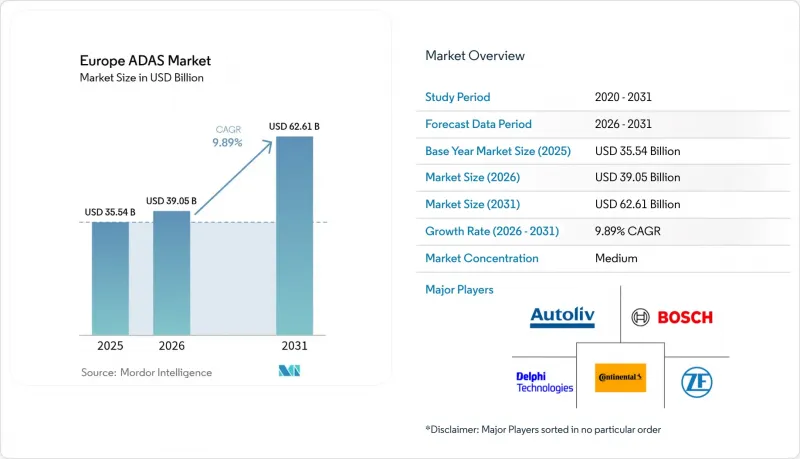
本報告按系統類型(泊車輔助系統等)、感測器類型(雷達、LiDAR、攝影機、超音波、紅外線)、車輛類型(摩托車、乘用車等)、自動駕駛等級(L1、L2、L3、L4、L5)、銷售管道(原廠配套、售後改裝)和國家進行細分。市場預測以美元計價。
歐洲ADAS市場的趨勢與洞察
歐盟強制通用安全法規(2024 年)
該法規強制要求在歐盟銷售的所有新車類別必須配備自動緊急煞車、車道偏離預警和駕駛疲勞偵測功能。入門級乘用車、摩托車和農用機械也必須符合相同的安全標準,這迫使汽車製造商加快採購進度,尤其是一級供應商的訂單已經排到了2026年。不符合法規的車型將失去型式認證,並被完全排除在區域市場之外,而提前獲得認證的供應商則可以確保訂單量。
與 EURO NCAP 2030 願景藍圖保持一致
歐洲新車安全評估協會(Euro NCAP)的分階段藍圖設定了高於法定最低標準的性能標準,要求汽車製造商證明其車輛能夠在複雜的混合交通環境中識別自行車、行人和摩托車駕駛員。這些協議評估融合雷達、攝影機和雷射雷達輸入訊號的系統,以應對惡劣天氣、夜間路況和施工區域。由於評估結果直接影響車輛採購和保險費率計算,製造商被迫不斷升級感測器和軟體,這使得具備迭代檢驗能力的供應商更具優勢。
入門車型的額外成本很高
由於ADAS硬體和電子設備的整合,城市汽車平台目前面臨額外的成本。這種情況迫使汽車製造商在承受利潤率壓力和冒著失去東歐和南歐市場價格敏感型買家的風險之間做出選擇。同時,缺乏全球市場規模經濟的中小型製造商難以分攤工程的間接成本。因此,在半導體價格大幅下降之前,價格差異將持續存在。
細分市場分析
到2025年,自動緊急煞車系統(AEB)在歐洲高級駕駛輔助系統(ADAS)市佔率中佔比達到22.74%。 2024年頒布的《通用安全法規》進一步鞏固了這一地位,該法規強制要求所有新註冊車輛必須配備此功能。在歐洲ADAS市場,夜視解決方案市場預計到2031年將大幅成長,複合年成長率(CAGR)達到10.04%,因為熱成像攝影機能夠有效緩解霧霾和黑暗環境的影響,並有助於高階品牌之間的差異化。前向碰撞警報、車道偏離預警和主動式車距維持定速系統等功能繼續作為捆綁套裝的一部分大量出貨,加速了預測駕駛員意圖功能的普及。
OEM廠商的藍圖正在加速將停車輔助、盲點偵測和駕駛員疲勞偵測模組整合到單一網域控制器中,從而簡化ECU並降低線路複雜性。儘管由於隱私方面的擔憂,符合GDPR標準的駕駛員疲勞監測系統普及速度緩慢,但它仍然是Euro NCAP評估的關鍵要素。自我調整照明系統現在整合了矩陣式LED功能,可在不使對面來車眩目的情況下最佳化光束模式,使照明控制成為安全性和能源效率的關鍵組件。這些融合趨勢表明,歐洲ADAS市場是一個軟硬體生態系統,其模組化安全組件具有韌體功能,可在車輛的整個生命週期內進行升級。
2025年,雷達感測器在歐洲ADAS市場仍佔據37.10%的佔有率,主要得益於其中端模組約32美元的價格、強大的全天候性能以及監管部門的廣泛認可。預計到2031年,隨著單價降至500美元左右,以及歐洲新車安全評鑑協會(Euro NCAP)更加重視保護弱勢道路使用者,LiDAR市場將以10.06%的複合年成長率顯著成長。雖然攝影機對於識別車道線和交通標誌至關重要,但它們面臨著積雪遮蔽的挑戰,因此,熱成像攝影機與雷達融合技術的價值日益凸顯。
大陸集團的77GHz MIMO雷達陣列在提供更高解析度的同時,節省了封裝空間,從而保持了雷達在高速公路上的核心作用。同時,法雷奧固態雷射雷達價格的降低使其得以應用於量產的C級跨界車型——這一突破性進展為感測器層級帶來了新的平衡。整合感知堆疊將雷達速度資訊、攝影機語義資訊和雷射雷達深度資訊整合到單一ECU中,降低了延遲,並提供了L3認證所需的冗餘。這種整合正在加速歐洲ADAS市場供應商的重組,OEM廠商越來越傾向於選擇能夠最大限度減少檢驗環節的承包感測器套件。
其他好處:
- Excel格式的市場預測(ME)表
- 3個月的分析師支持
目錄
第1章:引言
- 研究假設和市場定義
- 調查範圍
第2章:調查方法
第3章執行摘要
第4章 市場狀況
- 市場概覽
- 市場促進因素
- 歐盟通用安全法規將於2024年強制執行
- 與 EURO NCAP 2030 願景藍圖保持一致
- 二級功能在大眾市場的商品搭售正在迅速增加。
- 降低成本並實現77 GHz雷達平台標準化
- 基於OTA的ADAS功能貨幣化模型
- 數位孿生認證框架
- 市場限制因素
- 入門車型的額外成本很高
- 雪霧條件下感應器性能下降
- 駕駛監視錄影機遵守 GDPR 的成本
- 鎵出口限制正在影響雷射雷達的供應。
- 價值供應鏈分析
- 監理情勢
- 技術展望
- 波特五力模型
第5章 市場規模與成長預測
- 依系統類型
- 停車輔助系統
- 自我調整頭燈
- 夜視系統
- 盲點偵測
- 自動緊急制動
- 前方碰撞警報
- 駕駛員疲勞警報系統
- 交通標誌識別
- 車道偏離警示
- 主動式車距維持定速系統
- 依感測器類型
- 雷達
- LiDAR
- 相機
- 超音波
- 紅外線的
- 按車輛類型
- 摩托車
- 搭乘用車
- 中型和大型商用車輛
- 按自動駕駛級別
- 一級
- 二級
- 3級
- 4級
- 5級
- 按銷售管道
- 原廠正品零件
- 售後改裝
- 國家
- 德國
- 英國
- 法國
- 義大利
- 西班牙
- 俄羅斯
- 其他歐洲國家
第6章 競爭情勢
- 市場集中度
- 策略趨勢
- 市佔率分析
- 公司簡介
- Robert Bosch GmbH
- Continental AG
- ZF Friedrichshafen AG
- Valeo SA
- Aptiv PLC
- Autoliv Inc.
- Denso Corporation
- Hella KGaA Hueck & Co.
- Mobileye(NXP/Intel)
- Infineon Technologies AG
- Magna International Inc.
- NXP Semiconductors NV
- STMicroelectronics NV
- Panasonic Corp.
- Renesas Electronics Corp.
- Hyundai Mobis Co. Ltd.
- Veoneer AB
- Texas Instruments Inc.
- Innoviz Technologies Ltd.
- Ibeo Automotive Systems GmbH
第7章 市場機會與未來展望
According to Mordor Intelligence, the Europe ADAS market size was valued at USD 35.54 billion in 2025 and estimated to grow from USD 39.05 billion in 2026 to reach USD 62.61 billion by 2031, at a CAGR of 9.89% during the forecast period (2026-2031).
This report is Segmented by System Type (Parking Assist Systems and More), Sensor Type (Radar, Lidar, Camera, Ultrasonic, and Infra-Red), Vehicle Type (Two-Wheelers, Passenger Cars, and More), Level of Autonomy (Level 1, Level 2, Level 3, Level 4, and Level 5), Sales Channel (OEM-Fitted and Aftermarket Retrofit), and Country. The Market Forecasts are Provided in Terms of Value (USD).
Europe ADAS Market Trends and Insights
EU General Safety Regulation 2024 Mandate
The regulation requires automatic emergency braking, lane departure warning, and driver drowsiness detection across every new vehicle category sold in the bloc. Entry-level passenger cars, motorcycles, and agricultural machinery must meet identical baseline safety specifications, forcing OEMs to accelerate procurement schedules that have already filled Tier 1 order books through 2026. Non-compliant models lose type approval, creating a hard stop on regional market access and giving early certified suppliers guaranteed volume visibility .
EURO NCAP 2030 Vision Roadmap Alignment
Euro NCAP's staged roadmap sets performance thresholds higher than legislative minima, requiring OEMs to demonstrate cyclist, pedestrian, and motorcyclist recognition in complex mixed-traffic conditions. These protocols reward systems that fuse radar, camera, and LiDAR inputs to handle adverse weather, nighttime, and construction zones. Ratings directly influence fleet procurement and insurance pricing, pushing manufacturers toward continuous sensor and software upgrades that favor suppliers with iterative validation capacity.
High Incremental Cost For Entry-Level Vehicles
City-car platforms now face an added cost due to the integration of ADAS hardware and electronics. This development forces OEMs to either absorb the margin pressure or potentially alienate budget-conscious buyers in Eastern Europe and southern markets. Meanwhile, smaller manufacturers, without the advantage of global scale, find it challenging to distribute engineering overheads. As a result, they face an extended affordability gap, awaiting a significant drop in semiconductor prices.
Other drivers and restraints analyzed in the detailed report include:
- Mass-Market Level 2 Feature Bundling Surge
- 77 GHz Radar Cost Decline & Platform Standardization
- Sensor Performance Loss In Snow/Fog Conditions
For complete list of drivers and restraints, kindly check the Table Of Contents.
Segment Analysis
Automatic emergency braking held 22.74% of the European ADAS market share in 2025, a position cemented when the 2024 General Safety Regulation made the feature mandatory across new registrations. The Europe ADAS market size for night-vision solutions is forecast to grow exponentially by 2031, translating into a 10.04% CAGR as thermal cameras mitigate fog and darkness and help brands differentiate in premium tiers. Forward-collision warning, lane-departure warning, and adaptive cruise control continue to ship in volume bundles, reinforcing pathway migration from reactive to predictive functions that anticipate driver intent.
OEM roadmaps increasingly fuse parking, blind-spot, and drowsiness modules into unified domain controllers that consolidate ECUs and cut wiring complexity. GDPR-compliant drowsiness monitoring expands slowly due to privacy safeguards, yet remains critical for Euro NCAP scoring. Adaptive lighting systems add matrix-LED capabilities that optimize beam patterns without blinding oncoming traffic, positioning illumination control as a safety and energy efficiency play. These converging trends confirm the European ADAS market as a hardware-software ecosystem in which modular safety building blocks become firmware features upgradeable over a vehicle's lifetime.
Radar sensors retained 37.10% of the European ADAS market share in 2025, benefiting from USD 32 mid-range module pricing, robust all-weather performance, and regulatory familiarity. The Europe ADAS market size for LiDAR is projected to grow significantly by 2031, riding a 10.06% CAGR once unit pricing falls toward USD 500 and Euro NCAP stresses vulnerable road-user protection. Cameras remain indispensable for lane-line and traffic-sign recognition, yet face snow occlusion issues that elevate the value proposition of thermal and radar fusion.
Continental's 77 GHz MIMO radar arrays deliver finer resolution while conserving package space, protecting the radar's core highway role. Simultaneously, Valeo's solid-state LiDAR price cuts push the sensor into high-volume C-segment crossovers, a milestone that rebalances sensory hierarchies. Integrated perception stacks merge radar velocity, camera semantics, and LiDAR depth into single ECUs, lowering latency and creating redundancy demanded for Level 3 approvals. This integration accelerates supplier consolidation inside the European ADAS market, with OEMs favoring turnkey sensor suites that minimize validation loops.
Complete Report Scope:
- By System Type
- Parking Assist Systems
- Adaptive Front-Lighting
- Night Vision Systems
- Blind-Spot Detection
- Automatic Emergency Braking
- Forward Collision Warning
- Driver Drowsiness Alert
- Traffic Sign Recognition
- Lane Departure Warning
- Adaptive Cruise Control
- By Sensor Type
- Radar
- LiDAR
- Camera
- Ultrasonic
- Infra-red
- By Vehicle Type
- Two-Wheelers
- Passenger Cars
- Medium & Heavy Commercial Vehicles
- By Level of Autonomy
- Level 1
- Level 2
- Level 3
- Level 4
- Level 5
- By Sales Channel
- OEM-Fitted
- Aftermarket Retrofit
- By Geography
- Germany
- United Kingdom
- France
- Italy
- Spain
- Russia
- Rest of Europe
List of Companies Covered in this Report:
- Robert Bosch GmbH
- Continental AG
- ZF Friedrichshafen AG
- Valeo SA
- Aptiv PLC
- Autoliv Inc.
- Denso Corporation
- Hella KGaA Hueck & Co.
- Mobileye (NXP/Intel)
- Infineon Technologies AG
- Magna International Inc.
- NXP Semiconductors NV
- STMicroelectronics N.V.
- Panasonic Corp.
- Renesas Electronics Corp.
- Hyundai Mobis Co. Ltd.
- Veoneer AB
- Texas Instruments Inc.
- Innoviz Technologies Ltd.
- Ibeo Automotive Systems GmbH
Additional Benefits:
- The market estimate (ME) sheet in Excel format
- 3 months of analyst support
TABLE OF CONTENTS
1 Introduction
- 1.1 Study Assumptions & Market Definition
- 1.2 Scope of the Study
2 Research Methodology
3 Executive Summary
4 Market Landscape
- 4.1 Market Overview
- 4.2 Market Drivers
- 4.2.1 EU General Safety Regulation 2024 Mandate
- 4.2.2 EURO NCAP 2030 Vision Roadmap Alignment
- 4.2.3 Mass-Market Level 2 Feature Bundling Surge
- 4.2.4 77 GHZ Radar Cost Decline & Platform Standardization
- 4.2.5 OTA-Based Adas Feature Monetization Models
- 4.2.6 Digital-Twin Homologation Frameworks
- 4.3 Market Restraints
- 4.3.1 High Incremental Cost For Entry-Level Vehicles
- 4.3.2 Sensor Performance Loss In Snow/Fog Conditions
- 4.3.3 GDPR Compliance Cost For Driver-Monitoring Cameras
- 4.3.4 Gallium Export Controls Hitting Lidar Supply
- 4.4 Value / Supply-Chain Analysis
- 4.5 Regulatory Landscape
- 4.6 Technological Outlook
- 4.7 Porter's Five Forces
- 4.7.1 Threat of New Entrants
- 4.7.2 Bargaining Power of Suppliers
- 4.7.3 Bargaining Power of Buyers
- 4.7.4 Threat of Substitutes
- 4.7.5 Competitive Rivalry
5 Market Size & Growth Forecasts (Value (USD))
- 5.1 By System Type
- 5.1.1 Parking Assist Systems
- 5.1.2 Adaptive Front-Lighting
- 5.1.3 Night Vision Systems
- 5.1.4 Blind-Spot Detection
- 5.1.5 Automatic Emergency Braking
- 5.1.6 Forward Collision Warning
- 5.1.7 Driver Drowsiness Alert
- 5.1.8 Traffic Sign Recognition
- 5.1.9 Lane Departure Warning
- 5.1.10 Adaptive Cruise Control
- 5.2 By Sensor Type
- 5.2.1 Radar
- 5.2.2 LiDAR
- 5.2.3 Camera
- 5.2.4 Ultrasonic
- 5.2.5 Infra-red
- 5.3 By Vehicle Type
- 5.3.1 Two-Wheelers
- 5.3.2 Passenger Cars
- 5.3.3 Medium & Heavy Commercial Vehicles
- 5.4 By Level of Autonomy
- 5.4.1 Level 1
- 5.4.2 Level 2
- 5.4.3 Level 3
- 5.4.4 Level 4
- 5.4.5 Level 5
- 5.5 By Sales Channel
- 5.5.1 OEM-Fitted
- 5.5.2 Aftermarket Retrofit
- 5.6 By Geography
- 5.6.1 Germany
- 5.6.2 United Kingdom
- 5.6.3 France
- 5.6.4 Italy
- 5.6.5 Spain
- 5.6.6 Russia
- 5.6.7 Rest of Europe
6 Competitive Landscape
- 6.1 Market Concentration
- 6.2 Strategic Moves
- 6.3 Market Share Analysis
- 6.4 Company Profiles (Includes Global Level Overview, Market Level Overview, Core Segments, Financials as Available, Strategic Information, Market Rank/Share for Key Companies, Products and Services, SWOT Analysis, and Recent Developments)
- 6.4.1 Robert Bosch GmbH
- 6.4.2 Continental AG
- 6.4.3 ZF Friedrichshafen AG
- 6.4.4 Valeo SA
- 6.4.5 Aptiv PLC
- 6.4.6 Autoliv Inc.
- 6.4.7 Denso Corporation
- 6.4.8 Hella KGaA Hueck & Co.
- 6.4.9 Mobileye (NXP/Intel)
- 6.4.10 Infineon Technologies AG
- 6.4.11 Magna International Inc.
- 6.4.12 NXP Semiconductors NV
- 6.4.13 STMicroelectronics N.V.
- 6.4.14 Panasonic Corp.
- 6.4.15 Renesas Electronics Corp.
- 6.4.16 Hyundai Mobis Co. Ltd.
- 6.4.17 Veoneer AB
- 6.4.18 Texas Instruments Inc.
- 6.4.19 Innoviz Technologies Ltd.
- 6.4.20 Ibeo Automotive Systems GmbH
7 Market Opportunities & Future Outlook
- 7.1 White-space & Unmet-Need Assessment

 2026-2030年全球汽車高級駕駛輔助系統(ADAS)感測器市場
 2026-2034年全球高級駕駛輔助系統(ADAS)市場規模、佔有率、趨勢和成長分析報告
 印度汽車ADAS(先進駕駛輔助系統):市佔率分析、產業趨勢與統計及成長預測(2026-2031年)中東和非洲高級駕駛輔助系統 (ADAS):市場佔有率分析、行業趨勢和統計數據以及成長預測 (2026-2031)汽車短程雷達系統市場規模、佔有率、成長、全球產業分析、區域趨勢及2026年至2034年預測
 攝影機和感測器清潔系統市場規模及預測(2021-2034 年)、全球及區域佔有率、趨勢和成長機會分析報告:按車輛類型、感測器類型、自動駕駛等級和地區分類
 青少年駕駛技術市場-2026-2032年全球市場預測
 ADAS模擬市場:按組件、模擬類型、應用、車輛類型、最終用戶、國家及地區分類-行業分析、市場規模、市場佔有率及2026年至2033年預測ADAS訂閱市場:按訂閱模式、車輛類型、通路、自動駕駛等級、驅動系統、最終用戶、國家和地區分類-全球產業分析、市場規模、市場佔有率和預測(2026-2033)
 共享自動駕駛出行市場預測至2034年-按服務類型、車輛類型、動力系統、自動化程度、應用、最終用戶和地區分類的全球分析