


 |
市場調查報告書
商品編碼
2116345
印度城市物流:市場佔有率分析、產業趨勢與統計及成長預測(2026-2031)India Intra-city Logistics - Market Share Analysis, Industry Trends & Statistics, Growth Forecasts (2026 - 2031) |
||||||

※ 本網頁內容可能與最新版本有所差異。詳細情況請與我們聯繫。
根據 Mordor Intelligence 估計,印度城市物流市場規模在 2026 年將達到 349.3 億美元,高於 2025 年的 335 億美元,預計到 2031 年將達到 430.6 億美元。
預計2026年至2031年複合年成長率為4.26%。
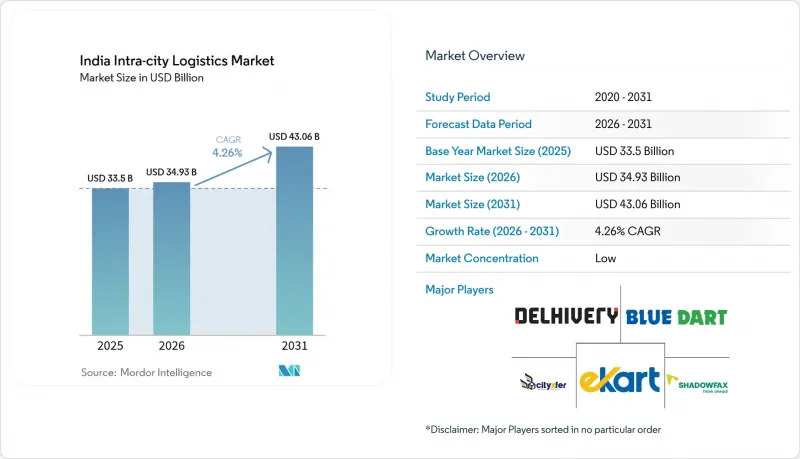
本報告按服務類型(運輸、倉儲配送及其他)、經營模式(B2B、B2C、C2C)、配送速度(當日達、次日達)、終端用戶行業(電商零售、時尚生活、美容及個人護理、住宅及家具、家用電器、醫療保健及醫療用品及其他)以及城市層級進行細分。市場預測以美元計價。
印度城市物流市場趨勢與洞察
電子商務小包裹。
到了2024年,當日達將佔配送速度細分市場的54.0%,凸顯消費者對即時的期望,並推動印度城市物流市場的發展。 Zepto和Blinkit等電商公司正在租賃A級倉庫,預計到2025年,全國倉庫需求將超過3億平方英尺。微型倉配中心的激增正在重新定義最後一公里配送路線,縮短運輸距離,並使即時視覺化成為日益重要的營運需求。物流業者正在採用人工智慧驅動的調度工具來最佳化車輛利用率,並確保30分鐘以內的配送時間。電子商務佔終端用戶佔有率的47.0%,顯然,它是都市區配送投資的關鍵成長驅動力。
國家物流政策與PM-Gati Shakti的實施
政府計畫正在推動多模態基礎設施和數位化管治的現代化。一項於2024年12月簽署的3.5億美元SMILE貸款計劃,正為智慧系統和標準化倉儲框架提供資金,以減少印度城市物流市場的交付延誤。 ULIP在2025年3月API調用量突破10億次,展現了快速的數據互通性,從而減少了官僚主義,並加快了車輛清關速度。在PM-Gati Shakti計畫下開發的多模態物流園區,將城市配送網路與鐵路和公路連接起來,縮短了從「第一公里」到「最後一公里」的運輸時間。這些結構性改進正推動該行業朝著實現「國家物流政策」的目標邁進,即把物流成本從佔GDP的14%降低到8%,從而為都市區貨運的價格競爭力創造空間。
都市區交通嚴重堵塞,停車位短缺
在孟買和班加羅爾的交通高峰期,送貨貨車的平均速度低於15公里/小時,導致車輛效率下降,燃油成本上升。隨著23個城市的土地交易量在2024年達到2,335英畝,換算後的價格飆升至每英畝17印度盧比(約2,030萬美元),貨運站的開發也變得日益複雜。裝卸空間不足導致車輛雙排停放,造成罰款和配送週期延長。雖然大規模基礎設施項目有望改善現狀,但其運作計畫超出了現有產業計畫的範圍,迫使承運商採用動態路線規劃軟體並利用夜間配送時段來避開擁塞。
細分市場分析
到2025年,運輸業在印度城市物流市場仍將佔據70.35%的佔有率。這主要得益於都市區對貨運的迫切需求。隨著電子商務交易量的成長以及食品配送服務在主要城市和二線城市的擴張,該產業將繼續保持成長勢頭。倉儲和配送服務也穩步發展,這得益於都市區整合中心作為微型倉配樞紐的推動。目前規模較小的附加價值服務領域預計將以3.67%的複合年成長率成長,這主要得益於客戶對逆向物流、即時追蹤和高階服務等需求的成長。
數位化正在重塑服務業的經濟格局。人工智慧驅動的路線最佳化提高了車輛利用率,而自動化發票處理則縮短了中型企業的後勤部門處理週期。在印度的城市物流行業,運輸和庫存管理的整合趨勢日益明顯,這使得托運人能夠將整合工作流程外包。遵守環境法規是另一個促進因素。托運人重視擁有符合BS6標準車輛並已引進電動貨車的合作夥伴,而附加價值服務正成為合約競標的差異化因素。
到2025年,B2C模式將主導印度城市物流市場,佔銷售額的58.30%。這直接得益於電子商務的加速發展以及消費者對送貨上門服務的偏好。亞馬遜與印度鐵路的合作已擴展至120多條城際線路,展現了大規模平台如何將國家幹線與城市配送整合。 B2B貨運仍佔據重要地位,尤其是在日常消費品(FMCG)和醫藥行業,但其成長速度低於零售小包裹。
儘管C2C物流目前僅佔個位數市場佔有率,但由於ONDC開放式物流層降低了進入門檻,其成長率仍高達3.38%。社群媒體賣家現在可以以接近商業價格接入標準小包裹網路,從而推動了點對點(P2P)貨運量的成長。對於物流公司而言,C2C提供了一種提高利用率、填補空置回程運輸能力並平衡尖峰時段工作量的新途徑。
其他好處:
- Excel格式的市場預測(ME)表
- 3個月的分析師支持
目錄
第1章:引言
- 研究假設和市場定義
- 調查範圍
第2章:調查方法
第3章執行摘要
第4章 市場狀況
- 市場概覽
- 市場促進因素
- 電子商務導致小包裹數量爆炸性成長
- 國家物流政策與PM-Gati Shakti的實施
- 城市貨運基本規劃要求設立城市群中心
- 二、三線城市零售業的數位化浪潮
- 最後一公里運輸車輛的快速電氣化
- 由 ONDC主導的開放式物流互通性
- 市場限制因素
- 都市區交通嚴重堵塞,停車位短缺
- 一群高度分散的小規模企業
- 微型倉配中心的土地成本和合規成本不斷上漲。
- 零工勞工強制性安全措施和社會保障要求的未來。
- 價值供應鏈分析
- 監理情勢
- 技術展望
- 波特五力模型
- 新冠疫情對市場和經濟的影響
第5章 市場規模與成長預測
- 按服務
- 運輸
- 倉儲/物流
- 附加價值服務
- 按經營模式
- B2B
- B2C
- C2C
- 按配送速度
- 當日送達(24小時內)
- 隔日送達(24-48小時)
- 按最終用戶行業分類
- 電子商務零售
- 時尚與生活風格
- 美容、健康和個人護理
- 住宅和家具
- 家用電子產品和家用電器
- 醫療保健和醫療用品
- 其他
- 城市層級
- 一級
- 二級
- 三級及以下
第6章 競爭情勢
- 市場集中度
- 策略趨勢
- 市佔率分析
- 公司簡介
- Delhivery
- Blue Dart Express
- Shadowfax
- Ekart Logistics
- CityXfer
- COGOS Technologies
- Loadshare Networks
- TruckGuru
- DHL Express India
- TCI(Transport Corporation of India)
- LetsTransport
- Blowhorn
- DTDC
- XpressBees
- FM Logistic India
- Good Move Logistics and Transport
- JustDeliveries
- Logistica India
- SafeExpress
- Om Logistics
第7章 市場機會與未來展望
According to Mordor Intelligence, the India intra-city logistics market size in 2026 is estimated at USD 34.93 billion, growing from 2025 value of USD 33.5 billion with 2031 projections showing USD 43.06 billion, growing at 4.26% CAGR over 2026-2031.
This report is Segmented by Service (Transportation, Warehousing & Distribution, and More), Business Model (B2B, B2C, C2C), Delivery Speed (Same-Day, Next-Day), End-User Industry (E-Commerce Retail, Fashion & Lifestyle, Beauty & Personal Care, Home & Furniture, Consumer Electronics, Healthcare & Medical Supplies, Others), and City Tier. Market Forecasts are Provided in Terms of Value (USD).
India Intra-city Logistics Market Trends and Insights
Explosive E-commerce Parcel Growth
Same-day delivery seized 54.0% of the delivery-speed segment in 2024, underscoring consumer expectations for immediacy and fueling the India intra-city logistics market. Quick-commerce firms such as Zepto and Blinkit are leasing Grade A warehouses, pushing nationwide demand beyond 300 million sq ft by 2025. The proliferation of micro-fulfillment centers is redefining last-mile routing, shrinking travel distances, and elevating real-time visibility as an operational imperative. Logistics providers are deploying AI-enabled dispatch tools to optimize fleet utilization and ensure turn-around times under thirty minutes. E-commerce's 47.0% end-user share establishes it as the pivotal growth catalyst for urban delivery investments.
National Logistics Policy and PM-Gati Shakti Implementation
Government programs are modernizing multimodal infrastructure and digital governance. The USD 350 million SMILE loan signed in December 2024 is financing smart systems and standard warehousing frameworks that reduce hand-off delays in the India intra-city logistics market. ULIP surpassed 100 crore API calls in March 2025, evidencing rapid data interoperability that cuts paperwork and accelerates vehicle clearances. Multi-modal logistics parks under PM-Gati Shakti link city distribution networks with rail and expressways, trimming first-mile to last-mile transit times. These structural upgrades help the sector move toward the National Logistics Policy target of lowering logistics cost from 14% to 8% of GDP, creating headroom for price competitiveness in urban freight.
Severe Urban Traffic Congestion and Curb Scarcity
Delivery vans face average speeds below 15 km/h in Mumbai and Bengaluru rush hours, eroding fleet productivity and inflating fuel bills. Land transactions climbed to 2,335 acres across 23 cities in 2024, with prices escalating to INR 17 crore per acre USD 20.3 million after conversion complicating terminal development. Scarce loading bays force double-parking that attracts fines and escalates turnaround times. While infrastructure mega-projects pledge relief, their commissioning schedules stretch beyond immediate operational horizons, compelling carriers to overlay dynamic routing software and night-time delivery slots to navigate congestion.
Other drivers and restraints analyzed in the detailed report include:
- Urban Consolidation Centers Mandated in City-Freight Plans
- Tier-2/3 City Retail Digitalization Wave
- Pending Gig-Worker Safety / Social-Security Mandates
For complete list of drivers and restraints, kindly check the Table Of Contents.
Segment Analysis
Transportation retained 70.35% of the India intra-city logistics market share in 2025, driven by the non-discretionary need for urban freight movement. Growth continues as e-commerce volumes climb and food delivery scales across metros and Tier-2 towns. Warehousing and distribution services are expanding steadily, supported by urban consolidation centers that act as staging points for micro-fulfillment. The value-added segment, while smaller today, is registering a 3.67% CAGR as customers demand reverse logistics, real-time tracking, and white-glove services.
Digitization is reshaping service economics. AI-enabled route optimization lifts vehicle utilization, while automated invoicing reduces back-office cycles for mid-tier operators. The India intra-city logistics industry increasingly bundles transport with inventory management, enabling shippers to outsource integrated workflows. Environmental compliance is another catalyst: shippers value partners that certify fleets to BS6 norms and deploy electric vans, positioning value-added services as a differentiator in contract bids.
The B2C model dominated the India intra-city logistics market with 58.30% revenue contribution in 2025, a direct result of e-commerce acceleration and consumer preference for doorstep delivery. Amazon's partnership with Indian Railways, scaling to 120+ intercity routes, illustrates how large platforms integrate national trunk routes with city distribution. B2B shipments remain significant, especially for FMCG and pharma, but their growth is slower relative to retail parcels.
C2C deliveries, although only a single-digit share today, are accelerating at 3.38% as ONDC's open logistics layer levels entry barriers. Individuals selling on social media can now tap standard parcel networks at near enterprise rates, expanding peer-to-peer shipment volumes. For logistics companies, C2C represents an incremental utilization lever, filling backhaul capacity and smoothing peak workloads.
Complete Report Scope:
- By Service
- Transportation
- Warehousing and Distribution
- Value-added Services
- By Business Model
- B2B
- B2C
- C2C
- By Delivery Speed
- Same-day (<24 h)
- Next-day (24-48 h)
- By End-user Industry
- E-commerce Retail
- Fashion and Lifestyle
- Beauty, Wellness and Personal Care
- Home and Furniture
- Consumer Electronics and Appliances
- Healthcare and Medical Supplies
- Others
- By City Tier
- Tier-1 Metros
- Tier-2 Cities
- Tier-3 and Below
List of Companies Covered in this Report:
- Delhivery
- Blue Dart Express
- Shadowfax
- Ekart Logistics
- CityXfer
- COGOS Technologies
- Loadshare Networks
- TruckGuru
- DHL Express India
- TCI (Transport Corporation of India)
- LetsTransport
- Blowhorn
- DTDC
- XpressBees
- FM Logistic India
- Good Move Logistics and Transport
- JustDeliveries
- Logistica India
- SafeExpress
- Om Logistics
Additional Benefits:
- The market estimate (ME) sheet in Excel format
- 3 months of analyst support
TABLE OF CONTENTS
1 Introduction
- 1.1 Study Assumptions and Market Definition
- 1.2 Scope of the Study
2 Research Methodology
3 Executive Summary
4 Market Landscape
- 4.1 Market Overview
- 4.2 Market Drivers
- 4.2.1 Explosive e-commerce parcel growth
- 4.2.2 National Logistics Policy and PM-Gati Shakti implementation
- 4.2.3 Urban consolidation centres mandated in city-freight master plans
- 4.2.4 Tier-2/3 city retail digitalisation wave
- 4.2.5 Rapid electrification of last-mile fleets
- 4.2.6 ONDC-driven open logistics interoperability
- 4.3 Market Restraints
- 4.3.1 Severe urban traffic congestion and curb scarcity
- 4.3.2 Hyper-fragmented small-fleet operator base
- 4.3.3 Rising land and compliance costs for micro-fulfilment sites
- 4.3.4 Pending gig-worker safety / social-security mandates
- 4.4 Value / Supply-Chain Analysis
- 4.5 Regulatory Landscape
- 4.6 Technological Outlook
- 4.7 Porter's Five Forces
- 4.7.1 Bargaining Power of Suppliers
- 4.7.2 Bargaining Power of Buyers
- 4.7.3 Threat of New Entrants
- 4.7.4 Threat of Substitutes
- 4.7.5 Intensity of Competitive Rivalry
- 4.8 Impact of COVID-19 on Market and Economy
5 Market Size and Growth Forecasts (Value)
- 5.1 By Service
- 5.1.1 Transportation
- 5.1.2 Warehousing and Distribution
- 5.1.3 Value-added Services
- 5.2 By Business Model
- 5.2.1 B2B
- 5.2.2 B2C
- 5.2.3 C2C
- 5.3 By Delivery Speed
- 5.3.1 Same-day (<24 h)
- 5.3.2 Next-day (24-48 h)
- 5.4 By End-user Industry
- 5.4.1 E-commerce Retail
- 5.4.2 Fashion and Lifestyle
- 5.4.3 Beauty, Wellness and Personal Care
- 5.4.4 Home and Furniture
- 5.4.5 Consumer Electronics and Appliances
- 5.4.6 Healthcare and Medical Supplies
- 5.4.7 Others
- 5.5 By City Tier
- 5.5.1 Tier-1 Metros
- 5.5.2 Tier-2 Cities
- 5.5.3 Tier-3 and Below
6 Competitive Landscape
- 6.1 Market Concentration
- 6.2 Strategic Moves
- 6.3 Market Share Analysis
- 6.4 Company Profiles (includes Global-level Overview, Market-level Overview, Core Segments, Financials as available, Strategic Information, Market Rank/Share, Products and Services, Recent Developments)
- 6.4.1 Delhivery
- 6.4.2 Blue Dart Express
- 6.4.3 Shadowfax
- 6.4.4 Ekart Logistics
- 6.4.5 CityXfer
- 6.4.6 COGOS Technologies
- 6.4.7 Loadshare Networks
- 6.4.8 TruckGuru
- 6.4.9 DHL Express India
- 6.4.10 TCI (Transport Corporation of India)
- 6.4.11 LetsTransport
- 6.4.12 Blowhorn
- 6.4.13 DTDC
- 6.4.14 XpressBees
- 6.4.15 FM Logistic India
- 6.4.16 Good Move Logistics and Transport
- 6.4.17 JustDeliveries
- 6.4.18 Logistica India
- 6.4.19 SafeExpress
- 6.4.20 Om Logistics
7 Market Opportunities and Future Outlook
- 7.1 White-space and Unmet-need Assessment

 資料中心物流市場報告:趨勢、預測與競爭分析(至2035年)
 城市物流技術市場預測至2034年—全球解決方案、交付方式、技術、物流功能、最終用戶和區域分析
 全球資料中心物流市場規模、佔有率、趨勢和成長分析報告(2026-2034年)
 數位航運市場規模、佔有率和成長分析:按解決方案、部署基礎設施、供應鏈功能、最終用戶產業和地區分類-2026-2033年產業預測
 物流市場:市場規模、佔有率和趨勢分析(按服務、類別、模型、類型、營運、運輸方式、應用和地區分類),細分市場預測(2026-2033 年)
 裝卸整平機市場規模、佔有率和成長分析:按操作方式、核心材料成分、最終用途產業、分銷管道和地區分類-2026-2033年產業預測
 印度中程配送:市場佔有率分析、產業趨勢與統計及成長預測(2026-2031 年)美國中程配送:市場佔有率分析、產業趨勢與統計及成長預測(2026-2031 年)全球物流市場:市場規模、佔有率、趨勢和成長分析(2026-2034)
 2026年全球智慧物流市場報告