


 |
市場調查報告書
商品編碼
2116029
光纖組件:市場佔有率分析、產業趨勢與統計、成長預測(2026-2031)Fiber Optic Component - Market Share Analysis, Industry Trends & Statistics, Growth Forecasts (2026 - 2031) |
||||||

※ 本網頁內容可能與最新版本有所差異。詳細情況請與我們聯繫。
據 Mordor Intelligence 稱,光纖組件的市場規模預計在 2026 年達到 388.1 億美元,高於 2025 年的 354.2 億美元,預計到 2031 年將達到 612.4 億美元。
預計從 2026 年到 2031 年,其複合年成長率將達到 9.56%。
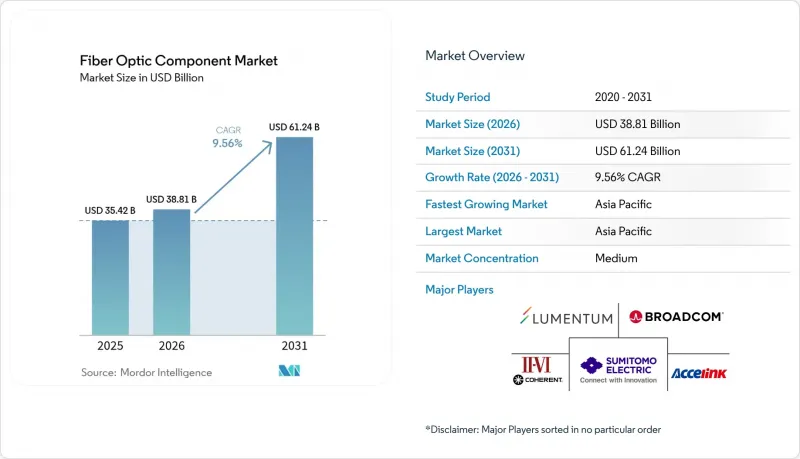
本報告按類型(電纜、放大器、分路器、主動光纜、連接器、收發器等)、應用(分散式感測、通訊、分析和醫療設備、照明)、最終用戶(電信營運商、超大規模和企業資料中心、工業和能源、醫療保健和生命科學、國防和航太)以及地區進行分類。
全球光纖元件市場趨勢與洞察
超大規模資料中心的光纖升級浪潮
快速成長的生成式人工智慧訓練叢集光連接模組密度的需求遠高於傳統雲端節點。康寧公司報告稱,其2025年第一季光纖通訊業務收入達13.6億美元,年增46%。這主要得益於一項多年期供應契約,該合約確保康寧全球10%的光纖產量供應給一家資料中心營運商。 2024年第二季度,光纖收發器出貨收益超過30億美元,創下2019年以來最佳的季度環比銷售業績。供應商正在重新設計葉脊式架構,主要用於800G和1.6T光學模組,這需要在電纜配線架內使用高等級、更耐彎曲的光纖。這些變化正在推動對低損耗光纖的需求成長,並擴大共封裝光元件的訂單。這一廣泛的更新周期為組件供應商提供了未來幾年更清晰的前景。
高密度 5G去程傳輸與回程傳輸
大規模獨立組網的5G部署正使無線終端到基頻單元的光纖數量增加一倍。泰國的鄉村寬頻網路舉措已於2025年3月前將光纖覆蓋到24,700個偏遠社區。在馬來西亞的國家寬頻計畫(總投資210億馬幣,約44億美元)中,截至2024年12月,已有60%的住宅升級為光纖網路。住友電工的0.07毫秒轉換器提高了去程傳輸協調所需的時間同步精度。普睿司曼最新的超高密度帶狀光纜使電信業者能夠在有限的管道內容納更多光纖(普睿司曼集團)。這些部署正在將網路拓撲結構轉變為分散式架構,從而增加了對連接器、光纜接頭和低延遲光纜的需求。
磷化銦和砷化鎵的外延能力不足
2023年,中國對鎵和鍺實施出口限制,導致現貨價格分別上漲250%和75%。美國地質調查局(USGS)估計,全面實施這些限制措施可能會對GDP造成34億美元的損失。相干公司( 連貫 )位於德克薩斯州的新型6吋磷化銦晶圓生產線預計,運作的晶片產量提高四倍。弗勞恩霍夫太陽能系統研究所(Fraunhofer ISE)的InP-on-GaAs基板將使晶圓成本降低80%,並實現8吋晶圓的試生產。然而,由於設備引進週期限制了短期供應緩解,契約製造製造商不得不優先滿足高利潤收發器客戶的需求,並延長低速組件的交貨週期。
細分市場分析
受城域網路和長途骨幹網路成熟部署的推動,光纖電纜在2025年仍佔據光纖組件市場40.62%的佔有率。該細分市場的光纖組件規模達到143.9億美元,反映出無源光纜在政府資助的大規模部署項目中佔據主導地位。然而,隨著超大規模營運商轉向伺服器機架內完全整合、可插拔的鏈路,預計到2031年,有源光纖電纜的複合年成長率將達到10.97%。放大器和分路器的需求仍然依賴現有線路的點對點升級,尤其是在政府資助的區域網路擴建項目中。
隨著共封裝光元件的普及,主動電纜正轉型為短距離頻寬擴展的關鍵引擎。康寧公司發布了整合功率最佳化連接器的 Gen-AI 光纖組件,適用於 102.4T 交換器機箱。收發器製造商透過整合數位訊號處理器和光子晶片,在提高能源效率的同時縮小了體積。因此,主動式光纜正逐步取代傳統幹線,用於 100 公尺以下的短距離資料通訊,從而擴大市場佔有率。擁有玻璃拉絲技術和模組整合技術的供應商預計將在未來獲得更多訂單。
區域分析
預計到2025年,亞太地區將佔光纖組件市場38.74%的佔有率,複合年成長率(CAGR)為10.44%。 50G無源光纖網路的部署以及中國「Gigabit城市」計畫的實施,正顯著提升光網路終端的容量。日本國立資訊通訊技術研究所(NICT)成功完成了1808公里、1.02 Pbit/s的傳輸實驗,證明現有地面光纖能夠處理長距離人工智慧流量。政府補貼保障了印度和菲律賓等新興經濟體「最後一公里」光纖基礎設施的建設資金,即使在宏觀經濟放緩時期也能維持基本需求。
北美是全球第二大貢獻地區,這得益於維吉尼亞州資料中心走廊超大規模園區和奧勒岡州可再生能源伺服器集群的擴張。美國寬頻股權、接入和部署 (BEAD) 計劃已撥款 424.5 億美元用於服務不足的地區,並強制要求在可行的情況下鋪設光纖電纜。波士頓和芝加哥的量子網路測試平台正在展示利用現有暗纖進行超安全金鑰分發,從而加速推廣這種新型超低損耗光纜。
在歐洲,工業自動化和採用量子安全措施的政府間通訊正變得日益重要。德國已成功展示了在現有德國電信光纖線路(76公里長)上進行量子通訊,而無需使用中繼器。英國的一個工作小組於2025年4月實現了410公里長的量子安全影像傳輸。南歐的公共產業公司正在投資升級基於光纖的SCADA(監控和控制數據採集系統),而北歐國家則利用其豐富的水力資源吸引人工智慧叢集,從而推動對共封裝光學模組的需求。拉丁美洲以及中東和非洲地區目前規模較小,但隨著海底電纜登陸點的增加和資料中心激勵措施的訂定,這些地區正經歷兩位數的成長。
其他好處:
- Excel格式的市場預測(ME)表
- 3個月的分析師支持
目錄
第1章:引言
- 研究假設和市場定義
- 調查範圍
第2章:調查方法
第3章執行摘要
第4章 市場狀況
- 市場概覽
- 市場促進因素
- 超大規模資料中心的光纖升級浪潮
- 高密度 5G去程傳輸/回程傳輸
- 用於人工智慧/機器學習的光組件:高速 PAM4/共封裝光組件,容量超過 800 Gb
- 光纖到府 (FTTH) 在亞太地區 (APAC) 和新興非洲國家迅速普及。
- 政府資助的本地寬頻計畫(美國、歐盟)
- 量子容錯網路試點計畫需要超低損耗光纖。
- 市場限制因素
- 磷化銦和砷化鎵外延生產能力短缺
- 對銷往中國的先進光電產品的地緣政治出口限制
- 長距離光纖網路中的網實整合破壞風險
- 中空光纖作為替代材料的應用正在不斷擴大。
- 價值供應鏈分析
- 監理情勢
- 技術展望
- 波特五力分析
第5章 市場規模與成長預測
- 按類型
- 電纜
- 擴大機
- 主動光纜
- 分線器
- 連接器
- 收發器
- 其他
- 透過使用
- 分散式感知
- 溝通
- 分析和醫療設備
- 照明
- 最終用戶
- 電信營運商
- 超大規模和企業資料中心
- 工業和能源
- 醫療保健和生命科學
- 國防/航太
- 按地區
- 北美洲
- 美國
- 加拿大
- 墨西哥
- 南美洲
- 巴西
- 阿根廷
- 其他南美國家
- 歐洲
- 德國
- 英國
- 法國
- 俄羅斯
- 其他歐洲國家
- 亞太地區
- 中國
- 日本
- 印度
- 韓國
- 其他亞太國家
- 中東和非洲
- 阿拉伯聯合大公國
- 沙烏地阿拉伯
- 南非
- 奈及利亞
- 其他中東和非洲國家
- 北美洲
第6章 競爭情勢
- 市場集中度
- 策略趨勢
- 市佔率分析
- 公司簡介
- Lumentum Holdings Inc.
- Broadcom Inc.
- Coherent Corp.(II-VI)
- Sumitomo Electric Industries Ltd.
- Accelink Technologies
- Fujitsu Optical Components
- Source Photonics
- NeoPhotonics(Cisco)
- O-Net Technologies
- Corning Incorporated
- Prysmian Group
- Sterlite Technologies
- Hisense Broadband
- Innolight Technology
- EMCORE Corporation
- Reflex Photonics
- FiberHome Telecommunication
- Huawei Technologies
- Mwtechnologies LDA
- OptiEnz Sensors
第7章 市場機會與未來展望
According to Mordor Intelligence, fiber optic component market size in 2026 is estimated at USD 38.81 billion, growing from 2025 value of USD 35.42 billion with 2031 projections showing USD 61.24 billion, growing at 9.56% CAGR over 2026-2031.
This report is Segmented by Type (Cables, Amplifiers, Splitters, Active Optical Cables, Splitters, Connectors, Transceivers, and Others), Application (Distributed Sensing, Communications, Analytical and Medical Equipment, and Lighting), End-User (Telecom Operators, Hyperscale and Enterprise Data Centers, Industrial and Energy, Healthcare and Life-Sciences, and Defense and Aerospace), and Geography.
Global Fiber Optic Component Market Trends and Insights
Hyperscale-data-center fiber refresh wave
Surging generative-AI training clusters require far denser optical interconnects than legacy cloud nodes. Corning reported a 46% year-over-year jump in optical-communications revenue to USD 1.36 billion during Q1 2025, underpinned by a multi-year supply agreement that reserves 10% of its global fiber output for a single data-center operator. Optical transceiver shipments exceeded USD 3 billion in Q2 2024, marking the strongest sequential revenue performance since 2019. Equipment vendors are redesigning leaf-and-spine architectures around 800 G and 1.6 T optics, which requires higher-grade bend-insensitive fiber inside cable trays. These shifts elevate demand for low-loss fiber types and advance orders for co-packaged optics. The broad refresh cycle increases visibility for component suppliers over a multi-year horizon.
5G fronthaul and backhaul densification
Wide-scale standalone 5G rollouts multiply fiber counts from radio head to baseband unit. Thailand's Village Broadband Internet initiative extended fiber to 24,700 remote communities by March 2025. Malaysia's national broadband project, valued at MYR 21 billion (USD 4.4 billion), upgraded 60% of premises to fiber as of December 2024. Sumitomo Electric's 0.07-millisecond converter improves the time-synchronization precision needed for fronthaul coordination. Prysmian's latest ultra-high-density ribbon cables help operators push more fibers into constrained ducts Prysmian Group. These deployments transform network topologies toward distributed architectures, lifting demand for connectors, closures, and low-latency cables.
Shortage of indium-phosphide and gallium-arsenide epi-capacity
China's export restriction on gallium and germanium in 2023 lifted spot prices by 250% and 75%, respectively. The U.S. Geological Survey calculated a potential USD 3.4 billion GDP hit if bans become absolute. Coherent's new six-inch indium-phosphide wafer line in Texas promises 60% cost reduction once fully ramped, quadrupling die output per wafer. Fraunhofer ISE's InP-on-GaAs substrates lower wafer costs by 80% and enable eight-inch pilot runs. Even so, tooling cycles limit near-term relief, forcing contract manufacturers to prioritize high-margin transceiver customers and extend delivery windows on lower-speed parts.
Other drivers and restraints analyzed in the detailed report include:
- AI/ML optics accelerating PAM4 and co-packaged integration
- Rapid FTTH expansion in emerging markets
- Geopolitical export controls are fragmenting global supply chains
For complete list of drivers and restraints, kindly check the Table Of Contents.
Segment Analysis
Optical cables retained a 40.62% share of the fiber optic component market in 2025, driven by entrenched deployments in metro and long-haul backbones. The fiber optic component market size for this segment reached USD 14.39 billion, reflecting the dominance of passive cable spending in large state-funded rollouts. However, active optical cables post an 10.97% CAGR to 2031 as hyperscale operators migrate to fully integrated, pluggable links inside server racks. Demand for amplifiers and splitters remains tied to point-to-point upgrades on existing routes, particularly where governments finance rural reach projects.
Adoption of co-packaged optics turns active cables into short-reach engines of bandwidth scaling. Corning introduced Gen-AI fiber assemblies with integrated power-optimized connectors aimed at 102.4 T switch enclosures. Transceiver makers bundle digital signal processors with photonic dies, shrinking footprint while lifting energy efficiency. The active segment thereby captures incremental share by substituting traditional trunks at datacom distances below 100 meters. Suppliers that couple glass-drawing expertise with module integration stand to gain follow-on design wins.
Complete Report Scope:
- By Type
- Cables
- Amplifiers
- Active Optical Cables
- Splitters
- Connectors
- Transceivers
- Others
- By Application
- Distributed Sensing
- Communications
- Analytical and Medical Equipment
- Lighting
- By End-user
- Telecom Operators
- Hyperscale and Enterprise Data Centers
- Industrial and Energy
- Healthcare and Life-Sciences
- Defense and Aerospace
- By Geography
- North America
- United States
- Canada
- Mexico
- South America
- Brazil
- Argentina
- Rest of South America
- Europe
- Germany
- United Kingdom
- France
- Russia
- Rest of Europe
- Asia-Pacific
- China
- Japan
- India
- South Korea
- Rest of Asia-Pacific
- Middle East and Africa
- United Arab Emirated
- Saudi Arabia
- South Africa
- Nigeria
- Rest of Middle East and Africa
- North America
Geography Analysis
Asia Pacific held 38.74% of the fiber optic component market in 2025 and is growing at 10.44% CAGR. China's 50 G passive optical network rollout and 10-gigabit city program create step-function increases in optical-line-terminal capacity. Japan's National Institute of Information and Communications Technology demonstrated 1.02 Pbit/s transmission across 1,808 kilometers, proving that existing terrestrial fiber can meet long-haul AI traffic. Government subsidies ensure that emerging economies such as India and the Philippines fund last-mile fiber, sustaining baseline demand even during macro-slowdowns.
North America is the second-largest regional contributor, buoyed by hyperscale campus expansions in Virginia's data-center corridor and Oregon's renewable-powered server farms. The U.S. Broadband Equity, Access, and Deployment (BEAD) program allocates USD 42.45 billion for unserved areas, mandating fiber where feasible. Quantum-network testbeds in Boston and Chicago validate ultra-secure key distribution over installed dark fiber, catalysing new categories of ultra-low-loss cabling.
Europe emphasizes industrial automation and quantum-safe government links. Germany recorded quantum communications over existing Deutsche Telekom fiber spanning 76 kilometers without repeaters. The UK taskforce achieved 410-kilometer quantum-secure video transmission in April 2025. Southern European utility firms invest in fiber-based SCADA upgrades, while the Nordics leverage abundant hydropower to attract AI clusters, thereby drawing co-packaged optics demand. Latin America and the Middle East & Africa remain smaller today but log double-digit growth as undersea cable landings and data-center incentives proliferate.
- Lumentum Holdings Inc.
- Broadcom Inc.
- Coherent Corp. (II-VI)
- Sumitomo Electric Industries Ltd.
- Accelink Technologies
- Fujitsu Optical Components
- Source Photonics
- NeoPhotonics (Cisco)
- O-Net Technologies
- Corning Incorporated
- Prysmian Group
- Sterlite Technologies
- Hisense Broadband
- Innolight Technology
- EMCORE Corporation
- Reflex Photonics
- FiberHome Telecommunication
- Huawei Technologies
- Mwtechnologies LDA
- OptiEnz Sensors
Additional Benefits:
- The market estimate (ME) sheet in Excel format
- 3 months of analyst support
TABLE OF CONTENTS
1 INTRODUCTION
- 1.1 Study Assumptions and Market Definition
- 1.2 Scope of the Study
2 RESEARCH METHODOLOGY
3 EXECUTIVE SUMMARY
4 MARKET LANDSCAPE
- 4.1 Market Overview
- 4.2 Market Drivers
- 4.2.1 Hyperscale-data-center fibre refresh wave
- 4.2.2 5G fronthaul/backhaul densification
- 4.2.3 AI/ML optics Greater than 800 Gb accelerating PAM4/Co-Packaged Optics
- 4.2.4 Rapid FTTH rollout in emerging APAC and Africa
- 4.2.5 Government-funded rural broadband programs (US, EU)
- 4.2.6 Quantum-safe network pilots demanding ultra-low-loss fibre
- 4.3 Market Restraints
- 4.3.1 Shortage of indium-phosphide and gallium-arsenide epi-capacity
- 4.3.2 Geopolitical export controls on advanced photonics to China
- 4.3.3 Cyber-physical vandalism risk on long-haul fibre routes
- 4.3.4 Growing adoption of hollow-core fibre as substitute
- 4.4 Value/Supply-Chain Analysis
- 4.5 Regulatory Landscape
- 4.6 Technological Outlook
- 4.7 Porter's Five Forces Analysis
- 4.7.1 Bargaining Power of Suppliers
- 4.7.2 Bargaining Power of Buyers
- 4.7.3 Threat of New Entrants
- 4.7.4 Threat of Substitutes
- 4.7.5 Intensity of Competitive Rivalry
5 MARKET SIZE AND GROWTH FORECASTS (VALUE)
- 5.1 By Type
- 5.1.1 Cables
- 5.1.2 Amplifiers
- 5.1.3 Active Optical Cables
- 5.1.4 Splitters
- 5.1.5 Connectors
- 5.1.6 Transceivers
- 5.1.7 Others
- 5.2 By Application
- 5.2.1 Distributed Sensing
- 5.2.2 Communications
- 5.2.3 Analytical and Medical Equipment
- 5.2.4 Lighting
- 5.3 By End-user
- 5.3.1 Telecom Operators
- 5.3.2 Hyperscale and Enterprise Data Centers
- 5.3.3 Industrial and Energy
- 5.3.4 Healthcare and Life-Sciences
- 5.3.5 Defense and Aerospace
- 5.4 By Geography
- 5.4.1 North America
- 5.4.1.1 United States
- 5.4.1.2 Canada
- 5.4.1.3 Mexico
- 5.4.2 South America
- 5.4.2.1 Brazil
- 5.4.2.2 Argentina
- 5.4.2.3 Rest of South America
- 5.4.3 Europe
- 5.4.3.1 Germany
- 5.4.3.2 United Kingdom
- 5.4.3.3 France
- 5.4.3.4 Russia
- 5.4.3.5 Rest of Europe
- 5.4.4 Asia-Pacific
- 5.4.4.1 China
- 5.4.4.2 Japan
- 5.4.4.3 India
- 5.4.4.4 South Korea
- 5.4.4.5 Rest of Asia-Pacific
- 5.4.5 Middle East and Africa
- 5.4.5.1 United Arab Emirated
- 5.4.5.2 Saudi Arabia
- 5.4.5.3 South Africa
- 5.4.5.4 Nigeria
- 5.4.5.5 Rest of Middle East and Africa
- 5.4.1 North America
6 COMPETITIVE LANDSCAPE
- 6.1 Market Concentration
- 6.2 Strategic Moves
- 6.3 Market Share Analysis
- 6.4 Company Profiles (includes Global level Overview, Market level overview, Core Segments, Financials as available, Strategic Information, Market Rank/Share for key companies, Products and Services, and Recent Developments)
- 6.4.1 Lumentum Holdings Inc.
- 6.4.2 Broadcom Inc.
- 6.4.3 Coherent Corp. (II-VI)
- 6.4.4 Sumitomo Electric Industries Ltd.
- 6.4.5 Accelink Technologies
- 6.4.6 Fujitsu Optical Components
- 6.4.7 Source Photonics
- 6.4.8 NeoPhotonics (Cisco)
- 6.4.9 O-Net Technologies
- 6.4.10 Corning Incorporated
- 6.4.11 Prysmian Group
- 6.4.12 Sterlite Technologies
- 6.4.13 Hisense Broadband
- 6.4.14 Innolight Technology
- 6.4.15 EMCORE Corporation
- 6.4.16 Reflex Photonics
- 6.4.17 FiberHome Telecommunication
- 6.4.18 Huawei Technologies
- 6.4.19 Mwtechnologies LDA
- 6.4.20 OptiEnz Sensors
7 MARKET OPPORTUNITIES AND FUTURE OUTLOOK
- 7.1 White-space and Unmet-need Assessment

 2026年全球平面光波電路(PLC)分路器盒市場報告
 HUD光學元件市場分析及預測(至2035年):類型、產品、技術、零件、應用、材料類型、設備、終端用戶、功能、安裝方式
 光纖元件市場-2026-2032年全球市場預測全球光纖元件市場:機會與策略展望(至2035年)
 GRIN光纖準直器市場報告:趨勢、預測和競爭分析(至2035年)
 被動光元件市場:商業機會、成長要素、產業趨勢分析及2026-2035年預測
 光隔離器市場:按類型、類別、功率等級、應用、最終用途和地區分類(2026-2034 年)平面光波電路分路器市場報告:按類型、設計類型、應用和地區分類,2026-2034年
 2026-2034年全球摻鉺光纖放大器市場規模、佔有率、趨勢和成長分析報告光放大器市場分析及預測(至2035年):類型、產品類型、技術、組件、應用、最終用戶、功能、安裝方式、解決方案