


 |
市場調查報告書
商品編碼
2115926
現場組裝冷卻塔:市場佔有率分析、行業趨勢和統計數據以及成長預測(2026-2031 年)Field-Erected Cooling Tower - Market Share Analysis, Industry Trends & Statistics, Growth Forecasts (2026 - 2031) |
||||||

※ 本網頁內容可能與最新版本有所差異。詳細情況請與我們聯繫。
2025 年現場組裝冷卻塔的市場規模為 29.3 億美元,預計到 2031 年將從 2026 年的 30.9 億美元成長至 40.6 億美元,預測期(2026-2031 年)的複合年成長率為 5.58%。
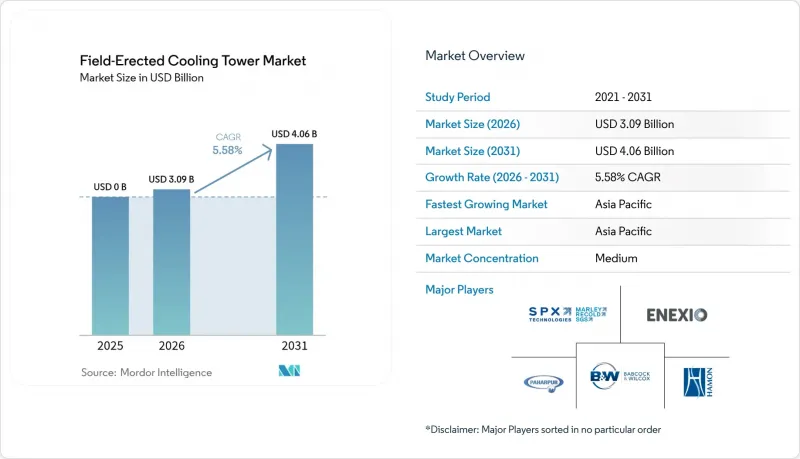
本報告按類型(濕式、乾式、混合式)、設計(自然通風、誘導通風、強制通風)、最終用戶(發電、石油化工、石油和天然氣、鋼鐵和冶金、造紙及其他最終用戶)和地區(北美、歐洲、亞太地區、南美以及中東和非洲)進行分類。
全球現場組裝冷卻塔市場趨勢及洞察
新興經濟體火力發電產能擴張
印度、中國和東南亞地區電力需求的激增,正推動對大規模蒸氣循環系統的投資,這些系統依賴高容量的現場組裝冷卻塔來最佳化冷凝器性能。印度國家電力公司(NTPC)的「拉拉超臨界發電工程」擴建項目以及中國的南通通州灣超臨界機組項目,都展現了這些大型企劃如何為冷卻塔的尺寸、材料耐久性和節水能力樹立新的標竿。電力公司工程師對冷卻水塔在整個生命週期內的漂移損失、羽流可見性和耐腐蝕性等方面的性能保證提出了更高的要求,這使得擁有成熟的計算流體力學(CFD)設計和內部FRP(纖維增強複合材料)製造能力的供應商的價值日益凸顯。位於古吉拉突邦、廣西壯族自治區和胡志明市的本地合資製造地也有助於降低運輸成本、加快施工進度,從而加強設備供應商與工程、採購和施工(EPC)承包商之間的區域合作。由於大多數國家的能源計畫都延長至 2030 年以後,這項因素支持亞太地區持續多年的採購計畫。
對老舊電廠冷卻設備進行強制維修。
在北美和歐盟,大多數石化燃料和核能發電機組在1995年之前就開始運作。目前,冷凝器真空損失、風扇效率下降和結構腐蝕威脅著發電量和許可證要求的合規性。電力公司正在增加資本預算,用於更換填充材、升級齒輪箱和安裝高效風機,以在不造成長時間停機的情況下恢復進風溫度。 Holtec公司在帕利塞茲發電廠的熱交換器更換專案展示了模組化撬裝組件如何縮短連接時間並最大限度地減少昂貴的土木工程。這種維修需求也使巴爾的摩空氣盤管公司等全球供應商的售後市場部門受益,該公司提供承包維修方案,包括升級熱審計、振動監測和維修功能。由於這些方案通常涉及長達10年或更久的維護契約,因此這部分收入有助於緩解新建設項目相關的經濟波動的影響。
乾旱地區過度用水將受到處罰
亞利桑那州、內華達州和中東部分地區的公共產業委員會已引入“水基附加費”,對超過指定閾值的蒸發損失徵收。對於遠離豐富淡水資源的燃煤、燃氣和聚光型太陽熱能發電而言,這些成本會侵蝕發電利潤,並使輸出調整的經濟性更加複雜。雖然乾式冷卻是符合監管要求的一種手段,但其較低的傳熱係數會增加汽輪機背壓,從而降低淨輸出。因此,專案發起人需要在節水和燃料效率之間做出權衡,這可能會削弱本已充滿挑戰的自由電力市場中火力發電發電工程的經濟可行性。雖然這種政策環境鼓勵混合式冷卻,但也提高了缺水地區純濕式冷卻塔專案的資金籌措門檻,限制了現場安裝冷卻塔市場的短期成長潛力。
細分市場分析
到2025年,濕式冷卻系統將佔全球銷售額的66.42%,其無與倫比的動態效率在水資源豐富的地區尤為突出。由於蒸發冷卻能使冷凝器溫度遠低於乾球溫度,因此,對於旨在最大限度提高循環效率的燃煤、燃氣和生質能發電廠而言,濕式冷卻系統是首選。因此,在亞太和拉丁美洲部分地區,濕式冷卻系統繼續主導現場安裝的冷卻塔市場。然而,混合式冷卻系統正以6.55%的複合年成長率快速成長,這得益於監管政策的變化,例如限制大都會圈可見煙羽高度以及企業在環境、社會和治理(ESG)報告方面設定的水資源管理目標。
隨著模組化附加元件組件可改裝到現有水箱上,無需單獨的乾式冷卻器,混合式冷卻系統與乾式冷卻水塔之間的成本差異正逐年縮小。此外,填充材幾何形狀和除霧器葉片輪廓的技術進步提高了濕式冷卻模式的效率,使得混合式冷卻系統能夠在氣候溫暖的地區以最小的用水量增加運作。另一方面,乾式冷卻水塔是乾旱和易旱地區的重要解決方案,但其高昂的資本投入限制了其在政府強制規定之外的推廣應用。供應商正透過採用更高的翅片管束和改進的管表面塗層來克服成本障礙,從而提高傳熱係數並減少面積。這些進步共同表明,推動現場組裝冷卻塔市場發展的動力並非簡單的技術革新,而是產品的演進。
區域分析
預計到2025年,亞太地區將佔全球銷售額的42.10%,並在2031年之前以6.92%的複合年成長率成長,這主要得益於火電廠的快速擴張、工業發展以及政府對輸電基礎設施的投資。中國超臨界燃煤機組的部署以及印度計畫新增超過80吉瓦的發電裝置容量,都清楚顯示了當前市場需求的規模。印尼和越南石化產業叢集的快速擴張進一步提升了該地區對先進冷卻技術的需求。中國江蘇省和印度馬哈拉斯特拉邦的本地冷卻塔製造廠,透過降低物流成本和培育本土技術基礎,正在增強亞太地區的成本競爭力,使其在現場組裝冷卻塔市場中保持領先地位。
北美市場規模位居第二,這主要得益於其現有的燃煤和核能發電廠正面臨日益嚴格的環境績效標準。該地區的市場成長主要由維修、混合動力改造和延壽項目驅動,而非新建項目。美國環保署 (EPA) 關於取水和有害空氣污染物的規定日益複雜,促使電力公司部署高效的除霧器、煙羽控制模組和先進的水處理系統。同時,維吉尼亞州勞登縣和奧勒岡州哥倫比亞河流域的資料中心集群也產生了需求。在這些地區,電力公司對餘熱再利用的補貼使得部署可與區域供熱系統整合的現場組裝設備在經濟上具有可行性。
在歐洲,以科技主導的趨勢仍在持續,其核心在於脫碳、降噪和水資源管理。大多數歐盟成員國都對污染可見度設定了嚴格的閾值,這加速了混合式冷卻塔的普及應用。氫能燃氣渦輪機和垃圾焚化發電發電廠也需要客製化的冷卻解決方案,丹麥首個整合碳捕集功能的垃圾焚化發電發電廠(位於奧胡斯)便是這一趨勢的典型例證。該廠所採用的複合填充材專為低氯化物、高鹼度水質設計,能夠有效容納循環冷凝水,凸顯了製程化學與冷卻塔設計之間的相互作用。
拉丁美洲、中東和非洲雖然面積不大,但卻是重要的成長區域。巴西和沙烏地阿拉伯在發現天然氣田後正在開發聯合循環發電廠,而南非則在考慮維修乾式冷卻系統來緩解淡水短缺。由於各地工程能力持續存在差異,全球供應商通常與當地的工程總承包(EPC)公司合作,共同進行土木工程和試運行。儘管主權信用風險導致貸款成本上升,為融資帶來挑戰,但多邊氣候基金對節水型混合冷卻系統和乾式冷卻系統的支持力度不斷加大,正逐步提升這些地區市場的可行性。
其他好處:
- Excel格式的市場預測(ME)表
- 3個月的分析師支持
目錄
第1章:引言
- 研究假設和市場定義
- 調查範圍
第2章:調查方法
第3章執行摘要
第4章 市場狀況
- 市場概覽
- 市場促進因素
- 新興國家火力發電產能擴張
- 老舊工廠冷卻設備的強制性維修。
- 更嚴格的排放氣體法規有利於混合塔式結構。
- 地熱和廢棄物發電 (WtE) 專案需要低用水量的乾式作業人員
- 區域資料中心熱能再利用的冷卻需求
- 模組化FRP組件可降低現場人事費用
- 市場限制因素
- 乾旱地區用水量過高將處以罰款
- 原料價格波動(鋼材、FRP樹脂)
- 沿海工廠銅沉積物導致FRP豎井開裂
- 更嚴格的噪音法規導致風扇維修成本高。
- 供應鏈分析
- 監理情勢
- 技術展望
- 波特五力模型
第5章 市場規模與成長預測
- 按類型
- 濕的
- 乾燥
- 混合
- 有意為之
- 自然通風
- 引風式
- 強制通氣
- 最終用戶
- 發電
- 石油化學產品
- 石油和天然氣
- 鋼鐵冶金
- 造紙廠
- 其他最終用戶
- 按地區
- 北美洲
- 美國
- 加拿大
- 墨西哥
- 歐洲
- 德國
- 英國
- 法國
- 義大利
- 北歐國家
- 俄羅斯
- 其他歐洲國家
- 亞太地區
- 中國
- 印度
- 日本
- 韓國
- 東南亞國協
- 其他亞太國家
- 南美洲
- 巴西
- 阿根廷
- 其他南美國家
- 中東和非洲
- 沙烏地阿拉伯
- 阿拉伯聯合大公國
- 南非
- 埃及
- 其他中東和非洲國家
- 北美洲
第6章 競爭情勢
- 市場集中度
- 策略趨勢(併購、聯盟、購電協議)
- 市場佔有率分析(主要公司的市場排名和佔有率)
- 公司簡介
- SPX Cooling Technologies, Inc.
- Hamon & Cie International SA
- Paharpur Cooling Towers Ltd
- Enexio Management GmbH
- Babcock & Wilcox Enterprises Inc.
- Evapco Inc.
- Towertech Cooling Systems Pvt Ltd
- Watco Group Ltd(Wacon)
- Cyrco Inc.
- Marley Flow Control Pty Ltd
- Baltimore Aircoil Company
- Johnson Controls(York Process Systems)
- Delta Cooling Towers Inc.
- Composite Cooling Solutions LP
- Nooter Eriksen(NEXT Cooling)
- Chart Industries/Howden
- Cooling Tower Depot Inc.
- Mesan Group
- Liang Chi Industry Co. Ltd
- Star Cooling Towers Pvt Ltd
第7章 市場機會與未來展望
According to Mordor Intelligence, the field-Erected cooling tower market size was valued at USD 2.93 billion in 2025 and estimated to grow from USD 3.09 billion in 2026 to reach USD 4.06 billion by 2031, at a CAGR of 5.58% during the forecast period (2026-2031).
This report is Segmented by Type (Wet, Dry, and Hybrid), Design (Natural Draft, Induced Draft, and Forced Draft), End User (Power Generation, Petrochemicals, Oil and Gas, Iron and Steel and Metallurgy, Paper Mills, and Other End Users), and Geography (North America, Europe, Asia-Pacific, South America, and Middle East and Africa).
Global Field-Erected Cooling Tower Market Trends and Insights
Expansion of Thermal-Power Capacity in Emerging Economies
Surging electricity demand in India, China, and Southeast Asia is driving large-scale steam-cycle investments that rely on high-capacity, field-erected cooling towers for optimal condenser performance. NTPC's Lara Super Thermal Power Project extension in India and Nantong Tongzhou Bay ultra-supercritical units in China illustrate how mega-projects are setting new standards for tower dimensions, material durability, and water-saving capabilities. Utility engineers are increasingly mandating performance guarantees for drift loss, plume visibility, and lifecycle corrosion resistance, elevating suppliers with proven computational fluid dynamics design and in-house FRP fabrication capabilities. Local joint-venture manufacturing hubs in Gujarat, Guangxi, and Ho Chi Minh City also help reduce transport costs and expedite erection schedules, thereby strengthening regional ties between equipment vendors and engineering, procurement, and construction (EPC) contractors. With most national energy plans extending to 2030 and beyond, the driver supports a continuous, multi-year procurement pipeline in the Asia-Pacific region.
Mandatory Refurbishment of Aging Plant Cooling Assets
In North America and the European Union, the majority of fossil and nuclear generating units entered service before 1995; condenser vacuum losses, fan inefficiencies, and structural corrosion now threaten output and compliance with permit requirements. Utilities are allocating rising capital budgets to replace fill media, upgrade gearboxes, and install high-efficiency fans that restore approach temperatures without extended outages. Holtec's heat-exchanger replacement at the Palisades facility exemplifies how modular skid assemblies reduce tie-in windows and minimize costly civil works. Retrofit demand also benefits aftermarket divisions of global suppliers such as Baltimore Aircoil Company, which offer turnkey rebuild programs involving thermal audits, vibration monitoring, and drift-elimination upgrades. Because refurbishment programs often lock in service contracts for 10 years or more, this revenue stream helps temper the cyclical swings associated with new-build projects.
High Water-Use Penalties in Arid Regions
Utility commissions in Arizona, Nevada, and parts of the Middle East have introduced volumetric surcharges that punish evaporative losses above specified thresholds. For coal, gas-fired, and concentrating solar power stations located far from abundant freshwater sources, these fees erode generation margins and complicate dispatch economics. Although dry cooling offers a compliance pathway, lower heat-transfer coefficients translate into higher turbine back-pressure and reduced net output. Project sponsors, therefore, face a trade-off between water savings and fuel efficiency, which can undermine the economics of thermal projects in already challenging merchant power markets. The policy environment encourages hybridization but simultaneously raises financing hurdles for pure wet tower projects in water-stressed geographies, capping near-term field-erected cooling tower market growth potential.
Other drivers and restraints analyzed in the detailed report include:
- Tightening Plume-Abatement Norms Favouring Hybrid Towers
- Geothermal & Waste-to-Energy Projects Seeking Low-Water Dry Towers
- Raw-Material Price Volatility (Steel, FRP Resins)
For complete list of drivers and restraints, kindly check the Table Of Contents.
Segment Analysis
Wet systems contributed 66.42% of global revenue in 2025, underscoring their unrivalled thermodynamic efficiency wherever water is readily available. These units are the default choice for coal-, gas-, and biomass-fired plants aiming to maximize cycle efficiency because evaporative cooling lowers condenser temperatures well below dry-bulb levels. As a result, the field-erected cooling tower market continues to see sizeable procurement volumes for wet designs across Asia-Pacific and parts of Latin America. Yet, the hybrid subsegment is expanding at a 6.55% CAGR, benefiting from rule changes that cap visible plume height in metropolitan jurisdictions, as well as corporate water-stewardship targets linked to ESG reporting.
The premium for hybrid systems narrows every year thanks to modular add-on sections that retrofit onto existing basins and eliminate the need for separate dry coolers. Innovation in fill-material geometry and drift-eliminator blade profiles also enhances wet-mode efficiency, allowing plants in moderate climates to operate hybrids with minimal water penalty. Conversely, dry towers represent an essential solution for arid or drought-prone areas, although their high capital intensity limits their adoption outside government-mandated contexts. Suppliers are countering the cost hurdle through taller finned-tube bundles and enhanced tube-surface coatings that elevate heat-transfer coefficients, thereby reducing footprint. Collectively, these advances illustrate how product evolution, rather than outright technology substitution, sustains momentum in the field-erected cooling tower market.
Complete Report Scope:
- By Type
- Wet
- Dry
- Hybrid
- By Design
- Natural Draft
- Induced Draft
- Forced Draft
- By End User
- Power Generation
- Petrochemicals
- Oil and Gas
- Iron and Steel and Metallurgy
- Paper Mills
- Other End Users
- By Geography
- North America
- United States
- Canada
- Mexico
- Europe
- Germany
- United Kingdom
- France
- Italy
- NORDIC Countries
- Russia
- Rest of Europe
- Asia-Pacific
- China
- India
- Japan
- South Korea
- ASEAN Countries
- Rest of Asia-Pacific
- South America
- Brazil
- Argentina
- Rest of South America
- Middle East and Africa
- Saudi Arabia
- United Arab Emirates
- South Africa
- Egypt
- Rest of Middle East and Africa
- North America
Geography Analysis
The Asia-Pacific region retained 42.10% of global revenue in 2025 and is projected to grow at a 6.92% CAGR to 2031, driven by aggressive thermal power additions, industrial expansion, and supportive state investment in transmission infrastructure. China's deployment of ultra-supercritical coal units and India's pipeline of >80 GW of new capacity demonstrate the scale of ongoing demand. The rapid build-out of petrochemical clusters in Indonesia and Vietnam further amplifies the regional pull for advanced cooling technologies. Local tower fabrication yards in China's Jiangsu province and India's Maharashtra state reduce logistics costs and nurture domestic skill bases, reinforcing competitive cost advantages that keep Asia-Pacific at the heart of the field-erected cooling tower market.
North America ranks second by value, anchored by an entrenched fleet of coal and nuclear stations facing tightening environmental performance standards. The region's market grows largely through retrofits, hybrid conversions, and life-extension projects rather than fresh capacity. Environmental Protection Agency (EPA) rules on water intake and hazardous air pollutants increase compliance complexity, prompting utilities to adopt high-efficiency drift eliminators, plume control modules,, advanced water chemistry systems. Parallel demand emerges from data centre clusters in Virginia's Loudoun County and Oregon's Columbia River corridor, where utility rebates for heat reuse strengthen the business case for field-erected installations capable of district energy integration.
Europe maintains a technology-driven profile centered on decarbonization, noise abatement, and water stewardship. Most EU member states enforce stringent pollution visibility thresholds, which accelerate the adoption of hybrid towers. Hydrogen-ready gas turbines and waste-to-energy plants also require bespoke cooling solutions, a trend exemplified by Denmark's first WtE plant with integrated carbon capture in Aalborg. Composite fill packs engineered for low-chloride, high-alkalinity water accommodate recirculated condensate streams, underscoring the interplay between process chemistry and tower design.
Latin America and the Middle East & Africa together add a smaller yet important growth pocket. Brazil and Saudi Arabia are advancing combined-cycle plants tied to gas discoveries, while South Africa examines dry-cooling retrofits to mitigate freshwater shortages. Local engineering expertise remains uneven; therefore, global suppliers often partner with regional EPC firms for civil works and commissioning. Financial closure challenges arise when sovereign credit risk increases lending costs, yet multilateral climate funds are increasingly supporting hybrid or dry installations that conserve water, thereby gradually enhancing market viability in these regions.
- SPX Cooling Technologies, Inc.
- Hamon & Cie International SA
- Paharpur Cooling Towers Ltd
- Enexio Management GmbH
- Babcock & Wilcox Enterprises Inc.
- Evapco Inc.
- Towertech Cooling Systems Pvt Ltd
- Watco Group Ltd (Wacon)
- Cyrco Inc.
- Marley Flow Control Pty Ltd
- Baltimore Aircoil Company
- Johnson Controls (York Process Systems)
- Delta Cooling Towers Inc.
- Composite Cooling Solutions LP
- Nooter Eriksen (NEXT Cooling)
- Chart Industries / Howden
- Cooling Tower Depot Inc.
- Mesan Group
- Liang Chi Industry Co. Ltd
- Star Cooling Towers Pvt Ltd
Additional Benefits:
- The market estimate (ME) sheet in Excel format
- 3 months of analyst support
TABLE OF CONTENTS
1 Introduction
- 1.1 Study Assumptions & Market Definition
- 1.2 Scope of the Study
2 Research Methodology
3 Executive Summary
4 Market Landscape
- 4.1 Market Overview
- 4.2 Market Drivers
- 4.2.1 Expansion of thermal-power capacity in emerging economies
- 4.2.2 Mandatory refurbishment of aging plant cooling assets
- 4.2.3 Tightening plume-abatement norms favouring hybrid towers
- 4.2.4 Geothermal & WtE projects seeking low-water dry towers
- 4.2.5 District-scale data-centre heat-reuse cooling demand
- 4.2.6 Modular FRP components reducing on-site labour costs
- 4.3 Market Restraints
- 4.3.1 High water-use penalties in arid regions
- 4.3.2 Raw-material price volatility (steel, FRP resins)
- 4.3.3 FRP-shaft CU-deposit cracking in coastal plants
- 4.3.4 Stricter acoustic rules driving costly fan retrofits
- 4.4 Supply-Chain Analysis
- 4.5 Regulatory Landscape
- 4.6 Technological Outlook
- 4.7 Porter's Five Forces
- 4.7.1 Bargaining Power of Suppliers
- 4.7.2 Bargaining Power of Consumers
- 4.7.3 Threat of New Entrants
- 4.7.4 Threat of Substitute Products & Services
- 4.7.5 Intensity of Competitive Rivalry
5 Market Size & Growth Forecasts
- 5.1 By Type
- 5.1.1 Wet
- 5.1.2 Dry
- 5.1.3 Hybrid
- 5.2 By Design
- 5.2.1 Natural Draft
- 5.2.2 Induced Draft
- 5.2.3 Forced Draft
- 5.3 By End User
- 5.3.1 Power Generation
- 5.3.2 Petrochemicals
- 5.3.3 Oil and Gas
- 5.3.4 Iron and Steel and Metallurgy
- 5.3.5 Paper Mills
- 5.3.6 Other End Users
- 5.4 By Geography
- 5.4.1 North America
- 5.4.1.1 United States
- 5.4.1.2 Canada
- 5.4.1.3 Mexico
- 5.4.2 Europe
- 5.4.2.1 Germany
- 5.4.2.2 United Kingdom
- 5.4.2.3 France
- 5.4.2.4 Italy
- 5.4.2.5 NORDIC Countries
- 5.4.2.6 Russia
- 5.4.2.7 Rest of Europe
- 5.4.3 Asia-Pacific
- 5.4.3.1 China
- 5.4.3.2 India
- 5.4.3.3 Japan
- 5.4.3.4 South Korea
- 5.4.3.5 ASEAN Countries
- 5.4.3.6 Rest of Asia-Pacific
- 5.4.4 South America
- 5.4.4.1 Brazil
- 5.4.4.2 Argentina
- 5.4.4.3 Rest of South America
- 5.4.5 Middle East and Africa
- 5.4.5.1 Saudi Arabia
- 5.4.5.2 United Arab Emirates
- 5.4.5.3 South Africa
- 5.4.5.4 Egypt
- 5.4.5.5 Rest of Middle East and Africa
- 5.4.1 North America
6 Competitive Landscape
- 6.1 Market Concentration
- 6.2 Strategic Moves (M&A, Partnerships, PPAs)
- 6.3 Market Share Analysis (Market Rank/Share for key companies)
- 6.4 Company Profiles (includes Global level Overview, Market level overview, Core Segments, Financials as available, Strategic Information, Products & Services, and Recent Developments)
- 6.4.1 SPX Cooling Technologies, Inc.
- 6.4.2 Hamon & Cie International SA
- 6.4.3 Paharpur Cooling Towers Ltd
- 6.4.4 Enexio Management GmbH
- 6.4.5 Babcock & Wilcox Enterprises Inc.
- 6.4.6 Evapco Inc.
- 6.4.7 Towertech Cooling Systems Pvt Ltd
- 6.4.8 Watco Group Ltd (Wacon)
- 6.4.9 Cyrco Inc.
- 6.4.10 Marley Flow Control Pty Ltd
- 6.4.11 Baltimore Aircoil Company
- 6.4.12 Johnson Controls (York Process Systems)
- 6.4.13 Delta Cooling Towers Inc.
- 6.4.14 Composite Cooling Solutions LP
- 6.4.15 Nooter Eriksen (NEXT Cooling)
- 6.4.16 Chart Industries / Howden
- 6.4.17 Cooling Tower Depot Inc.
- 6.4.18 Mesan Group
- 6.4.19 Liang Chi Industry Co. Ltd
- 6.4.20 Star Cooling Towers Pvt Ltd
7 Market Opportunities & Future Outlook
- 7.1 White-Space & Unmet-Need Assessment

 船舶冷卻水系統市場:全球市場預測,2026-2032年閉式迴路組合流方形冷卻塔市場:全球市場預測,2026-2032年冷卻塔控制器市場:全球市場預測,2026-2032年
 冷卻塔市場規模、佔有率、成長、全球產業分析、區域趨勢及2026年至2034年預測。冷卻塔市場:全球預測,2026-2032年
 冷卻塔:市場佔有率分析、產業趨勢與統計、成長預測(2026-2031)
 冷卻塔市場-全球產業規模、佔有率、趨勢、機會、預測:按產品、材料、應用、區域和競爭格局分類,2021-2031年現場安裝式冷卻塔市場 - 全球產業規模、佔有率、趨勢、機會及預測(按類型、設計、最終用戶、地區和競爭格局分類,2021-2031年)
 日本冷卻水塔市場報告(按塔型、流型、設計、結構材料(纖維增強塑膠、鋼材、混凝土、木材、高密度聚乙烯及其他)、最終用戶和地區分類,2026-2034年)
 冷卻塔市場機會、成長要素、產業趨勢分析及預測(2026年至2035年)