


 |
市場調查報告書
商品編碼
2115844
東協計程車市場:市佔率分析、產業趨勢與統計及成長預測(2026-2031)ASEAN Taxi - Market Share Analysis, Industry Trends & Statistics, Growth Forecasts (2026 - 2031) |
||||||

※ 本網頁內容可能與最新版本有所差異。詳細情況請與我們聯繫。
根據 Mordor Intelligence 預測,東協計程車市場規模將從 2025 年的 243.9 億美元成長到 2026 年的 261.6 億美元,然後在 2031 年達到 371.5 億美元,2026 年至 2031 年的複合年成長率為 7.26%。
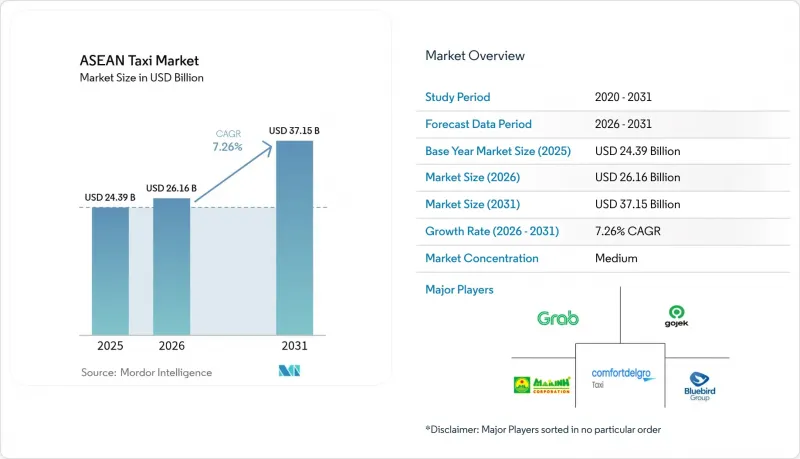
本報告按預訂類型(線上和線下)、服務類型(傳統計程車等)、車輛類型(摩托車等)、車身樣式(轎車等)、車輛等級(經濟型、高級/行政型等)、最終用戶(企業、遊客等)和國家進行細分。市場預測以美元計價。
東協計程車市場趨勢與洞察
快速的都市化和日益嚴重的交通堵塞
隨著東協特大城市都市區日益嚴重,雅加達等城市在尖峰時段正經歷嚴重的交通堵塞。在馬尼拉,交通堵塞導致生產力顯著下降,凸顯了人們對可靠的點對點交通服務的巨大需求。計程車變得至關重要,尤其是在洪水等季節性挑戰以及公共交通不可靠的情況下。另一方面,叫車平台可以透過巧妙地調整駕駛路線來降低出行的不確定性,從而在科技發達的都市區比傳統的街頭攔車服務更具競爭優勢。
企業行動辦公室訂閱服務需求激增
在東協地區,企業正加速向出行訂閱模式轉型,其主要吸引力在於成本節約和營運柔軟性的提升。一個顯著的變化是,企業正從車輛所有權轉向基於平台的出行服務。 GoCorp等服務供應商的強勁成長印證了這一趨勢。公部門也積極跟進,例如巴科洛德市就已開始使用Grab進行公務。此舉帶來了許多益處,例如簡化計費流程和改善合規管理。隨著混合辦公模式的日益普及,對靈活移動服務的需求不斷成長,使得基於訂閱的計程車服務成為企業極具吸引力且擴充性的解決方案。
嚴重的交通堵塞會降低駕駛員的運轉率和可靠性。
在東協特大城市,嚴重的交通堵塞正在削弱司機的工作效率和服務的可靠性。雅加達尖峰時段的緩慢車速導致服務班次減少,燃油成本上升。同時,曼谷和馬尼拉也正面臨交通堵塞帶來的嚴重經濟損失。長時間的延誤使得駕駛不願接長途單,尤其是在回程車費難以預測的情況下。儘管叫車平台提供路線最佳化服務,但仍受制於尖峰時段的交通瓶頸,進一步加劇了該地區計程車市場的結構性缺陷。
細分市場分析
預計到2025年,線上通路將佔東協計程車市場佔有率的62.11%,並將在2031年之前以7.72%的複合年成長率成長。這反映了智慧型手機在東協主要城市的普及率不斷提高。使用者偏好即時追蹤和無現金支付的趨勢持續削弱了離線客服中心和叫車服務的需求。然而,不熟悉本地應用程式的遊客仍然會使用這些服務。目前,線下預訂佔市場佔有率的37.89%,但隨著4G網路覆蓋區域城市的擴展,這一佔有率正在逐年下降。
在東協計程車市場,尤其是在泰國和馬來西亞,傳統計程車公司紛紛推出自己的應用程式,模糊了線上和線下服務的界限。混合模式既能提供數位化的便利,又能維持計程車收費,從而留住了那些偏好固定收費的老年乘客群。機場和飯店等場所線下服務的持續重要性表明,個人化服務和數位化便利性是可以共存的。
到2025年,與平台整合的計程車將佔據東協計程車市場佔有率的43.55%。這種混合模式透過使用受監管的計程車來保持車費透明度,同時利用應用程式進行叫車,從而提高了乘車量。同時,隨著消費者將即時位置共用和電子錢包視為必備功能,傳統的線下業者正面臨客流量下降的困境。
受企業成本削減政策和永續發展目標的推動,預計到2031年,共享接駁車服務將以7.63%的複合年成長率高速成長。 B2B客戶更傾向於固定路線的交通方式,因為這種方式能夠帶來穩定的客座率和更低的乘客人均排放量。雖然這一細分市場的成長會略微減緩辦公高峰時段個人用車的需求,但隨著企業從自有車輛轉向訂閱式出行服務,整體市場價值仍在上升。
其他好處:
- Excel格式的市場預測(ME)表
- 3個月的分析師支持
目錄
第1章:引言
- 研究假設和市場定義
- 調查範圍
第2章:調查方法
第3章執行摘要
第4章 市場狀況
- 市場概覽
- 市場促進因素
- 快速的都市化和日益嚴重的交通堵塞
- 智慧型手機和電子錢包的普及使得透過應用程式預訂成為可能。
- 政府支持規範化的共乘框架
- 與公共運輸網路的多模態
- 企業行動辦公室訂閱服務需求激增
- 鼓勵計程車電動化(電動計程車)的獎勵
- 市場限制因素
- 交通流量大會降低駕駛員的運轉率和可靠性。
- 許可限制和分配限制
- 平台費用不斷上漲,給司機的收入帶來了壓力。
- 在各大城市,摩托車計程車越來越比汽車計程車更受歡迎。
- 價值供應鏈分析
- 監理情勢
- 技術展望
- 波特五力模型
第5章 市場規模與成長預測
- 按預訂類型
- 線上
- 離線
- 按服務類型
- 傳統計程車
- 平台一體化計程車
- 共享/接駁車(面向企業客戶/B2B)
- 按車身樣式
- 轎車
- 掀背車
- SUV 和 MPV
- 按車輛類別
- 經濟
- 高級/行政級
- 豪華車/商務
- 最終用戶
- 公司
- 遊客
- 飛機場
- 其他(個人等)
- 國家
- 新加坡
- 印尼
- 馬來西亞
- 泰國
- 菲律賓
- 越南
- 其他東南亞國協
第6章 競爭情勢
- 市場集中度
- 策略趨勢
- 市佔率分析
- 公司簡介
- Grab Holdings Inc.
- Gojek(GoTo Group)
- ComfortDelGro Taxi
- Blue Bird Group
- Mai Linh Group
- Vinasun Corp.
- TADA Mobility
- Ryde Technologies
- Trans-Cab Services
- SMRT Taxis(Strides)
- Sunlight Taxi
- Public Cab Sdn Bhd
- MyCar
- inDrive
- Maxim Taxi
- Thai Taxi Radio
- Uber Technologies Inc.
第7章 市場機會與未來展望
According to Mordor Intelligence, the ASEAN taxi market size is expected to grow from USD 24.39 billion in 2025 to USD 26.16 billion in 2026 and is forecast to reach USD 37.15 billion by 2031 at 7.26% CAGR over 2026-2031.
This report is Segmented by Booking Type (Online and Offline), Service Type (Traditional Metered Taxi, and More), Vehicle Type (Motorcycles, and More), Vehicle Body Style (Sedan, and More), Vehicle Class Type (Economy, Premium/Executive, and More), End-User (Corporate, Tourist, and More), and Country. The Market Forecasts are Provided in Terms of Value (USD).
ASEAN Taxi Market Trends and Insights
Rapid Urbanization and Worsening Congestion
As urban congestion tightens its grip on ASEAN megacities, cities like Jakarta grapple with pronounced peak-hour slowdowns. In Manila, traffic toll manifests as significant productivity losses, underscoring the demand for dependable point-to-point mobility. Taxis are indispensable, particularly during seasonal challenges like flooding and when public transport falters. Meanwhile, ride-hailing platforms distinguish themselves by adeptly rerouting drivers, curbing travel uncertainties-this edge positions them favorably against conventional street-hail services in tech-savvy urban areas.
Corporate Mobility-Subscription Demand Surge
Across ASEAN, corporations are increasingly turning to mobility subscriptions, drawn by the allure of cost savings and enhanced operational flexibility. In a notable shift, companies are moving away from owning fleets and opting for platform-based services. This trend is underscored by providers like GoCorp, which have reported robust growth. The public sector isn't lagging, with Bacolod City prominently utilizing Grab for official travel. This move has allowed the city to enjoy streamlined billing and efficient compliance tracking benefits. As hybrid work models gain traction, the demand for flexible ride services intensifies, making subscription-based taxi services an attractive and scalable solution for businesses.
Heavy Traffic Lowers Driver Utilization and Reliability
In ASEAN megacities, severe traffic congestion undermines driver productivity and service reliability. Jakarta's peak-hour slow speeds curtail trip volumes and escalate fuel costs. Meanwhile, Bangkok and Manila grapple with significant economic setbacks caused by gridlock. Prolonged delays deter drivers from taking longer trips, particularly when return fares remain unpredictable. While ride-hailing platforms provide routing optimizations, they remain hampered by physical bottlenecks during rush hours, further entrenching the structural constraints of the region's taxi market.
Other drivers and restraints analyzed in the detailed report include:
- Taxi-Fleet Electrification Incentives (E-Taxis)
- Government Support for Regulated Ride-Hailing Frameworks
- Licensing Caps and Quota Restrictions
For complete list of drivers and restraints, kindly check the Table Of Contents.
Segment Analysis
Online channels captured 62.11% of the ASEAN taxi market share in 2025 and are growing at a CAGR of 7.72% through 2031, reflecting widespread smartphone adoption in core ASEAN cities. User propensity for real-time tracking and cashless settlement continues to pull demand from offline call centers and street-hail services, which still cater to tourists unfamiliar with local apps. Offline bookings hold a 37.89% share yet shrink annually as 4G networks extend to secondary towns.
The ASEAN taxi market benefits from traditional fleets launching proprietary apps in Thailand and Malaysia, a shift that blurs the distinction between online and offline categories. Hybrid models allow meter-based pricing while offering digital convenience, which sustains ridership among older demographics who favor regulated fares. Offline's continued relevance at airports and hotels signals that high-touch service can coexist with digital convenience.
Platform-integrated metered taxis delivered 43.55% of the ASEAN taxi market share in 2025. The ASEAN taxi market share associated with this hybrid model leverages regulated meters to preserve fare transparency while using apps for dispatch, resulting in higher trip density. Traditional operators that remain offline face declining occupancy rates as consumers rank real-time location sharing and digital wallets as must-have features.
Shared shuttle services post the fastest 7.63% CAGR to 2031, propelled by corporate cost-control mandates and sustainability targets. B2B clients prefer fixed-route pickups that yield consistent occupancy and lower emissions per passenger. The segment's growth marginally tempers demand for solo rides during peak office hours, yet overall market value still climbs as enterprises shift from owned fleets to subscription mobility.
Complete Report Scope:
- By Booking Type
- Online
- Offline
- By Service Type
- Traditional Metered Taxi
- Platform-Integrated Metered Taxi
- Shared/Shuttle (Corporate/B2B)
- By Vehicle Body Style
- Sedan
- Hatchback
- SUVs & MPVs
- By Vehicle Class Type
- Economy
- Premium/Executive
- Luxury/Business
- By End-User
- Corporate
- Tourist
- Airport
- Others (Individual etc.)
- By Country
- Singapore
- Indonesia
- Malaysia
- Thailand
- Philippines
- Vietnam
- Rest of ASEAN
List of Companies Covered in this Report:
- Grab Holdings Inc.
- Gojek (GoTo Group)
- ComfortDelGro Taxi
- Blue Bird Group
- Mai Linh Group
- Vinasun Corp.
- TADA Mobility
- Ryde Technologies
- Trans-Cab Services
- SMRT Taxis (Strides)
- Sunlight Taxi
- Public Cab Sdn Bhd
- MyCar
- inDrive
- Maxim Taxi
- Thai Taxi Radio
- Uber Technologies Inc.
Additional Benefits:
- The market estimate (ME) sheet in Excel format
- 3 months of analyst support
TABLE OF CONTENTS
1 Introduction
- 1.1 Study Assumptions & Market Definition
- 1.2 Scope of the Study
2 Research Methodology
3 Executive Summary
4 Market Landscape
- 4.1 Market Overview
- 4.2 Market Drivers
- 4.2.1 Rapid Urbanization & Worsening Congestion
- 4.2.2 Smartphone and E-Wallet Penetration Enabling App-Based Bookings
- 4.2.3 Government Support for Regulated Ride-Hailing Frameworks
- 4.2.4 Multimodal Integration with Mass-Transit Networks
- 4.2.5 Corporate Mobility-Subscription Demand Surge
- 4.2.6 Taxi-Fleet Electrification Incentives (E-Taxis)
- 4.3 Market Restraints
- 4.3.1 Heavy Traffic Lowers Driver Utilization & Reliability
- 4.3.2 Licensing Caps and Quota Restrictions
- 4.3.3 Rising Platform Commission Fees Squeeze Driver Earnings
- 4.3.4 Preference For Motorcycle Taxis Over Cars in Key Cities
- 4.4 Value / Supply-Chain Analysis
- 4.5 Regulatory Landscape
- 4.6 Technological Outlook
- 4.7 Porter's Five Forces
- 4.7.1 Bargaining Power of Suppliers
- 4.7.2 Bargaining Power of Buyers
- 4.7.3 Threat of New Entrants
- 4.7.4 Threat of Substitutes
- 4.7.5 Competitive Rivalry
5 Market Size & Growth Forecasts (Value (USD))
- 5.1 By Booking Type
- 5.1.1 Online
- 5.1.2 Offline
- 5.2 By Service Type
- 5.2.1 Traditional Metered Taxi
- 5.2.2 Platform-Integrated Metered Taxi
- 5.2.3 Shared/Shuttle (Corporate/B2B)
- 5.3 By Vehicle Body Style
- 5.3.1 Sedan
- 5.3.2 Hatchback
- 5.3.3 SUVs & MPVs
- 5.4 By Vehicle Class Type
- 5.4.1 Economy
- 5.4.2 Premium/Executive
- 5.4.3 Luxury/Business
- 5.5 By End-User
- 5.5.1 Corporate
- 5.5.2 Tourist
- 5.5.3 Airport
- 5.5.4 Others (Individual etc.)
- 5.6 By Country
- 5.6.1 Singapore
- 5.6.2 Indonesia
- 5.6.3 Malaysia
- 5.6.4 Thailand
- 5.6.5 Philippines
- 5.6.6 Vietnam
- 5.6.7 Rest of ASEAN
6 Competitive Landscape
- 6.1 Market Concentration
- 6.2 Strategic Moves
- 6.3 Market Share Analysis
- 6.4 Company Profiles (Includes Global-level overview, Market-level overview, Core Segments, Financials as available, Strategic Information, Market Rank/Share for key companies, Products & Services, Recent Developments)
- 6.4.1 Grab Holdings Inc.
- 6.4.2 Gojek (GoTo Group)
- 6.4.3 ComfortDelGro Taxi
- 6.4.4 Blue Bird Group
- 6.4.5 Mai Linh Group
- 6.4.6 Vinasun Corp.
- 6.4.7 TADA Mobility
- 6.4.8 Ryde Technologies
- 6.4.9 Trans-Cab Services
- 6.4.10 SMRT Taxis (Strides)
- 6.4.11 Sunlight Taxi
- 6.4.12 Public Cab Sdn Bhd
- 6.4.13 MyCar
- 6.4.14 inDrive
- 6.4.15 Maxim Taxi
- 6.4.16 Thai Taxi Radio
- 6.4.17 Uber Technologies Inc.
7 Market Opportunities & Future Outlook

 全球計程車和豪華轎車服務市場
 電動計程車:市場佔有率分析、行業趨勢和統計數據、成長預測(2026-2031)
 計程車市場規模、市場佔有率、成長、全球產業分析、區域趨勢及2026-2034年預測。
 計程車服務市場:全球市場預測,2026-2032年計程車:市場佔有率分析、產業趨勢和統計數據、成長預測(2026-2031 年)摩托計程車服務市場-2026-2032年全球市場預測摩托車計程車服務市場-2026-2032年全球市場預測新能源汽車計程車市場:2026-2032年全球市場預測(按車輛類型、車身尺寸、驅動技術、續航里程、服務類型和最終用戶分類)
 2026年全球計程車服務市場報告豪華轎車服務市場:2026-2032年全球市場預測(依服務類型、時間長度、車輛燃料類型、車輛類型、最終用戶和預訂方式分類)