


 |
市場調查報告書
商品編碼
2115839
歐洲輕度混合動力車:市佔率分析、產業趨勢與統計及成長預測(2026-2031)Europe Mild Hybrid Vehicles - Market Share Analysis, Industry Trends & Statistics, Growth Forecasts (2026 - 2031) |
||||||

※ 本網頁內容可能與最新版本有所差異。詳細情況請與我們聯繫。
根據 Mordor Intelligence 預測,歐洲輕度混合動力車市場規模預計將在 2026 年達到 1,023.6 億美元,到 2031 年達到 1,344.7 億美元,年複合成長率為 5.63%。
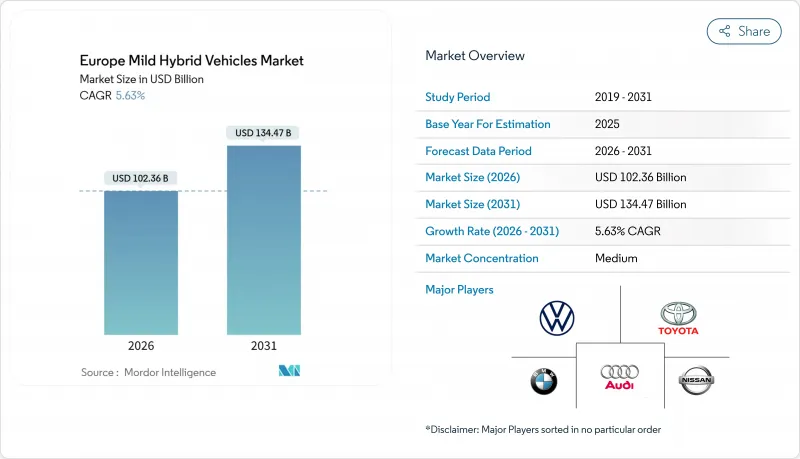
本報告按電池類型(48伏特以下、48伏特、48伏以上)、車輛類型(乘用車、商用車)、動力傳動系統類型(汽油輕混、柴油輕混)、推進技術(皮帶驅動啟動發電機等)以及國家/地區(德國、英國等)進行細分。市場預測以價值(美元)和銷售(輛)表示。
歐洲輕度混合動力車市場的趨勢與洞察
歐盟收緊2025-2030年二氧化碳排放目標
歐盟將於2025年1月生效的乘用車平均二氧化碳排放上限(93.6克/公里)規定,每超過限值1克,將被處以95歐元(約110美元)的罰款,罰款金額將乘以每年註冊車輛的總數。這意味著,即使排放量僅比目標值低5克/公里,大規模生產製造商也將面臨龐大的合規成本。該法規下的零排放和低排放氣體車輛積分制度,一方面給予電池式電動車電池式電動車(BEV)和插電式混合動力汽車汽車超額積分,另一方面卻自相矛盾地鼓勵引入輕度混合動力車動力汽車作為風險對沖手段。製造商可以透過將15%的純電動車和40%的輕度混合動力車相結合的方式來達到2025年的目標,而不是堅持只引入25%的純電動車,從而節省資金,為2030年即將實施的更嚴格的49.5克/公里標準做好準備。
柴油車的減少將加速48V系統的普及。
2025年第一季,由於巴黎、馬德里和米蘭等都市區低排放氣體區對符合歐盟6d-TEMP排放標準的車輛實施更嚴格的准入限制,柴油車市場萎縮了27.1%,市佔率降至9.5%。這一萎縮迫使擁有傳統柴油引擎生產能力的汽車製造商對其生產線進行改造。 Stellantis公司決定在其標緻3008和歐寶Grandland平台上的1.5升MultiJet柴油引擎上配備48伏皮帶驅動式啟動發電機,便是這項策略的典型例證。此舉將使他們能夠在實現二氧化碳排放目標的同時,從已投入的模具中獲得剩餘價值。無論是柴油車還是汽油車,輕度混合動力車憑藉著再生煞車和啟動停止功能等特性,在都市區都能略微提高燃油效率。柴油引擎一直以來都以其在高速公路上的高燃油效率而聞名,但在走走停停的都市區路況下,其節油效果卻不如以往預期那樣顯著,柴油引擎的傳統優勢正在逐漸消失。目前,車隊營運商傾向於為汽油車輛配備48伏輕混系統。這些系統不僅簡化了維護,避免了柴油顆粒過濾器(DPF)再生帶來的複雜性,而且還能在都市區下節省燃油,同時不會增加太多額外成本。
純電動車價格競爭力的快速提升降低了輕混車的價值。
2025年,在歐洲,電池式電動車(BEV)市場將進一步成長,這得益於產品陣容的擴大和更具競爭力的定價策略。尤其是在小型轎車領域,一些歐洲市場的入門級純電動車售價約為25,000歐元(約27,148美元)或更低,比內燃機車更具價格優勢。特斯拉也在歐洲採取了積極的定價策略,推出了價格更低的Model 3車型,以刺激需求並增強其與高階內燃機汽車和混合動力轎車的競爭力。這些發展反映出,隨著製造商加速推廣電動車並在日益嚴格的排放氣體法規下捍衛市場佔有率,歐洲電池式電動車市場的價格競爭日益激烈。
細分市場分析
到2025年,48伏特輕度混合動力車市佔率將達到87.13%。這主要歸功於汽車製造商充分利用了48伏特系統的優勢,該系統能夠以遠低於全混合動力汽車的成本,將二氧化碳排放量降低8-12克/公里。直流-直流轉換器使得傳統的12伏特負載得以保留,從而避免了大規模的設計變更。預計到2031年,用於3.5噸廂型車再生煞車所需的48伏特以上電池組的年複合成長率將達到21.37%。
汽車製造商正將目光聚焦於 48V 輕度混合動力系統,將其視為提高燃油效率和減少排放氣體的經濟有效的解決方案,尤其是在歐 7 等更嚴格的法規訂定的背景下。這些 48V 系統提供諸如再生煞車、扭力輔助和改進的啟動停止功能等先進特性,與傳統的 12V 系統相比,可進一步降低油耗和二氧化碳排放。
預計到2025年,乘用車銷售量將佔總銷售量的81.26%,主要是由於企業買家最佳化了實體購置課稅。同時,商用車預計到2031年將以14.18%的複合年成長率成長,因為末端配送業者為了規避負載容量限制,傾向於選擇價格低於4萬歐元(約4.7萬美元)的貨車。
在德國,內燃機車輛適用標準的1%實體福利稅率。相較之下,純電動車在達到一定限額之前,適用0.25%的優惠課稅(以課稅計算) 。插電式混合動力汽車則適用中間稅率,前提是它們符合特定的續航里程和二氧化碳排放標準。這種做法強調根據車輛動力傳動系統類型進行稅收差異化。不符合這些嚴格標準的混合動力汽車將不再享有優惠待遇,並適用標準的1%稅率。這項變更將對企業的車輛選擇產生重大影響。
其他好處:
- Excel格式的市場預測(ME)表
- 3個月的分析師支持
目錄
第1章:引言
- 研究假設和市場定義
第2章:調查方法
第3章執行摘要
第4章 市場狀況
- 市場概覽
- 市場促進因素
- 收緊歐盟二氧化碳減排目標(2025-2030 年)
- 柴油車的衰退正在加速,48V系統的普及也不斷推進。
- 降低48V系統的成本
- 由於對成本和充電的擔憂,消費者的興趣正從電池式電動車(BEV)轉向混合動力汽車。
- 無需高壓匯流排即可驅動 ADAS L2+,需要 48V 電壓。
- 工廠轉型生產電池式電動車。
- 市場限制因素
- 電池式電動車(BEV) 價格競爭力的快速提升,正在降低輕度混合動力車(MHEV) 的價值。
- 對輕度混合動力車的稅收待遇不一致
- BSG設計中皮帶傳動裝置的耐用性和保固風險
- 80-100V MOSFET 的供應限制
- 價值供應鏈分析
- 監理情勢
- 技術展望
- 波特五力模型
第5章 市場規模與成長預測
- 依電池類型
- 低於48伏
- 48伏
- 超過48伏
- 按車輛類型
- 搭乘用車
- 商用車輛
- 依動力傳動系統類型
- 汽油輕混
- 柴油輕混
- 透過推進技術
- 皮帶驅動啟動發電機(BSG)
- 整合啟動發電機(ISG)
- 曲軸安裝式啟動發電機
- 國家
- 德國
- 英國
- 法國
- 義大利
- 西班牙
- 其他歐洲國家
第6章 競爭情勢
- 市場集中度
- 策略趨勢
- 市佔率分析
- 公司簡介
- Volkswagen AG
- Stellantis NV
- Mercedes-Benz Group AG
- BMW Group
- Nissan Motor Co. Ltd.
- Ford Motor Company
- Renault Group
- Hyundai Motor Company
- Kia Corporation
- Toyota Motor Corporation
- Suzuki Motor Corporation
- Volvo Car Corporation
- Audi AG
- Skoda
第7章 市場機會與未來展望
According to Mordor Intelligence, the european mild hybrid vehicles market size stood at USD 102.36 billion in 2026 and is projected to reach USD 134.47 billion by 2031, expanding at a 5.63% CAGR.
This report is Segmented by Battery Type (Less Than 48 Volt, 48 Volt, and Above 48 Volt), Vehicle Type (Passenger Cars and Commercial Vehicles), Powertrain Type (Gasoline Mild Hybrid and Diesel Mild Hybrid), Propulsion Technology (Belt-Driven Starter Generator, and More), and Country (Germany, United Kingdom, and More). The Market Forecasts are Provided in Terms of Value (USD) and Volume in Units.
Europe Mild Hybrid Vehicles Market Trends and Insights
EU CO2-Target Tightening 2025-2030
The European Union's fleet-average CO2 ceiling of 93.6 g/km for passenger cars, effective January 2025, imposes a EUR 95 (approximately USD 110) penalty per excess gram multiplied by total annual registrations, creating a huge compliance cost for volume manufacturers missing the target by 5 g/km. The regulation's zero- and low-emission vehicle crediting mechanism, which awards super-credits for battery electric vehicles (BEVs) and plug-in hybrids, paradoxically incentivizes mild-hybrid deployment as a hedge; manufacturers can meet the 2025 target by blending 15% BEVs with 40% mild hybrids rather than committing to 25% battery electric vehicles (BEVs) alone, preserving capital for the steeper 49.5 g/km threshold arriving in 2030.
Diesel Decline Accelerating 48V Adoption
In Q1 2025, diesel vehicles captured a 9.5% market share, following a 27.1% decline in the diesel car market, as urban low-emission zones in Paris, Madrid, and Milan tighten access for Euro 6d-TEMP vehicles. This contraction forces automakers with legacy diesel-engine capacity to repurpose production lines; Stellantis's decision to equip its 1.5-liter MultiJet diesel with a 48-volt belt-driven starter generator across the Peugeot 3008 and Opel Grandland platforms exemplifies this strategy, extracting residual value from sunk tooling investments while meeting CO2 targets. Mild-hybrid vehicles, whether diesel or gasoline, enhance fuel economy modestly in urban settings, due to features like regenerative braking and start-stop functionality. Although diesel engines have been known for their efficiency on highways, the fuel savings in urban stop-and-go scenarios are not as pronounced as once thought, diminishing the perceived advantage of diesel efficiency. Fleet operators are now leaning towards 48-volt mild-hybrid gasoline systems. These systems not only simplify maintenance and sidestep the complexities of diesel particulate filter regeneration but also offer urban fuel savings without significant added costs.
Rapid BEV Price Parity Eroding MHEV Value
Battery-electric vehicles (BEVs) continued to gain traction in Europe in 2025, supported by expanding model availability and more competitive pricing strategies. Several entry-level electric models, particularly in the small-car segment, are now priced around or below EUR 25,000 (approximately USD 27,148) in select European markets, improving affordability relative to internal-combustion alternatives. Tesla has also adopted aggressive pricing in Europe, introducing lower-priced Model 3 variants to stimulate demand and enhance competitiveness against premium internal-combustion and hybrid sedans. These developments reflect intensifying price competition in the European battery electric vehicle market as manufacturers seek to accelerate adoption and defend market share amid tightening emissions regulations.
Other drivers and restraints analyzed in the detailed report include:
- Falling 48V System Costs
- Consumer Shift from BEV to Hybrids Amid Cost and Charging Anxiety
- Non-Harmonized Tax Rules for Mild Hybrids
For complete list of drivers and restraints, kindly check the Table Of Contents.
Segment Analysis
The 48-volt segment captured an 87.13% Europe mild hybrid vehicles market share in 2025 as OEMs exploited its ability to trim 8-12 g/km CO2 at a fraction of full-hybrid cost. DC-DC converters let them retain legacy 12-volt loads, avoiding wholesale redesign. Above-48-volt packs, required for regenerative braking in 3.5-ton vans, are projected to grow at a 21.37% CAGR through 2031.
Automakers are turning to 48-volt mild-hybrid systems as a budget-friendly solution to boost fuel efficiency and curb emissions, especially in light of tightening standards like Euro 7. These 48V systems enable advanced features such as regenerative braking, torque assist, and improved start-stop functionality, leading to greater reductions in fuel consumption and CO2 emissions compared to traditional 12V systems.
Passenger cars accounted for 81.26% of the 2025 volume as fleet buyers optimized benefit-in-kind taxation. Commercial vehicles, however, are set to clock a 14.18% CAGR to 2031 as last-mile operators target sub-EUR 40,000 (approximately USD 47,000) vans that sidestep payload penalties.
In Germany, the taxation of company cars employs a standard 1% "Benefit-in-Kind" (BIK) rule for internal combustion vehicles. In contrast, fully electric vehicles enjoy a reduced tax base of 0.25% of their gross list price, albeit up to certain thresholds. Plug-in hybrids, contingent on meeting specific range and CO2 criteria, are taxed at intermediate rates. This approach underscores a fiscal differentiation rooted in the vehicle's powertrain type. Notably, hybrids failing to meet these stringent criteria forfeit their preferential status, reverting to the standard 1% rate, a shift that significantly impacts corporate fleet choices.
Complete Report Scope:
- By Battery Type
- Less Than 48 Volt
- 48 Volt
- Above 48 Volt
- By Vehicle Type
- Passenger Cars
- Commercial Vehicles
- By Powertrain Type
- Gasoline Mild Hybrid
- Diesel Mild Hybrid
- By Propulsion Technology
- Belt-Driven Starter Generator (BSG)
- Integrated Starter Generator (ISG)
- Crankshaft-Mounted Starter Generator
- By Country
- Germany
- United Kingdom
- France
- Italy
- Spain
- Rest of Europe
List of Companies Covered in this Report:
- Volkswagen AG
- Stellantis NV
- Mercedes-Benz Group AG
- BMW Group
- Nissan Motor Co. Ltd.
- Ford Motor Company
- Renault Group
- Hyundai Motor Company
- Kia Corporation
- Toyota Motor Corporation
- Suzuki Motor Corporation
- Volvo Car Corporation
- Audi AG
- Skoda
Additional Benefits:
- The market estimate (ME) sheet in Excel format
- 3 months of analyst support
TABLE OF CONTENTS
1 Introduction
- 1.1 Study Assumptions and Market Definition
2 Research Methodology
3 Executive Summary
4 Market Landscape
- 4.1 Market Overview
- 4.2 Market Drivers
- 4.2.1 Europe (EU) CO2-Target Tightening 2025-2030
- 4.2.2 Diesel Decline Accelerating 48 V Adoption
- 4.2.3 Falling 48 V System Costs
- 4.2.4 Consumer Shift from Battery Electric Vehicle (BEV) to Hybrids Amid Cost and Charging Anxiety
- 4.2.5 48 V Needed to Power ADAS L2+ Without HV Bus
- 4.2.6 Battery Electric Vehicle (BEV) Plant-Conversion Gaps Back-Filled by MHEV Production
- 4.3 Market Restraints
- 4.3.1 Rapid Battery Electric Vehicle (BEV) Price Parity Eroding Mild Hybrid Electric Vehicle (MHEV) Value
- 4.3.2 Non-Harmonized Tax Rules for Mild Hybrids
- 4.3.3 Belt-Drive Durability and Warranty Risk in BSG Designs
- 4.3.4 80-100 V MOSFET Supply Constraints
- 4.4 Value/Supply-Chain Analysis
- 4.5 Regulatory Landscape
- 4.6 Technological Outlook
- 4.7 Porter's Five Forces
- 4.7.1 Bargaining Power of Suppliers
- 4.7.2 Bargaining Power of Buyers
- 4.7.3 Threat of New Entrants
- 4.7.4 Threat of Substitutes
- 4.7.5 Competitive Rivalry
5 Market Size and Growth Forecasts (Value (USD) and Volume (Units))
- 5.1 By Battery Type
- 5.1.1 Less Than 48 Volt
- 5.1.2 48 Volt
- 5.1.3 Above 48 Volt
- 5.2 By Vehicle Type
- 5.2.1 Passenger Cars
- 5.2.2 Commercial Vehicles
- 5.3 By Powertrain Type
- 5.3.1 Gasoline Mild Hybrid
- 5.3.2 Diesel Mild Hybrid
- 5.4 By Propulsion Technology
- 5.4.1 Belt-Driven Starter Generator (BSG)
- 5.4.2 Integrated Starter Generator (ISG)
- 5.4.3 Crankshaft-Mounted Starter Generator
- 5.5 By Country
- 5.5.1 Germany
- 5.5.2 United Kingdom
- 5.5.3 France
- 5.5.4 Italy
- 5.5.5 Spain
- 5.5.6 Rest of Europe
6 Competitive Landscape
- 6.1 Market Concentration
- 6.2 Strategic Moves
- 6.3 Market Share Analysis
- 6.4 Company Profiles (Includes Global level Overview, Market level overview, Core Segments, Financials as available, Strategic Information, Market Rank/Share for key companies, Products and Services, and Recent Developments)
- 6.4.1 Volkswagen AG
- 6.4.2 Stellantis NV
- 6.4.3 Mercedes-Benz Group AG
- 6.4.4 BMW Group
- 6.4.5 Nissan Motor Co. Ltd.
- 6.4.6 Ford Motor Company
- 6.4.7 Renault Group
- 6.4.8 Hyundai Motor Company
- 6.4.9 Kia Corporation
- 6.4.10 Toyota Motor Corporation
- 6.4.11 Suzuki Motor Corporation
- 6.4.12 Volvo Car Corporation
- 6.4.13 Audi AG
- 6.4.14 Skoda
7 Market Opportunities and Future Outlook
- 7.1 White-space and Unmet-Need Assessment

 混合動力小型汽車市場:2026-2032年全球市場預測(按混合動力架構、驅動系統、車輛類型、變速箱類型、電池類型、燃料類型、功率輸出和最終用戶分類)
 汽車混合動力系統市場規模、佔有率和成長分析:按系統類型、組件、車輛類型、銷售管道和地區分類-2026-2033年產業預測
 混合動力系統市場-全球產業規模、佔有率、趨勢、機會和預測:按車輛類型、電池類型、系統、組件、地區和競爭格局分類,2021-2031年
 輕度混合動力車:市佔率分析、產業趨勢與統計及成長預測(2026-2031)
 輕度混合動力車市場:按電池容量、車輛類型和地區分類
 汽車並聯式混合動力系統市場機會、成長要素、產業趨勢分析及2026-2035年預測
 全球混合動力傳動系統市場規模、佔有率、趨勢和成長分析報告(2026-2034)混合動力傳動系統市場-全球產業規模、佔有率、趨勢、機會與預測:按動力傳動系統類型、車輛類型、地區和競爭格局分類,2021-2031年
 輕度混合動力車市場規模、佔有率和成長分析(按容量、車輛類型、電池類型和地區分類)—2026-2033年產業預測混合動力自行車市場按類型、零件、齒輪類型、懸吊類型、車架材料、最終用戶和分銷管道分類 - 2025-2030 年全球預測