


 |
市場調查報告書
商品編碼
2044100
輕度混合動力車:市佔率分析、產業趨勢與統計及成長預測(2026-2031)Mild Hybrid Vehicles - Market Share Analysis, Industry Trends & Statistics, Growth Forecasts (2026 - 2031) |
||||||

※ 本網頁內容可能與最新版本有所差異。詳細情況請與我們聯繫。
預計輕度混合動力車市場將從 2025 年的 1,102.1 億美元成長到 2026 年的 1,178.3 億美元,到 2031 年達到 1,645.6 億美元。
預測期(2026-2031 年)的複合年成長率預計為 6.91%。
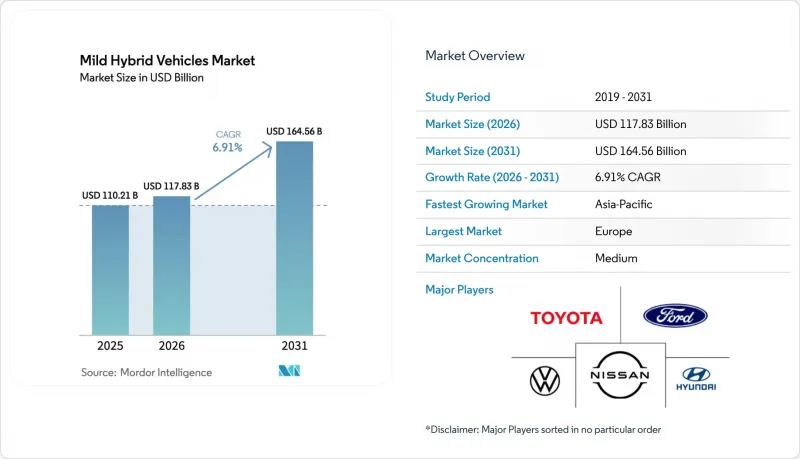
短期前景受以下因素影響:歐洲逐步淘汰柴油車的強制性政策、鋰離子電池價格的下降,以及有利於符合48V標準的解決方案的監管趨勢——這些解決方案的成本僅為插電式混合動力汽車的幾分之一。汽車製造商正在推出輕度混合動力車,以滿足日益嚴格的二氧化碳排放法規,同時避免全面轉型為純電動車(BEV),因為純電動車的經濟效益仍然不穩定。一級供應商正在圍繞LV148電氣標準重新設計動力傳動系統,旨在透過空中下載(OTA)功能來實現盈利,從而提高每輛車的終身收益。同時,鈉離子電池的商業化正在降低48V電池組的成本,使其更適用於對成本敏感的輕型商用車和入門車型,從而擴大了在印度、巴西和東南亞的目標市場。
全球輕度混合動力車市場趨勢及洞察
加強全球二氧化碳排放和燃油效率法規
歐洲的排放氣體目標,以及相應的違規處罰措施,使得48V輕混動力系統成為最具成本效益的合規解決方案。即使在歐盟修訂後的目標允許內燃機使用合成燃料的情況下,這些混合動力汽車仍然是可行的選擇。在印度,修訂後的法規引入了「超級積分」計劃,繼續支持輕混動力系統的發展。同樣,中國插電式汽車法規的調整也促使預算轉向48V解決方案,並利用豪華車稅收優惠和政府獎勵。這些法規變化的協調一致正在加速汽車製造商的決策流程。因此,輕混動力系統正從利基市場轉向主流選擇,尤其對於那些無法大規模部署電池式電動車(BEV)的製造商而言更是如此。
低成本的48V架構可實現大規模電氣化
汽車製造商認知到皮帶驅動式起動發電機的優勢。雖然它們會略微增加製造成本,但卻能顯著降低油耗,並使大規模生產的車型能夠快速回收投資。梅賽德斯-奔馳、寶馬和大眾汽車採用LV148介面,使得製造商能夠跨平台實現零件通用。這種額外的動力容量支持了諸如電動渦輪增壓器、主動懸吊和線傳轉向等技術進步。博世已在中國開始量產48V模組,產業預測此模組將被廣泛採用。因此,48V系統正成為對成本敏感的細分市場中更受歡迎的電氣化選擇。
純電動車成本的下降正在削弱輕度混合動力車的價格優勢。
鋰離子電池組價格大幅下降,中國電池製造商已開始提供更低的報價。這一趨勢正在縮小電池式電動車(BEV)和48V輕混動力傳動系統之間傳統的成本差距。特斯拉和比亞迪已調整其在中國的入門級純電動車價格,使其與同級的內燃機轎車持平。福特也表示計劃推出一款基於新平台的經濟型中型跨界車。隨著純電動車總擁有成本的持續下降,消費者正在權衡輕混動力系統帶來的燃油節省與純電動車的零排放優勢以及潛在的更高轉售價值,尤其是在嚴格監管的地區。歐洲汽車製造商擔心,純電動車價格的急劇下降可能會削弱近期對48V系統的投資,並大幅縮短投資回收期。因此,輕度混合動力車市場正面臨利潤率壓力,尤其是在充電基礎設施正在發展且政府獎勵日益推動全面電氣化的地區。
細分市場分析
到2025年,乘用車將佔據輕度混合動力車市場佔有率的68.12%。這主要歸功於汽車製造商將48V系統引入量產轎車和SUV。儘管輕型商用車的絕對數量仍然較小,但預計到2031年,其複合年成長率將達到8.17%,這將通過優先考慮快速加註而非在充電站充電的車隊契約,進一步推動輕度混合動力車市場的銷售成長。歐洲和北美的兩班製宅配路線清楚地表明,在目前的基礎設施限制下,48V貨車為何能夠比純電動車(BEV)保持更低的整體成本。
在以每公里成本為採購決定因素的市場,輕型商用車 (LCV) 的發展勢頭最為強勁。尤其是在印度和東南亞,燃油補貼降低了柴油車的經濟效益,進一步縮小了鈉離子電池組的成本差距。由於48V電壓下的峰值輸出有限,中型和重型卡車仍然是一個小眾市場。這些車輛的運作週期正在向氫燃料電池和800V驅動系統轉變。
預計到2025年,48V拓樸結構將佔據輕度混合動力車市場73.88%的佔有率,並將以8.91%的複合年成長率持續成長至2031年,隨著12V啟停系統成長趨於平緩,其主導地位將進一步鞏固。推動OEM廠商轉型為48V拓撲結構的主要動力來自LV148總線,該匯流排實現了組件介面的標準化,並顯著縮短了整合時間。單一P0模組即可節省10-17%的燃油,而成本僅為全混合動力系統的30%左右,為大規模生產平台提供了極具吸引力的成本績效。
雖然全混合動力架構對於獲得二氧化碳超級積分仍然至關重要,但其高昂的價格限制了其在日本和歐盟以外特定細分市場的普及。同時,24V解決方案已在低速非公路機械領域站穩腳跟,但對全球銷售的貢獻微乎其微。因此,預計未來十年,48V解決方案將在新型輕度混合動力車市場佔據主導地位。
區域分析
預計到2025年,歐洲將佔全球銷售量的48.74%,這主要得益於每公里93.6克的嚴格二氧化碳排放法規以及對柴油車替代車型的需求。德國、法國、義大利和西班牙的銷售總和將佔該地區註冊量的三分之二以上。柴油輕混合模式,例如奧迪的3.0升V6引擎和Stellantis即將推出的1.6升引擎,在幫助汽車製造商滿足歐7顆粒物排放法規的同時,也避免了選擇性催化後後處理系統的複雜性。由於燃油價格較低且基礎建設速度較慢,東歐地區的輕混車型普及速度較慢;而英國嚴格的零排放法規則縮小了輕度混合動力車在該國的市場機會。
亞太地區是成長最快的地區,預計到2031年將達到8.11%的複合年成長率。中國目前在該地區處於領先地位,其收緊的插電式混合動力汽車(PHEV)補貼政策有利於那些價格低於奢侈稅閾值的48V混合動力系統。由於印度的CAFE-III超級補貼計劃,輕度混合動力車仍然符合FAME II補貼的條件。同時,印尼、泰國和越南已推出針對混合動力汽車的增值稅退稅政策。日本製造商則專注於為國內市場生產全混合動力汽車,同時向注重成本的東南亞國協出口48V系統,凸顯了該地區內部法規的差異。
預計北美市場將保持穩定成長和適度擴張。在美國,由於充電基礎設施的挑戰,越來越多的消費者重新選擇混合動力汽車混合動力汽車。 Stellantis 和福特正在更新其卡車和 SUV 產品線,並採用皮帶驅動式啟動發電機來應對純電動車 (BEV) 的價格挑戰。同時,南美汽車市場主要受區域稅收優惠政策的影響。例如,聖保羅州的增值稅豁免政策使在當地組裝混合動力汽車的汽車製造商獲得了優勢。
其他好處:
- Excel格式的市場預測(ME)表
- 3個月的分析師支持
目錄
第1章:引言
- 研究假設和市場定義
- 調查範圍
第2章:調查方法
第3章執行摘要
第4章 市場狀況
- 市場概覽
- 市場促進因素
- 加強全球二氧化碳排放和燃油效率法規
- 低成本的48V架構可實現大規模電氣化
- 鋰離子電池價格下降和鈉離子電池價格上漲
- 歐洲逐步淘汰柴油車正在加速產品推出。
- 車隊對節能型小型商用貨車的需求
- 透過OTA軟體升級實現48V功能的產生收入
- 市場限制因素
- 純電動車成本的下降正在削弱輕度混合動力車的價格優勢。
- 高功率48V 組件的熱限制和 EMC 限制
- 電力電子供應鏈中的關稅波動
- 新興市場對混合動力汽車的獎勵不一致
- 價值/供應鏈分析
- 監理情勢
- 技術展望
- 波特五力模型
- 新進入者的威脅
- 供應商的議價能力
- 買方的議價能力
- 替代品的威脅
- 競爭公司之間的競爭
- 投資和資金籌措趨勢
- 專利分析
第5章 市場規模及成長預測(價值(美元)及數量(單位))
- 車輛類型
- 搭乘用車
- 輕型商用車(LCV)
- 中型和重型商用車輛(MHCV)
- 混合系統
- 12V輕混系統
- 24V輕混系統
- 48V輕混系統
- 依推進類型
- 汽油輕混
- 柴油輕混
- 依電池類型
- 鋰離子
- 鎳氫電池(NiMH)
- 其他(例如,鈉離子、LTO)
- 按地區
- 北美洲
- 美國
- 加拿大
- 北美其他地區
- 南美洲
- 巴西
- 阿根廷
- 南美洲其他地區
- 歐洲
- 德國
- 英國
- 法國
- 義大利
- 西班牙
- 其他歐洲地區
- 亞太地區
- 中國
- 印度
- 日本
- 韓國
- 亞太其他地區
- 中東和非洲
- 阿拉伯聯合大公國
- 沙烏地阿拉伯
- 南非
- 土耳其
- 其他中東和非洲地區
- 北美洲
第6章 競爭情勢
- 市場集中度
- 策略趨勢
- 市佔率分析
- 公司簡介
- Ford Motor Company
- General Motors Company
- Honda Motor Company Ltd
- Hyundai Motor Company
- Kia Motors Corporation
- Nissan Motor Co. Ltd.
- Mitsubishi Motors Corporation
- Toyota Motor Corporation
- Suzuki Motor Corporation
- Volkswagen AG
- BMW AG
第7章 市場機會與未來展望
The mild hybrid vehicles market size is projected to grow from USD 110.21 billion in 2025 to USD 117.83 billion in 2026 and is forecast to reach USD 164.56 billion by 2031, growing at a CAGR of 6.91% during the forecast period (2026-2031).
The near-term outlook is shaped by diesel phase-out mandates in Europe, lithium-ion price deflation, and a regulatory tilt that rewards 48V compliance solutions at a fraction of the cost of plug-in hybrid capital costs. Automakers are deploying mild hybrids to bridge tightening CO2 rules without committing to the still-volatile economics of full battery-electric vehicles. Tier-one suppliers are redesigning powertrains around the LV148 electrical standard, aiming to monetize over-the-air features that lift lifetime revenue per vehicle. Meanwhile, the commercialization of sodium-ion batteries is lowering 48V pack costs for cost-sensitive light vans and entry-level cars, broadening the addressable market in India, Brazil, and Southeast Asia.
Global Mild Hybrid Vehicles Market Trends and Insights
Tightening Global CO2 / Fuel-Economy Mandates
European fleet targets for emissions, supported by penalties for non-compliance, have positioned 48V mild hybrids as the most cost-effective compliance solution . These hybrids remain relevant even with the bloc's updated goals, which allow internal combustion engines to run on synthetic fuels. In India, updated regulations introduce super-credits that continue to support mild hybrids. Similarly, changes in China's plug-in rules are redirecting budgets toward 48V solutions, which benefit from reduced luxury tax bands and government incentives. The alignment of these regulatory changes is accelerating OEM decision-making processes. As a result, mild hybrids are shifting from a niche market to a mainstream option, particularly for manufacturers unable to scale battery electric vehicles competitively.
Low-Cost 48V Architecture Enabling Mass Electrification
Automakers are recognizing the advantages of a belt-starter-generator, which slightly increases build costs but significantly reduces fuel consumption, offering a quick return on investment for high-volume models. With Mercedes-Benz, BMW, and Volkswagen adopting the LV148 interface, manufacturers can now pool parts across platforms. This additional electrical capacity enables advancements such as electric turbocharging, active suspension, and steer-by-wire features. Bosch has commenced large-scale production of 48V modules in China, and industry projections indicate widespread adoption . As a result, the 48V system is becoming the preferred electrification option for cost-sensitive segments.
Falling BEV Costs Compress Mild-Hybrid Price Advantage
Lithium-ion pack prices have declined significantly, with Chinese cell manufacturers already quoting lower costs. This trend is reducing the historical cost gap between battery-electric vehicles (BEVs) and 48V mild hybrid powertrains. Tesla and BYD have adjusted the entry-level prices of their BEVs in China to match those of comparable internal-combustion sedans. Ford has also indicated plans to introduce an affordable midsize crossover on its new platform. As the total cost of ownership for BEVs continues to decrease, consumers are comparing the fuel savings offered by mild hybrids with the zero-emission benefits and potentially higher resale values of BEVs, particularly in regulated areas. European OEMs have expressed concerns that a rapid decline in BEV prices could undermine their recent investments in 48V systems, significantly reducing the payback period. As a result, the mild hybrid vehicle market is experiencing margin pressures, especially in areas where charging infrastructure is improving, and government incentives increasingly favor full electrification.
Other drivers and restraints analyzed in the detailed report include:
- Declining Lithium-Ion Prices and Sodium-Ion Emergence
- Diesel Phase-Out in Europe Accelerating OEM Rollouts
- Inconsistent Hybrid Incentives in Emerging Markets
For complete list of drivers and restraints, kindly check the Table Of Contents.
Segment Analysis
Passenger cars accounted for 68.12% of the mild hybrid vehicles market share in 2025, as OEMs deployed 48V systems across high-volume sedans and SUVs. Light commercial vans, though smaller in absolute numbers, are forecast to expand at an 8.17% CAGR to 2031, adding incremental volume to the mild hybrid vehicle market via fleet contracts that favor quick refueling over depot charging. Dual-shift courier routes in Europe and North America illustrate why 48V vans deliver lower total cost than BEVs under present infrastructure constraints.
LCV momentum is strongest where pay-per-kilometer economics dominate procurement. Sodium-ion packs further close the cost gap, especially in India and Southeast Asia, where fuel subsidies narrow diesel economics. Medium and heavy trucks remain a niche because 48V limits peak power; those duty cycles are migrating toward hydrogen fuel cells and 800-volt traction systems.
The 48V topology captured 73.88% of the mild hybrid vehicles market share in 2025 and is on track for an 8.91% CAGR through 2031, widening its leadership as 12V start-stop systems plateau. OEM migrations are catalyzed by the LV148 bus, which standardizes component interfaces and slashes integration time. A single P0 module yields 10-17% fuel savings at roughly 30% of full-hybrid cost, an attractive ratio for mass-market platforms.
Full-hybrid architectures remain relevant for CO2 super-credits, yet their premium limits penetration outside Japan and select EU segments. Conversely, 24V solutions find footholds in low-speed off-highway machinery but contribute marginally to global volume. The 48V pathway is therefore expected to dominate the new mild-hybrid vehicle market share throughout the decade.
The Mild Hybrid Vehicles Market Report is Segmented by Vehicle Type (Passenger Cars, Light Commercial Vehicles, and Medium and Heavy Commercial Vehicles), Hybrid System (12V, 24V, and 48V), Propulsion Type (Gasoline and Diesel), Battery Type (Lithium-Ion, Nickel-Metal Hydride, and Others), and Geography. The Market Forecasts are Provided in Terms of Value (USD) and Volume (Units).
Geography Analysis
Europe captured 48.74% of 2025 volume, buoyed by stringent 93.6 g CO2/km fleet rules and diesel-replacement demand. Germany, France, Italy, and Spain collectively generate more than two-thirds of regional registrations. Diesel-mild-hybrid variants-such as Audi's 3.0-liter V6 and Stellantis' upcoming 1.6-liter unit-help automakers meet Euro 7 particle metrics while avoiding selective-catalytic after-treatment complexity. Eastern European uptake lags due to lower fuel prices and slower infrastructure rollout, whereas the United Kingdom's aggressive zero-emission mandate is compressing the local mild hybrid window.
Asia-Pacific is the fastest-growing cluster, with an 8.11% CAGR through 2031. China steers the region with PHEV credit tightening that now favors 48V packages able to slip under luxury-tax thresholds. India's CAFE-III super-credits keep mild hybrids eligible for FAME II subsidies, and Indonesia, Thailand, and Vietnam deploy hybrid-targeted excise rebates. While Japanese manufacturers focus on full hybrids for their domestic market, they export 48V systems to budget-conscious ASEAN neighbors, highlighting the regulatory differences within the region.
North America is set to grow at a steady pace, with moderate expansion projected. In the United States, hybrid vehicle adoption has increased significantly, driven by some consumers turning back to hybrids due to charging challenges. Stellantis and Ford are updating their truck and SUV lineups, integrating belt-starter-generators as a buffer against potential BEV affordability challenges. Meanwhile, South America's automotive landscape is largely influenced by regional tax incentives. For instance, Sao Paulo's IPVA waiver currently gives OEMs that assemble hybrids locally an edge.
- Ford Motor Company
- General Motors Company
- Honda Motor Company Ltd
- Hyundai Motor Company
- Kia Motors Corporation
- Nissan Motor Co. Ltd.
- Mitsubishi Motors Corporation
- Toyota Motor Corporation
- Suzuki Motor Corporation
- Volkswagen AG
- BMW AG
Additional Benefits:
- The market estimate (ME) sheet in Excel format
- 3 months of analyst support
TABLE OF CONTENTS
1 Introduction
- 1.1 Study Assumptions and Market Definition
- 1.2 Scope of the Study
2 Research Methodology
3 Executive Summary
4 Market Landscape
- 4.1 Market Overview
- 4.2 Market Drivers
- 4.2.1 Tightening Global CO2/ Fuel-Economy Mandates
- 4.2.2 Low-Cost 48V Architecture Enabling Mass Electrification
- 4.2.3 Declining Lithium-Ion Battery Prices and Sodium-Ion Emergence
- 4.2.4 Diesel Phase-Out in Europe Accelerating OEM Rollouts
- 4.2.5 Fleet Demand for Fuel-Efficient Light-Commercial Vans
- 4.2.6 OTA Software Upgrades Unlocking 48V Feature Revenues
- 4.3 Market Restraints
- 4.3.1 Falling BEV Costs Compress Mild-Hybrid Price Advantage
- 4.3.2 Thermal and EMC Limits on High-Power 48V Components
- 4.3.3 Tariff Volatility on Power-Electronics Supply Chain
- 4.3.4 Inconsistent Hybrid Incentives in Emerging Markets
- 4.4 Value / Supply-Chain Analysis
- 4.5 Regulatory Landscape
- 4.6 Technological Outlook
- 4.7 Porter's Five Forces
- 4.7.1 Threat of New Entrants
- 4.7.2 Bargaining Power of Suppliers
- 4.7.3 Bargaining Power of Buyers
- 4.7.4 Threat of Substitutes
- 4.7.5 Competitive Rivalry
- 4.8 Investment and Funding Landscape
- 4.9 Patent Analysis
5 Market Size and Growth Forecasts (Value (USD) and Volume (Units))
- 5.1 By Vehicle Type
- 5.1.1 Passenger Cars
- 5.1.2 Light Commercial Vehicles (LCVs)
- 5.1.3 Medium and Heavy Commercial Vehicles (MHCVs)
- 5.2 By Hybrid System
- 5.2.1 12V Mild Hybrid System
- 5.2.2 24V Mild Hybrid System
- 5.2.3 48V Mild Hybrid System
- 5.3 By Propulsion Type
- 5.3.1 Gasoline Mild Hybrid
- 5.3.2 Diesel Mild Hybrid
- 5.4 By Battery Type
- 5.4.1 Lithium-Ion
- 5.4.2 Nickel-Metal Hydride (NiMH)
- 5.4.3 Others (e.g., Sodium-ion, LTO)
- 5.5 By Geography
- 5.5.1 North America
- 5.5.1.1 United States
- 5.5.1.2 Canada
- 5.5.1.3 Rest of North America
- 5.5.2 South America
- 5.5.2.1 Brazil
- 5.5.2.2 Argentina
- 5.5.2.3 Rest of South America
- 5.5.3 Europe
- 5.5.3.1 Germany
- 5.5.3.2 United Kingdom
- 5.5.3.3 France
- 5.5.3.4 Italy
- 5.5.3.5 Spain
- 5.5.3.6 Rest of Europe
- 5.5.4 Asia-Pacific
- 5.5.4.1 China
- 5.5.4.2 India
- 5.5.4.3 Japan
- 5.5.4.4 South Korea
- 5.5.4.5 Rest of Asia-Pacific
- 5.5.5 Middle East and Africa
- 5.5.5.1 United Arab Emirates
- 5.5.5.2 Saudi Arabia
- 5.5.5.3 South Africa
- 5.5.5.4 Turkey
- 5.5.5.5 Rest of Middle East and Africa
- 5.5.1 North America
6 Competitive Landscape
- 6.1 Market Concentration
- 6.2 Strategic Moves
- 6.3 Market Share Analysis
- 6.4 Company Profiles {(Includes Global level Overview, Market level overview, Core Segments, Financials as available, Strategic Information, Market Rank/Share for key companies, Products and Services, and Recent Developments)}
- 6.4.1 Ford Motor Company
- 6.4.2 General Motors Company
- 6.4.3 Honda Motor Company Ltd
- 6.4.4 Hyundai Motor Company
- 6.4.5 Kia Motors Corporation
- 6.4.6 Nissan Motor Co. Ltd.
- 6.4.7 Mitsubishi Motors Corporation
- 6.4.8 Toyota Motor Corporation
- 6.4.9 Suzuki Motor Corporation
- 6.4.10 Volkswagen AG
- 6.4.11 BMW AG
7 Market Opportunities and Future Outlook
- 7.1 White-space and Unmet-need Assessment

 歐洲輕度混合動力車:市佔率分析、產業趨勢與統計及成長預測(2026-2031)
 混合動力小型汽車市場:2026-2032年全球市場預測(按混合動力架構、驅動系統、車輛類型、變速箱類型、電池類型、燃料類型、功率輸出和最終用戶分類)
 汽車混合動力系統市場規模、佔有率和成長分析:按系統類型、組件、車輛類型、銷售管道和地區分類-2026-2033年產業預測
 混合動力系統市場-全球產業規模、佔有率、趨勢、機會和預測:按車輛類型、電池類型、系統、組件、地區和競爭格局分類,2021-2031年
 輕度混合動力車市場:按電池容量、車輛類型和地區分類
 汽車並聯式混合動力系統市場機會、成長要素、產業趨勢分析及2026-2035年預測
 全球混合動力傳動系統市場規模、佔有率、趨勢和成長分析報告(2026-2034)混合動力傳動系統市場-全球產業規模、佔有率、趨勢、機會與預測:按動力傳動系統類型、車輛類型、地區和競爭格局分類,2021-2031年
 輕度混合動力車市場規模、佔有率和成長分析(按容量、車輛類型、電池類型和地區分類)—2026-2033年產業預測混合動力自行車市場按類型、零件、齒輪類型、懸吊類型、車架材料、最終用戶和分銷管道分類 - 2025-2030 年全球預測