


 |
市場調查報告書
商品編碼
2114687
排煙脫硫(FGD):市場佔有率分析、產業趨勢與統計、成長預測(2026-2031)Flue Gas Desulfurization (FGD) - Market Share Analysis, Industry Trends & Statistics, Growth Forecasts (2026 - 2031) |
||||||

※ 本網頁內容可能與最新版本有所差異。詳細情況請與我們聯繫。
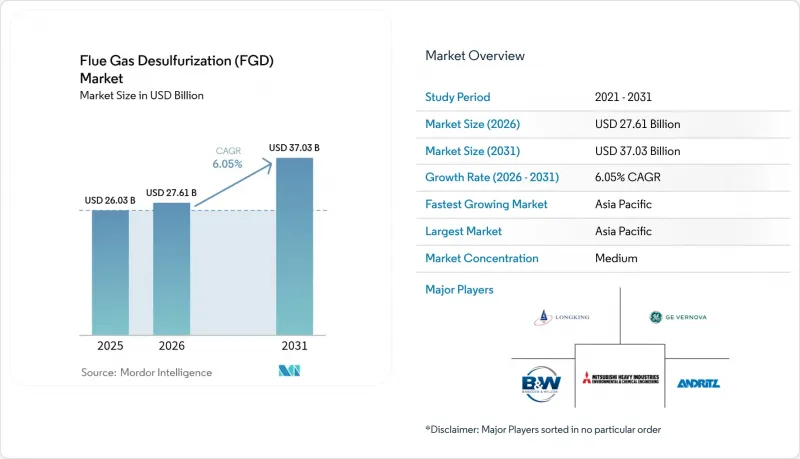
據 Mordor Intelligence 稱,排煙脫硫市場預計到 2026 年價值 276.1 億美元,高於 2025 年的 260.3 億美元,預計到 2031 年將達到 370.3 億美元。
預計 2026 年至 2031 年的複合年成長率為 6.05%。
本報告按類型(濕式煙氣脫硫、乾式/半乾式煙氣脫硫、混合式/高吸附劑注入法)、試劑/吸附劑類型(石灰石、石灰、海水、鈉基及其他鹼性物質)、最終用戶業(發電、水泥、鋼鐵、化學/石化、非鐵金屬等)和地區(北美、歐洲、亞太、南美等)進行分類。
全球排煙脫硫(FGD)市場趨勢及分析
對燃煤發電廠二氧化硫排放設定嚴格的限制
全球為限制硫氧化物排放而採取的統一行動正在重塑採購計畫。中國的超低排放標準將二氧化硫(SO2)排放量限制在35毫克/標準立方米,並透過石灰石-石膏循環系統實現了99%的去除率。歐盟修訂後的《工業排放指令》對大型燃燒設施施加了更嚴格的標準,迫使其全面更換老舊設備。美國環保署(EPA)已最終確定其2024年法規,該法規強制要求剩餘燃煤發電廠遵守嚴格的每小時硫排放限值,從而加速了中西部和阿巴拉契亞地區電廠的維修。在波蘭,強制安裝使得回收效率超過 90%,石灰石的使用量從 1994 年的幾乎為零增加到 2019 年的每年 340 萬噸。諸如自動試劑最佳化、模組化吸收器段和雙鹼性迴路等增強合規性的技術減少了停機時間,加強了更新周期,即使燃煤電廠的運轉率逐漸下降,也能延長已安裝反應器的經濟壽命。
強制維修老舊工業鍋爐和窯爐
熱輸出功率低於 50 兆瓦的工業點源現已納入歐盟《中型燃燒設施指令》的管轄範圍,該指令涵蓋褐煤乾燥機、窯爐和煉油廠加熱設備等數千種設施。在水泥廠,廢氣中水分的再利用可用於製備原料,從而抵消部分公用事業成本,帶來經濟效益。海德堡材料公司在印第安納州投資 5 億美元維修米切爾工廠,旨在透過將胺吸收技術與新的煙氣脫硫預處理生產線相結合,每年捕獲 200 萬噸二氧化碳。類似的案例也出現在非鐵金屬冶煉廠,其中元素硫的回收將收入與排放權交易連結起來。因此,維修計畫正轉向多污染物反應方案,以進一步減少汞和氮氧化物的排放,使排煙脫硫市場成為一個跨產業的綜合污染控制平台。
濕式煙氣脫硫污泥高昂的資本投資成本與處置成本
安裝成本約為每兆瓦1200萬印度盧比,這阻礙了該技術在印度的推廣應用,諮詢委員會也對統一的強制性規定提出了質疑。如果需要對污泥進行熱乾燥或處理滲濾液,處置成本會更高,這使得新興經濟體的平準化發電成本每兆瓦時增加高達3美元。 「零液體排放」法規正在推動對水處理設施的投資。賓州霍默市發電廠在2024年關閉前,投資7.5億美元用於購買受控蒸發結晶設備。因此,儘管乾式吸附劑噴射法的收集效率較低,但人們對該方法的興趣日益濃厚,而且在資金受限的地區,排煙脫硫市場正在形成價格上限。
細分市場分析
預計到2025年,濕式石灰和石膏反應器將佔據排煙脫硫市場86.92%的佔有率,這主要得益於其在中國超低排放法規下超過95%的二氧化硫捕集效率。在價值226.3億美元的排煙脫硫市場中,該方法正蓬勃發展,這得益於成熟的供應商生態系統和穩定的吸附劑供應鏈。混合式和吸附劑噴射式脫硫製程雖然目前市佔率不大,但其複合年成長率高達9.65%,並在太空和水資源受限、無法採用濕式脫硫製程的工業維修工程中備受關注。
儘管營運商仍傾向於使用成熟的濕式迴路處理高硫、大流量煙囪,但迴圈式流體化床洗滌器領域的創新正在加速發展,這些洗滌器整合了顆粒物去除功能,並能減少靜電除塵器的資本投入。例如,Tri-Mer公司的「SorbSaver」系統將乾式吸附劑分散技術與低能耗袋式過濾器結合,可將試劑過量用量減少高達40%,使其適用於25MW以下工業鍋爐的預算。成熟設計與新型設計的並存,使得使用者可以將混合組件添加到現有的吸收塔中,從而擴大供應商的潛在收入,並維持排煙脫硫市場的良性競爭。
區域分析
亞太地區預計到2025年將佔總營收的61.70%,並預計到2031年將以6.98%的複合年成長率成長。這項預測得益於以下事實:濕式脫硫系統在中國的普及率超過95%,而儘管印度政策方面存在間歇性爭議,但仍在推進數吉瓦級計畫。越南、印尼和菲律賓正透過優惠融資鼓勵升級二氧化硫應對措施,進一步加強了區域供應商服務網路。日本和韓國專注於供應船用脫硫裝置,並利用其造船生態系統向世界各地的船隊出口承包工程。
歐洲擁有世界上最嚴格的排放上限,這刺激了中小工業企業的維修。德國、比利時和波蘭正在歐盟創新基金的支持下,對碳捕獲試點計畫進行大量投資,使該地區成為技術培養箱。北歐國家的海事法規正在加速閉合迴路洗滌器的應用,在全球推廣監管模式,並有助於解決歐洲的設備訂單積壓問題。
在北美,儘管燃煤發電廠的裝置容量呈現結構性下降趨勢,但工業領域的應用卻不斷推進,從而帶動了訂單成長。在美國水泥廠,基於利用煙氣脫硫裝置排放的碳進行溶劑保護的概念,價值超過5億美元的二氧化碳捕集、利用與儲存(CCUS)維修正在進行中。在加拿大,對油砂鍋爐硫排放的更嚴格限制導致新建成套設備的競標增加。同時,墨西哥電力公司正根據修訂後的NOM-085-SEMARNAT標準制定現代化改造藍圖。儘管南美和中東/非洲地區的銷售佔有率仍處於個位數,但與煉油廠擴建、化肥廠和銅冶煉廠相關的零星大額訂單為全球運營的原始設備製造商(OEM)提供了長期的商機。
其他好處:
- Excel格式的市場預測(ME)表
- 3個月的分析師支持
目錄
第1章:引言
- 市場分析與定義的前提條件
- 分析範圍
第2章 分析方法
第3章執行摘要
第4章 市場狀況
- 市場概覽
- 市場促進因素
- 對燃煤發電廠二氧化硫排放設定嚴格的限制
- 強制維修老舊工業鍋爐和窯爐
- 煙氣脫硫合成石膏的需求日益成長
- 煙氣脫硫與碳捕獲維修的整合
- 國際海事組織(IMO)的規定正在推動高硫船用燃料洗滌器的應用。
- 透過預測性維護分析降低營運成本 (OPEX)
- 市場限制因素
- 濕式煙氣脫硫污泥高昂的資本投資成本與處置成本
- 從煤炭能源轉向可再生能源正在抑制新的裝置容量。
- 石灰石供應鏈中的瓶頸和價格波動
- 由於零液體排放 (ZLD) 法規,用水成本增加。
- 供應鏈分析
- 監理情勢
- 技術展望
- 波特五力分析
第5章:預測市場規模與成長率
- 按類型
- 濕式煙氣脫硫
- 石灰石/石膏濕式洗滌器
- 海水洗滌器
- 乾式/半乾式煙氣脫硫
- 噴霧乾燥吸收裝置
- 迴圈式流體化床乾式洗滌器
- 混合型高吸附劑注射法
- 濕式煙氣脫硫
- 通過試劑/吸附劑
- 石灰石
- 萊姆
- 海水
- 鈉基鹼和其他鹼
- 按最終用戶行業分類
- 發電
- 水泥
- 鋼
- 化工/石油化工
- 非鐵金屬
- 垃圾焚化發電及其他相關領域
- 按地區
- 北美洲
- 美國
- 加拿大
- 墨西哥
- 歐洲
- 德國
- 英國
- 法國
- 義大利
- 西班牙
- 俄羅斯
- 其他歐洲國家
- 亞太地區
- 中國
- 印度
- 日本
- 韓國
- 東南亞國協
- 其他亞太國家
- 南美洲
- 巴西
- 阿根廷
- 其他南美國家
- 中東和非洲
- 沙烏地阿拉伯
- 阿拉伯聯合大公國
- 南非
- 埃及
- 其他中東和非洲國家
- 北美洲
第6章 競爭情勢
- 市場集中度
- 策略趨勢(併購、聯盟、購電協議)
- 市場佔有率分析(主要公司的市場排名和佔有率)
- 公司簡介
- Alstom SA
- Andritz AG
- Babcock & Wilcox Enterprises Inc.
- Ducon Technologies Inc.
- Fujian Longking Co. Ltd
- GE Vernova
- Hamon Corporation
- John Wood Group PLC
- Mitsubishi Heavy Industries Environmental & Chemical Engg. Co.
- Thermax Ltd
- Chiyoda Corp.
- Doosan Lentjes GmbH
- Marsulex Environmental Technologies
- Valmet Oyj
- Siemens Energy AG
- FLSmidth A/S
- Carmeuse Group
- Larsen & Toubro-MHI Power Boilers Pvt Ltd
- Clyde Bergemann Power Group
- John Cockerill Environment
第7章 市場機會與未來展望
According to Mordor Intelligence, the flue gas desulfurization market size in 2026 is estimated at USD 27.61 billion, growing from 2025 value of USD 26.03 billion with 2031 projections showing USD 37.03 billion, growing at 6.05% CAGR over 2026-2031.
This report is Segmented by Type (Wet FGD, Dry and Semi-Dry FGD, and Hybrid and Advanced Sorbent Injection), Reagent/Sorbent (Limestone, Lime, Seawater, and Sodium-Based and Other Alkalis), End-User Industry (Power Generation, Cement, Iron and Steel, Chemical and Petrochemical, Non-Ferrous Metals, and More), and Geography (North America, Europe, Asia-Pacific, South America, and More).
Global Flue Gas Desulfurization (FGD) Market Trends and Insights
Stringent SO2-Emission Caps in Coal-Fired Power Plants
Global alignment on sulfur-oxide limits is reshaping procurement calendars. China's ultra-low emission code caps SO2 at 35 mg/Nm3 and achieves 99% capture through limestone-gypsum loops. The EU's revised Industrial Emissions Directive imposes tighter benchmarks for large combustion plants, compelling upgrades across legacy fleets. The US Environmental Protection Agency finalized a 2024 rule obligating residual coal units to meet stringent hourly sulfur ceilings, catalyzing retrofits in Midwest and Appalachian stations. In Poland, mandated installations lifted limestone use from negligible in 1994 to 3.4 million t/y by 2019 as capture efficiencies passed the 90% mark. Compliance accelerators such as automatic reagent optimization, modular absorber sections, and dual-alkali loops reduce downtime, reinforcing a replacement cycle that lengthens the economic life of installed reactors even as coal dispatch inches downward.
Mandatory Retrofits of Aging Industrial Boilers & Kilns
Industrial point sources below 50 MW thermal capacity now fall under the EU Medium Combustion Plant Directive, multiplying the addressable base by thousands of lignite dryers, kilns, and refinery heaters. Cement plants reveal favorable economics because flue moisture can be reused for raw-meal conditioning, offsetting utility costs. Heidelberg Materials' USD 500 million Mitchell upgrade in Indiana targets a 2 million t/y CO2 capture plateau, pairing amine absorption with a new FGD pretreatment train. Similar archetypes materialize in non-ferrous smelters, where elemental-sulfur recovery couples revenue streams with compliance credit sales. Retrofits therefore gravitate toward multi-contaminant kits delivering incremental mercury and NOx abatement, making the flue gas desulfurization market a cross-sector platform for integrated pollution control.
High CAPEX & Disposal Costs of Wet FGD Sludge
Installation expenses near INR 12 million/MW hinder India's rollout, prompting advisory panels to question blanket mandates. Disposal charges escalate where sludge requires thermal drying or leachate sealing, lifting the levelized cost of electricity by up to USD 3/MWh in emerging grids. Zero-liquid-discharge prescriptions magnify water treatment capital; Pennsylvania's Homer City power station invested USD 750 million in a compliant evaporator crystallizer train before closing in 2024. As a result, dry sorbent injection garners interest despite lower capture efficiency, creating a price ceiling for the flue gas desulfurization market in capital-constrained regions.
Other drivers and restraints analyzed in the detailed report include:
- Rising Demand for FGD-Derived Synthetic Gypsum
- Integration of FGD with Carbon-Capture Retrofits
- Coal-to-Renewables Shift Curbing New Installations
For complete list of drivers and restraints, kindly check the Table Of Contents.
Segment Analysis
Wet limestone-gypsum reactors represented 86.92% of the flue gas desulfurization market share in 2025, cemented by>95% SO2 capture efficiencies under ultra-low emission codes in China. At a flue gas desulfurization market size of USD 22.63 billion, the type thrives on established vendor ecosystems and stable sorbent supply chains. Hybrid and sorbent-injection variants, while accounting for a modest revenue slice, clocked a 9.65% CAGR and attracted industrial retrofits where space or water scarcity constrains wet designs.
Operators favor proven wet loops for high-sulfur, high-volume stacks, yet innovation accelerates around circulating fluidized bed scrubbers that fold in particulate removal, cutting electrostatic precipitator capital outlay. Tri-Mer's SorbSaver system, for example, integrates dry sorbent dispersion with low-energy baghouses and lowers reagent overdosing by up to 40%, aligning with budgets in sub-25 MW industrial boilers. The coexistence of established and novel designs expands supplier addressable revenue as users layer hybrid kits onto legacy absorbers, sustaining healthy competition within the flue gas desulfurization market.
Complete Report Scope:
- By Type
- Wet FGD
- Limestone/Gypsum Wet Scrubbers
- Seawater Scrubbers
- Dry and Semi-Dry FGD
- Spray-Dry Absorbers
- Circulating Fluidized-Bed Dry Scrubbers
- Hybrid and Advanced Sorbent Injection
- Wet FGD
- By Reagent/Sorbent
- Limestone
- Lime
- Seawater
- Sodium-based and Other Alkalis
- By End-User Industry
- Power Generation
- Cement
- Iron and Steel
- Chemical and Petrochemical
- Non-Ferrous Metals
- Waste-to-Energy and Others
- By Geography
- North America
- United States
- Canada
- Mexico
- Europe
- Germany
- United Kingdom
- France
- Italy
- Spain
- Russia
- Rest of Europe
- Asia Pacific
- China
- India
- Japan
- South Korea
- ASEAN Countries
- Rest of Asia Pacific
- South America
- Brazil
- Argentina
- Rest of South America
- Middle East and Africa
- Saudi Arabia
- United Arab Emirates
- South Africa
- Egypt
- Rest of Middle East and Africa
- North America
Geography Analysis
Asia-Pacific commands 61.70% of 2025 revenue and will tack on a 6.98% CAGR through 2031, anchored by China's>95% wet-system penetration and India's multi-gigawatt pipeline despite intermittent policy debate. Vietnam, Indonesia, and the Philippines incentivize SO2 control upgrades via concessional lending, adding density to regional vendor service networks. Japan and South Korea specialize in marine scrubber supply, leveraging shipyard ecosystems to export turnkey kits across global fleets.
Europe enforces the world's strictest emission ceilings, spurring retrofits in small-to-medium industrial plants. Germany, Belgium, and Poland invest heavily in absorber upgrades linked to carbon-capture pilots under the EU Innovation Fund, positioning the region as a technology incubator. Nordic maritime regulations accelerate the adoption of closed-loop scrubbers, export regulatory templates worldwide, and sustain European equipment backlogs.
North America experiences structural attrition in utility coal capacity, yet industrial adopters buoy order intake. Cement plants in the United States advance with USD 500 million-plus CCUS retrofits that assume FGD bleeds for solvent protection. Canada tightens sulfur limits in oil-sands boilers, stimulating fresh package-plant bids, while Mexican utilities outline modernization roadmaps aligning with updated NOM-085-SEMARNAT limits. South America and the Middle East & Africa contribute single-digit revenue shares but deliver sporadic large orders tied to refinery expansions, fertiliser complexes, and copper smelters, offering long-cycle prospects for globally active OEMs.
- Alstom SA
- Andritz AG
- Babcock & Wilcox Enterprises Inc.
- Ducon Technologies Inc.
- Fujian Longking Co. Ltd
- GE Vernova
- Hamon Corporation
- John Wood Group PLC
- Mitsubishi Heavy Industries Environmental & Chemical Engg. Co.
- Thermax Ltd
- Chiyoda Corp.
- Doosan Lentjes GmbH
- Marsulex Environmental Technologies
- Valmet Oyj
- Siemens Energy AG
- FLSmidth A/S
- Carmeuse Group
- Larsen & Toubro-MHI Power Boilers Pvt Ltd
- Clyde Bergemann Power Group
- John Cockerill Environment
Additional Benefits:
- The market estimate (ME) sheet in Excel format
- 3 months of analyst support
TABLE OF CONTENTS
1 Introduction
- 1.1 Study Assumptions & Market Definition
- 1.2 Scope of the Study
2 Research Methodology
3 Executive Summary
4 Market Landscape
- 4.1 Market Overview
- 4.2 Market Drivers
- 4.2.1 Stringent SO2-emission caps in coal-fired power plants
- 4.2.2 Mandatory retrofits of aging industrial boilers & kilns
- 4.2.3 Rising demand for FGD-derived synthetic gypsum
- 4.2.4 Integration of FGD with carbon-capture retrofits
- 4.2.5 IMO rules driving high-sulfur marine fuel scrubbers
- 4.2.6 Predictive-maintenance analytics lowering OPEX
- 4.3 Market Restraints
- 4.3.1 High CAPEX & disposal costs of wet FGD sludge
- 4.3.2 Coal-to-renewables shift curbing new installations
- 4.3.3 Limestone supply chain bottlenecks & price volatility
- 4.3.4 Zero-liquid-discharge (ZLD) rules inflating water-use costs
- 4.4 Supply-Chain Analysis
- 4.5 Regulatory Landscape
- 4.6 Technological Outlook
- 4.7 Porter's Five Forces
- 4.7.1 Bargaining Power of Suppliers
- 4.7.2 Bargaining Power of Buyers
- 4.7.3 Threat of New Entrants
- 4.7.4 Threat of Substitutes
- 4.7.5 Intensity of Competitive Rivalry
5 Market Size & Growth Forecasts
- 5.1 By Type
- 5.1.1 Wet FGD
- 5.1.1.1 Limestone/Gypsum Wet Scrubbers
- 5.1.1.2 Seawater Scrubbers
- 5.1.2 Dry and Semi-Dry FGD
- 5.1.2.1 Spray-Dry Absorbers
- 5.1.2.2 Circulating Fluidized-Bed Dry Scrubbers
- 5.1.3 Hybrid and Advanced Sorbent Injection
- 5.1.1 Wet FGD
- 5.2 By Reagent/Sorbent
- 5.2.1 Limestone
- 5.2.2 Lime
- 5.2.3 Seawater
- 5.2.4 Sodium-based and Other Alkalis
- 5.3 By End-User Industry
- 5.3.1 Power Generation
- 5.3.2 Cement
- 5.3.3 Iron and Steel
- 5.3.4 Chemical and Petrochemical
- 5.3.5 Non-Ferrous Metals
- 5.3.6 Waste-to-Energy and Others
- 5.4 By Geography
- 5.4.1 North America
- 5.4.1.1 United States
- 5.4.1.2 Canada
- 5.4.1.3 Mexico
- 5.4.2 Europe
- 5.4.2.1 Germany
- 5.4.2.2 United Kingdom
- 5.4.2.3 France
- 5.4.2.4 Italy
- 5.4.2.5 Spain
- 5.4.2.6 Russia
- 5.4.2.7 Rest of Europe
- 5.4.3 Asia Pacific
- 5.4.3.1 China
- 5.4.3.2 India
- 5.4.3.3 Japan
- 5.4.3.4 South Korea
- 5.4.3.5 ASEAN Countries
- 5.4.3.6 Rest of Asia Pacific
- 5.4.4 South America
- 5.4.4.1 Brazil
- 5.4.4.2 Argentina
- 5.4.4.3 Rest of South America
- 5.4.5 Middle East and Africa
- 5.4.5.1 Saudi Arabia
- 5.4.5.2 United Arab Emirates
- 5.4.5.3 South Africa
- 5.4.5.4 Egypt
- 5.4.5.5 Rest of Middle East and Africa
- 5.4.1 North America
6 Competitive Landscape
- 6.1 Market Concentration
- 6.2 Strategic Moves (M&A, Partnerships, PPAs)
- 6.3 Market Share Analysis (Market Rank/Share for key companies)
- 6.4 Company Profiles (includes Global level Overview, Market level overview, Core Segments, Financials as available, Strategic Information, Products & Services, and Recent Developments)
- 6.4.1 Alstom SA
- 6.4.2 Andritz AG
- 6.4.3 Babcock & Wilcox Enterprises Inc.
- 6.4.4 Ducon Technologies Inc.
- 6.4.5 Fujian Longking Co. Ltd
- 6.4.6 GE Vernova
- 6.4.7 Hamon Corporation
- 6.4.8 John Wood Group PLC
- 6.4.9 Mitsubishi Heavy Industries Environmental & Chemical Engg. Co.
- 6.4.10 Thermax Ltd
- 6.4.11 Chiyoda Corp.
- 6.4.12 Doosan Lentjes GmbH
- 6.4.13 Marsulex Environmental Technologies
- 6.4.14 Valmet Oyj
- 6.4.15 Siemens Energy AG
- 6.4.16 FLSmidth A/S
- 6.4.17 Carmeuse Group
- 6.4.18 Larsen & Toubro-MHI Power Boilers Pvt Ltd
- 6.4.19 Clyde Bergemann Power Group
- 6.4.20 John Cockerill Environment
7 Market Opportunities & Future Outlook
- 7.1 White-space & Unmet-Need Assessment

 全球排煙脫硫(FGD)系統市場(至2031年):按類型(濕式FGD系統、乾式和半乾式FGD系統)、部署方式(待開發區和棕地)、終端用戶行業(發電、化工和石化)及地區分類
 廢氣脫硫系統市場-2026-2032年全球市場預測
 排煙脫硫設備市場機會、成長要素、產業趨勢分析及2026-2035年預測
 洗滌器(FGDs)工業廢氣脫硫塔市場:依技術、材料、安裝、塔型和最終用戶分類,全球預測(2026-2032)
 全球廢氣脫硫市場規模、佔有率、趨勢及成長分析報告(2026-2034年)
 2026年全球濕式煙氣脫硫系統市場報告2026年全球煙道氣體脫硫系統市場報告
 煙氣脫硫市場 - 全球產業規模、佔有率、趨勢、機會及預測(按類型、終端用戶產業、安裝量、地區和競爭格局分類,2021-2031年)
 排煙脫硫(FGD)市場按材料類型、最終用途行業和地區分類