


 |
市場調查報告書
商品編碼
2045780
排煙脫硫設備市場機會、成長要素、產業趨勢分析及2026-2035年預測Flue Gas Desulfurization System Market Opportunity, Growth Drivers, Industry Trend Analysis, and Forecast 2026 - 2035 |
||||||

預計到 2025 年,全球排煙脫硫設備市場規模將達到 224 億美元,並預計以 6.1% 的複合年成長率成長,到 2035 年達到 404 億美元。
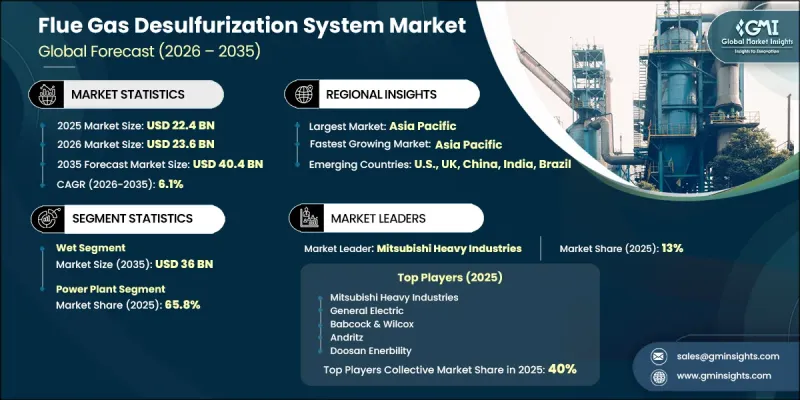
市場成長受全球能源需求不斷成長的驅動,而能源需求的持續成長也對排放和環境永續性構成越來越大的壓力。經濟的快速發展導致工業活動增加,空氣污染物排放上升,加劇了對有效排放控制解決方案的需求。各國政府和監管機構正在實施更嚴格的環境政策,迫使各行業採用先進技術來限制有害排放。工業基礎設施的擴張和對大型生產設施投資的增加進一步加劇了污染水平,使得空氣品質管理成為至關重要的優先事項。隨著人們對環境問題的日益關注,各行業面臨越來越大的壓力,需要透過改善營運實踐來減少有害排放。這加速了排煙脫硫設備及相關技術在各領域的應用。持續的創新和系統效率的提升也推動了市場擴張,因為各行業正在尋求可靠的解決方案,以在滿足不斷變化的環境標準的同時保持營運績效。
| 市場範圍 | |
|---|---|
| 開始年份 | 2025 |
| 預測期 | 2026-2035 |
| 上市時的市場規模 | 224億美元 |
| 預計金額 | 404億美元 |
| 複合年成長率 | 6.1% |
預計2035年,濕式排煙脫硫( WQF)市場規模將達360億美元。這些系統的擴張主要受日益嚴格的排放法規和高效處理工業廢棄物的需求所驅動。它們能夠高效去除含硫污染物,因此成為面臨嚴格合規要求的各行業的首選。隨著環保標準的不斷提高,預計對這些系統的需求將穩定成長。
到2035年,發電廠應用領域將佔據65.8%的市場。這些系統被廣泛用於控制發電過程中產生的排放量。它們在減少污染物排放發揮著重要作用,既確保了符合環境標準,也支持了永續能源生產。經濟成長和工業擴張推動了電力需求的成長,進而促使發電能力提升,進而推動了排放控制技術的應用。
受政府投資增加和旨在減少排放的各項措施的推動,預計到2025年,美國排煙脫硫設備市場規模將達到21億美元。各項旨在改善環境績效的專案正在加速先進技術的應用,使系統部署更具成本效益。這些趨勢預計將在未來幾年為市場擴張創造機會。
目錄
第1章:調查方法和範圍
第2章執行摘要
第3章 行業洞察
- 產業生態系分析
- 監理情勢
- 影響產業的因素
- 促進因素
- 對二氧化硫排放制定嚴格的法規結構
- 電力需求增加
- 產業潛在風險與挑戰
- 高昂的實施成本
- 促進因素
- 成長潛力分析
- 波特的分析
- PESTLE分析
- 煙氣脫硫成本結構分析
- 新機會和趨勢
- 數位化和物聯網整合
- 投資分析及未來展望
- 人工智慧和生成式人工智慧對市場的影響
- 利用人工智慧最佳化生產
- 預測性維護和故障檢測
第4章 競爭情勢
- 介紹
- 企業市佔率分析
- 按地區
- 北美洲
- 歐洲
- 亞太地區
- 中東和非洲
- 拉丁美洲
- 市場集中度分析
- 按地區
- 主要市場公司的競爭分析
- 競爭定位矩陣
- 主要進展
- 併購
- 夥伴關係和聯盟
- 新產品發布
- 業務拓展計劃及資金籌措
- 按公司規模進行基準測試
- 排名分類標準與選擇標準
- 按銷售額、地區和創新能力分類的層級定位矩陣。
第5章 市場規模及預測:依技術分類,2022-2035年
- 濕的
- 乾燥
第6章 市場規模與預測:依應用領域分類,2022-2035年
- 發電廠
- 化工/石油化工
- 水泥
- 金屬加工和採礦
- 製造業
- 其他
第7章 市場規模及預測:依地區分類,2022-2035年
- 北美洲
- 美國
- 加拿大
- 墨西哥
- 歐洲
- 德國
- 英國
- 法國
- 西班牙
- 義大利
- 亞太地區
- 中國
- 印度
- 日本
- 韓國
- 印尼
- 澳洲
- 越南
- 中東和非洲
- 沙烏地阿拉伯
- UAE
- 南非
- 奈及利亞
- 拉丁美洲
- 巴西
- 阿根廷
- 智利
第8章:公司簡介
- AirPoll Technologies
- Alstom
- Andritz
- Babcock &Wilcox
- Beijing SPC Environment Protection Tech
- Chiyoda
- Doosan Enerbility
- Ducon Infratechnologies
- GEA Group
- General Electric
- GKD
- Hamon
- Kawasaki Heavy Industries
- KC Cottrell
- KEPCO
- Ljungstrom
- Longking Environmental Protection
- Marsulex Environmental Technologies
- Mitsubishi Heavy Industries
- Thermax
- Valmet
The Global Flue Gas Desulfurization System Market was valued at USD 22.4 billion in 2025 and is estimated to grow at a CAGR of 6.1% to reach USD 40.4 billion by 2035.
Market growth is driven by the rising global demand for energy, which continues to place pressure on emission levels and environmental sustainability. Rapid economic development has increased industrial activity, leading to higher volumes of air pollutants and intensifying the need for effective emission control solutions. Governments and regulatory bodies are enforcing stricter environmental policies, compelling industries to adopt advanced technologies to limit harmful emissions. Expanding industrial infrastructure and increasing investments in large-scale production facilities are further contributing to elevated pollution levels, making air quality management a critical priority. As environmental concerns gain prominence, industries are under growing pressure to reduce emissions of harmful substances through improved operational practices. This has accelerated the adoption of flue gas desulfurization systems and related technologies across multiple sectors. Continuous innovation and improved system efficiency are also supporting market expansion, as industries seek reliable solutions to meet evolving environmental standards while maintaining operational performance.
| Market Scope | |
|---|---|
| Start Year | 2025 |
| Forecast Year | 2026-2035 |
| Start Value | $22.4 Billion |
| Forecast Value | $40.4 Billion |
| CAGR | 6.1% |
The wet flue gas desulfurization system segment is expected to reach USD 36 billion by 2035. The increasing adoption of these systems is largely driven by stringent emission regulations and the need for efficient management of industrial waste streams. Their ability to deliver high removal efficiency for sulfur-related pollutants has made them a preferred choice across industries facing strict compliance requirements. As environmental standards continue to tighten, demand for these systems is expected to rise steadily.
The power plant applications segment accounted for a share of 65.8% in 2035. These systems are widely deployed to control emission levels generated during power production processes. Their role in reducing pollutant output ensures compliance with environmental norms while supporting sustainable energy generation. Rising electricity demand, driven by economic growth and industrial expansion, has led to increased capacity additions in power generation, thereby boosting the adoption of emission control technologies.
U.S. Flue Gas Desulfurization System Market was valued at USD 2.1 billion in 2025, supported by increasing government investments and initiatives aimed at reducing emissions. Various programs focused on improving environmental performance are encouraging the adoption of advanced technologies, making system deployment more cost-effective. These developments are expected to create favorable opportunities for market expansion in the coming years.
Key companies operating in the Global Flue Gas Desulfurization System Market include Mitsubishi Heavy Industries, General Electric, Babcock & Wilcox, Thermax, Andritz, Doosan Enerbility, Valmet, GEA Group, KC Cottrell, Longking Environmental Protection, Hamon, Kawasaki Heavy Industries, Marsulex Environmental Technologies, Ducon Infratechnologies, AirPoll Technologies, Alstom, Chiyoda, KEPCO, Beijing SPC Environment Protection Tech, GKD, and Ljungstrom. Companies in the flue gas desulfurization system market are implementing strategic initiatives to strengthen their competitive position and expand their global presence. They are focusing on continuous investment in research and development to enhance system efficiency and performance. Strategic partnerships and collaborations are being pursued to expand technological capabilities and enter new markets. Many players are also prioritizing cost optimization and process improvements to deliver competitive solutions. Expanding manufacturing capacities and strengthening supply chain networks are key focus areas for meeting growing demand.
Table of Contents
Chapter 1 Methodology & Scope
- 1.1 Research approach
- 1.2 Quality commitment
- 1.2.1 GMI AI policy & data integrity commitment
- 1.2.1.1 Source consistency protocol
- 1.2.1 GMI AI policy & data integrity commitment
- 1.3 Research Trail & Confidence Scoring
- 1.3.1 Research Trail Components
- 1.3.2 Scoring Components
- 1.4 Data Collection
- 1.4.1 Partial list of primary sources
- 1.5 Data mining sources
- 1.5.1 Paid sources
- 1.5.1.1 Sources, by region
- 1.5.1 Paid sources
- 1.6 Base estimates and calculations
- 1.6.1 Base year calculation for any one approach
- 1.7 Forecast model
- 1.8 Research transparency addendum
- 1.8.1 Source attribution framework
- 1.8.2 Quality assurance metrics
- 1.8.3 Our commitment to trust
- 1.9 Market definitions
Chapter 2 Executive Summary
- 2.1 Industry synopsis, 2022 - 2035
- 2.1.1 Business trends
- 2.1.2 Technology trends
- 2.1.3 Application trends
- 2.1.4 Regional trends
Chapter 3 Industry Insights
- 3.1 Industry ecosystem analysis
- 3.2 Regulatory landscape
- 3.3 Industry impact forces
- 3.3.1 Growth drivers
- 3.3.1.1 Stringent regulatory framework toward SOx emissions
- 3.3.1.2 Growing electricity demand
- 3.3.2 Industry pitfalls & challenges
- 3.3.2.1 High installation cost
- 3.3.1 Growth drivers
- 3.4 Growth potential analysis
- 3.5 Porter's analysis
- 3.5.1 Bargaining power of suppliers
- 3.5.2 Bargaining power of buyers
- 3.5.3 Threat of new entrants
- 3.5.4 Threat of substitutes
- 3.6 PESTEL analysis
- 3.6.1 Political factors
- 3.6.2 Economic factors
- 3.6.3 Social factors
- 3.6.4 Technology factors
- 3.6.5 environmental factors
- 3.6.6 Legal factors
- 3.7 Cost structure analysis of FGD
- 3.8 Emerging opportunities & trends
- 3.9 Digitalization & IoT integration
- 3.10 Investment analysis & future prospects
- 3.11 Impact of AI & Generative AI on the market (Solution Core)
- 3.11.1 AI-driven production optimization
- 3.11.2 Predictive maintenance & fault detection
Chapter 4 Competitive landscape, 2026
- 4.1 Introduction
- 4.2 Company market share analysis, 2025
- 4.2.1 By region
- 4.2.1.1 North America
- 4.2.1.2 Europe
- 4.2.1.3 Asia Pacific
- 4.2.1.4 Middle East & Africa
- 4.2.1.5 Latin America
- 4.2.2 Market concentration analysis
- 4.2.1 By region
- 4.3 Competitive analysis of major market players
- 4.4 Competitive positioning matrix
- 4.4.1 key developments
- 4.4.2 Merger & acquisition
- 4.4.3 Partnership & collaboration
- 4.4.4 New product launched
- 4.5 Expansion plans & funding
- 4.6 Company tier benchmarking
- 4.6.1 Tier classification criteria & qualifying thresholds
- 4.6.2 Tier positioning matrix by revenue, geography & innovation
Chapter 5 Market Size and Forecast, By Technology, 2022 - 2035 (USD Million)
- 5.1 Key trends
- 5.2 Wet
- 5.3 Dry
Chapter 6 Market Size and Forecast, By Application, 2022 - 2035 (USD Million)
- 6.1 Key trends
- 6.2 Power plants
- 6.3 Chemical & petrochemical
- 6.4 Cement
- 6.5 Metal processing & mining
- 6.6 Manufacturing
- 6.7 Others
Chapter 7 Market Size and Forecast, By Region, 2022 - 2035 (USD Million)
- 7.1 Key trends
- 7.2 North America
- 7.2.1 U.S.
- 7.2.2 Canada
- 7.2.3 Mexico
- 7.3 Europe
- 7.3.1 Germany
- 7.3.2 UK
- 7.3.3 France
- 7.3.4 Spain
- 7.3.5 Italy
- 7.4 Asia Pacific
- 7.4.1 China
- 7.4.2 India
- 7.4.3 Japan
- 7.4.4 South Korea
- 7.4.5 Indonesia
- 7.4.6 Australia
- 7.4.7 Vietnam
- 7.5 Middle East & Africa
- 7.5.1 Saudi Arabia
- 7.5.2 UAE
- 7.5.3 South Africa
- 7.5.4 Nigeria
- 7.6 Latin America
- 7.6.1 Brazil
- 7.6.2 Argentina
- 7.6.3 Chile
Chapter 8 Company Profiles
- 8.1 AirPoll Technologies
- 8.2 Alstom
- 8.3 Andritz
- 8.4 Babcock & Wilcox
- 8.5 Beijing SPC Environment Protection Tech
- 8.6 Chiyoda
- 8.7 Doosan Enerbility
- 8.8 Ducon Infratechnologies
- 8.9 GEA Group
- 8.10 General Electric
- 8.11 GKD
- 8.12 Hamon
- 8.13 Kawasaki Heavy Industries
- 8.14 KC Cottrell
- 8.15 KEPCO
- 8.16 Ljungstrom
- 8.17 Longking Environmental Protection
- 8.18 Marsulex Environmental Technologies
- 8.19 Mitsubishi Heavy Industries
- 8.20 Thermax
- 8.21 Valmet

 全球排煙脫硫(FGD)系統市場(至2031年):按類型(濕式FGD系統、乾式和半乾式FGD系統)、部署方式(待開發區和棕地)、終端用戶行業(發電、化工和石化)及地區分類
 排煙脫硫(FGD):市場佔有率分析、產業趨勢與統計、成長預測(2026-2031)
 廢氣脫硫系統市場-2026-2032年全球市場預測
 洗滌器(FGDs)工業廢氣脫硫塔市場:依技術、材料、安裝、塔型和最終用戶分類,全球預測(2026-2032)
 全球廢氣脫硫市場規模、佔有率、趨勢及成長分析報告(2026-2034年)
 2026年全球濕式煙氣脫硫系統市場報告2026年全球煙道氣體脫硫系統市場報告
 煙氣脫硫市場 - 全球產業規模、佔有率、趨勢、機會及預測(按類型、終端用戶產業、安裝量、地區和競爭格局分類,2021-2031年)
 排煙脫硫(FGD)市場按材料類型、最終用途行業和地區分類