


 |
市場調查報告書
商品編碼
2114649
工業空氣污染控制解決方案:市場佔有率分析、行業趨勢和統計數據、成長預測(2026-2031 年)Industrial Air Pollution Control Solutions - Market Share Analysis, Industry Trends & Statistics, Growth Forecasts (2026 - 2031) |
||||||

※ 本網頁內容可能與最新版本有所差異。詳細情況請與我們聯繫。
預計工業空氣污染控制解決方案的市場規模將從 2025 年的 834.1 億美元成長到 2026 年的 881.8 億美元,到 2031 年將達到 1,164.6 億美元,2026 年至 2031 年的複合年成長率為 5.72%。
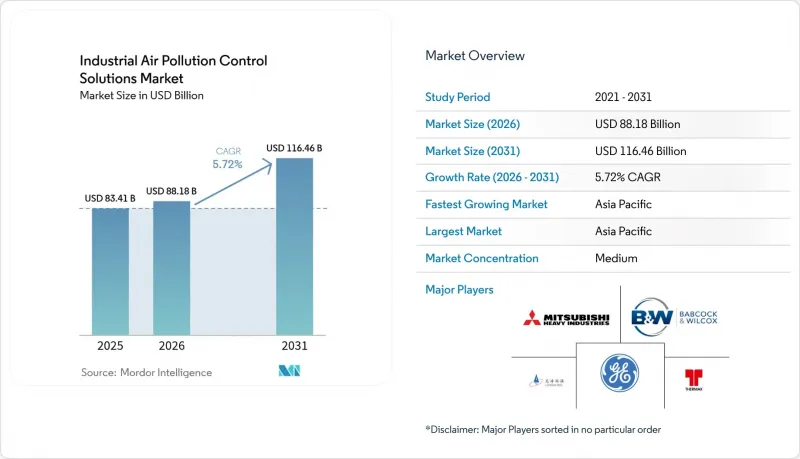
本報告按類型(靜電除塵器、選擇性催化還原和脫硝、布過濾器、排煙脫硫等)、應用(發電、廢棄物焚燒和生質能、水泥和石灰、化學品和石油化工、其他)和地區(北美、歐洲、亞太地區、南美、中東和非洲)進行分類。
全球工業空氣污染控制解決方案市場趨勢與洞察
多個行業實施更嚴格的排放法規
修訂後的歐盟工業排放指令於2024年8月生效,該指令要求工業設施將主要污染物排放量較2020年水準降低至多40%。同時,美國也收緊了相關法規,要求進一步減少新建固定式燃氣渦輪機的氮氧化物(NOx)排放,一項法規草案的目標是到2032年每年減少2659噸氮氧化物排放。歐盟和美國基準值的趨同實際上形成了一個全球最低合規標準,推動了高選擇性選擇性催化還原(SCR)反應器、濕式靜電除塵器(ESP)系統和混合模組的領先訂單。亞洲也出現了類似的監理收緊趨勢。韓國擴大了許可製度,將目標工業設施的數量從四年前的400家增加到1013家,從而促成了2024年韓國國內PM2.5濃度創歷史新低。為此,水泥和鋼鐵企業正透過將硫、氮和粉塵排放控制措施整合到單一的EPC合約中來應對,這標誌著企業開始摒棄以往分散的翻新維修。這些措施加在一起,將增加受影響設施的總數,並將相關支出提前到預測期的早期階段。
新興國家公眾健康意識的提高
印度的國家清潔空氣計畫旨在2026年將100多個城市的粒狀物濃度降低40%,目標得益於一個規模達230億美元的環境技術市場,該市場正以每年7.5%的速度成長。泰國也緊隨其後,於2024年在內閣層級批准了一項專門的空氣品質管理法案。中國的健康經濟學研究表明,加強顆粒物監管到2030年可避免21.8萬人過早死亡,從而提升地方政府對終端用戶排放控制投資的支持力度。企業買家也看到了實際的生產力提升。安裝在工業區各處的感測器顯示,PM2.5濃度每降低10微克/立方米,就能提高工人生產力,並使工廠盈利提高1%。這項發現正促使經營團隊將討論的重點從合規風險轉向提高利潤率。在新加坡和印尼的碳定價機制中,這些健康效益已被納入總量管制與交易,使清潔空氣成為可交易的資產,並進一步擴大了工業空氣污染控制解決方案的市場。
引進先進的空氣污染控制設備需要高額的資本投資(Capex)和營運成本(Opex)。
每個工廠的全面維修項目成本可能在 5,000 萬美元到 2 億美元之間,而吸附劑、試劑和電力方面的支出會使年度營運成本增加 10% 到 15%。配備整合數位孿生軟體的高階 SCR 煙囪比傳統設備貴 30% 到 40%,這使得許多中型冶煉廠和陶瓷廠難以負擔。因此,開發中國家的資金籌措延長了設備更換週期。儘管業界正在轉向模組化撬裝設備和租賃-營運-移交 (LOT) 模式,但資金籌措仍然使可實現的複合年成長率 (CAGR) 下降了近 1.5 個百分點。像美國能源局7,700 萬美元的「苔原計畫」這樣的公私合營計畫正在促進大規模公共產業合約的簽訂,但對中小企業的支持仍然不足。在資產抵押貸款普及之前,工業空氣污染控制解決方案市場在成本敏感地區將繼續落後於其理論需求潛力。
細分市場分析
2025年,靜電除塵器將佔據工業空氣污染控制解決方案市場34.62%的佔有率,鞏固其作為粒狀物去除領先技術的地位。現有設備正透過升級高頻電源和開關整合整流器來維持性能,而成長動力正轉向選擇性催化還原(SCR)系統,隨著中國、歐盟和美國多個州降低氮氧化物排放上限,SCR系統的複合年成長率(CAGR)將達到7.79%。供應商正透過改進釩鈦複合技術來提升自身競爭力,這些技術能夠承受更高的硫和粉塵負荷,並減少氨洩漏和維護週期。將SCR反應器置於濕式靜電集塵器(ESP)上游的混合裝置可將安裝面積減少高達25%,這為空間有限的工廠提供了決定性優勢。袋濾式集塵器除塵器在水泥窯和二次鉛冶煉廠的市佔率持續成長,這些企業的目標是將顆粒物排放量限制在5 mg/Nm³以下。同時,老舊燃煤煙囪的排煙脫硫(FGD)維修仍然至關重要。能夠一次處理粉塵、二氧化硫和氮氧化物的先進催化過濾器,體現了市場向一體化設計發展的趨勢,並推高了每兆瓦平均價格。
僅就選擇性催化還原(SCR)系統而言,工業空氣污染控制解決方案的市場規模預計將從2026年的252.2億美元成長到2031年的366.9億美元,這反映了發電廠和石化煉廠新建設的需求,以及因設備使用壽命結束而產生的更換需求。同時,活性碳噴射和乾式吸附劑加藥系統在汞減量維修專案中重新得到應用,儘管基數較低。等離子體和紫外線氧化系統仍處於小眾市場,但在半導體工廠和一些特殊的揮發性有機化合物(VOC)排放源中,由於傳統熱氧化系統存在產品污染風險,因此這些系統的需求正在成長。這些技術趨勢共同表明,市場正在從單一污染物最佳化轉向全面減排,這使得擁有廣泛產品系列的供應商能夠在客戶帳戶中佔據更大的市場佔有率。
區域分析
預計到2025年,亞太地區將佔工業空氣污染控制解決方案市場銷售額的48.70%,並維持最快的成長勢頭,到2031年複合年成長率將達到6.18%。推動這項整體需求成長的因素包括:北京為到2027年將煤炭排放強度降低50%而推出的財政獎勵;印度規模達230億美元的環境技術產業以7.5%的年成長率快速成長;以及韓國在PM2.5治理方面取得的成功。日本的「綠色轉型」藍圖正引導資金流向鋼鐵、化學和水泥產業的設備維修,而東協的碳定價框架則將排放限制轉化為工業營運商必須透過快速設備升級來規避的財務風險。此外,該地區擁有最多的新建垃圾焚化發電發電廠項目,從而推動了對整合混合系統需求的成長。
北美市場成熟且盈利豐厚,主要集中在設備升級和全生命週期服務合約方面。聯邦政府針對燃氣渦輪機和大規模煤改氣項目的氮氧化物排放標準預計將持續推動選擇性催化還原(SCR)、布袋除塵器和濕式洗滌器的訂單成長。諸如耗資7,700萬美元的「苔原計畫」(Project Tundra)等大規模碳捕集、利用與封存(CCUS)維修項目,進一步拓展了整合解決方案的應用範圍。加拿大的碳捕集稅額扣抵政策正在推動水泥廠和化肥廠採用高容量濕式靜電除塵設備(ESP)和混合式催化過濾器。在墨西哥,工業走廊的擴張正在催生對經濟高效的乾式吸附劑噴射裝置的局部需求。
歐洲透過2024年《工業排放指令》繼續保持在政策領域的領先地位,並將適用範圍擴大到金屬採礦和電池生產領域。一家德國水泥廠正在試驗應用95%的二氧化碳捕集系統,芬蘭一家垃圾焚化發電則採用了全流量二氧化碳捕捉技術,這些都凸顯了該地區對尖端混合解決方案的強勁需求。在南美洲,巴西鋼鐵和水泥製造商的訂單不斷湧現;而在中東和非洲,需求則集中在煉油廠和天然氣處理設施的廢氣處理方面,例如南非杜瓦發電廠的二氧化碳洗滌器維修。
其他好處:
- Excel格式的市場預測(ME)表
- 3個月的分析師支持
目錄
第1章:引言
- 研究假設和市場定義
- 調查範圍
- 調查範圍
第2章:調查方法
第3章執行摘要
第4章 市場狀況
- 市場概覽
- 市場促進因素
- 多個行業實施更嚴格的排放法規
- 新興國家公共衛生意識的提高
- 新一代催化劑和數位孿生技術提高了效率。
- 亞太地區煤炭氣化廠和垃圾焚化發電發電廠的建設仍在繼續。
- 人工智慧驅動的預測性維護可降低合規風險。
- 採用模組化APC組件的淨零排放工業叢集
- 市場限制因素
- 先進APC設備的高資本投資和營運成本
- 經合組織市場燃煤電廠退役
- 釩及其他催化劑材料的供應鏈波動
- 轉向減少進程內的排放(氧氣燃燒法、低氮氧化物燃燒器)正在降低對末端處理的需求。
- 供應鏈分析
- 監理情勢
- 技術展望
- 波特五力模型
第5章 市場規模與成長預測
- 按類型
- 靜電集塵器(乾式和濕式)
- 廢氣脫硫(濕法、乾法和半乾法)
- 選擇性催化還原(SCR)和脫硝
- 布質過濾器(袋式除塵器、筒式除塵器)
- 混合型和多污染物材料處理系統
- 活性碳和吸附劑注入
- 其他(氧化劑、紫外線、等離子體)
- 透過使用
- 發電
- 水泥和石灰
- 鋼
- 化工/石油化工
- 廢棄物焚化和生質能
- 紙漿和造紙
- 其他(藥品、食品和飲料)
- 按地區
- 北美洲
- 美國
- 加拿大
- 墨西哥
- 歐洲
- 德國
- 法國
- 英國
- 義大利
- 俄羅斯
- 其他歐洲國家
- 亞太地區
- 中國
- 印度
- 日本
- 韓國
- 東南亞國協
- 其他亞太國家
- 南美洲
- 巴西
- 阿根廷
- 其他南美國家
- 中東和非洲
- 沙烏地阿拉伯
- 阿拉伯聯合大公國
- 南非
- 其他中東和非洲國家
- 北美洲
第6章 競爭情勢
- 市場集中度
- 策略趨勢(併購、聯盟、購電協議)
- 市場佔有率分析(主要公司的市場排名和佔有率)
- 公司簡介
- Mitsubishi Heavy Industries-Power & Env.
- General Electric Company
- Babcock & Wilcox Enterprises Inc.
- Thermax Ltd.
- Fujian Longking Co. Ltd.
- Hamon Group
- Andritz AG
- John Wood Group PLC
- GEA Bischoff GmbH
- Pure Air Solutions Inc.
- Tri-Mer Corporation
- Ducon Technologies Inc.
- Horiba Ltd.
- Calgon Carbon Corporation
- Esco International Holding
- Siemens Energy
- Donaldson Company Inc.
- Valmet Oyj
- Camfil AB
- AAF International
- CECO Environmental
- Durr Systems AG
- Anguil Environmental Systems
- SLY Inc.
- Albarrie Canada Ltd.
第7章 市場機會與未來展望
According to Mordor Intelligence, the industrial air pollution control solutions market size market is expected to grow from USD 83.41 billion in 2025 to USD 88.18 billion in 2026 and is forecast to reach USD 116.46 billion by 2031 at 5.72% CAGR over 2026-2031.
This report is Segmented by Type (Electrostatic Precipitators, Selective Catalytic Reduction and Denitrification, Fabric Filters, Flue-Gas Desulfurization, and More), Application (Power Generation, Waste Incineration and Biomass, Cement and Lime, Chemicals and Petrochemicals, and More), and Geography (North America, Europe, Asia-Pacific, South America, and Middle East and Africa).
Global Industrial Air Pollution Control Solutions Market Trends and Insights
Stricter Multi-Sector Emission Regulations
The European Union's revised Industrial Emissions Directive entered into force in August 2024, obliging industrial sites to trim key pollutants by up to 40% versus 2020 levels. Parallel tightening in the United States now targets deeper NOx cuts from new stationary turbines, with draft rules slated to eliminate 2,659 tons of NOx annually by 2032. Convergence between EU and U.S. thresholds creates a de facto global compliance floor that drives advance orders for high-selectivity SCR reactors, wet ESP systems, and hybrid modules. Enforcement is equally visible in Asia: South Korea's expanded permitting regime now covers 1,013 industrial facilities, versus 400 four years earlier, contributing to record-low national PM2.5 readings in 2024. Cement and steel operators have responded by bundling sulfur, nitrogen, and dust controls into single EPC contracts, signaling a clear shift away from piecemeal retrofits. Collectively, these measures raise the addressable pool of installations and pull forward spending into the early part of the forecast window.
Rising Public-Health Awareness in Emerging Economies
India's National Clean Air Programme now seeks 40% particulate reductions across more than 100 cities by 2026, a target backed by an environmental-technology market worth USD 23 billion and expanding at 7.5% annually. Thailand followed with cabinet-level approval of a dedicated air-quality management bill in 2024. Health-economics studies in China suggest stricter particulate controls could avert 218,000 premature deaths by 2030, fuelling local support for end-of-pipe investments. Corporate buyers also capture tangible productivity benefits; sensors installed across industrial zones indicate that a 10 µg/m3 drop in PM2.5 lifts worker output enough to add 1% to plant-level profitability, a finding that has moved boardroom discussions from compliance risk to margin enhancement. Carbon-pricing schemes in Singapore and Indonesia embed these health benefits into cap-and-trade balances, turning cleaner air into a tradable asset, further enlarging the industrial air pollution control solution market.
High Capex & Opex of Advanced APC Installations
Comprehensive retrofits can command USD 50-200 million per site, with sorbent, reagent, and electricity outlays lifting annual operating costs 10-15%. Premium SCR stacks that integrate digital-twin software price 30-40% above legacy units, putting them out of reach for many mid-tier smelters and ceramics plants. Financing gaps in developing countries thus prolong equipment replacement cycles. The sector is pivoting to modular skids and lease-operate-transfer models, but capital frictions still shave nearly 1.5 percentage points off the otherwise addressable CAGR. Public-private loan guarantees, such as the U.S. Department of Energy's USD 77 million Project Tundra package, help close large utility deals, yet smaller enterprises remain underserved. Until asset-based financing becomes commonplace, the industrial air pollution control solution market will trail its theoretical demand potential in cost-sensitive regions.
Other drivers and restraints analyzed in the detailed report include:
- Efficiency Gains from Next-Gen Catalysts & Digital Twins
- Continued Build-Out of Coal-to-Gas & Waste-to-Energy Plants in APAC
- Retirement of Coal-Fired Assets in OECD Markets
For complete list of drivers and restraints, kindly check the Table Of Contents.
Segment Analysis
Electrostatic precipitators commanded a 34.62% industrial air pollution control solution market share in 2025, confirming their status as the workhorse for particulate removal. While replacement activity for high-frequency power supplies and switched-integrated rectifiers keeps the installed base current, the growth spotlight has shifted to SCR systems, which are advancing at a 7.79% CAGR in response to NOx ceiling reductions in China, the EU, and several U.S. states. Suppliers differentiate through improved vanadium-titania formulations that withstand higher sulfur and dust loads, reducing ammonia slip and maintenance cycles. Hybrid units that couple SCR reactors upstream of wet ESP stages shrink total footprint by up to 25%, a decisive advantage in plants with little spare space. Fabric filters continue to gain share in cement kilns and secondary lead smelters seeking sub-5 mg/Nm3 particulate limits, while flue-gas desulfurization retrofits remain indispensable for aging coal stacks. Advanced catalytic filtration, capable of tackling dust, SO2, and NOx in one pass, exemplifies the market's march toward integrated designs and underpins the rising average price per megawatt capacity.
The industrial air pollution control solution market size for SCR equipment alone is projected to climb from USD 25.22 billion in 2026 to USD 36.69 billion by 2031, reflecting both new-build demand and end-of-life replacement at utilities and petrochemical refineries. Concurrently, activated-carbon injection and dry-sorbent dosing systems see renewed uptake in mercury-control retrofits, albeit from a lower base. Plasma and UV oxidizers remain niche but grow in semiconductor fabs and specialized VOC streams where conventional thermal oxidizers would risk product contamination. Collectively, these technology trends underscore a shift from single-pollutant optimization toward holistic abatement, positioning vendors with broad portfolios for superior wallet share across customer accounts.
Complete Report Scope:
- By Type
- Electrostatic Precipitators (Dry and Wet)
- Flue-Gas Desulfurization (Wet, Dry, Semi-Dry)
- Selective Catalytic Reduction (SCR) and Denitrification
- Fabric Filters (Baghouse, Cartridge)
- Hybrid and Multi-pollutant Systems
- Activated Carbon and Sorbent Injection
- Others (Oxidizers, UV, Plasma)
- By Application
- Power Generation
- Cement and Lime
- Iron and Steel
- Chemicals and Petrochemicals
- Waste Incineration and Biomass
- Pulp and Paper
- Others (Pharmaceuticals, Food and Beverage)
- By Geography
- North America
- United States
- Canada
- Mexico
- Europe
- Germany
- France
- United Kingdom
- Italy
- Russia
- Rest of Europe
- Asia Pacific
- China
- India
- Japan
- South Korea
- ASEAN Countries
- Rest of Asia Pacific
- South America
- Brazil
- Argentina
- Rest of South America
- Middle East and Africa
- Saudi Arabia
- United Arab Emirates
- South Africa
- Rest of Middle East and Africa
- North America
Geography Analysis
Asia-Pacific claims 48.70% of the industrial air pollution control solution market revenue in 2025 and sustains the steepest trajectory at a 6.18% CAGR through 2031. Beijing's fiscal incentives for 50% coal-emission-intensity cuts by 2027, India's USD 23 billion environmental-tech sector expanding 7.5% annually, and South Korea's successful PM2.5 crackdown drive aggregate demand. Japan's Green-Transformation road map funnels capital toward steel, chemicals, and cement retrofits, while ASEAN carbon-pricing frameworks turn emission limits into financial liabilities that industrial operators must hedge via rapid equipment upgrades. The region also hosts the largest pipeline of new waste-to-energy facilities, intensifying demand for integrated hybrid systems.
North America represents a mature but profitable arena focused on equipment upgrades and lifecycle-service contracts. Proposed federal NOx standards for turbines and substantial coal-to-gas conversions sustain a stream of SCR, baghouses, and wet-scrubber orders. Large CCUS retrofits, such as the USD 77 million Project Tundra undertaking, further enlarge the scope of integrated solutions. Canada's carbon-capture tax credits push cement and fertilizer plants toward high-capacity wet ESP and hybrid catalytic filters. Mexico's growing industrial corridors present pockets of demand for cost-effective dry-sorbent injection packages.
Europe keeps the policy vanguard through the 2024 Industrial Emissions Directive, extending coverage to metal mining and battery production. German cement plants piloting 95% CO2 capture units and Finnish waste-to-energy plants specifying full-stream carbon capture highlight the region's appetite for cutting-edge hybrid solutions. South America sees budding orders from Brazilian steel and cement producers, while the Middle East & Africa demand centers on flue-gas conditioning for refinery and gas-processing facilities, including South Africa's CO2-scrubber retrofit at Duvha Power Station.
- Mitsubishi Heavy Industries - Power & Env.
- General Electric Company
- Babcock & Wilcox Enterprises Inc.
- Thermax Ltd.
- Fujian Longking Co. Ltd.
- Hamon Group
- Andritz AG
- John Wood Group PLC
- GEA Bischoff GmbH
- Pure Air Solutions Inc.
- Tri-Mer Corporation
- Ducon Technologies Inc.
- Horiba Ltd.
- Calgon Carbon Corporation
- Esco International Holding
- Siemens Energy
- Donaldson Company Inc.
- Valmet Oyj
- Camfil AB
- AAF International
- CECO Environmental
- Durr Systems AG
- Anguil Environmental Systems
- SLY Inc.
- Albarrie Canada Ltd.
Additional Benefits:
- The market estimate (ME) sheet in Excel format
- 3 months of analyst support
TABLE OF CONTENTS
1 Introduction
- 1.1 Study Assumptions & Market Definition
- 1.2 Scope of the Study
- 1.2.1 Scope of the Study
2 Research Methodology
3 Executive Summary
4 Market Landscape
- 4.1 Market Overview
- 4.2 Market Drivers
- 4.2.1 Stricter multi-sector emission regulations
- 4.2.2 Rising public-health awareness in emerging economies
- 4.2.3 Efficiency gains from next-gen catalysts & digital twins
- 4.2.4 Continued build-out of coal-to-gas & waste-to-energy plants in APAC
- 4.2.5 AI-enabled predictive maintenance lowers compliance risk
- 4.2.6 Net-zero industrial clusters adopting modular APC packages
- 4.3 Market Restraints
- 4.3.1 High capex & opex of advanced APC installations
- 4.3.2 Retirement of coal-fired assets in OECD markets
- 4.3.3 Supply-chain volatility for vanadium & other catalyst materials
- 4.3.4 Shift toward in-process abatement (oxy-fuel, low-NOx burners) cuts end-of-pipe demand
- 4.4 Supply-Chain Analysis
- 4.5 Regulatory Landscape
- 4.6 Technological Outlook
- 4.7 Porter's Five Forces
- 4.7.1 Bargaining Power of Suppliers
- 4.7.2 Bargaining Power of Consumers
- 4.7.3 Threat of New Entrants
- 4.7.4 Threat of Substitute Products & Services
- 4.7.5 Intensity of Competitive Rivalry
5 Market Size & Growth Forecasts
- 5.1 By Type
- 5.1.1 Electrostatic Precipitators (Dry and Wet)
- 5.1.2 Flue-Gas Desulfurization (Wet, Dry, Semi-Dry)
- 5.1.3 Selective Catalytic Reduction (SCR) and Denitrification
- 5.1.4 Fabric Filters (Baghouse, Cartridge)
- 5.1.5 Hybrid and Multi-pollutant Systems
- 5.1.6 Activated Carbon and Sorbent Injection
- 5.1.7 Others (Oxidizers, UV, Plasma)
- 5.2 By Application
- 5.2.1 Power Generation
- 5.2.2 Cement and Lime
- 5.2.3 Iron and Steel
- 5.2.4 Chemicals and Petrochemicals
- 5.2.5 Waste Incineration and Biomass
- 5.2.6 Pulp and Paper
- 5.2.7 Others (Pharmaceuticals, Food and Beverage)
- 5.3 By Geography
- 5.3.1 North America
- 5.3.1.1 United States
- 5.3.1.2 Canada
- 5.3.1.3 Mexico
- 5.3.2 Europe
- 5.3.2.1 Germany
- 5.3.2.2 France
- 5.3.2.3 United Kingdom
- 5.3.2.4 Italy
- 5.3.2.5 Russia
- 5.3.2.6 Rest of Europe
- 5.3.3 Asia Pacific
- 5.3.3.1 China
- 5.3.3.2 India
- 5.3.3.3 Japan
- 5.3.3.4 South Korea
- 5.3.3.5 ASEAN Countries
- 5.3.3.6 Rest of Asia Pacific
- 5.3.4 South America
- 5.3.4.1 Brazil
- 5.3.4.2 Argentina
- 5.3.4.3 Rest of South America
- 5.3.5 Middle East and Africa
- 5.3.5.1 Saudi Arabia
- 5.3.5.2 United Arab Emirates
- 5.3.5.3 South Africa
- 5.3.5.4 Rest of Middle East and Africa
- 5.3.1 North America
6 Competitive Landscape
- 6.1 Market Concentration
- 6.2 Strategic Moves (M&A, Partnerships, PPAs)
- 6.3 Market Share Analysis (Market Rank/Share for key companies)
- 6.4 Company Profiles (includes Global level Overview, Market level overview, Core Segments, Financials as available, Strategic Information, Products & Services, and Recent Developments)
- 6.4.1 Mitsubishi Heavy Industries - Power & Env.
- 6.4.2 General Electric Company
- 6.4.3 Babcock & Wilcox Enterprises Inc.
- 6.4.4 Thermax Ltd.
- 6.4.5 Fujian Longking Co. Ltd.
- 6.4.6 Hamon Group
- 6.4.7 Andritz AG
- 6.4.8 John Wood Group PLC
- 6.4.9 GEA Bischoff GmbH
- 6.4.10 Pure Air Solutions Inc.
- 6.4.11 Tri-Mer Corporation
- 6.4.12 Ducon Technologies Inc.
- 6.4.13 Horiba Ltd.
- 6.4.14 Calgon Carbon Corporation
- 6.4.15 Esco International Holding
- 6.4.16 Siemens Energy
- 6.4.17 Donaldson Company Inc.
- 6.4.18 Valmet Oyj
- 6.4.19 Camfil AB
- 6.4.20 AAF International
- 6.4.21 CECO Environmental
- 6.4.22 Durr Systems AG
- 6.4.23 Anguil Environmental Systems
- 6.4.24 SLY Inc.
- 6.4.25 Albarrie Canada Ltd.
7 Market Opportunities & Future Outlook
- 7.1 White-space & Unmet-need Assessment

 服飾去漬服務:2026年全球市場報告
 汽車碳罐市場:按類型、車輛類型、應用、國家和地區分類-全球產業分析、市場規模、市場佔有率及2026-2033年預測
 淤泥簾市場規模、佔有率和成長分析:按類型、產品類型、材料、應用、分銷管道和地區分類-2026-2033年產業預測
 空氣污染控制設備市場:商機、成長要素、產業趨勢分析及2026-2035年預測
 淤泥簾:市場佔有率分析、產業趨勢與統計、成長預測(2026-2031)
 2026-2030年全球空氣污染控制市場
 先進海洋廢棄物回收設備市場分析及預測(至2035年):依類型、技術、應用、組件、最終用戶、產品類型、材料類型、部署方式及功能分類
 全球淤泥幕市場規模、佔有率、趨勢和成長分析報告(2026-2034)
 汽車碳罐市場-全球產業規模、佔有率、趨勢、機會與預測:按車輛類型、銷售管道類型、地區和競爭格局分類,2021-2031年空氣污染控制設備服務市場-全球產業規模、佔有率、趨勢、機會與預測:按服務、維修和大修服務、應用、地區和競爭格局分類,2021-2031年