


 |
市場調查報告書
商品編碼
2062386
淤泥簾:市場佔有率分析、產業趨勢與統計、成長預測(2026-2031)Silt Curtain - Market Share Analysis, Industry Trends & Statistics, Growth Forecasts (2026 - 2031) |
||||||

※ 本網頁內容可能與最新版本有所差異。詳細情況請與我們聯繫。
根據 Mordor Intelligence 預測,淤泥簾市場規模預計在 2025 年達到 981 萬美元,在 2026 年達到 1,018 萬美元,在 2031 年達到 1,226 萬美元,2026 年至 2031 年的複合年成長率為 3.78%。
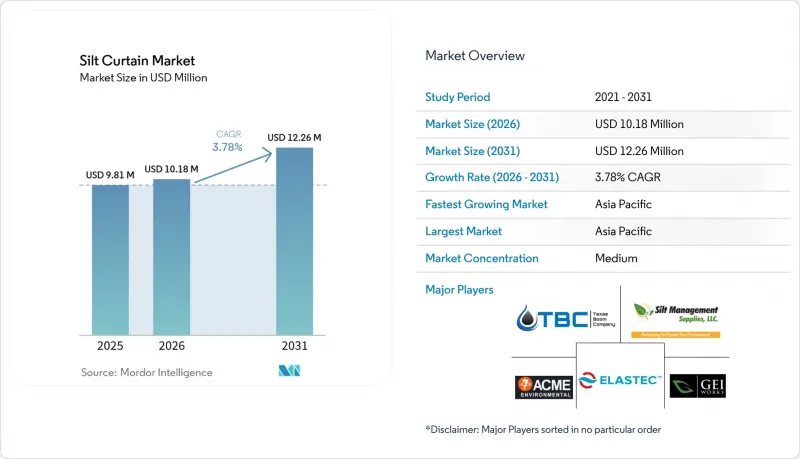
本報告按類型(I型(靜水)、II型(緩流)等)、材料(聚氯乙烯、聚氨酯等)、應用(疏浚、海洋和沿海建設、海上能源等)以及地區(亞太地區、北美地區、歐洲地區、南美地區、中東和非洲地區)進行細分。市場預測以美元計價。
全球防淤簾市場趨勢與洞察
加強新興國家的水質監管
2024年,印度中央污染控制委員會將濁度閾值從自願性建議轉變為強制性規定,要求疏浚承包商對超過1萬立方公尺的疏浚工程實施即時監測。這項規定首先應用於帕拉迪普維護項目,該項目價值12.28億印度盧比(約1316萬美元),計劃於2026-2027年實施。在中國,《長江保護法》的適用範圍擴大,強制要求洋山港四期碼頭安裝防濁簾,預計到2025年,碼頭的吞吐能力將增加223萬標準箱(TEU)。泰國南部陸橋(一條耗資280億美元的走廊)包含4.63公里的海上工程,並強制要求從2025年至2030年實施濁度管理。到2025年底,該地區68%的港口將獲得國際標準化組織(ISO)14001認證,並且某些規範將在競標文件中進行預篩選,從而降低供應商因變更要求而面臨的風險。
隨著離岸風力發電發電廠建設的快速成長,對泥沙控制的需求日益增加。
在北海、黃海和美國大西洋租賃區塊進行的單樁打樁和電纜鋪設專案會產生需要採取措施控制的泥沙羽流。在浪高超過4公尺的道格灘,130公里長的電纜鋪設工程強制要求使用增強型聚氨酯裙板。 2024年,日本科學技術委員會指出颱風引發的侵蝕風險,促使專案業主在計畫建造的10吉瓦(GW)裝置容量中採用III型幕簾。韓國批准了一項在2030年建成的8.2吉瓦租賃項目,其中納入了泥沙控制要求。在美國,如果開發商無法證明屏障在40公尺以下深度的性能,國家海洋能源管理局(BOEM)現在會將環境評估平均推遲9個月。為了應對這些挑戰,包括GEI Works在內的製造商於2024年10月推出了複合材料層壓Triton幕簾。
強流和深海環境下的運作故障
標準聚氯乙烯(PVC)簾幕在流速超過2節或水深超過12公尺時,會面臨變形和斷裂等結構性問題。在北海,有報導稱,當波浪載荷達到15千牛(kN)時,錨會被拉出,導致混合繫錨碇系統的成本翻倍。在五河口風電場,當河口流速達到3.2節時,在電纜上增加配重壓安定器導致成本增加了35%。在墨西哥灣,水深60-90公尺區域的退役計畫現在需要使用內建浮力艙的複合材料層壓板。此外,只有不到20%的裝置配備了即時濁度感測器,導致超出圍堰範圍的損害無法被偵測到。
細分市場分析
專為平靜港口環境設計的I型防泥簾,主要受保護港口定期維護疏浚的推動,預計到2025年將佔據44.11%的市場佔有率。同時,III型防泥簾正以4.41%的複合年成長率快速成長,這主要得益於其在北海風電場、墨西哥灣退役計畫以及日本颱風多發地區風電場的應用。這些因素推高了平均售價,從而推動了防泥簾市場的整體擴張。 GEI Works公司的「Triton」防泥簾採用增強型聚氯乙烯(PVC)材質,裙邊長6英尺,能夠應付5節的流速,有望贏得深海項目的訂單。
I型和III型幕簾的成本差異從每米60-80美元到每米180-220美元不等,溢價30-40%,這主要是由於增加了安定器鏈、混合錨和感測器組件。深度超過12公尺的深海作業推動了對專業承包商的需求,儘管市場規模不斷萎縮,但利潤率卻在上升。
區域分析
預計到2025年,亞太地區將佔全球整體銷售額的41.11%,年複合成長率達5.89%。這一成長主要得益於大規模港口擴建、棕地修復項目以及離岸風力發電項目的開發。印度的混合年金資金籌措模式——在建設期撥付60%的資金,剩餘40%在10年內分期支付——改善了國內防沙堤生產商的現金流,從而擴大了該地區防沙堤的市場佔有率。在中國,長江經濟帶正在進行的23個港口的修復項目中,低滲透性地工織物備受青睞。同時,泰國耗資280億美元的南陸大橋計畫也保證了未來六年穩定的市場需求。
北美市場動態受海洋能源管理局 (BOEM) 的租賃協議和各州沿海韌性預算的影響。新澤西州一項耗資 5000 萬美元的海岸養護項目和馬薩諸塞州一項耗資 3000 萬美元的濕地修復計劃,都促使沿海地區的需求增加。然而,在佛羅裡達州,由於 5 月至 10 月是繁殖季節,施工禁令限制了工期,並推高了專案保險成本。此外,加拿大標準協會 (CSA) 標準和美國材料與試驗協會 (ASTM) 標準之間的差異,雖然使進口物流變得複雜,但也為本地供應商提供了競爭優勢。
歐洲市場的成長主要由離岸風力發電項目驅動。在多格爾班克、五大河口和德國北海等區域,租賃協議要求在水深小於30公尺的區域設置防泥簾,這增加了對III型防泥簾產品的需求。在英國,預計也存在長期發展機遇,包括2000座海上平台的退役,這將為未來幾十年市場成長提供動力。此外,西班牙和義大利在地中海的疏浚計畫以及俄羅斯北極地區的液化天然氣(LNG)計畫也帶來了新的機會。然而,這些項目都受到製裁的限制。
在南美洲,巴西的港口私有化舉措是市場活動的重點。中東和非洲地區正受益於沙烏地阿拉伯的NEOM沿海開發案和南非的德班港疏浚計畫。土耳其的「伊斯坦堡運河」計畫雖然等候核准,但仍是推動其長期成長的催化劑。
其他好處:
- Excel格式的市場預測(ME)表
- 3個月的分析師支持
目錄
第1章:引言
- 研究假設和市場定義
- 調查範圍
第2章:調查方法
第3章執行摘要
第4章 市場狀況
- 市場概覽
- 市場促進因素
- 加強新興國家的水質監管
- 防止離岸風力發電發電廠快速建造帶來的土壤侵蝕的必要性。
- 氣候變遷適應性投資,用於沿海沙灘修復和紅樹林再生。
- 棕地港口受污染沉積物的原位覆蓋率增加
- 採用檢驗的濁度控制措施的承包商可享有保險費折扣。
- 市場限制因素
- 強流和深海環境下的運作故障
- 當障礙物影響遷移物種時,延長環境許可期限
- 缺乏統一的檢驗標準導致採購過程中出現猶豫不決的情況。
- 價值鏈分析
- 波特五力模型
第5章 市場規模與成長預測
- 按類型
- I 型(普通水)
- 第二類(弱電流)
- III 型(強流,離岸)
- 材料
- 聚氯乙烯
- 聚氨酯
- 地工織物織物
- 複合層壓材料
- 透過使用
- 疏浚
- 海洋/沿海建築
- 海洋能源(石油和天然氣、風能)
- 環境修復和棲息地保護項目
- 其他用途
- 按地區
- 亞太地區
- 中國
- 印度
- 日本
- 韓國
- 澳洲和紐西蘭
- 東南亞國協
- 其他亞太國家
- 北美洲
- 美國
- 加拿大
- 墨西哥
- 歐洲
- 德國
- 英國
- 法國
- 義大利
- 西班牙
- 俄羅斯
- 其他歐洲國家
- 南美洲
- 巴西
- 阿根廷
- 其他南美國家
- 中東和非洲
- 沙烏地阿拉伯
- 土耳其
- 南非
- 其他中東和非洲國家
- 亞太地區
第6章 競爭情勢
- 市場集中度
- 策略趨勢
- 市佔率和排名分析
- 公司簡介
- ABASCO
- ACME Environmental
- BMP Supplies Inc.
- BTL
- Clarion Municipal
- Elastec
- Floatex Srl
- Gecko Cleantech
- GEI Works
- JXY Heavy Industry
- Layfield Group
- Silt Management Supplies, LLC.
- Solmax
- Texas Boom Company
- Tritonbuoys
- Water Pollution Solutions
第7章 市場機會與未來展望
According to Mordor Intelligence, the silt curtain market size is projected to be USD 9.81 million in 2025, USD 10.18 million in 2026, and reach USD 12.26 million by 2031, growing at a CAGR of 3.78% from 2026 to 2031.
This report is Segmented by Type (Type I (Calm Water), Type II (Mild Current), and More), Material (Polyvinyl Chloride, Polyurethane, and More), Application (Dredging, Marine and Coastal Construction, Offshore Energy, and More), and Geography (Asia-Pacific, North America, Europe, South America, and Middle-East and Africa). The Market Forecasts are Provided in Terms of Value (USD).
Global Silt Curtain Market Trends and Insights
Stricter Water-Quality Mandates in Emerging Economies
India's Central Pollution Control Board transitioned from voluntary advisories to mandatory nephelometric thresholds in 2024, requiring dredging contractors to implement real-time monitoring for projects exceeding 10,000 cubic meters. This regulation was first applied to the INR 1,228 million (USD 13.16 million) Paradip maintenance project, scheduled for fiscal 2026-27. In China, the Yangtze River Protection Law was extended to mandate curtain deployment at the Yangshan Phase IV terminal, which added 2.23 million twenty-foot equivalent unit (TEU) capacity in 2025. Thailand's Southern Land Bridge, a USD 28 billion corridor, includes 4.63 kilometers of marine works with mandatory turbidity controls from 2025 to 2030. By the end of 2025, 68% of ports in the region had obtained International Organization for Standardization (ISO) 14001 certification, and bid documents now pre-qualify certain specifications, reducing change-order risks for suppliers.
Surging Offshore Wind Farm Construction Needing Sediment Containment
Monopile driving and cable trenching activities in the North Sea, Yellow Sea, and U.S. Atlantic lease blocks generate sediment plumes that require containment. At Dogger Bank, reinforced polyurethane skirts were mandated during 130 kilometers of cable work due to wave heights exceeding 4 meters. In 2024, Japan's Science Council highlighted typhoon-driven scour risks, prompting project owners to adopt Type III curtains for planned 10 gigawatts (GW) of capacity. South Korea approved 8.2 GW of leases through 2030, incorporating sediment-containment requirements. In the U.S., the Bureau of Ocean Energy Management (BOEM) now delays environmental reviews by an average of nine months if developers fail to demonstrate barrier performance below 40 meters in depth. Manufacturers, including GEI Works, introduced composite-laminate Triton curtains in October 2024 to address these challenges.
Operational Failures in High-Current and Deep-Water Conditions
Standard polyvinyl chloride (PVC) curtains face structural issues, such as bowing or tearing, when exposed to currents exceeding 2 knots or depths beyond 12 meters. In the North Sea, pilots reported anchor pullouts under wave loads of 15 kilonewtons (kN), which doubled mobilization costs for hybrid moorings. Retrofitting weighted ballasts for Five Estuaries wind-farm cables resulted in a 35% cost increase when estuary currents reached 3.2 knots. In the Gulf of Mexico, decommissioning projects in water depths of 60 to 90 meters now require composite laminates with integrated buoyancy chambers. Additionally, fewer than 20% of deployments include real-time turbidity sensors, leading to undetected breaches that extend beyond containment zones.
Other drivers and restraints analyzed in the detailed report include:
- Climate-Adaptation Investments in Beach Nourishment and Mangrove Restoration
- Rise in In-Situ Capping of Contaminated Sediments in Brownfield Ports
- Lengthy Environmental-Permit Delays When Barriers Affect Migratory Species
For complete list of drivers and restraints, kindly check the Table Of Contents.
Segment Analysis
Type I silt curtains, designed for calm harbor conditions, accounted for 44.11% of the market share in 2025, driven by routine maintenance dredging in protected ports. Meanwhile, Type III curtains are expanding at a compound annual growth rate (CAGR) of 4.41%, supported by applications in North Sea wind farms, Gulf of Mexico decommissioning projects, and Japan's typhoon-prone wind zones. These factors are contributing to higher average selling prices, thereby increasing the overall silt curtain market size. GEI Works' Triton launch introduced a reinforced polyvinyl chloride (PVC) design with a six-foot skirt, rated for five-knot currents, positioning the company to secure contracts for deep-water projects.
The cost disparity between Type I and Type III curtains ranges from USD 60-80 to USD 180-220 per linear meter, reflecting a 30-40% premium due to the inclusion of ballast chains, hybrid anchors, and sensor packages. Deep-water operations beyond 12 meters are driving demand for specialized contractors, reducing addressable volume but increasing profit margins.
Geography Analysis
In 2025, the Asia-Pacific region accounted for 41.11% of global revenue and is projected to grow at a compound annual growth rate (CAGR) of 5.89%. This growth is driven by large-scale port expansions, brownfield remediation projects, and offshore wind allocations. India's hybrid annuity financing model, which allocates 60% of funds during construction and 40% over a 10-year period, enhances cash cycles for domestic barrier manufacturers, thereby increasing the regional silt curtain market share. In China, the 23-port remediation program under the Yangtze Economic Belt prioritizes low-permeability geotextiles. Meanwhile, Thailand's USD 28 billion Southern Land Bridge project ensures six years of consistent demand.
North America's market dynamics are influenced by the Bureau of Ocean Energy Management (BOEM) lease pipeline and state-level beach-resilience budgets. New Jersey's USD 50 million nourishment portfolio and Massachusetts' USD 30 million marsh restoration program contribute to increased near-shore volume. However, Florida's May-October nesting blackout restricts the construction window, leading to higher project insurance costs. Additionally, Canada's Canadian Standards Association (CSA) standard, which differs from the American Society for Testing and Materials (ASTM), complicates import logistics but provides a competitive advantage to local suppliers.
Europe's market growth is primarily driven by offshore wind projects. Leases in areas such as Dogger Bank, Five Estuaries, and the German North Sea require sediment curtains for depths under 30 meters, boosting demand for Type III silt curtain products. The United Kingdom also faces long-term opportunities with the decommissioning of 2,000 offshore platforms, creating a multi-decade growth driver. Incremental opportunities arise from Mediterranean dredging projects in Spain and Italy, as well as Arctic liquefied natural gas (LNG) activities in Russia, though these are constrained by sanctions.
In South America, Brazil's port privatization initiatives are the primary focus of market activity. The Middle East and Africa regions benefit from Saudi Arabia's NEOM coastal developments and South Africa's Durban port deepening projects. Turkey's Kanal Istanbul project remains a potential long-term growth catalyst, pending permit approvals.
- ABASCO
- ACME Environmental
- BMP Supplies Inc.
- BTL
- Clarion Municipal
- Elastec
- Floatex Srl
- Gecko Cleantech
- GEI Works
- JXY Heavy Industry
- Layfield Group
- Silt Management Supplies, LLC.
- Solmax
- Texas Boom Company
- Tritonbuoys
- Water Pollution Solutions
Additional Benefits:
- The market estimate (ME) sheet in Excel format
- 3 months of analyst support
TABLE OF CONTENTS
1 Introduction
- 1.1 Study Assumptions and Market Definition
- 1.2 Scope of the Study
2 Research Methodology
3 Executive Summary
4 Market Landscape
- 4.1 Market Overview
- 4.2 Market Drivers
- 4.2.1 Stricter Water-Quality Mandates in Emerging Economies
- 4.2.2 Surging Offshore Wind Farm Construction Needing Sediment Containment
- 4.2.3 Climate-Adaptation Investments in Beach Nourishment and Mangrove Restoration
- 4.2.4 Rise in In-Situ Capping of Contaminated Sediments in Brownfield Ports
- 4.2.5 Insurance Premium Discounts for Contractors Using Verified Turbidity Controls
- 4.3 Market Restraints
- 4.3.1 Operational Failures in High-Current and Deep-Water Conditions
- 4.3.2 Lengthy Environmental-Permit Delays When Barriers Affect Migratory Species
- 4.3.3 Lack of Universal Testing Standards Causing Procurement Hesitancy
- 4.4 Value Chain Analysis
- 4.5 Porter's Five Forces
- 4.5.1 Bargaining Power of Suppliers
- 4.5.2 Bargaining Power of Buyers
- 4.5.3 Threat of New Entrants
- 4.5.4 Threat of Substitutes
- 4.5.5 Competitive Rivalry
5 Market Size and Growth Forecasts (Value)
- 5.1 By Type
- 5.1.1 Type I (Calm Water)
- 5.1.2 Type II (Mild Current)
- 5.1.3 Type III (Strong Current and Offshore)
- 5.2 By Material
- 5.2.1 Polyvinyl Chloride
- 5.2.2 Polyurethane
- 5.2.3 Geotextile Fabric
- 5.2.4 Composite Laminates
- 5.3 By Application
- 5.3.1 Dredging
- 5.3.2 Marine and Coastal Construction
- 5.3.3 Offshore Energy (Oil, Gas, Wind)
- 5.3.4 Environmental Remediation and Habitat Projects
- 5.3.5 Other Applications
- 5.4 By Geography
- 5.4.1 Asia-Pacific
- 5.4.1.1 China
- 5.4.1.2 India
- 5.4.1.3 Japan
- 5.4.1.4 South Korea
- 5.4.1.5 Australia and New Zealand
- 5.4.1.6 ASEAN Countries
- 5.4.1.7 Rest of Asia-Pacific
- 5.4.2 North America
- 5.4.2.1 United States
- 5.4.2.2 Canada
- 5.4.2.3 Mexico
- 5.4.3 Europe
- 5.4.3.1 Germany
- 5.4.3.2 United Kingdom
- 5.4.3.3 France
- 5.4.3.4 Italy
- 5.4.3.5 Spain
- 5.4.3.6 Russia
- 5.4.3.7 Rest of Europe
- 5.4.4 South America
- 5.4.4.1 Brazil
- 5.4.4.2 Argentina
- 5.4.4.3 Rest of South America
- 5.4.5 Middle-East and Africa
- 5.4.5.1 Saudi Arabia
- 5.4.5.2 Turkey
- 5.4.5.3 South Africa
- 5.4.5.4 Rest of Middle-East and Africa
- 5.4.1 Asia-Pacific
6 Competitive Landscape
- 6.1 Market Concentration
- 6.2 Strategic Moves
- 6.3 Market Share(%)/Ranking Analysis
- 6.4 Company Profiles (includes Global Overview, Market Overview, Core Segments, Financials, Strategic Information, Products and Services, and Recent Developments)
- 6.4.1 ABASCO
- 6.4.2 ACME Environmental
- 6.4.3 BMP Supplies Inc.
- 6.4.4 BTL
- 6.4.5 Clarion Municipal
- 6.4.6 Elastec
- 6.4.7 Floatex Srl
- 6.4.8 Gecko Cleantech
- 6.4.9 GEI Works
- 6.4.10 JXY Heavy Industry
- 6.4.11 Layfield Group
- 6.4.12 Silt Management Supplies, LLC.
- 6.4.13 Solmax
- 6.4.14 Texas Boom Company
- 6.4.15 Tritonbuoys
- 6.4.16 Water Pollution Solutions
7 Market Opportunities and Future Outlook
- 7.1 White-space and Unmet-Need Assessment

 服飾去漬服務:2026年全球市場報告
 汽車碳罐市場:按類型、車輛類型、應用、國家和地區分類-全球產業分析、市場規模、市場佔有率及2026-2033年預測
 工業空氣污染控制解決方案:市場佔有率分析、行業趨勢和統計數據、成長預測(2026-2031 年)
 淤泥簾市場規模、佔有率和成長分析:按類型、產品類型、材料、應用、分銷管道和地區分類-2026-2033年產業預測
 空氣污染控制設備市場:商機、成長要素、產業趨勢分析及2026-2035年預測
 2026-2030年全球空氣污染控制市場
 先進海洋廢棄物回收設備市場分析及預測(至2035年):依類型、技術、應用、組件、最終用戶、產品類型、材料類型、部署方式及功能分類
 全球淤泥幕市場規模、佔有率、趨勢和成長分析報告(2026-2034)
 汽車碳罐市場-全球產業規模、佔有率、趨勢、機會與預測:按車輛類型、銷售管道類型、地區和競爭格局分類,2021-2031年空氣污染控制設備服務市場-全球產業規模、佔有率、趨勢、機會與預測:按服務、維修和大修服務、應用、地區和競爭格局分類,2021-2031年