


 |
市場調查報告書
商品編碼
2114642
醫療自動販賣機:市場佔有率分析、產業趨勢與統計、成長預測(2026-2031)Medical Vending Machines - Market Share Analysis, Industry Trends & Statistics, Growth Forecasts (2026 - 2031) |
||||||

※ 本網頁內容可能與最新版本有所差異。詳細情況請與我們聯繫。
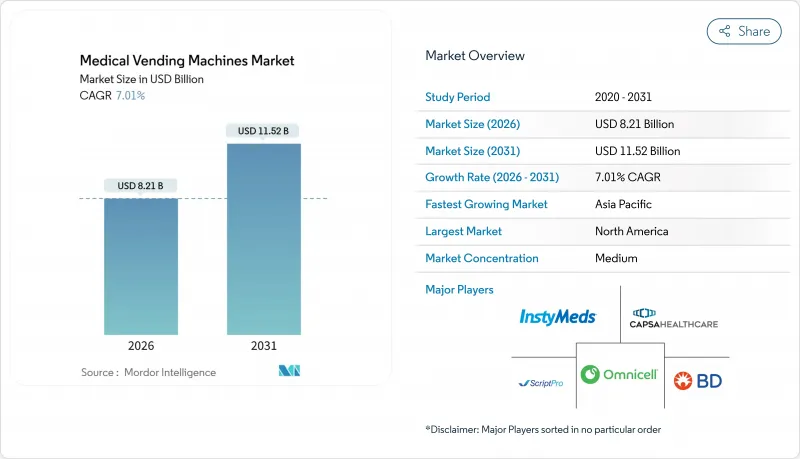
2026 年醫療自動販賣機市場規模估計為 82.1 億美元,預計在預測期(2026-2031 年)內將以 7.01% 的複合年成長率成長,到 2031 年達到 115.2 億美元。
本報告按產品類型(落地式、桌上型/檯面式、壁掛式/緊湊型、智慧配藥櫃)、藥品分類(處方藥等)、技術(RFID技術等)、最終用戶(醫院等)和地區(北美等)進行細分。市場預測以美元計價。
全球醫療自動販賣機市場趨勢及洞察
偏遠和農村地區對處方藥的依賴日益增強
由於藥局短缺,農村地區的患者必須跋涉30英里(約48公里)以上才能補充處方藥,這種不均衡的現狀正在推動醫療自動販賣機市場的需求。社區中心、消防局和便利商店正在安裝可以全天候提供慢性病藥物的自動販賣機,從而降低患者的旅行成本,並有助於提高患者的用藥依從性。洛杉磯縣計劃在2025年推出免費提供納洛酮和新冠病毒檢測套組的自動販賣機,這反映了地方政府如何利用無人值守的自動販賣機來縮小公共衛生差距。在印度,國家衛生任務試點推廣的太陽能自動販賣機正與遠距遠端醫療亭配合使用,幫助鄉村診所避免滯銷藥品庫存積壓。這些案例表明,當基礎設施和遠端檢驗相結合時,醫療自動販賣機市場蘊藏著巨大的潛力。
對即時庫存可見性和解決庫存短缺問題的措施的需求
在美國,醫院每年因庫存去向不明而損失45億美元,而濫用鴉片類藥物的處罰進一步加劇了這項負擔。 BD公司2024年的研究發現,在長期照護機構中,配備生物識別鎖的RFID藥櫃可將不明損失減少高達77%。雲端儀錶板可以檢測異常情況,例如在臨床醫生工作時間之外取藥,從而在濫用情況升級之前觸發合規性審查。 2024年,紐約市健康與醫院管理局整合了旗下11家機構的藥櫃數據,以減少重複訂單並釋放營運資金。這些成果為採購決策提供了支持,並增強了面臨成本壓力的醫療機構對醫療自動販賣機的市場前景。
網路安全和物理濫用風險
2024年,針對醫療產業的勒索軟體攻擊激增。光是Change Healthcare的資料外洩事件,其修復成本就高達23億至25億美元。連網藥品庫同樣脆弱,劑量設定和存取日誌都可能成為駭客的攻擊目標。 2024年5月,Ascension Health遭受網路攻擊,迫使140家醫院恢復紙本流程,導致預定的手術延誤數週。物理性篡改,例如指紋竊取和撬棍攻擊,也構成進一步的風險。儘管供應商現在建議空氣間隙網路、多因素身份驗證和防篡改封條,但日益成長的威脅仍在減緩醫療保健自動販賣機市場的短期發展勢頭。
細分市場分析
到2025年,落地式自動販賣機將佔總銷售額的57.24%。這反映了醫院的需求,例如能夠容納200多種SKU,以及與氣動管道整合以減少護理人員的奔波時間。其較大的面積也支撐了高危機醫療機構中醫療自動販賣機市場的規模。預計到2031年,桌上型和桌上型自動販賣機的複合年成長率將達到11.43%,對於空間預算有限的門診中心、急診診所和職場健康管理辦公室來說,這類自動販賣機極具吸引力。壁掛式和緊湊型自動販賣機則更適合救護車和海上鑽井平台等場所,在這些場所,移動性比庫存量更為重要。智慧分配櫃雖然價格昂貴,但透過降低庫存和人事費用,能夠快速收回投資。
在藥局,桌上型自動販賣機正在取代傳統的藥房櫃檯,使工作人員能夠專注於諮詢,而遠端藥劑師則可以在藥品從抽屜中取出時查看處方箋。急診室的壁掛式設備可在夜班期間為醫護人員提供納洛酮和事後緊急避孕藥的即時供應。人工智慧視覺感測器可以識別藥片的形狀和顏色,並在藥品到達患者手中之前檢測出錯誤。這些技術進步正在推動醫療自動販賣機市場在各類醫療機構中蓬勃發展。
到2025年,處方藥將佔藥品價值佔有率的44.63%,涵蓋從維持治療到需要審計追蹤的管制藥品。非處方藥(OTC)的銷售額在交通樞紐和校園等場所穩步成長。疫情過後,由於醫院為應對激增病例而儲備物資,個人防護工具(PPE)和醫療用品的銷售額仍維持在高位。預計到2031年,疫苗和低溫運輸藥品將以每年10.32%的速度成長,這需要配備緊急電源和持續記錄功能的冷藏櫃,從而擴大了免疫接種計畫中醫療自動販賣機的市場。
低溫運輸設備比常溫設備貴40%到60%,但它使當地診所能夠在現場接種疫苗,從而增加收入並提高疫苗接種率。處方藥自動販賣機受到更嚴格的監管,儘管美國一些州仍然要求在分發麻醉藥品前由藥劑師進行面對面核實。非處方藥自助售貨亭依照零售法律運營,可以安裝在飯店和機場。安裝在走廊的個人防護設備(PPE)櫃子透過減少人工核實和自動化訂購,凸顯了醫療自動販賣機市場的效率優勢。
區域分析
到2025年,北美將佔全球銷售額的33.11%,主要得益於美國醫院自動化醫療櫃的普及率已達86.1%。隨著與電子健康記錄(EHR)的日益融合,這些機器能夠驗證過敏資訊並自動記錄劑量。紐約市公立醫院系統(NYC Health+Hospitals)計劃於2024年在11家醫療機構推廣使用,凸顯了公共部門推動這一趨勢的強勁勢頭。美國食品藥物管理局(FDA)510(k)核准流程的監管澄清,也為投資提供了支持,並鞏固了醫療自動販賣機市場的基礎。
歐洲位居第二,其中德國、法國和英國主導。由於監管差異(一些國家禁止自助處方箋販賣機),各地的普及率有所不同。西班牙和義大利正在透過在鄉村診所安裝小型設備來推廣遠距藥事照護,以應對農村地區老化帶來的醫療服務需求。 GDPR合規性增加了加密和用戶同意的要求,這影響了區域醫療自動販賣機市場供應商的設計選擇。
亞太地區是成長的主要驅動力,預計到2031年複合年成長率將達到10.20%。在中國,將於2026年強制實施的基於區塊鏈的可追溯性要求正在推動自動販賣機的升級。在日本,火車站正在安裝壁掛式自動販賣機,以方便老年人使用;而在印度,北方邦和比哈爾邦正在試行與遠端醫療相連的太陽能自動販賣機。在澳大利亞,處方箋透過「我的健康記錄」與智慧卡關聯,實現了處方的無人處方箋更新。韓國的數位基礎設施,支援物聯網儀表板,可最佳化多個醫院系統的庫存水平,這些因素共同推動了醫療自動販賣機市場的發展。
儘管規模較小,中東、非洲和南美洲的發展勢頭依然強勁。在海灣合作理事會(GCC)國家,自動配藥是智慧醫院計畫的核心。巴西將於2024年推出新的監管政策,允許在藥劑師的監督下於藥房安裝自動販賣機,這將為供應商帶來新的商機。阿根廷布宜諾斯艾利斯和科爾多瓦的試點計畫檢驗了這些系統的可行性,儘管面臨寬頻環境不穩定和電子設備收費等挑戰,這表明醫療自動販賣機市場仍有進一步擴張的空間。
其他好處:
- Excel格式的市場預測(ME)表
- 3個月的分析師支持
目錄
第1章:引言
- 研究假設和市場定義
- 調查範圍
第2章:調查方法
第3章執行摘要
第4章 市場狀況
- 市場概覽
- 市場促進因素
- 偏遠和農村地區對處方藥的依賴日益增強
- 對即時庫存可見性和庫存損失管理的需求
- 慢性病負擔日益加重,使得全天候取得藥品的需求日益迫切。
- 與遠距藥事照護和電子處方箋平台整合
- 基於區塊鏈的藥品分發認證以防止假冒
- 醫院個人防護裝備和耗材的微型倉配
- 市場限制因素
- 網路安全和物理濫用風險
- 涉及多個國家的複雜法規核准程序
- 小規模場所的維護、補給和校準成本很高。
- 消費者對自動販賣機銷售的藥品缺乏信任。
- 價值供應鏈分析
- 監理情勢
- 技術展望
- 波特五力分析
第5章 市場規模與成長預測
- 依產品類型
- 固定式機器
- 桌上型/工作台機械
- 壁掛式/緊湊型
- 智慧分送櫃
- 按藥物分類
- 處方藥
- 非處方藥(OTC)
- 個人防護工具(PPE)和醫療用品
- 疫苗和低溫運輸藥品
- 透過技術
- 支援RFID功能的設備
- 僅條碼系統
- 物聯網/雲端連接設備
- 基於人工智慧視覺的配藥
- 最終用戶
- 醫院和專科診所
- 零售藥局和藥房
- 職場/企業診所
- 交通及公共設施
- 偏遠和農村地區的醫療中心
- 按地區
- 北美洲
- 美國
- 加拿大
- 墨西哥
- 歐洲
- 德國
- 法國
- 英國
- 義大利
- 西班牙
- 其他歐洲國家
- 亞太地區
- 中國
- 日本
- 印度
- 韓國
- 澳洲
- 其他亞太國家
- 中東和非洲
- GCC
- 南非
- 其他中東和非洲國家
- 南美洲
- 巴西
- 阿根廷
- 其他南美國家
- 北美洲
第6章 競爭情勢
- 市場集中度
- 市佔率分析
- 公司簡介
- Advantage Vending & Distribution
- Asteres Inc.
- Becton, Dickinson and Company
- Capsa Healthcare
- CVS Health Corporation
- Evoca Group
- InstyMeds Corporation
- Magex LLC
- MedAvail Holdings Inc.
- Omnicell Inc.
- Parata Systems LLC
- Pharmashop24 srl
- RXAutomated Solutions
- ScriptPro LLC
- Shanghai Tongsan Vending
- SuZhou Ruiling Medical
- Tabula Rasa HealthCare(DosePak)
- Talyst Systems LLC
- Xenco Medical
- Yuyama Co., Ltd.
第7章 市場機會與未來展望
According to Mordor Intelligence, the medical vending machines market size is estimated at USD 8.21 billion in 2026, and is expected to reach USD 11.52 billion by 2031, at a CAGR of 7.01% during the forecast period (2026-2031).
This report is Segmented by Product Type (Floor-Standing Machines, Countertop/Benchtop Machines, Wall-Mounted/Compact Units, Smart Dispensing Cabinets), Medication Class (Prescription Drugs, and More), Technology (RFID-Enabled, and More), End User (Hospitals, and More), and Geography (North America, and More). Market Forecasts are Provided in Terms of Value (USD).
Global Medical Vending Machines Market Trends and Insights
Growing Dependency on Prescription Medicines in Remote & Rural Areas
Pharmacy deserts leave patients in rural districts traveling 30 miles or more for refills, a gap that fuels demand in the medical vending machines market. Community centers, fire stations, and convenience stores host 24/7 machines that dispense chronic-disease drugs, lowering travel costs and improving adherence. Los Angeles County's 2025 rollout of free units stocked with naloxone and COVID-19 tests illustrates how municipalities leverage unattended cabinets to close public-health gaps. In India, solar-powered dispensers piloted under the National Health Mission pair with telemedicine kiosks, helping village clinics avoid over-stocking slow-moving SKUs. Such deployments demonstrate the medical vending machines market potential when infrastructure and remote verification converge.
Demand for Real-Time Inventory Visibility & Shrinkage Control
Unaccounted inventory costs U.S. hospitals USD 4.5 billion annually, a burden magnified by opioid diversion penalties. RFID cabinets with biometric locks have cut unexplained losses by up to 77% in long-term-care settings, according to a 2024 BD study. Cloud dashboards surface anomalies-such as withdrawals outside a clinician's shift-and trigger compliance reviews before diversion escalates. New York City Health + Hospitals unified cabinet data across 11 facilities in 2024, trimming duplicate purchase orders and freeing working capital. These gains reinforce purchasing decisions, strengthening the medical vending machines market outlook among cost-pressured providers.
Cyber-Security & Physical Misuse Risks
Healthcare ransomware attacks spiked in 2024; the Change Healthcare breach alone imposed USD 2.3 billion to USD 2.5 billion in remediation costs. Connected cabinets inherit these vulnerabilities, exposing dose settings and access logs to hackers. Ascension Health's May 2024 cyberattack forced 140 hospitals back to paper workflows, delaying elective surgeries for weeks. Physical tampering-such as stolen fingerprints or crowbar attacks-adds another risk layer. Vendors now promote air-gapped networks, multifactor log-ins, and tamper seals, yet rising threat vectors still temper near-term momentum in the medical vending machines market.
Other drivers and restraints analyzed in the detailed report include:
- Rising Chronic-Disease Burden Driving 24/7 Medication Access
- Integration with Tele-Pharmacy & E-Prescription Platforms
- Complex Multi-Country Regulatory Approvals
For complete list of drivers and restraints, kindly check the Table Of Contents.
Segment Analysis
Floor-standing machines captured 57.24% revenue in 2025, reflecting hospitals' need for 200-plus SKU capacity and integration with pneumatic tubes that cut nurse walk-time. Their footprint anchors the medical vending machines market size in high-acuity settings. Countertop and benchtop models, forecast to post an 11.43% CAGR to 2031, appeal to ambulatory centers, urgent-care clinics, and workplace health rooms that face tight real-estate budgets. Wall-mounted and compact units address EMS vehicles and offshore rigs where mobility trumps inventory depth. Smart dispensing cabinets, while pricey, deliver rapid payback by reducing shrinkage and labor.
Countertop machines are edging out traditional pharmacy counters in drugstores as remote pharmacists verify scripts while the drawer dispenses, freeing staff for counseling. Wall-mounted units in emergency departments provide immediate naloxone or emergency contraception access during overnight shifts. AI vision sensors identify pill shape and color, flagging errors before they reach patients. These evolutions keep the medical vending machines market vibrant across facility types.
Prescription drugs held 44.63% value share in 2025, spanning maintenance therapies and controlled substances that demand audit trails. Over-the-counter items grow steadily in transport hubs and campuses. PPE and supplies stabilized at higher baselines post-pandemic as hospitals maintain surge stockpiles. Vaccines and cold-chain drugs, expected to grow 10.32% annually to 2031, require refrigerated cabinets fitted with backup power and continuous logging, expanding the medical vending machines market size in immunization programs.
Cold-chain units cost 40%-60% more than ambient models yet enable rural clinics to administer shots on-site, boosting revenues and coverage. Prescription-drug vending faces stricter oversight; several U.S. states still mandate live pharmacist review before dispensing narcotics. OTC kiosks operate under retail statutes, opening placement in hotels and airports. PPE cabinets in corridors cut manual checks and automate orders, underscoring the medical vending machines market efficiency benefits.
Complete Report Scope:
- By Product Type
- Floor-Standing Machines
- Countertop / Benchtop Machines
- Wall-Mounted / Compact Units
- Smart Dispensing Cabinets
- By Medication Class
- Prescription Drugs
- Over-the-Counter (OTC) Medicines
- PPE & Medical Supplies
- Vaccines & Cold-Chain Drugs
- By Technology
- RFID-Enabled Machines
- Barcode-Only Systems
- IoT / Cloud-Connected Units
- AI Vision-Based Dispensing
- By End User
- Hospitals & Specialty Clinics
- Retail Pharmacies & Drugstores
- Workplace & Corporate Clinics
- Transportation & Public Venues
- Remote & Rural Health Centres
- By Geography
- North America
- United States
- Canada
- Mexico
- Europe
- Germany
- France
- United Kingdom
- Italy
- Spain
- Rest of Europe
- Asia-Pacific
- China
- Japan
- India
- South Korea
- Australia
- Rest of Asia-Pacific
- Middle East & Africa
- GCC
- South Africa
- Rest of Middle East & Africa
- South America
- Brazil
- Argentina
- Rest of South America
- North America
Geography Analysis
North America held 33.11% revenue share in 2025, anchored by 86.1% U.S. hospital penetration of automated cabinets. Mature EHR integration lets machines verify allergies and log doses automatically. NYC Health + Hospitals' 2024 rollout across 11 facilities underscores public-sector momentum. Regulatory clarity via the FDA's 510(k) pathway sustains investment, reinforcing the medical vending machines market foothold.
Europe sits second, with Germany, France, and the U.K. leading. Fragmented oversight-some states ban unattended prescription vending-creates uneven uptake. Spain and Italy push telepharmacy to serve aging rural areas, installing compact units in village posts. GDPR compliance adds encryption and consent requirements, influencing vendor design choices in the regional medical vending machines market.
Asia-Pacific is the growth engine, forecast at 10.20% CAGR to 2031. China's 2026 blockchain traceability mandate drives cabinet upgrades. Japan installs wall units in train stations for elderly convenience, while India pilots solar-powered dispensers tied to telemedicine in Uttar Pradesh and Bihar. Australia links scripts to smart cards via My Health Record, enabling unattended refills. South Korea's digital infrastructure supports IoT dashboards that optimize par levels across multi-hospital systems, collectively propelling the medical vending machines market forward.
Middle East & Africa and South America remain smaller yet active. GCC smart-hospital projects include automated dispensing as a pillar. Brazil's 2024 rule change allowed cabinets in pharmacies under pharmacist oversight, opening new lanes for vendors. Argentina's pilots in Buenos Aires and Cordoba test viability despite patchy broadband and electronics tariffs, signaling incremental room for the medical vending machines market to expand.
- Advantage Vending & Distribution
- Asteres Inc.
- Beckton Dickinson
- Capsa Healthcare
- CVS Health
- Evoca Group
- InstyMeds Corporation
- Magex LLC
- MedAvail Holdings Inc.
- Omnicell
- Parata Systems
- Pharmashop24
- RXAutomated Solutions
- ScriptPro
- Shanghai Tongsan Vending
- SuZhou Ruiling Medical
- Tabula Rasa HealthCare (DosePak)
- Talyst Systems LLC
- Xenco Medical
- Yuyama Co., Ltd.
Additional Benefits:
- The market estimate (ME) sheet in Excel format
- 3 months of analyst support
TABLE OF CONTENTS
1 Introduction
- 1.1 Study Assumptions & Market Definition
- 1.2 Scope of the Study
2 Research Methodology
3 Executive Summary
4 Market Landscape
- 4.1 Market Overview
- 4.2 Market Drivers
- 4.2.1 Growing Dependency on Prescription Medicines in Remote & Rural Areas
- 4.2.2 Demand for Real-Time Inventory Visibility & Shrinkage Control
- 4.2.3 Rising Chronic-Disease Burden Driving 24/7 Medication Access
- 4.2.4 Integration With Tele-Pharmacy & E-Prescription Platforms
- 4.2.5 Blockchain-Enabled Anti-Counterfeit Dispensing Authentication
- 4.2.6 Hospital Micro-Fulfillment for PPE & Consumables
- 4.3 Market Restraints
- 4.3.1 Cyber-Security & Physical Misuse Risks
- 4.3.2 Complex Multi-Country Regulatory Approvals
- 4.3.3 High Service, Refill & Calibration Costs in Low-Volume Sites
- 4.3.4 Consumer Trust Gap Around Machine-Dispensed Medicines
- 4.4 Value / Supply-Chain Analysis
- 4.5 Regulatory Landscape
- 4.6 Technological Outlook
- 4.7 Porter's Five Forces Analysis
- 4.7.1 Threat of New Entrants
- 4.7.2 Bargaining Power of Buyers
- 4.7.3 Bargaining Power of Suppliers
- 4.7.4 Threat of Substitutes
- 4.7.5 Intensity of Competitive Rivalry
5 Market Size & Growth Forecasts (Value in USD)
- 5.1 By Product Type
- 5.1.1 Floor-Standing Machines
- 5.1.2 Countertop / Benchtop Machines
- 5.1.3 Wall-Mounted / Compact Units
- 5.1.4 Smart Dispensing Cabinets
- 5.2 By Medication Class
- 5.2.1 Prescription Drugs
- 5.2.2 Over-the-Counter (OTC) Medicines
- 5.2.3 PPE & Medical Supplies
- 5.2.4 Vaccines & Cold-Chain Drugs
- 5.3 By Technology
- 5.3.1 RFID-Enabled Machines
- 5.3.2 Barcode-Only Systems
- 5.3.3 IoT / Cloud-Connected Units
- 5.3.4 AI Vision-Based Dispensing
- 5.4 By End User
- 5.4.1 Hospitals & Specialty Clinics
- 5.4.2 Retail Pharmacies & Drugstores
- 5.4.3 Workplace & Corporate Clinics
- 5.4.4 Transportation & Public Venues
- 5.4.5 Remote & Rural Health Centres
- 5.5 By Geography
- 5.5.1 North America
- 5.5.1.1 United States
- 5.5.1.2 Canada
- 5.5.1.3 Mexico
- 5.5.2 Europe
- 5.5.2.1 Germany
- 5.5.2.2 France
- 5.5.2.3 United Kingdom
- 5.5.2.4 Italy
- 5.5.2.5 Spain
- 5.5.2.6 Rest of Europe
- 5.5.3 Asia-Pacific
- 5.5.3.1 China
- 5.5.3.2 Japan
- 5.5.3.3 India
- 5.5.3.4 South Korea
- 5.5.3.5 Australia
- 5.5.3.6 Rest of Asia-Pacific
- 5.5.4 Middle East & Africa
- 5.5.4.1 GCC
- 5.5.4.2 South Africa
- 5.5.4.3 Rest of Middle East & Africa
- 5.5.5 South America
- 5.5.5.1 Brazil
- 5.5.5.2 Argentina
- 5.5.5.3 Rest of South America
- 5.5.1 North America
6 Competitive Landscape
- 6.1 Market Concentration
- 6.2 Market Share Analysis
- 6.3 Company Profiles (includes Global level Overview, Market level overview, Core Segments, Financials as available, Strategic Information, Market Rank/Share for key companies, Products and Services, and Recent Developments)
- 6.3.1 Advantage Vending & Distribution
- 6.3.2 Asteres Inc.
- 6.3.3 Becton, Dickinson and Company
- 6.3.4 Capsa Healthcare
- 6.3.5 CVS Health Corporation
- 6.3.6 Evoca Group
- 6.3.7 InstyMeds Corporation
- 6.3.8 Magex LLC
- 6.3.9 MedAvail Holdings Inc.
- 6.3.10 Omnicell Inc.
- 6.3.11 Parata Systems LLC
- 6.3.12 Pharmashop24 srl
- 6.3.13 RXAutomated Solutions
- 6.3.14 ScriptPro LLC
- 6.3.15 Shanghai Tongsan Vending
- 6.3.16 SuZhou Ruiling Medical
- 6.3.17 Tabula Rasa HealthCare (DosePak)
- 6.3.18 Talyst Systems LLC
- 6.3.19 Xenco Medical
- 6.3.20 Yuyama Co., Ltd.
7 Market Opportunities & Future Outlook
- 7.1 White-space & Unmet-Need Assessment

 2026-2030年全球自動販賣機食品飲料市場
 智慧自動販賣機食品解決方案市場預測至2034年-全球分析(按產品類型、技術整合、安裝位置、經營模式、食品類別創新、消費者細分和區域分類)
 連網自動販賣機:市場佔有率分析、產業趨勢與統計及成長預測(2026-2031 年)北美和歐洲自動販賣機:市場佔有率分析、行業趨勢和統計數據以及成長預測(2026-2031 年)自動販賣機:市場佔有率分析、產業趨勢與統計、成長預測(2026-2031)
 零售自動販賣機市場-2026-2032年全球市場預測
 全球冷藏自動販賣機市場規模、佔有率、趨勢和成長分析報告(2026-2034)
 2026-2030年全球自動販賣機市場
 2026年全球生牛奶起司旅遊市場報告
 零售自動販賣機市場規模、佔有率和成長分析:按型號、產品類型、安裝類型、所有權模式、最終用戶和地區分類-2026-2033年產業預測