


 |
市場調查報告書
商品編碼
2114488
壓鑄機械:市場佔有率分析、產業趨勢與統計、成長預測(2026-2031)Die Casting Machinery - Market Share Analysis, Industry Trends & Statistics, Growth Forecasts (2026 - 2031) |
||||||

※ 本網頁內容可能與最新版本有所差異。詳細情況請與我們聯繫。
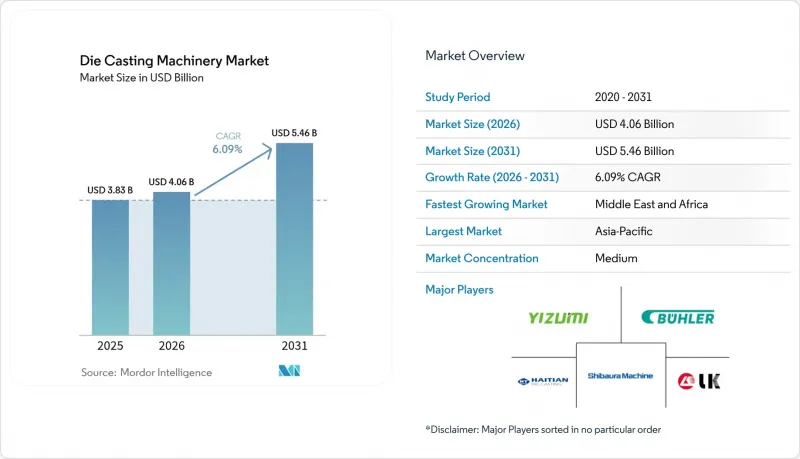
根據 Mordor Intelligence 預測,壓鑄機市場規模將從 2025 年的 38.3 億美元成長到 2026 年的 40.6 億美元,然後在 2031 年達到 54.6 億美元,2026 年至 2031 年的複合年成長率為 6.09%。
本報告按機器類型(熱室壓鑄機和冷室壓鑄機)、材料類型(鋁等)、終端用戶行業(汽車、電氣電子設備等)、沖壓能力(小於50噸等)、自動化程度(手動、半自動、全自動)和地區進行細分。市場預測以美元計價。
全球壓鑄機械市場趨勢及洞察
電動車主導巨型/超大型鑄造需求激增
高噸位壓平機透過將後底盤鑄件一次性生產出來,取代了多個零件,從而簡化了生產流程。繼特斯拉專案取得成功後,福特、Volvo和通用汽車也開始採用在車輛整個生命週期中依賴GigaPress供應的結構架構。中國汽車製造商,例如萬風奧威,正在擴大鎂合金巨型鑄件的測試,旨在滿足底盤整合電池組的需求。在競爭日益激烈的背景下,壓鑄機械市場正在分化為兩個截然不同的領域:傳統的中噸位生產線和專門用於關鍵結構件的高投資GigaPress設備。隨著電池和底盤整合成為設計標準,市場需求預測將持續到2030年以後,預計在三大洲的多個工廠都將迎來一波投資熱潮。
電子設備的微型化正在推動對高溫腔室的需求。
隨著半導體封裝技術的演進,高精度壓鑄解決方案的需求激增。凸塊間距的縮小提高了對具有嚴格加工公差的機殼和散熱器的要求。為了滿足這些嚴苛的標準,高速循環熱室系統,特別是採用鋅和鎂的熱室系統,正受到越來越多的關注。為台積電和英特爾等大型公司提供支援的鑄造製造商正在採用多滑塊鑄造單元,這些單元能夠提供卓越的熔融金屬溫度控制和快速的循環時間,以滿足現代電子製造的需求。在5G基礎設施領域,大規模鎂鑄造生產線供應天線外殼等輕量化組件,進一步證明了熱室鑄造技術的效用。鑽石半導體和量子運算等新興應用領域預計將需要先進的溫度控管,這將進一步提升熱室系統的重要性。由於熱室系統能夠快速適應各種產品類型,因此是高混合生產環境的理想選擇,在這些環境中,柔軟性和精確度至關重要。
鋁和鎂價格波動
2024年,倫敦金屬交易所(LME)鋁價在每噸2100美元至2400美元之間波動,而鎂價由於中國供應集中,波動幅度更大。原料是成品零件的關鍵成本組成部分,正給鑄造利潤帶來壓力。鑄造製造商正採用避險策略來應對價格波動。儘管產量不斷成長,但由於投入成本波動,一些製造商的銷售額卻出現下滑。能源成本,尤其是熔爐用電成本,對盈利產生了顯著影響。價格飆升會立即轉化為財務負擔。鑄造製造商正在採取一些短期措施,例如供應商多元化和合金替代,但這些只是暫時的緩解。持續的成本波動正在減緩壓鑄機械市場的投資,儘管技術不斷進步,但相關人員仍保持謹慎。
細分市場分析
到2025年,冷室壓鑄機將佔據壓鑄機市場63.72%的佔有率,這反映了其在高溫鋁合金壓鑄方面的優勢。熱室壓鑄機雖然裝機量較少,但隨著電子相關產品訂單的成長,預計其年複合成長率將達到6.58%。隨著原始設備製造商(OEM)轉向使用一體式鑄件生產電動車車身,與GigaPress冷室生產線相關的壓鑄機市場正在擴張,平均噸位也在不斷提高。目前,這兩類壓鑄機都在擴大整合伺服注射系統和封閉回路型冷卻系統,這表明它們的功能正在趨於融合。
在熱室細分市場中,鋅合金多滑塊平台滿足了5G無線電機殼30秒的循環時間要求,而鎂合金系統則在以輕量化而非耐腐蝕性為優先考慮的領域表現出色。工業4.0模組可對這兩種類型的機器進行改造,收集熔融金屬和柱塞資料以進行雲端分析。熱回收選項和混合驅動液壓系統可降低能耗並改善整體擁有成本。隨著品質公差的日益嚴格,這兩種類型的機器均採用在線X光和超音波檢測來檢驗壓機出口處的近淨成形。原始設備製造商(OEM)的雙供應商籌資策略維持了壓鑄機市場需求的多元化。
鋁材憑藉其在電動車平台中優異的強度重量比,在2025年佔據了壓鑄機械市場72.75%的主導佔有率。鎂材比鋁材輕35%,預計到2031年將以7.42%的複合年成長率成長,這主要得益於通訊設備和筆記型電腦機殼對輕量化的需求。雖然鋁材仍然用於汽車超大型鑄造,以吸收碰撞時的能量,但鎂材正擴大應用於內裝支架和方向盤的製造。
鋅因其在短循環週期內優異的尺寸穩定性,仍是複雜硬體和微機電系統(MEMS)外殼的重要材料。新型合金,例如鋁鈧合金,正在改善電池機殼的焊接性能並拓展其應用範圍。基底金屬價格的波動促使用戶根據期貨合約進行合金調配。然而,對於關鍵任務部件而言,效能要求正日益優先於成本因素。持續監測熔融金屬的質量,可以在不污染保溫爐的情況下切換合金,這項技術在壓鑄機械市場變得越來越普及。
區域分析
預計到2025年,亞太地區將佔全球銷售額的46.55%,主要得益於中國高效的供應鏈以及印度電動車組裝廠的擴張。日本企業透過持續出口高階機械設備和加大對鑽石半導體的研發投入,為區域創新提供支援。韓國封裝巨頭正在推動對熱室設備的需求,而東南亞國協則在扶持中型生產線的契約製造中心。
歐洲的成長主要得益於為滿足監管要求而進行的設備升級,因為BAT-2024標準要求工廠淘汰高能耗的壓力機。德國的ReGAIN聯盟正在進行先導計畫,將人工智慧助理與低碳電力合約結合。在義大利Lombardia叢集,隨形冷卻工具正被大規模採用,而北歐的鑄造廠則正在實施封閉回路型水循環系統,以符合嚴格的排放上限要求。
中東和非洲地區雖然從絕對值來看仍處於起步階段,但根據其經濟多元化藍圖,預計將實現7.74%的複合年成長率,其中包括對鋁冶煉廠、電網升級和技能培訓學院的資金支持。沙烏地阿拉伯的「2030願景」正在推動其本土汽車零件計畫的發展,而埃及則在吸引尋求免關稅進入歐盟市場的電子組裝製造商。電網限制仍阻礙著千兆壓機的普及,但模組化微電網和太陽能熱電汽電共生計畫預計在未來十年為大規模壓機部署創造機會。北美在產量成長方面落後於亞洲,但受益於有利於國內結構件鑄造產能的電動車稅收優惠政策。生產回流和「購買美國貨」條款正在進一步鞏固該地區在壓鑄機械市場的佔有率。
其他好處:
- Excel格式的市場預測(ME)表
- 3個月的分析師支持
目錄
第1章:引言
- 研究假設和市場定義
- 調查範圍
第2章:調查方法
第3章執行摘要
第4章 市場狀況
- 市場概覽
- 市場促進因素
- 電動車主導巨型/超大型鑄造需求激增
- 電子設備的微型化正在推動對高溫腔室的需求成長。
- 工業4.0改裝正在取代老舊的印刷機。
- 遵守歐盟BAT-2024法規正在推動維修以提高能源效率。
- 棕地流變鑄造改裝套件,適用於結構構件
- 採用積層製造技術的保形模具的模具更換時間
- 市場限制因素
- 鋁鎂價格波動
- 引進 Gigapress 的資本投資面臨障礙,成本超過 1,000 萬歐元。
- 新興市場電網當前容量不足
- 超高等級熱作模具鋼供不應求
- 價值供應鏈分析
- 監理情勢
- 技術展望
- 波特五力模型
第5章 市場規模與成長預測
- 按機器類型
- 熱室壓鑄機
- 冷室式壓鑄機
- 材料類型
- 鋁
- 鋅
- 鎂
- 其他
- 按最終用戶行業分類
- 車
- 電氣和電子設備
- 航太
- 工業製造
- 其他
- 拳擊能力
- 不到50噸
- 50-100噸
- 超過100噸
- 按自動化級別
- 手動的
- 半自動
- 全自動
- 按地區
- 北美洲
- 美國
- 加拿大
- 其他北美國家
- 南美洲
- 巴西
- 阿根廷
- 其他南美國家
- 歐洲
- 德國
- 英國
- 法國
- 義大利
- 西班牙
- 其他歐洲國家
- 亞太地區
- 中國
- 印度
- 日本
- 韓國
- 其他亞太國家
- 中東和非洲
- 阿拉伯聯合大公國
- 沙烏地阿拉伯
- 南非
- 土耳其
- 其他中東和非洲國家
- 北美洲
第6章 競爭情勢
- 市場集中度
- 策略趨勢
- 市佔率分析
- 公司簡介
- Buhler Group
- LK Technology Holdings Limited
- Shibaura Machine
- Haitian Die Casting
- Yizumi Holdings Co., Ltd.
- ItalpresseGauss
- Toyo Machine Manufacturing Co., Ltd
- UBE Machinery Inc.
- Birch Machinery Company
- Guangdong Hongtu Technology(Holdings)Co.,Ltd.
- Colosio Srl
- Zitai Precision Machinery Co., Ltd.
- Suzhou Sanji Foundry Equipment Co.,Ltd
- Wuxi Xinjiasheng
- Pace Industries LLC
- Dynacast(Form Technologies)
第7章 市場機會與未來展望
According to Mordor Intelligence, the die casting machinery market size is expected to grow from USD 3.83 billion in 2025 to USD 4.06 billion in 2026 and is forecast to reach USD 5.46 billion by 2031 at 6.09% CAGR over 2026-2031.
This report is Segmented by Machine Type (Hot Chamber Die Casting Machines and Cold Chamber Die Casting Machines), Material Type (Aluminum and More), End-User Industry (Automotive, Electrical and Electronics, and More), Punching Capacity (Below 50 Tons and More), Automation Level (Manual, Semi-Automated, and Fully Automated), and Geography. The Market Forecasts are Provided in Terms of Value (USD).
Global Die Casting Machinery Market Trends and Insights
EV-Led Mega-/Giga-Casting Demand Surge
High-tonnage presses produce single-piece rear underbody castings, replacing multiple components and streamlining production. Tesla's program success encouraged Ford, Volvo, and GM to commit to structural architectures that depend on giga-press supplies throughout the vehicle lifecycle. Chinese OEMs such as Wanfeng Aowe are expanding magnesium mega-cast trials, aiming to capitalize on chassis-integrated battery packs. As competition intensifies, the die casting machinery market is bifurcating into two distinct segments: conventional mid-tonnage lines and high-investment giga-press setups, which are tailored for significant structural components. Demand visibility extends beyond 2030 as battery-to-chassis integration becomes a design standard, ensuring multi-plant investment waves across three continents.
Electronics Miniaturization Boosting Hot-Chamber Demand
As semiconductor packaging evolves, the demand for precise die casting solutions surges. With bump pitches tightening, there's a heightened demand for casings and heat-spreaders that boast tight machining tolerances. To meet these exacting standards, fast-cycle hot-chamber systems, particularly those utilizing zinc and magnesium, are gaining traction. Foundries supporting major players like TSMC and Intel are adopting multi-slide casting cells, which offer superior melt temperature control and rapid cycle times to meet the needs of modern electronics manufacturing. In 5G infrastructure, large-scale magnesium casting lines are supplying lightweight components, such as antenna housings, which reinforces the case for hot-chamber casting technologies. Emerging applications in diamond semiconductors and quantum computing are expected to demand advanced thermal management, further solidifying the relevance of hot-chamber systems. Their quick adaptability to various product types makes them ideal for high-mix production environments that require flexibility and precision.
Aluminum and Magnesium Price Volatility
LME aluminum prices fluctuated between USD 2,100 and USD 2,400 per metric ton during 2024, while magnesium prices gyrated even more sharply due to heavy Chinese supply concentration. Raw materials, a significant cost component for finished components, are pressuring casting margins. Foundries are adopting hedging strategies to manage volatility. Despite higher production volumes, some manufacturers face revenue declines due to fluctuating input costs. Energy costs, particularly electricity for melt furnaces, have a significant impact on profitability. Price spikes lead to immediate financial strain. Foundries are using short-term measures, such as dual sourcing and alloy substitution, but these offer only temporary relief. Persistent cost instability is dampening investment in the die casting machinery market, with stakeholders adopting cautious approaches despite ongoing technological advancements.
Other drivers and restraints analyzed in the detailed report include:
- Industry 4.0 Retrofits Replacing Legacy Presses
- EU BAT-2024 Compliance Driving Energy-Efficient Upgrades
- Grid Amperage Deficits in Emerging Markets
For complete list of drivers and restraints, kindly check the Table Of Contents.
Segment Analysis
Cold-chamber units accounted for 63.72% of the die casting machinery market share in 2025, reflecting their suitability for high-temperature aluminum alloys. Hot-chamber machines, while smaller in installed base, are tracking a 6.58% CAGR as electronics contracts escalate. The die casting machinery market size attached to giga-press cold-chamber lines is growing as OEMs transition to single-piece EV body castings, driving the average tonnage upward. Integrated servo shot systems and closed-loop cooling now appear on both machine classes, signaling feature convergence.
In hot-chamber niches, zinc multi-slide platforms meet 30-second takt-time mandates for 5G radio casings, whereas magnesium systems win where weight trimming outranks corrosion concerns. Industry 4.0 modules retrofit across both types, collecting melt and plunger data for cloud analytics. Heat-recovery options and hybrid drive hydraulics cut power draw, improving total cost of ownership. As quality tolerance windows shrink, both machine types embrace inline X-ray and ultrasonic inspection to verify near-net geometry at the press exit. Dual-supplier sourcing strategies by OEMs sustain demand diversity across the die casting machinery market.
Aluminum held a commanding 72.75% share of the 2025 die casting machinery market size due to its favorable strength-to-weight ratio for EV platforms. Magnesium, which is 35% lighter, is on track for a 7.42% CAGR through 2031 as telecom gear and laptop frames pursue weight savings. Automotive giga-casting still relies on aluminum for crash energy absorption, but interior brackets and steering wheels are increasingly being made from magnesium.
Zinc remains vital for intricately detailed hardware and MEMS housings, as it is favored for its dimensional stability at low cycle times. New alloy families, such as aluminum-scandium, improve weldability in battery enclosures, broadening the application scope. Volatility in base-metal pricing prompts users to blend alloys based on forward contracts, but performance needs increasingly trump cost factors for mission-critical parts. Continuous melt-quality monitoring facilitates switching between alloys without contaminating holding furnaces, a practice gaining traction across the die-casting machinery market.
Complete Report Scope:
- By Machine Type
- Hot Chamber Die Casting Machines
- Cold Chamber Die Casting Machines
- By Material Type
- Aluminum
- Zinc
- Magnesium
- Others
- By End-User Industry
- Automotive
- Electrical and Electronics
- Aerospace
- Industrial Manufacturing
- Others
- By Punching Capacity
- Below 50 Tons
- 50 - 100 Tons
- Above 100 Tons
- By Automation Level
- Manual
- Semi-Automated
- Fully Automated
- By Geography
- North America
- United States
- Canada
- Rest of North America
- South America
- Brazil
- Argentina
- Rest of South America
- Europe
- Germany
- United Kingdom
- France
- Italy
- Spain
- Rest of Europe
- Asia-Pacific
- China
- India
- Japan
- South Korea
- Rest of Asia-Pacific
- Middle East and Africa
- United Arab Emirates
- Saudi Arabia
- South Africa
- Turkey
- Rest of Middle East and Africa
- North America
Geography Analysis
Asia-Pacific secured 46.55% of 2025 revenue, lifted by China's cost-efficient supply chain and India's ascending EV assembly footprint. Japanese firms sustain premium machine exports and diamond semiconductor research and development, undergirding regional innovation. South Korea's packaging giants are reinforcing demand for hot-chamber equipment, while ASEAN nations are incubating contract manufacturing hubs for mid-capacity lines.
Europe's growth rests on compliance-driven replacement as BAT-2024 forces energy-wasteful presses off the floor. Germany's ReGAIN consortium serves as a pilot, merging AI assistants with low-carbon electricity contracts. Italy's Lombardy cluster adopts conformal-cooling tooling at scale, while Nordic foundries push closed-loop water systems to align with strict emissions caps.
The Middle East and Africa, although still in its early stages in terms of absolute volume, is expected to record a 7.74% CAGR as economic diversification blueprints finance aluminum smelters, grid upgrades, and skill academies. Saudi Arabia's Vision 2030 triggers local automotive component programs, and Egypt courts electronics assemblers seeking tariff-free access to the EU. Grid limitations still hinder giga-press rollouts, but modular micro-grids and solar cogeneration projects aim to unlock large-scale press opportunities in the coming decade. North America trails Asia in tonnage additions but benefits from EV tax incentives that favor domestic structural casting capacity. Reshoring campaigns and Buy American clauses further bolster the regional share of the die casting machinery market.
- Buhler Group
- L.K. Technology Holdings Limited
- Shibaura Machine
- Haitian Die Casting
- Yizumi Holdings Co., Ltd.
- ItalpresseGauss
- Toyo Machine Manufacturing Co., Ltd
- UBE Machinery Inc.
- Birch Machinery Company
- Guangdong Hongtu Technology (Holdings) Co.,Ltd.
- Colosio Srl
- Zitai Precision Machinery Co., Ltd.
- Suzhou Sanji Foundry Equipment Co.,Ltd
- Wuxi Xinjiasheng
- Pace Industries LLC
- Dynacast (Form Technologies)
Additional Benefits:
- The market estimate (ME) sheet in Excel format
- 3 months of analyst support
TABLE OF CONTENTS
1 Introduction
- 1.1 Study Assumptions and Market Definition
- 1.2 Scope of the Study
2 Research Methodology
3 Executive Summary
4 Market Landscape
- 4.1 Market Overview
- 4.2 Market Drivers
- 4.2.1 EV-Led Mega-/Giga-Casting Demand Surge
- 4.2.2 Electronics Miniaturization Boosting Hot-Chamber Demand
- 4.2.3 Industry 4.0 Retrofits Replacing Legacy Presses
- 4.2.4 EU BAT-2024 Compliance Driving Energy-Efficient Upgrades
- 4.2.5 Brown-Field Rheocasting Retro-Kits for Structural Parts
- 4.2.6 Additive Manufactured Conformal Dies Cutting Change-Over Time
- 4.3 Market Restraints
- 4.3.1 Aluminum and Mg Price Volatility
- 4.3.2 EUR 10 m-Plus Giga-Press CAPEX Barrier
- 4.3.3 Grid Amperage Deficits in Emerging Markets
- 4.3.4 Short Supply of Ultra-Premium Hot-Work Tool Steels
- 4.4 Value / Supply-Chain Analysis
- 4.5 Regulatory Landscape
- 4.6 Technological Outlook
- 4.7 Porter's Five Forces
- 4.7.1 Threat of New Entrants
- 4.7.2 Bargaining Power of Suppliers
- 4.7.3 Bargaining Power of Buyers
- 4.7.4 Threat of Substitutes
- 4.7.5 Competitive Rivalry
5 Market Size and Growth Forecasts (Value, USD)
- 5.1 By Machine Type
- 5.1.1 Hot Chamber Die Casting Machines
- 5.1.2 Cold Chamber Die Casting Machines
- 5.2 By Material Type
- 5.2.1 Aluminum
- 5.2.2 Zinc
- 5.2.3 Magnesium
- 5.2.4 Others
- 5.3 By End-User Industry
- 5.3.1 Automotive
- 5.3.2 Electrical and Electronics
- 5.3.3 Aerospace
- 5.3.4 Industrial Manufacturing
- 5.3.5 Others
- 5.4 By Punching Capacity
- 5.4.1 Below 50 Tons
- 5.4.2 50 - 100 Tons
- 5.4.3 Above 100 Tons
- 5.5 By Automation Level
- 5.5.1 Manual
- 5.5.2 Semi-Automated
- 5.5.3 Fully Automated
- 5.6 By Geography
- 5.6.1 North America
- 5.6.1.1 United States
- 5.6.1.2 Canada
- 5.6.1.3 Rest of North America
- 5.6.2 South America
- 5.6.2.1 Brazil
- 5.6.2.2 Argentina
- 5.6.2.3 Rest of South America
- 5.6.3 Europe
- 5.6.3.1 Germany
- 5.6.3.2 United Kingdom
- 5.6.3.3 France
- 5.6.3.4 Italy
- 5.6.3.5 Spain
- 5.6.3.6 Rest of Europe
- 5.6.4 Asia-Pacific
- 5.6.4.1 China
- 5.6.4.2 India
- 5.6.4.3 Japan
- 5.6.4.4 South Korea
- 5.6.4.5 Rest of Asia-Pacific
- 5.6.5 Middle East and Africa
- 5.6.5.1 United Arab Emirates
- 5.6.5.2 Saudi Arabia
- 5.6.5.3 South Africa
- 5.6.5.4 Turkey
- 5.6.5.5 Rest of Middle East and Africa
- 5.6.1 North America
6 Competitive Landscape
- 6.1 Market Concentration
- 6.2 Strategic Moves
- 6.3 Market Share Analysis
- 6.4 Company Profiles (Includes Global level Overview, Market level overview, Core Segments, Financials as available, Strategic Information, Market Rank/Share, Products and Services, and Recent Developments)
- 6.4.1 Buhler Group
- 6.4.2 L.K. Technology Holdings Limited
- 6.4.3 Shibaura Machine
- 6.4.4 Haitian Die Casting
- 6.4.5 Yizumi Holdings Co., Ltd.
- 6.4.6 ItalpresseGauss
- 6.4.7 Toyo Machine Manufacturing Co., Ltd
- 6.4.8 UBE Machinery Inc.
- 6.4.9 Birch Machinery Company
- 6.4.10 Guangdong Hongtu Technology (Holdings) Co.,Ltd.
- 6.4.11 Colosio Srl
- 6.4.12 Zitai Precision Machinery Co., Ltd.
- 6.4.13 Suzhou Sanji Foundry Equipment Co.,Ltd
- 6.4.14 Wuxi Xinjiasheng
- 6.4.15 Pace Industries LLC
- 6.4.16 Dynacast (Form Technologies)
7 Market Opportunities and Future Outlook

 2026-2030年全球鋅壓鑄微型零件市場
 重力鑄造:市場佔有率分析、產業趨勢與統計、成長預測(2026-2031)
 壓鑄和鍛造市場:全球市場預測,2026-2032年壓鑄市場:全球市場預測,2026-2032年壓鑄機械市場-2026-2032年全球市場預測壓鑄:市場佔有率分析、產業趨勢與統計、成長預測(2026-2031)鋁零件重力鑄造市場-2026-2032年全球市場預測工業鑄造市場:按類型、材料、應用和最終用戶產業分類-2026-2032年全球市場預測真空鋁鑄造市場:依製程類型、合金類型、產品類型及應用分類,2026-2032年全球預測燃燒室鑄件市場:按部件類型、鑄造工藝、材料類型、鑄造工藝技術和最終用途行業分類,全球預測,2026-2032年