


 |
市場調查報告書
商品編碼
2114478
重力鑄造:市場佔有率分析、產業趨勢與統計、成長預測(2026-2031)Gravity Die Casting - Market Share Analysis, Industry Trends & Statistics, Growth Forecasts (2026 - 2031) |
||||||

※ 本網頁內容可能與最新版本有所差異。詳細情況請與我們聯繫。
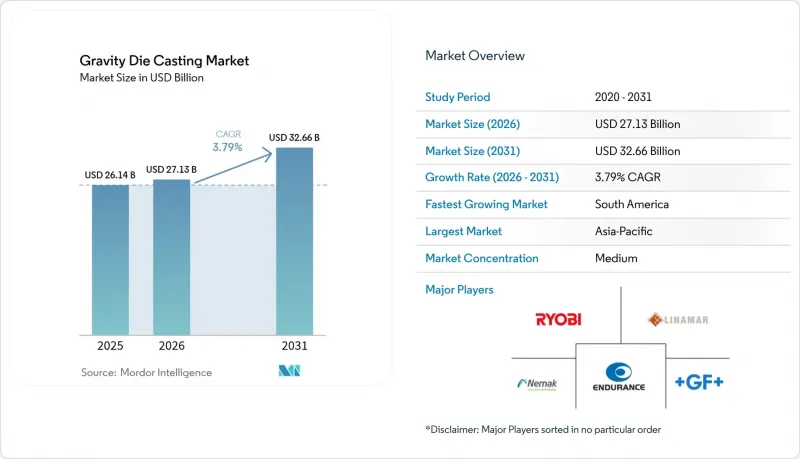
據 Mordor Intelligence 稱,重力鑄造市場預計到 2026 年價值 271.3 億美元,高於 2025 年的 261.4 億美元,預計到 2031 年將達到 326.6 億美元。
預計從 2026 年到 2031 年,其複合年成長率將達到 3.79%。
本報告材料類型(例如鋁合金)、應用領域(例如汽車零件、電氣和電子設備)、產品類型(例如引擎缸體、變速箱殼體、車輪)、製程類型(標準重力鑄造和傾斜澆注重力鑄造)以及地區進行細分。市場預測以美元(USD)計價。
全球重力鑄造市場趨勢與洞察
採用高強度重力鑄造合金
先進的A356和A380配方在保持機械完整性的同時提高了流動性,使設計人員能夠在底盤支架和轉向殼體中用鍛造件替代鑄造件。奈米顆粒增強的AA7075合金展現出接近鍛造件的拉伸性能,並在薄壁渦輪葉輪中實現了減重,這表明合金創新能夠使複雜零件繼續在重力鑄造市場中佔有一席之地。透過添加稀土元素,鎂合金開發商解決了電流腐蝕和易燃性問題。這項進步為鎂合金鑄造在航太結構和電動車變速箱蓋的應用鋪平了道路。賽峰集團的先進高溫合金葉片毛坯專利證實,在中溫渦輪級中,重力鑄造正逐漸取代熔模鑄造佔據主導地位。隨著更多適用於高溫環境的合金的出現,重力鑄造的應用範圍正在不斷擴大。
透過自動化和傾斜孔隙加工提高生產效率。
伺服控制的傾斜式氣孔單元可減少填充過程中的湍流和氧化物夾雜,從而提高首輪成型率並縮短生產週期。在歐洲和美國,機器人技術正在解決技術純熟勞工短缺的問題,實現無人連續作業並提高生產柔軟性。例如,庫卡(KUKA)的自動化單元透過記錄鑄造輪廓並將傳輸到雲端控制面板來最佳化工作流程。這種洞察力能夠實現預測性維護,在熱分佈發生變化時自動啟動,從而確保產品品質穩定並最大限度地減少停機時間。此外,中國製造商正在透過採用反向傾斜鑄造技術來提高材料利用率並減少廢棄物,尤其是在對稱變速箱領域。此方法無需使用長流道系統,從而最佳化了金屬利用率並簡化了生產過程。這些創新技術正在共同改變壓鑄產業。自動化、數據分析和製程改進的結合,提高了效率,減少了廢品,並能夠滿足多品種生產的需求。
批量生產部件中高壓壓鑄的替代
由於其生產週期短、成本效益高,高壓壓鑄 (HPDC) 正日益廣泛地應用於外殼和支架等零件的製造。產能的擴大提高了擴充性並降低了單位成本,使 HPDC 成為重力鑄造的有力競爭者。高延展性合金的進步使得製造符合碰撞安全標準的更薄壁件成為可能,從而在不影響安全性的前提下減輕了重量。 OEM 廠商之間的全球平台共用使得一套模具可以在多個地點共享,無需重新檢驗,從而簡化了物流並縮短了產品上市時間。 HPDC 優異的表面光潔度通常無需對車輪和支架等零件進行二次加工,進一步增強了其在大批量、成本敏感型應用中相對於重力鑄造的成本優勢。
細分市場分析
到2025年,鋁將佔據重力壓鑄市場80.12%的佔有率。這主要得益於全球回收的努力以及兼具流動性和抗張強度的標準合金。預計到2031年,鎂將以4.68%的複合年成長率推動市場成長,這主要得益於稀土元素合金技術的進步解決了鎂的易燃性問題,以及高階電動車對輕量化驅動外殼的需求不斷成長。鋁受益於龐大的廢料回收網路,該網路供應了其大部分鑄造原料,這有助於抑制原料成本的波動,並支持其在歐盟生態設計審核中作為永續產品的地位。亞洲冶煉廠利用水力發電提供低碳原生鋁,吸引了尋求減少範圍3排放的歐洲原始設備製造商的注意。
鋁材在熱交換器板、缸頭和逆變器殼體蓋等領域仍佔據主導地位,添加矽元素可改善鑄造的流動性和氣密性。另一方面,鎂的應用範圍正在從壓鑄變速箱殼體擴展到防火牆加強件和座椅框架。這是因為透過珠擊處理進行表面硬化可提高鎂合金在100兆帕應力下的疲勞壽命至1000萬次循環。在歐洲,對重量低於1000公斤的車輛實施優惠政策,進一步促進了鎂合金的應用。
到2025年,汽車零件將佔重力鑄造市場佔有率的62.55%,這主要得益於引擎缸體和變速箱殼體的長期合約。相較之下,航太零件預計將呈現最高的成長率,2026年至2031年的複合年成長率將達到4.61%。汽車製造商正朝著混合動力和電池平台轉型,並在增程器模組和商用皮卡的大型渦輪增壓柴油引擎專案中繼續使用重力鑄造引擎缸體。對於車輛結構件,例如副車架和懸吊轉向節,當強度要求超過高壓鑄合金時,重力鑄造通常是更合適的選擇。
在航太領域,鑄鋁肋條和翼梢小翼配件具有顯著的成本優勢。隨著航空企業在經歷了2020年至2023年的低迷期後擴大交付,鑄鋁的優勢尤為突出,這主要得益於其加工廢棄物低於坯料生產方式。國防計畫正在尋求推重比更高的渦輪機,並正在評估高成本鑄造件。電子設備鑄件也是一個極具發展前景的領域。 5G基地台機殼需要電磁干擾屏蔽和導熱通道,而重力鑄造鋁材比擠壓成型機殼更能有效率地實現這些功能。
區域分析
到2025年,亞太地區將佔據重力壓鑄市場46.78%的佔有率。這得歸功於中國龐大的合金供應鏈和垂直整合的鑄造叢集。亞太地區各國政府都在為「工業4.0」維修提供津貼,將感測器整合到鋼包和模具中,推動數位轉型速度超過歐洲。在日本的航太和精密電子產業,對高可靠性鑄件的高階需求依然強勁;同時,韓國一級供應商正利用機器人技術向其美國子公司出口電動橋殼體。
預計到2031年,南美洲將以4.78%的複合年成長率實現最高成長,這主要得益於美國汽車製造商(OEM)為實現採購多元化而將生產外包至巴西和墨西哥。智利和秘魯採礦業的擴張催生了對大型破碎機機架和挖掘機臂的需求,這些部件更傾向於採用厚壁重力鑄造工藝而非焊接工藝。巴西的在地採購義務刺激了區域模具設計中心的發展,從而縮短了關鍵模具的前置作業時間並降低了進口關稅。在北美,自動化是解決技術純熟勞工短缺問題的首要任務,密西根州和安大略省的工廠正在實施整合雲端品質控制面板的機器人傾斜澆註生產線。雖然環境許可流程相對寬鬆於歐盟法規,但不斷上漲的能源成本正在推動封閉回路型爐熱回收計畫的發展。在歐洲,對揮發性有機化合物(VOC)和粉塵的更嚴格監管增加了合規成本,但也為低碳鋁鑄件創造了出口機會。中東和非洲正在崛起成為主要市場,重點是飛機MRO(維修、修理和大修)零件和防禦彈藥。
其他好處:
- Excel格式的市場預測(ME)表
- 3個月的分析師支持
目錄
第1章:引言
- 研究假設和市場定義
- 調查範圍
第2章:調查方法
第3章執行摘要
第4章 市場狀況
- 市場概覽
- 市場促進因素
- 為減輕汽車和電動車重量所做的努力
- 採用高強度重力鑄造合金
- 燃油效率監管要求
- 透過自動化和傾斜澆注提高生產效率。
- 歐盟要求遵守基於最佳可行技術(BAT)的低揮發性有機化合物(VOC)法規。
- 積層製造相容複合材料芯材設計
- 市場限制因素
- 批量生產部件中的高壓壓鑄替代
- 鋁鎂價格波動
- 傾斜孔隙管線熟練操作人員短缺
- OEM廠商因千兆廣播而面臨的蠶食風險
- 價值供應鏈分析
- 監理情勢
- 技術展望
- 波特五力模型
第5章 市場規模與成長預測
- 材料類型
- 鋁合金
- 鋅合金
- 鎂合金
- 透過使用
- 汽車零件
- 電氣和電子設備
- 航太零件
- 工業機械
- 消費品
- 依產品類型
- 引擎缸體
- 變速箱殼體
- 車輪
- 壓鑄外殼
- 結構構件
- 其他
- 依工藝類型
- 標準重力鑄造
- 傾斜澆注重力鑄造
- 按地區
- 北美洲
- 美國
- 加拿大
- 其他北美國家
- 南美洲
- 巴西
- 阿根廷
- 其他南美國家
- 歐洲
- 德國
- 英國
- 法國
- 義大利
- 西班牙
- 其他歐洲國家
- 亞太地區
- 中國
- 印度
- 日本
- 韓國
- 其他亞太國家
- 中東和非洲
- 阿拉伯聯合大公國
- 沙烏地阿拉伯
- 南非
- 土耳其
- 其他中東和非洲國家
- 北美洲
第6章 競爭情勢
- 市場集中度
- 策略趨勢
- 市佔率分析
- 公司簡介
- Nemak SAB de CV
- Endurance Technologies Ltd.
- Ryobi Ltd.
- Pace Industries LLC
- Bocar SA de CV
- Sundaram-Clayton Ltd.
- Shiloh Industries Inc.
- LTH Castings
- Rockman Industries
- Linamar Corporation
- Koch Enterprises(Gibbs)
- Hitchiner Mfg. Co.
- ATA Casting Technology Co.
- Georg Fischer AG
- Sunrise Metal Technology
- Alcoa Corporation
第7章 市場機會與未來展望
According to Mordor Intelligence, gravity die casting market size in 2026 is estimated at USD 27.13 billion, growing from 2025 value of USD 26.14 billion with 2031 projections showing USD 32.66 billion, growing at 3.79% CAGR over 2026-2031.
This report is Segmented by Material Type (Aluminum Alloys, and More), Application (Automotive Components, Electrical & Electronics, and More), Product Type (Engine Blocks, Transmission Housings, Wheels, and More), Process Type (Standard Gravity Die Casting and Tilt-Pouring Gravity Die Casting), and Geography. The Market Forecasts are Provided in Terms of Value (USD).
Global Gravity Die Casting Market Trends and Insights
Adoption of High-Strength Gravity-Cast Alloys
Advanced A356 and A380 formulations enhance fluidity while maintaining mechanical integrity, allowing designers to replace cast parts with forgings in chassis brackets and steering housings. Nanoparticle-reinforced AA7075 achieves near-wrought tensile properties and mass savings in thin-wall turbine wheels, illustrating how alloy innovations enable complex parts to remain within the gravity die casting market. By incorporating rare earth elements, developers of magnesium alloys have addressed concerns related to galvanic corrosion and flammability. This advancement paves the way for magnesium casting in aerospace structures and electric vehicle gearbox covers. Safran's patents on advanced super-alloy blade blanks underscore the growing dominance of gravity casting over investment casting in medium-temperature turbine stages. As more alloys become available for higher-temperature operations, the applications for gravity casting are expanding.
Automation and Tilt-Pour Productivity Gains
Servo-controlled tilt-pour cells cut fill turbulence and oxide inclusion, lifting first-pass yield rates and trimming cycle time . Across Europe and the United States, robotics is addressing skilled labor shortages, facilitating continuous unmanned operations, and boosting production flexibility. For instance, KUKA's automated cells are refining workflows by logging pour profiles and relaying them to cloud-based dashboards. Such insights enable predictive maintenance, which activates when thermal patterns shift, ensuring consistent quality and minimizing downtime. Additionally, Chinese manufacturers are enhancing material efficiency and cutting waste by adopting reverse-tilt casting techniques, especially for symmetric gear housings. This approach, which dispenses with extended runner systems, not only optimizes metal use but also streamlines production. Collectively, these innovations are transforming the die casting industry, combining automation, data analytics, and process advancements to enhance efficiency, reduce scrap, and meet the demands of high-mix manufacturing.
HPDC Substitution in High-Volume Parts
High-pressure die casting (HPDC) is increasingly used for producing components such as housings and brackets due to its fast cycle times and cost efficiency. Expanding manufacturing capacity enhances scalability, reduces unit costs, and makes HPDC a competitive alternative to gravity casting. Advancements in high-ductility alloys enable thinner walls that meet crash standards, supporting lightweighting without compromising safety. Global platform sharing among OEMs allows a single mold set to be used across multiple sites without requiring revalidation, streamlining logistics, and speeding up the time-to-market. HPDC's superior surface finishes often eliminate the need for secondary machining on components like wheels and brackets, further strengthening its cost advantage over gravity casting in high-volume, cost-sensitive applications.
Other drivers and restraints analyzed in the detailed report include:
- Automotive and EV Lightweighting Push
- Regulatory Fuel-Efficiency Mandates
- OEM Giga Casting Cannibalization Risk
For complete list of drivers and restraints, kindly check the Table Of Contents.
Segment Analysis
Aluminum held an 80.12% gravity die casting market share in 2025, driven by global recycling initiatives and standard alloys, which strike a balance between flow and tensile strength. Magnesium is set to outpace at a 4.68% CAGR through 2031 as breakthroughs in rare-earth alloying tackle flammability, pushing the gravity die casting market toward lighter drive casings in premium EVs. Aluminum benefits from a vast scrap network that supplies most of its foundry feedstock, dampening raw material cost swings and supporting sustainable product claims under EU ecodesign audits. Asian smelters offer low-carbon primary aluminum backed by hydroelectric power, raising interest from European OEMs seeking Scope 3 emission cuts.
Aluminum's dominance persists in heat-exchanger plates, cylinder heads, and inverter housing lids, where silicon additions confer casting fluidity and pressure tightness. Magnesium, meanwhile, is expanding beyond die-cast transmission cases into firewall stiffeners and seat frames, due to shot-peen surface hardening, which increases fatigue life to 10 million cycles at 100 MPa. Incentives in Europe for vehicles with a curb weight of under 1,000 kg add extra impetus for Mg penetration.
The automotive component accounted for 62.55% of the gravity die casting market size in 2025, primarily due to long-term contracts for engine blocks and transmission housings. In contrast, the aerospace parts are forecasted to grow at the fastest rate, with a 4.61% CAGR from 2026 to 2031. Automakers shifting to hybrid and battery platforms are maintaining gravity-cast engine blocks for range-extender modules and larger turbo-diesel programs aimed at commercial pickups. Structural vehicle parts, such as subframes and suspension knuckles, often justify gravity casting when the strength requirements exceed those of HPDC alloys.
In aerospace, cast aluminum ribs and winglet fittings reduce machining waste compared to billet routes, presenting a compelling cost case as airlines ramp up deliveries after a 2020-2023 downturn. Defense programs seeking higher thrust-to-weight turbines are evaluating gravity-cast super-alloy stator vanes that replace costlier investment-castings. Electronics castings are another bright spot; 5G base-station housings demand EMI shielding and thermal paths that gravity cast aluminum provides more efficiently than extruded boxes.
Complete Report Scope:
- By Material Type
- Aluminum Alloys
- Zinc Alloys
- Magnesium Alloys
- By Application
- Automotive Components
- Electrical and Electronics
- Aerospace Parts
- Industrial Machinery
- Consumer Goods
- By Product Type
- Engine Blocks
- Transmission Housings
- Wheels
- Die-Cast Housings
- Structural Components
- Others
- By Process Type
- Standard Gravity Die Casting
- Tilt-Pouring Gravity Die Casting
- By Geography
- North America
- United States
- Canada
- Rest of North America
- South America
- Brazil
- Argentina
- Rest of South America
- Europe
- Germany
- United Kingdom
- France
- Italy
- Spain
- Rest of Europe
- Asia-Pacific
- China
- India
- Japan
- South Korea
- Rest of Asia-Pacific
- Middle East and Africa
- United Arab Emirates
- Saudi Arabia
- South Africa
- Turkey
- Rest of Middle East and Africa
- North America
Geography Analysis
Asia-Pacific held 46.78% of the gravity die casting market share in 2025, anchored by China's extensive alloy supply chain and vertically integrated casting clusters. Regional governments subsidize Industry 4.0 retrofits that embed sensors in ladles and dies, driving digital adoption faster than in Europe. Japan's aerospace and precision electronics sectors sustain premium demand for high-integrity castings, while South Korea's Tier-1 suppliers leverage robotics to export e-axle housings to US transplants.
South America is expected to record the fastest CAGR of 4.78% through 2031, driven by automotive nearshoring to Brazil and Mexico as the United States OEMs diversify their sourcing. Mining expansions in Chile and Peru require large crusher frames and excavator arms, which favor thick-section, gravity-cast components over fabricated ones. Local content mandates in Brazil stimulate regional die design centers, shortening lead times and lowering import duties on critical tooling. North America prioritizes automation to counter skilled labor shortages, with Michigan and Ontario plants installing robotic tilt-pour lines linked to cloud-based quality dashboards. Environmental permitting processes remain comparatively lenient versus EU rules, yet rising energy costs encourage closed-loop furnace heat recovery projects. Europe tightens VOC and dust rules, raising compliance costs but creating opportunities for exporting low-carbon aluminum castings. The Middle East and Africa are emerging as key markets, focusing on aircraft MRO parts and defense shells.
- Nemak SAB de CV
- Endurance Technologies Ltd.
- Ryobi Ltd.
- Pace Industries LLC
- Bocar SA de CV
- Sundaram-Clayton Ltd.
- Shiloh Industries Inc.
- LTH Castings
- Rockman Industries
- Linamar Corporation
- Koch Enterprises (Gibbs)
- Hitchiner Mfg. Co.
- ATA Casting Technology Co.
- Georg Fischer AG
- Sunrise Metal Technology
- Alcoa Corporation
Additional Benefits:
- The market estimate (ME) sheet in Excel format
- 3 months of analyst support
TABLE OF CONTENTS
1 Introduction
- 1.1 Study Assumptions and Market Definition
- 1.2 Scope of the Study
2 Research Methodology
3 Executive Summary
4 Market Landscape
- 4.1 Market Overview
- 4.2 Market Drivers
- 4.2.1 Automotive and EV Lightweighting Push
- 4.2.2 Adoption of High-Strength Gravity-Cast Alloys
- 4.2.3 Regulatory Fuel-Efficiency Mandates
- 4.2.4 Automation and Tilt-Pour Productivity Gains
- 4.2.5 EU BAT-Driven Low-VOC Compliance Demand
- 4.2.6 AM-Enabled Complex Core Designs
- 4.3 Market Restraints
- 4.3.1 HPDC Substitution in High-Volume Parts
- 4.3.2 Aluminum and Mg Price Volatility
- 4.3.3 Skilled-Operator Shortage for Tilt-Pour Lines
- 4.3.4 OEM Giga Casting Cannibalization Risk
- 4.4 Value / Supply-Chain Analysis
- 4.5 Regulatory Landscape
- 4.6 Technological Outlook
- 4.7 Porter's Five Forces
- 4.7.1 Bargaining Power of Suppliers
- 4.7.2 Bargaining Power of Buyers
- 4.7.3 Threat of New Entrants
- 4.7.4 Threat of Substitutes
- 4.7.5 Competitive Rivalry
5 Market Size and Growth Forecasts (Value (USD))
- 5.1 By Material Type
- 5.1.1 Aluminum Alloys
- 5.1.2 Zinc Alloys
- 5.1.3 Magnesium Alloys
- 5.2 By Application
- 5.2.1 Automotive Components
- 5.2.2 Electrical and Electronics
- 5.2.3 Aerospace Parts
- 5.2.4 Industrial Machinery
- 5.2.5 Consumer Goods
- 5.3 By Product Type
- 5.3.1 Engine Blocks
- 5.3.2 Transmission Housings
- 5.3.3 Wheels
- 5.3.4 Die-Cast Housings
- 5.3.5 Structural Components
- 5.3.6 Others
- 5.4 By Process Type
- 5.4.1 Standard Gravity Die Casting
- 5.4.2 Tilt-Pouring Gravity Die Casting
- 5.5 By Geography
- 5.5.1 North America
- 5.5.1.1 United States
- 5.5.1.2 Canada
- 5.5.1.3 Rest of North America
- 5.5.2 South America
- 5.5.2.1 Brazil
- 5.5.2.2 Argentina
- 5.5.2.3 Rest of South America
- 5.5.3 Europe
- 5.5.3.1 Germany
- 5.5.3.2 United Kingdom
- 5.5.3.3 France
- 5.5.3.4 Italy
- 5.5.3.5 Spain
- 5.5.3.6 Rest of Europe
- 5.5.4 Asia-Pacific
- 5.5.4.1 China
- 5.5.4.2 India
- 5.5.4.3 Japan
- 5.5.4.4 South Korea
- 5.5.4.5 Rest of Asia-Pacific
- 5.5.5 Middle East and Africa
- 5.5.5.1 United Arab Emirates
- 5.5.5.2 Saudi Arabia
- 5.5.5.3 South Africa
- 5.5.5.4 Turkey
- 5.5.5.5 Rest of Middle East and Africa
- 5.5.1 North America
6 Competitive Landscape
- 6.1 Market Concentration
- 6.2 Strategic Moves
- 6.3 Market Share Analysis
- 6.4 Company Profiles (Includes Global level Overview, Market level overview, Core Segments, Financials as available, Strategic Information, Market Rank/Share for key companies, Products and Services, and Recent Developments)
- 6.4.1 Nemak SAB de CV
- 6.4.2 Endurance Technologies Ltd.
- 6.4.3 Ryobi Ltd.
- 6.4.4 Pace Industries LLC
- 6.4.5 Bocar SA de CV
- 6.4.6 Sundaram-Clayton Ltd.
- 6.4.7 Shiloh Industries Inc.
- 6.4.8 LTH Castings
- 6.4.9 Rockman Industries
- 6.4.10 Linamar Corporation
- 6.4.11 Koch Enterprises (Gibbs)
- 6.4.12 Hitchiner Mfg. Co.
- 6.4.13 ATA Casting Technology Co.
- 6.4.14 Georg Fischer AG
- 6.4.15 Sunrise Metal Technology
- 6.4.16 Alcoa Corporation
7 Market Opportunities and Future Outlook

 2026-2030年全球鋅壓鑄微型零件市場
 壓鑄機械:市場佔有率分析、產業趨勢與統計、成長預測(2026-2031)
 壓鑄和鍛造市場:全球市場預測,2026-2032年壓鑄市場:全球市場預測,2026-2032年壓鑄機械市場-2026-2032年全球市場預測壓鑄:市場佔有率分析、產業趨勢與統計、成長預測(2026-2031)鋁零件重力鑄造市場-2026-2032年全球市場預測工業鑄造市場:按類型、材料、應用和最終用戶產業分類-2026-2032年全球市場預測真空鋁鑄造市場:依製程類型、合金類型、產品類型及應用分類,2026-2032年全球預測燃燒室鑄件市場:按部件類型、鑄造工藝、材料類型、鑄造工藝技術和最終用途行業分類,全球預測,2026-2032年