


 |
市場調查報告書
商品編碼
2114408
東協貨運代理:市場佔有率分析、產業趨勢與統計及成長預測(2026-2031)ASEAN Freight Forwarding - Market Share Analysis, Industry Trends & Statistics, Growth Forecasts (2026 - 2031) |
||||||

※ 本網頁內容可能與最新版本有所差異。詳細情況請與我們聯繫。
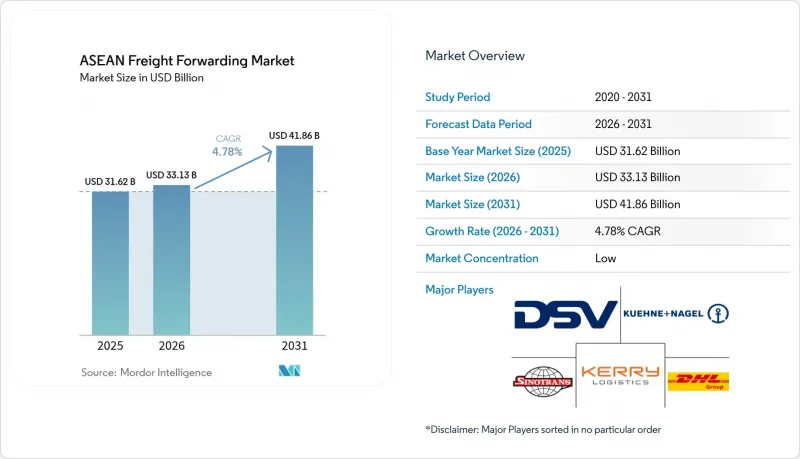
根據 Mordor Intelligence 預測,東協貨運代理市場規模將從 2025 年的 316.2 億美元成長到 2026 年的 331.3 億美元,到 2031 年將達到 418.6 億美元,2026 年至 2031 年的複合年成長率為 4.78%。
本報告按運輸方式(空運、海運及其他)、最終用戶(製造業和汽車業、石油天然氣業、採礦和採石業、農業、漁業和林業、建築業及其他)以及國家/地區(新加坡、泰國、馬來西亞、印尼、越南、菲律賓和其他東南亞國協)進行分類。市場預測以美元計價。
東協貨運代理市場趨勢與洞察
東協地區製造業的快速回流正在加速區域貿易流量。
電子產品、汽車和耐用消費品的生產網路正穩步從中國沿海地區轉移到越南、泰國和馬來西亞。曾經只在單一國家工廠運作的契約製造製造商,如今為了規避地緣政治風險並利用低15%的工資水平,在東協各國設立了多個生產基地。一級和二級零件供應商的多元化發展,增加了區域內的貨運路線,迫使貨運代理商在嚴格的準時制條件下協調各工廠之間的貨物運輸。連接泰國東部經濟走廊和越南組裝叢集的專用通道已開始處理頻繁的小批量貨物運輸,而位於印尼巴淡島和爪哇島的工業園區則為新加坡的轉運路線提供補充支線貨物。東協海關過境制度下的海關過境保證允許密封貨車無需重複檢查即可過境,從而將邊境停留時間縮短至不到4小時。
電子商務迷你樞紐正在改變跨境小包裹物流的結構。
東南亞各地的線上市場如今紛紛延長訂單截止時間至深夜,甚至承諾跨境購物也能隔天送達。為了維持這些服務水平,貨運代理和平台營運商正在柔佛、巴淡島和宋卡等地部署微型倉配中心,將庫存維持在主要都市區四小時車程範圍內。小包裹在保稅集中中心批量清關,然後再送往最後一公里配送網路,從而降低單件包裹的關稅,並緩解每日貨運量高峰。基於區塊鏈的追蹤服務為買賣雙方提供近乎即時的狀態更新。自動化的海關計算引擎會在結帳時預先計算總到貨成本,從而提高購物車到購買的轉換率。這種微型物流中心模式提高了出貨頻率,降低了平均貨運量,並刺激了吉隆坡至胡志明市等高密度航線上對時效性要求高的空運需求。
卡車所有權結構的分散阻礙了最後一公里配送效率。
在印尼和菲律賓,超過70%的商用車輛由獨立司機運營,這阻礙了遠端資訊處理技術的普及和穩定服務品質的保障。管理數百家小規模運輸公司的貨運代理面臨高昂的管理成本,而維護標準的不一致增加了車輛在路上發生故障的風險。小規模車輛擁有者依賴非正式的借貸管道,這使得資本密集的升級改造(例如昇級到歐VI排放標準或購買電動卡車)在經濟上難以承受,行業整合進程也仍然緩慢。隨著電子商務的興起,配送頻率不斷提高,但由於缺乏擴充性的幹線合作夥伴,貨運代理不得不在旺季支付附加費,進一步壓縮了利潤空間。
細分市場分析
海運佔市場佔有率的54.60%,凸顯了其作為東協貨運代理市場支柱的地位,透過麻六甲海峽和南海運輸電子產品、服裝和汽車零件等容器化出口貨物。在整個東協貨運代理市場中,整箱貨運(FCL)受惠於製造業回流,而拼箱貨運(LCL)則受惠於區域內貿易的成長。空運雖然噸位小規模,但以5.12%的複合年成長率(2026-2031年)快速成長,電子商務企業透過曼谷、吉隆坡和新加坡運輸智慧型手機、藥品和時尚單品等高附加價值商品。限時跨境小包裹和溫控單元貨載(ULD)等服務創新降低了生命科學貨物的劣化風險,從而為高額利潤奠定了基礎。
一種名為「混合航線策略」的運輸方式正日益普及,即托運人將海運用於補充基本負載,並結合定期包船服務來補充庫存。國際海事組織(IMO)的脫碳法規迫使航運公司過渡到能夠處理液化天然氣(LNG)和甲醇的新型船舶,這促使貨運代理商以較低的運費附加費提供低排放航線。大湄公河地區的公路和鐵路聯運拓展了海鐵聯運的選擇,使貨物能夠避開沿海繞行路線,並在河內和曼谷之間的某些航線上縮短400公里的運輸距離。這些服務增強了營運韌性,即使在氣候相關的惡劣天氣和常見的泊位擁塞情況下也能有效應對。
其他好處:
- Excel格式的市場預測(ME)表
- 3個月的分析師支持
目錄
第1章:引言
- 研究假設和市場定義
- 調查範圍
第2章:調查方法
第3章執行摘要
第4章 市場狀況
- 市場概覽
- 市場促進因素
- 東協地區製造業快速回流
- 推動跨境小包裹量成長的電子商務迷你樞紐。
- 發展自由貿易走廊(例如,大湄公河次區域、國際海運-全球貿易走廊等)
- 實施近即時港口社區系統
- 托運人推廣第三方碳抵消計劃
- 東協數位海關單一窗口系統介紹
- 市場限制因素
- 卡車所有權結構的分散導致最後一公里運輸成本增加。
- 貨櫃設施長期供需失衡
- 成員國之間危險物品法規的不一致
- 缺乏經FIATA認證的貨物運輸專家
- 價值供應鏈分析
- 監理情勢
- 技術展望
- 波特五力模型
- 貨物轉運走廊
- 政府法規和努力
- 電子商務洞察(國內和跨境)
- 經濟特區和製造地
- CPTPP對貨運代理的影響
第5章 市場規模與成長預測
- 透過交通工具
- 空運貨運代理
- 海運貨運代理
- 整箱貨(FCL)
- 拼箱貨物(LCL)
- 其他
- 最終用戶
- 製造業/汽車
- 石油和天然氣
- 採礦和採石
- 農業、漁業、林業
- 建造
- 分銷業(批發、零售、快速消費品)
- 其他終端用戶(電信、製藥等)
- 國家
- 新加坡
- 泰國
- 馬來西亞
- 印尼
- 越南
- 菲律賓
- 其他東南亞國協(緬甸、寮國、柬埔寨、汶萊)
第6章 競爭情勢
- 市場集中度與策略動態
- 市佔率分析
- 公司簡介
- Deutsche Post DHL Group(DHL Global Forwarding)
- Kuehne+Nagel International AG
- DSV A/S
- Sinotrans Ltd
- Kerry Logistics Network Ltd
- Nippon Express Co. Ltd
- CEVA Logistics
- Kintetsu World Express Inc.
- Yusen Logistics Co. Ltd
- PT Samudera Indonesia Tbk
- CH Robinson Worldwide Inc.
- Expeditors International
- GEODIS
- YCH Group Pte Ltd
- GKE Corp Ltd
- AIT Worldwide Logistics
- LOGISTEED
- Gemadept Logistics
- Freight Management Holdings Bhd
- PT Cahaya Pundimas Indonusa
第7章 市場機會與未來展望
According to Mordor Intelligence, the ASEAN freight forwarding market size is expected to grow from USD 31.62 billion in 2025 to USD 33.13 billion in 2026 and is forecast to reach USD 41.86 billion by 2031 at 4.78% CAGR over 2026-2031.
This report is Segmented by Mode of Transport (Air Freight Forwarding, Sea Freight Forwarding, and Others), End User (Manufacturing & Automotive, Oil & Gas, Mining & Quarrying, Agriculture, Fishing & Forestry, Construction, and More), Country (Singapore, Thailand, Malaysia, Indonesia, Vietnam, Philippines, and Rest of ASEAN). The Market Forecasts are Provided in Terms of Value (USD).
ASEAN Freight Forwarding Market Trends and Insights
Rapid Intra-ASEAN Manufacturing Re-shoring Accelerates Regional Trade Flows
Production networks for electronics, automotive, and consumer durables are steadily migrating from coastal China into Vietnam, Thailand, and Malaysia. Contract manufacturers that once operated single-country plants now run multi-site footprints across ASEAN to hedge geopolitical exposure and tap 15% lower wage structures. The dispersion of tier-1 and tier-2 component suppliers multiplies intra-regional cargo legs, requiring freight forwarders to synchronize plant-to-plant movements under tight just-in-time parameters. Dedicated corridors linking Thailand's Eastern Economic Corridor to Vietnamese assembly clusters are already handling higher-frequency, less-than-container-load shipments, while Indonesia's Batam and Java industrial parks are feeding supplemental feeder volumes into Singapore's transshipment streams. Customs transit guarantees under the ASEAN Customs Transit System allow sealed trucks to move across borders without repeated inspections, trimming border dwell times to under four hours.
E-commerce Mini-hubs Transform Cross-border Parcel Logistics Architecture
Online marketplaces across Southeast Asia now push order cut-off times deeper into the evening and promise next-day delivery even for cross-border purchases. To honor those service levels, freight forwarders and platform operators have rolled out micro-fulfillment nodes in Johor, Batam, and Songkhla, keeping inventory within a four-hour line-haul of major metro areas. Small parcels clear customs in bulk at bonded consolidation centers before being injected into last-mile networks, reducing per-item brokerage costs and smoothing daily volume spikes. Blockchain-enabled track-and-trace services give sellers and buyers near-real-time status updates, while automated duty assessment engines pre-calculate landed costs at checkout to improve cart-conversion rates. The mini-hub model increases shipment frequency, compresses average consignment size, and lifts demand for time-definite air cargo uplift on high-density lanes such as Kuala Lumpur-Ho Chi Minh City.
Fragmented Truck Ownership Structure Constrains Last-mile Efficiency
Owner-drivers operate over 70% of commercial vehicles in Indonesia and the Philippines, limiting telematics penetration and consistent service quality. Freight forwarders juggling hundreds of micro-carriers face elevated administrative overhead, while inconsistent maintenance standards inflate roadside-breakdown risks. Consolidation remains slow because small fleets rely on informal lending circles, making capital-intensive upgrades to Euro VI or electric trucks financially out of reach. As e-commerce pushes delivery frequency higher, the shortage of scalable line-haul partners forces forwarders to pay rate premiums during peak seasons, eroding margins.
Other drivers and restraints analyzed in the detailed report include:
- Free-trade Corridor Build-outs Unlock Multimodal Connectivity Gains
- Near-real-time Port Community Systems Enhance Operational Transparency
- Chronic Container Equipment Imbalance Disrupts Service Reliability
For complete list of drivers and restraints, kindly check the Table Of Contents.
Segment Analysis
Sea freight's 54.60% share underscores its role as the backbone of the ASEAN freight forwarding market, funneling containerized exports of electronics, apparel, and automotive parts through the Straits of Malacca and the South China Sea. Within the broader ASEAN freight forwarding market size, full-container-load movements benefited most from manufacturing reshoring, while less-than-container-load volumes captured rising intra-bloc trade. Air freight, though smaller in tonnage, is scaling at a 5.12% CAGR (2026-2031) as e-retailers route high-value smartphones, pharmaceuticals, and fashion items via Bangkok, Kuala Lumpur, and Singapore. Service innovations such as time-definite cross-border parcel flights and temperature-controlled ULDs reduce spoilage risks on life-science cargo and underpin premium yields.
Hybrid routing strategies are spreading as shippers blend ocean for base-load replenishment with scheduled charters for inventory top-ups. The International Maritime Organization's decarbonization rules push carriers toward LNG and methanol-ready newbuilds, prompting freight forwarders to market low-emission lanes at modest rate premiums. Road-rail combinations in the Greater Mekong Subregion extend sea-rail intermodal options, letting cargo skip coastal detours and shave 400 kilometers off certain Hanoi-to-Bangkok routings. These offerings increase operational resilience amid climate-linked weather disruptions and periodic berth congestion.
Complete Report Scope:
- By Mode of Transport
- Air Freight Forwarding
- Sea Freight Forwarding
- Full-Container-Load (FCL)
- Less-than-Container-Load (LCL)
- Others
- By End User
- Manufacturing & Automotive
- Oil & Gas, Mining & Quarrying
- Agriculture, Fishing & Forestry
- Construction
- Distributive Trade (Wholesale/Retail, FMCG)
- Other End Users (Telecom, Pharmaceutical, etc.)
- By Country
- Singapore
- Thailand
- Malaysia
- Indonesia
- Vietnam
- Philippines
- Rest of ASEAN (Myanmar, Laos, Cambodia, Brunei)
List of Companies Covered in this Report:
- Deutsche Post DHL Group (DHL Global Forwarding)
- Kuehne + Nagel International AG
- DSV A/S
- Sinotrans Ltd
- Kerry Logistics Network Ltd
- Nippon Express Co. Ltd
- CEVA Logistics
- Kintetsu World Express Inc.
- Yusen Logistics Co. Ltd
- PT Samudera Indonesia Tbk
- C.H. Robinson Worldwide Inc.
- Expeditors International
- GEODIS
- YCH Group Pte Ltd
- GKE Corp Ltd
- AIT Worldwide Logistics
- LOGISTEED
- Gemadept Logistics
- Freight Management Holdings Bhd
- PT Cahaya Pundimas Indonusa
Additional Benefits:
- The market estimate (ME) sheet in Excel format
- 3 months of analyst support
TABLE OF CONTENTS
1 Introduction
- 1.1 Study Assumptions & Market Definition
- 1.2 Scope of the Study
2 Research Methodology
3 Executive Summary
4 Market Landscape
- 4.1 Market Overview
- 4.2 Market Drivers
- 4.2.1 Rapid intra-ASEAN manufacturing re-shoring
- 4.2.2 E-commerce mini-hubs powering cross-border parcel volumes
- 4.2.3 Free-trade corridor build-outs (e.g., GMS, IMT-GT)
- 4.2.4 Near-real-time port community systems deployment
- 4.2.5 Widespread third-party carbon-offset programs by shippers
- 4.2.6 ASEAN digital customs single-window rollout
- 4.3 Market Restraints
- 4.3.1 Fragmented truck ownership raising last-mile costs
- 4.3.2 Chronic container equipment imbalance
- 4.3.3 Non-harmonised dangerous-goods codes among members
- 4.3.4 Shortage of FIATA-certified freight professionals
- 4.4 Value / Supply-Chain Analysis
- 4.5 Regulatory Landscape
- 4.6 Technological Outlook
- 4.7 Porter's Five Forces
- 4.7.1 Bargaining Power of Buyers
- 4.7.2 Bargaining Power of Suppliers
- 4.7.3 Threat of New Entrants
- 4.7.4 Threat of Substitutes
- 4.7.5 Degree of Rivalry
- 4.8 Freight Transport Corridors
- 4.9 Government Regulations & Initiatives
- 4.10 Insights on E-commerce (Domestic & Cross-border)
- 4.11 Special Economic Zones & Manufacturing Hubs
- 4.12 CPTPP Impact on Freight Forwarding
5 Market Size & Growth Forecasts
- 5.1 By Mode of Transport
- 5.1.1 Air Freight Forwarding
- 5.1.2 Sea Freight Forwarding
- 5.1.2.1 Full-Container-Load (FCL)
- 5.1.2.2 Less-than-Container-Load (LCL)
- 5.1.3 Others
- 5.2 By End User
- 5.2.1 Manufacturing & Automotive
- 5.2.2 Oil & Gas, Mining & Quarrying
- 5.2.3 Agriculture, Fishing & Forestry
- 5.2.4 Construction
- 5.2.5 Distributive Trade (Wholesale/Retail, FMCG)
- 5.2.6 Other End Users (Telecom, Pharmaceutical, etc.)
- 5.3 By Country
- 5.3.1 Singapore
- 5.3.2 Thailand
- 5.3.3 Malaysia
- 5.3.4 Indonesia
- 5.3.5 Vietnam
- 5.3.6 Philippines
- 5.3.7 Rest of ASEAN (Myanmar, Laos, Cambodia, Brunei)
6 Competitive Landscape
- 6.1 Market Concentration & Strategic Moves
- 6.2 Market Share Analysis
- 6.3 Company Profiles {(includes Global level Overview, Market level overview, Core Segments, Financials as available, Strategic Information, Market Rank/Share for key companies, Products & Services, and Recent Developments)}
- 6.3.1 Deutsche Post DHL Group (DHL Global Forwarding)
- 6.3.2 Kuehne + Nagel International AG
- 6.3.3 DSV A/S
- 6.3.4 Sinotrans Ltd
- 6.3.5 Kerry Logistics Network Ltd
- 6.3.6 Nippon Express Co. Ltd
- 6.3.7 CEVA Logistics
- 6.3.8 Kintetsu World Express Inc.
- 6.3.9 Yusen Logistics Co. Ltd
- 6.3.10 PT Samudera Indonesia Tbk
- 6.3.11 C.H. Robinson Worldwide Inc.
- 6.3.12 Expeditors International
- 6.3.13 GEODIS
- 6.3.14 YCH Group Pte Ltd
- 6.3.15 GKE Corp Ltd
- 6.3.16 AIT Worldwide Logistics
- 6.3.17 LOGISTEED
- 6.3.18 Gemadept Logistics
- 6.3.19 Freight Management Holdings Bhd
- 6.3.20 PT Cahaya Pundimas Indonusa
7 Market Opportunities & Future Outlook
- 7.1 White-space & Unmet-need Assessment

 2026-2030年全球貨運市場
 貨運:市場佔有率分析、產業趨勢與統計、成長預測(2026-2031)
 航空貨運代理市場-2026-2032年全球市場預測
 全球貨運代理市場:2026 年
 貨運市場分析及至2035年預測:類型、服務、技術、組件、應用、最終用戶、解決方案、運輸方式
 貨運代理市場機會、成長促進因素、產業趨勢分析及2026-2035年預測。
 貨運代理市場:按運輸方式、客戶類型、服務、應用和地區分類的市場規模、佔有率和趨勢分析,以及細分市場預測(2026-2033 年)
 航空貨運代理市場報告:按類型、服務類型、最終用戶行業和地區分類(2026-2034 年)
 貨運市場:依運輸方式、服務類型、最終用戶產業及地區分類
 2026年全球國際貨運代理市場報告