


 |
市場調查報告書
商品編碼
2114393
歐洲木塑複合材料(WPC):市場佔有率分析、行業趨勢和統計數據以及成長預測(2026-2031 年)Europe Wood-plastic Composite (WPC) - Market Share Analysis, Industry Trends & Statistics, Growth Forecasts (2026 - 2031) |
||||||

※ 本網頁內容可能與最新版本有所差異。詳細情況請與我們聯繫。
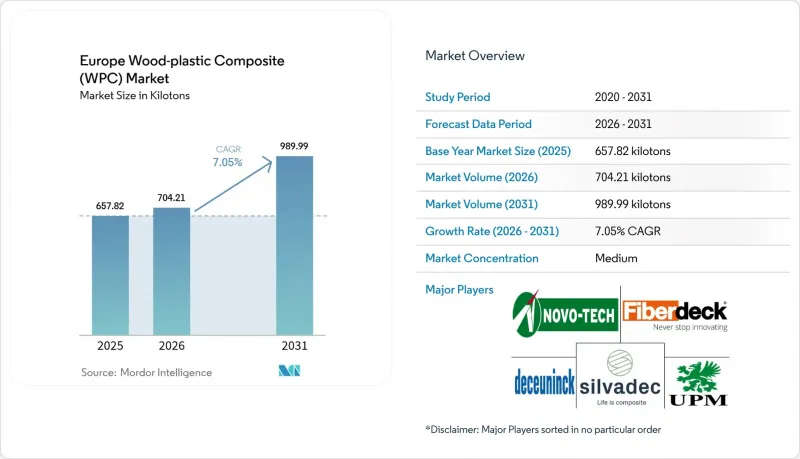
根據 Mordor Intelligence 預測,歐洲木塑複合材料市場預計將從 2025 年的 657.82 千噸成長到 2026 年的 704.21 千噸,並將從 2026 年到 2031 年以 7.05% 的複合年成長率,到 2031 年達到 9891 年。
本報告按聚合物類型(聚乙烯、聚丙烯及其他聚合物類型)、應用領域(甲板、汽車內飾件、牆板和圍欄、技術應用、家具和消費品)以及地區(德國、英國、法國、比利時、義大利、西班牙、芬蘭、挪威、丹麥、瑞典及其他歐洲國家)進行細分。市場預測以噸為單位。
歐洲木塑複合材料(WPC)市場趨勢與洞察
木塑複合材料的永續性正在推動循環經濟的普及。
歐洲品牌正將其產品定位為更具碳環保特性的替代品,以滿足歐洲木塑複合材料市場的需求。這些產品不僅能滿足 VinylPlus 審核標準,還能用回收材料取代高達一半的聚合物基材。機械回收商將分離的薄膜和硬質塑膠送入雙螺桿擠出機,偶聯劑可恢復纖維與基體之間的黏合力,從而保持板材的抗彎強度。整合城市固態廢棄物可減少送往掩埋的廢棄物數量,並保護加工商免受原生聚合物價格波動風險的影響。德國的回收計畫現已對可追溯地理來源的木纖維流進行認證,這項監管優勢正在增強買家的信心。即使聚合物鏈在多次熔融循環後發生斷裂,混煉商也能透過在受控閾值下混合原生顆粒來保持尺寸穩定性。因此,歐洲木塑複合材料(WPC) 市場正在獲得環境積分,促使公共部門承包商採納相關規範。
建築業需求的復甦正在加速基礎設施投資。
根據荷蘭國際集團(ING)發布的2025年展望報告,歐洲建築業產出預計將轉正,歐盟復甦基金的支出將轉向維修工程,並優先選擇低維護成本的覆材。北歐開發商正在使用耐凍融循環的隔熱複合複合材料維修學校和市政廳。在法國,針對沿海城鎮的資本項目中,木塑複合材料人行道和防洪潮汐系統被結合使用。供應商正在採用隱藏式卡扣系統以減少現場勞動力,這在工資水平較高的西歐地區是一項顯著優勢。屋頂更換和陽台維修正在推動專業公司管道的存貨周轉,而公共採購框架也擴大將生命週期排放量作為競標評估的依據。因此,建築業的復甦為歐洲木塑複合材料市場提供了永續的銷售基礎。
較高的初始成本以及與防腐木材的比較限制了其在大眾市場的滲透。
羅馬尼亞和保加利亞的價格對比顯示,WPC(木塑複合材料)地板的零售價比防腐雲杉高出40-60%,融資拮据的住宅仍然傾向於選擇傳統木材。雖然降低人事費用的優勢要幾年後才會顯現,但發票總價仍是購買決策的主要因素。建商必須負擔EN 15534標準下的CE認證費用,這為小批量生產設定了很高的進入門檻。補貼計畫很少涵蓋複合材料,迫使加工商自行開發資金籌措方案。在生產規模經濟和回收材料帶來的收益降低成本之前,這些限制將阻礙外圍經濟體的單價成長,並限制歐洲木塑複合材料(WPC)市場的銷售成長。
細分市場分析
預計到2025年,聚乙烯(PE)將佔據歐洲木塑複合材料市場52.06%的佔有率。這主要歸功於其完善的加工基礎設施以及與軟木纖維的優異相容性。非發泡PE型材的低熔體黏度使其能夠實現高生產線速度,從而降低每米成本。該領域受益於來自瓶子回收商的大量廢棄高密度聚苯乙烯(HDPE)原料,這些原料可輕鬆添加到擠出配方中。混煉商使用馬來酸酐接枝相容劑來穩定界面,從而生產出符合EN 310彎曲測試標準的板材,同時最大限度地減少新聚合物的添加量。儘管PE具有這些優勢,但其相對較低的熱變形溫度限制了其在汽車和技術面板領域的應用,因為這些領域的工作溫度通常超過90 度C。
儘管聚丙烯 (PP) 的產量落後於聚乙烯 (PE),但預計其複合年成長率將達到 7.75%,在該細分市場中最高,因為汽車製造商 (OEM) 對內飾模組的耐熱性和剛性提出了更高的要求。歐洲研究機構的研究人員已經證明,在纖維含量相當的情況下,PP 基複合材料的撓曲模數PE 基複合材料高 15%,吸濕性低 25%。 PP 的模內著色能力滿足了汽車製造商對無需噴漆的 A-Class 表面的需求。然而,PP 的加工需要更嚴格的溫度控制以防止氧化劣化,這迫使加工商投資於氮氣環境下的重力式給料機。聚氯乙烯 (PVC) 在窗框和船舶甲板等領域佔據著一定的市場佔有率,在這些領域,其固有的抗紫外線和阻燃性能比成本更為重要。由於價格原因,PLA 和 PHA 等新興生物塑膠的市佔率不到 1%,但荷蘭正在考慮透過試點生產線進行整合,這表明歐洲木塑複合材料市場未來有多元化發展的潛力。
其他好處
- Excel格式的市場預測(ME)表
- 3個月的分析師支持
目錄
第1章:引言
- 研究假設和市場定義
- 調查範圍
第2章:調查方法
第3章執行摘要
第4章 市場狀況
- 市場概覽
- 市場促進因素
- 透過WPC永續性促進循環經濟的引入
- 由於建築業需求復甦,基礎建設投資加速成長
- 透過歐洲汽車內裝輕量化技術創造利基商機。
- 歐盟對亞洲膠合板徵收反傾銷稅,以鼓勵以WPC(濕塑膠濃縮物)取代。
- 對具備 EUDR 可追溯性的 WPC 的需求不斷成長
- 利用低溫矽交聯技術實現高可回收性木塑複合材料
- 市場限制因素
- 與經過防腐處理的木材相比,其較高的初始成本限制了其在大眾市場的滲透。
- 需要先進的穩定系統來解決紫外線耐受性、耐候性和褪色等問題。
- 滿足歐盟建築防火標準所需的成本。
- 價值鏈分析
- 波特五力模型
第5章 市場規模與成長預測
- 按聚合物類型
- 聚乙烯(PE)
- 聚丙烯(PP)
- 聚氯乙烯(PVC)
- 其他聚合物類型
- 透過使用
- 甲板材料
- 汽車內裝部件
- 牆板圍欄
- 科技應用
- 家具
- 消費品
- 按地區
- 德國
- 英國
- 法國
- 比利時
- 義大利
- 西班牙
- 芬蘭
- 挪威
- 丹麥
- 瑞典
- 其他歐洲國家
第6章 競爭情勢
- 市場集中度
- 策略趨勢
- 市佔率和排名分析
- 公司簡介
- Bausano SpA
- Beologic NV
- Coperion GmbH
- Deceuninck
- Fiberdeck
- FKuR
- JELU-WERK J. Ehrler GmbH & Co. KG
- Kosche Holzwerkstoffe GmbH & Co. KG
- MOLLER GMBH & CO. KG
- Naftex GmbH
- NaturinForm
- NOVO-TECH GmbH & Co. KG
- Novowood(Iperwood srl)
- PolyPlank Solutions AB
- RENOLIT SE
- Silvadec
- TECHWOODN Co., Ltd.
- The AZEK Company Inc.
- Trex Company, Inc.
- UPM
第7章 市場機會與未來展望
According to Mordor Intelligence, the Europe wood-plastic composite market size is expected to grow from 657.82 kilotons in 2025 to 704.21 kilotons in 2026 and is forecast to reach 989.99 kilotons by 2031 at 7.05% CAGR over 2026-2031.
This report is Segmented by Polymer Type(Polyethylene, Polypropylene, and Other Polymer Types), Application (Decking, Auto-Interior Components, Siding and Fencing, Technical Applications, Furniture, and Consumer Goods), and Geography (Germany, United Kingdom, France, Belgium, Italy, Spain, Finland, Norway, Denmark, Sweden, and Rest of Europe). The Market Forecasts are Provided in Terms of Volume (Tons).
Europe Wood-plastic Composite (WPC) Market Trends and Insights
Sustainable Characteristics of WPC Drive Circular Economy Adoption
European brands position Europe Wood Plastic Composite market offerings as carbon-smarter substitutes that can lock up to half of their polymer matrix in recyclate while still clearing VinylPlus audits. Mechanical recyclers feed sorted film and rigids into twin-screw extruders, and coupling agents restore fiber-matrix adhesion so decking boards retain flexural strength. The integration of municipal solid-waste streams diverts landfill tonnage and shields processors from virgin polymer volatility. Germany's take-back schemes now certify geo-tracked wood fiber streams, a regulatory advantage that increases buyer confidence. Even with polymer chain scission after multiple melt cycles, compounders maintain dimensional stability by blending virgin pellets at calibrated thresholds. As a result, the Europe Wood Plastic Composite market secures environmental credits that translate into specification wins with public-sector contractors.
Construction-Sector Demand Resurgence Accelerates Infrastructure Investment
ING's 2025 outlook confirmed that Europe's building output returns to positive territory, converting EU Recovery Fund disbursements into renovation outlays that favor low-maintenance cladding. Nordic developers retrofit schools and municipal offices with insulated composite facades that withstand freeze-thaw cycles. Capital projects in France bundle WPC walkways with flood-resilient flood-barrier systems for coastal towns. Suppliers embed hidden-clip systems to reduce onsite labor, an advantage in high-wage Western Europe. Re-roofing and balcony revamps fuel inventory turnover in specialty merchant channels, while public procurement frameworks increasingly score bids on life-cycle emissions. Consequently, the construction rebound supplies a durable volume baseline for the Europe Wood Plastic Composite market.
Higher Upfront Cost vs. Pressure-Treated Timber Limits Mass-Market Penetration
Price comparisons in Romania and Bulgaria show WPC decking retailing at 40-60% premiums versus impregnated spruce boards, keeping cash-constrained homeowners on traditional lumber. Labor savings only accrue over years, whereas purchase decisions remain dominated by invoice totals. Builders face certification fees for CE marking under EN 15534, inflating entry barriers for small lot sizes. Subsidy programs rarely target composite materials, leaving processors to craft own-brand financing schemes. Until production economies of scale or recycled-content credits compress cost curves, this restraint moderates unit uptake in peripheral economies, tempering volume expansion for the Europe Wood Plastic Composite market.
Other drivers and restraints analyzed in the detailed report include:
- Lightweighting Push in European Automotive Interiors Creates Niche Opportunities
- EU Anti-Dumping Duties on Asian Plywood Spur WPC Substitution
- UV / Weathering and Color-Fade Challenges Require Advanced Stabilization Systems
For complete list of drivers and restraints, kindly check the Table Of Contents.
Segment Analysis
Polyethylene recorded a 52.06% share of the Europe Wood Plastic Composite market in 2025, underscoring the entrenched processing infrastructure and its compatibility with softwood fibers. Un-foamed PE profiles exhibit low melt viscosity, enabling high line speeds that translate into cost-per-linear-meter advantages. The segment benefits from widespread availability of post-consumer high-density polyethylene streams sourced from bottle reclaimers, which plug easily into extrusion recipes. Compounders leverage maleic-anhydride-grafted compatibilizers to stabilize the interface, allowing boards to pass EN 310 flexural testing with modest virgin polymer additions. Despite these strengths, PE's comparatively low heat-deflection temperature curtails its use in automotive or technical panels that encounter service temperatures above 90 °C.
Polypropylene, although trailing in volume, is projected to register the segment-leading 7.75% CAGR as OEMs seek higher heat performance and stiffness for interior modules. Researchers at European institutes demonstrate that PP-based composites deliver 15% higher flexural modulus than PE analogues at equal fiber loadings, while absorbing 25% less moisture. Mold-in-color capability aligns with carmaker demands for class-A surfaces that avoid paint. However, PP processing necessitates tighter thermal windows to avert oxidative degradation, compelling processors to invest in nitrogen-blanketed gravimetric feeders. PVC maintains smaller niches in window profiles and marine decking where inherent UV and flame behavior outweigh cost. Emerging bio-resins such as PLA and PHA remain below 1% share due to price, yet pilot lines in the Netherlands explore their integration, signaling future possibilities for diversifying the Europe Wood Plastic Composite market.
Complete Report Scope:
- By Polymer Type
- Polyethylene (PE)
- Polypropylene (PP)
- Polyvinyl Chloride (PVC)
- Other Polymer Types
- By Application
- Decking
- Auto-interior Components
- Siding and Fencing
- Technical Applications
- Furniture
- Consumer Goods
- By Geography
- Germany
- United Kingdom
- France
- Belgium
- Italy
- Spain
- Finland
- Norway
- Denmark
- Sweden
- Rest of Europe
List of Companies Covered in this Report:
- Bausano S.p.A
- Beologic NV
- Coperion GmbH
- Deceuninck
- Fiberdeck
- FKuR
- JELU-WERK J. Ehrler GmbH & Co. KG
- Kosche Holzwerkstoffe GmbH & Co. KG
- MOLLER GMBH & CO. KG
- Naftex GmbH
- NaturinForm
- NOVO-TECH GmbH & Co. KG
- Novowood by Iperwood srl
- PolyPlank Solutions AB
- RENOLIT SE
- Silvadec
- TECHWOODN Co., Ltd.
- The AZEK Company Inc.
- Trex Company, Inc.
- UPM
Additional Benefits:
- The market estimate (ME) sheet in Excel format
- 3 months of analyst support
TABLE OF CONTENTS
1 Introduction
- 1.1 Study Assumptions and Market Definition
- 1.2 Scope of the Study
2 Research Methodology
3 Executive Summary
4 Market Landscape
- 4.1 Market Overview
- 4.2 Market Drivers
- 4.2.1 Sustainable Characteristics of WPC Drive Circular Economy Adoption
- 4.2.2 Construction-Sector Demand Resurgence Accelerates Infrastructure Investment
- 4.2.3 Lightweighting Push in European Automotive Interiors Creates Niche Opportunities
- 4.2.4 EU Anti-Dumping Duties on Asian Plywood Spur WPC Substitution
- 4.2.5 EUDR Traceability Boosts Demand for Certified-Origin WPC
- 4.2.6 Low-Temperature Silicone-Coupling Tech Enables High-Recycled-Content WPC
- 4.3 Market Restraints
- 4.3.1 Higher Upfront Cost vs. Pressure-Treated Timber Limits Mass-Market Penetration
- 4.3.2 UV / Weathering and Color-Fade Challenges Require Advanced Stabilization Systems
- 4.3.3 Fire-Performance Compliance Costs Under EU Building Codes
- 4.4 Value Chain Analysis
- 4.5 Porter's Five Forces
- 4.5.1 Bargaining Power of Suppliers
- 4.5.2 Bargaining Power of Buyers
- 4.5.3 Threat of New Entrants
- 4.5.4 Threat of Substitutes
- 4.5.5 Degree of Competition
5 Market Size and Growth Forecasts (Volume)
- 5.1 By Polymer Type
- 5.1.1 Polyethylene (PE)
- 5.1.2 Polypropylene (PP)
- 5.1.3 Polyvinyl Chloride (PVC)
- 5.1.4 Other Polymer Types
- 5.2 By Application
- 5.2.1 Decking
- 5.2.2 Auto-interior Components
- 5.2.3 Siding and Fencing
- 5.2.4 Technical Applications
- 5.2.5 Furniture
- 5.2.6 Consumer Goods
- 5.3 By Geography
- 5.3.1 Germany
- 5.3.2 United Kingdom
- 5.3.3 France
- 5.3.4 Belgium
- 5.3.5 Italy
- 5.3.6 Spain
- 5.3.7 Finland
- 5.3.8 Norway
- 5.3.9 Denmark
- 5.3.10 Sweden
- 5.3.11 Rest of Europe
6 Competitive Landscape
- 6.1 Market Concentration
- 6.2 Strategic Moves
- 6.3 Market Share (%)/Ranking Analysis
- 6.4 Company Profiles {(includes Global level Overview, Market level overview, Core Segments, Financials as available, Strategic Information, Market Rank/Share for key companies, Products and Services, and Recent Developments)}
- 6.4.1 Bausano S.p.A
- 6.4.2 Beologic NV
- 6.4.3 Coperion GmbH
- 6.4.4 Deceuninck
- 6.4.5 Fiberdeck
- 6.4.6 FKuR
- 6.4.7 JELU-WERK J. Ehrler GmbH & Co. KG
- 6.4.8 Kosche Holzwerkstoffe GmbH & Co. KG
- 6.4.9 MOLLER GMBH & CO. KG
- 6.4.10 Naftex GmbH
- 6.4.11 NaturinForm
- 6.4.12 NOVO-TECH GmbH & Co. KG
- 6.4.13 Novowood by Iperwood srl
- 6.4.14 PolyPlank Solutions AB
- 6.4.15 RENOLIT SE
- 6.4.16 Silvadec
- 6.4.17 TECHWOODN Co., Ltd.
- 6.4.18 The AZEK Company Inc.
- 6.4.19 Trex Company, Inc.
- 6.4.20 UPM
7 Market Opportunities and Future Outlook
- 7.1 White-space and Unmet-need Assessment

 木塑複合材料市場-2026-2032年全球市場預測
 塑木市場:依材料、產品類型、應用、最終用戶、國家及地區分類-全球產業分析、市場規模、市場佔有率及2026年至2033年預測
 木塑複合材料(WPC)地板:市場佔有率分析、行業趨勢和統計數據、成長預測(2026-2031)
 木塑複合材料市場報告:按類型、應用和地區分類(2026-2034 年)
 2026年全球木塑複合地板材料市場報告
 木塑複合材料市場:按類型、應用和地區分類木塑複合材料機械市場:按機器類型、自動化類型、產能、應用、最終用戶分類,全球預測(2026-2032年)木塑複合材料(WPC):市場佔有率分析、產業趨勢與統計、成長預測(2026-2031)
 全球木塑複合材料地板市場規模、佔有率、趨勢及成長分析報告(2026-2034)全球木塑複合材料市場規模、佔有率、趨勢和成長分析報告(2026-2034年)