

 |
市場調查報告書
商品編碼
2114332
北美二手:市佔率分析、產業趨勢與統計及成長預測(2026-2031 年)North America Used Truck - Market Share Analysis, Industry Trends & Statistics, Growth Forecasts (2026 - 2031) |
||||||

※ 本網頁內容可能與最新版本有所差異。詳細情況請與我們聯繫。
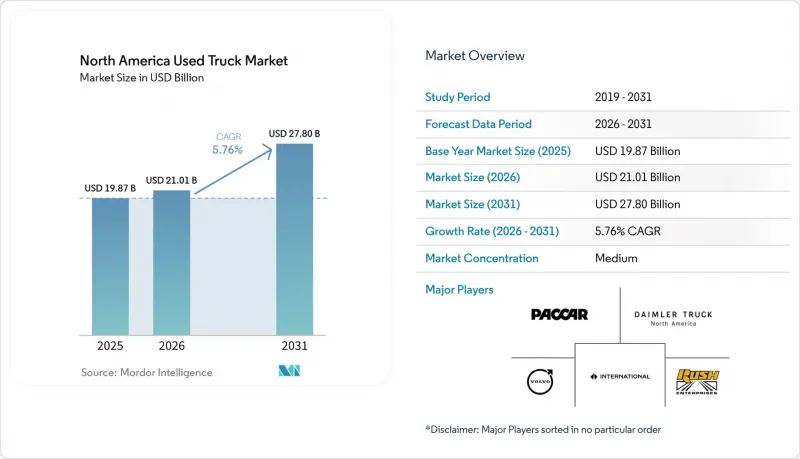
據 Mordor Intelligence 稱,2025 年北美二手卡車市場價值 198.7 億美元,預計將從 2026 年的 210.1 億美元成長到 2031 年的 278 億美元,2026 年至 2031 年的複合年成長率為 5.76%。
本報告按車輛類型(輕型卡車(3-5級)、中型卡車(6-7級)、其他)、燃料類型(柴油、汽油、其他)、車齡(3年以下、4-7年、其他)、最終用途行業(建築/基礎設施、物流/電商配送、其他)、銷售管道和國家/地區進行細分。市場預測以價值(美元)和銷售(輛)為單位呈現。
北美二手卡車市場的趨勢與洞察
電子商務的快速發展正在推動短程貨運的需求成長。
預計到2025年,小包裹遞送量將顯著成長,遞送時間要求也將更加嚴格,物流業者被迫在每英里路線上部署更多3-5級卡車。二手輕型和中型卡車能夠以新車價格的40-60%滿足運輸需求,因此,注重資金效率的車隊營運商通常會在車輛掛牌後30天內購買。都市區的返廠營運模式允許透過預測性維護來最大限度地減少停機時間,從而抵消了老舊車輛額外維護成本的弊端。預計電子商務將在2025年加速成長,並持續成長至2028年,短程貨運能力的成長速度將超過原始設備製造商(OEM)的生產速度,從而支撐了3-7年車齡車齡的持續溢價。因此,北美二手卡車市場受益於都市區配送車輛更新換代帶來的結構性而非週期性需求成長。
半導體短缺導致新車供應緊張,從而產生了剩餘需求。
2025年,持續的半導體資源分配挑戰導致8級卡車產量低於疫情前的峰值水準。車隊公司延長了車輛更換週期,並顯著提高了二手卡車的殘值。配備ADAS(高級駕駛輔助系統)技術的卡車目前交易價格遠高於原始價值,改變了傳統的折舊免稅額曲線。雖然半導體製造能力預計將在2026年恢復正常,但客製化車輛的交付週期可能仍將較長。這種延遲使得現貨二手車庫存能夠維持高利潤率。能夠短期交付的經銷商正在利用這一機會,推動供應受限的價格上漲趨勢,從而支撐北美二手卡車市場。
波動劇烈的現貨票價正在削弱自僱人士的購買力。
到2025年,乾貨車(普通貨物貨櫃)的平均現貨運費已降至僅略高於獨立業者通常面臨的成本門檻。同年,大量自營商退出市場,導致獨立業者青睞的價格區間內的牽引車市場萎縮。短程運輸路線的興起降低了對臥舖駕駛室的需求,而臥舖駕駛室是自僱者車型的標準配備。加州AB5法案的重新分類導致2024年至2025年間獨立承包商數量大幅減少,抑制了他們的自由裁量權支出。服務這些獨立承包商的經銷商現在面臨一個選擇:要么採用基於收入的還款策略,要么承擔庫存停滯的風險,這可能會阻礙北美二手卡車市場的成長。
細分市場分析
到2025年,輕型卡車的市場佔有率仍然較小,但隨著末端配送公司將配送路線擴展到人口密集的都市區,廂型車在單次配送成本方面將優於牽引車,從而成為所有車型中成長率最高的,複合年成長率將達到6.63%。重型卡車將繼續保持45.03%的主導市場佔有率,因為8級卡車的動力對於長途貨運和特殊負載容量仍然至關重要。中型卡車既可處理本地配送,又能受益於150-200英里的新興電池續航里程,這與往返配送中心的循環週期相匹配。電子商務的佔有率不斷成長(佔零售額的16%),推動了更頻繁的配送,進而強化了採購每3-5年更新一次的3-5級平台的趨勢。因此,準新車將重新進入北美二手卡車市場。經銷商銷售的零售貨車優先考慮快速週轉,滿足了小包裹遞送公司的資本效率要求;而專用重型卡車由於其特殊的配置抑制了細分市場之間的競爭,因此保持了較高的殘值。
配備車道維持和碰撞緩解技術的最新臥舖卡車估值居高不下,因為長途運輸業者既需要滿足監管要求,又需要留住司機。與此同時,中型卡車的買家正在權衡柴油車完善的加油網路與日益嚴格的監管要求之間的矛盾:在加州空氣資源委員會 (CARB) 管轄的州,到 2032 年,零排放車輛的滲透率必須達到 40%,這會導致折舊免稅額不平衡。對於經銷商而言,精細的庫存細分(都市區配送、區域樞紐輻射式運輸和全功能長途運輸)是最佳化整個北美二手卡車市場毛利的關鍵因素。
儘管到2025年柴油車仍將佔市場需求的75.12%,但隨著加州空氣資源委員會(CARB)法規和企業環境、社會及治理(ESG)要求的生效,混合動力汽車動力汽車和電池式電動車預計將以14.12%的年均成長率從較低的基數成長。汽油車將在市政輕型車輛這一細分市場中繼續存在,而壓縮天然氣(CNG)和液化天然氣(LNG)則在可再生天然氣供應鏈能夠將生命週期排放量減少高達80%的地區呈現局部成長。 2021-2023款eCascadia和VNR電動車湧入二手市場,擴大了買家的選擇範圍,但由於缺乏統一的測試標準,電池組的狀況仍然是評估的一大障礙。電池容量確認在85-90%的車輛售價比新車價格低30-40%,這吸引了那些在補貼力度較大的州率先體驗新車的消費者。
在預測期內,柴油車的主導地位將會減弱,但不會完全消失。這是因為,對於每天行駛里程超過400英里的運作循環而言,能量密度和加油時間等指標仍然有利於石化燃料。然而,在區域性線路上,如果充電樞紐站能夠提供充電服務,中型純電動車(BEV)的成本優勢正在逐漸顯現,並且其市場佔有率正在逐步擴展到先前由柴油車主導的細分市場。混合動力汽車也逐漸成為車隊尋求減少排放氣體而不犧牲續航里程的過渡方案。總體而言,這些變化將微妙地重新平衡二手二手卡車市場的燃料類型市場佔有率,而柴油車仍將在高利用率線路上保持其核心地位。
其他好處:
- Excel格式的市場預測(ME)表
- 3個月的分析師支持
目錄
第1章:引言
- 研究假設和市場定義
- 調查範圍
第2章:調查方法
第3章執行摘要
第4章 市場狀況
- 市場概覽
- 市場促進因素
- 電子商務的快速發展正在推動短程貨運的需求。
- 半導體短缺導致新車供應緊張,從而產生了潛在需求。
- OEM主導的認證二手(CPO)計劃正在推動更多人獲得資金取得。
- 加州空氣資源委員會 (CARB) 和美國環保署 (EPA) 的第三階段溫室氣體 (GHG) 法規正在加速車輛更換週期。
- 人工智慧驅動的預測性維護工具正在延長設備的實際使用壽命。
- 企業ESG政策正在推動循環經濟型和再利用型汽車模式的普及。
- 市場限制因素
- 波動劇烈的現貨票價正在削弱獨立承包商的購買力。
- 基準利率上升導致樓層平面圖和租賃成本增加。
- 持續的司機短缺限制了產能的逐步吸收。
- 二手電動卡車缺乏公共充電基礎設施
- 價值供應鏈分析
- 監理情勢
- 技術展望
- 波特五力模型
第5章 市場規模與成長預測
- 車輛類型
- 小型卡車(3-5級)
- 中型卡車(6-7級)
- 大型卡車(8級以上,15噸以上)
- 按燃料類型
- 柴油引擎
- 汽油
- 天然氣和液化石油氣
- 混合動力汽車和電池式電動車
- 按年齡層
- 3歲以下
- 4至7歲
- 8至12歲
- 12歲以上
- 產業最終用途
- 建築和基礎設施
- 物流與電子商務配送
- 採礦和採石
- 農業和林業
- 地方政府與公共產業
- 其他
- 按銷售管道
- 獨立經銷商
- 特許經銷商
- 原廠認證二手車
- 在線點對點交易和競標
- 國家
- 美國
- 加拿大
- 其他北美國家
第6章 競爭情勢
- 市場集中度
- 策略趨勢
- 市佔率分析
- 公司簡介
- PACCAR Inc
- Daimler Truck North America
- Volvo Group
- International Motors, LLC
- Hino Motors, Ltd.
- Isuzu Commercial Truck of America, Inc.
- Ford Motor Company
- General Motors Company
- Stellantis NV
- Rush Enterprises, Inc.
- Penske Used Trucks
- Ryder System, Inc.
- Arrow Truck Sales, Inc.
- IronPlanet, Inc.
- Murphy-Hoffman Company(MHC)
第7章 市場機會與未來展望
According to Mordor Intelligence, the north american used truck market size was valued at USD 19.87 billion in 2025 and is projected to expand from USD 21.01 billion in 2026 to USD 27.80 billion by 2031, registering a 5.76% CAGR between 2026 and 2031.
This report is Segmented by Vehicle Type (Light Trucks (Class 3-5), Medium-Duty Trucks (Class 6-7), and More), Fuel Type (Diesel, Gasoline, and More), Age (Up To 3 Years, 4 To 7 Years, and More), End-Use Industry (Construction and Infrastructure, Logistics and E-Commerce Delivery, and More), Sales Channel, and Country. The Market Forecasts are Provided in Terms of Value (USD) and Volume (Units).
North America Used Truck Market Trends and Insights
Rapid E-Commerce Growth Boosting Short-Haul Freight Demand
Parcel deliveries rose significantly in 2025, compressing fulfillment windows and obliging logistics providers to field more Class 3-5 trucks per route-mile. Used light- and medium-duty units meet maneuverability requirements at 40-60% of new prices, hence capital-efficient fleets snap them up within 30 days of listing. Urban return-to-base patterns dilute the disadvantage of extra maintenance on older assets because predictive servicing minimizes downtime. As e-commerce penetration advances in 2025 and is expected to grow further by 2028, short-haul freight capacity continues to expand more quickly than OEM production, supporting sustained premiums for three-to-seven-year-old trucks. The North American used truck market, therefore, benefits from a structural, not cyclical, uplift in urban-delivery equipment turnover.
Tight New-Truck Supply Due to Semiconductor Shortages Creating Residual Demand
In 2025, Class 8 output remained below the pre-pandemic peak due to ongoing chip allocation challenges. Fleets extended their replacement cycles, leading to a significant increase in residual values for used tractors. Tractors equipped with ADAS technology now command record-high prices relative to their original value, altering the typical depreciation curve. While fab capacity is expected to normalize in 2026, bespoke specifications continue to face extended lead times. This delay allows ready-to-roll used inventory to maintain premium margins. Dealers capable of delivering within a short timeframe are capitalizing on this opportunity, bolstering the supply-constrained pricing dynamics that support the North American used truck market.
Volatile Spot-Freight Rates Eroding Owner-Operator Purchasing Power
In 2025, dry-van spot averages declined, barely surpassing the cost threshold that independent operators typically face. That year saw a significant exit of owner-operators, shrinking the market for tractors in the price range favored by independents. A shift towards shorter hauls has diminished the demand for sleeper cabs, a staple of the owner-operator model. California's AB5 reclassification led to a notable reduction in independent contractors during 2024-2025, curbing their discretionary spending. Dealers catering to these independents now face a choice: adopt revenue-based repayment strategies or risk stagnant inventory, which could stifle growth in North America's used truck market.
Other drivers and restraints analyzed in the detailed report include:
- OEM-Led Certified Pre-Owned (CPO) Programs Expanding Finance Access
- CARB and EPA GHG Phase 3 Regulations Accelerating Fleet-Renewal Cycles
- Rising Benchmark Interest Rates Inflating Floor-Plan and Lease Costs
For complete list of drivers and restraints, kindly check the Table Of Contents.
Segment Analysis
Light trucks secured a modest slice in 2025, yet will outpace all classes at 6.63% CAGR as last-mile couriers expand dense urban routes where vans outperform tractors for cost per stop. Heavy-duty vehicles clung to a dominant 45.03% share because long-haul freight and vocational payloads still require Class 8 muscle. Medium-duty units straddle regional distribution and benefit from emerging battery ranges of 150-200 miles that dovetail with depot return cycles. Rising e-commerce share, now 16% of retail, propels high-frequency deliveries, tilting procurement toward Class 3-5 platforms that turn every three to five years, injecting nearly new units back into the North America used truck market. Dealers focusing on quick-turn retail vans match capital-efficiency priorities of parcel integrators, whereas vocational heavy-duty assets retain premium residuals where specialized configurations curb cross-segment competition.
Late-model sleepers replete with lane-keeping and collision-mitigation tech command top valuations because long-haul carriers need both compliance and driver-retention features. Meanwhile, medium-duty buyers weigh diesel's mature refueling network against tightening mandates that will require 40% zero-emission penetration by 2032 in CARB states, creating uneven depreciation landscapes. For remarketers, finely tuned inventory segmentation-urban delivery versus regional hub-and-spoke versus bona-fide long haul-now shapes gross-margin optimization across the North America used truck market size continuum.
Diesel still covered 75.12% of 2025 demand, yet hybrids and battery-electrics will advance 14.12% annually from a low base as CARB and corporate ESG imperatives bite. Gasoline survives in light-duty municipal niches, while CNG and LNG enjoy pockets of growth where renewable natural-gas supply chains slash lifecycle emissions up to 80%. The trickle of 2021-2023 eCascadias and VNR Electrics entering secondary channels broadens buyer access, though pack health remains an evaluation hurdle lacking uniform testing. Units carrying verified 85-90% capacity sell for 30-40% below new, enticing early adopters in subsidy-rich states.
Over the forecast period, diesel's supremacy eases but does not break because energy-density and refueling-time metrics still favor fossil fuel above 400-mile daily duty cycles. Nevertheless, medium-duty BEVs find cost parity on depot-charged regional routes, channeling incremental share into segments previously diesel-dominated. The hybrid bridge solution grows among fleets seeking partial emissions relief without range compromises. In aggregate, these shifts delicately rebalance the North America used truck market share among fuel types while preserving diesel as the anchor in high-utilization lanes.
Complete Report Scope:
- By Vehicle Type
- Light Trucks (Class 3-5)
- Medium-Duty Trucks (Class 6-7)
- Heavy-Duty Trucks (Class 8 and Above 15 t)
- By Fuel Type
- Diesel
- Gasoline
- Natural Gas and LPG
- Hybrid and Battery-Electric
- By Age
- Up to 3 Years
- 4 to 7 Years
- 8 to 12 Years
- Above 12 Years
- By End-Use Industry
- Construction and Infrastructure
- Logistics and E-commerce Delivery
- Mining and Quarrying
- Agriculture and Forestry
- Municipal and Utilities
- Others
- By Sales Channel
- Independent Dealer
- Franchised Dealer
- OEM-Backed Certified Pre-Owned
- Online Peer-to-Peer and Auction
- By Country
- United States
- Canada
- Rest of North America
List of Companies Covered in this Report:
- PACCAR Inc
- Daimler Truck North America
- Volvo Group
- International Motors, LLC
- Hino Motors, Ltd.
- Isuzu Commercial Truck of America, Inc.
- Ford Motor Company
- General Motors Company
- Stellantis N.V.
- Rush Enterprises, Inc.
- Penske Used Trucks
- Ryder System, Inc.
- Arrow Truck Sales, Inc.
- IronPlanet, Inc.
- Murphy-Hoffman Company (MHC)
Additional Benefits:
- The market estimate (ME) sheet in Excel format
- 3 months of analyst support
TABLE OF CONTENTS
1 Introduction
- 1.1 Study Assumptions & Market Definition
- 1.2 Scope of the Study
2 Research Methodology
3 Executive Summary
4 Market Landscape
- 4.1 Market Overview
- 4.2 Market Drivers
- 4.2.1 Rapid E-Commerce Growth Boosting Short-Haul Freight Demand
- 4.2.2 Tight New-Truck Supply Due to Semiconductor Shortages Creating Residual Demand
- 4.2.3 OEM-Led Certified Pre-Owned (CPO) Programs Expanding Finance Access
- 4.2.4 CARB and EPA GHG Phase 3 Regulations Accelerating Fleet-Renewal Cycles
- 4.2.5 AI-Driven Predictive-Maintenance Tools Extending Viable Service Life
- 4.2.6 Corporate ESG Mandates Encouraging Reuse and Circular-Fleet Models
- 4.3 Market Restraints
- 4.3.1 Volatile Spot-Freight Rates Eroding Owner-Operator Purchasing Power
- 4.3.2 Rising Benchmark Interest Rates Inflating Floor-Plan and Lease Costs
- 4.3.3 Persistent Driver Shortage Limiting Incremental Capacity Absorption
- 4.3.4 Inadequate Public Charging For Electric Used Trucks
- 4.4 Value/Supply-Chain Analysis
- 4.5 Regulatory Landscape
- 4.6 Technological Outlook
- 4.7 Porter's Five Forces
- 4.7.1 Bargaining Power of Suppliers
- 4.7.2 Bargaining Power of Buyers
- 4.7.3 Threat of New Entrants
- 4.7.4 Threat of Substitutes
- 4.7.5 Competitive Rivalry
5 Market Size & Growth Forecasts (Value (USD) and Volume (Units))
- 5.1 By Vehicle Type
- 5.1.1 Light Trucks (Class 3-5)
- 5.1.2 Medium-Duty Trucks (Class 6-7)
- 5.1.3 Heavy-Duty Trucks (Class 8 and Above 15 t)
- 5.2 By Fuel Type
- 5.2.1 Diesel
- 5.2.2 Gasoline
- 5.2.3 Natural Gas and LPG
- 5.2.4 Hybrid and Battery-Electric
- 5.3 By Age
- 5.3.1 Up to 3 Years
- 5.3.2 4 to 7 Years
- 5.3.3 8 to 12 Years
- 5.3.4 Above 12 Years
- 5.4 By End-Use Industry
- 5.4.1 Construction and Infrastructure
- 5.4.2 Logistics and E-commerce Delivery
- 5.4.3 Mining and Quarrying
- 5.4.4 Agriculture and Forestry
- 5.4.5 Municipal and Utilities
- 5.4.6 Others
- 5.5 By Sales Channel
- 5.5.1 Independent Dealer
- 5.5.2 Franchised Dealer
- 5.5.3 OEM-Backed Certified Pre-Owned
- 5.5.4 Online Peer-to-Peer and Auction
- 5.6 By Country
- 5.6.1 United States
- 5.6.2 Canada
- 5.6.3 Rest of North America
6 Competitive Landscape
- 6.1 Market Concentration
- 6.2 Strategic Moves
- 6.3 Market Share Analysis
- 6.4 Company Profiles (includes Global Level Overview, Market Level Overview, Core Segments, Financials as Available, Strategic Information, Market Rank/Share for Key Companies, Products and Services, SWOT Analysis, and Recent Developments)
- 6.4.1 PACCAR Inc
- 6.4.2 Daimler Truck North America
- 6.4.3 Volvo Group
- 6.4.4 International Motors, LLC
- 6.4.5 Hino Motors, Ltd.
- 6.4.6 Isuzu Commercial Truck of America, Inc.
- 6.4.7 Ford Motor Company
- 6.4.8 General Motors Company
- 6.4.9 Stellantis N.V.
- 6.4.10 Rush Enterprises, Inc.
- 6.4.11 Penske Used Trucks
- 6.4.12 Ryder System, Inc.
- 6.4.13 Arrow Truck Sales, Inc.
- 6.4.14 IronPlanet, Inc.
- 6.4.15 Murphy-Hoffman Company (MHC)
7 Market Opportunities & Future Outlook
- 7.1 White-space & Unmet-Need Assessment

 二手卡車市場分析及至2035年預測:車輛類型、產品類型、服務、技術、零件、應用、流程、最終用戶
 2026年全球二手卡車市場報告
 二手卡車市場規模、佔有率、成長及全球產業分析:按類型、應用和地區的洞察,2026-2034年預測
 日本二手卡車市場報告:按車輛類型、銷售管道、最終用戶和地區分類(2026-2034年)
 二手卡車市場機會、成長要素、產業趨勢分析及2026年至2035年預測
 二手卡車市場規模、佔有率和成長分析(按車輛類型、最終用戶、分銷管道和地區分類)-2026-2033年產業預測
 二手卡車:市場佔有率分析、行業趨勢、統計數據和成長預測(2025-2030 年)