


 |
市場調查報告書
商品編碼
2114276
聚對苯二甲酸乙二醇酯(PET)泡沫:市場佔有率分析、行業趨勢和統計數據以及成長預測(2026-2031 年)Polyethylene Terephthalate (PET) Foam - Market Share Analysis, Industry Trends & Statistics, Growth Forecasts (2026 - 2031) |
||||||

※ 本網頁內容可能與最新版本有所差異。詳細情況請與我們聯繫。
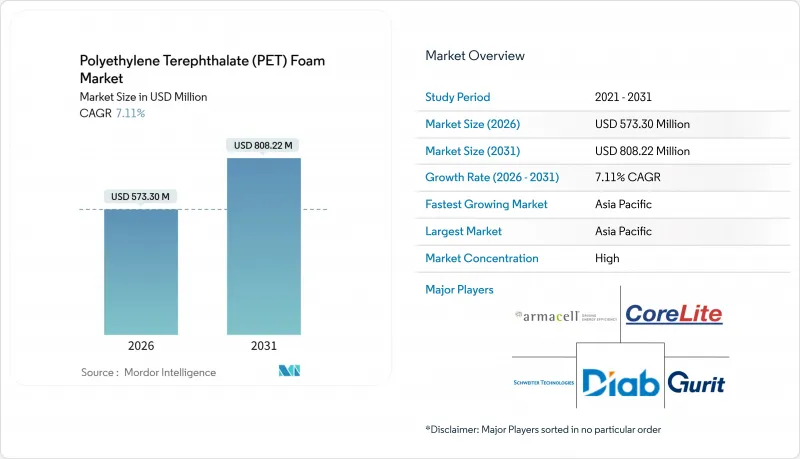
據 Mordor Intelligence 稱,聚對苯二甲酸乙二醇酯 (PET)發泡體市場預計在 2026 年達到 5.733 億美元,預計在預測期(2026-2031 年)內將以 7.11% 的複合年成長率成長,到 2031 年達到 8.0822 億美元。
本報告按類型(低密度PET發泡體和高密度PET發泡體)、終端用戶行業(建築、交通運輸、船舶、風力發電、包裝及其他行業)和地區(亞太地區、北美、歐洲、南美以及中東和非洲)進行細分。市場預測以美元計價。
全球聚對苯二甲酸乙二醇酯(PET)泡沫市場趨勢及洞察
在整個行動平台推廣減重
美國和歐盟的燃油效率和碳排放法規迫使汽車製造商在確保碰撞安全性的同時減輕車輛重量。與鋁相比,在電池機殼內使用PET泡沫夾芯板可以減輕重量,從而延長電動車的續航里程。商用車製造商正在對冷藏車車身進行PET芯材面板的改裝,以實現隔熱和結構剛性的雙重目標。航太公司正在評估該材料在無人機(UAV)中的合格,但由於認證過程漫長,預計要到2028年或更晚才能進入市場。目前,PET泡沫材料在引擎室和排氣系統附近等區域的應用仍然有限,因為在這些區域,發泡體的性能在100 度C以上會迅速下降。
擴大風力發電裝置容量並增加葉片尺寸
全球風電裝置容量預計將持續成長至2028年。離岸風力發電葉片的長度已超過臨界閾值,由此產生的離心負荷促使人們避免使用較重的芯材。主要構成葉片尖端外層的PET發泡體,其抗疲勞性能優於輕木,即使在低密度下也能維持抗張強度。 LM Wind Power透過在芯材中使用回收材料,成功降低了葉片整個生命週期的碳足跡。中國風力渦輪機葉片製造商佔全球產量的一半以上,隨著中國力爭在2030年實現大規模離岸風力發電裝置容量,這些製造商正在加大投入。
成熟的替代材料限制了定價權。
輕木、聚氯乙烯和苯乙烯-丙烯腈發泡體憑藉比PET更低的成本,鞏固了其在風力渦輪機葉片基體材料中的地位。由於葉片製造商已熟悉輕木的加工工藝,其銷售量逐年成長。贏創的聚Polymethacrylimide發泡體可減少樹脂用量,並在高溫環境下的航太細分市場中佔據主導地位。為了達到類似的剛度,PET需要提高密度,但這會增加對價格敏感的船舶應用領域的成本。
細分市場分析
到2025年,低密度PET泡棉將佔聚對苯二甲酸乙二醇酯(PET)發泡體市場價值的66.98%,預計到2031年將以每年7.22%的速度成長,這主要得益於其在風力渦輪機葉片尖端的應用,因為在這些轉動,抗疲勞性和最小化部位至關重要。特定密度的PET泡棉可達到適用於葉片外表面和船舶甲板的抗壓強度,從而實現更輕的層壓結構。高密度PET泡棉則用於支撐葉片底部和船體底部。儘管高密度PET泡棉市場有所成長,但成長速度較為溫和,這可能是由於來自輕木和PVC的競爭所致。 2024年5月,阿姆斯壯在蘇州運作了其第四條擠出生產線,戰略重點是為中國海上項目生產客製化的低密度PET泡沫產品。
原型採用分層溝槽和穿孔結構,展現了未來在強度和輕量化之間實現平衡的潛力。諸如3A Composites公司的「AIREX T92 SealX」等表面處理技術可以減少樹脂吸附,從而降低成本和碳排放。高密度泡棉材料在需要耐壓的場合,例如作為保護性包裝材料和屋頂隔熱材料,需求量很大,但與它們在渦輪機和船舶結構中的應用相比,其使用量仍然有限。
區域分析
預計到2025年,亞太地區將佔全球銷售額的57.67%,並預計到2031年將以每年8.11%的速度成長。這反映了葉片製造在中國的集中以及東南亞海洋複合材料中心的崛起。中國預計將在2030年實現其離岸風力發電裝置容量目標,並已對葉片從芯材到葉尖的年消耗量進行了估算。常州天盛和萬凱等國內企業以低於歐洲進口產品的價格銷售產品,加劇了市場競爭。在印度,風電裝置容量逐年成長,但由於缺乏成熟的國內解聚工藝,樹脂進口成本飆升。同時,越南和泰國正利用其有利的勞動力和港口基礎設施,向歐洲出口使用PET芯材的船舶。
在北美,受大西洋離岸風力發電電場的蓬勃發展和電動車強制普及的推動,預計市場將持續成長。美國在2024年擴大了發電裝置容量,馬薩諸塞州和紐約州大規模離岸風力發電的運作需要100公尺長的葉片。到2026年,燃油效率標準(CAFE)要求提高燃油效率,這推動了對複合材料需求的激增。然而,由於耐熱性的限制,PET的應用僅限於在車輛內部溫度下運行的零件。加拿大國家建築規範目前建議提高牆體隔熱性能(R值),並鼓勵在結構保溫板中使用PET芯材,儘管其成本較高。
在歐洲,隨著北海和波羅的海項目的推進以及循環經濟指令促進建築業使用再生材料,市場預計將會擴大。 2024年,德國、丹麥和英國聯合安裝了離岸風力發電電場。計劃於2025年生效的生產者延伸責任制(EPR)法規正在增加對含再生材料發泡體的需求,但由於化學回收的處理能力有限,供應成長受到限制。南美洲、中東和非洲僅佔市場佔有率的一小部分,但巴西陸上風電的發展和南非造船業的成長都顯示出成長跡象。
其他好處:
- Excel格式的市場預測(ME)表
- 3個月的分析師支持
目錄
第1章:引言
- 研究假設和市場定義
- 調查範圍
第2章:調查方法
第3章執行摘要
第4章 市場狀況
- 市場概覽
- 市場促進因素
- 在整個行動平台推廣減重
- 擴大風力發電裝置容量並增加葉片尺寸
- 綠建築對隔熱材料的需求
- 向循環經濟和再生PET原料轉型
- 用於無人機/無人飛行器機身的PET發泡芯材出現。
- 市場限制因素
- 成熟的替代品(PVC、SAN、輕木)限制了價格的形成。
- rPET樹脂的供應和成本波動
- 超過 100 度C的高溫零件的熱變形極限
- 價值鏈分析
- 波特五力模型
第5章 市場規模與成長預測
- 按類型
- 低密度PET泡沫
- 高密度PET泡沫
- 按最終用戶行業分類
- 建築/施工
- 運輸
- 海上
- 風力
- 包裝
- 其他行業(航太、運動、電子、家具)
- 按地區
- 亞太地區
- 中國
- 印度
- 日本
- 韓國
- 東南亞國協
- 其他亞太國家
- 北美洲
- 美國
- 加拿大
- 墨西哥
- 歐洲
- 德國
- 英國
- 義大利
- 法國
- 西班牙
- 俄羅斯
- 北歐國家
- 其他歐洲國家
- 南美洲
- 巴西
- 阿根廷
- 其他南美國家
- 中東和非洲
- 沙烏地阿拉伯
- 南非
- 其他中東和非洲國家
- 亞太地區
第6章 競爭情勢
- 市場集中度
- 策略趨勢
- 市佔率和排名分析
- 公司簡介
- 3A Composites(Schweiter Technologies AG)
- Airex AG
- Armacell
- BASF SE
- Carbon-Core Corp.
- Changzhou Tiansheng New Materials Co., Ltd.
- Composites One
- CoreLite
- Diab Group
- Feininger(Nanjing)Energy Saving Technology Co.,ltd.
- Gneuss Kunststofftechnik GmbH
- Gurit Services AG
- Liner
- Longhua Technology Group(Luoyang)Co., Ltd.
- Nanjing Chuangbo Machinery Co., Ltd.
- Nitto Denko Corporation
- Polyumac USA, LLC.
- Sekisui Kasei Co., Ltd.
- Shanghai Yueke New Materials
- TOPOLO
- USEON Technology Limited
- Wankai New Materials Co., Ltd.
第7章 市場機會與未來展望
According to Mordor Intelligence, the polyethylene terephthalate foam market size is estimated at USD 573.30 million in 2026, and is expected to reach USD 808.22 million by 2031, at a CAGR of 7.11% during the forecast period (2026-2031).
This report is Segmented by Type (Low-Density PET Foam and High-Density PET Foam), End-User Industry (Building and Construction, Transportation, Marine, Wind Energy, Packaging, and Other Industries), and Geography (Asia-Pacific, North America, Europe, South America, and Middle-East and Africa). The Market Forecasts are Provided in Terms of Value (USD).
Global Polyethylene Terephthalate (PET) Foam Market Trends and Insights
Light-Weighting Push Across Mobility Platforms
Fuel-economy and carbon-emission regulations in the United States and European Union are forcing automakers to lower vehicle mass while protecting crashworthiness. PET foam sandwich panels inside battery enclosures deliver weight savings against aluminum and extend electric-vehicle range. Commercial-vehicle builders are retrofitting refrigerated truck bodies with PET-cored panels to mix thermal insulation and structural stiffness. Aerospace adopters are qualifying the material for unmanned-aerial-vehicle wings, but certification cycles extend market entry beyond 2028. Penetration is still limited in engine-bay or exhaust-adjacent zones because foam properties fall rapidly above 100 °C.
Wind-Energy Capacity Expansion and Larger Blades
Global wind additions are poised to grow annually through 2028. Offshore blade lengths have now surpassed significant thresholds, leading to centrifugal loads that sidestep the use of heavier core materials. Dominating the outer sections of the tip, PET foam outperforms balsa in fatigue resistance and sustains tensile strength at lower densities. By sourcing recycled content for its cores, LM Wind Power has successfully reduced the blade's life-cycle carbon footprint. China's wind-blade manufacturers, accounting for over half of the global production, are ramping up efforts as the country sets its sights on achieving significant offshore capacity by 2030.
Mature Substitutes Constrain Pricing Power
Balsa wood, polyvinyl-chloride, and styrene-acrylonitrile foams, by undercutting PET on cost, have solidified their foothold in wind-blade root sections. Balsa sales are growing annually, thanks to blade makers' familiarity with its processing. Evonik's polymethacrylimide foam conserves resin and dominates high-temperature aerospace niches. To achieve comparable stiffness, PET needs to increase its density, a move that escalates costs in price-sensitive marine applications.
Other drivers and restraints analyzed in the detailed report include:
- Green-Building Insulation Demand
- Shift to Circular, Recycled PET Feedstocks
- Volatile Recycled-PET Resin Supply and Cost
For complete list of drivers and restraints, kindly check the Table Of Contents.
Segment Analysis
Low-density grades held 66.98% of the Polyethylene Terephthalate (PET) foam market value in 2025 and are expanding at 7.22% a year to 2031, propelled by use in wind-blade tip sections that value fatigue resistance and minimal inertia. Compressive strengths suitable for outer blades and marine decks are achieved with specific densities, allowing for a reduction in laminate weight. High-density grades are utilized for supporting blade roots and hull bottoms. Despite growth, the expansion appears subdued, likely due to competition from balsa and PVC. In May 2024, Armacell inaugurated its fourth extrusion line in Suzhou, with a strategic focus on low-density outputs tailored for China's offshore projects.
Prototypes featuring hierarchical groove-perforation demonstrate a potential future balance between strength and lightweight properties. Surface treatments, such as 3A Composites' AIREX T92 SealX, achieve a reduction in resin uptake, subsequently lowering both cost and carbon metrics. While high-density foam is sought after for protective packaging and flat-roof insulation-both demanding compression resistance-its volumes remain modest when compared to those used in turbines and marine constructions.
Complete Report Scope:
- By Type
- Low-Density PET Foam
- High-Density PET Foam
- By End-User Industry
- Building and Construction
- Transportation
- Marine
- Wind Energy
- Packaging
- Other Industries (Aerospace, Sports, Electronics, Furniture)
- By Geography
- Asia-Pacific
- China
- India
- Japan
- South Korea
- ASEAN Countries
- Rest of Asia-Pacific
- North America
- United States
- Canada
- Mexico
- Europe
- Germany
- United Kingdom
- Italy
- France
- Spain
- Russia
- NORDIC Countries
- Rest of Europe
- South America
- Brazil
- Argentina
- Rest of South America
- Middle-East and Africa
- Saudi Arabia
- South Africa
- Rest of Middle-East and Africa
- Asia-Pacific
Geography Analysis
Asia-Pacific generated 57.67% of 2025 revenue and is expanding 8.11% yearly to 2031, reflecting concentrated blade manufacturing in China and nascent marine-composite hubs in Southeast Asia. China is set to achieve a target of offshore wind capacity by 2030, with an estimated annual consumption of core for tip sections. Domestic players, Changzhou Tiansheng and Wankai, are undercutting European imports, heightening price competition. While India adds wind capacity annually, its absence of domestic depolymerization leads to elevated resin import costs. Meanwhile, Vietnam and Thailand are capitalizing on their advantageous labor and port infrastructure to export PET-cored boats to Europe.
North America is projected to grow, buoyed by the momentum of Atlantic offshore wind farms and electric vehicle mandates. The U.S. bolstered its capacity in 2024, marking the debut of large-scale offshore arrays in Massachusetts and New York, necessitating 100-m blades. With CAFE standards pushing for higher fuel efficiency by 2026, there's a surge in composite demand, even as heat constraints limit PET's application to cabin-temperature components. Canada's national building code is now advocating for elevated wall R-values, driving the adoption of PET cores in structural-insulated panels, albeit at a premium.
Europe is set to grow as projects in the North Sea and Baltic progress, and circular-economy directives push for recycled materials in construction. In 2024, Germany, Denmark, and the U.K. collectively installed offshore wind capacity. While extended-producer-responsibility rules set to take effect in 2025 are boosting demand for recycled-content foam, the limited capacity for chemical recycling is curbing volume growth. South America, along with the Middle East and Africa, collectively represents a small portion of the market; however, Brazil's onshore wind developments and South Africa's marine craft industry signal budding growth.
- 3A Composites (Schweiter Technologies AG)
- Airex AG
- Armacell
- BASF SE
- Carbon-Core Corp.
- Changzhou Tiansheng New Materials Co., Ltd.
- Composites One
- CoreLite
- Diab Group
- Feininger (Nanjing) Energy Saving Technology Co.,ltd.
- Gneuss Kunststofftechnik GmbH
- Gurit Services AG
- Liner
- Longhua Technology Group (Luoyang) Co., Ltd.
- Nanjing Chuangbo Machinery Co., Ltd.
- Nitto Denko Corporation
- Polyumac USA, LLC.
- Sekisui Kasei Co., Ltd.
- Shanghai Yueke New Materials
- TOPOLO
- USEON Technology Limited
- Wankai New Materials Co., Ltd.
Additional Benefits:
- The market estimate (ME) sheet in Excel format
- 3 months of analyst support
TABLE OF CONTENTS
1 Introduction
- 1.1 Study Assumptions and Market Definition
- 1.2 Scope of the Study
2 Research Methodology
3 Executive Summary
4 Market Landscape
- 4.1 Market Overview
- 4.2 Market Drivers
- 4.2.1 Light-weighting push across mobility platforms
- 4.2.2 Wind-energy capacity expansion and larger blades
- 4.2.3 Green-building insulation demand
- 4.2.4 Shift to circular, recycled PET feedstocks
- 4.2.5 Emergence of PET foam cores for UAV/Drone airframes
- 4.3 Market Restraints
- 4.3.1 Mature substitutes (PVC, SAN, balsa) constrain pricing
- 4.3.2 Volatile rPET resin supply and cost
- 4.3.3 Heat-deflection limits above 100 °C for high-temp parts
- 4.4 Value Chain Analysis
- 4.5 Porter's Five Forces
- 4.5.1 Bargaining Power of Suppliers
- 4.5.2 Bargaining Power of Buyers
- 4.5.3 Threat of New Entrants
- 4.5.4 Threat of Substitutes
- 4.5.5 Competitive Rivalry
5 Market Size and Growth Forecasts (Value)
- 5.1 By Type
- 5.1.1 Low-Density PET Foam
- 5.1.2 High-Density PET Foam
- 5.2 By End-User Industry
- 5.2.1 Building and Construction
- 5.2.2 Transportation
- 5.2.3 Marine
- 5.2.4 Wind Energy
- 5.2.5 Packaging
- 5.2.6 Other Industries (Aerospace, Sports, Electronics, Furniture)
- 5.3 By Geography
- 5.3.1 Asia-Pacific
- 5.3.1.1 China
- 5.3.1.2 India
- 5.3.1.3 Japan
- 5.3.1.4 South Korea
- 5.3.1.5 ASEAN Countries
- 5.3.1.6 Rest of Asia-Pacific
- 5.3.2 North America
- 5.3.2.1 United States
- 5.3.2.2 Canada
- 5.3.2.3 Mexico
- 5.3.3 Europe
- 5.3.3.1 Germany
- 5.3.3.2 United Kingdom
- 5.3.3.3 Italy
- 5.3.3.4 France
- 5.3.3.5 Spain
- 5.3.3.6 Russia
- 5.3.3.7 NORDIC Countries
- 5.3.3.8 Rest of Europe
- 5.3.4 South America
- 5.3.4.1 Brazil
- 5.3.4.2 Argentina
- 5.3.4.3 Rest of South America
- 5.3.5 Middle-East and Africa
- 5.3.5.1 Saudi Arabia
- 5.3.5.2 South Africa
- 5.3.5.3 Rest of Middle-East and Africa
- 5.3.1 Asia-Pacific
6 Competitive Landscape
- 6.1 Market Concentration
- 6.2 Strategic Moves
- 6.3 Market Share(%)/Ranking Analysis
- 6.4 Company Profiles {(includes Global level Overview, Market level overview, Core Segments, Financials as available, Strategic Information, Products and Services, and Recent Developments)}
- 6.4.1 3A Composites (Schweiter Technologies AG)
- 6.4.2 Airex AG
- 6.4.3 Armacell
- 6.4.4 BASF SE
- 6.4.5 Carbon-Core Corp.
- 6.4.6 Changzhou Tiansheng New Materials Co., Ltd.
- 6.4.7 Composites One
- 6.4.8 CoreLite
- 6.4.9 Diab Group
- 6.4.10 Feininger (Nanjing) Energy Saving Technology Co.,ltd.
- 6.4.11 Gneuss Kunststofftechnik GmbH
- 6.4.12 Gurit Services AG
- 6.4.13 Liner
- 6.4.14 Longhua Technology Group (Luoyang) Co., Ltd.
- 6.4.15 Nanjing Chuangbo Machinery Co., Ltd.
- 6.4.16 Nitto Denko Corporation
- 6.4.17 Polyumac USA, LLC.
- 6.4.18 Sekisui Kasei Co., Ltd.
- 6.4.19 Shanghai Yueke New Materials
- 6.4.20 TOPOLO
- 6.4.21 USEON Technology Limited
- 6.4.22 Wankai New Materials Co., Ltd.
7 Market Opportunities and Future Outlook
- 7.1 White-space and Unmet-Need Assessment

 聚對苯二甲酸乙二醇酯樹脂市場報告:趨勢、預測與競爭分析(至2035年)
 聚對苯二甲酸乙二醇酯(PET)纖維市場規模、佔有率、趨勢和預測:按原料、纖維類型、形態、應用和地區分類,2026-2034年
 聚對苯二甲酸乙二醇酯(PET)市場:依產品種類、應用及地區分類
 再生聚對苯二甲酸乙二醇酯市場:2026-2032年全球市場預測(依原料種類、形態、等級、製造流程、顏色及應用分類)
 聚對苯二甲酸乙二醇酯(PET)市場規模、佔有率、成長率、全球產業分析、按類型、應用和地區分類的分析以及未來預測(2026-2034)。
 2026年全球聚對苯二甲酸乙二醇酯(PET)杯市場報告全球聚對苯二甲酸乙二醇酯(PET)市場規模、佔有率、趨勢和成長分析報告(2026-2034年)
 聚對苯二甲酸乙二醇酯(PET)杯市場規模、佔有率和成長分析:按杯子設計與應用、原料、製造技術、最終用途和地區分類-2026-2033年產業預測
 歐洲聚對苯二甲酸乙二醇酯(PET):市場佔有率分析、產業趨勢和統計數據以及成長預測(2026-2031 年)
 全球雙向拉伸聚對苯二甲酸乙二醇酯(BOPET)薄膜市場分析:按厚度、應用、終端用戶產業和預測(2018-2034 年)