


 |
市場調查報告書
商品編碼
2114025
甘蔗收割機:市場佔有率分析、產業趨勢與統計、成長預測(2026-2031)Sugarcane Harvesters - Market Share Analysis, Industry Trends & Statistics, Growth Forecasts (2026 - 2031) |
||||||

※ 本網頁內容可能與最新版本有所差異。詳細情況請與我們聯繫。
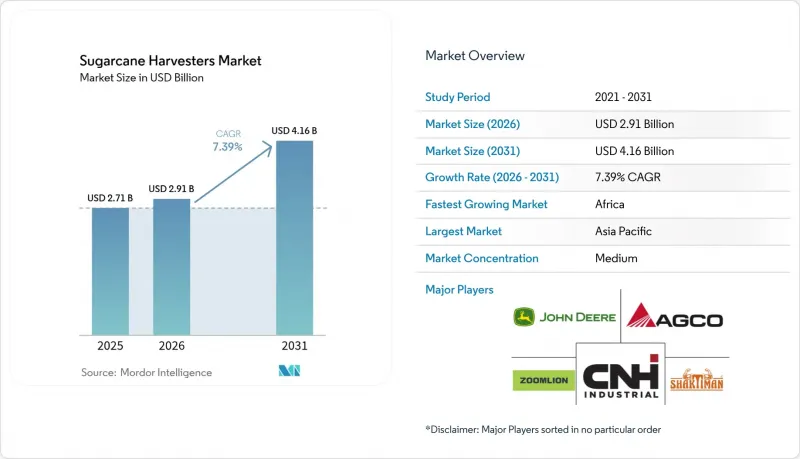
據 Mordor Intelligence 稱,甘蔗收割機市場預計到 2026 年價值 29.1 億美元,高於 2025 年的 27.1 億美元,預計到 2031 年將達到 41.6 億美元。
預計從 2026 年到 2031 年,其複合年成長率將達到 7.39%。
本報告按類型(整莖收割機和切碎/鋼坯收割機)、驅動系統(自走式和曳引機懸掛/牽引式)、行處理能力(單行和多行)以及地區(北美、歐洲、亞太、南美以及中東和非洲)進行細分。市場預測以美元計價。
全球甘蔗收割機市場趨勢及洞察
主要生產國強制實施機械化收割
政府推出的禁止收割前焚燒和強制機械化收割的法規正在改變甘蔗的生產方式。泰國甘蔗和糖業委員會秘書處(OCSB)設定了一個雄心勃勃的目標,即在2024-2025收割季將甘蔗種植園的收割前焚燒減少高達90%,旨在顯著降低有害的PM2.5顆粒物排放。在巴西,此類法規的實施使勞動力需求減少了64%,機械化收割已成為主要收割方式。這些監管措施標誌著甘蔗生產正從根本上轉向機械化和以效率為導向的生產方式。
農業勞動力長期短缺,推動了小型自走式機械的普及。
人口結構變化和向城市遷移導致農業勞動力減少,因此需要提高機械化程度和工資水準。根據中國國家統計局數據顯示,到2023年,隨著年輕人從農村湧入都市區,都市化將達到66.16%。攜帶式收割機的引進提高了工作效率,減少了對人工的需求。根據歐盟統計局的數據,歐盟農業工資上漲了12%,達到每小時34.4美元,這主要是由於季節性工作人員難以招募。這凸顯了對小型自走式甘蔗收割機的需求。
發展中地區高產能機械價格高昂
由於大型收割設備需要大量資金投入,許多小規模農戶尚未實現機械化作業。這種現代機械獲取管道有限的情況導致部分地區生產力下降。雖然從長遠來看,機械化收割可以降低每噸甘蔗的成本,但高昂的初始投資仍然是一大障礙。該行業正在探索資金籌措方案和合作所有權模式作為潛在的解決方案。然而,除非技術普及化程度提高,否則機械化可能會加劇甘蔗產業現有的不平等現象。
細分市場分析
切碎式甘蔗收割機在甘蔗收割市場佔據主導地位,預計2025年將佔總銷售量的71.35%。由於其與高產能糖廠的兼容性以及在收割帶葉甘蔗時的卓越性能,這類機器成為大型農場的首選。它們配備了改進的刀片和提取系統,提高了處理能力並最大限度地減少了停機時間。與智慧型系統的整合可以自動調節刀片壓力和殘渣分離,從而提高各種田間條件下的作業效率。整莖收割機仍然佔有一席之地,尤其是在那些需要最大限度減少汁液損失的專業領域,例如高檔糖的生產。
預計到2031年,全莖收割機將維持6.89%的複合年成長率,這主要得益於優質糖生產商和注重果汁保留的地區的需求。隨著田間焚燒法規的日益嚴格,切碎式收割機能夠更好地管理殘茬並減少堵塞。製造商正在開發符合當地農業需求的切碎式收割機配置,將機械可靠性與精準收割能力相結合,以滿足環境法規和作業要求。
區域分析
亞太地區憑藉其廣大的耕地面積和政府政策的支持,佔了甘蔗收割機市場54.65%的佔有率。中國和印度正在加大對機械化的投資,以應對勞動力短缺和營運成本問題。在印度,馬哈拉斯特拉邦的一家合作糖廠正在共同出資購買機械化收割機,以確保高效能收割並減少對季節性工人的依賴。泰國政府正在提供補貼,以促進中型農民採用機械化收割機。在亞太地區,本地製造商和全球設備製造商之間的合作正在不斷加強,以開發適合當地條件的收割技術。
儘管非洲目前的市佔率較小,但其複合年成長率 (CAGR) 仍高達 7.49%。研究表明,與人工收割相比,機械化可以顯著降低成本,尤其是在蘇丹。南非正透過引入創新技術(例如用於作物管理的噴灑無人機)來實現技術進步。非洲各國政府正與國際金融機構合作,為農業機械開發資金籌措方案,這顯示整個產業正向機械化和數據驅動的耕作方式轉變。
南美洲保持其市場地位,巴西在2023/24年度的產量達7.05億噸。哥倫比亞和秘魯緊跟巴西之後,開始引進中型甘蔗收割機。環保法規促使農民轉向收割青甘蔗(未精製甘蔗)和生產乙醇,而數位化解決方案則有助於提高營運效率。在北美,路易斯安那州的製糖業正在採用自動化技術來控制人事費用並滿足貿易要求。儘管市場佔有率較小,但歐洲和中東正在優先發展永續和特種糖生產,導致對高效環保型收割設備的需求增加。
其他好處:
- Excel格式的市場預測(ME)表
- 3個月的分析師支持
目錄
第1章:引言
- 研究假設和市場定義
- 調查範圍
第2章:調查方法
第3章執行摘要
第4章 市場狀況
- 市場概覽
- 市場促進因素
- 主要生產國強制實施機械化收割
- 農業勞動力長期短缺,推動了小型自走式機械的普及。
- 隨著糖和乙醇加工廠的擴建,需要具有高現場加工能力的機械設備。
- 收割綠色甘蔗(不進行露天焚燒)所獲得的碳權溢價正在推動資本投資。
- OEM車載資訊系統/人工智慧模組可減少坯料損耗
- 多行收割機的引入降低了營運成本。
- 市場限制因素
- 發展中地區大容量機械成本高昂
- 鄉村地區售後服務網匱乏
- 現有切割機底座設計與甘蔗品種不匹配,導致莖稈損傷加劇。
- 由於收割者很少有資格獲得綠色房產稅額扣抵,這給了資金籌措。
- 監理情勢
- 技術展望
- 波特五力分析
第5章 市場規模與成長預測
- 按類型
- 全莖收割機
- 切碎機/鋼坯收割機
- 透過驅動系統
- 自推進式
- 曳引機式/牽引式
- 按柱處理能力
- 解排
- 多行
- 按地區
- 北美洲
- 美國
- 加拿大
- 墨西哥
- 其他北美國家
- 歐洲
- 法國
- 西班牙
- 葡萄牙
- 俄羅斯
- 其他歐洲國家
- 亞太地區
- 中國
- 印度
- 泰國
- 印尼
- 澳洲
- 其他亞太國家
- 南美洲
- 巴西
- 阿根廷
- 哥倫比亞
- 其他南美國家
- 中東
- 阿拉伯聯合大公國
- 沙烏地阿拉伯
- 土耳其
- 其他中東國家
- 非洲
- 南非
- 埃及
- 蘇丹
- 其他非洲國家
- 北美洲
第6章 競爭情勢
- 市場集中度
- 策略趨勢
- 市佔率分析
- 公司簡介
- Deere & Company
- CNH Industrial NV
- AGCO Corporation
- Samart Kasetyon Co., Ltd.
- Zoomlion Heavy Industry Science and Technology Co., Ltd.
- Tirth Agro Technology Private Limited(Shaktiman Agro)
- TAGRM Co. Ltd.
- Grupo Jacto
- Jiangsu World Agriculture Machinery Co., Ltd(World Group)
- Kartar Agro Industries Private Limited
- Yanmar Holdings Co., Ltd.
- Guangxi LiuGong Group
- CANETEC Pty Ltd
- Wuhan Wubota Machinery Co., Ltd.
第7章 市場機會與未來展望
According to Mordor Intelligence, the sugarcane harvesters market size in 2026 is estimated at USD 2.91 billion, growing from 2025 value of USD 2.71 billion with 2031 projections showing USD 4.16 billion, growing at 7.39% CAGR over 2026-2031.
This report is Segmented by Type (Whole-Stalk Harvesters and Chopper/Billet Harvesters), by Drive Mode (Self-Propelled and Tractor-Mounted/Towed), by Row-Capacity (Single-Row and Multi-Row), and by Geography (North America, Europe, Asia-Pacific, South America, Middle East, and Africa). The Market Forecasts are Provided in Terms of Value (USD).
Global Sugarcane Harvesters Market Trends and Insights
Mechanized-harvesting Mandates in Major Producing Countries
Government regulations prohibiting pre-harvest burning and mandating mechanical harvesting are transforming sugarcane production practices. The Office of the Cane and Sugar Board (OCSB), Thailand, has set an ambitious target to reduce the burning of sugar cane plantations prior to harvest by up to 90% during the 2024-25 harvest season, with the aim of significantly lowering harmful PM2.5 fine particle emissions. Brazil's implementation of these regulations reduced labor requirements by 64%, establishing mechanical harvesting as the primary method. These regulatory measures indicate a fundamental shift toward mechanized, efficiency-focused sugarcane production.
Permanent Farm-labor Shortages Pushing Adoption of Compact Self-propelled Units
Demographic changes and urban migration are reducing the agricultural workforce, necessitating increased mechanization and higher wages. In China, the National Bureau of Statistics (NBS) reported urbanization reached 66.16% in 2023, as younger populations moved from rural areas. The adoption of portable harvesters has enhanced operational efficiency and reduced manual labor requirements. According to Eurostat, in the European Union, agricultural wages increased by 12% to USD 34.4 per hour, primarily due to reduced seasonal immigrant labor availability, highlighting the necessity of compact self-propelled sugarcane harvester units.
High-price for High-capacity Machines in Developing Regions
The significant capital requirements for high-capacity harvesting equipment prevent many small-scale growers from mechanizing their operations. This limited access to modern machinery has led to productivity declines in several regions. While mechanical harvesting reduces per-ton costs over time, the substantial initial investment remains prohibitive. The industry is exploring financing options and cooperative ownership models as potential solutions. However, without broader access to technology, mechanization may increase existing inequalities within the sugarcane sector.
Other drivers and restraints analyzed in the detailed report include:
- Sugar-ethanol Flex-mill Expansion Demanding Higher Field-throughput Machinery
- OEM Telematics / AI Modules that Cut Billet Losses
- Limited After-sales Service Network in Rural Areas
For complete list of drivers and restraints, kindly check the Table Of Contents.
Segment Analysis
Chopper-style harvesters dominate the sugarcane harvesters market size, accounting for 71.35% of the 2025 revenue. These machines are the primary choice for large-scale operations due to their compatibility with high-tonnage mills and performance in leafy cane conditions. The machines feature upgraded blades and extractors that increase throughput and minimize downtime. Integration with smart systems enables automatic adjustment of knife pressure and trash separation, improving operational efficiency across varying field conditions. Whole-stalk harvesters retain their market presence in specialized segments where minimal juice loss is essential, particularly in premium sugar production.
Whole-stalk harvesters maintain a CAGR of 6.89%, supported by demand from premium sugar producers and regions focusing on juice retention through 2031. With increasing field burn restrictions, chopper designs provide enhanced residue management capabilities and reduced clogging. Manufacturers are developing chopper configurations specific to regional agronomic requirements, combining mechanical reliability with precise harvesting capabilities to address environmental regulations and operational requirements.
Complete Report Scope:
- By Type
- Whole-Stalk Harvesters
- Chopper / Billet Harvesters
- By Drive Mode
- Self-Propelled
- Tractor-Mounted / Towed
- By Row-Capacity
- Single-Row
- Multi-Row
- By Geography
- North America
- United States
- Canada
- Mexico
- Rest of North America
- Europe
- France
- Spain
- Portugal
- Russia
- Rest of Europe
- Asia-Pacific
- China
- India
- Thailand
- Indonesia
- Australia
- Rest of Asia-Pacific
- South America
- Brazil
- Argentina
- Colombia
- Rest of South America
- Middle East
- United Arab Emirates
- Saudi Arabia
- Turkey
- Rest of Middle East
- Africa
- South Africa
- Egypt
- Sudan
- Rest of Africa
- North America
Geography Analysis
Asia-Pacific holds a 54.65% of the Sugarcane Harvester market share, supported by extensive cultivation areas and government policies. China and India are increasing their mechanization investments to address labor shortages and operational costs. In India, Maharashtra's cooperative mills are providing joint financing for mechanical harvesters to ensure efficient harvesting and reduce reliance on seasonal workers. Thailand's government is offering subsidies to increase adoption among mid-sized farmers. The region is seeing increased collaboration between local manufacturers and global equipment makers to develop harvesting technologies suited to local conditions.
Africa, despite its current smaller market share, is growing at a 7.49% CAGR. Research indicates substantial cost reductions through mechanization compared to manual harvesting, particularly in Sudan. South Africa is advancing technologically by incorporating innovations like spray drones for crop management. African governments are working with international financial institutions to create equipment financing options, indicating an industry-wide transition to mechanized and data-based farming practices.
South America maintains its market position, with Brazil producing 705 million metric tons in 2023/24. Colombia and Peru follow Brazil in the adoption of mid-capacity harvester models. Environmental regulations are directing farmers toward green-cane harvesting and ethanol production, while digital solutions enhance operations. In North America, Louisiana's sugar industry is implementing automation to manage labor costs and comply with trade requirements. Europe and the Middle East, with smaller market shares, are prioritizing sustainable and specialty sugar production, increasing demand for efficient, environmentally conscious harvesting equipment.
- Deere & Company
- CNH Industrial N.V.
- AGCO Corporation
- Samart Kasetyon Co., Ltd.
- Zoomlion Heavy Industry Science and Technology Co., Ltd.
- Tirth Agro Technology Private Limited (Shaktiman Agro)
- TAGRM Co. Ltd.
- Grupo Jacto
- Jiangsu World Agriculture Machinery Co., Ltd (World Group)
- Kartar Agro Industries Private Limited
- Yanmar Holdings Co., Ltd.
- Guangxi LiuGong Group
- CANETEC Pty Ltd
- Wuhan Wubota Machinery Co., Ltd.
Additional Benefits:
- The market estimate (ME) sheet in Excel format
- 3 months of analyst support
TABLE OF CONTENTS
1 Introduction
- 1.1 Study Assumptions and Market Definition
- 1.2 Scope of the Study
2 Research Methodology
3 Executive Summary
4 Market Landscape
- 4.1 Market Overview
- 4.2 Market Drivers
- 4.2.1 Mechanized-harvesting Mandates in Major Producing Countries
- 4.2.2 Permanent Farm-labor Shortages Pushing Adoption of Compact Self-propelled Units
- 4.2.3 Sugar-ethanol Flex-mill Expansion Demanding Higher Field-throughput Machinery
- 4.2.4 Carbon-credit Premiums for Green-cane Harvesting (No Field-burn) Driving Equipment Spend
- 4.2.5 OEM Telematics / AI Modules that Cut Billet Losses
- 4.2.6 Multi-row Harvester Introductions Lowering Operating Cost
- 4.3 Market Restraints
- 4.3.1 High-price for High-capacity Machines in Developing Regions
- 4.3.2 Limited After-sales Service Network in Rural Areas
- 4.3.3 Cane-variety Mismatch with Existing Cutter-base Designs Raising Stool Damage
- 4.3.4 Financing Barriers as Harvesters Seldom Qualify for Green-asset Tax Credits
- 4.4 Regulatory Landscape
- 4.5 Technological Outlook
- 4.6 Porter's Five Forces Analysis
- 4.6.1 Bargaining Power of Suppliers
- 4.6.2 Bargaining Power of Buyers
- 4.6.3 Threat of New Entrants
- 4.6.4 Threat of Substitutes
- 4.6.5 Intensity of Competitive Rivalry
5 Market Size and Growth Forecasts (Value)
- 5.1 By Type
- 5.1.1 Whole-Stalk Harvesters
- 5.1.2 Chopper / Billet Harvesters
- 5.2 By Drive Mode
- 5.2.1 Self-Propelled
- 5.2.2 Tractor-Mounted / Towed
- 5.3 By Row-Capacity
- 5.3.1 Single-Row
- 5.3.2 Multi-Row
- 5.4 By Geography
- 5.4.1 North America
- 5.4.1.1 United States
- 5.4.1.2 Canada
- 5.4.1.3 Mexico
- 5.4.1.4 Rest of North America
- 5.4.2 Europe
- 5.4.2.1 France
- 5.4.2.2 Spain
- 5.4.2.3 Portugal
- 5.4.2.4 Russia
- 5.4.2.5 Rest of Europe
- 5.4.3 Asia-Pacific
- 5.4.3.1 China
- 5.4.3.2 India
- 5.4.3.3 Thailand
- 5.4.3.4 Indonesia
- 5.4.3.5 Australia
- 5.4.3.6 Rest of Asia-Pacific
- 5.4.4 South America
- 5.4.4.1 Brazil
- 5.4.4.2 Argentina
- 5.4.4.3 Colombia
- 5.4.4.4 Rest of South America
- 5.4.5 Middle East
- 5.4.5.1 United Arab Emirates
- 5.4.5.2 Saudi Arabia
- 5.4.5.3 Turkey
- 5.4.5.4 Rest of Middle East
- 5.4.6 Africa
- 5.4.6.1 South Africa
- 5.4.6.2 Egypt
- 5.4.6.3 Sudan
- 5.4.6.4 Rest of Africa
- 5.4.1 North America
6 Competitive Landscape
- 6.1 Market Concentration
- 6.2 Strategic Moves
- 6.3 Market Share Analysis
- 6.4 Company Profiles (Includes Global Level Overview, Market Level Overview, Core Segments, Financials as Available, Strategic Information, Market Rank/Share for Key Companies, Products and Services, and Recent Developments)
- 6.4.1 Deere & Company
- 6.4.2 CNH Industrial N.V.
- 6.4.3 AGCO Corporation
- 6.4.4 Samart Kasetyon Co., Ltd.
- 6.4.5 Zoomlion Heavy Industry Science and Technology Co., Ltd.
- 6.4.6 Tirth Agro Technology Private Limited (Shaktiman Agro)
- 6.4.7 TAGRM Co. Ltd.
- 6.4.8 Grupo Jacto
- 6.4.9 Jiangsu World Agriculture Machinery Co., Ltd (World Group)
- 6.4.10 Kartar Agro Industries Private Limited
- 6.4.11 Yanmar Holdings Co., Ltd.
- 6.4.12 Guangxi LiuGong Group
- 6.4.13 CANETEC Pty Ltd
- 6.4.14 Wuhan Wubota Machinery Co., Ltd.
7 Market Opportunities and Future Outlook

 2026年全球稻米收割機市場報告
 大豆收割機市場規模、佔有率和成長分析:按產品類型、產量、農場規模、驅動系統、分銷通路、最終用戶和地區分類-2026-2033年產業預測
 收割機械:市場佔有率分析、產業趨勢與統計、成長預測(2026-2031)
 甘蔗收割機市場:依產品類型、動力來源、類型、產量、最終用戶和通路分類-2026-2032年全球市場預測馬鈴薯收穫機械:市場佔有率分析、產業趨勢與統計、成長預測(2026-2031)
 水果採摘機市場:商機、成長要素、產業趨勢分析及2026-2035年預測
 農業收割機市場規模、佔有率、趨勢和預測:按產品類型、驅動系統、應用和地區分類,2026-2034年棉花收割機市場:2026-2032年全球市場預測(依產品類型、引擎功率、技術、農場規模、銷售管道及最終用戶分類)森林採伐與森林運輸機械市場:2026-2032年全球市場預測(依設備類型、功率輸出、驅動系統、應用及銷售管道)收割設備市場:依設備類型、作物類型、最終用戶和通路分類-2026年至2032年全球市場預測