


 |
市場調查報告書
商品編碼
2113730
收割機械:市場佔有率分析、產業趨勢與統計、成長預測(2026-2031)Harvesting Machinery - Market Share Analysis, Industry Trends & Statistics, Growth Forecasts (2026 - 2031) |
||||||

※ 本網頁內容可能與最新版本有所差異。詳細情況請與我們聯繫。
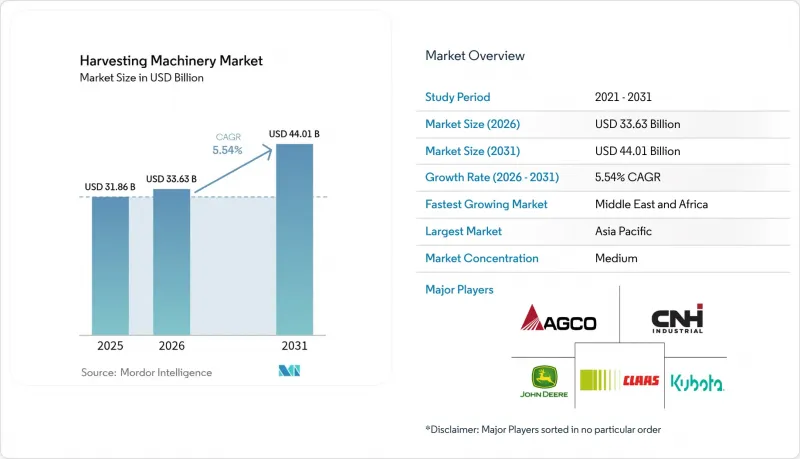
據 Mordor Intelligence 稱,2025 年收割機械市場價值為 318.6 億美元,預計到 2031 年將達到 440.1 億美元,而 2026 年為 336.3 億美元,預測期(2026-2031 年)的複合年成長率為 5.54%。
本報告按機器類型(聯合收割機、飼料收割機等)、動力來源(柴油、混合動力/電力)、作物類型(穀物、飼料作物等)和地區(北美、歐洲、南美等)進行細分。市場預測以價值(美元)和數量(台)表示。
全球收割機械市場趨勢及洞察
對大容量聯合收割機的需求不斷成長
在中國和印度,隨著大規模農業叢集的出現以及政策制定者對現代化設備的補貼投入,機械化收割正蓬勃發展。使用高產能聯合收割機收割多種作物,可以減少收穫後損失,提高糧食質量,並縮短播種週期。這種規模、技術和政策的協同作用預計將確保該地區在中期內保持在聯合收割機升級的主導地位。
政府獎勵加速開發中國家的機械化進程
公共津貼、稅收回饋和低利率貸款正在重塑收割機械市場,尤其是在非洲和南美洲部分地區。在各國的機械化發展藍圖中,收割機械與曳引機並列為優先事項,被認為是減少收穫後損失和實現糧食安全目標的關鍵。在一些國家,補貼與國內組裝要求掛鉤,鼓勵全球品牌建立散件組裝(KD)工廠,並與當地合作夥伴合作提供售後服務支援。
高昂的初始成本與小規模農戶的收入水準之間的差距。
最新聯合收割機的售價在30萬至50萬美元之間,這對大多數小規模來說難以負擔。非洲和南亞土地所有權的分散化降低了機器的利用率,延長了投資回收期。嚴重的資金籌措困難加劇了技術普及的差距,並導致市場上充斥著過時、高排放、燃油效率低且糧食品質較差的機械設備。
細分市場分析
到2025年,聯合收割機將佔整個收割機械市場64.40%的佔有率,成為最大的收入來源。感測模組和自動化系統的不斷改進,使得操作員能夠將脫粒、分類和清洗等大部分協調工作委託給軟體,從而提高處理能力並節省燃料。這種成本效益正在推動面臨勞動力短缺的商業農場對收割機的更新換代需求。人工收割帶來的產量損失風險日益增加,加上健康和安全法規的限制,進一步凸顯了在這些地區採用自走式甘蔗收割機的必要性。
相較之下,甘蔗收割機雖然面積較低,但預計到2031年,隨著巴西、印度和泰國機械化甘蔗種植的擴張,其年複合成長率將達到7.20%。人工收割帶來的產量損失風險日益增加,加上勞動安全和健康法規的約束,預計將進一步推動這些地區自走式甘蔗收割機的普及。製造商正在開發適用於窄行距、陡坡和濕潤土壤的甘蔗收割機型號,並整合遠端資訊處理功能,用於報告甘蔗段長度均勻性和抽吸風扇轉速。這些針對特定作物的改進有助於提高產品價格。飼料收割機對於乳牛飼料品質至關重要,隨著新型牧草收割機不斷升級,例如允許操作員精確控制切割長度以及配備青貯接種劑噴灑器的型號,其產量正保持中等個位數的成長。
區域分析
亞太地區佔全球收割機械市場的44.60%,預計2031年將維持高於全球平均的成長率。中國農地的快速整合以及印度合約收割車輛的增加,推動了車輛的持續更新換代。在中國,省級補貼計畫可報銷符合資格的機械成本的30%,鼓勵選擇具備精準導航功能、符合國家增產目標的機型。
預計中東和非洲地區將成為成長最快的地區,2026年至2031年的複合年成長率將達到7.62%。各國政府正優先推動機械化,以確保糧食自給自足並減少收穫後損失,小規模農戶的損失率可能超過20%。對零件進口徵收豁免以及為合作收割車隊提供信貸擔保,旨在發揮規模經濟效益。中東地區仍處於發展初期,受控環境農業和政府支持的沙漠農業需要專門的收割機械來收割溫室種植的番茄、綠葉蔬菜和椰棗。投資激勵措施和自由區物流系統正鼓勵跨國公司建立區域分銷中心,從而縮短前置作業時間並改善零件供應鏈。
北美和歐洲合計佔全球銷售量的四分之一,但兩地的換車趨勢卻有所不同。北美生產商正致力於將自動駕駛和連網功能整合到現有車隊中,從而推動了對延長車輛使用壽命並提供先進功能的售後改裝套件的需求。同時,在歐洲,嚴格的排放氣體法規和通用農業政策(CAP)的獎勵正在加速混合動力汽車汽車和電動車的普及。
其他好處:
- Excel格式的市場預測(ME)表
- 3個月的分析師支持
目錄
第1章:引言
- 研究假設和市場定義
- 調查範圍
第2章:調查方法
第3章執行摘要
第4章 市場狀況
- 市場概覽
- 市場促進因素
- 對大容量聯合收割機的需求不斷成長
- 政府獎勵措施加速開發中國家的機械化進程
- 勞動力短缺和工資上漲正在推動自動化。
- 擴大合約採伐經營模式
- 將精密農業和遠端資訊處理技術整合到收割機中
- 原廠融資和租賃方案有助於減輕資本投資負擔。
- 市場限制因素
- 高昂的初始成本與小規模農戶的收入水準形成鮮明對比。
- 商品價格波動導致機械設備採購放緩。
- 非洲和中東地區經銷商和服務網路短缺
- 柴油廢氣引發的環境問題
- 波特五力分析
第5章 市場規模與成長預測
- 按機器類型
- 聯合收割機
- 飼料收割機
- 其他收割機(甘蔗收割機、馬鈴薯收割機、甜菜收割機、棉花收割機等)
- 透過電源
- 柴油引擎
- 混合動力/電動
- 按作物類型
- 穀物和穀類
- 飼料作物
- 園藝作物
- 特種作物(甘蔗、棉花等)
- 按地區
- 北美洲
- 美國
- 加拿大
- 墨西哥
- 其他北美國家
- 歐洲
- 德國
- 英國
- 法國
- 西班牙
- 俄羅斯
- 其他歐洲國家
- 亞太地區
- 中國
- 印度
- 日本
- 其他亞太國家
- 南美洲
- 巴西
- 阿根廷
- 其他南美國家
- 中東和非洲
- 沙烏地阿拉伯
- UAE
- 土耳其
- 南非
- 其他中東和非洲國家
- 北美洲
第6章 競爭情勢
- 市場集中度
- 市佔率分析
- 公司簡介
- Deere & Company
- CNH Industrial NV
- AGCO Corporation
- CLAAS KGaA mbH
- Kubota Corporation
- Mahindra & Mahindra Ltd.
- Yanmar Co., Ltd.
- SDF Group(Same Deutz-Fahr)
- Tractors & Farm Equipment Ltd.
第7章 市場機會與未來展望
According to Mordor Intelligence, the harvesting machinery market size was valued at USD 31.86 billion in 2025 and estimated to grow from USD 33.63 billion in 2026 to reach USD 44.01 billion by 2031, at a CAGR of 5.54% during the forecast period (2026-2031).
This report is Segmented by Machinery Type (Combine Harvester, Forage Harvester, and More), by Power Source (Diesel and Hybrid/Electric), by Crop Type (Grains and Cereals, Forage Crops, and More), and by Geography (North America, Europe, South America, and More). The Market Forecasts are Provided in Terms of Value (USD) and Volume (Units).
Global Harvesting Machinery Market Trends and Insights
Rising Demand for High-Capacity Combine Harvesters
Mechanical harvesting is gaining momentum across China and India as larger farm clusters emerge and policymakers channel subsidies toward modern equipment. Broad-acre crops harvested with high throughput combine lower post-harvest losses, improve grain quality, and shorten turnaround times between planting cycles. This confluence of scale, technology, and policy is projected to maintain the region's leadership in combined upgrades through the medium term.
Government Incentives Accelerating Mechanization in Developing Economies
Public-sector grants, tax rebates, and subsidized loans are reshaping the harvesting machinery market, particularly in Africa and parts of South America. National mechanization roadmaps now prioritize harvesters alongside tractors, viewing them as essential to post-harvest loss reduction and food-security targets. Several countries are linking subsidies to domestic assembly conditions, nudging global brands to establish knock-down facilities and engage local partners for after-sales support.
High Upfront Cost Versus Small-Farm Income Levels
Modern combines can cost between USD 300,000 and USD 500,000, a figure beyond the reach of most smallholders. Fragmented land holdings in Africa and South Asia dilute machinery utilization rates and elongate payback periods. Acute financing gaps widen technology adoption divides and sustain a secondary market for aging, high-emission machines that underperform on fuel and grain quality.
Other drivers and restraints analyzed in the detailed report include:
- Labor Scarcity and Wage Inflation are Pushing Automation
- Integration of Precision Agriculture and Telematics into Harvesters
- Limited Dealer and Service Networks in Africa and the Middle East
For complete list of drivers and restraints, kindly check the Table Of Contents.
Segment Analysis
Combine harvesters generated the highest revenue in 2025, accounting for 64.40% of the harvesting machinery market. Continuous improvements in sensing modules and automation packages now enable operators to delegate most threshing, separation, and cleaning adjustments to software, which raises throughput while conserving fuel. The cost-benefit proposition drives replacement demand among commercial farms facing tighter labor markets. Rising yield penalties from manual cutting, plus health and safety rules, strengthen the case for self-propelled cane machines in these regions.
In contrast, sugar-cane harvesters, though smaller in volume, are forecast to post a 7.20% CAGR to 2031 as Brazil, India, and Thailand expand the acreage under mechanized cane. Rising yield penalties from manual cutting, plus health and safety rules, strengthen the case for self-propelled cane machines in these regions. Manufacturers tailor sugar-cane models for narrow-row layouts, steep slopes, and wetter soils, integrating telematics that report billet length uniformity and extractor-fan speed. Such crop-specific refinements support premium pricing. Forage harvesters, essential for dairy ration quality, maintain mid-single-digit growth as operators upgrade to models with precision chop length control and silage-inoculant applicators.
Complete Report Scope:
- By Machinery Type
- Combine Harvesters
- Forage Harvesters
- Other Harvesters (Sugarcane Harvesters, Potato Harvesters, Beet Harvesters, Cotton Harvesters, etc.)
- By Power Source
- Diesel
- Hybrid/Electric
- By Crop Type
- Grains and Cereals
- Forage Crops
- Horticultural Crops
- Speciality Crops (Sugarcane, Cotton, and Others)
- By Geography
- North America
- United States
- Canada
- Mexico
- Rest of North America
- Europe
- Germany
- United Kingdom
- France
- Spain
- Russia
- Rest of Europe
- Asia-Pacific
- China
- India
- Japan
- Rest of Asia-Pacific
- South America
- Brazil
- Argentina
- Rest of South America
- Middle East and Africa
- Saudi Arabia
- UAE
- Turkey
- South Africa
- Rest of Middle East and Africa
- North America
Geography Analysis
Asia-Pacific anchors 44.60% of the harvesting machinery market and continues to outpace global averages through 2031. Rapid consolidation of cropland in China and growing contract-harvesting fleets in India stimulate continual fleet renewal. Provincial subsidies in China reimburse up to 30% of eligible machine costs, influencing technology choices toward models with precision guidance that aligns with national yield-improvement targets.
The Middle East and Africa is the fastest-growing region at an 7.62% CAGR between 2026 and 2031. Governments prioritize mechanization to secure grain self-sufficiency and reduce post-harvest losses that can exceed 20% in smallholder systems. Import-duty waivers on components and credit guarantees for cooperative fleets aim to leverage scale effects. The Middle East remains an emerging locale where controlled-environment agriculture and government-backed desert farming require specialized harvesters for greenhouse tomatoes, leafy greens, and date palms. Investment incentives and free-zone logistics encourage multinational brands to position regional distribution hubs, closing lead-time gaps and fostering parts availability.
North America and Europe contribute a combined quarter of global sales but differ in replacement dynamics. North American growers focus on integrating autonomy and connectivity into existing fleets, leading to a rise in retrofit kits that extend asset life while delivering advanced functionality. Europe, guided by stringent emissions rules and Common Agricultural Policy incentives, accelerates the adoption of hybrid and electric units.
- Deere & Company
- CNH Industrial N.V.
- AGCO Corporation
- CLAAS KGaA mbH
- Kubota Corporation
- Mahindra & Mahindra Ltd.
- Yanmar Co., Ltd.
- SDF Group (Same Deutz-Fahr)
- Tractors & Farm Equipment Ltd.
Additional Benefits:
- The market estimate (ME) sheet in Excel format
- 3 months of analyst support
TABLE OF CONTENTS
1 Introduction
- 1.1 Study Assumptions and Market Definition
- 1.2 Scope of the Study
2 Research Methodology
3 Executive Summary
4 Market Landscape
- 4.1 Market Overview
- 4.2 Market Drivers
- 4.2.1 Rising demand for high-capacity combine harvesters
- 4.2.2 Government incentives accelerating mechanization in developing economies
- 4.2.3 Labor scarcity and wage inflation are pushing automation
- 4.2.4 Expansion of contract-harvesting business models
- 4.2.5 Integration of precision agriculture and telematics in harvesters
- 4.2.6 OEM financing and leasing programmes easing capital expenditures burden
- 4.3 Market Restraints
- 4.3.1 High upfront cost versus small-farm income levels
- 4.3.2 Volatility in commodity prices dampening machinery purchases
- 4.3.3 Limited dealer and service networks in Africa and the Middle East
- 4.3.4 Environmental concerns over diesel emissions
- 4.4 Porter's Five Forces Analysis
- 4.4.1 Threat of New Entrants
- 4.4.2 Bargaining Power of Buyers
- 4.4.3 Bargaining Power of Suppliers
- 4.4.4 Threat of Substitutes
- 4.4.5 Intensity of Competitive Rivalry
5 Market Size and Growth Forecasts (Value and Volume)
- 5.1 By Machinery Type
- 5.1.1 Combine Harvesters
- 5.1.2 Forage Harvesters
- 5.1.3 Other Harvesters (Sugarcane Harvesters, Potato Harvesters, Beet Harvesters, Cotton Harvesters, etc.)
- 5.2 By Power Source
- 5.2.1 Diesel
- 5.2.2 Hybrid/Electric
- 5.3 By Crop Type
- 5.3.1 Grains and Cereals
- 5.3.2 Forage Crops
- 5.3.3 Horticultural Crops
- 5.3.4 Speciality Crops (Sugarcane, Cotton, and Others)
- 5.4 By Geography
- 5.4.1 North America
- 5.4.1.1 United States
- 5.4.1.2 Canada
- 5.4.1.3 Mexico
- 5.4.1.4 Rest of North America
- 5.4.2 Europe
- 5.4.2.1 Germany
- 5.4.2.2 United Kingdom
- 5.4.2.3 France
- 5.4.2.4 Spain
- 5.4.2.5 Russia
- 5.4.2.6 Rest of Europe
- 5.4.3 Asia-Pacific
- 5.4.3.1 China
- 5.4.3.2 India
- 5.4.3.3 Japan
- 5.4.3.4 Rest of Asia-Pacific
- 5.4.4 South America
- 5.4.4.1 Brazil
- 5.4.4.2 Argentina
- 5.4.4.3 Rest of South America
- 5.4.5 Middle East and Africa
- 5.4.5.1 Saudi Arabia
- 5.4.5.2 UAE
- 5.4.5.3 Turkey
- 5.4.5.4 South Africa
- 5.4.5.5 Rest of Middle East and Africa
- 5.4.1 North America
6 Competitive Landscape
- 6.1 Market Concentration
- 6.2 Market Share Analysis
- 6.3 Company Profiles (includes Global Level Overview, Market Level Overview, Core Segments, Financials as available, Strategic Information, Market Rank/Share, Products and Services, Recent Developments)
- 6.3.1 Deere & Company
- 6.3.2 CNH Industrial N.V.
- 6.3.3 AGCO Corporation
- 6.3.4 CLAAS KGaA mbH
- 6.3.5 Kubota Corporation
- 6.3.6 Mahindra & Mahindra Ltd.
- 6.3.7 Yanmar Co., Ltd.
- 6.3.8 SDF Group (Same Deutz-Fahr)
- 6.3.9 Tractors & Farm Equipment Ltd.
7 Market Opportunities and Future Outlook

 2026年全球稻米收割機市場報告
 大豆收割機市場規模、佔有率和成長分析:按產品類型、產量、農場規模、驅動系統、分銷通路、最終用戶和地區分類-2026-2033年產業預測
 甘蔗收割機:市場佔有率分析、產業趨勢與統計、成長預測(2026-2031)
 甘蔗收割機市場:依產品類型、動力來源、類型、產量、最終用戶和通路分類-2026-2032年全球市場預測馬鈴薯收穫機械:市場佔有率分析、產業趨勢與統計、成長預測(2026-2031)
 水果採摘機市場:商機、成長要素、產業趨勢分析及2026-2035年預測
 農業收割機市場規模、佔有率、趨勢和預測:按產品類型、驅動系統、應用和地區分類,2026-2034年棉花收割機市場:2026-2032年全球市場預測(依產品類型、引擎功率、技術、農場規模、銷售管道及最終用戶分類)森林採伐與森林運輸機械市場:2026-2032年全球市場預測(依設備類型、功率輸出、驅動系統、應用及銷售管道)收割設備市場:依設備類型、作物類型、最終用戶和通路分類-2026年至2032年全球市場預測