


 |
市場調查報告書
商品編碼
2097423
馬鈴薯收穫機械:市場佔有率分析、產業趨勢與統計、成長預測(2026-2031)Potato Harvesting Machinery - Market Share Analysis, Industry Trends & Statistics, Growth Forecasts (2026 - 2031) |
||||||

※ 本網頁內容可能與最新版本有所差異。詳細情況請與我們聯繫。
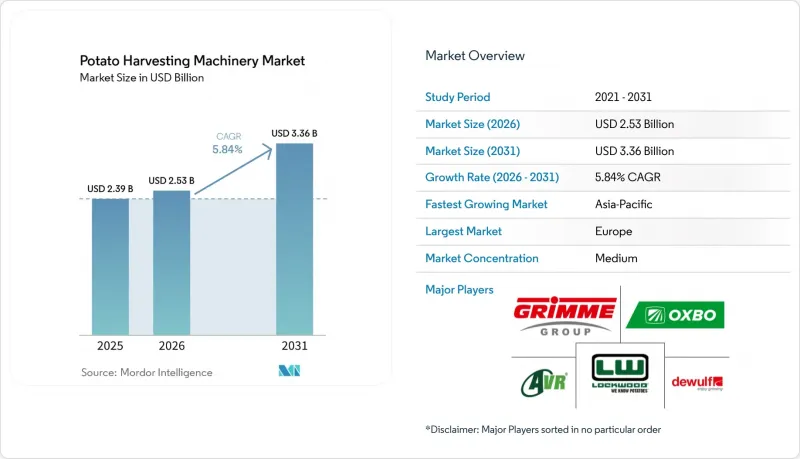
根據 Mordor Intelligence 預測,馬鈴薯收穫機械市場規模預計將在 2025 年達到 23.9 億美元,在 2026 年成長至 25.3 億美元,並在 2031 年達到 33.6 億美元,2026 年至 2031 年的複合年成長率為 5.84%。
本報告按機器類型(自走式收割機、牽引式收割機等)、自動化程度(傳統收割機、自動化收割機等)、農場規模(小規模農場、中型農場等)和地區(北美、南美、歐洲、亞太、中東和非洲)進行細分。市場預測以美元計價。
全球馬鈴薯收穫機市場趨勢及洞察
農業勞動力短缺和季節性工資上漲
不斷上漲的農業勞動成本正在推動馬鈴薯收割機械市場的成長,因為機械化系統的投資回收期正在縮短。根據美國農業部國家農業統計局的報告,2024年7月至10月,農場工人的平均時薪為18.42美元。美國農業部經濟研究局預測,人事費用將在2025年進一步上漲,這將增加生產者的壓力。儘管2024會計年度批准了38.5萬份H-2A臨時農業簽證,但季節性勞動力供不應求仍然存在。在勞動密集且對時間要求嚴格的馬鈴薯種植中,這些趨勢迫使生產者轉向機械化收割系統,因為人工收割已不再可行,尤其是在大規模農場。
精準收割和智慧機器升級
隨著生產商日益重視數據驅動的效率和控制,精準功能已成為馬鈴薯收穫機械市場的核心。美國政府責任署 (GAO) 於 2024 年 1 月發布的報告顯示,GPS 定位自動駕駛和產量監測技術已廣泛應用,預計到 2024 年,自動駕駛系統在大豆種植面積的導航系統中佔比將達到 53%。為了順應這一趨勢,GRIMME 集團於 2025 年 4 月對其雙行 VARITRON 系列進行了升級,配備了 CCI 1200 終端、支援多達 13 個攝影機的 SmartView 視訊功能以及可選的產量測繪功能。這些創新表明,整合農業和機械數據的重要性日益凸顯,並將市場價值拓展至收穫季節之外。透過幫助加工商、貸款方和供應商做出明智的決策,馬鈴薯收穫機械市場正在推動整個供應鏈的效率提升和長期營運效益。
前期實施成本高,投資回收期長。
馬鈴薯收穫機械的高昂初始投資成本嚴重限制了市場成長。這是因為高階機型的價格往往超出了許多生產者的負擔能力。例如,一家歐洲大型公司生產的新型四行自走式馬鈴薯收穫機售價超過40萬歐元(約43.2萬美元),對於面積有限或計劃週期短的農場來說,難以負擔。美國政府責任署(GAO)2024年1月的一項研究強調,高昂的初始投資成本阻礙了中小農場採用精密農業,高性能馬鈴薯收穫機械也面臨著同樣的挑戰。對於每季收穫面積小於100-150公頃的農場來說,10-15年的投資回收期往往超出了生產者的承受能力。雖然承包商、合作社和承包服務可以提供部分解決方案,但其供應有限,仍然限制著市場成長,尤其是在新興地區,凸顯了高昂初始成本這一持續存在的挑戰。
細分市場分析
到2025年,自走式收穫機將主導市場,佔據馬鈴薯收穫機械市場49.0%的佔有率。其優勢在於能夠實現高產量和一次性收穫,滿足商業農場和承包商對速度、分離品質和料倉管理的雙重需求。這些機器無需依賴曳引機,操作員可以精確控制挖掘速度、葉片分離和裝載流量,這在收穫期較短的情況下尤其重要。
預計牽引式收割機將成為成長最快的作物類型,2026年至2031年的複合年成長率將達到6.5%。在2025年歐洲馬鈴薯展上展出的AVR BV Spirit 9200i VW等創新產品,展示如何將Varioweb模組和ISOBUS相容性等先進技術整合到一個經濟高效的平台中。同時,懸掛式收割機在亞太地區、南美洲和非洲的小規模農場中仍然發揮著至關重要的作用,是人工或半機械化收割系統向自動化收割過渡的有效工具。
區域分析
預計到2025年,歐洲將佔據馬鈴薯收穫機市場最大佔有率,達35.0%。德國、法國、荷蘭和英國等國憑藉大規模的商業馬鈴薯種植、強大的加工業和完善的分銷網路,推動了這項需求。根據聯合國糧食及農業組織(糧農組織)的數據,儘管收穫面積減少,但歐洲2024年馬鈴薯產量仍將達到1.01億噸,種植面積為400萬公頃,比2023年增加2.03%。這凸顯了面積對生產效率和精準度的重視。該地區的成長與設備更新換代週期以及互聯技術和自適應清洗技術等先進系統的應用密切相關。
亞太地區是馬鈴薯收穫機械市場成長最快的區域市場,預計2026年至2031年將以6.8%的複合年成長率成長。 2024年,中國和印度對全球馬鈴薯產量做出了重大貢獻,為機械化收穫奠定了堅實的基礎。作為全球最大的馬鈴薯生產國,中國正在推動內蒙古和華南等地區對多行自走式收穫系統的需求。相較之下,美國、加拿大以及德國、荷蘭、法國和比利時等主要歐洲國家等已開發國家,正透過先進的技術、自動化和高效的品管體系,實現更高的加工標準。日本和澳洲由於人事費用高且擁有完善的分銷網路,構成了一個高階市場,也為該地區的整體成長提供了有力支撐。
在北美,以愛達荷州、華盛頓州和愛德華王子島為主要農業區,由於加工商制定了嚴格的品質標準,預計市場將保持溫和成長。在南美,巴西和阿根廷等國的成長勢頭強勁,這主要得益於加工領域投資的增加和農場規模的擴大。在中東,土耳其和沙烏地阿拉伯正透過現代化計畫推動機械化進程,而非洲則面臨資金籌措管道有限和經銷商網路不均衡等挑戰。然而,南非和埃及的商業農業活動正在蓬勃發展。值得注意的是,GRIMME集團於2025年9月在開普敦開設了分店,以加強對南部非洲生產者的支持。在所有地區,市場成長都離不開對生產力、機械化和先進收割技術的通用關注,以滿足不斷變化的農業需求。
其他好處:
- Excel格式的市場預測(ME)表
- 3個月的分析師支持
目錄
第1章:引言
- 研究假設和市場定義
- 調查範圍
第2章:調查方法
第3章執行摘要
第4章 市場狀況
- 市場概覽
- 市場促進因素
- 農業勞動力短缺和季節性工資上漲
- 精準收割和智慧機器升級
- 加工用馬鈴薯需求的不斷成長,提高了對馬鈴薯收成品質的要求。
- 機械化補貼和現代化計劃
- 加工公司對凹痕和異物規定的合約違約金
- 天氣條件縮短了收割期,有利於高產機械的生產。
- 市場限制因素
- 初始設備成本高,投資回收期長。
- 熟練操作人員和服務網路短缺
- 土壤變異性和塊莖碰傷敏感性
- 季節性低運轉率限制了車隊的盈利。
- 監理情勢
- 技術展望
- 波特五力模型
第5章 市場規模與成長預測
- 按機器類型
- 自走式收割機
- 拖曳收割機
- 車載式收割機
- 按自動化級別
- 傳統收割機
- 自動收割機
- 配備GPS和網路連線的收割機
- 按農場規模
- 小規模農場
- 中型農場
- 大型商業農場
- 按地區
- 北美洲
- 美國
- 加拿大
- 墨西哥
- 其他北美國家
- 南美洲
- 巴西
- 阿根廷
- 其他南美國家
- 歐洲
- 德國
- 法國
- 英國
- 荷蘭
- 俄羅斯
- 其他歐洲國家
- 亞太地區
- 中國
- 印度
- 日本
- 澳洲
- 其他亞太國家
- 中東
- 土耳其
- 沙烏地阿拉伯
- 其他中東國家
- 非洲
- 南非
- 埃及
- 其他非洲國家
- 北美洲
第6章 競爭情勢
- 市場集中度
- 策略趨勢
- 市佔率分析
- 公司簡介
- GRIMME Group
- Dewulf Group
- AVR BV
- Lockwood Manufacturing
- Oxbo
- Allan Equipment Manufacturing Ltd.
- ROPA Fahrzeug-und Maschinenbau GmbH
- Standen Engineering Ltd.
- Advanced Farm Equipment LLC
- Unia Sp. z oo
- VSS Machinebouw BV
- Kujawska Fabryka Maszyn Rolniczych Sp. z oo
- JJ Broch, SL
- Bomet Sp. z oo
- Shandong Transce Agricultural Machinery Technology Co., Ltd.
第7章 市場機會與未來展望
According to Mordor Intelligence, the potato harvesting machinery market is valued at USD 2.39 billion in 2025 and is anticipated to grow from USD 2.53 billion in 2026 to USD 3.36 billion by 2031, registering a CAGR of 5.84% through 2026-2031.
This report is Segmented by Machine Type (Self-Propelled Harvesters, Trailed Harvesters, and More), by Automation Level (Conventional Harvesters, Automated Harvesters, and More), by Farm Scale (Small Farms, Medium Farms, and More), and by Geography (North America, South America, Europe, Asia-Pacific, Middle East, and Africa). The Market Forecasts are Provided in Terms of Value (USD).
Global Potato Harvesting Machinery Market Trends and Insights
Farm Labor Scarcity and Rising Seasonal Wages
Rising farm labor costs are driving the growth of the potato harvesting machinery market by shortening the payback period for mechanized systems. The United States Department of Agriculture National Agricultural Statistics Service reported that average field worker wages from July to October 2024 were USD 18.42 per hour. With labor expenses projected to rise further in 2025, as per the United States Department of Agriculture Economic Research Service, the pressure on growers continues to intensify. Despite H-2A temporary agricultural visa certifications reaching 385,000 in fiscal 2024, the seasonal labor supply gap persists. In labor-intensive and time-sensitive potato operations, these trends are compelling growers to transition to mechanized harvesting systems, particularly as manual methods become impractical at larger scales.
Precision Harvesting and Smart-Machine Upgrades
Precision features are now central to the potato harvesting machinery market as growers focus on data-driven efficiency and control. A January 2024 review by the United States Government Accountability Office reported that GPS-supported autosteer and yield monitoring were widely adopted, with automated steering accounting for 53% of guidance system use on soybean crop acreage in 2024. Reflecting this shift, GRIMME Group enhanced its two-row VARITRON series in April 2025 with the CCI 1200 terminal, SmartView video support for up to 13 cameras, and optional yield mapping. These innovations underscore the growing importance of integrated agronomic and machine data, extending the market's value beyond the harvest season. By enabling informed decisions for processors, lenders, and input suppliers, the potato harvesting machinery market is driving efficiency and long-term operational benefits across the supply chain.
High Upfront Machine Cost and Long Payback
The high capital cost of potato harvesting machinery significantly limits market growth, as premium equipment often exceeds many growers' financial capacity. For example, new four-row self-propelled machines from leading European manufacturers are priced above EUR 400,000 (USD 432,000), making them inaccessible for farms with limited acreage or shorter planning horizons. A January 2024 review by the United States Government Accountability Office emphasized that high acquisition costs hinder the adoption of precision agriculture on small and medium farms, a challenge equally applicable to premium potato harvesters. For farms harvesting less than 100 to 150 hectares per season, payback periods of 10 to 15 years often exceed growers' financial capabilities. While contractors, cooperatives, and custom hiring services offer partial solutions, their uneven availability continues to restrict market growth, particularly in emerging regions, underscoring the persistent challenge of high upfront costs.
Other drivers and restraints analyzed in the detailed report include:
- Processed-Potato Demand Raising Harvest Quality Requirements
- Mechanization Subsidies and Modernization Programs
- Skilled Operator and Service-Network Shortages
For complete list of drivers and restraints, kindly check the Table Of Contents.
Segment Analysis
Self-propelled harvesters led, holding the largest 49.0% share of the potato harvesting machinery market size in 2025. Their dominance stems from their ability to deliver high-throughput, single-pass harvesting, meeting the needs of commercial farms and contractors that require speed, separation quality, and bunker management in a single platform. By eliminating tractor dependency, these machines provide operators with precise control over digging speed, haulm separation, and loading flow, especially critical during narrow harvest windows.
Trailed harvesters are projected to be the fastest-growing machine type, with a 6.5% CAGR over 2026-2031. Innovations such as AVR BV's Spirit 9200i VW, showcased at Potato Europe 2025, demonstrate how advanced technologies, such as the Varioweb module and ISOBUS compatibility, are being integrated into cost-effective platforms. At the same time, mounted harvesters remain significant for smaller farms in Asia-Pacific, South America, and Africa, serving as a transitional option from manual or semi-mechanized systems.
Complete Report Scope:
- By Machine Type
- Self-propelled harvesters
- Trailed harvesters
- Mounted harvesters
- By Automation Level
- Conventional harvesters
- Automated harvesters
- GPS-enabled and connected harvesters
- By Farm Scale
- Small farms
- Medium farms
- Large commercial farms
- By Geography
- North America
- United States
- Canada
- Mexico
- Rest of North America
- South America
- Brazil
- Argentina
- Rest of South America
- Europe
- Germany
- France
- United Kingdom
- Netherlands
- Russia
- Rest of Europe
- Asia-Pacific
- China
- India
- Japan
- Australia
- Rest of Asia-Pacific
- Middle East
- Turkey
- Saudi Arabia
- Rest of Middle East
- Africa
- South Africa
- Egypt
- Rest of Africa
- North America
Geography Analysis
Europe held the largest share, accounting for 35.0% of the potato harvesting machinery market in 2025. Countries such as Germany, France, the Netherlands, and the United Kingdom drive this demand through extensive commercial potato farming, robust processing, and established dealer networks. Food and Agriculture Organization (FAO) data indicates Europe produced 101 million metric tons of potatoes from 4.0 million hectares in 2024, with a 2.03% yield increase from 2023 despite reduced harvested areas, highlighting a focus on productivity and precision. The region's growth is linked to replacement cycles and the adoption of advanced systems, such as connected and adaptable cleaning technologies.
Asia-Pacific is the fastest regional segment in the potato harvesting machinery market and is projected to expand at 6.8% CAGR during 2026-2031. In 2024, China and India significantly contributed to global potato production, creating a large base for mechanized harvesting. China, the largest producer, drives demand for multi-row self-propelled systems in regions such as Inner Mongolia and Yunnan. In comparison, developed countries such as the United States, Canada, and key European nations, including Germany, the Netherlands, France, and Belgium, achieve much higher processing levels due to advanced technologies, automation, and efficient quality control systems. Japan and Australia represent the premium segment due to high labor costs and established dealer networks, complementing the region's overall growth.
North America, with significant farming regions in Idaho, Washington, and Prince Edward Island, is anticipated to witness moderate growth due to strict processor-quality standards. In South America, countries such as Brazil and Argentina are experiencing growth driven by increased processing investments and larger field scales. In the Middle East, Turkey and Saudi Arabia promote mechanization through modernization programs, while Africa faces challenges such as limited financing and uneven dealer networks. However, South Africa and Egypt show stronger commercial farming activity. A notable development in September 2025 saw GRIMME Group opening a branch in Cape Town, enhancing support for southern African growers. Across regions, the market's growth is interconnected by a shared focus on productivity, mechanization, and advanced harvesting technologies to meet evolving agricultural demands.
- GRIMME Group
- Dewulf Group
- AVR BV
- Lockwood Manufacturing
- Oxbo
- Allan Equipment Manufacturing Ltd.
- ROPA Fahrzeug- und Maschinenbau GmbH
- Standen Engineering Ltd.
- Advanced Farm Equipment LLC
- Unia Sp. z o.o.
- VSS Machinebouw B.V.
- Kujawska Fabryka Maszyn Rolniczych Sp. z o.o.
- J.J. Broch, S.L.
- Bomet Sp. z o.o.
- Shandong Transce Agricultural Machinery Technology Co., Ltd.
Additional Benefits:
- The market estimate (ME) sheet in Excel format
- 3 months of analyst support
TABLE OF CONTENTS
1 Introduction
- 1.1 Study Assumptions and Market Definition
- 1.2 Scope of the Study
2 Research Methodology
3 Executive Summary
4 Market Landscape
- 4.1 Market Overview
- 4.2 Market Drivers
- 4.2.1 Farm labor scarcity and rising seasonal wages
- 4.2.2 Precision harvesting and smart-machine upgrades
- 4.2.3 Processed-potato demand raising harvest quality requirements
- 4.2.4 Mechanization subsidies and modernization programs
- 4.2.5 Processor contract penalties for bruising and foreign material
- 4.2.6 Weather-compressed harvest windows favoring high-capacity machines
- 4.3 Market Restraints
- 4.3.1 High upfront machine cost and long payback
- 4.3.2 Skilled operator and service-network shortages
- 4.3.3 Soil variability and tuber bruise sensitivity
- 4.3.4 Seasonal utilization limiting fleet economics
- 4.4 Regulatory Landscape
- 4.5 Technological Outlook
- 4.6 Porter's Five Forces
- 4.6.1 Threat of new entrants
- 4.6.2 Bargaining power of suppliers
- 4.6.3 Bargaining power of buyers
- 4.6.4 Threat of substitutes
- 4.6.5 Intensity of competitive rivalry
5 Market Size and Growth Forecasts (Value)
- 5.1 By Machine Type
- 5.1.1 Self-propelled harvesters
- 5.1.2 Trailed harvesters
- 5.1.3 Mounted harvesters
- 5.2 By Automation Level
- 5.2.1 Conventional harvesters
- 5.2.2 Automated harvesters
- 5.2.3 GPS-enabled and connected harvesters
- 5.3 By Farm Scale
- 5.3.1 Small farms
- 5.3.2 Medium farms
- 5.3.3 Large commercial farms
- 5.4 By Geography
- 5.4.1 North America
- 5.4.1.1 United States
- 5.4.1.2 Canada
- 5.4.1.3 Mexico
- 5.4.1.4 Rest of North America
- 5.4.2 South America
- 5.4.2.1 Brazil
- 5.4.2.2 Argentina
- 5.4.2.3 Rest of South America
- 5.4.3 Europe
- 5.4.3.1 Germany
- 5.4.3.2 France
- 5.4.3.3 United Kingdom
- 5.4.3.4 Netherlands
- 5.4.3.5 Russia
- 5.4.3.6 Rest of Europe
- 5.4.4 Asia-Pacific
- 5.4.4.1 China
- 5.4.4.2 India
- 5.4.4.3 Japan
- 5.4.4.4 Australia
- 5.4.4.5 Rest of Asia-Pacific
- 5.4.5 Middle East
- 5.4.5.1 Turkey
- 5.4.5.2 Saudi Arabia
- 5.4.5.3 Rest of Middle East
- 5.4.6 Africa
- 5.4.6.1 South Africa
- 5.4.6.2 Egypt
- 5.4.6.3 Rest of Africa
- 5.4.1 North America
6 Competitive Landscape
- 6.1 Market Concentration
- 6.2 Strategic Moves
- 6.3 Market Share Analysis
- 6.4 Company Profiles (Includes Global Level Overview, Market Level Overview, Core Segments, Financials as Available, Strategic Information, Market Rank/Share for Key Companies, Products and Services, and Recent Developments)
- 6.4.1 GRIMME Group
- 6.4.2 Dewulf Group
- 6.4.3 AVR BV
- 6.4.4 Lockwood Manufacturing
- 6.4.5 Oxbo
- 6.4.6 Allan Equipment Manufacturing Ltd.
- 6.4.7 ROPA Fahrzeug- und Maschinenbau GmbH
- 6.4.8 Standen Engineering Ltd.
- 6.4.9 Advanced Farm Equipment LLC
- 6.4.10 Unia Sp. z o.o.
- 6.4.11 VSS Machinebouw B.V.
- 6.4.12 Kujawska Fabryka Maszyn Rolniczych Sp. z o.o.
- 6.4.13 J.J. Broch, S.L.
- 6.4.14 Bomet Sp. z o.o.
- 6.4.15 Shandong Transce Agricultural Machinery Technology Co., Ltd.
7 Market Opportunities and Future Outlook

 2026年全球稻米收割機市場報告
 大豆收割機市場規模、佔有率和成長分析:按產品類型、產量、農場規模、驅動系統、分銷通路、最終用戶和地區分類-2026-2033年產業預測
 甘蔗收割機:市場佔有率分析、產業趨勢與統計、成長預測(2026-2031)收割機械:市場佔有率分析、產業趨勢與統計、成長預測(2026-2031)
 甘蔗收割機市場:依產品類型、動力來源、類型、產量、最終用戶和通路分類-2026-2032年全球市場預測
 水果採摘機市場:商機、成長要素、產業趨勢分析及2026-2035年預測
 農業收割機市場規模、佔有率、趨勢和預測:按產品類型、驅動系統、應用和地區分類,2026-2034年棉花收割機市場:2026-2032年全球市場預測(依產品類型、引擎功率、技術、農場規模、銷售管道及最終用戶分類)森林採伐與森林運輸機械市場:2026-2032年全球市場預測(依設備類型、功率輸出、驅動系統、應用及銷售管道)收割設備市場:依設備類型、作物類型、最終用戶和通路分類-2026年至2032年全球市場預測