


 |
市場調查報告書
商品編碼
2114003
歐洲汽車診斷工具:市場佔有率分析、產業趨勢與統計及成長預測(2026-2031)Europe Automotive Diagnostics Tool - Market Share Analysis, Industry Trends & Statistics, Growth Forecasts (2026 - 2031) |
||||||

※ 本網頁內容可能與最新版本有所差異。詳細情況請與我們聯繫。
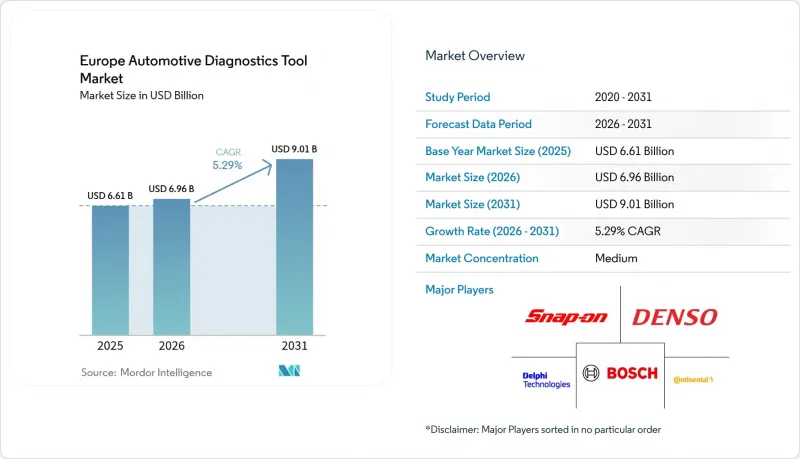
據 Mordor Intelligence 稱,歐洲汽車診斷工具市場預計到 2026 年價值 69.6 億美元,高於 2025 年的 66.1 億美元,預計到 2031 年將達到 90.1 億美元。
預計 2026 年至 2031 年的複合年成長率為 5.29%。
本報告按工具類型(例如 OBD 掃描儀)、車輛類型(例如乘用車、輕型商用車等)、動力系統(例如內燃機等)、連接方式(例如有線和無線)、最終用戶(例如 OEM 經銷商等)和地區進行細分。市場預測以美元 (USD) 為單位。
歐洲汽車診斷工具市場趨勢與洞察
汽車電子技術的複雜性迅速增加
目前,歐洲汽車整合了多個電控系統),數量是十年前的五倍。這就需要採用能夠同時讀取CAN、LIN、FlexRay和汽車乙太網路訊號的掃描器。此外,這些工具還必須能夠檢驗無線軟體更新,並跨多個域追蹤故障,例如從ADAS感測器向煞車模組發送訊號。為了解決這些問題,供應商正在引入人工智慧(AI)來評估潛在故障的可能性,並自動執行先前需要專家介入的測試程序。維修店非常重視那些能夠提供每週協議更新並與雲端入口網站整合的設備,以便遠端專家在技術人員遇到不熟悉的架構時進行干預。因此,市場需求正在轉向整合式軟體包,這些軟體包結合了堅固手持終端機、基於瀏覽器的儀表板和訂閱式收費。
更嚴格的歐盟6/7排放氣體測試法規
將於2025年生效的歐7排放標準將強制要求在車輛的整個生命週期內監測實際排放氣體,並將合規認證方式從年度檢驗轉變為持續的運作中檢驗。掃描工具需要即時記錄顆粒物過濾器效率、催化劑氮氧化物性能和感測器漂移,並同時產生經國家檢驗資料庫認可的統一報告。獨立維修店在軟體更新或更換零件後,需要取得原廠等級的存取碼才能重新排放氣體系統。可攜式測量系統能夠檢驗車輛在實際駕駛負載條件下的合規性,因此在處理都市區配送貨車的車隊維修店中越來越受到關注,因為低排放氣體區的罰款正在迅速增加。
商用掃描工具需要大量的資金投入。
儘管價格差異很大,但在東歐都市區的小規模家族式維修店中,整合診斷站正逐漸成為標準配備。科技的快速發展縮短了折舊免稅額週期,使得直接購買風險較高。租賃和訂閱協議可以降低前期成本,但五年內的總擁有成本可能會翻倍。因此,維修店正在尋求能夠擴展功能的模組化附加元件,而不是完全更換現有設備。那些提案向下相容的探頭、許可證金鑰升級和以舊換新抵扣服務的供應商,正在贏得對成本高度敏感的客戶的青睞。
細分市場分析
預計到2025年,專業掃描工具將佔據歐洲汽車診斷工具市場35.02%的佔有率,凸顯其作為維修車間多系統故障排除介面的核心角色。該細分市場的銷售成長主要得益於ECU程式功能的增強和人工智慧故障樹的普及,這些技術縮短了複雜電子系統的診斷時間。雖然電氣系統分析儀市場規模較小,但隨著北歐和西歐市場電動車普及率的加快,預計其複合年成長率將達到5.41%。從機械架構向電氣架構的轉變,推動了對高壓絕緣測試儀和整合電池化學特性雲庫的電池電阻儀的需求成長。
專業掃描器透過增加乙太網路連接埠、安全閘道認證和引導式ADAS校準工作流程來應對這些變更。雲端控制面板會記錄所有會話,方便維修店經理審核技師表現,並確保特許經銷商符合保固合規要求。電氣系統分析儀的獨特之處在於其整合的熱成像疊加功能,可即時顯示絕緣導線、III類安全標準和電池不平衡情況。這些功能符合歐盟關於處理60V以上電池的安全指令。
到2025年,乘用車將佔歐洲汽車診斷工具市場規模的72.88%。這主要得益於歐洲龐大的私家車保有量以及由此帶來的定期保養需求。該細分市場對快速處理能力和廣泛品牌相容性的需求尤為突出,因此功能全面的掃描工具至關重要。同時,輕型商用車預計將以5.41%的複合年成長率成長,這主要得益於依賴高車輛運轉率的電子商務物流。車隊營運商更傾向於使用整合遠端資訊處理功能的診斷工具,這類工具可以將故障資料傳送到中央控制面板,從而最佳化服務計劃。中型和重型卡車市場將保持穩定的市場佔有率,這主要得益於安全關鍵型檢測以及跨境排放氣體法規的合規性要求。
在商業車隊中,越來越多的企業開始指定API存取權限,以便將診斷結果直接匯入維護管理軟體。這種整合能夠實現預測性零件訂購和停機時間預測。此外,都市區輕型貨車營運商還需要能夠即時檢驗車輛是否符合歐盟7排放氣體標準的工具,以避免在低排放氣體區受到處罰。
其他好處:
- Excel格式的市場預測(ME)表
- 3個月的分析師支持
目錄
第1章:引言
- 研究假設和市場定義
- 調查範圍
第2章:調查方法
第3章執行摘要
第4章 市場狀況
- 市場概覽
- 市場促進因素
- 汽車電子產品的複雜性正在迅速增加。
- 更嚴格的歐盟6/7排放氣體測試法規
- 與電動車/混合動力汽車普及相關的診斷要求
- 歐盟關於「維修權」的資料共用義務
- OTA 更新失敗導致的成本降低
- 透過 OEM SaaS 實現診斷功能的商業化
- 市場限制因素
- 商用高昂的資本投資成本
- 電動車維修專業技術人員短缺
- 網路安全和資料隱私的障礙
- 協定碎片化和互通性差距
- 價值供應鏈分析
- 監理情勢
- 技術展望
- 波特五力模型
第5章 市場規模與成長預測
- 新產品
- OBD掃描儀
- 專業掃描工具
- 電氣系統分析儀
- 壓力和洩漏測試機
- 程式碼讀取器
- 車輛類型
- 搭乘用車
- 輕型商用車
- 中型和大型商用車輛
- 透過推進力
- 內燃機(ICE)
- 電池式電動車(BEV)
- 混合動力汽車和插電式混合動力汽車(HEV 和 PHEV)
- 連結性別
- 有線
- 無線的
- 最終用戶
- OEM經銷商
- 獨立售後維修店
- 車隊營運商
- 國家
- 德國
- 英國
- 法國
- 義大利
- 俄羅斯
- 其他歐洲國家
第6章 競爭情勢
- 市場集中度
- 策略趨勢
- 市佔率分析
- 公司簡介
- Robert Bosch GmbH
- Snap-On Inc.
- Texa SpA
- Delphi Technologies
- Continental AG
- Autel Intelligent Technology
- Launch Tech Co.
- Hella Gutmann Solutions
- ACTIA Group
- DENSO Corporation
- Softing Automotive
- AVL DiTEST
- Innova Electronics
- Shenzhen Foxwell Technology Co., Ltd.
- THINKCAR Tech
- SPX Service Solutions
- TOPDON Europe SL
- Warth Group
- Maha Maschinenbau
第7章 市場機會與未來展望
According to Mordor Intelligence, the Europe automotive diagnostics tool market size in 2026 is estimated at USD 6.96 billion, growing from 2025 value of USD 6.61 billion with 2031 projections showing USD 9.01 billion, growing at 5.29% CAGR over 2026-2031.
This report is Segmented by Tool Type (OBD Scanners and More), Vehicle Type (Passenger Cars, Light Commercial Vehicles, and More), Propulsion (Internal Combustion Engine and More), Connectivity (Wired and Wireless), End User (OEM Dealerships and More), and Geography. The Market Forecasts are Provided in Terms of Value (USD).
Europe Automotive Diagnostics Tool Market Trends and Insights
Vehicle Electronics Complexity Surge
European cars now integrate multiple electronic control units, a five-fold increase over a decade ago, which forces workshops to adopt scanners capable of interrogating CAN, LIN, FlexRay, and Automotive Ethernet simultaneously. Tools must also verify over-the-air software updates and trace faults that span multiple domains, such as ADAS sensors feeding braking modules. Vendors respond by embedding AI to rank probable faults and to automate test routines that once required expert intervention. Workshops value devices coupled with cloud portals that push protocol updates weekly and allow remote experts to step in when technicians meet unfamiliar architectures. Demand therefore pivots toward integrated packages that combine ruggedized handhelds with browser-based dashboards and subscription billing .
Tightening Euro 6/7 Emission-Testing Rules
Euro 7, effective 2025, requires real-world driving emissions monitoring across a vehicle's entire lifespan, shifting compliance documentation from annual checks to continuous in-service validation. Scan tools must log particulate filter efficiency, catalyst NOx performance, and sensor drift in real time while issuing harmonized reports accepted by national inspection databases. Independent garages require OEM-level access codes to reprogram emission systems after software updates or parts replacement. Portable measurement systems that verify compliance under actual road load conditions are gaining traction among fleet garages serving urban-delivery vans, where low-emission zone fines multiply quickly .
High Capex For Professional Scan Tools
Integrated diagnostic stations, with prices varying fairly, are standard in small, family-run garages in Eastern European cities. Rapid technology cycles shorten depreciation periods, making outright purchase risky. While leasing and subscription packages reduce upfront cash outlay, they can double the total cost of ownership over a five-year horizon. Workshops, therefore, seek modular add-ons that augment existing devices rather than replace them entirely. Vendors showcasing backward-compatible probes, license key upgrades, and trade-in credits win contracts in cost-sensitive segments.
Other drivers and restraints analyzed in the detailed report include:
- Uptake of EV/HEV Diagnostic Requirements
- EU Right-To-Repair Data-Sharing Mandates
- Cyber-Security & Data-Privacy Barriers
For complete list of drivers and restraints, kindly check the Table Of Contents.
Segment Analysis
Professional scan tools held a 35.02% share of the European automotive diagnostic tools market in 2025, underscoring their role as the workshop's central interface for multi-system troubleshooting. Revenue growth for this segment stems from the expansion of ECU programming features and AI-assisted fault trees, which shorten diagnostic times for complex electronics. Electric-system analyzers, while representing a smaller base, are expected to post a 5.41% CAGR as EV uptake accelerates in Nordic and Western European markets. The shift from mechanical to electrical architectures raises demand for high-voltage isolation testers and battery impedance meters coupled with cloud libraries of cell chemistries.
Professional scanners adapt by adding Ethernet ports, secure gateway authentications, and guided ADAS calibration workflows. Cloud dashboards record every session, allowing shop managers to audit technician efficiency and meet warranty compliance for franchised dealers. Electric-system analyzers differentiate themselves by offering insulated leads, Category III safety ratings, and integrated thermal imaging overlays that reveal cell imbalances in real-time. These features align with EU safety directives for handling batteries exceeding 60 V.
Passenger cars accounted for 72.88% of the European automotive diagnostic tools market size in 2025, driven by the continent's extensive private vehicle parc and the routine maintenance cycles associated with it. Demand in this segment centers on rapid throughput and broad brand coverage, making versatile scan tools a necessity. Light commercial vehicles, however, are projected to deliver a 5.41% CAGR, propelled by e-commerce logistics that depend on high vehicle availability. Fleet operators prefer telematics-integrated diagnostics that transmit fault data to centralized dashboards, enabling them to optimize service schedules. Medium and heavy trucks maintain a stable share, driven by safety-critical inspections and compliance with cross-border emissions regulations.
Commercial fleets are increasingly specifying API access, enabling diagnostic outputs to be fed directly into maintenance-management software. This integration allows for predictive part ordering and downtime forecasting. Light van operators in urban zones also require tools capable of instant Euro 7 emission verification to avoid penalties in low-emission zones.
Complete Report Scope:
- By Tool Type
- OBD Scanners
- Professional Scan Tools
- Electric-System Analyzers
- Pressure & Leak Testers
- Code Readers
- By Vehicle Type
- Passenger Cars
- Light Commercial Vehicles
- Medium & Heavy Commercial Vehicles
- By Propulsion
- Internal Combustion Engine (ICE)
- Battery-Electric Vehicle (BEV)
- Hybrid & Plug-in Hybrid (HEV & PHEV)
- By Connectivity
- Wired
- Wireless
- By End User
- OEM Dealerships
- Independent Aftermarket Garages
- Fleet Operators
- By Country
- Germany
- United Kingdom
- France
- Italy
- Russia
- Rest of Europe
List of Companies Covered in this Report:
- Robert Bosch GmbH
- Snap-On Inc.
- Texa S.p.A.
- Delphi Technologies
- Continental AG
- Autel Intelligent Technology
- Launch Tech Co.
- Hella Gutmann Solutions
- ACTIA Group
- DENSO Corporation
- Softing Automotive
- AVL DiTEST
- Innova Electronics
- Shenzhen Foxwell Technology Co., Ltd.
- THINKCAR Tech
- SPX Service Solutions
- TOPDON Europe SL
- Warth Group
- Maha Maschinenbau
Additional Benefits:
- The market estimate (ME) sheet in Excel format
- 3 months of analyst support
TABLE OF CONTENTS
1 Introduction
- 1.1 Study Assumptions & Market Definition
- 1.2 Scope of the Study
2 Research Methodology
3 Executive Summary
4 Market Landscape
- 4.1 Market Overview
- 4.2 Market Drivers
- 4.2.1 Vehicle Electronics Complexity Surge
- 4.2.2 Tightening Euro 6/7 Emission-Testing Rules
- 4.2.3 Uptake of EV/HEV Diagnostic Requirements
- 4.2.4 EU Right-To-Repair Data-Sharing Mandates
- 4.2.5 OTA-Update Failure Cost Containment
- 4.2.6 OEM Saas Monetisation of Diagnostics
- 4.3 Market Restraints
- 4.3.1 High Capex for Professional Scan Tools
- 4.3.2 Shortage of EV-Trained Technicians
- 4.3.3 Cyber-Security & Data-Privacy Barriers
- 4.3.4 Protocol Fragmentation Interoperability Gaps
- 4.4 Value / Supply-Chain Analysis
- 4.5 Regulatory Landscape
- 4.6 Technological Outlook
- 4.7 Porter's Five Forces
- 4.7.1 Threat of New Entrants
- 4.7.2 Bargaining Power of Suppliers
- 4.7.3 Bargaining Power of Buyers
- 4.7.4 Threat of Substitutes
- 4.7.5 Competitive Rivalry
5 Market Size & Growth Forecasts (Value (USD))
- 5.1 By Tool Type
- 5.1.1 OBD Scanners
- 5.1.2 Professional Scan Tools
- 5.1.3 Electric-System Analyzers
- 5.1.4 Pressure & Leak Testers
- 5.1.5 Code Readers
- 5.2 By Vehicle Type
- 5.2.1 Passenger Cars
- 5.2.2 Light Commercial Vehicles
- 5.2.3 Medium & Heavy Commercial Vehicles
- 5.3 By Propulsion
- 5.3.1 Internal Combustion Engine (ICE)
- 5.3.2 Battery-Electric Vehicle (BEV)
- 5.3.3 Hybrid & Plug-in Hybrid (HEV & PHEV)
- 5.4 By Connectivity
- 5.4.1 Wired
- 5.4.2 Wireless
- 5.5 By End User
- 5.5.1 OEM Dealerships
- 5.5.2 Independent Aftermarket Garages
- 5.5.3 Fleet Operators
- 5.6 By Country
- 5.6.1 Germany
- 5.6.2 United Kingdom
- 5.6.3 France
- 5.6.4 Italy
- 5.6.5 Russia
- 5.6.6 Rest of Europe
6 Competitive Landscape
- 6.1 Market Concentration
- 6.2 Strategic Moves
- 6.3 Market Share Analysis
- 6.4 Company Profiles (includes Global Level Overview, Market Level Overview, Core Segments, Financials as Available, Strategic Information, Market Rank/Share for Key Companies, Products and Services, SWOT Analysis, and Recent Developments)
- 6.4.1 Robert Bosch GmbH
- 6.4.2 Snap-On Inc.
- 6.4.3 Texa S.p.A.
- 6.4.4 Delphi Technologies
- 6.4.5 Continental AG
- 6.4.6 Autel Intelligent Technology
- 6.4.7 Launch Tech Co.
- 6.4.8 Hella Gutmann Solutions
- 6.4.9 ACTIA Group
- 6.4.10 DENSO Corporation
- 6.4.11 Softing Automotive
- 6.4.12 AVL DiTEST
- 6.4.13 Innova Electronics
- 6.4.14 Shenzhen Foxwell Technology Co., Ltd.
- 6.4.15 THINKCAR Tech
- 6.4.16 SPX Service Solutions
- 6.4.17 TOPDON Europe SL
- 6.4.18 Warth Group
- 6.4.19 Maha Maschinenbau
7 Market Opportunities & Future Outlook
- 7.1 White-space & Unmet-Need Assessment


