


 |
市場調查報告書
商品編碼
2113674
汽車診斷工具:市場佔有率分析、產業趨勢與統計、成長預測(2026-2031)Automotive Diagnostic Tools - Market Share Analysis, Industry Trends & Statistics, Growth Forecasts (2026 - 2031) |
||||||

※ 本網頁內容可能與最新版本有所差異。詳細情況請與我們聯繫。
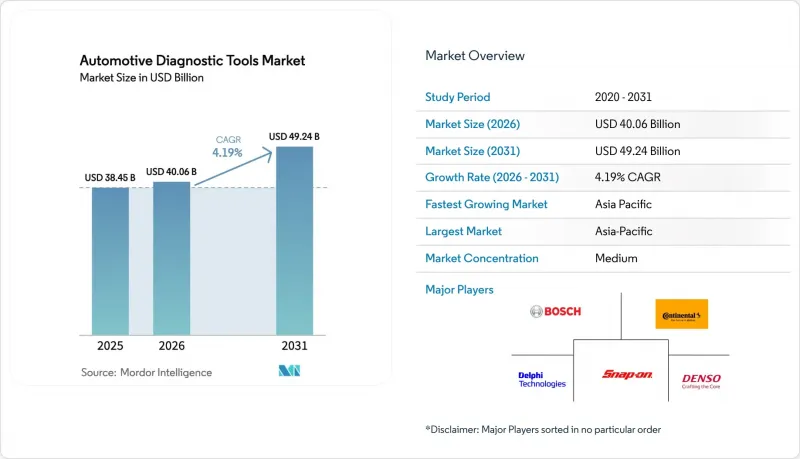
據 Mordor Intelligence 稱,汽車診斷工具市場預計到 2026 年價值 400.6 億美元,高於 2025 年的 384.5 億美元,預計到 2031 年將達到 492.4 億美元。
預計 2026 年至 2031 年的複合年成長率為 4.19%。
本報告按工具類型(車載診斷掃描器、專業診斷工具等)、車輛類型(乘用車、輕型商用車等)、動力系統(內燃機等)、連接方式(有線、無線和藍牙/Wi-Fi)、最終用戶(OEM經銷商等)和地區進行細分。市場預測以價值(美元)和數量(台)兩種形式呈現。
全球汽車診斷工具市場趨勢與洞察
動力傳動系統的快速電氣化
電池式電動車)採用高壓電路、熱電池組和雙向充電器,這些設備無法被標準的 OBD-II 讀取器讀取。加州將於 2026 年強制推行統一的電動車診斷介面,要求所有供應商(無論品牌)都必須分析電池健康狀況、絕緣電阻和充電器故障。諸如 Fluke FEV150 之類的充電站分析儀已開始在維修車間部署,用於檢驗車輛與電網的交互作用。供應商也紛紛推出電動車專用測試儀,例如 THINKTOOL CE EVD,該產品涵蓋 80 多個品牌。由於技工認證未能跟上車輛普及的速度,能夠幫助經驗不足的技工進行維修的、數據豐富的工具正在贏得越來越多的市場佔有率。
加強 OBD-III/遠距診斷法規
SAE J1979-2 標準強制要求對 2027 年後銷售的內燃機車輛提供統一的診斷服務支持,即將推出的 J1979-3 標準則針對零排放車輛。加州空氣資源委員會 (CARB) 和歐盟監管機構也在推廣基於雲端的即時故障報告,將服務從維修店轉移到資料中心。領先的工具製造商正在投資安全閘道器認證和 ISO/SAE 21434 流程,而小規模的競爭對手難以資金籌措。根據 40 CFR 86.010-18 的規定,總重超過 14,000 磅的大型引擎必須接受並行監控。遠端架構使車隊營運商能夠在故障發生前安排維護,從而減少意外停機時間。
先進掃描工具的初始成本很高
頂級ADAS校準設備和高壓分析儀每個工位的成本可能超過5萬美元,這對小規模維修店來說是一筆不小的負擔。即使日本政府為每家維修店提供高達16萬日圓的補貼,也只能涵蓋硬體和訓練總成本的一小部分。訂閱式續費增加了設備擁有成本,但對於存取安全閘道而言卻不可或缺。這些經濟因素正促使獨立維修店轉向加盟網路和遠端服務平台,例如asTech,這些平台提供原廠工具的隨選租賃服務。
細分市場分析
由於 OBD 掃描儀支援 1996 年至今的所有乘用車車型,預計到 2025 年,它們將佔據汽車診斷工具市場 44.12% 的最大佔有率。儘管此類汽車診斷工具的市場規模持續擴大,但現代化的維修車間需要集 ADAS(高級駕駛輔助系統)、高壓和雲端同步功能於一體的工具,而這些功能是傳統手持式診斷工具所缺乏的。 Snap-on 於 2025 年春季發布的程式碼庫新增了數百萬個測試項目以及一個適用於梅賽德斯-奔馳的安全閘道器,這凸顯了將 OEM 級功能整合到通用硬體中的競爭日益激烈。
電氣系統分析儀的複合年成長率最高,達到 5.88%,其中藍牙 5.0 和雙頻 Wi-Fi 模組是確保即時遙測資料上傳期間吞吐量的關鍵。壓力洩漏測試儀和電池隔離探頭與核心掃描器相輔相成,確保電動車電池組的熱安全,Redline Detection 的設備已通過車隊安全認證。透過將多個感測器線束整合到單一底盤中,供應商將成本分攤到每個任務上,即使對於預算敏感的維修店來說,也足以證明其溢價的合理性。
2025年,乘用車在汽車診斷工具市場仍維持60.74%的佔有率,主要得益於常規的排放氣體和安全檢查。然而,車隊貨車和卡車正在引領工具規格的發展趨勢。隨著電子商務的擴張加速了配送週期,以及停機時間變得不可接受,預計到2031年,輕型商用車市場將以6.05%的複合年成長率成長。像是International Trucks的「OnCommand Connection」這樣的平台,透過將即時效能資料傳送到雲端控制面板並提示預防性維護請求,正在減少路邊故障。
總重超過 14,000 磅的重型卡車需遵守更嚴格的聯邦法規 (CFR) 診斷標準,這擴大了多品牌相容設備的協議合規性要求。博斯的車輛健康報告現在可以突出顯示混合車隊中的冷卻液和機油異常情況,使維修經理能夠在引擎損壞之前解決問題。隨著送貨車電氣化程度的不斷提高,工具製造商需要將內燃機和電池分析整合到單一工作流程中,以降低技術人員的學習並簡化庫存管理。
區域分析
預計到2025年,亞太地區將佔據汽車診斷工具市場36.05%的佔有率,年複合成長率(CAGR)高達7.52%,成長最快。中國2023年電動車產量預估成長50%,加上高達10兆元的龐大汽車銷售規模,將為診斷工具的需求提供強勁支撐。北京計劃在2025年前推廣自動駕駛汽車,屆時需要使用支援V2X功能的診斷工具來檢查雷達對準情況和LiDAR污染情況,然後再進行部署。日本將於2024年10月起強制執行OBD檢測,並為維修店購買掃描工具提供津貼,以確保符合法規要求。在印度,ASK Auto和愛信汽車在售後市場成立的合資企業正在南亞地區拓展零件和服務網路,提高二線城市的掃描工具普及率。
在北美,強勁的監管勢頭仍在持續。加州的「先進清潔汽車II」法規要求在2026年前實現電動車診斷的標準化,而加州空氣資源委員會(CARB)正在試驗遠端車載診斷系統(OBD),該系統無需現場檢測。車隊營運商正在採用Uptake的AI健康報告來最佳化維護預算,並推動工具升級,將數據發送到雲端儀錶板。 OEM經銷商正透過Snap-on的2025年軟體更新,為賓士等品牌增加安全閘道解鎖功能。
在歐洲,聯合國R155網路安全法規要求對診斷介面進行型式認可審核。領先的供應商已採用ISO/SAE 21434框架來滿足這些審核要求,而加盟維修店也受惠於企業合規。經汽車工業協會(IMI)認證的培訓計畫正在努力彌補技能缺口,尤其是在高壓系統維護方面。
其他好處:
- Excel格式的市場預測(ME)表
- 3個月的分析師支持
目錄
第1章:引言
- 研究假設和市場定義
- 調查範圍
第2章:調查方法
第3章執行摘要
第4章 市場狀況
- 市場概覽
- 市場促進因素
- 動力傳動系統的快速電氣化
- 加強對 OBD-III 和遠距離診斷的監管(美國、歐盟)
- 預測性維護分析的需求日益成長
- 全球微型車擁有量增加
- 整合OTA軟體更新診斷功能
- 車載電子設備的日益複雜化
- 市場限制因素
- 先進掃描工具的初始成本很高
- 互聯工具網路安全認證的障礙
- 獨立售後維修店的技能差距
- OEM廠商之間缺乏統一的通訊標準。
- 價值供應鏈分析
- 監理情勢
- 技術展望
- 波特五力模型
第5章 市場規模與成長預測
- 新產品
- OBD掃描儀
- 專業掃描工具
- 電氣系統分析儀
- 壓力和洩漏測試機
- 程式碼讀取器
- 車輛類型
- 搭乘用車
- 輕型商用車
- 中型和重型商用車輛
- 透過推進力
- 內燃機
- 電池式電動車
- 混合動力汽車和插電式混合動力汽車
- 連結性別
- 有線
- 無線/藍牙/Wi-Fi
- 最終用戶
- OEM經銷商
- 獨立售後維修店
- 車隊營運商
- 地區
- 北美洲
- 美國
- 加拿大
- 其他北美國家
- 南美洲
- 巴西
- 阿根廷
- 其他南美國家
- 歐洲
- 德國
- 英國
- 法國
- 義大利
- 俄羅斯
- 其他歐洲國家
- 亞太地區
- 中國
- 日本
- 印度
- 韓國
- 澳洲
- 中東和非洲
- GCC
- 南非
- 其他中東和非洲國家
- 北美洲
第6章 競爭情勢
- 市場集中度
- 策略趨勢
- 市佔率分析
- 公司簡介
- Robert Bosch GmbH
- Snap-on Inc.
- Continental AG
- Delphi/BorgWarner Technologies
- ACTIA Group
- Autel Intelligent Tech
- Launch Tech Co.
- Softing AG
- Vector Informatik GmbH
- KPIT Technologies Ltd.
- Hella KGaA Hueck & Co.
- Texa SpA
- Siemens Digital Industries Software
- Foxwell Tech
- OBD Solutions LLC
- Denso Corporation
- Innova Electronics
- Pico Technology Ltd.
第7章 市場機會與未來展望
According to Mordor Intelligence, automotive diagnostic tools market size in 2026 is estimated at USD 40.06 billion, growing from 2025 value of USD 38.45 billion with 2031 projections showing USD 49.24 billion, growing at 4.19% CAGR over 2026-2031.
This report is Segmented by Tool Type (OBD Scanners, Professional Scan Tools, and More), Vehicle Type (Passenger Cars, Light Commercial Vehicles, and More), Propulsion (Internal Combustion Engine and More), Connectivity (Wired and Wireless and Bluetooth / Wi-Fi), End User (OEM Dealerships and More), and Geography. The Market Forecasts are Provided in Terms of Value (USD) and Volume (Units).
Global Automotive Diagnostic Tools Market Trends and Insights
Rapid electrification of powertrains
Battery-electric models use high-voltage circuits, thermal packs, and bidirectional chargers that standard OBD-II readers cannot interrogate. California will require a unified EV diagnostic interface by 2026, forcing tool vendors to decode battery health, insulation resistance, and charger faults across brands. Charging-station analyzers such as Fluke FEV150 now join service bays to validate grid interaction. Suppliers answer with purpose-built EV testers like THINKTOOL CE EVD, covering more than 80 brands. Workforce certification lags vehicle rollout, so data-rich tools that guide less-experienced technicians win share.
Tightening OBD-III/remote diagnostics rules
SAE J1979-2 obliges combustion-engine vehicles sold from 2027 to support unified diagnostic services, while the forthcoming J1979-3 standard targets zero-emission models. CARB and EU regulators also press for real-time, cloud-based fault reporting that shifts service from the garage to the data center. Large tool makers invest in secure-gateway credentials and ISO/SAE 21434 processes that small rivals may struggle to fund. Heavy-duty engines above 14,000 lb GVWR face parallel monitoring mandates under 40 CFR 86.010-18. Remote architecture enables fleets to schedule service before breakdowns, reducing unplanned downtime.
High up-front cost of advanced scan tools
Top-tier ADAS calibration rigs and high-voltage analyzers can exceed USD 50,000 per bay, a stretch for small garages. Japan's subsidy of up to JPY 160,000 per shop offsets only a fraction of the total hardware plus training spend. Subscription updates compound ownership cost yet remain essential for secure-gateway access. These economics push independents toward franchise networks or remote-service platforms such as asTech that rent OEM tools on demand.
Other drivers and restraints analyzed in the detailed report include:
- Growing demand for predictive maintenance analytics
- Rising global light-vehicle parc
- Cyber-security certification hurdles
For complete list of drivers and restraints, kindly check the Table Of Contents.
Segment Analysis
OBD scanners secured the largest slice of the automotive diagnostic tools market at 44.12% in 2025 because they work on every post-1996 passenger model. The automotive diagnostic tools market size attached to this category still grows, yet modern service bays demand combined ADAS, high-voltage, and cloud-sync features that legacy handhelds lack. Snap-on's spring 2025 code library adds millions of tests and secure gateways for Mercedes-Benz, underscoring the race to embed OEM depth inside universal hardware.
Electric-System analyzers, posting the fastest 5.88% CAGR, hinge on Bluetooth 5.0 and dual-band Wi-Fi modules that maintain throughput during live telemetry uploads. Pressure leak testers and battery insulation probes complement the core scanner by ensuring thermal safety in EV packs, with Redline Detection equipment gaining fleet-safety endorsements. Suppliers integrate multiple sensor harnesses into one chassis to spread cost across tasks and justify price premiums amid budget-sensitive workshops.
Passenger cars retained 60.74% of the automotive diagnostic tools market share in 2025, supported by routine emissions and safety inspections. Fleet-oriented vans and trucks, however, drive tool specification trends. Light commercial vehicles grow at 6.05% CAGR to 2031 as e-commerce accelerates delivery cycles that punish downtime. Platforms like International Trucks' OnCommand Connection feed real-time performance data to cloud dashboards, prompting proactive service orders that cut roadside events.
Heavy rigs over 14,000 lb GVWR comply with stricter CFR diagnostics, expanding protocol support requirements inside multi-brand devices. Bosch Vehicle Health reports now highlight coolant and oil deviations on mixed fleets, letting maintenance managers address issues before engine damage. As electrification reaches delivery vans, tool makers must bridge combustion and battery analytics in a single workflow, smoothing technician learning curves and inventory.
Complete Report Scope:
- By Tool Type
- OBD Scanners
- Professional Scan Tools
- Electric-System Analyzers
- Pressure & Leak Testers
- Code Readers
- By Vehicle Type
- Passenger Cars
- Light Commercial Vehicles
- Medium and Heavy Commercial Vehicles
- By Propulsion
- Internal Combustion Engine
- Battery-Electric Vehicle
- Hybrid & Plug-in Hybrid
- By Connectivity
- Wired
- Wireless / Bluetooth / Wi-Fi
- By End User
- OEM Dealerships
- Independent Aftermarket Garages
- Fleet Operators
- Geography
- North America
- United States
- Canada
- Rest of North America
- South America
- Brazil
- Argentina
- Rest of South America
- Europe
- Germany
- United Kingdom
- France
- Italy
- Russia
- Rest of Europe
- Asia-Pacific
- China
- Japan
- India
- South Korea
- Australia
- Middle East and Africa
- GCC
- South Africa
- Rest of Middle East and Africa
- North America
Geography Analysis
Asia-Pacific holds 36.05% of the automotive diagnostic tools market share in 2025 and expands the fastest at 7.52% CAGR. China's 50% surge in EV production during 2023, plus a 10 trillion-yuan automotive revenue base, keeps tool demand buoyant. Beijing's push toward autonomous-mobility fleets by 2025 requires V2X-aware diagnostics that validate radar alignment and lidar cleanliness before dispatch. Japan begins obligatory OBD inspections in October 2024 and subsidizes scan-tool purchases for workshops to ensure compliance. India's aftermarket joint ventures between ASK Auto and AISIN extend parts and service networks across South Asia, lifting scan-tool penetration in tier-2 cities.
North America follows with strong regulatory momentum. California's Advanced Clean Cars II rule forces standardized EV diagnostics by 2026, and CARB pilots remote-OBD concepts that remove the need for physical inspection visits. Fleets adopt Uptake's AI health reports to optimize maintenance budgets, reinforcing tool upgrades that push data into cloud dashboards. OEM dealerships add secure-gateway unlocks for brands like Mercedes-Benz through Snap-on's 2025 software wave.
Europe aligns with UN R155 cybersecurity rules that demand type-approval audits for diagnostic interfaces. Large suppliers embed ISO/SAE 21434 frameworks to meet these audits, and franchise workshops benefit from corporate compliance coverage. Training schemes certified by the Institute of the Motor Industry close skill gaps, especially for high-voltage servicing.
- Robert Bosch GmbH
- Snap-on Inc.
- Continental AG
- Delphi/BorgWarner Technologies
- ACTIA Group
- Autel Intelligent Tech
- Launch Tech Co.
- Softing AG
- Vector Informatik GmbH
- KPIT Technologies Ltd.
- Hella KGaA Hueck & Co.
- Texa S.p.A.
- Siemens Digital Industries Software
- Foxwell Tech
- OBD Solutions LLC
- Denso Corporation
- Innova Electronics
- Pico Technology Ltd.
Additional Benefits:
- The market estimate (ME) sheet in Excel format
- 3 months of analyst support
TABLE OF CONTENTS
1 Introduction
- 1.1 Study Assumptions & Market Definition
- 1.2 Scope of the Study
2 Research Methodology
3 Executive Summary
4 Market Landscape
- 4.1 Market Overview
- 4.2 Market Drivers
- 4.2.1 Rapid electrification of powertrains
- 4.2.2 Tightening OBD-III/remote diagnostics regulations (U.S., EU)
- 4.2.3 Growing demand for predictive maintenance analytics
- 4.2.4 Rising global light-vehicle parc
- 4.2.5 Integration of OTA software update diagnostics
- 4.2.6 Escalating in-vehicle electronics complexity
- 4.3 Market Restraints
- 4.3.1 High up-front cost of advanced scan tools
- 4.3.2 Cyber-security certification hurdles for connected tools
- 4.3.3 Skills gap in independent aftermarket workshops
- 4.3.4 Fragmented communication standards across OEMs
- 4.4 Value/Supply-Chain Analysis
- 4.5 Regulatory Landscape
- 4.6 Technological Outlook
- 4.7 Porter's Five Forces
- 4.7.1 Threat of New Entrants
- 4.7.2 Bargaining Power of Buyers
- 4.7.3 Bargaining Power of Suppliers
- 4.7.4 Threat of Substitutes
- 4.7.5 Competitive Rivalry Intensity
5 Market Size & Growth Forecasts (Value (USD) and Volume (Units))
- 5.1 By Tool Type
- 5.1.1 OBD Scanners
- 5.1.2 Professional Scan Tools
- 5.1.3 Electric-System Analyzers
- 5.1.4 Pressure & Leak Testers
- 5.1.5 Code Readers
- 5.2 By Vehicle Type
- 5.2.1 Passenger Cars
- 5.2.2 Light Commercial Vehicles
- 5.2.3 Medium and Heavy Commercial Vehicles
- 5.3 By Propulsion
- 5.3.1 Internal Combustion Engine
- 5.3.2 Battery-Electric Vehicle
- 5.3.3 Hybrid & Plug-in Hybrid
- 5.4 By Connectivity
- 5.4.1 Wired
- 5.4.2 Wireless / Bluetooth / Wi-Fi
- 5.5 By End User
- 5.5.1 OEM Dealerships
- 5.5.2 Independent Aftermarket Garages
- 5.5.3 Fleet Operators
- 5.6 Geography
- 5.6.1 North America
- 5.6.1.1 United States
- 5.6.1.2 Canada
- 5.6.1.3 Rest of North America
- 5.6.2 South America
- 5.6.2.1 Brazil
- 5.6.2.2 Argentina
- 5.6.2.3 Rest of South America
- 5.6.3 Europe
- 5.6.3.1 Germany
- 5.6.3.2 United Kingdom
- 5.6.3.3 France
- 5.6.3.4 Italy
- 5.6.3.5 Russia
- 5.6.3.6 Rest of Europe
- 5.6.4 Asia-Pacific
- 5.6.4.1 China
- 5.6.4.2 Japan
- 5.6.4.3 India
- 5.6.4.4 South Korea
- 5.6.4.5 Australia
- 5.6.5 Middle East and Africa
- 5.6.5.1 GCC
- 5.6.5.2 South Africa
- 5.6.5.3 Rest of Middle East and Africa
- 5.6.1 North America
6 Competitive Landscape
- 6.1 Market Concentration
- 6.2 Strategic Moves
- 6.3 Market Share Analysis
- 6.4 Company Profiles (includes Global Level Overview, Market Level Overview, Core Segments, Financials as Available, Strategic Information, Market Rank/Share for Key Companies, Products and Services, SWOT Analysis, and Recent Developments)
- 6.4.1 Robert Bosch GmbH
- 6.4.2 Snap-on Inc.
- 6.4.3 Continental AG
- 6.4.4 Delphi/BorgWarner Technologies
- 6.4.5 ACTIA Group
- 6.4.6 Autel Intelligent Tech
- 6.4.7 Launch Tech Co.
- 6.4.8 Softing AG
- 6.4.9 Vector Informatik GmbH
- 6.4.10 KPIT Technologies Ltd.
- 6.4.11 Hella KGaA Hueck & Co.
- 6.4.12 Texa S.p.A.
- 6.4.13 Siemens Digital Industries Software
- 6.4.14 Foxwell Tech
- 6.4.15 OBD Solutions LLC
- 6.4.16 Denso Corporation
- 6.4.17 Innova Electronics
- 6.4.18 Pico Technology Ltd.
7 Market Opportunities & Future Outlook
- 7.1 Remote Diagnostics-as-a-Service
- 7.2 ADAS & Autonomous Calibration Tools
- 7.3 Subscription-based Software Licensing


