


 |
市場調查報告書
商品編碼
2113726
歐洲飼料預混合料:市佔率分析、產業趨勢與統計及成長預測(2026-2031 年)Europe Feed Premix - Market Share Analysis, Industry Trends & Statistics, Growth Forecasts (2026 - 2031) |
||||||

※ 本網頁內容可能與最新版本有所差異。詳細情況請與我們聯繫。
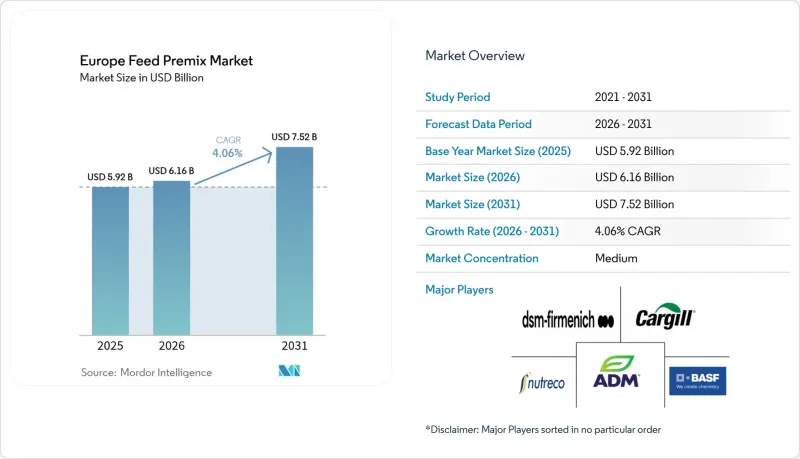
歐洲飼料預混合料市場預計將從 2025 年的 59.2 億美元成長到 2026 年的 61.6 億美元,然後在 2031 年達到 75.2 億美元,2026 年至 2031 年的複合年成長率為 4.06%。
本報告依動物種類(反芻動物、家禽等)、成分(抗生素、維生素等)及地區(西班牙、英國等)分類。市場預測以美元計價。
歐洲飼料預混合料市場的趨勢與洞察
對優質動物性蛋白質的需求量大
歐洲消費者持續優先選擇符合高福利、環保和營養標準的動物性蛋白質來源,促使畜牧養殖戶採用能改善肉質、蛋殼強度和牛奶成分的預混合料配方。預計到2024年,歐盟人均家禽消費量將達到24.8公斤,高於2020年的23.1公斤,而有機乳製品的銷售量則是年增了9%。這反映出消費者願意為可追溯的生產支付更高的價格。這些需求的變化促使飼料生產商使用富含維生素E、硒酵母和ω-3脂肪酸的高品質預混合料,從而顯著提高產品的氧化穩定性和保存期限。家樂福和利德爾等零售商現在要求自有品牌家禽產品必須標註“不含抗生素”,這一要求也提升了鋅和銅等免疫支持微量元素在雛雞和育成雞預混合料中的重要性。追求優質優質化的趨勢也蔓延到了水產養殖領域,挪威和蘇格蘭的鮭魚養殖戶使用添加了蝦青素的預混合料來獲得深紅色的魚肉,從而使他們在亞洲市場獲得高額出口價格。
關注動物健康與營養
畜牧業健康管理正從被動的疾病治療轉向預防性的營養策略,預混合料逐漸成為提供功能性添加劑的主要載體,這些添加劑能夠調節腸道菌叢、減少發炎並提高飼料轉換率。歐盟於2022年全面生效的預防性抗生素禁令加速了有機酸、精油和酵母細胞壁萃取物等成分在預混合料的應用。因此,2022年至2024年間,肉雞預混合料中植物來源成分的比例從總重量的0.3%增加到0.8%。德國和法國的酪農擴大指定使用含有瘤胃抗性甲硫胺酸和膽鹼的預混合料,以減輕高產乳牛的酮病和脂肪肝症候群。據估計,這些措施可使每頭泌乳牛的獸醫成本降低50歐元(54美元)。
歐盟對飼料添加劑有嚴格的規定
歐洲食品安全局 (EFSA) 於 2024 年推出的飼料添加劑十年一次的註冊續期制度,加重了中小預混合料生產商的合規負擔,尤其對那些缺乏足夠內部毒性和功效測試能力的企業造成了不成比例的影響。每次續約申請的費用在 50 萬至 150 萬歐元(54 萬至 162 萬美元)之間,如此高昂的費用已導致三家德國中型預混料生產商退出市場,並合併成大規模的公司。法國國家食品安全機構—法國食品、環境及職業健康安全局 (ANSES) 於 2024 年新增了一項國家審查階段,要求提交法語文件,並對從未在法國銷售過的添加劑進行現場測試。這項措施加劇了單一市場的分裂,並提高了法國以外供應商的進入門檻。
細分市場分析
至2025年,家禽業將佔歐洲飼料預混合料市場的42.14%。這反映了該產業的規模,歐盟每年生產1,320萬噸雞肉,飼養3.6億隻蛋雞。肉雞預混合料優先考慮快速生長和飼料轉換率,配方中含有高濃度的甲硫胺酸、離胺酸和維生素E,以促進胸肌發育和增強免疫功能。相較之下,蛋雞複合飼料則優先考慮鈣、磷和維生素D3,以維持蛋殼強度,並使蛋雞能夠持續產蛋至80週齡以上。火雞預混合料是小規模眾市場,主要集中在德國和法國,這兩個國家的生產商會指定高濃度的菸鹼酸和生物素,以防止體重較大的公雞腿部受傷。
水產養殖是成長最快的產業,預計到2031年將以6.72%的複合年成長率快速成長。這主要得益於丹麥、荷蘭和蘇格蘭循環水養殖系統的擴張,這些系統需要高消化率的微量營養素混合物來維持封閉循環環境中的水質和魚類健康。鮭魚和鱸魚是魚類預混合料的主要需求來源,它們需要蝦青素著色,並需要高濃度維生素C來預防脊椎畸形。同時,用於蝦子和螯蝦的甲殼類預混合料添加了銅和硒,以增強其蛻皮和抗病能力。歐盟的「2024年甲烷減量藍圖」旨在2030年將腸道廢棄物減少30%,該路線圖正在加速推廣含有海藻萃取物和3-硝基氧丙醇的預混合料動物預混料。這些添加劑可以抑制瘤胃中產甲烷菌的活性,並符合排碳權計畫的要求。
其他好處:
- Excel格式的市場預測(ME)表
- 3個月的分析師支持
目錄
第1章:引言
- 研究假設和市場定義
- 調查範圍
第2章:調查方法
第3章執行摘要
第4章 市場狀況
- 市場概覽
- 市場促進因素
- 對優質動物性蛋白質的需求量大
- 專注於動物健康和營養
- 政府主導的永續性獎勵
- 精密餵料數位孿生
- 循環經濟中微量營養素的可追溯性
- 隨著昆蟲蛋白的快速擴張,預混合料配方也需要做出改變。
- 市場限制因素
- 歐盟嚴格的添加劑法規
- 預混合料配方成本高
- 對中國維生素供應的依賴
- 歐盟降低黴菌毒素基準值增加了研發成本。
- 監理情勢
- 技術展望
- 波特五力分析
第5章 市場規模與成長預測
- 依動物類型
- 反芻動物
- 家禽
- 豬
- 水產養殖
- 其他動物類型
- 按成分
- 維他命
- 礦物
- 胺基酸
- 抗生素
- 抗氧化劑
- 其他成分
- 按地區
- 德國
- 法國
- 英國
- 西班牙
- 義大利
- 俄羅斯
- 其他歐洲國家
第6章 競爭情勢
- 策略趨勢
- 市佔率分析
- 公司簡介
- DSM-Firmenich NV
- Cargill, Incorporated
- Nutreco NV
- Archer Daniels Midland Company(ADM)
- BASF SE
- Royal De Heus Group BV
- Land O'Lakes Inc.
- Evonik Industries AG
- Bluestar Adisseo Company
- Alltech Inc.
- DLG amba
- Kemin Industries Inc.
- ForFarmers NV
- AB Agri Limited
- Novus International Inc.
第7章 市場機會與未來展望
According to Mordor Intelligence, the Europe feed premix market size is expected to grow from USD 5.92 billion in 2025 to USD 6.16 billion in 2026 and is forecast to reach USD 7.52 billion by 2031 at 4.06% CAGR over 2026-2031.
This report is Segmented by Animal Type (Ruminant, Poultry, and More), by Ingredients (Antibiotics, Vitamins, and More) and by Geography (Spain, United Kingdom, and More). The Market Forecasts are Provided in Terms of Value (USD).
Europe Feed Premix Market Trends and Insights
High Demand for Premium Animal Protein
European consumers continue to prioritize animal protein sources that meet elevated welfare, environmental, and nutritional standards, prompting livestock producers to adopt premix formulations that enhance meat quality, eggshell strength, and milk composition. Per-capita poultry consumption in the Europe Union reached 24.8 kilograms in 2024, up from 23.1 kilograms in 2020, while organic dairy sales climbed 9% year-over-year, reflecting willingness to pay premiums for traceable production. This demand shift compels feed mills to specify higher-grade vitamin E, selenium yeast, and omega-3-enriched premixes that deliver measurable improvements in oxidative stability and shelf life. Retailers such as Carrefour and Lidl now require antibiotic-free labels on private-label poultry, a mandate that elevates the role of immune-supporting trace minerals like zinc and copper in starter and grower premixes. The protein premiumization trend also extends to aquaculture, where Norwegian and Scottish salmon farmers adopt astaxanthin-fortified premixes to achieve the deep red flesh color that commands export premiums in Asian markets.
Focus on Animal Health and Nutrition
Livestock health management has evolved from reactive disease treatment to proactive nutrition strategies, positioning premixes as the primary vehicle for delivering functional additives that modulate gut microbiota, reduce inflammation, and improve feed conversion ratios. The Europe Union ban on prophylactic antibiotic use, fully enforced since 2022, accelerated the incorporation of organic acids, essential oils, and yeast cell wall extracts into premix matrices, with phytogenic inclusion rates in broiler premixes rising from 0.3% to 0.8% of total formulation weight between 2022 and 2024. Dairy producers in Germany and France are increasingly specifying premixes containing rumen-protected methionine and choline to mitigate ketosis and fatty liver syndrome in high-yielding cows, interventions that reduce veterinary costs by an estimated EUR 50 (USD 54) per cow per lactation.
Stringent Europe Union Additive Regulations
The European Food Safety Authority's 10-year dossier renewal cycle for feed additives, introduced in 2024, imposes a compliance burden that disproportionately affects smaller premix manufacturers, who often lack in-house toxicology and efficacy testing capabilities. Each renewal dossier costs between EUR 500,000 and EUR 1.5 million (USD 540,000 to USD 1.62 million), a threshold that has already prompted three mid-tier German formulators to exit the market and consolidate into larger entities. France's French Agency for Food, Environmental, and Occupational Health & Safety (ANSES), the national food safety agency, introduced a supplementary national review layer in 2024, requiring French-language documentation and domestic field trials for any additive not previously marketed in the country. This move fragments the single market and raises entry costs for non-French suppliers.
Other drivers and restraints analyzed in the detailed report include:
- Government-Led Sustainability Incentives
- Precision-Feeding Digital Twins
- High Premix Formulation Costs
For complete list of drivers and restraints, kindly check the Table Of Contents.
Segment Analysis
Poultry captured 42.14% of the European feed premix market size in 2025, reflecting the sector's scale, with the Europe Union producing 13.2 million metric tons of poultry meat annually and maintaining 360 million layer hens . Broiler premixes emphasize rapid growth and feed efficiency, incorporating elevated levels of methionine, lysine, and vitamin E to support breast muscle development and immune function. In contrast, layer formulations prioritize calcium, phosphorus, and vitamin D3 to maintain eggshell integrity and laying persistence beyond 80 weeks of age. Turkey premixes represent a smaller niche, concentrated in Germany and France, where producers specify higher niacin and biotin levels to prevent leg disorders in heavy toms.
Aquaculture is the fastest-growing segment, surge at a 6.72% CAGR through 2031, propelled by the expansion of recirculating aquaculture systems in Denmark, the Netherlands, and Scotland, which demand highly digestible micronutrient blends to maintain water quality and fish health in closed-loop environments. Salmon and seabass dominate fin-fish premix demand, requiring astaxanthin for pigmentation and high-potency vitamin C to prevent spinal deformities, while crustacean premixes for shrimp and crayfish incorporate copper and selenium to support molting and disease resistance. The Europe Union 2024 methane reduction roadmap, targeting a 30% cut in enteric emissions by 2030, accelerates the adoption of ruminant premixes containing seaweed extracts and 3-nitrooxypropanol, additives that inhibit methanogen activity in the rumen and qualify for carbon credit schemes.
Complete Report Scope:
- By Animal Type
- Ruminants
- Poultry
- Swine
- Aquaculture
- Other Animal Types
- By Ingredient
- Vitamins
- Minerals
- Amino Acids
- Antibiotics
- Antioxidants
- Other Ingredients
- By Geography
- Germany
- France
- United Kingdom
- Spain
- Italy
- Russia
- Rest of Europe
List of Companies Covered in this Report:
- DSM-Firmenich N.V.
- Cargill, Incorporated
- Nutreco N.V.
- Archer Daniels Midland Company (ADM)
- BASF SE
- Royal De Heus Group B.V.
- Land O'Lakes Inc.
- Evonik Industries AG
- Bluestar Adisseo Company
- Alltech Inc.
- DLG amba
- Kemin Industries Inc.
- ForFarmers N.V.
- AB Agri Limited
- Novus International Inc.
Additional Benefits:
- The market estimate (ME) sheet in Excel format
- 3 months of analyst support
TABLE OF CONTENTS
1 INTRODUCTION
- 1.1 Study Assumptions and Market Definition
- 1.2 Scope of the Study
2 RESEARCH METHODOLOGY
3 EXECUTIVE SUMMARY
4 MARKET LANDSCAPE
- 4.1 Market Overview
- 4.2 Market Drivers
- 4.2.1 High demand for premium animal protein
- 4.2.2 Focus on animal health and nutrition
- 4.2.3 Government-led sustainability incentives
- 4.2.4 Precision-feeding digital twins
- 4.2.5 Circular-economy micronutrient traceability
- 4.2.6 Rapid expansion of insect protein requiring premix reformulation
- 4.3 Market Restraints
- 4.3.1 Stringent Europe Union additive regulations
- 4.3.2 High premix formulation costs
- 4.3.3 Vitamin-supply dependence on China
- 4.3.4 Lowered Europe Uniomycotoxin limits raising R&D costs
- 4.4 Regulatory Landscape
- 4.5 Technological Outlook
- 4.6 Porter's Five Forces Analysis
- 4.6.1 Bargaining Power of Suppliers
- 4.6.2 Bargaining Power of Buyers
- 4.6.3 Threat of New Entrants
- 4.6.4 Threat of Substitutes
- 4.6.5 Intensity of Competitive Rivalry
5 MARKET SIZE AND GROWTH FORECASTS (VALUE)
- 5.1 By Animal Type
- 5.1.1 Ruminants
- 5.1.2 Poultry
- 5.1.3 Swine
- 5.1.4 Aquaculture
- 5.1.5 Other Animal Types
- 5.2 By Ingredient
- 5.2.1 Vitamins
- 5.2.2 Minerals
- 5.2.3 Amino Acids
- 5.2.4 Antibiotics
- 5.2.5 Antioxidants
- 5.2.6 Other Ingredients
- 5.3 By Geography
- 5.3.1 Germany
- 5.3.2 France
- 5.3.3 United Kingdom
- 5.3.4 Spain
- 5.3.5 Italy
- 5.3.6 Russia
- 5.3.7 Rest of Europe
6 COMPETITIVE LANDSCAPE
- 6.1 Strategic Moves
- 6.2 Market Share Analysis
- 6.3 Company Profiles (Includes Global level Overview, Market level Overview, Core Segments, Financials as available, Strategic Information, Market Rank/Share, Products and Services, Recent Developments)
- 6.3.1 DSM-Firmenich N.V.
- 6.3.2 Cargill, Incorporated
- 6.3.3 Nutreco N.V.
- 6.3.4 Archer Daniels Midland Company (ADM)
- 6.3.5 BASF SE
- 6.3.6 Royal De Heus Group B.V.
- 6.3.7 Land O'Lakes Inc.
- 6.3.8 Evonik Industries AG
- 6.3.9 Bluestar Adisseo Company
- 6.3.10 Alltech Inc.
- 6.3.11 DLG amba
- 6.3.12 Kemin Industries Inc.
- 6.3.13 ForFarmers N.V.
- 6.3.14 AB Agri Limited
- 6.3.15 Novus International Inc.
7 MARKET OPPORTUNITIES AND FUTURE OUTLOOK

 北美飼料預混合料:市佔率分析、產業趨勢與統計及成長預測(2026-2031 年)
 飼料預混合料市場:2026-2032年全球市場預測(按類型、目標動物、形態、原料來源、應用、分銷管道和最終用戶分類)飼料預混合料:市佔率分析、產業趨勢與統計、成長預測(2026-2031)
 全球飼料預混合料市場規模、佔有率、趨勢和成長分析報告(2026-2034年)飼料預混合料市場-2026-2031年預測
 家禽飼料預混合料市場規模、佔有率及成長分析(按類型、動物、形態及地區分類)-2026-2033年產業預測
 飼料預混料市場-全球產業規模、佔有率、趨勢、機會及預測(按成分類型、牲畜、形式、地區和競爭細分,2020-2030 年)