


 |
市場調查報告書
商品編碼
2061515
飼料預混合料:市佔率分析、產業趨勢與統計、成長預測(2026-2031)Feed Premix - Market Share Analysis, Industry Trends & Statistics, Growth Forecasts (2026 - 2031) |
||||||

※ 本網頁內容可能與最新版本有所差異。詳細情況請與我們聯繫。
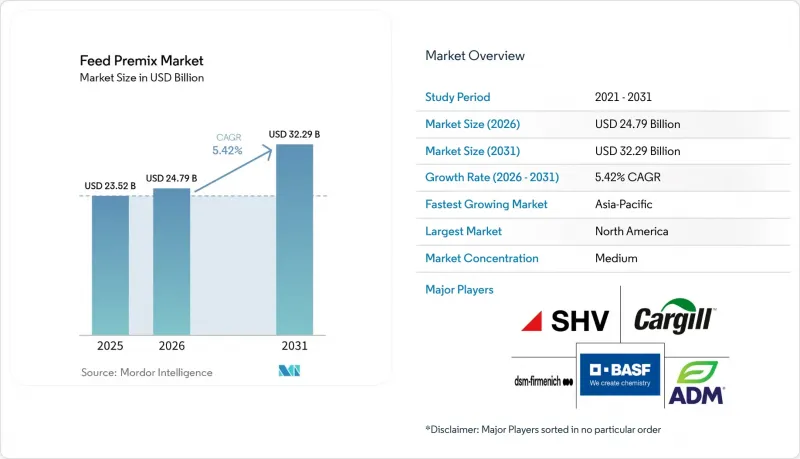
根據 Mordor Intelligence 預測,飼料預混合料市場規模將從 2025 年的 235.2 億美元和 2026 年的 247.9 億美元成長到 2031 年的 322.9 億美元,2026 年至 2031 年的年複合成長率(CAGR)為 5.42%。
本報告按成分類型(維生素、礦物質、胺基酸等)、劑型(粉末和液體)、動物種類(家禽、反芻動物、豬、水產養殖動物、寵物和其他動物)以及地區(北美、歐洲、亞太地區、南美等)進行細分。市場預測以美元計價。
全球飼料預混合料市場趨勢及洞察
家禽及蛋飼料消費量增加
根據Alltech發布的《農業食品展望》,2025年肉雞飼料產量較2024年增加3.7%,達到4.004億噸。這鞏固了家禽作為飼料預混合料市場最大消費群的地位。這項需求並非僅源自於養殖動物數量的增加,而是因為大規模家禽生產系統中的生產者正在轉向更高密度的養殖環境、更短的生產週期以及更嚴格的飼料轉換率目標。這些商業模式推動了對維生素和微量元素的需求成長,而這些成分必須可靠地添加到每噸成品飼料中。根據Alltech發布的《2026年農業食品展望》,受亞洲和非洲強勁的雞蛋消費需求推動,儘管紅肉價格上漲,但蛋飼料在2025年仍較2024年成長3.2%,達到1.801億噸。因此,家禽飼料為飼料預混合料市場提供了廣泛且持續的需求基礎,這種需求是透過頻繁的生產週期而非季節性採購來補充的。此外,鑑於肉雞和蛋雞飼料在全球複合飼料生產中所佔比例很高,生產商很難在不影響品質穩定性的前提下偏離經過認證的預混合料供應商。正因如此,即使某些地區爆發疾病導致供應中斷,家禽飼料仍能發揮穩定飼料預混合料市場的角色。
商業複合飼料在亞洲和非洲的滲透率
根據Alltech發布的《農業食品展望》,2024年至2025年間,非洲商業飼料產量預計將增加11.5%,是本報告草案中各地區成長最高的。奈及利亞、埃及、肯亞和衣索比亞等市場的家禽、乳牛和反芻動物飼料產量均有所增加。更重要的是,這項轉變反映了飼料通路從非正式穀物混合料向工業化複合飼料的過渡。隨著飼料生產向正規加工系統轉型,經認證的預混合料不再是可選項,而是成為標準投入品。這種轉變往往會推動預混合料的需求成長,其速度可能比僅從牲畜數量推斷出的速度更快。在東南亞,嘉吉公司位於越南江田的預混合料工廠於2024年建成,年產能達4萬噸,自動化率超過95%,這表明當地已建立起符合可追溯性和出口品質標準的生產體系。此外,印尼對動物飼料原料的清真認證要求也促使飼料生產商採購經過認證和檢驗的預混合料。因此,開發中地區商業飼料的標準化仍是飼料預混合料市場最顯著的結構性成長要素之一。
農民利潤率面臨壓力,成本波動加劇
成本壓力仍然是飼料預混合料市場面臨的一大阻礙因素,因為穀物和添加劑成本飆升往往迫使飼料買家調整配方品質。 2026年初,玉米採購成本飆升,加上同期豆粕價格上漲,擠壓了家禽和生豬養殖戶的利潤空間。隨著這些壓力加劇,一些買家可能會轉向低規格混合料或更便宜的礦物質成分,而不是繼續維持高品質的預混合料配方。 2025年至2026年墨西哥灣沿岸地區供應中斷期間,類似的成本壓力也影響了維生素、胺基酸、礦物質和有機酸,導致維生素E和甲硫胺酸等成分的價格大幅上漲。這些壓力對特種功能性產品的影響尤其顯著,因為這類產品比最低營養需求產品具有更大的採購柔軟性。因此,買家越來越依賴期貨合約、選擇權和雙重採購策略來保障其供應計劃。然而,如果生產者優先考慮成本控制而不是高階配方的深度,利潤率的壓力可能會減緩飼料預混合料市場的價值成長。
細分市場分析
到2025年,維生素預混合料將成為該細分市場的主要驅動力,佔據32.1%的市場。這主要歸功於維生素在所有物種的免疫力、繁殖力和胴體品質中所扮演的核心角色。在飼料預混合料產業中,維生素預混料的需求基礎最為廣泛,因為即使在成本壓力時期,市售飼料中也很少缺乏維生素。其在包括家禽、豬、反芻動物、水產養殖和寵物飼料在內的廣泛應用,持續支撐著穩定、長期的全球需求。
預計礦物質預混合料將以最快的速度成長,2026年至2031年的複合年成長率將達到7.6%,因為生物利用度和嚴格的排泄控制在飼料預混合料市場中變得越來越重要。胺基酸混合物也受益於降低粗蛋白含量的策略,而酵素預混合料的需求則因複合飼料中採用更多種類的替代成分而增加。益生菌和益生元混合物在限制使用抗生素的生產系統中正迅速發展,抗氧化劑、酸味劑和特種功能混合物擴大作為多功能組合的一部分銷售,而不是作為獨立的添加劑。精準營養計畫和注重永續性的畜牧生產系統正在進一步加速全球先進礦物質和功能性預混合料解決方案的採用。
區域分析
預計2025年,北美將佔飼料預混合料市場34.3%的佔有率。這得歸功於北美高產能的飼料廠、嚴格的監管體系,以及對最佳化牛、家禽和豬供應鏈增重成本的持續關注。該地區的生產商正在利用先進的近紅外光譜分析技術和雲端配方軟體即時調整預混合料配方,從而減少營養浪費並確保符合標籤標準。監管政策的澄清,例如美國食品藥物食品藥物管理局)於2024年10月批准的動物飼料原料以及更新的飼料標籤合規要求,正在加強整個飼料行業的可追溯性和配方標準化。監管確定性的提高使得預混合料生產商能夠擴大其區域產能和技術支援體系。
亞太地區預計將呈現最快的成長軌跡,2026年至2031年的複合年成長率將達到7.9%,這主要得益於畜牧業數量的快速成長以及市售飼料相對於自製飼料的優勢日益凸顯。中國預混合料生產商正利用農業農村部(MARA)2024年核准的添加劑,加速向市場推出新型複合飼料,以滿足尋求提高生產力的綜合水產養殖業者的需求。印度酪農的現代化、印尼蝦類養殖業的擴張以及泰國肉雞出口的成長,進一步擴大了目標市場規模。曾經由西方市場主導的數位化飼料平台,正透過雲端為基礎的行動工具在東南亞迅速普及,這些工具使現場技術人員能夠即時調整營養密度。
歐洲飼料預混合料市場已趨於成熟,但由於抗生素法規和添加劑停用導致產品設計變更,配方頻繁更新。南美洲家禽和牛肉生產持續展現成長潛力,但農民利潤率的波動可能會暫時降低配方的深度。預計到2025年,非洲飼料生產成長率將最高。這點意義重大,因為在禽類和乳牛養殖系統中,複合飼料正日益取代農場自製飼料。中東的需求仍然集中在畜牧業投資上,這主要受糧食安全問題的驅動,從而推動了從歐洲和亞洲供應商進口預混合料的成長。
其他好處:
- Excel格式的市場預測(ME)表
- 3個月的分析師支持
目錄
第1章:引言
- 研究假設和市場定義
- 調查範圍
第2章:調查方法
第3章執行摘要
第4章 市場狀況
- 市場概覽
- 市場促進因素
- 提高家禽和雞蛋的飼料轉換率
- 亞洲和非洲市售複合飼料的普及
- 減少抗生素使用的營養計劃
- 精準營養和數位化配方簡介
- 擴大飼料強化在酪農生產系統的應用。
- 替代成分需調整微量營養素含量
- 市場限制因素
- 農民利潤率面臨壓力,成本波動加劇
- 飼料預混合料相關法規碎片化
- 微量元素供應鏈中斷
- 消費者對過度強化動物產品的強烈抵制
- 監理情勢
- 技術展望
- 波特五力分析
第5章 市場規模與成長預測
- 依成分類型
- 維他命
- 礦物
- 胺基酸
- 抗氧化劑
- 酵素
- 益生菌和益生元
- 酸味劑
- 其他特殊功能預混合料
- 按形式
- 粉末
- 液體
- 依動物類型
- 家禽
- 反芻動物
- 豬
- 水產養殖
- 寵物
- 其他動物
- 按地區
- 北美洲
- 美國
- 加拿大
- 墨西哥
- 其他北美國家
- 南美洲
- 巴西
- 阿根廷
- 智利
- 其他南美國家
- 歐洲
- 德國
- 英國
- 法國
- 西班牙
- 義大利
- 荷蘭
- 波蘭
- 俄羅斯
- 其他歐洲國家
- 亞太地區
- 中國
- 印度
- 日本
- 澳洲
- 泰國
- 越南
- 印尼
- 其他亞太國家
- 中東
- 沙烏地阿拉伯
- 阿拉伯聯合大公國
- 其他中東國家
- 非洲
- 南非
- 埃及
- 其他非洲國家
- 北美洲
第6章 競爭情勢
- 市場集中度
- 策略趨勢
- 市佔率分析
- 公司簡介
- Cargill, Incorporated.
- Archer Daniels Midland Company
- DSM-Firmenich AG
- BASF SE
- Nutreco NV(SHV Holdings NV)
- Evonik Industries AG
- Alltech Inc.
- Land O'Lakes Inc.
- Adisseo(China National Bluestar Group)
- International Flavors & Fragrances Inc.
- Koninklijke De Heus BV
- Novus International, Inc.
- Kemin Industries, Inc.
- Phibro Animal Health Corporation
- Zinpro Corporation
第7章 市場機會與未來展望
According to Mordor Intelligence, the feed premix market size is projected to grow from USD 23.52 billion in 2025 and USD 24.79 billion in 2026 to USD 32.29 billion by 2031, registering a CAGR of 5.42% between 2026 and 2031.
This report is Segmented by Ingredient Type (Vitamins, Minerals, Amino Acids, and More), by Form (Powder and Liquid), by Animal Type (Poultry, Ruminants, Swine, Aquaculture, Pets, and Other Animals), and by Geography (North America, Europe, Asia-Pacific, South America, and More). The Market Forecasts are Provided in Terms of Value (USD).
Global Feed Premix Market Trends and Insights
Rising Poultry and Egg Feed Intensity
Broiler feed production rose 3.7% to 400.4 million metric tons in 2025 compared to 2024, which reinforced poultry as the largest consumption base for premix demand in the feed premix market, according to Alltech Agri-Food Outlook. Demand is not coming only from flock growth, because producers are also moving toward denser housing, faster cycles, and tighter feed conversion targets in large poultry systems. That operating model raises the need for dependable vitamin and trace mineral inclusion per ton of finished feed. Layer feed also increased by 3.2% to 180.1 million metric tons between 2024 and 2025, supported by steady egg consumption in Asia and Africa amid higher red meat prices, according to the Alltech Agri-Food Outlook 2026. Poultry, therefore, provides the feed premix market with a broad, recurring demand base that is renewed through frequent production cycles rather than seasonal buying. The large share of broiler and layer feed in global compound feed output also limits producers' ability to move away from certified premix suppliers without compromising quality consistency. This makes poultry a stabilizing force for the feed premix market even when disease events disrupt individual regions.
Commercial Compound Feed Penetration in Asia and Africa
Africa recorded 11.5% growth in commercial feed production between 2024 and 2025, the fastest regional growth rate reported in the draft, with gains across poultry, dairy, and ruminant systems in markets such as Nigeria, Egypt, Kenya, and Ethiopia, according to Alltech Agri-Food Outlook. The larger significance is that this shift reflects a move away from informal grain blending toward industrial compound feed channels. Once feed output moves into formal mill systems, certified premix becomes a standard input rather than an optional add-on. That change tends to raise premix demand faster than animal numbers alone would suggest. In Southeast Asia, Cargill Incorporated's Giang Dien premix plant in Vietnam, established in 2024, features an annual capacity of 40,000 metric tons and over 95% automation, showing how local production is being built around traceability and export-grade quality requirements. Indonesia's halal certification requirements for animal nutrition inputs are also pushing mills toward documented and verified premix procurement. As a result, commercial feed formalization remains one of the clearest structural growth supports for the feed premix market in developing regions.
Farmer Margin Pressure and Cost Volatility
Cost pressure remains a clear restraint for the feed premix market because feed buyers often adjust formulation quality when grain and additive costs rise quickly. Corn procurement costs increased sharply in early 2026, while soybean meal prices also moved higher over the same period, squeezing margins for poultry and swine producers. When these pressures intensify, some buyers shift toward lower-specification blends or cheaper mineral sources rather than maintaining premium premix formulas unchanged. Similar cost stress affected vitamins, amino acids, minerals, and organic acids during the 2025-2026 Gulf supply disruption, with vitamin E and methionine among the inputs facing notable price increases. This pressure tends to weigh more heavily on specialty functional products because those purchases are more flexible than minimum nutritional requirements. Buyers are therefore relying increasingly on forward contracting, options, and dual sourcing strategies to protect supply plans. Even so, margin pressure can still slow value growth in the feed premix market when producers prioritize cost control over premium formulation depth.
Other drivers and restraints analyzed in the detailed report include:
- Antibiotic-Reduction Nutrition Programs
- Precision Nutrition and Digital Formulation Adoption
- Regulatory Fragmentation for Feed Premixes
For complete list of drivers and restraints, kindly check the Table Of Contents.
Segment Analysis
Vitamin premixes led this segment with a 32.1% share in 2025, supported by their central role in immunity, reproduction, and carcass quality across species. Within the feed premix industry, this category remained the broadest demand base because commercial diets rarely remove vitamins even during periods of cost pressure. Their widespread inclusion across poultry, swine, ruminant, aquaculture, and pet nutrition applications continues to support stable, long-term global demand.
Mineral premixes are projected to grow at the fastest pace, at a 7.6% CAGR from 2026 to 2031, as tighter control of bioavailability and excretion becomes more important in the feed premix market. Amino acid blends also benefit from lower crude protein strategies, while enzyme premixes gain from reformulated diets that use more variable alternative ingredients. Probiotic and prebiotic blends are gaining momentum in antibiotic-restricted production systems, and antioxidant, acidifier, and specialty functional blends are increasingly sold as part of multi-functional packages rather than stand-alone additives. Precision nutrition programs and sustainability-focused livestock production systems are further accelerating the adoption of advanced mineral and functional premix solutions globally.
Geography Analysis
North America held a 34.3% share of the feed premix market in 2025, underpinned by high-throughput feed mills, rigorous oversight, and an enduring focus on cost-of-gain optimization within cattle, poultry, and swine supply chains. The region's producers use sophisticated NIR analytics and cloud-linked formulation software to adjust premix inclusion in real time, reducing nutrient waste and ensuring label compliance. Ongoing regulatory clarity, such as the Food and Drug Administration's (FDA's) October 2024 update to animal feed ingredient approval and feed labeling compliance requirements, has strengthened traceability and formulation standardization across the feed industry, enabling premix manufacturers to expand regional production capacity and technical support operations with greater regulatory certainty.
The Asia-Pacific region exhibits the fastest trajectory, with an 7.9% CAGR from 2026 to 2031, driven by rapid livestock population growth and a growing dominance of commercial feeds over farm-mixed rations. China's premix manufacturers capitalize on the Ministry of Agriculture and Rural Affairs' (MARA) 2024 additive approvals, accelerating time-to-market for novel blends that appeal to integrators seeking performance lifts. India's dairy modernization, Indonesia's shrimp expansion, and Thailand's broiler exports further enlarge addressable volumes. Digital feed platforms, once the domain of Western markets, are proliferating in Southeast Asia through cloud-based mobile tools that enable field technicians to adjust nutrient density on-site.
Europe remains a mature but reformulation-heavy region for the feed premix market because antibiotic restrictions and additive withdrawals are reshaping product design. South America continues to offer poultry and beef growth potential, although farmer margin volatility can lead to temporary downgrades in formulation depth. Africa posted the fastest feed production growth rate in 2025, and that is important because compound feed is replacing on-farm mixing in poultry and dairy systems. Middle East demand remains centered on food security-driven livestock investment, which supports incremental premix imports from both European and Asian suppliers.
- Cargill, Incorporated.
- Archer Daniels Midland Company
- DSM-Firmenich AG
- BASF SE
- Nutreco N.V. (SHV Holdings N.V.)
- Evonik Industries AG
- Alltech Inc.
- Land O'Lakes Inc.
- Adisseo (China National Bluestar Group)
- International Flavors & Fragrances Inc.
- Koninklijke De Heus B.V.
- Novus International, Inc.
- Kemin Industries, Inc.
- Phibro Animal Health Corporation
- Zinpro Corporation
Additional Benefits:
- The market estimate (ME) sheet in Excel format
- 3 months of analyst support
TABLE OF CONTENTS
1 Introduction
- 1.1 Study Assumptions and Market Definition
- 1.2 Scope of the Study
2 Research Methodology
3 Executive Summary
4 Market Landscape
- 4.1 Market Overview
- 4.2 Market Drivers
- 4.2.1 Rising poultry and egg feed intensity
- 4.2.2 Commercial compound feed penetration in Asia and Africa
- 4.2.3 Antibiotic-reduction nutrition programs
- 4.2.4 Precision nutrition and digital formulation adoption
- 4.2.5 Increasing feed fortification in dairy production systems
- 4.2.6 Alternative ingredients requiring micronutrient formulation adjustment
- 4.3 Market Restraints
- 4.3.1 Farmer margin pressure and cost volatility
- 4.3.2 Regulatory fragmentation for feed premixes
- 4.3.3 Trace-mineral supply chain disruptions
- 4.3.4 Consumer pushback on over-fortified animal products
- 4.4 Regulatory Landscape
- 4.5 Technological Outlook
- 4.6 Porter's Five Forces Analysis
- 4.6.1 Bargaining Power of Suppliers
- 4.6.2 Bargaining Power of Buyers
- 4.6.3 Threat of New Entrants
- 4.6.4 Threat of Substitutes
- 4.6.5 Intensity of Competitive Rivalry
5 Market Size and Growth Forecasts (Value)
- 5.1 By Ingredient Type
- 5.1.1 Vitamins
- 5.1.2 Minerals
- 5.1.3 Amino Acids
- 5.1.4 Antioxidants
- 5.1.5 Enzymes
- 5.1.6 Probiotics and Prebiotics
- 5.1.7 Acidifiers
- 5.1.8 Other Specialty Functional Premixes
- 5.2 By Form
- 5.2.1 Powder
- 5.2.2 Liquid
- 5.3 By Animal Type
- 5.3.1 Poultry
- 5.3.2 Ruminants
- 5.3.3 Swine
- 5.3.4 Aquaculture
- 5.3.5 Pets
- 5.3.6 Other Animals
- 5.4 By Geography
- 5.4.1 North America
- 5.4.1.1 United States
- 5.4.1.2 Canada
- 5.4.1.3 Mexico
- 5.4.1.4 Rest of North America
- 5.4.2 South America
- 5.4.2.1 Brazil
- 5.4.2.2 Argentina
- 5.4.2.3 Chile
- 5.4.2.4 Rest of South America
- 5.4.3 Europe
- 5.4.3.1 Germany
- 5.4.3.2 United Kingdom
- 5.4.3.3 France
- 5.4.3.4 Spain
- 5.4.3.5 Italy
- 5.4.3.6 Netherlands
- 5.4.3.7 Poland
- 5.4.3.8 Russia
- 5.4.3.9 Rest of Europe
- 5.4.4 Asia-Pacific
- 5.4.4.1 China
- 5.4.4.2 India
- 5.4.4.3 Japan
- 5.4.4.4 Australia
- 5.4.4.5 Thailand
- 5.4.4.6 Vietnam
- 5.4.4.7 Indonesia
- 5.4.4.8 Rest of Asia-Pacific
- 5.4.5 Middle East
- 5.4.5.1 Saudi Arabia
- 5.4.5.2 United Arab Emirates
- 5.4.5.3 Rest of Middle East
- 5.4.6 Africa
- 5.4.6.1 South Africa
- 5.4.6.2 Egypt
- 5.4.6.3 Rest of Africa
- 5.4.1 North America
6 Competitive Landscape
- 6.1 Market Concentration
- 6.2 Strategic Moves
- 6.3 Market Share Analysis
- 6.4 Company Profiles (Includes Global Level Overview, Market Level Overview, Core Segments, Financials as Available, Strategic Information, Market Rank/Share for Key Companies, Products and Services, and Recent Developments)
- 6.4.1 Cargill, Incorporated.
- 6.4.2 Archer Daniels Midland Company
- 6.4.3 DSM-Firmenich AG
- 6.4.4 BASF SE
- 6.4.5 Nutreco N.V. (SHV Holdings N.V.)
- 6.4.6 Evonik Industries AG
- 6.4.7 Alltech Inc.
- 6.4.8 Land O'Lakes Inc.
- 6.4.9 Adisseo (China National Bluestar Group)
- 6.4.10 International Flavors & Fragrances Inc.
- 6.4.11 Koninklijke De Heus B.V.
- 6.4.12 Novus International, Inc.
- 6.4.13 Kemin Industries, Inc.
- 6.4.14 Phibro Animal Health Corporation
- 6.4.15 Zinpro Corporation
7 Market Opportunities and Future Outlook

 北美飼料預混合料:市佔率分析、產業趨勢與統計及成長預測(2026-2031 年)歐洲飼料預混合料:市佔率分析、產業趨勢與統計及成長預測(2026-2031 年)
 飼料預混合料市場:2026-2032年全球市場預測(按類型、目標動物、形態、原料來源、應用、分銷管道和最終用戶分類)
 全球飼料預混合料市場規模、佔有率、趨勢和成長分析報告(2026-2034年)飼料預混合料市場-2026-2031年預測
 家禽飼料預混合料市場規模、佔有率及成長分析(按類型、動物、形態及地區分類)-2026-2033年產業預測
 飼料預混料市場-全球產業規模、佔有率、趨勢、機會及預測(按成分類型、牲畜、形式、地區和競爭細分,2020-2030 年)