


 |
市場調查報告書
商品編碼
2113660
控制閥:市場佔有率分析、產業趨勢與統計、成長預測(2026-2031)Control Valve - Market Share Analysis, Industry Trends & Statistics, Growth Forecasts (2026 - 2031) |
||||||

※ 本網頁內容可能與最新版本有所差異。詳細情況請與我們聯繫。
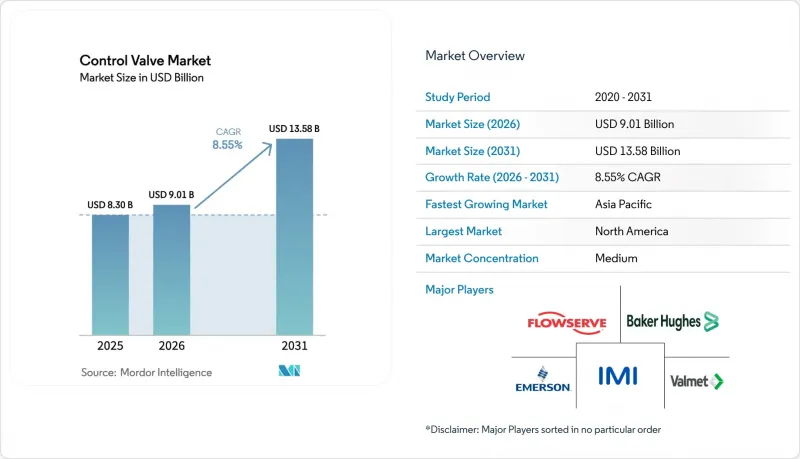
根據 Mordor Intelligence 預測,控制閥市場規模預計在 2026 年達到 90.1 億美元,到 2031 年達到 135.8 億美元,預測期內複合年成長率為 8.55%。
本報告依閥門類型(截止閥、球閥、蝶閥、旋塞閥等)、操作技術(氣動、液壓等)、終端用戶產業(石油天然氣、化學、石化及化學肥料、能源電力等)、材質(鋼、鑄鐵、合金、塑膠)及地區細分。市場預測以美元計價。
全球控制閥市場趨勢與洞察
增加對用水和污水基礎設施的投資
全球公共產業正在推動近30年來最大的設備升級週期。美國《基礎設施投資與就業法案》已撥款650億美元,用於未來10年的水務項目,推動了手動閘閥向具備遠距離診斷功能的自動蝶閥和球閥的全面轉型。塞文特倫特水務公司耗資2億英鎊(約2.54億美元)的明沃斯維修項目,便是歐洲競標中控制、安全和訊號系統如何打包成多年期合約的典範。新興的亞太市場也緊隨其後,在東協2021年至2024年間直接投資成長44%的推動下,水務基礎建設投資額高達130億美元。公共產業傾向於採用緊湊型自動蝶閥和無線定位器,這種組合可以減少進入密閉空間的作業,並延長美國環保署洩漏檢測計劃規定的檢查週期。閥門供應商現在正透過診斷軟體獲得持續收入,該軟體可將意外停機時間減少高達30%,從而在硬體銷售之外,透過服務創造經常性收入。
老舊電廠和加工廠的現代化改造
在煤改氣和高速聯合循環燃氣燃氣渦輪機中,能夠承受快速溫度變化的籠式導引球閥正被採用,以取代幾十年前的閥內件設計。 2025年,北美某燃氣渦輪機冷卻迴路的控制閥維修,提高了最小負載能力,並實現了使用氫燃料混合物。數位化平台將閥門健康數據與電廠的分散式控制系統(DCS)整合,使操作人員能夠在不違反沖壓速率限制的情況下,調整機組輸出以匹配間歇性可再生能源的輸出曲線。在流程工業中,支援藍牙功能的電動執行器使技術人員能夠在危險區域無需公開工作許可即可訪問診斷信息,從而將設備壽命延長15-20年,並將噴射排放量降低到日益嚴格的閾值以下。
原油價格波動抑制了對石油和天然氣設施的投資。
大宗商品價格波動抑制了探勘熱情,導致大量依賴高價值閥門的管道和液化天然氣項目被推遲。據澳洲能源生產商稱,過去五年,該國僅吸引了全球1.2%的探勘支出,凸顯了其保守的投資環境。馬來西亞國家石油公司(Petronas)2025-2027年的展望也反映了這種謹慎的態度,優先考慮最佳化現有設施而非擴大產能。雖然現有設施在基本維護下仍能運作,但在價格前景改善之前,用於短期專案的可自由支配支出仍面臨風險。大型企劃的推遲,例如陶氏化學公司投資85億美元的薩斯喀徹溫堡綜合體項目,取消了多年閥門採購計劃,減緩了原本預計強勁成長的控制閥市場的成長。
細分市場分析
儘管塞閥在2025年的銷售佔有率不高,但預計到2031年,其複合年成長率將達到9.03%,這主要得益於礦業、紙漿和污水處理行業的運營商對其自清潔和耐磨設計的青睞。相比之下,蝶閥憑藉其在大直徑供水管中緊湊的面積,佔據了29.84%的市場佔有率,但由於壓力等級的限制,其在嚴苛運行環境下的成長受到限制。隨著傳統截止閥被塞閥取代,以減少泥漿管道和選礦廠的停機時間,塞閥市場預計將會成長。供應商正在銷售硬化旋塞套筒和活載填料,以延長平均故障間隔時間(MTBF),而營運商則更青睞直角回轉執行器相比線性截止閥配置更易於自動化。在連續製程裝置中,較低的扭力需求也備受重視,這使得能夠採用更小的馬達驅動裝置,從而符合節能改善計畫的要求。
儘管球閥和球閥在高壓和緊急停止應用中仍然必不可少,但其高昂的初始投資成本和安裝空間要求阻礙了市場成長。因此,產品差異化主要集中在閥內件形狀和降噪籠的設計上,降噪籠可將空化現象降低高達 35 分貝,這些特性在蒸汽甲烷重整 (SMR)蒸氣迴路中尤為重要。拉門公司在球閥領域的設計表明,最初為瑞典紙漿廠開發的專業技術可以擴展到更廣泛的漿料應用領域。隨著全球對銅、鋰和稀土元素礦石需求的加速成長,處理磨蝕性介質的需求將推動旋塞閥在控制閥市場中的穩定普及。
預計到2031年,電動閥市場將以10.02%的複合年成長率成長,超過氣動產品(氣動產品在2025年仍將佔據47.73%的市場佔有率)。總擁有成本(TCO)的降低主要歸功於無需產生壓縮空氣,而壓縮空氣的消耗量可能佔工廠電力消耗量的10%至30%。最新的無刷直流馬達、碳化矽逆變器和板載電力電子元件能夠實現精確的階躍變化,並有助於實現先進的模型預測控制。以Rotork的IQ4和AUMA的MATIC AM系列為例,遠端韌體升級和藍牙診斷功能減少了技術人員的出行,並提高了密閉空間作業的安全性。因此,與數位服務合約相關的收入將隨著硬體出貨量的成長而增加,從而鞏固控制閥市場作為經常性收入來源的地位。
在本質安全運作至關重要的場合,尤其是在受ATEX和IECEx法規約束的碳氫化合物處理裝置中,氣動致動器仍然是首選。將氣壓安全切斷機構與驅動裝置精細流控制相結合的混合式組件在氫氣壓縮撬裝設備中越來越受歡迎,因為這些設備既需要降低爆炸風險,又需要毫秒級的行程解析度。液壓方案僅限於海底裝置和超大型船閘,其主要競爭領域在於電動系統和氣動系統之間的較量。
區域分析
預計到2025年,北美將佔全球銷售額的38.73%,這主要得益於一項650億美元的聯邦水資源基金、一項150億美元的製藥業務擴張計劃,以及預計到2030年將達到770億美元的上游資本支出(CAPEX)。美國環保署(EPA)的洩漏排放法規正在加速低洩漏填料和數位控制器的應用,而Chart和Flowserve的合併則催生了一家市值190億美元的公司,該公司預計將主導售後服務市場。加拿大首個BWRX-300小型模組化反應器(SMR)正在達靈頓建設中,這將進一步推高對嚴苛運行條件的需求,而Velan已獲得一份供應關鍵閥門的合約。
亞太地區是成長最快的地區,預計到2031年複合年成長率將達到9.69%。東協預計到2024年將吸引2,260億美元的外國直接投資(FDI),其中製造業流入量將成長147%,電子產業佔待開發區投資的27%。新加坡、馬來西亞和越南半導體製造廠和資料中心的建設正在推動超純水和冷卻閥的訂單。在印度,隨著GDP成長率達到8.2%,聯邦資本投資激增28%,基礎建設項目正在加速推進。同時,中國在稀土元素加工領域的領先地位正在重塑控制閥市場的競爭格局,使本土執行器供應商獲得成本優勢。
在歐洲,儘管去工業化壓力導致新增產能擴張放緩,但受排放法規和電廠改造的推動,升級改造的需求仍穩定。在中東和非洲,低利潤油田、石化產業的多元化以及大型企劃藍氫計畫支撐著強勁的專案需求。貝克休斯公司2024年擴建杜肯工廠以及訂單公司為埃及乙烯聯合裝置投資1.5億美元的自動化項目,都是該地區大規模的典型訂單。南美洲依賴巴西的深海油氣開發案和阿根廷的頁岩氣開發,但政治不穩定仍是個不利因素。
其他好處:
- Excel格式的市場預測(ME)表
- 3個月的分析師支持
目錄
第1章:引言
- 研究假設和市場定義
- 調查範圍
第2章:調查方法
第3章執行摘要
第4章 市場狀況
- 市場概覽
- 市場促進因素
- 增加對用水和污水基礎設施的投資
- 老舊電廠和加工廠的現代化改造
- 嚴格的排放氣體排放環境法規
- 後疫情時代,藥品生產能力擴張迅猛。
- 高壓閥門對於氫能經濟的擴張至關重要。
- SMR 的引入推動了對適用於惡劣工作環境的閥門的需求。
- 市場限制因素
- 原油價格波動抑制了對石油和天然氣設施的投資。
- 來自亞洲低成本供應商的價格壓力
- 合金供應鏈中斷
- 智慧定位器中的網路安全風險
- 產業價值鏈分析
- 監理情勢
- 技術展望
- 波特五力分析
第5章 市場規模與成長預測
- 按閥門類型
- 手套
- 球
- 蝴蝶
- 插頭
- 隔膜
- 其他閥門類型
- 透過驅動技術
- 氣壓
- 油壓
- 電的
- 手動的
- 按最終用戶行業分類
- 石油和天然氣
- 化工、石油化工、化肥
- 能源與電力
- 供水和廢水處理
- 金屬和採礦
- 食品/飲料
- 製藥
- 紙漿和造紙
- 其他終端用戶產業
- 材料
- 鋼
- 鑄鐵
- 合金體系
- 塑膠(PVC、PP、PVDF)
- 其他材料
- 按地區
- 北美洲
- 美國
- 加拿大
- 墨西哥
- 南美洲
- 巴西
- 阿根廷
- 其他南美國家
- 歐洲
- 德國
- 英國
- 法國
- 義大利
- 西班牙
- 其他歐洲國家
- 亞太地區
- 中國
- 日本
- 印度
- 韓國
- ASEAN
- 其他亞太國家
- 中東和非洲
- 中東
- 沙烏地阿拉伯
- 阿拉伯聯合大公國
- 其他中東國家
- 非洲
- 南非
- 奈及利亞
- 其他非洲國家
- 中東
- 北美洲
第6章 競爭情勢
- 市場集中度
- 策略趨勢
- 市佔率分析
- 公司簡介
- Emerson Electric Co.
- Flowserve Corporation
- Baker Hughes Company
- Valmet Oyj
- IMI plc
- CIRCOR International Inc.
- Christian Burkert GmbH and Co. KG
- Crane Company
- Neway Valve(Suzhou)Co., Ltd.
- ABB Ltd
- Alfa Laval AB
- Rotork plc
- AUMA Riester GmbH and Co. KG
- SAMSON Aktiengesellschaft
- KSB SE and Co. KGaA
- AVK Holding A/S
- Cla-Val Company
- Velan Inc.
- Spirax-Sarco Engineering plc
- Azbil Corporation
- SMC Corporation
- Parker Hannifin Corporation
- Belimo Holding AG
- Siemens AG
- Danfoss A/S
第7章 市場機會與未來展望
According to Mordor Intelligence, the control valve market size stood at USD 9.01 billion in 2026 and is projected to advance to USD 13.58 billion by 2031, registering an 8.55% CAGR during the forecast period.
This report is Segmented by Valve Type (Globe, Ball, Butterfly, Plug, and More), Actuation Technology (Pneumatic, Hydraulic, and More), End-User Industry (Oil and Gas, Chemical, Petrochemical and Fertilizer, Energy and Power, and More), Material (Steel, Cast Iron, Alloy-Based, and Plastic), and Geography. The Market Forecasts are Provided in Terms of Value (USD).
Global Control Valve Market Trends and Insights
Rising Investments in Water and Wastewater Infrastructure
Global utilities are executing the largest capital replacement cycle in three decades. The United States Infrastructure Investment and Jobs Act allocates USD 65 billion over 10 years for water projects, prompting a wholesale switch from manual gate valves to automated butterfly and ball formats with remote diagnostics. Severn Trent Water's GBP 200 million (USD 254 million) Minworth upgrade illustrates how European tenders bundle control, safety, and signaling packages into single multi-year lots. Emerging Asia-Pacific markets follow suit, fueled by ASEAN foreign direct investment that rose 44% between 2021 and 2024, channeling USD 13 billion into water infrastructure. Utilities favor compact automated butterfly valves coupled with wireless positioners, cutting confined-space entries and extending inspection intervals mandated by EPA leak-detection programs. Valve suppliers now earn recurring revenue from diagnostics software that reduces unplanned downtime by up to 30%, creating service annuities atop hardware sales.
Modernization of Aging Power and Process Plants
Coal-to-gas conversions and fast-cycling combined-cycle gas turbines replace decades-old trim designs with cage-guided globe valves able to withstand high thermal swings. A 2025 regulating-valve retrofit in a North American turbine cooling circuit improved minimum-load capability while enabling hydrogen-ready fuel blends. Digital platforms integrate valve health with plant DCS, letting operators ramp units to meet intermittent renewable profiles without violating ramp-rate constraints. In process industries, Bluetooth-enabled electric actuators allow technicians to access diagnostics in hazardous areas without hot-work permits, extending asset life by 15-20 years and trimming fugitive emissions below tightening thresholds.
Oil-Price Volatility Curbing Oil and Gas CAPEX
Commodity swings dampen exploration appetite, deferring greenfield pipeline and LNG projects that rely heavily on high-value valves. Australian Energy Producers note that the country attracted only 1.2% of global exploration spending over five years, underscoring a conservative investment climate. PETRONAS' 2025-2027 outlook echoes this caution, emphasizing brownfield optimization over capacity expansion. While baseline maintenance keeps the installed base active, short-cycle discretionary spending remains at risk until pricing visibility improves. Deferred megaprojects such as Dow's USD 8.5 billion Fort Saskatchewan complex eliminate multiyear valve procurement pipelines, tempering the otherwise robust expansion of the control valve market.
Other drivers and restraints analyzed in the detailed report include:
- Stringent Environmental Regulations on Emissions
- Surging Post-Pandemic Pharmaceutical Capacity Expansions
- Pricing Pressure from Low-Cost Asian Suppliers
For complete list of drivers and restraints, kindly check the Table Of Contents.
Segment Analysis
Plug valves accounted for a modest portion of 2025 revenue yet are poised to post a 9.03% CAGR to 2031 as mining, pulp, and wastewater operators favor their self-cleaning, abrasion-resistant design. In contrast, butterfly valves dominated with 29.84% share thanks to their compact footprint in large-diameter water mains, although pressure-class limitations restrain their growth in severe service. The control valve market for plug valves is set to grow as slurry pipelines and mineral concentrators retrofit legacy globe valves to reduce downtime. Suppliers market hardened plug sleeves and live-loaded packing to extend mean time between failures, while operators cite easier automation with quarter-turn actuators compared with linear globe configurations. Continuous-process plants also appreciate the lower torque demands, permitting adoption of smaller electric drives that align with energy-efficiency programs.
Globe and ball variants remain indispensable in high-pressure and emergency shutdown duties, respectively, but their higher capex and space requirements temper growth. Product differentiation, therefore, centers on trim geometry and noise-attenuation cages that cut cavitation by up to 35 dB, features especially valued in SMR steam circuits. Ramen's ball-sector design illustrates how niche engineering, originally created for Swedish pulp mills, can migrate into wider slurry services. As global demand for copper, lithium, and rare-earth ores accelerates, abrasive media handling will underpin steady uptake of plug valves within the control valve market.
The electric segment will record a 10.02% CAGR through 2031, outpacing pneumatic alternatives that still commanded 47.73% share in 2025. Lower total cost of ownership stems from eliminating compressed-air generation, which can absorb 10-30% of a plant's electricity. Modern brushless-DC motors, silicon-carbide inverters, and onboard power electronics enable precise step changes, facilitating advanced model-predictive control. Remote firmware upgrades and Bluetooth diagnostics, exemplified by Rotork's IQ4 and AUMA's MATIC AM ranges, reduce technician travel and improve safety in confined spaces. Consequently, segment revenues tied to digital service contracts expand alongside hardware shipments, reinforcing the annuity profile of the control valve market.
Pneumatic actuators remain favored where intrinsic fail-safe action is paramount, especially in hydrocarbon processing units regulated by ATEX and IECEx. Hybrid packages combine pneumatics for safety shutoff with electric drives for fine throttling, a design growing popular in hydrogen compression skids that must accommodate both explosion-risk mitigation and millisecond-level stroke resolution. Hydraulic options stay confined to subsea and extra-large penstock gates, leaving the competitive frontier squarely between electric and pneumatic systems.
Complete Report Scope:
- By Valve Type
- Globe
- Ball
- Butterfly
- Plug
- Diaphragm
- Other Valve Types
- By Actuation Technology
- Pneumatic
- Hydraulic
- Electric
- Manual
- By End-user Industry
- Oil and Gas
- Chemical, Petrochemical and Fertilizer
- Energy and Power
- Water and Waste-water Treatment
- Metal and Mining
- Food and Beverage
- Pharmaceuticals
- Pulp and Paper
- Other End-user Industries
- By Material
- Steel
- Cast Iron
- Alloy-based
- Plastic (PVC, PP, PVDF)
- Other Materials
- By Geography
- North America
- United States
- Canada
- Mexico
- South America
- Brazil
- Argentina
- Rest of South America
- Europe
- Germany
- United Kingdom
- France
- Italy
- Spain
- Rest of Europe
- Asia-Pacific
- China
- Japan
- India
- South Korea
- ASEAN
- Rest of Asia-Pacific
- Middle East and Africa
- Middle East
- Saudi Arabia
- United Arab Emirates
- Rest of Middle East
- Africa
- South Africa
- Nigeria
- Rest of Africa
- Middle East
- North America
Geography Analysis
North America generated 38.73% of 2025 revenue, underpinned by USD 65 billion in federal water funding, USD 15 billion in announced pharmaceutical expansions, and upstream CAPEX expected to add USD 77 billion by 2030. EPA fugitive-emission rules accelerate adoption of low-leakage packing and digital controllers, while the Chart-Flowserve merger forms a USD 19 billion entity positioned to dominate aftermarket services. Canada's first BWRX-300 SMR at Darlington further lifts severe-service demand, with Velan booked to supply critical valves.
Asia-Pacific is the fastest-growing region at a 9.69% CAGR to 2031. ASEAN attracted USD 226 billion in FDI during 2024, with manufacturing inflows up 147% and electronics commanding 27% of greenfield value. Semiconductor fabs and data centers in Singapore, Malaysia, and Vietnam propel orders for ultrapure-water and cooling valves. India's 8.2% GDP growth and 28% jump in federal capex turbocharge infrastructure pipelines, while China's dominance in rare-earth processing provides local actuator suppliers with cost leverage, reshaping the competitive map of the control valve market.
Europe exhibits steady replacement demand driven by emission regulations and power-plant conversions, even as deindustrialization pressures slow new capacity. In the Middle East and Africa, low breakeven oil fields, petrochemical diversification, and blue-hydrogen megaprojects sustain a robust project slate. Baker Hughes's 2024 expansion of its Dukhan facility and Emerson's USD 150 million automation award for an Egyptian ethylene complex exemplify sizable regional orders. South America depends on Brazil's deepwater programs and Argentina's shale rollout, though political volatility remains a headwind.
- Emerson Electric Co.
- Flowserve Corporation
- Baker Hughes Company
- Valmet Oyj
- IMI plc
- CIRCOR International Inc.
- Christian Burkert GmbH and Co. KG
- Crane Company
- Neway Valve (Suzhou) Co., Ltd.
- ABB Ltd
- Alfa Laval AB
- Rotork plc
- AUMA Riester GmbH and Co. KG
- SAMSON Aktiengesellschaft
- KSB SE and Co. KGaA
- AVK Holding A/S
- Cla-Val Company
- Velan Inc.
- Spirax-Sarco Engineering plc
- Azbil Corporation
- SMC Corporation
- Parker Hannifin Corporation
- Belimo Holding AG
- Siemens AG
- Danfoss A/S
Additional Benefits:
- The market estimate (ME) sheet in Excel format
- 3 months of analyst support
TABLE OF CONTENTS
1 INTRODUCTION
- 1.1 Study Assumptions and Market Definition
- 1.2 Scope of the Study
2 RESEARCH METHODOLOGY
3 EXECUTIVE SUMMARY
4 MARKET LANDSCAPE
- 4.1 Market Overview
- 4.2 Market Drivers
- 4.2.1 Rising investments in water and wastewater infrastructure
- 4.2.2 Modernization of aging power and process plants
- 4.2.3 Stringent environmental regulations on emissions
- 4.2.4 Surging post-pandemic pharmaceutical capacity expansions
- 4.2.5 Hydrogen-economy scale-up requiring high-pressure valves
- 4.2.6 SMR rollout driving demand for severe-service valves
- 4.3 Market Restraints
- 4.3.1 Oil-price volatility curbing oil and gas CAPEX
- 4.3.2 Pricing pressure from low-cost Asian suppliers
- 4.3.3 Alloy supply-chain disruptions
- 4.3.4 Cyber-security risks in smart positioners
- 4.4 Indusy Value Chain Analysis
- 4.5 Regulatory Landscape
- 4.6 Technological Outlook
- 4.7 Porter's Five Forces Analysis
- 4.7.1 Bargaining Power of Suppliers
- 4.7.2 Bargaining Power of Buyers
- 4.7.3 Threat of New Entrants
- 4.7.4 Threat of Substitutes
- 4.7.5 Intensity of Competitive Rivalry
5 MARKET SIZE AND GROWTH FORECASTS (VALUE)
- 5.1 By Valve Type
- 5.1.1 Globe
- 5.1.2 Ball
- 5.1.3 Butterfly
- 5.1.4 Plug
- 5.1.5 Diaphragm
- 5.1.6 Other Valve Types
- 5.2 By Actuation Technology
- 5.2.1 Pneumatic
- 5.2.2 Hydraulic
- 5.2.3 Electric
- 5.2.4 Manual
- 5.3 By End-user Industry
- 5.3.1 Oil and Gas
- 5.3.2 Chemical, Petrochemical and Fertilizer
- 5.3.3 Energy and Power
- 5.3.4 Water and Waste-water Treatment
- 5.3.5 Metal and Mining
- 5.3.6 Food and Beverage
- 5.3.7 Pharmaceuticals
- 5.3.8 Pulp and Paper
- 5.3.9 Other End-user Industries
- 5.4 By Material
- 5.4.1 Steel
- 5.4.2 Cast Iron
- 5.4.3 Alloy-based
- 5.4.4 Plastic (PVC, PP, PVDF)
- 5.4.5 Other Materials
- 5.5 By Geography
- 5.5.1 North America
- 5.5.1.1 United States
- 5.5.1.2 Canada
- 5.5.1.3 Mexico
- 5.5.2 South America
- 5.5.2.1 Brazil
- 5.5.2.2 Argentina
- 5.5.2.3 Rest of South America
- 5.5.3 Europe
- 5.5.3.1 Germany
- 5.5.3.2 United Kingdom
- 5.5.3.3 France
- 5.5.3.4 Italy
- 5.5.3.5 Spain
- 5.5.3.6 Rest of Europe
- 5.5.4 Asia-Pacific
- 5.5.4.1 China
- 5.5.4.2 Japan
- 5.5.4.3 India
- 5.5.4.4 South Korea
- 5.5.4.5 ASEAN
- 5.5.4.6 Rest of Asia-Pacific
- 5.5.5 Middle East and Africa
- 5.5.5.1 Middle East
- 5.5.5.1.1 Saudi Arabia
- 5.5.5.1.2 United Arab Emirates
- 5.5.5.1.3 Rest of Middle East
- 5.5.5.2 Africa
- 5.5.5.2.1 South Africa
- 5.5.5.2.2 Nigeria
- 5.5.5.2.3 Rest of Africa
- 5.5.5.1 Middle East
- 5.5.1 North America
6 COMPETITIVE LANDSCAPE
- 6.1 Market Concentration
- 6.2 Strategic Moves
- 6.3 Market Share Analysis
- 6.4 Company Profiles (includes Global level Overview, Market level overview, Core Segments, Financials as available, Strategic Information, Market Rank/Share, Products and Services, Recent Developments)
- 6.4.1 Emerson Electric Co.
- 6.4.2 Flowserve Corporation
- 6.4.3 Baker Hughes Company
- 6.4.4 Valmet Oyj
- 6.4.5 IMI plc
- 6.4.6 CIRCOR International Inc.
- 6.4.7 Christian Burkert GmbH and Co. KG
- 6.4.8 Crane Company
- 6.4.9 Neway Valve (Suzhou) Co., Ltd.
- 6.4.10 ABB Ltd
- 6.4.11 Alfa Laval AB
- 6.4.12 Rotork plc
- 6.4.13 AUMA Riester GmbH and Co. KG
- 6.4.14 SAMSON Aktiengesellschaft
- 6.4.15 KSB SE and Co. KGaA
- 6.4.16 AVK Holding A/S
- 6.4.17 Cla-Val Company
- 6.4.18 Velan Inc.
- 6.4.19 Spirax-Sarco Engineering plc
- 6.4.20 Azbil Corporation
- 6.4.21 SMC Corporation
- 6.4.22 Parker Hannifin Corporation
- 6.4.23 Belimo Holding AG
- 6.4.24 Siemens AG
- 6.4.25 Danfoss A/S
7 MARKET OPPORTUNITIES AND FUTURE OUTLOOK
- 7.1 White-space and Unmet-need Assessment

 2026年全球軸流閥市場報告
 全球控制閥市場規模、佔有率、趨勢和成長分析報告(2026-2034年)
 飛機氣壓閥市場報告:趨勢、預測與競爭分析(至2035年)
 2026 年至 2035 年控制閥的市場機會、成長促進因素、產業趨勢分析與預測。
 傘閥市場規模、佔有率和成長分析:按材料、應用、閥門尺寸、最終用戶、分銷管道和地區分類-2026-2033年產業預測
 關鍵閥門市場規模、佔有率和成長分析:按閥門類型、材質、應用、最終用戶、分銷管道和地區分類-2026-2033年產業預測
 控制閥市場:2026-2032年全球市場預測(依閥類型、材料類型、驅動技術、組件、閥門尺寸、工作模式、應用、終端用戶產業及銷售管道)
 全球控制閥市場(至 2032 年):按類型(旋轉式(球閥、蝶閥、旋塞閥)、線性式(截止閥、夾管閥、閘閥、隔膜閥、止回閥、電磁閥、針閥、固定錐閥)、閥門尺寸(小於 1 英寸、1-6 英寸、6-25 英寸、25-50 英寸)
 夾管閥市場 - 全球產業規模、佔有率、趨勢、機會、預測:按類型、材料、應用、地區和競爭格局分類,2021-2031年
 控制閥市場報告:按類型、技術、組件、材質、最終用途行業和地區分類(2026-2034 年)