

 |
市場調查報告書
商品編碼
2113528
歐洲汽車產業每股收益:市場佔有率分析、行業趨勢和統計數據以及成長預測(2026-2031 年)Europe Automotive EPS - Market Share Analysis, Industry Trends & Statistics, Growth Forecasts (2026 - 2031) |
||||||

※ 本網頁內容可能與最新版本有所差異。詳細情況請與我們聯繫。
據 Mordor Intelligence 稱,2025 年歐洲電動方向盤市值為 77.6 億美元,預計到 2031 年將達到 107.4 億美元,而 2026 年為 81.6 億美元,預測期(2026-2031 年)的複合年成長率為 5.65%。
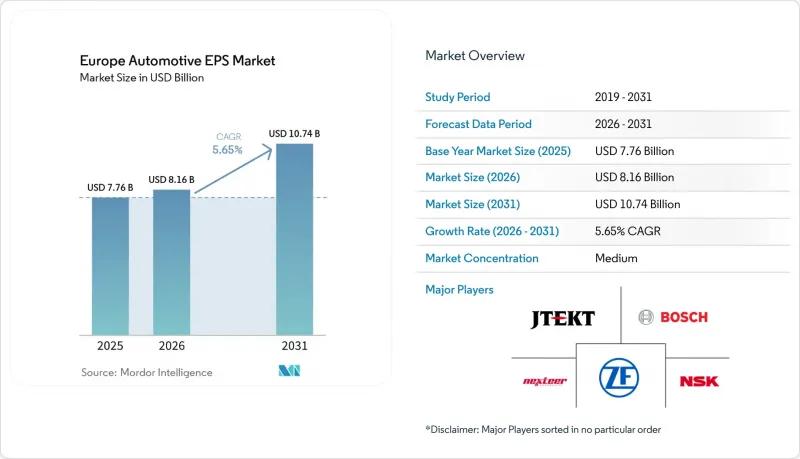
本報告按類型(柱式、齒輪式等)、零件(轉向齒條/轉向柱、感測器等)、車輛類型(乘用車、商用車)、驅動系統(內燃機車輛、混合動力汽車等)和國家(德國、英國等)進行分類。市場預測以貨幣價值(美元)和銷售(輛)兩種形式呈現。
歐洲汽車EPS市場的趨勢與洞察
ADAS(進階駕駛輔助系統)的擴展
在歐洲,高級駕駛輔助系統 (ADAS) 是汽車電動方向盤需求的主要來源。車道維持輔助、行人避讓和交通堵塞輔助等功能需要精確的轉向修正和電子回饋。液壓轉向系統無法提供同等的封閉回路型控制能力。歐盟法規 (EU) 2019/2144 強制要求新車型配備某些安全系統,推動了支援這些功能的轉向系統架構的研發。歐洲新車安全評估協會 (Euro NCAP) 的 2026 年協議更加重視自動干預功能,車輛評估重點關注「安全駕駛」、「碰撞避免」、「碰撞保護」和「碰撞後安全性」。因此,製造商正在將支援 ADAS 的轉向系統擴展到量產車型,這使得能夠實現封閉回路型轉向控制的系統更具優勢。
乘用車和商用車電氣化進展
向電動動力傳動系統的轉型為歐洲電動方向盤市場創造了穩固的需求基礎。 2026年上半年,電池式電動車註冊量年增35%,佔歐洲新車註冊總量的22%。電動卡車和巴士需要比乘用車更高扭力的轉向系統。由於液壓轉向系統在這些應用中仍然普遍,電動方向盤的應用仍處於起步階段。因此,預計商用車將在預測期的下半年做出更大的貢獻。
與液壓和電液系統相比,系統成本更高。
在扭力水準相當的情況下,電動方向盤的零件成本高於液壓轉向系統。這種成本差異可能會擠壓經濟型車輛的利潤空間,並可能減緩部分商用車轉型為電氣化的步伐。小型、價格敏感型平台在南歐和東歐市場尤其重要。一些製造商在初始成本較低的情況下,仍然選擇使用電液系統,因為其較低的初始成本超過了全電動系統的營運優勢。此外,在大型商用車中,由於電動轉向系統的扭力容量歷來有限,電液轉向系統仍被廣泛應用。採埃孚(ZF)累積生產1億套電動方向盤系統,充分證明了產量在降低單位成本的重要作用。然而,在ADAS層級的系統中,冗餘感測器和雙通道執行器的存在仍然推高了成本。
細分市場分析
截至2025年,柱式電動方向盤將佔60.15%的市場。這一地位主要歸功於其適用於前輪驅動車輛的佈局,以及其低成本和易於整合到量產車型中的優勢。這些因素在歐洲乘用車市場依然十分重要,因為轉向系統在歐洲已被廣泛採用。齒輪式轉向系統則適用於柱式佈局不適用的中等扭力應用場景,例如大型乘用車和輕型商用車。在歐洲電動方向盤市場,當車輛佈局和扭力需求需要時,這種架構仍然備受青睞,尤其是在製造商優先考慮易於安裝的佈局、簡易的組裝和成本控制等因素時。
雙小齒輪預計在2026年至2031年間將以9.48%的複合年成長率成長。該系統提供主轉向扭矩和冗餘轉向扭矩,支援符合ASIL-D標準的系統以及更高等級的車輛自動化。積極推動自動化專案的製造商正擴大在未來的平台開發中採用冗餘轉向設計。 UNECE R79標準對更高自動化等級的要求進一步凸顯了即使在發生故障時也能運作的轉向系統的重要性。 ZF為賓士量產的線控轉向系統展現了歐洲高階轉向系統投資的方向。蒂森克虜伯普雷斯塔也正在為下一代冗餘系統開發電子機械轉向執行器和轉向柱組件。
到2025年,轉向齒條/轉向柱組件將佔40.33%。這一比例反映了每個電動方向盤單元中機械致動器組件的成本佔比。隨著無刷永磁電機取代傳統的有刷電機,方向盤馬達電機的種類也日益豐富。這些馬達具有更低的噪音和更高的扭矩密度。此外,對稀土元素磁體的依賴性也不斷提高。其餘組件類別包括電控系統和線束。
在歐洲電動方向盤市場,感測器市場預計將在2026年至2031年間以8.12%的複合年成長率成長。扭力、角度和路面狀況偵測正從單軸測量轉向多軸資料集,以支援轉向控制和進階駕駛輔助系統(ADAS)功能。耐世特(Nexteer)的MotionIQ平台利用感測器資訊進行路面偵測和切換偵測。這提升了感測器和軟體組合在安全關鍵型應用中的價值。擁有ISO 26262認證的感測器融合軟體的供應商受硬體商品化的影響較小。即使由於大規模生產導致單一感測器的價格下降,隨著冗餘需求的成長,每輛車的感測器數量也可能會增加。
其他好處:
- Excel格式的市場預測(ME)表
- 3個月的分析師支持
目錄
第1章:引言
- 研究假設和市場定義
- 調查範圍
第2章:調查方法
第3章執行摘要
第4章 市場狀況
- 市場概覽
- 市場促進因素
- ADAS(進階駕駛輔助系統)的廣泛應用
- 乘用車和商用車電氣化進展
- 歐洲加強車輛安全和排放氣體法規
- 軟體定義轉向能力的需求日益成長
- 轉向系統與車輛運動控制架構的整合
- 擴大線控轉向架構的應用
- 市場限制因素
- 與液壓和電液系統相比,此系統成本較高。
- 半導體、感測器和稀土元素元件的供應風險
- 功能安全和網路安全檢驗的複雜性
- 電子元件或馬達故障後維修的可能性低,更換成本高。
- 價值供應鏈分析
- 監理情勢
- 技術展望
- 波特五力分析
第5章 市場規模與成長預測
- 按類型
- 列類型
- 小齒輪類型
- 雙小齒輪
- 依組件類型
- 轉向齒條/轉向柱
- 感應器
- 方向盤馬達
- 其他回應類型
- 車輛類型
- 搭乘用車
- 商用車輛
- 依推進類型
- 內燃機車
- 混合動力汽車
- 電池式電動車
- 國家
- 德國
- 英國
- 法國
- 義大利
- 俄羅斯
- 其他歐洲國家
第6章 競爭情勢
- 市場集中度
- 策略趨勢
- 市佔率分析
- 公司簡介
- JTEKT Corporation
- Robert Bosch GmbH
- Nexteer Automotive
- ZF Friedrichshafen AG
- Denso Corporation
- NSK Ltd.
- Hyundai Mobis Co. Ltd.
- Thyssenkrupp Presta AG
- Continental AG
- Knorr-Bremse AG
- HL Mando Corporation
- Mitsubishi Electric Corporation
- Astemo Ltd.
第7章 市場機會與未來展望
According to Mordor Intelligence, the European electric power steering market size was valued at USD 7.76 billion in 2025 and is estimated to grow from USD 8.16 billion in 2026 to reach USD 10.74 billion by 2031, at a CAGR of 5.65% during the forecast period (2026-2031).
This report is Segmented by Type (Column Type, Pinion Type, and More), Component Type (Steering Rack/Column, Sensor, and More), Vehicle Type (Passenger Cars, Commercial Vehicles), Propulsion Type (Internal Combustion Engine Vehicles, Hybrid Vehicles, and More), and Country (Germany, United Kingdom, and More). The Market Forecasts are Provided in Terms of Value (USD) and Volume (Units).
Europe Automotive EPS Market Trends and Insights
Rising Adoption of Advanced Driver-Assistance Systems
Advanced driver-assistance systems are a major source of demand for automotive electric power steering in Europe. Lane-keeping assist, pedestrian avoidance, and traffic-jam assist require precise steering corrections and electronic feedback. Hydraulic steering does not provide the same closed-loop control capability. Regulation (EU) 2019/2144 requires specified safety systems for new vehicle types, which supports steering architectures compatible with these functions. Euro NCAP's 2026 protocol places vehicle assessment around Safe Driving, Crash Avoidance, Crash Protection, and Post-Crash Safety, with greater attention to automated interventions . Manufacturers are therefore extending ADAS-ready steering to more mid-volume platforms, which favors systems capable of managing closed-loop steering control.
Increasing Electrification of Passenger and Commercial Vehicles
The move to electric powertrains provides a firm demand base for the European electric power steering market. In the first half of 2026, battery electric vehicle registrations grew 35% year over year and accounted for 22% of new vehicle registrations across Europe . Electric trucks and buses require higher-torque steering systems than passenger vehicles. Their adoption of electric power steering is still in its early stages because hydraulic steering remains common in those applications. This leaves commercial vehicles positioned to contribute more strongly during the later years of the forecast period.
High System Cost Compared With Hydraulic and Electrohydraulic Alternatives
Electric power steering has higher bill-of-materials costs than hydraulic steering at comparable torque levels. The difference can put pressure on margins for value-segment vehicles and delay conversion in some commercial vehicle lines. Smaller and price-sensitive platforms are particularly relevant in Southern and Eastern Europe. Some manufacturers retain electrohydraulic systems where a lower upfront cost outweighs the operating benefit of a fully electric system. Electrohydraulic steering also remains present in heavy commercial vehicles, where electric steering torque capacity was historically limited. ZF's production of 100 million electric power steering systems illustrates the role of volume in reducing unit costs. However, redundant sensors and dual-channel actuators preserve a cost premium for ADAS-grade systems.
Other drivers and restraints analyzed in the detailed report include:
- Stricter European Vehicle Safety and Emissions Requirements
- Growing Demand for Software-Defined Steering Functions
- Semiconductor, Sensor, and Rare-Earth Component Supply Exposure
For complete list of drivers and restraints, kindly check the Table Of Contents.
Segment Analysis
Column-type electric power steering held 60.15% in 2025. Its position reflects its fit with front-wheel-drive vehicle packaging and its lower cost and simpler integration for high-volume models. These factors remain relevant for European passenger vehicles where steering fitment is already widespread. Pinion-type systems serve mid-torque uses where column packaging is less suitable. They are used in larger passenger vehicles and light commercial applications. The European electric power steering market continues to support this architecture where vehicle layout and torque requirements call for it, particularly when manufacturers prioritize familiar packaging, simpler assembly, and cost control on high-volume vehicle programs.
The dual-pinion type is forecast to grow at a 9.48% CAGR from 2026 to 2031. It can provide primary and redundant steering torque, which supports ASIL-D-rated systems and higher levels of vehicle automation. Manufacturers with active automation programs are allocating future platform work to redundant steering designs. UNECE R79 requirements for higher automation levels make fail-operational steering more important. ZF's series-production steer-by-wire system for Mercedes-Benz shows the direction of premium steering investment in Europe. Thyssenkrupp Presta is also developing electromechanical steering actuators and column assemblies for next-generation redundant systems.
Steering Rack/Column components held 40.33% in 2025. Their share reflects the cost weight of the mechanical actuator assembly in each electric power steering unit. Steering motors are becoming more differentiated as brushless permanent-magnet designs replace earlier brushed designs. These motors offer lower noise and greater torque density. They also increase exposure to the rare-earth magnet supply. Electronic control units and wiring harnesses make up the remaining component categories.
Sensors are forecast to grow at an 8.12% CAGR from 2026 to 2031 within the European electric power steering market. Torque, angle, and road-surface sensing are moving from single measurements to multi-axis data sets that support both steering control and ADAS functions. Nexteer's MotionIQ platform uses sensor information for Road Surface Detection and Hands-Off Detection. This makes the sensor-software combination more valuable in safety-rated applications. Suppliers with sensor-fusion software certified to ISO 26262 can be less exposed to hardware commoditization. The number of sensors per unit can rise as redundancy requirements increase, even if individual sensor prices decline with volume.
Complete Report Scope:
- By Type
- Column Type
- Pinion Type
- Dual Pinion Type
- By Component Type
- Steering Rack/Column
- Sensor
- Steering Motor
- Other Component Types
- By Vehicle Type
- Passenger Cars
- Commercial Vehicles
- By Propulsion Type
- Internal Combustion Engine Vehicles
- Hybrid Vehicles
- Battery Electric Vehicles
- By Country
- Germany
- United Kingdom
- France
- Italy
- Russia
- Rest of Europe
List of Companies Covered in this Report:
- JTEKT Corporation
- Robert Bosch GmbH
- Nexteer Automotive
- ZF Friedrichshafen AG
- Denso Corporation
- NSK Ltd.
- Hyundai Mobis Co. Ltd.
- Thyssenkrupp Presta AG
- Continental AG
- Knorr-Bremse AG
- HL Mando Corporation
- Mitsubishi Electric Corporation
- Astemo Ltd.
Additional Benefits:
- The market estimate (ME) sheet in Excel format
- 3 months of analyst support
TABLE OF CONTENTS
1 Introduction
- 1.1 Study Assumptions and Market Definition
- 1.2 Scope of the Study
2 Research Methodology
3 Executive Summary
4 Market Landscape
- 4.1 Market Overview
- 4.2 Market Drivers
- 4.2.1 Rising Adoption of Advanced Driver-Assistance Systems
- 4.2.2 Increasing Electrification of Passenger and Commercial Vehicles
- 4.2.3 Stricter European Vehicle Safety and Emissions Requirements
- 4.2.4 Growing Demand for Software-Defined Steering Functions
- 4.2.5 Integration of Steering Systems With Vehicle Motion-Control Architectures
- 4.2.6 Increasing Deployment of Steer-by-Wire-Ready Architectures
- 4.3 Market Restraints
- 4.3.1 High System Cost Compared With Hydraulic and Electrohydraulic Alternatives
- 4.3.2 Semiconductor, Sensor, and Rare-Earth Component Supply Exposure
- 4.3.3 Functional-Safety and Cybersecurity Validation Complexity
- 4.3.4 Limited Repairability and High Replacement Costs After Electronic or Motor Failures
- 4.4 Value / Supply-Chain Analysis
- 4.5 Regulatory Landscape
- 4.6 Technological Outlook
- 4.7 Porter's Five Forces Analysis
- 4.7.1 Threat of New Entrants
- 4.7.2 Bargaining Power of Buyers/Consumers
- 4.7.3 Bargaining Power of Suppliers
- 4.7.4 Threat of Substitute Products
- 4.7.5 Intensity of Competitive Rivalry
5 Market Size and Growth Forecasts (Value (USD) and Volume (Units))
- 5.1 By Type
- 5.1.1 Column Type
- 5.1.2 Pinion Type
- 5.1.3 Dual Pinion Type
- 5.2 By Component Type
- 5.2.1 Steering Rack/Column
- 5.2.2 Sensor
- 5.2.3 Steering Motor
- 5.2.4 Other Component Types
- 5.3 By Vehicle Type
- 5.3.1 Passenger Cars
- 5.3.2 Commercial Vehicles
- 5.4 By Propulsion Type
- 5.4.1 Internal Combustion Engine Vehicles
- 5.4.2 Hybrid Vehicles
- 5.4.3 Battery Electric Vehicles
- 5.5 By Country
- 5.5.1 Germany
- 5.5.2 United Kingdom
- 5.5.3 France
- 5.5.4 Italy
- 5.5.5 Russia
- 5.5.6 Rest of Europe
6 Competitive Landscape
- 6.1 Market Concentration
- 6.2 Strategic Moves
- 6.3 Market Share Analysis
- 6.4 Company Profiles (includes Global Level Overview, Market Level Overview, Core Segments, Financials as Available, Strategic Information, Market Rank/Share for Key Companies, Products and Services, SWOT Analysis, and Recent Developments)
- 6.4.1 JTEKT Corporation
- 6.4.2 Robert Bosch GmbH
- 6.4.3 Nexteer Automotive
- 6.4.4 ZF Friedrichshafen AG
- 6.4.5 Denso Corporation
- 6.4.6 NSK Ltd.
- 6.4.7 Hyundai Mobis Co. Ltd.
- 6.4.8 Thyssenkrupp Presta AG
- 6.4.9 Continental AG
- 6.4.10 Knorr-Bremse AG
- 6.4.11 HL Mando Corporation
- 6.4.12 Mitsubishi Electric Corporation
- 6.4.13 Astemo Ltd.
7 Market Opportunities and Future Outlook
- 7.1 White-space and Unmet-need Assessment

 電動方向盤:市場佔有率分析、產業趨勢與統計、成長預測(2026-2031)
 電動方向盤市場-全球市場預測(2026-2032年)中國汽車電動方向盤(EPS):市場佔有率分析、產業趨勢與統計及成長預測(2026-2031)中東和非洲(MEA)汽車產業每股收益:市場佔有率分析、產業趨勢和統計數據以及成長預測(2026-2031 年)
 電動方向盤系統市場預測至2034年-全球分析(依EPS類型、組件、驅動系統、電壓架構、自動化程度、應用與地區分類)
 電動方向盤市場分析與預測(至2035年):類型、產品類型、技術、組件、應用、功能、安裝方式、解決方案、模式汽車電動方向盤市場預測至2034年-全球分析(按轉向系統、組件、自動化程度、車輛類型、驅動系統、電壓架構、銷售管道和地區分類)
 電動方向盤市場規模、佔有率、趨勢和預測:按組件、機構、類型、車輛類型和地區分類,2026-2034年
 2026年全球電動方向盤市場報告
 汽車電動方向盤(EPS)系統市場:按類型、組件和地區分類