

 |
市場調查報告書
商品編碼
2113518
電動方向盤:市場佔有率分析、產業趨勢與統計、成長預測(2026-2031)Electric Power Steering - Market Share Analysis, Industry Trends & Statistics, Growth Forecasts (2026 - 2031) |
||||||

※ 本網頁內容可能與最新版本有所差異。詳細情況請與我們聯繫。
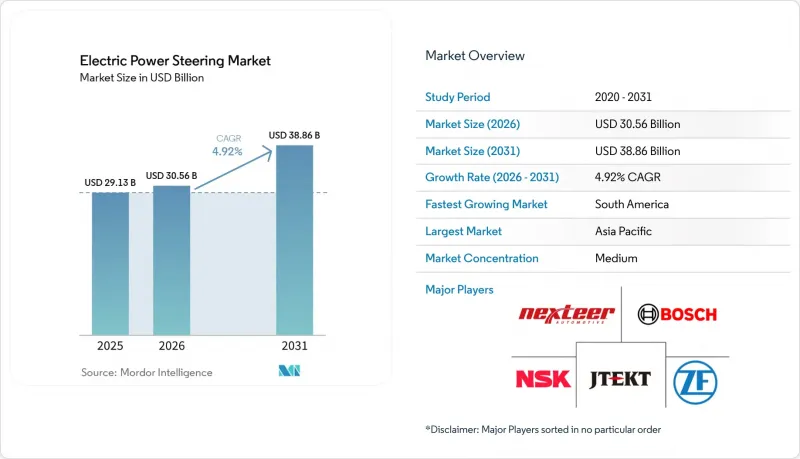
據 Mordor Intelligence 稱,2025 年電動方向盤市值為 291.3 億美元,預計到 2031 年將達到 388.6 億美元,而 2026 年為 305.6 億美元,預測期(2026-2031 年)的複合年成長率為 4.92%。
本報告按類型(柱式、齒輪式、雙齒輪式)、零件(轉向器/轉向柱、感測器、方向盤馬達等)、車輛類型(乘用車、商用車)、驅動系統(內燃機車輛、電池式電動車等)和地區進行細分。市場預測以價值(美元)和數量(輛)兩種形式呈現。
全球電動方向盤市場趨勢與洞察
汽車平臺快速電氣化
汽車電氣化從根本上改變了電動輔助轉向系統 (EPS) 的應用模式,消除了液壓系統固有的寄生損耗,從而降低了內燃機的輸出功率。電動車需要高能源效率的轉向解決方案,在商用車應用中,混合動力 EPS 系統與傳統的液壓動力方向盤系統相比,能耗降低了 50% 以上。隨著汽車製造商認知到 EPS 是整合再生煞車和最佳化電池續航里程的關鍵基礎設施,這一轉變正在加速。美國國家公路交通安全管理局 (NHTSA) 針對 2027-2031 年車型製定的企業平均燃油經濟性 (CAFE) 標準要求燃油經濟性每年提高 2%,這使得內燃機汽車採用 EPS 在經濟上勢在必行,同時也為電動車 (EV) 帶來了競爭優勢。這種監管壓力正在催生兩種市場趨勢:EPS 既是傳統汽車滿足監管要求的手段,也是電動平台提升性能的途徑。
對提高燃油效率和減少排放氣體的需求日益成長
燃油效率法規正推動電動輔助轉向系統 (EPS) 的普及,因為其能顯著降低油耗。美國國家研究委員會 (NRC) 的一項研究表明,以 EPS 取代液壓系統預計可使中型車輛的油耗降低 1.3%,重型車輛的油耗降低 1.1%。這種效率提昇在整個車隊中產生協同效應,使 EPS 成為面臨燃油成本上漲和碳定價的商用車營運商極具經濟吸引力的選擇。歐盟《通用安全條例 II》(General Safety Regulation II) 將於 2024 年 7 月生效,該條例強制要求採用與 EPS 系統無縫整合的先進安全技術,從而形成監管協同效應並加速 EPS 的普及。效率要求和安全標準的融合使 EPS 不再只是一項可選功能,而是一項基礎技術。車隊營運商越來越意識到,EPS 是一項基礎設施投資,它不僅能即時降低營運成本,還能同時為未來的自動駕駛功能奠定基礎。
低價車輛液壓系統價格比較
在價格敏感的細分市場,確保成本競爭力仍然是一項挑戰,因為儘管液壓系統的運作效率較低,但其經濟優勢仍然存在。印度汽車製造商正在採用不同的成本管理方法;塔塔汽車已在其Harrier電動車中實現了80%的零件在地採購,而像Ola Electric這樣的公司正在開發無磁電機,以避免依賴稀土元素材料。由於中國對稀土元素出口的限制給供應鏈帶來了壓力,印度正在考慮放寬其50%的在地採購要求,以維持電動車製造的可行性,這將進一步加劇成本差距。在大規模生產領域,現有液壓系統供應商在規模經濟方面具有優勢,導致市場兩極化:豪華車普遍採用電動輔助轉向系統(EPS),而經濟型車則對這種轉變持抵制態度。在商用車應用領域,挑戰更為嚴峻,因為初始資本成本直接影響車隊盈利,因此需要明確證明營運成本的降低才能證明高昂的採購價格是合理的。
細分市場分析
預計到2025年,柱式電動輔助轉向系統(EPS)將佔據53.65%的市場佔有率,這反映了其在主流汽車平臺上已確立的整合優勢和成本效益。然而,受自動駕駛應用對轉向精度要求不斷提高以及對更好轉向響應特性的需求驅動,雙小齒輪式轉向系統正成為成長最快的細分市場,預計到2031年將以11.07%的複合年成長率成長。小齒輪式轉向系統在成本和性能之間實現了良好的平衡,在中階應用領域中保持著穩定的市場佔有率。此細分市場的演變反映了製造商的策略定位,他們預見到未來出行需求的變化,在自動駕駛功能中,轉向精確度至關重要,而安全性又至關重要。
ZF在蔚來ET9車款上引進的線控轉向技術,展現了先進的架構如何協助打造全新方向盤設計並提升操控性能,尤其惠及電動車平台。柱式轉向系統在售後市場和對成本要求較高的細分市場仍保持優勢,而雙齒輪轉向系統則吸引著追求差異化駕駛體驗的高階製造商。技術進步預示著市場將出現兩極化:久經考驗的柱式轉向系統可靠性在量產市場佔據主導地位,而注重性能的應用領域則會轉向精度更高的雙齒輪轉向系統。
預計到2025年,轉向齒條/轉向柱組件將維持42.12%的市場佔有率,構成所有車型電動輔助轉向系統(EPS)的機械基礎。感測器組件預計將成長最快,到2031年複合年成長率(CAGR)將達到9.86%,這反映了高階駕駛輔助系統(ADAS)整合所需的回饋機制日益複雜。方向盤馬達作為關鍵驅動組件,將繼續保持穩定成長,而「其他組件類型」則包括網路安全模組和OTA(空中下載)更新功能等新興技術。組件配置的演進顯示市場已趨於成熟,正從單純的電氣化轉向智慧系統結構。
感測器的發展軌跡與監管要求相契合,這些要求旨在提升車輛安全系統的性能,而精準的回饋則能夠實現緊急轉向干預和車道維持輔助功能。 NSK 為線控轉向系統開發的力回饋致動器和車輪執行器,標誌著下一代轉向系統所需組件的日益精密化。傳統機械組件正面臨商品化的壓力,而電子組件則憑藉其先進的功能保持高價位,這重塑了供應商的價值提案和競爭格局。
區域分析
到2025年,亞太地區將佔電動方向盤市場46.35%的佔有率。中國垂直整合的電動車生態系統將國產馬達控制器、車輛組件和轉向裝置打包成具有成本競爭力的模組,供應國內和出口項目。蔚來汽車採用採埃孚的線控轉向系統,顯示中國已做好直接邁向先進架構的準備。同時,日本在高精度軸承和角度感測器領域保持主導,使當地供應商能夠向全球一級供應商銷售關鍵子組件。政府為實現碳中和而採取的獎勵正在加速需求成長,而區域產能則確保了零件的穩定供應。
歐洲市場日趨成熟,但同時也是受監管主導的產業。歐盟的《通用安全法規II》強制要求汽車製造商(OEM)整合車道維持和行人避讓功能,而這些功能依賴於電動輔助轉向系統(EPS)的精準性。由於實施日期固定,供應商可以享受穩定的規劃週期。預計在2020年代中期推出的網路安全法規將進一步提高進入門檻,並導致訂單訂單擁有專業軟體團隊的公司。
在北美,燃油效率法規備受關注。美國國家公路交通安全管理局 (NHTSA) 的 CAFE 標準要求乘用車車隊到 2031 年每年燃油效率提高 2%。以巴西為首的南美洲是成長最快的地區,預計到 2031 年複合年成長率將達到 8.94%。 2024 年電動車銷量激增 90%,顯示先前被抑制的需求已因進口電池模組免稅而釋放。此後,Stellantis 宣布投資 56 億歐元開發整合 EPS 的生物混合動力傳動系統,以實現雙燃料柔軟性。該地區的成長代表著超越液壓系統既得利益的技術飛躍。
其他好處:
- Excel格式的市場預測(ME)表
- 3個月的分析師支持
目錄
第1章:引言
- 研究假設和市場定義
- 調查範圍
第2章:調查方法
第3章執行摘要
第4章 市場狀況
- 市場概覽
- 市場促進因素
- 汽車平臺快速電氣化
- 對提高燃油效率和減少排放氣體的需求日益成長
- 引入高級駕駛輔助系統(ADAS)的法規要求
- 線控轉向研發領域的突破性進展
- 48V電動動力傳動系統模組的一級/二級供應商合作
- 透過OTA軟體進行轉向校準,實現大規模客製化
- 市場限制因素
- 與低價車輛的液壓系統相比,單位成本較高
- 新興市場缺乏轉向手感與安全隱患
- 馬達控制器用半導體的供應鏈波動
- 電子控制柱式馬達的網路安全風險
- 價值供應鏈分析
- 監理情勢
- 技術展望
- 波特五力模型
第5章 市場規模與成長預測
- 按類型
- 列類型
- 小齒輪類型
- 雙小齒輪
- 依組件類型
- 轉向齒條/轉向柱
- 感應器
- 方向盤馬達
- 其他回應類型
- 車輛類型
- 搭乘用車
- 商用車輛
- 依推進類型
- 內燃機車
- 混合動力汽車
- 電池式電動車
- 按地區
- 北美洲
- 美國
- 加拿大
- 其他北美國家
- 歐洲
- 德國
- 英國
- 法國
- 義大利
- 俄羅斯
- 其他歐洲國家
- 亞太地區
- 中國
- 日本
- 印度
- 韓國
- 其他亞太國家
- 中東和非洲
- 阿拉伯聯合大公國
- 沙烏地阿拉伯
- 土耳其
- 南非
- 埃及
- 其他中東和非洲國家
- 南美洲
- 巴西
- 阿根廷
- 其他南美國家
- 北美洲
第6章 競爭情勢
- 市場集中度
- 策略趨勢
- 市佔率分析
- 公司簡介
- JTEKT Corporation
- Robert Bosch GmbH
- Nexteer Automotive
- ZF Friedrichshafen AG
- Denso Corporation
- NSK Ltd.
- Hyundai Mobis Co. Ltd.
- Mitsubishi Electric Corporation
- Hitachi Astemo Ltd.
- Thyssenkrupp Presta AG
- Mando Corporation
- Continental AG
第7章 市場機會與未來展望
According to Mordor Intelligence, the electric power steering market size was valued at USD 29.13 billion in 2025 and estimated to grow from USD 30.56 billion in 2026 to reach USD 38.86 billion by 2031, at a CAGR of 4.92% during the forecast period (2026-2031).
This report is Segmented by Type (Column Type, Pinion Type, and Dual Pinion Type), Component Type (Steering Rack/Column, Sensor, Steering Motor, and More), Vehicle Type (Passenger Cars and Commercial Vehicles), Propulsion Type (Internal Combustion Engine Vehicles, Battery Electric Vehicles, and More), and Geography. The Market Forecasts are Provided in Terms of Value (USD) and Volume (Units).
Global Electric Power Steering Market Trends and Insights
Rapid Electrification of Vehicle Platforms
Vehicle electrification fundamentally reshapes EPS adoption patterns by eliminating the parasitic losses inherent in hydraulic systems that drain ICE engine power. Electric vehicles demand energy-efficient steering solutions, with hybrid EPS systems demonstrating over 50% energy consumption reduction compared to conventional hydraulic power steering in commercial vehicle applications. The transition accelerates as automakers recognize EPS as an essential infrastructure for regenerative braking integration and battery range optimization. NHTSA's Corporate Average Fuel Economy standards for model years 2027-2031 mandate 2% annual fuel efficiency improvements, making EPS adoption economically inevitable for ICE vehicles while providing competitive advantages for EVs. This regulatory pressure creates a dual-market dynamic where EPS becomes compliance-driven for traditional vehicles and performance-enhancing for electric platforms.
Increasing Demand for Fuel Efficiency and Emission Reduction
Fuel efficiency mandates drive EPS adoption through measurable consumption benefits, with National Research Council studies indicating 1.3% fuel reduction for midsize cars and 1.1% for large cars when replacing hydraulic systems. Efficiency gains compound across fleet operations, making EPS economically attractive for commercial vehicle operators facing rising fuel costs and carbon pricing mechanisms. European Union's General Safety Regulation II, effective July 2024, mandates advanced safety technologies that integrate seamlessly with EPS systems, creating regulatory synergies that accelerate adoption. The convergence of efficiency requirements and safety mandates EPS as a foundational technology rather than optional equipment. Fleet operators increasingly recognize EPS as an infrastructure investment that delivers immediate operational cost reductions while enabling future autonomous capabilities.
Higher Unit Cost vs. Hydraulic Systems in Low-Cost Cars
Cost competitiveness remains challenging in price-sensitive market segments where hydraulic systems maintain economic advantages despite operational inefficiencies. Indian automakers demonstrate varied approaches to cost management, with Tata Motors achieving 80% localization for Harrier EV components while companies like Ola Electric develop magnet-less motors to avoid rare-earth material dependencies. The cost differential becomes more pronounced as China's rare-earth export restrictions create supply chain pressures, with India considering the relaxation of 50% localization requirements to maintain EV manufacturing viability. Manufacturing scale economics favor established hydraulic system suppliers in volume segments, creating market bifurcation where premium vehicles adopt EPS while economy segments resist transition. The challenge intensifies in commercial vehicle applications where initial capital costs directly impact fleet profitability, requiring a clear operational savings demonstration to justify higher acquisition prices.
Other drivers and restraints analyzed in the detailed report include:
- Regulatory Mandates for ADAS Integration
- Steer-by-Wire R&D Breakthroughs
- Limited Steering Feel and Safety Concerns in Emerging Markets
For complete list of drivers and restraints, kindly check the Table Of Contents.
Segment Analysis
Column Type EPS systems commanded a 53.65% market share in 2025, reflecting their established integration advantages and cost-effectiveness for mainstream vehicle platforms. However, dual-pinion type configurations emerge as the fastest-growing segment at 11.07% CAGR through 2031, driven by precision requirements for autonomous driving applications and enhanced steering response characteristics. Pinion Type systems maintain a steady market presence in mid-range applications, offering balanced performance between cost and capability. The segment evolution reflects manufacturers' strategic positioning for future mobility requirements, where steering precision becomes critical for safety-critical autonomous functions.
ZF's steer-by-wire technology deployment in NIO's ET9 demonstrates how advanced architecture enables new steering wheel designs and improved maneuverability, particularly benefiting electric vehicle platforms. Column Type systems retain advantages in retrofit applications and cost-sensitive segments, while Dual Pinion configurations attract premium manufacturers seeking differentiated driving experiences. Technology progression suggests market bifurcation where volume segments prioritize proven Column Type reliability while performance-oriented applications migrate toward Dual Pinion precision capabilities.
Steering Rack/Column components maintained 42.12% market share in 2025, representing the mechanical foundation of EPS systems across all vehicle types. Sensor components accelerate fastest at 9.86% CAGR through 2031, reflecting the increasing sophistication of feedback mechanisms required for advanced driver assistance systems integration. Steering Motor segments provide consistent performance as the primary actuation component, while Other Component Types encompass emerging technologies like cybersecurity modules and OTA update capabilities. The component mix evolution indicates market maturation beyond basic electrification toward intelligent system architectures.
The sensor growth trajectory aligns with regulatory requirements for enhanced vehicle safety systems, where precise feedback enables emergency steering interventions and lane-keeping assistance functions. NSK's development of Force Feedback Actuators and Road Wheel Actuators for steer-by-wire applications exemplifies the component sophistication required for next-generation steering systems. Traditional mechanical components face commoditization pressure while electronic components command premium pricing through advanced functionality, reshaping supplier value propositions and competitive dynamics.
Complete Report Scope:
- By Type
- Column Type
- Pinion Type
- Dual Pinion Type
- By Component Type
- Steering Rack/Column
- Sensor
- Steering Motor
- Other Component Types
- By Vehicle Type
- Passenger Cars
- Commercial Vehicles
- By Propulsion Type
- Internal Combustion Engine Vehicles
- Hybrid Vehicles
- Battery Electric Vehicles
- By Geography
- North America
- United States
- Canada
- Rest of North America
- Europe
- Germany
- United Kingdom
- France
- Italy
- Russia
- Rest of Europe
- Asia-Pacific
- China
- Japan
- India
- South Korea
- Rest of Asia-Pacific
- Middle East and Africa
- United Arab Emirates
- Saudi Arabia
- Turkey
- South Africa
- Egypt
- Rest of Middle East and Africa
- South America
- Brazil
- Argentina
- Rest of South America
- North America
Geography Analysis
Asia-Pacific anchored 46.35% of the electric power steering market revenue in 2025. China's vertically integrated EV ecosystem packages domestic motor controllers, vehicle domains, and steering gears into cost-competitive modules serving local and export programs. NIO's adoption of steer-by-wire from ZF underscores China's readiness to leap directly into advanced architectures. Japan, meanwhile, protects leadership in high-precision bearings and angle sensors, enabling local suppliers to sell critical sub-assemblies to global Tier-1s. Government incentives for carbon neutrality accelerate demand, and regional capacity ensures component availability.
Europe represents a mature but regulation-driven arena. The EU General Safety Regulation II forces OEMs to fit lane-keeping and pedestrian-avoidance functions that rely on EPS precision. Suppliers gain from stable planning cycles as implementation dates are locked. Mid-decade cybersecurity rules further elevate barriers, consolidating volume among companies with dedicated software teams.
North America focuses on efficiency mandates. NHTSA's CAFE standards impose 2% annual gains for passenger fleets through 2031. South America, led by Brazil, is the fastest-expanding region with a 8.94% CAGR through 2031. A 90% spike in EV sales in 2024 demonstrated pent-up demand once taxes were waived for imported battery modules. Stellantis followed with a EUR 5.6 billion commitment to develop Bio-Hybrid powertrains that integrate EPS for dual-fuel flexibility. The region's growth illustrates tech leapfrogging, bypassing hydraulic incumbency.
- JTEKT Corporation
- Robert Bosch GmbH
- Nexteer Automotive
- ZF Friedrichshafen AG
- Denso Corporation
- NSK Ltd.
- Hyundai Mobis Co. Ltd.
- Mitsubishi Electric Corporation
- Hitachi Astemo Ltd.
- Thyssenkrupp Presta AG
- Mando Corporation
- Continental AG
Additional Benefits:
- The market estimate (ME) sheet in Excel format
- 3 months of analyst support
TABLE OF CONTENTS
1 Introduction
- 1.1 Study Assumptions and Market Definition
- 1.2 Scope of the Study
2 Research Methodology
3 Executive Summary
4 Market Landscape
- 4.1 Market Overview
- 4.2 Market Drivers
- 4.2.1 Rapid electrification of vehicle platforms
- 4.2.2 Increasing demand for fuel efficiency and emission reduction
- 4.2.3 Regulatory mandates for ADAS integration
- 4.2.4 Steer-by-wire RandD breakthroughs
- 4.2.5 Tier-1/2 collaboration on 48-V e-Powertrain modules
- 4.2.6 OTA software steering calibration for mass customisation
- 4.3 Market Restraints
- 4.3.1 Higher unit cost vs. hydraulic systems in low-cost cars
- 4.3.2 Limited steering feel and safety concerns in emerging markets
- 4.3.3 Semiconductor supply-chain volatility for motor controllers
- 4.3.4 Cyber-security risks in electronically actuated columns
- 4.4 Value / Supply-Chain Analysis
- 4.5 Regulatory Landscape
- 4.6 Technological Outlook
- 4.7 Porter's Five Forces
- 4.7.1 Threat of New Entrants
- 4.7.2 Bargaining Power of Buyers/Consumers
- 4.7.3 Bargaining Power of Suppliers
- 4.7.4 Threat of Substitute Products
- 4.7.5 Intensity of Competitive Rivalry
5 Market Size and Growth Forecasts (Value (USD) and Volume (Units))
- 5.1 By Type
- 5.1.1 Column Type
- 5.1.2 Pinion Type
- 5.1.3 Dual Pinion Type
- 5.2 By Component Type
- 5.2.1 Steering Rack/Column
- 5.2.2 Sensor
- 5.2.3 Steering Motor
- 5.2.4 Other Component Types
- 5.3 By Vehicle Type
- 5.3.1 Passenger Cars
- 5.3.2 Commercial Vehicles
- 5.4 By Propulsion Type
- 5.4.1 Internal Combustion Engine Vehicles
- 5.4.2 Hybrid Vehicles
- 5.4.3 Battery Electric Vehicles
- 5.5 By Geography
- 5.5.1 North America
- 5.5.1.1 United States
- 5.5.1.2 Canada
- 5.5.1.3 Rest of North America
- 5.5.2 Europe
- 5.5.2.1 Germany
- 5.5.2.2 United Kingdom
- 5.5.2.3 France
- 5.5.2.4 Italy
- 5.5.2.5 Russia
- 5.5.2.6 Rest of Europe
- 5.5.3 Asia-Pacific
- 5.5.3.1 China
- 5.5.3.2 Japan
- 5.5.3.3 India
- 5.5.3.4 South Korea
- 5.5.3.5 Rest of Asia-Pacific
- 5.5.4 Middle East and Africa
- 5.5.4.1 United Arab Emirates
- 5.5.4.2 Saudi Arabia
- 5.5.4.3 Turkey
- 5.5.4.4 South Africa
- 5.5.4.5 Egypt
- 5.5.4.6 Rest of Middle East and Africa
- 5.5.5 South America
- 5.5.5.1 Brazil
- 5.5.5.2 Argentina
- 5.5.5.3 Rest of South America
- 5.5.1 North America
6 Competitive Landscape
- 6.1 Market Concentration
- 6.2 Strategic Moves
- 6.3 Market Share Analysis
- 6.4 Company Profiles (Includes Global Level Overview, Market Level Overview, Core Segments, Financials as Available, Strategic Information, Market Rank/Share for Key Companies, Products and Services, SWOT Analysis, and Recent Developments)
- 6.4.1 JTEKT Corporation
- 6.4.2 Robert Bosch GmbH
- 6.4.3 Nexteer Automotive
- 6.4.4 ZF Friedrichshafen AG
- 6.4.5 Denso Corporation
- 6.4.6 NSK Ltd.
- 6.4.7 Hyundai Mobis Co. Ltd.
- 6.4.8 Mitsubishi Electric Corporation
- 6.4.9 Hitachi Astemo Ltd.
- 6.4.10 Thyssenkrupp Presta AG
- 6.4.11 Mando Corporation
- 6.4.12 Continental AG
7 Market Opportunities and Future Outlook
- 7.1 White-space and unmet-need assessment

 歐洲汽車產業每股收益:市場佔有率分析、行業趨勢和統計數據以及成長預測(2026-2031 年)
 電動方向盤市場-全球市場預測(2026-2032年)中國汽車電動方向盤(EPS):市場佔有率分析、產業趨勢與統計及成長預測(2026-2031)中東和非洲(MEA)汽車產業每股收益:市場佔有率分析、產業趨勢和統計數據以及成長預測(2026-2031 年)
 電動方向盤系統市場預測至2034年-全球分析(依EPS類型、組件、驅動系統、電壓架構、自動化程度、應用與地區分類)
 電動方向盤市場分析與預測(至2035年):類型、產品類型、技術、組件、應用、功能、安裝方式、解決方案、模式汽車電動方向盤市場預測至2034年-全球分析(按轉向系統、組件、自動化程度、車輛類型、驅動系統、電壓架構、銷售管道和地區分類)
 電動方向盤市場規模、佔有率、趨勢和預測:按組件、機構、類型、車輛類型和地區分類,2026-2034年
 2026年全球電動方向盤市場報告
 汽車電動方向盤(EPS)系統市場:按類型、組件和地區分類