


 |
市場調查報告書
商品編碼
2097062
中東和非洲(MEA)汽車產業每股收益:市場佔有率分析、產業趨勢和統計數據以及成長預測(2026-2031 年)MEA Automotive EPS - Market Share Analysis, Industry Trends & Statistics, Growth Forecasts (2026 - 2031) |
||||||

※ 本網頁內容可能與最新版本有所差異。詳細情況請與我們聯繫。
據 Mordor Intelligence 稱,中東和非洲 (MEA) 地區的汽車 EPS 市場預計將從 2025 年的 4.1 億美元和 2026 年的 4.4 億美元成長到 2031 年的 6.7 億美元,2026 年至 2031 年的年複合成長率(CAGR)為 8. 3%。
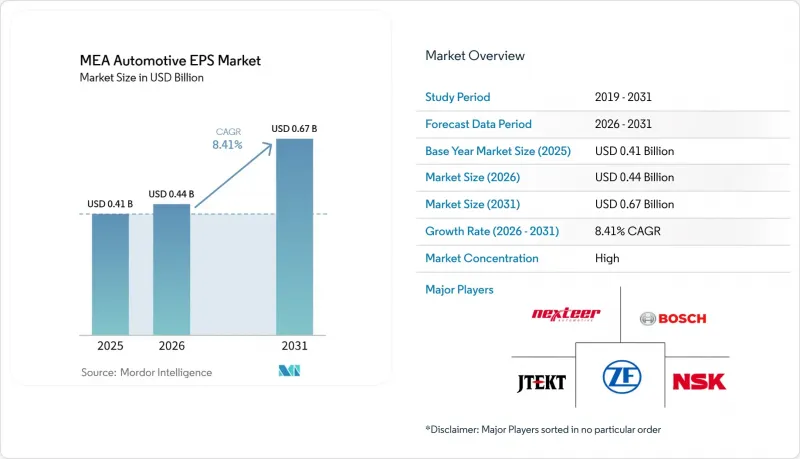
本報告按類型(柱式電動輔助轉向系統、齒條式電動輔助轉向系統等)、組件類型(方向盤和轉向柱、感測器等)、車輛類型(乘用車和商用車)以及國家/地區(阿拉伯聯合大公國、沙烏地阿拉伯等)進行細分。市場規模和預測以價值(美元)和數量(輛)兩種單位呈現。
中東和非洲(MEA)地區汽車EPS市場的趨勢和見解。
從液壓轉向系統過渡到電動方向盤(EPS),以提高燃油效率並減少二氧化碳排放。
電動幫浦系統 (EPS) 因其消除了液壓幫浦運作帶來的效率損失而日益普及。這在車隊需求量大的市場中至關重要,因為在這些市場中,燃油消耗、維護成本和生命週期成本都是購買決策前必須仔細考慮的因素。在海灣國家,公共車隊和大型業者的集中採購模式使得這些成本合理性顯得格外重要。此外,隨著許多買家將電動液壓系統視為臨時折衷方案而非永久解決方案,淘汰電動液壓系統的趨勢正在加速。也因為如此,中東和非洲地區的汽車電動幫浦系統市場轉型速度遠遠超過簡單的更換週期。
ADAS在乘用車和輕型商用車中的滲透率不斷提高。
由於沿岸地區對高級駕駛輔助系統 (ADAS) 的要求,電動輔助轉向系統 (EPS) 已成為新車平台的實際標準配備。液壓轉向系統並不適用於依賴電子控制轉向反應的車道維持輔助和自動煞車功能。因此,汽車製造商 (OEM) 必須在法規實施日期之前儘早確定 EPS 的規格。車隊採購也是一個重要因素,因為參與大規模物流和運輸專案的買家擴大要求車輛在訂購階段就具備 ADAS 相容性。因此,中東和非洲 (MEA) 地區的汽車 EPS 市場正受到法規和採購因素的雙重驅動。
與傳統轉向架構相比,初始系統成本較高
在富裕的海灣國家以外的市場,高昂的系統成本仍然是一大障礙。在許多非洲國家,汽車市場仍然依賴進口二手車,這減緩了配備最新電動輔助轉向系統(EPS)的新車型的市場佔有率成長。此外,外匯壓力也是一個重要因素,因為該地區的大部分EPS模組仍依賴進口。這增加了接收成本,使得本地買家對初始成本更加敏感。鑑於這些原因,在中東和非洲地區的汽車EPS市場,低成本的中國製造配置在價格最敏感的細分市場可能更具優勢。
細分市場分析
到2025年,柱式電動輔助轉向系統(EPS)將佔據中東和非洲地區汽車EPS市場51.53%的佔有率。這項領先優勢反映了沙烏地阿拉伯、阿拉伯聯合大公國和埃及等國大量進口大眾市場乘用車的強勁需求。這種類型的系統非常適合緊湊的佈局、成本控制以及與最新駕駛輔助功能所需的電子相容性。對於即將進入該地區的量產車型項目而言,它仍然是一種熟悉且實用的配置。因此,柱式系統將繼續在中東和非洲地區汽車EPS市場的當前需求結構中佔據核心地位。
此類別中成長最快的細分市場是齒輪式電動輔助轉向系統(EPS),預計到2031年將以10.47%的複合年成長率成長。這反映了新型汽車平臺的日益普及,這些平台需要兼顧效率、反應性和空間佈局柔軟性。中國汽車製造商(OEM)在這方面發揮關鍵作用,因為他們的許多新型電動車和中型車型已經採用了齒輪式轉向佈局。海灣市場SUV比例的不斷上升也是推動這一轉變的因素,因為消費者越來越希望獲得更精準的轉向響應,而無需升級到高階的齒輪齒條式轉向系統。未來,這可能會提高齒輪式轉向系統的市場佔有率,但它不會立即取代柱式轉向系統的核心地位。
截至2025年,方向盤和轉向柱總成佔了40.49%的市場。這一主導地位源於它們在所有電動輔助轉向系統(EPS)架構中的核心作用,無論驅動方式或車輛類型如何。目前該地區的市場應用仍嚴重偏向轉向柱輔助系統,這自然支撐了對該組件的需求。此外,這些總成對於汽車製造商(OEM)在轉向系統方案中的成本、封裝和整合決策至關重要。因此,它們與中東和非洲地區(MEA)整體汽車EPS市場的量產密切相關。
預計到2031年,感測器將以9.98%的複合年成長率(CAGR)實現最高成長。原因很簡單:最新的電動輔助轉向系統(EPS)需要越來越高的扭力、角度和位置偵測精度,才能與高階駕駛輔助系統(ADAS)和基於軟體的控制邏輯協同工作。隨著轉向系統電子化程度的提高,價值創造正從純機械層轉向感測和控制層。這對於那些面向配備車道維持輔助、自動煞車和連網軟體功能的車輛的供應商而言尤其重要。事實上,中東和非洲地區汽車EPS市場成長最快的領域正從基礎結構組件轉向配備豐富感測器的轉向平台。
其他好處:
- Excel格式的市場預測(ME)表
- 3個月的分析師支持
目錄
第1章:引言
- 研究假設和市場定義
- 調查範圍
第2章:調查方法
第3章執行摘要
第4章 市場狀況
- 市場概覽
- 市場促進因素
- 從液壓轉向系統過渡到電動方向盤,以提高燃油效率並減少二氧化碳排放。
- ADAS在乘用車和輕型商用車中的滲透率不斷提高。
- 電動汽車和混合動力汽車平台的發展
- 針對惡劣路況、高溫環境和混合式車輛工況,採用軟體定義轉向校準。
- 透過減少維護和提高能源效率來降低車輛總擁有成本。
- OEM平臺本地化和新型車輛架構的電氣化
- 抑制因子
- 與傳統轉向架構相比,初始系統成本較高
- 電子設備在行駛過程中容易受到高溫、灰塵、電壓波動和衝擊的影響。
- 中東和非洲部分地區缺乏售後調整、診斷和維修能力。
- 在價格敏感型市場中,轉向手感的接受度較低。
- 價值鏈分析
- 監理情勢
- 技術展望
- 波特五力分析
第5章 市場規模與成長預測
- 按類型
- 列“EPS”
- 機架 EPS
- Pinion EPS
- 依組件類型
- 方向盤和轉向柱
- 感應器
- 電控系統
- 馬達和執行器模組
- 齒輪齒條組件
- 其他回應類型
- 車輛類型
- 搭乘用車
- 商用車輛
- 依推進類型
- 內燃機車
- 混合動力汽車
- 電池式電動車
- 國家
- 阿拉伯聯合大公國
- 沙烏地阿拉伯
- 伊朗
- 埃及
- 南非
- 奈及利亞
- 摩洛哥
- 其他中東和非洲國家
第6章 競爭情勢
- 市場集中度
- 策略趨勢
- 市佔率分析
- 公司簡介
- Robert Bosch GmbH
- JTEKT Corporation
- ZF Friedrichshafen AG
- Nexteer Automotive
- NSK Ltd.
- Mando Corporation
- Hitachi Astemo, Ltd.
- Denso Corporation
- Hyundai Mobis Co., Ltd.
- Mitsubishi Electric Corporation
- Thyssenkrupp AG
- Valeo SE
- Continental AG
- Nidec Corporation
- Magna International Inc.
- Schaeffler AG
- Aptiv PLC
- BorgWarner Inc.
第7章 市場機會與未來展望
According to Mordor Intelligence, the MEA automotive EPS market size is projected to expand from USD 0.41 billion in 2025 and USD 0.44 billion in 2026, reaching USD 0.67 billion by 2031, registering a CAGR of 8.41% between 2026 and 2031.
This report is Segmented Based On Type (Column EPS, Rack EPS, and More), Component Type (Steering Wheel and Column, Sensors, and More), Vehicle Type (Passenger Cars and Commercial Vehicles), and by Country (United Arab Emirates, Saudi Arabia, and More). Market Size and Forecasts are Provided in Value (USD) and Volume (Units).
MEA Automotive EPS Market Trends and Insights
Shift From Hydraulic Steering to Electric Power Steering for Fuel Efficiency and Lower CO2 Emissions
EPS is gaining ground because it removes the efficiency loss that comes with hydraulic pump operation. That matters in fleet-heavy markets where fuel use, maintenance, and lifecycle cost are reviewed closely before purchase decisions are made. In the Gulf, centralized buying by public fleets and large operators makes that cost logic even more influential. It is also speeding up the move away from electro-hydraulic systems, which many buyers now see as a short-lived compromise rather than a lasting solution. This is why the MEA automotive EPS market is moving through the transition faster than a simple replacement cycle would suggest.
Rising ADAS Penetration in Passenger Cars and Light Commercial Vehicles
ADAS requirements in the Gulf are making EPS a practical necessity for new vehicle platforms. Hydraulic steering does not align well with lane support and automated braking functions that depend on electronic steering response. This is pushing OEMs to lock in EPS specifications well before enforcement dates arrive. Fleet procurement also plays a role because buyers linked to large logistics and transport programs are increasingly asking for ADAS-ready vehicles at the order stage. As a result, the MEA automotive EPS market is being pulled forward by regulation and procurement at the same time.
Higher Upfront System Cost Versus Conventional Steering Architectures
Higher system cost remains a real barrier outside the richer Gulf markets. In many African countries, the vehicle base is still shaped by used imports, which slows the share of new models carrying modern EPS setups. Currency pressure adds another problem because most EPS modules are still imported into the region. That raises landed costs and makes local buyers more sensitive to upfront pricing. This is likely to leave lower-cost Chinese configurations in a stronger position in the most price-sensitive parts of the MEA automotive EPS market.
Other drivers and restraints analyzed in the detailed report include:
- Growth of EV and Hybrid Vehicle Platforms
- Software-Defined Steering Calibration for Harsh Roads, High Heat, and Mixed Vehicle Duty Cycles
- Vulnerability of Electronics to Heat, Dust, Voltage Variability, and Road Shock
For complete list of drivers and restraints, kindly check the Table Of Contents.
Segment Analysis
Column EPS held 51.53% of the MEA automotive EPS market share in 2025. Its lead reflects the strong presence of imported mass-market passenger cars across Saudi Arabia, the UAE, and Egypt. This type fits well with compact packaging needs, cost control, and the electronic compatibility needed for modern driver support features. It also remains a familiar and practical configuration for high-volume vehicle programs entering the region. For that reason, column systems continue to anchor the present demand structure of the MEA automotive EPS market.
The fastest growth within this category is expected from pinion EPS, which is projected to expand at a 10.47% CAGR through 2031. This reflects the rising presence of newer vehicle platforms that need a balance between efficiency, responsiveness, and packaging flexibility. Chinese OEMs are important here because many of their newer electric and mid-segment models already use pinion-oriented steering layouts. The growing SUV mix in Gulf markets also supports this shift because buyers increasingly expect a more refined steering response without moving into premium rack-based systems. Over time, this should allow pinion systems to build share without immediately displacing column systems from their core role.
Steering wheel and column assemblies held 40.49% of the market in 2025. Their lead stems from their central role in every EPS architecture, regardless of propulsion type or vehicle class. The current installed base in the region still leans heavily toward column-assist systems, and that naturally supports demand for this component group. These assemblies also sit at the center of cost, packaging, and integration decisions for OEM steering programs. That keeps them closely tied to volume production across the MEA automotive EPS market.
Sensors are projected to record the fastest CAGR of 9.98% through 2031. The reason is straightforward because modern EPS systems need increasingly accurate torque, angle, and position sensing to work with ADAS and software-based control logic. As steering systems become more electronic, value creation shifts toward the sensing and control layer rather than only the mechanical layer. This is especially relevant for suppliers targeting vehicles with lane support, automated braking, and connected software functions. In practical terms, the fastest-growing opportunity inside the MEA automotive EPS market is moving toward sensor-rich steering platforms rather than basic structural assemblies.
Complete Report Scope:
- By Type
- Column EPS
- Rack EPS
- Pinion EPS
- By Component Type
- Steering Wheel and Column
- Sensors
- Electronic Control Unit
- Motor and Actuation Module
- Rack and Pinion Assembly
- Other Component Type
- By Vehicle Type
- Passenger Cars
- Commercial Vehicles
- By Propulsion Type
- Internal Combustion Engine (ICE) Vehicles
- Hybrid Vehicles
- Battery Electric Vehicles
- By Country
- United Arab Emirates
- Saudi Arabia
- Iran
- Egypt
- South Africa
- Nigeria
- Morocco
- Rest of the Middle East and Africa
List of Companies Covered in this Report:
- Robert Bosch GmbH
- JTEKT Corporation
- ZF Friedrichshafen AG
- Nexteer Automotive
- NSK Ltd.
- Mando Corporation
- Hitachi Astemo, Ltd.
- Denso Corporation
- Hyundai Mobis Co., Ltd.
- Mitsubishi Electric Corporation
- Thyssenkrupp AG
- Valeo SE
- Continental AG
- Nidec Corporation
- Magna International Inc.
- Schaeffler AG
- Aptiv PLC
- BorgWarner Inc.
Additional Benefits:
- The market estimate (ME) sheet in Excel format
- 3 months of analyst support
TABLE OF CONTENTS
1 Introduction
- 1.1 Study Assumptions and Market Definition
- 1.2 Scope of the Study
2 Research Methodology
3 Executive Summary
4 Market Landscape
- 4.1 Market Overview
- 4.2 Market Drivers
- 4.2.1 Shift From Hydraulic Steering to Electric Power Steering for Fuel Efficiency and Lower CO2 Emissions
- 4.2.2 Rising ADAS Penetration in Passenger Cars and Light Commercial Vehicles
- 4.2.3 Growth of EV and Hybrid Vehicle Platforms
- 4.2.4 Software-Defined Steering Calibration for Harsh Roads, High Heat, and Mixed Vehicle Duty Cycles
- 4.2.5 Lower Fleet Total Cost of Ownership Through Reduced Maintenance and Better Energy Efficiency
- 4.2.6 OEM Platform Localization and Electrification of New Vehicle Architectures
- 4.3 Restraints
- 4.3.1 Higher Upfront System Cost Versus Conventional Steering Architectures
- 4.3.2 Vulnerability of Electronics to Heat, Dust, Voltage Variability, and Road Shock
- 4.3.3 Weak Aftermarket Calibration, Diagnostics, and Repair Capability in Parts of MEA
- 4.3.4 Limited Steering Feel Acceptance in Price-Sensitive Segments
- 4.4 Value Chain Analysis
- 4.5 Regulatory Landscape
- 4.6 Technological Outlook
- 4.7 Porter's Five Forces Analysis
- 4.7.1 Threat of New Entrants
- 4.7.2 Bargaining Power of Buyers
- 4.7.3 Bargaining Power of Suppliers
- 4.7.4 Threat of Substitutes
- 4.7.5 Competitive Rivalry
5 Market Size and Growth Forecasts (Value (USD) and Volume (Units))
- 5.1 By Type
- 5.1.1 Column EPS
- 5.1.2 Rack EPS
- 5.1.3 Pinion EPS
- 5.2 By Component Type
- 5.2.1 Steering Wheel and Column
- 5.2.2 Sensors
- 5.2.3 Electronic Control Unit
- 5.2.4 Motor and Actuation Module
- 5.2.5 Rack and Pinion Assembly
- 5.2.6 Other Component Type
- 5.3 By Vehicle Type
- 5.3.1 Passenger Cars
- 5.3.2 Commercial Vehicles
- 5.4 By Propulsion Type
- 5.4.1 Internal Combustion Engine (ICE) Vehicles
- 5.4.2 Hybrid Vehicles
- 5.4.3 Battery Electric Vehicles
- 5.5 By Country
- 5.5.1 United Arab Emirates
- 5.5.2 Saudi Arabia
- 5.5.3 Iran
- 5.5.4 Egypt
- 5.5.5 South Africa
- 5.5.6 Nigeria
- 5.5.7 Morocco
- 5.5.8 Rest of the Middle East and Africa
6 Competitive Landscape
- 6.1 Market Concentration
- 6.2 Strategic Moves
- 6.3 Market Share Analysis
- 6.4 Company Profiles (Includes Global level Overview, Market level overview, Core Segments, Financials as available, Strategic Information, Market Rank/Share for key companies, Products and Services, and Recent Developments)
- 6.4.1 Robert Bosch GmbH
- 6.4.2 JTEKT Corporation
- 6.4.3 ZF Friedrichshafen AG
- 6.4.4 Nexteer Automotive
- 6.4.5 NSK Ltd.
- 6.4.6 Mando Corporation
- 6.4.7 Hitachi Astemo, Ltd.
- 6.4.8 Denso Corporation
- 6.4.9 Hyundai Mobis Co., Ltd.
- 6.4.10 Mitsubishi Electric Corporation
- 6.4.11 Thyssenkrupp AG
- 6.4.12 Valeo SE
- 6.4.13 Continental AG
- 6.4.14 Nidec Corporation
- 6.4.15 Magna International Inc.
- 6.4.16 Schaeffler AG
- 6.4.17 Aptiv PLC
- 6.4.18 BorgWarner Inc.
7 Market Opportunities and Future Outlook
- 7.1 White-space and Unmet-need Assessment

 歐洲汽車產業每股收益:市場佔有率分析、行業趨勢和統計數據以及成長預測(2026-2031 年)電動方向盤:市場佔有率分析、產業趨勢與統計、成長預測(2026-2031)
 電動方向盤市場-全球市場預測(2026-2032年)中國汽車電動方向盤(EPS):市場佔有率分析、產業趨勢與統計及成長預測(2026-2031)
 電動方向盤系統市場預測至2034年-全球分析(依EPS類型、組件、驅動系統、電壓架構、自動化程度、應用與地區分類)
 電動方向盤市場分析與預測(至2035年):類型、產品類型、技術、組件、應用、功能、安裝方式、解決方案、模式汽車電動方向盤市場預測至2034年-全球分析(按轉向系統、組件、自動化程度、車輛類型、驅動系統、電壓架構、銷售管道和地區分類)
 電動方向盤市場規模、佔有率、趨勢和預測:按組件、機構、類型、車輛類型和地區分類,2026-2034年
 2026年全球電動方向盤市場報告
 汽車電動方向盤(EPS)系統市場:按類型、組件和地區分類