

 |
市場調查報告書
商品編碼
2113472
歐洲汽車熱塑性聚合物複合材料:市場佔有率分析、產業趨勢與統計及成長預測(2026-2031)Europe Automotive Thermoplastic Polymer Composites - Market Share Analysis, Industry Trends & Statistics, Growth Forecasts (2026 - 2031) |
||||||

※ 本網頁內容可能與最新版本有所差異。詳細情況請與我們聯繫。
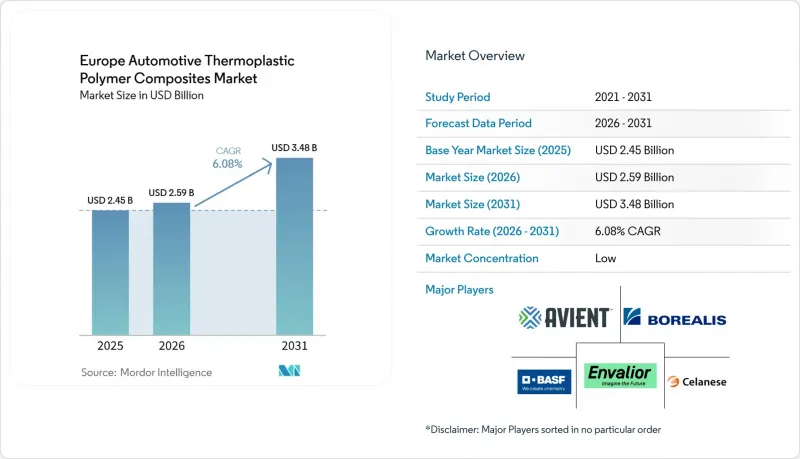
據 Mordor Intelligence 稱,歐洲汽車熱塑性聚合物複合材料市場預計在 2025 年達到 24.5 億美元,預計在預測期(2026-2031 年)內將以 6.08% 的複合年成長率成長,從 2026 年的 25.9 億美元成長到 2031 億美元的 34.8 年。
本報告按製造流程(例如射出成型)、應用領域(例如結構件)、產品形態(例如短纖維熱塑性塑膠)、車輛類型(例如乘用車)和國家/地區(德國、英國、法國、義大利、西班牙、北歐國家、俄羅斯和其他歐洲國家)進行細分。市場預測以美元計價。
歐洲汽車熱塑性聚合物複合材料市場趨勢與洞察。
歐盟車輛排放氣體法規(二氧化碳)與車輛減重
2025年12月訂定的汽車排放法規維持了車輛總排放量法規,其中包括2035年將新乘用車二氧化碳排放量在2021年的基礎上降低90%的目標。 2025年新乘用車平均二氧化碳排放量目標仍為93.6克/公里,但對某些內燃機車和混合動力汽車允許一定的柔軟性。超出車隊排放目標的製造商,每售出一輛車,每超標1克/公里二氧化碳排放量,將處以95歐元的收費。減重100公斤可使內燃機汽車的二氧化碳排放量減少8-12克/公里,並將純電動車的續航里程增加6-10公里。這些優勢使得減重在歐洲汽車熱塑性聚合物複合材料市場仍然至關重要,無論是對於新型電動車平台還是現有的內燃機平台。此外,歐盟型式認證法規下的材料認證也為已獲得電池式電動車製造商(OEM)認證的供應商提供了支援。
使用複合材料組件減輕電動車電池的重量
電池組會使現代電池式電動車的重量增加250至600公斤,因此車身、外殼和模組的設計亟需減輕重量。熱塑性電池外殼和結構蓋是歐洲汽車熱塑性聚合物複合材料市場滿足此需求的一種方式。 GroKuBat聯盟開發了一種熱塑性纖維複合材料電池外殼,與鋁製標準相比,其重量減輕了15%,整個生命週期的二氧化碳排放量減少了25%。此專案也透過桿碰撞模擬和全尺寸測試證明,生產週期可縮短至2分鐘以內。在另一項包覆成型電池蓋的演示中,碳纖維增強熱塑性塑膠(CFRTP)有機片材嵌件和長纖維熱塑性塑膠被組合在一個1.3米×1.8米的部件中,將生產週期控制在90秒以內。隨著熱失控控制成為材料選擇的必要條件,擁有耐火性和結構完整性認證的供應商可以提升其市場地位。
歐洲汽車產量波動及產能轉移
預計到2025年,歐洲熱塑性複合材料的總產量將達到132.9萬噸,較2024年的136.8萬噸下降2.9%。其中,交通運輸業佔比超過60%,顯示歐洲汽車熱塑性聚合物複合材料市場的需求與汽車生產密切相關。生產基地的搬遷可能會影響一級和二級複合材料供應商的採購模式,尤其是在需要接近性壓模機的結構件項目中。將組裝基地遷至歐洲成本較低的地區可能會增加物流成本,並擾亂準時制供應鏈。小規模的供應商可能需要額外資金在新工廠附近建立製造地。這可能導致客戶集中度上升,並增加單一OEM專案或本地工廠決策的風險。
細分市場分析
至2025年,射出成型將佔據歐洲汽車熱塑性聚合物複合材料市場35.56%的佔有率。這一地位反映了歐洲汽車製造商數十年來在模具方面的持續投入。該製程能夠以60-90秒的周期時間生產複雜形狀、多澆口和壁面一體化的零件。這樣的週期時間滿足了成熟乘用車生產的規模和成本要求。內裝件、引擎室支架和外殼仍然是此製程的主要應用領域。製造商正在採用射出成型成型來生產形狀精細、尺寸高度可重複的零件。電池組件的包覆成型在新車設計中也變得越來越重要。一次成型製程能夠將結構嵌件、外殼壁和連接器介面整合在一起。這種整合消除了可能成為潛在故障點的組裝接頭。成熟的設備基礎為加工商提供了一條切實可行的途徑,使其無需重新設計整個生產系統即可引入纖維增強複合材料。這一優勢意義重大。這是因為成熟的歐洲專案要求材料既要滿足大規模汽車生產的單位成本預期,又要與現有的壓平機、模具製造方法和品管流程相容。這種情況並非意味著不需要進行工程改造,而是為加工商提供了一條清晰的途徑,使其能夠在保留OEM團隊已掌握的製程知識的同時,引入改進的纖維增強材料、再生材料或重新設計的零件特徵。
預計壓縮成型將成為成長最快的工藝,2026年至2031年的複合年成長率將達到6.86%。這種成型方法在地板模組、底盤護板和電池外殼等領域越來越受歡迎,尤其適用於長纖維熱塑性塑膠(LFT)和玻璃纖維氈熱塑性塑膠。這些應用所需的結構部件尺寸比許多傳統的射出成型成型部件更大。在LFT-D製程中,連續纖維在壓制步驟前被送入雙螺桿擠出機。該工藝能夠保持纖維的長度,並且無需處理單獨的半成品。因此,可以在確保結構性能的同時降低製程複雜性。 GroKuBat公司採用壓縮成型製程生產電池外殼,其佈局設計基於廢棄物的矩形半成品。此案例研究支持在歐洲汽車熱塑性聚合物複合材料市場中將壓縮成型製程應用於大型電池結構零件。樹脂轉注成形(RTM)和真空灌注成型仍用於小批量連續纖維應用。儘管手工積層仍局限於特定應用領域,但 ISO 16750 測試仍是所有製程類型零件的檢驗標準。這項合規要求的負擔有利於那些能夠透過環境暴露、機械載荷和長期車輛項目週期來證明零件性能可重複性的成熟加工商。因此,壓縮成型不僅僅是生產輕量化零件;它的作用取決於供應商能否在原始設備製造商 (OEM) 要求的生產週期內持續生產大型結構件。加工速度快、纖維保留率高以及經過驗證的認證記錄,這些因素共同解釋了該工藝在這個不斷成長的市場中的地位。
至2025年,結構件將佔歐洲汽車熱塑性聚合物複合材料市場的33.11%。這一市場佔有率主要得益於對纖維增強型碰撞管理導軌、橫樑和電池外殼結構的需求。這些部件必須在保持所需承載能力的同時,減輕重量並滿足嚴格的碰撞管理要求。歐洲新車安全評鑑協會(Euro NCAP)的性能要求對電池結構和增強部件尤為重要。 GroKuBat專案證明,壓縮成型的熱塑性FRP電池外殼在測試中能夠滿足桿式碰撞標準。該項目表明,熱塑性複合材料可用於對結構要求更為嚴格的領域,並為電池外殼認證樹立了標竿。單一複合材料結構可以整合以往由多個金屬部件承擔的功能。因此,樹脂供應商、加工商和OEM設計團隊之間的早期合作至關重要,因為零件形狀、纖維取向、黏合方法以及與電池系統的介面等問題必須在專案進入量產階段之前解決。因此,當複合材料解決方案取代多個金屬零件或省去後續組裝工序時,其結構優勢最為顯著。這更依賴協調的設計選擇,全面考慮重量、衝擊性能、製造方法和認證要求,而不是簡單地進行材料替換。
預計2026年至2031年,內裝組件市場將以6.97%的複合年成長率成長。生物複合材料和再生材料正擴大應用於儀錶面板、車門內襯和頂棚系統。這些材料既能滿足永續性要求,又能與現有的射出成型過程保持相容性。 Materi'act公司於2025年開始大量生產雷諾儀錶面板的「IniCycled-P」材料。此複合材料含有20%的來自報廢車輛的再生聚丙烯。據報導,與原生聚丙烯相比,它還能減少24%的二氧化碳排放。在動力傳動系統應用中,耐熱工程聚醯胺材料被廣泛使用,例如BASF用於高壓電動車連接器的「Ultramid Advanced N3U42G6」。在外部應用方面,模壓成型的彩色聚甲基丙烯酸甲酯(PMMA)和玻璃纖維增強熱塑性面板正被廣泛應用。其他應用還包括底盤護板、電池外殼和前端模組。這種廣泛的應用範圍正在將歐洲汽車熱塑性聚合物複合材料市場拓展到傳統裝飾件之外。這是因為同一材料系列可用於製造高可見度的內裝表面、功能性外飾件、高壓連接器系統以及其他對耐久性和製造相容性要求極高的模組。這種多功能性為加工商提供了多種應用回收材料和生物基材料的選擇,而無需依賴單一的汽車零件。此外,隨著原始設備製造商 (OEM) 將循環材料要求納入更廣泛的內裝設計方案,現有射出成型設備的利用率也將隨之提高。
其他好處:
- Excel格式的市場預測(ME)表
- 3個月的分析師支持
目錄
第1章:引言
- 研究假設和市場定義
- 調查範圍
第2章:調查方法
第3章執行摘要
第4章 市場狀況
- 市場概覽
- 市場促進因素
- 響應歐盟車輛排放氣體法規並減輕車輛重量
- 利用複合材料零件減輕電動車電池的質量
- 可回收、可焊接、高通量熱塑性塑膠的加工。
- OEM廠商對複雜整合模組的需求
- 擴大採用天然纖維和再生材料的項目
- 由於熱失控要求,對電池外殼提出了認證要求。
- 市場限制因素
- 歐洲汽車生產波動及產能轉移
- 歐洲轉換器公司面臨高昂的能源成本、人事費用和合規成本。
- 碳纖維和高性能樹脂高成本
- 根據樹脂和纖維結構對廢棄產品進行碎片化分選
- 價值鏈分析
- 波特五力分析
第5章 市場規模與成長預測
- 透過製造程序
- 射出成型
- 壓縮成型
- 樹脂轉注成形
- 真空灌注處理
- 手工積層
- 透過使用
- 結構構件
- 動力傳動系統部件
- 內部零件
- 外部部件
- 其他組件(底盤護板、電池外殼和蓋子、前端模組)
- 按產品形式
- 短纖維熱塑性塑膠
- 長纖維熱塑性塑膠
- 連續纖維增強熱塑性塑膠
- 其他材料(玻璃纖維氈熱塑性樹脂、有機片材、預浸料、複合材料)
- 車輛類型
- 搭乘用車
- 商用車輛
- 其他
- 國家
- 德國
- 英國
- 法國
- 義大利
- 西班牙
- 北歐國家
- 俄羅斯
- 其他歐洲國家
第6章 競爭情勢
- 市場集中度
- 策略趨勢
- 市佔率和排名分析
- 公司簡介
- Arkema Group
- Avient Corporation
- BASF
- Bcomp
- Borealis GmbH
- Celanese Corporation
- Covestro AG
- DuPont
- Ensinger
- Envalior
- Hexcel Corporation
- LANXESS
- Mitsubishi Chemical Corporation
- Rochling
- SABIC
- SGL Carbon
- Solvay
- Teijin Limited
- TORAY INDUSTRIES, INC.
第7章 市場機會與未來展望
According to Mordor Intelligence, the Europe automotive thermoplastic polymer composites market size is estimated at USD 2.45 billion in 2025 and is estimated to grow from USD 2.59 billion in 2026 to USD 3.48 billion by 2031, at a CAGR of 6.08% during the forecast period (2026-2031).
This report is Segmented by Manufacturing Process (Injection Molding and More), Application (Structural Components and More), Product Form (Short Fiber Thermoplastics and More), Vehicle Type (Passenger Cars and More), and Country (Germany, United Kingdom, France, Italy, Spain, NORDIC Countries, Russia, and Rest of Europe). The Market Forecasts are Provided in Terms of Value (USD).
Europe Automotive Thermoplastic Polymer Composites Market Trends and Insights
EU Fleet CO2 Compliance and Vehicle Lightweighting
The December 2025 Automotive Package retained fleet-emissions requirements, including a 90% CO2 reduction objective from 2021 levels for new passenger cars by 2035. It also retained the 2025 fleet average target of 93.6 g CO2/km for new passenger cars while allowing a limited flexibility corridor for some internal combustion and hybrid vehicles. Manufacturers that exceed fleet targets may face a EUR 95 charge for every g CO2/km above the target for each vehicle sold. A 100 kg weight reduction can lower CO2 emissions from internal combustion engine (ICE) vehicles by 8 to 12 g/km and extend battery-electric driving range by 6 to 10 km. These benefits keep lightweighting relevant across new electric platforms and carryover combustion-engine platforms in the Europe automotive thermoplastic polymer composite market. Material qualification under EU type-approval rules also supports suppliers with established OEM approvals.
EV Battery Mass Offset Through Composite Components
Battery packs add 250 to 600 kg to modern battery-electric vehicles, increasing the need for mass savings in body, closure, and module designs. Thermoplastic battery enclosures and structural covers provide a route for the Europe automotive thermoplastic polymer composite market to address this requirement. The GroKuBat consortium developed a thermoplastic fiber-composite battery housing that reduced weight by 15% compared to an aluminum reference and lowered life-cycle CO2 emissions by 25%. The project also demonstrated production cycle times of less than 2 minutes, supported by pole-impact simulations and physical tests. A separate over-molded battery-cover demonstration combined carbon fiber reinforced thermoplastic (CFRTP) organosheet inserts and long-fiber thermoplastic resin in a component measuring 1.3 m by 1.8 m, with cycle times of less than 90 seconds. Suppliers that complete fire-resistance and structural-integrity qualifications can improve their market position as thermal-runaway containment becomes a material-selection requirement.
Automotive Production Volatility and European Capacity Relocation
European thermoplastic composite production totaled 1,329 kilotons in 2025, down 2.9% from 1,368 kilotons in 2024. Transportation accounted for more than 60% of this output, linking demand in the Europe automotive thermoplastic polymer composite market to vehicle production. Production shifts can affect purchasing patterns for Tier-1 and Tier-2 composite suppliers, particularly when structural programs require proximity to compression-molding presses. Relocating assembly to lower-cost European locations can increase logistics costs and disrupt just-in-time supply arrangements. Smaller suppliers may need additional capital to establish manufacturing operations near relocated programs. As a result, customer concentration can increase exposure to a single OEM program or local plant decision.
Other drivers and restraints analyzed in the detailed report include:
- Recyclable, Weldable, and High-Throughput Thermoplastic Processing
- OEM Demand for Complex, Integrated Modules
- High Cost of Carbon Fiber and High-Performance Resins
For complete list of drivers and restraints, kindly check the Table Of Contents.
Segment Analysis
Injection molding held 35.56% of the Europe automotive thermoplastic polymer composite market in 2025. This position reflected decades of OEM tooling investment across European vehicle programs. The process produces complex, multi-gate, wall-integrated components with cycle times of 60 to 90 seconds. These cycle times align with the scale and cost requirements of established passenger-car production. Interior trim, under-hood brackets, and housings remain core applications for the process. Manufacturers use injection molding where parts require detailed geometry and repeatable dimensions. Battery-component overmolding is also becoming increasingly relevant in newer vehicle designs. A one-shot operation can combine a structural insert, housing wall, and connector interface. This integration eliminates assembly joints that can become potential failure points. The mature equipment base gives converters a practical route to introduce fiber-reinforced formulations without redesigning the entire production system. This advantage matters because established European programs require materials that fit existing presses, tooling practices, and quality routines while meeting the unit-cost expectations of large-scale vehicle production. This position does not eliminate the need for engineering work, but it gives converters a clear path to introduce improved fiber reinforcement, recycled content, or redesigned part functions while retaining the process knowledge that OEM teams already understand.
Compression molding is forecast to record the highest process growth, at a 6.86% CAGR from 2026 to 2031. It is gaining ground in Long Fiber Thermoplastic (LFT) and glass-mat thermoplastic floor modules, underbody shields, and battery housings. These applications require larger structural parts than many conventional injection-molded components. The LFT-D route feeds continuous fibers into a twin-screw extruder before the press. This process preserves fiber length and avoids handling a separate semi-finished product. It can therefore support structural performance while reducing process complexity. GroKuBat used compression molding for a battery housing in a layout designed around waste-free rectangular semi-finished products. This example supports the use of compression molding for large-format battery structures in the Europe automotive thermoplastic polymer composite market. Resin transfer molding and vacuum infusion continue to serve lower-output continuous-fiber applications. Hand layup remains limited to specialized uses, while ISO 16750 testing continues to govern component validation across process types. This compliance burden favors established converters that can demonstrate repeatable part performance across environmental exposure, mechanical loading, and long vehicle program timelines. Compression molding, therefore, does more than produce lighter parts. Its role also depends on whether a supplier can consistently manufacture a large structural component within the production window required by an original equipment manufacturer (OEM). This combination of processing speed, fiber retention, and qualification experience explains the process's position in the growth market.
Structural components accounted for 33.11% of the Europe automotive thermoplastic polymer composite market size in 2025. Demand for fiber-reinforced crash-management rails, crossmembers, and battery-housing structures supported this position. These components must control weight while maintaining their required load-bearing function. They must also meet demanding crash-management requirements. The European New Car Assessment Program (Euro NCAP) performance expectations are particularly relevant to battery structures and reinforcement components. GroKuBat demonstrated that a compression-molded thermoplastic FRP battery housing could meet pole-impact criteria during testing. The project showed that thermoplastic composites can be used in more demanding structural positions. It also created a reference case for battery housing qualification. A single composite structure can combine functions that several metal parts previously handled. This makes early cooperation among resin suppliers, converters, and OEM design teams essential, as component geometry, fiber orientation, joining methods, and battery-system interfaces must be resolved before a program enters series production. The structural opportunity is therefore strongest where a composite solution replaces several metal parts or removes a later assembly stage. It depends less on simple material substitution and more on a coordinated design choice that addresses weight, crash performance, production method, and qualification requirements together.
Interior components are forecast to grow at a 6.97% CAGR from 2026 to 2031. Instrument panels, door liners, and overhead systems are adopting bio-composites and recycled-content formulations. These materials can meet sustainability requirements while retaining compatibility with established injection-molding processes. Materi'act placed IniCycled-P into series production for the Renault Master instrument panel in 2025. The compound contains 20% recycled end-of-life vehicle polypropylene. It also reported 24% lower CO2 emissions than a virgin polypropylene baseline. Powertrain applications use high-temperature engineering polyamides, including BASF Ultramid Advanced N3U42G6 for high-voltage electric-vehicle connectors. Exterior applications use mold-in-color polymethyl methacrylate (PMMA) and glass-fiber thermoplastic fascias. Other applications include underbody shields, battery enclosures, and front-end modules. This range of uses broadens the Europe automotive thermoplastic polymer composite market beyond conventional trim components because the same material family can serve visible interior surfaces, functional exterior parts, high-voltage connector systems, and other modules where durability and manufacturing compatibility are important. This diversity gives converters several routes to apply recycled or bio-based content without relying on a single vehicle part. It also makes existing injection-molding equipment more useful as OEMs bring circular-material requirements into broader interior programs.
Complete Report Scope:
- By Manufacturing Process
- Injection Molding
- Compression Molding
- Resin Transfer Molding
- Vacuum Infusion Processing
- Hand Layup
- By Application
- Structural Components
- Powertrain Components
- Interior Components
- Exterior Components
- Others (Underbody Shields, Battery Enclosures and Covers, Front-End Modules)
- By Product Form
- Short Fiber Thermoplastics
- Long Fiber Thermoplastics
- Continuous Fiber Thermoplastics
- Others (Glass Mat Thermoplastics, Organosheets, Prepregs and Composite Plates)
- By Vehicle Type
- Passenger Cars
- Commercial Vehicles
- Others
- By Country
- Germany
- United Kingdom
- France
- Italy
- Spain
- NORDIC Countries
- Russia
- Rest of Europe
List of Companies Covered in this Report:
- Arkema Group
- Avient Corporation
- BASF
- Bcomp
- Borealis GmbH
- Celanese Corporation
- Covestro AG
- DuPont
- Ensinger
- Envalior
- Hexcel Corporation
- LANXESS
- Mitsubishi Chemical Corporation
- Rochling
- SABIC
- SGL Carbon
- Solvay
- Teijin Limited
- TORAY INDUSTRIES, INC.
Additional Benefits:
- The market estimate (ME) sheet in Excel format
- 3 months of analyst support
TABLE OF CONTENTS
1 Introduction
- 1.1 Study Assumptions and Market Definition
- 1.2 Scope of the Study
2 Research Methodology
3 Executive Summary
4 Market Landscape
- 4.1 Market Overview
- 4.2 Market Drivers
- 4.2.1 EU Fleet CO2 Compliance and Vehicle Lightweighting
- 4.2.2 EV Battery Mass Offset Through Composite Components
- 4.2.3 Recyclable, Weldable and High-Throughput Thermoplastic Processing
- 4.2.4 OEM Demand for Complex, Integrated Modules
- 4.2.5 Growth of Natural-Fiber and Recycled-Content Programs
- 4.2.6 Battery-Enclosure Qualification Pull From Thermal-Runaway Requirements
- 4.3 Market Restraints
- 4.3.1 Automotive Production Volatility and European Capacity Relocation
- 4.3.2 High Energy, Labor and Compliance Costs for European Converters
- 4.3.3 High Cost of Carbon Fiber and High-Performance Resins
- 4.3.4 Fragmented End-of-Life Sorting by Resin and Fiber Architecture
- 4.4 Value Chain Analysis
- 4.5 Porter's Five Forces Analysis
- 4.5.1 Threat of New Entrants
- 4.5.2 Bargaining Power of Suppliers
- 4.5.3 Bargaining Power of Buyers
- 4.5.4 Threat of Substitutes
- 4.5.5 Competitive Rivalry
5 Market Size and Growth Forecasts (Value)
- 5.1 By Manufacturing Process
- 5.1.1 Injection Molding
- 5.1.2 Compression Molding
- 5.1.3 Resin Transfer Molding
- 5.1.4 Vacuum Infusion Processing
- 5.1.5 Hand Layup
- 5.2 By Application
- 5.2.1 Structural Components
- 5.2.2 Powertrain Components
- 5.2.3 Interior Components
- 5.2.4 Exterior Components
- 5.2.5 Others (Underbody Shields, Battery Enclosures and Covers, Front-End Modules)
- 5.3 By Product Form
- 5.3.1 Short Fiber Thermoplastics
- 5.3.2 Long Fiber Thermoplastics
- 5.3.3 Continuous Fiber Thermoplastics
- 5.3.4 Others (Glass Mat Thermoplastics, Organosheets, Prepregs and Composite Plates)
- 5.4 By Vehicle Type
- 5.4.1 Passenger Cars
- 5.4.2 Commercial Vehicles
- 5.4.3 Others
- 5.5 By Country
- 5.5.1 Germany
- 5.5.2 United Kingdom
- 5.5.3 France
- 5.5.4 Italy
- 5.5.5 Spain
- 5.5.6 NORDIC Countries
- 5.5.7 Russia
- 5.5.8 Rest of Europe
6 Competitive Landscape
- 6.1 Market Concentration
- 6.2 Strategic Moves
- 6.3 Market Share (%)/Ranking Analysis
- 6.4 Company Profiles (includes Global Overview, Market Overview, Core Segments, Financials as available, Strategic Information, Products and Services, and Recent Developments)
- 6.4.1 Arkema Group
- 6.4.2 Avient Corporation
- 6.4.3 BASF
- 6.4.4 Bcomp
- 6.4.5 Borealis GmbH
- 6.4.6 Celanese Corporation
- 6.4.7 Covestro AG
- 6.4.8 DuPont
- 6.4.9 Ensinger
- 6.4.10 Envalior
- 6.4.11 Hexcel Corporation
- 6.4.12 LANXESS
- 6.4.13 Mitsubishi Chemical Corporation
- 6.4.14 Rochling
- 6.4.15 SABIC
- 6.4.16 SGL Carbon
- 6.4.17 Solvay
- 6.4.18 Teijin Limited
- 6.4.19 TORAY INDUSTRIES, INC.
7 Market Opportunities and Future Outlook
- 7.1 White-Space and Unmet-Need Assessment

 汽車複合材料市場:依材料、製造流程、樹脂類型、應用和最終用途分類-2026-2032年全球市場預測
 汽車熱塑性複合材料市場分析與至2035年的預測:類型、產品類型、技術、組件、應用、形狀、材料類型、製造流程、最終用戶、功能
 汽車複合材料市場規模及預測(2021-2034年)、全球及區域佔有率、趨勢及成長機會分析報告:依纖維類型、車輛類型分類
 汽車輕量材料市場預測至2034年-全球材料類型、零件、車輛類型、動力傳動系統、製造流程、應用及區域分析
 2026年全球汽車複合材料市場報告
 非洲和中東汽車應用熱塑性聚合物複合材料:市場佔有率分析、產業趨勢和統計數據以及成長預測(2026-2031 年)汽車複合材料市場分析及預測(至2035年):依類型、產品、技術、組件、應用、材料類型、製程、最終用戶、功能及安裝類型分類2026年全球醫用可調力彈簧市場報告
 汽車用矽橡膠市場規模、佔有率和成長分析(按類型、產品類型、固化機制、應用、最終用途產業和地區分類)-2026-2033年產業預測
 全球汽車複合材料市場規模、佔有率、趨勢和成長分析報告(2026-2034)