

 |
市場調查報告書
商品編碼
2115782
全球汽車複合材料市場:按應用、纖維類型、製造流程、樹脂類型、車輛類型和地區分類-預測至2031年Automotive Composites Market by Fiber Type (Glass, Carbon), Resin Type (Thermoset, Thermoplastic), Manufacturing Process (Compression Molding, Injection Molding, RTM), Application, Vehicle Type, and Region - Forecast to 2031 |
||||||


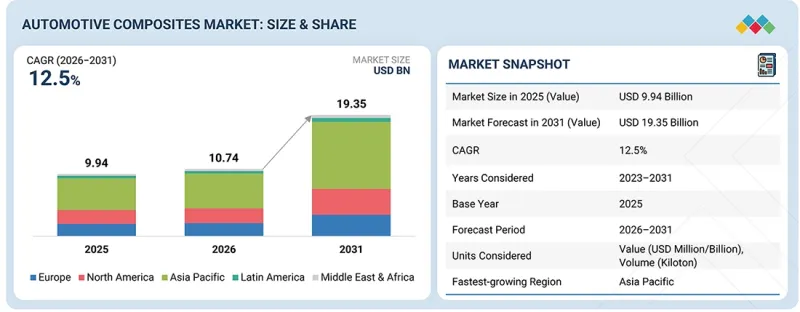
預計到 2026 年,汽車複合材料市場規模將達到 107.4 億美元,並預計從 2026 年到 2031 年將以 12.5% 的複合年成長率成長,到 2031 年達到 193.5 億美元。
隨著汽車產業致力於減輕車身重量、推動車輛電氣化並提高燃油效率,汽車複合材料中對碳纖維的需求正迅速成長。碳纖維複合材料強度、剛性和耐久性卓越,且重量遠輕於傳統材料,這使得汽車製造商能夠減輕車身重量、提升性能並延長電動車的續航里程。此外,其優異的強度重量比還有助於減少排放氣體、提高能源效率,進而幫助製造商滿足日益嚴格的環保法規要求。
| 調查範圍 | |
|---|---|
| 調查期 | 2023-2031 |
| 基準年 | 2025 |
| 預測期 | 2026-2031 |
| 計算單位 | 金額(百萬/十億美元)和數量(千噸) |
| 部分 | 按應用、纖維類型、製造流程、樹脂類型、載體類型和地區分類。 |
| 目標區域 | 歐洲、北美、亞太地區、中東和非洲以及拉丁美洲 |
碳纖維具有耐腐蝕性、設計柔軟性和可模製成複雜形狀等優點,因此非常適合用於車身面板、電池機殼、車頂系統、底盤部件和結構加固等應用。製造技術的不斷進步和對具成本效益碳纖維解決方案的持續投入,正進一步加速其在高階車型和下一代汽車平臺的應用。
“在預測期內,熱固性樹脂預計將在各類樹脂中呈現第二高的成長率。”
由於其卓越的機械強度、熱穩定性和成本效益,熱固性樹脂預計將在汽車複合材料市場中實現第二高的成長率。環氧樹脂、聚酯樹脂和乙烯基酯樹脂等廣泛應用的樹脂可用於製造輕量化、耐用且高性能的汽車零件,包括車身面板、結構零件和電池機殼。這些樹脂優異的強度重量比有助於減輕車輛重量、提高燃油效率和推動車輛電氣化。對高性能結構應用的持續需求以及熱固性複合材料加工技術的進步將繼續推動該領域的成長。
“在預測期內,壓縮成型製程預計將在各製造製程領域中呈現第二高的成長率。”
由於其生產效率高、成本效益好,且適用於大規模汽車應用,壓縮成型預計將成為汽車複合材料市場中第二快成長速度的製造流程。該工藝能夠生產複雜輕量化的零件,同時最大限度地減少材料浪費並縮短生產週期,使其成為大規模生產汽車的理想選擇。此外,它與熱固性和熱塑性複合材料的兼容性,使製造商能夠生產滿足不斷變化的性能和輕量化要求的結構件、車身面板和電池機殼組件。
“以金額為準,內裝應用在汽車複合材料市場中佔據第二大佔有率。”
到2025年,汽車內裝領域將佔據汽車複合材料市場第二大佔有率。由於其輕質、耐用和設計柔軟性等優點,複合材料被廣泛應用於座椅結構、頂棚、後行李箱地板、門板、內裝件和座艙部件。玻璃纖維和碳纖維複合材料有助於減輕車輛重量,同時保持結構完整性,從而提高燃油效率並延長電動車的續航里程。主要汽車製造商對輕量化內裝零件的日益重視預計將進一步推動汽車內裝應用領域對汽車複合材料的需求。
“在預測期內,亞太地區汽車複合材料市場預計將錄得最高的成長率。”
預計亞太地區將在預測期內實現汽車複合材料市場最高的成長率。這一成長主要得益於該地區在全球汽車製造領域的主導地位、電動車(EV)產量的快速擴張以及對輕量化汽車技術投資的增加。中國、日本、韓國和印度在汽車複合材料的應用方面處於領先地位,因為汽車製造商正致力於提高燃油效率、減少排放氣體並延長電動車的續航里程。預計到2025年,該地區將佔全球汽車製造產量的70%以上,以及全球電動車產量的近78%,對電池外殼、車身面板、結構件和內裝應用領域的複合材料產生巨大需求。政府對汽車電氣化的大力支持、強大的汽車供應鏈以及主要整車製造商和複合材料生產商的存在,預計將進一步加速全部區域的市場成長。
本報告對以下公司進行了全面分析:
該市場的主要參與者包括東麗株式會社(日本)、SGL Carbon(德國)、POLYTEC HOLDING AG、ElringKlinger AG(德國)、Syensqo(比利時)、HENGRUI CORPORATION (HRC)(中國)、Exel Composites(芬蘭)、帝人株式會社(日本)、日本化學集團(日本式會社)(日本式會社(英國) Composites Compositd(日本) International(美國)和Rochling SE & Co. KG(德國)。
調查範圍
本研究報告根據纖維類型(玻璃纖維、碳纖維)、樹脂類型(熱固性樹脂、熱塑性樹脂)、製造程序(壓縮成型、射出成型、樹脂轉注成形)、應用領域(外飾件、內飾件、動力傳動系統底盤、電池機殼)、車輛類型(非電動汽車、電動車)以及地區(北美、歐洲、亞太、中東、美國、亞太、中國報告涵蓋了影響汽車複合材料市場成長的關鍵因素(促進因素、阻礙因素、挑戰、機會等)的詳細資訊。對主要行業參與者的深入調查,揭示了他們的業務概況、解決方案和服務、關鍵策略以及汽車複合材料市場的最新趨勢。此外,該報告還對汽車複合材料市場生態系統中新興的新創公司進行了競爭分析。
購買本報告的理由:
本報告透過提供汽車複合材料市場及其細分市場最準確的銷售預測,幫助市場領導和新參與企業更好地了解市場。報告也幫助相關人員了解競爭格局,最佳化業務定位,並制定合適的打入市場策略。此外,報告還幫助相關人員掌握市場趨勢,並提供關鍵市場促進因素、阻礙因素、挑戰和機會的資訊。
本報告深入分析了以下幾點:
- 影響汽車複合材料市場成長的因素包括主要促進因素(對輕量化和節能型汽車的需求不斷成長、環保型電動汽車的成長以及在汽車應用中擴大使用經濟高效且環保的天然纖維)、阻礙因素(複合材料的高加工和製造成本以及新興國家技術進步緩慢)、機遇(嚴格的政府法規、新興國家對複合材料的高加工和製造成本以及新興國家技術進步緩慢)、機遇(嚴格的政府法規、新興國家對複合材料的需求不斷成長以及新興國家技術進步緩慢的汽車複合材料(嚴格的政府法規、新興國家對複合材料的需求不斷成長)。
- 產品開發/創新:深入了解汽車複合材料市場的未來技術、研發活動和新服務推出。
- 市場發展:盈利市場的全面資訊-本報告分析了各個地區的汽車複合材料市場。
- 市場多元化:提供汽車複合材料市場的服務、未開發地區、最新趨勢和投資方面的全面資訊。
- 競爭分析:對東麗株式會社(日本)、SGL Carbon(德國)、POLYTEC HOLDING AG、ElringKlinger AG(德國)、Syensqo(比利時)、HENGRUI CORPORATION (HRC)(中國)、Exel Composites(芬蘭)、帝人株式集車組(日本)、三化學會(英國) International(美國)和Lochling SE & Co. KG(德國)等主要公司的市場佔有率、成長策略和服務產品進行詳細評估。
目錄
第1章:引言
第2章執行摘要
第3章重要考察
第4章 市場概覽
- 市場動態
- 促進因素
- 抑制因子
- 機會
- 任務
- 未滿足的需求和未開發的領域
- 相互關聯的市場與跨產業機遇
- 新的經營模式和生態系統的變化
- 一級/二級/三級公司的策略性舉措
第5章 產業趨勢
- 波特五力分析
- 總體經濟指標
- 供應鏈分析
- 生態系分析
- 價格分析
- 貿易分析,2021-2025年
- 2026年至2028年主要會議及活動
- 影響客戶業務的趨勢/顛覆性因素
- 投資和資金籌措場景
- 案例研究分析
- 2025年美國關稅對汽車複合材料市場的影響
第6章:技術進步、人工智慧的影響、專利、創新與未來應用
- 主要新興技術
- 互補技術
- 技術/產品藍圖
- 專利分析
- 未來應用
- 人工智慧/生成式人工智慧對汽車複合材料市場的影響
- 成功案例和實際應用
第7章永續性和監管情勢
- 當地法規和合規性
- 對永續性的承諾
- 對永續性和監管政策舉措的影響
- 認證、標籤檢視、環境標準
第8章:顧客趨勢與購買行為
- 決策流程
- 買方相關人員和採購評估標準
- 實施障礙和內部挑戰
- 汽車和電動車領域尚未滿足的需求
- 市場盈利
第9章:汽車複合材料市場(按應用領域分類)
- 外部的
- 內部的
- 動力傳動系統和底盤
- 電池盒
第10章:汽車複合材料市場(依纖維類型分類)
- 碳纖維
- 玻璃纖維
- 其他
- 天然纖維
- 玄武岩纖維
- 醯胺纖維
- 混合纖維
第11章:汽車複合材料市場(依製造流程分類)
- 壓縮成型工藝
- 射出成型工藝
- 樹脂轉注成形工藝
- 其他
- 絲捲繞製程
- 連續製程
- 層壓工藝
第12章:汽車複合材料市場(依樹脂類型分類)
- 熱固性樹脂
- 熱塑性樹脂
第13章:汽車複合材料市場(依車輛類型分類)
- 非電力
- 電
第14章:汽車複合材料市場(按地區分類)
- 北美洲
- 美國
- 加拿大
- 歐洲
- 德國
- 法國
- 英國
- 義大利
- 西班牙
- 俄羅斯
- 比利時
- 其他
- 拉丁美洲
- 墨西哥
- 巴西
- 其他
- 亞太地區
- 中國
- 日本
- 印度
- 韓國
- 澳洲
- 其他
- 中東和非洲
- 海灣合作理事會國家
- 南非
- 其他
第15章 競爭格局
- 概述
- 主要參與企業的策略/優勢
- 收入分析
- 市佔率分析
- 品牌對比
- 企業估值矩陣:主要公司,2025 年
- 公司估值矩陣:新創企業/中小企業,2025 年
- 企業估值和財務指標
- 競爭格局
第16章:公司簡介
- 主要參與企業
- SGL CARBON
- SYENSQO
- POLYTEC HOLDING AG
- TORAY INDUSTRIES, INC.
- ELRINGKLINGER AG
- HRC
- EXEL COMPOSITES
- TEIJIN LIMITED
- MITSUBISHI CHEMICAL GROUP CORPORATION
- HEXCEL CORPORATION
- IDI COMPOSITES INTERNATIONAL
- ROCHLING SE & CO. KG
- KAUTEX
- MUHR UND BENDER KG
- GEORG FRITZMEIER GMBH & CO. KG
- TATA AUTOCOMP SYSTEMS LIMITED
- FLEX-N-GATE
- 其他公司
- HANKUK CARBON CO., LTD.
- CIE AUTOMOTIVE INDIA
- UFP TECHNOLOGIES, INC.
- ZHONGAO CARBON
- ATLAS FIBRE
- PIRAN ADVANCED COMPOSITES
- ENVALIOR
- TRB
- THE GUND COMPANY
- OPMOBILITY
第17章調查方法
第18章附錄
The automotive composites market is estimated to be valued at USD 10.74 billion in 2026 and reach USD 19.35 billion by 2031, at a CAGR of 12.5% from 2026 to 2031. The demand for carbon fiber in automotive composites is increasing rapidly due to the automotive industry's focus on lightweighting, vehicle electrification, and improved fuel efficiency. Carbon fiber composites offer exceptional strength, stiffness, and durability at a fraction of the weight of conventional materials, enabling automakers to reduce vehicle mass, enhance performance, and extend electric vehicle driving range. Their superior strength-to-weight ratio also contributes to lower emissions and improved energy efficiency, helping manufacturers meet increasingly stringent environmental regulations.
| Scope of the Report | |
|---|---|
| Years Considered for the Study | 2023-2031 |
| Base Year | 2025 |
| Forecast Period | 2026-2031 |
| Units Considered | Value (USD million/billion) and volume (kiloton) |
| Segments | Fiber type, resin type, manufacturing process, application, vehicle type, and region |
| Regions covered | Europe, North America, Asia Pacific, the Middle East & Africa, and Latin America |
Carbon fiber's corrosion resistance, design flexibility, and ability to be molded into complex geometries make it well-suited for applications such as body panels, battery enclosures, roof systems, chassis components, and structural reinforcements. Ongoing advancements in manufacturing technologies and growing investments in cost-effective carbon fiber solutions are further accelerating their adoption across both premium and next-generation vehicle platforms.
"Thermoset resin to be the second fastest-growing resin type segment during the forecast period"
Thermoset resins are projected to register the second-highest growth rate in the automotive composites market due to their excellent mechanical strength, thermal stability, and cost-effectiveness. Widely used resins such as epoxy, polyester, and vinyl ester enable the production of lightweight, durable, and high-performance automotive components, including body panels, structural parts, and battery enclosures. Their superior strength-to-weight ratio helps reduce vehicle weight, improve fuel efficiency, and support vehicle electrification initiatives. Ongoing demand for high-performance structural applications and advancements in thermoset composite processing technologies continue to drive segment growth.
"Compression molding segment to be second-fastest-growing manufacturing process segment during forecast period"
Compression molding is projected to be the second-fastest-growing manufacturing process in the automotive composites market due to its high production efficiency, cost-effectiveness, and suitability for large-scale automotive applications. The process enables the production of complex, lightweight components with minimal material waste and short cycle times, making it ideal for high-volume vehicle manufacturing. Its compatibility with both thermoset and thermoplastic composites allow manufacturers to produce structural parts, body panels, and battery enclosure components that meet evolving performance and lightweighting requirements.
"In terms of value, interior application accounted for the second-largest share in the overall automotive composites market"
In 2025, the interior segment accounted for the second-largest share of the automotive composites market. Composite materials are widely used in seat structures, headliners, load floors, door panels, interior trims, and cabin components due to their lightweight, durability, and design flexibility. Glass fiber and carbon fiber composites help reduce vehicle weight while maintaining structural integrity, supporting improved fuel efficiency and extended EV range. Growing adoption of lightweight interior components by leading automakers is expected to further drive demand for automotive composites in interior applications.
"Asia Pacific to register the highest growth rate in the automotive composites market during the forecast period"
The Asia Pacific region is projected to register the highest growth rate in the automotive composites market during the forecast period. This growth is driven by the region's dominance in global vehicle manufacturing, rapid expansion of electric vehicle production, and increasing investments in lightweight automotive technologies. China, Japan, South Korea, and India are leading the adoption of automotive composites as automakers focus on improving fuel efficiency, reducing emissions, and extending EV driving range. The region accounted for over 70% of global vehicle production and nearly 78% of global electric vehicle production in 2025, creating substantial demand for composite materials in battery enclosures, body panels, structural components, and interior applications. Strong government support for vehicle electrification, a robust automotive supply chain, and the presence of major OEMs and composite manufacturers are expected to further accelerate market growth across the region.
This study has been validated through primary interviews with industry experts globally. The primary sources have been divided into the following three categories:
- By Company Type: Tier 1 - 60%, Tier 2 - 20%, and Tier 3 - 20%
- By Designation: Directors - 33%, Managers - 33%, and Others - 34%
- By Region: North America - 20%, Europe - 25%, Asia Pacific - 25%, the Middle East & Africa - 10%, and Latin America - 20%
The report provides a comprehensive analysis of the following companies:
Prominent companies in this market include Toray Industries, Inc. (Japan), SGL Carbon (Germany), POLYTEC HOLDING AG, ElringKlinger AG (Germany), Syensqo (Belgium), HENGRUI CORPORATION (HRC) (China), Exel Composites (Finland), Teijin Limited (Japan), Mitsubishi Chemical Group Corporation (Japan), Piran Advanced Composites (UK), IDI Composites International (US), and Rochling SE & Co. KG (Germany).
Research coverage
This research report categorizes the automotive composites market based on fiber type (glass fiber, carbon fiber), resin type (thermoset, thermoplastic), manufacturing process (compression molding, injection molding, resin transfer molding), application (exterior, interior, powertrain & chassis, battery enclosures), vehicle type (non-electric, electric), and region (North America, Europe, Asia Pacific, Middle East & Africa, Latin America). The scope of the report includes detailed information on the major factors influencing the growth of the automotive composites market, including drivers, restraints, challenges, and opportunities. A thorough examination of the key industry players has been conducted to provide insights into their business overview, solutions and services, key strategies, and recent developments in the automotive composites market. This report includes a competitive analysis of upcoming startups in the automotive composites market ecosystem.
Reasons to buy this report:
The report will help market leaders/new entrants in this market with information on the closest approximations of revenue for the overall automotive composites market and its subsegments. This report will help stakeholders understand the competitive landscape and gain insights to better position their businesses and plan suitable go-to-market strategies. The report also helps stakeholders understand the pulse of the market and provides them with information on key market drivers, restraints, challenges, and opportunities.
The report provides insights into the following pointers:
- Analysis of key drivers (increase in demand for lightweight and fuel-efficient vehicles, growth of environment-friendly electric vehicles, rising use of cost-efficient and eco-friendly natural fibers in automotive applications), restraints (high processing and manufacturing cost of composites, lack of technological advancements in emerging economies), opportunities (stringent government regulations, growing demand for composites from emerging economies, penetration of carbon fiber composites in electric vehicles), and challenges (recyclability of composites) influencing the growth of the automotive composites market
- Product Development/Innovation: Detailed insights on upcoming technologies, research & development activities, and service launches in the automotive composites market
- Market Development: Comprehensive information about lucrative markets - the report analyses the automotive composites market across varied regions
- Market Diversification: Exhaustive information about services, untapped geographies, recent developments, and investments in the automotive composites market
- Competitive Assessment: In-depth assessment of market shares, growth strategies, and service offerings of leading players like Toray Industries, Inc. (Japan), SGL Carbon (Germany), POLYTEC HOLDING AG, ElringKlinger AG (Germany), Syensqo (Belgium), HENGRUI CORPORATION (HRC) (China), Exel Composites (Finland), Teijin Limited (Japan), Mitsubishi Chemical Group Corporation (Japan), Piran Advanced Composites (UK), IDI Composites International (US), and Rochling SE & Co. KG (Germany) in the automotive composites market
TABLE OF CONTENTS
1 INTRODUCTION
- 1.1 STUDY OBJECTIVES
- 1.2 MARKET DEFINITION
- 1.3 STUDY SCOPE
- 1.3.1 MARKETS COVERED AND REGIONAL SCOPE
- 1.3.2 INCLUSIONS AND EXCLUSIONS
- 1.3.3 YEARS CONSIDERED
- 1.3.4 CURRENCY CONSIDERED
- 1.3.5 UNITS CONSIDERED
- 1.4 LIMITATIONS
- 1.5 STAKEHOLDERS
- 1.6 SUMMARY OF CHANGES
2 EXECUTIVE SUMMARY
- 2.1 KEY INSIGHTS AND MARKET HIGHLIGHTS
- 2.2 KEY MARKET PARTICIPANTS: SHARE INSIGHTS AND STRATEGIC DEVELOPMENTS
- 2.3 DISRUPTIVE TRENDS SHAPING MARKET
- 2.4 HIGH-GROWTH SEGMENTS & EMERGING FRONTIERS
- 2.5 SNAPSHOT: GLOBAL MARKET SIZE, GROWTH RATE, AND FORECAST
3 PREMIUM INSIGHTS
- 3.1 ATTRACTIVE OPPORTUNITIES FOR PLAYERS IN AUTOMOTIVE COMPOSITES MARKET
- 3.2 AUTOMOTIVE COMPOSITES MARKET, BY END-USE INDUSTRY AND REGION
- 3.3 AUTOMOTIVE COMPOSITES MARKET, BY VEHICLE TYPE
- 3.4 AUTOMOTIVE COMPOSITES MARKET, BY RESIN TYPE
- 3.5 AUTOMOTIVE COMPOSITES MARKET, BY FIBER TYPE
- 3.6 AUTOMOTIVE COMPOSITES MARKET, BY MANUFACTURING PROCESS
- 3.7 AUTOMOTIVE COMPOSITES MARKET, BY COUNTRY
4 MARKET OVERVIEW
- 4.1 INTRODUCTION
- 4.2 MARKET DYNAMICS
- 4.2.1 DRIVERS
- 4.2.1.1 Increase in demand for lightweight and fuel-efficient vehicles
- 4.2.1.2 Rise in demand for enhanced vehicle safety and crash performance
- 4.2.1.3 Growing use of cost-efficient and eco-friendly natural fibers in automotive applications
- 4.2.2 RESTRAINTS
- 4.2.2.1 High material and production costs
- 4.2.2.2 Lack of standardization in manufacturing technologies
- 4.2.2.3 Damage repair and compatibility issues
- 4.2.3 OPPORTUNITIES
- 4.2.3.1 Stringent government regulations
- 4.2.3.2 Growing demand from emerging economies
- 4.2.3.3 Penetration of carbon fiber-reinforced composites in electric vehicles
- 4.2.4 CHALLENGES
- 4.2.4.1 Recyclability of composites
- 4.2.4.2 Supply chain concentration and precursor dependency
- 4.2.4.3 Certification and qualification barriers in high-performance applications
- 4.2.1 DRIVERS
- 4.3 UNMET NEEDS AND WHITE SPACES
- 4.3.1 UNMET NEEDS IN AUTOMOTIVE COMPOSITES MARKET
- 4.3.2 WHITE SPACE OPPORTUNITIES
- 4.4 INTERCONNECTED MARKETS AND CROSS-SECTOR OPPORTUNITIES
- 4.4.1 INTERCONNECTED MARKETS
- 4.4.2 CROSS-SECTOR OPPORTUNITIES
- 4.5 EMERGING BUSINESS MODELS AND ECOSYSTEM SHIFTS
- 4.5.1 EMERGING BUSINESS MODELS
- 4.5.2 ECOSYSTEM SHIFTS
- 4.6 STRATEGIC MOVES BY TIER-1/2/3 PLAYERS
- 4.6.1 KEY MOVES AND STRATEGIC FOCUS
5 INDUSTRY TRENDS
- 5.1 PORTER'S FIVE FORCES ANALYSIS
- 5.1.1 THREAT OF NEW ENTRANTS
- 5.1.2 THREAT OF SUBSTITUTES
- 5.1.3 BARGAINING POWER OF SUPPLIERS
- 5.1.4 BARGAINING POWER OF BUYERS
- 5.1.5 INTENSITY OF COMPETITIVE RIVALRY
- 5.2 MACROECONOMIC INDICATORS
- 5.2.1 INTRODUCTION
- 5.2.2 GDP TRENDS AND FORECAST
- 5.2.3 TRENDS IN AUTOMOTIVE INDUSTRY
- 5.3 SUPPLY CHAIN ANALYSIS
- 5.4 ECOSYSTEM ANALYSIS
- 5.5 PRICING ANALYSIS
- 5.5.1 AVERAGE SELLING PRICE OFFERED BY KEY PLAYERS, BY APPLICATION
- 5.5.2 AVERAGE SELLING PRICE TREND OF AUTOMOTIVE COMPOSITES, BY REGION
- 5.6 TRADE ANALYSIS, 2021-2025
- 5.6.1 IMPORT SCENARIO (HS CODE 681511)
- 5.6.2 EXPORT SCENARIO (HS CODE 681511)
- 5.7 KEY CONFERENCES AND EVENTS, 2026-2028
- 5.8 TRENDS/DISRUPTIONS IMPACTING CUSTOMER BUSINESS
- 5.9 INVESTMENT AND FUNDING SCENARIO
- 5.10 CASE STUDY ANALYSIS
- 5.10.1 CASE STUDY 1: MITSUBISHI'S DEVELOPMENT OF CARBON FIBER FOR STRUCTURAL AUTOMOTIVE COMPONENTS
- 5.10.2 CASE STUDY 2: WATT ELECTRIC VEHICLES PARTNERED WITH NATIONAL COMPOSITES CENTRE TO MANUFACTURE COMPOSITE BATTERIES
- 5.10.3 CASE STUDY 3: TEIJIN'S DEVELOPMENT OF CARBON FIBER BATTERY ENCLOSURE
- 5.11 IMPACT OF 2025 US TARIFF ON AUTOMOTIVE COMPOSITES MARKET
- 5.11.1 INTRODUCTION
- 5.11.2 KEY TARIFF RATES
- 5.11.3 PRICE IMPACT ANALYSIS
- 5.11.4 IMPACT ON COUNTRIES/REGIONS
- 5.11.4.1 North America
- 5.11.4.2 Europe
- 5.11.4.3 Asia Pacific
- 5.11.4.4 Middle East & Africa
6 TECHNOLOGICAL ADVANCEMENTS, AI-DRIVEN IMPACT, PATENTS, INNOVATIONS, AND FUTURE APPLICATIONS
- 6.1 KEY EMERGING TECHNOLOGIES
- 6.1.1 AUTOMOTIVE COMPOSITE MANUFACTURING
- 6.1.2 GLASS FIBER COMPOSITE MANUFACTURING
- 6.1.3 CARBON FIBER COMPOSITE MANUFACTURING
- 6.2 COMPLEMENTARY TECHNOLOGIES
- 6.2.1 RECYCLING TECHNOLOGY
- 6.3 TECHNOLOGY/PRODUCT ROADMAP
- 6.3.1 SHORT-TERM (2026-2028) | SCALING EV APPLICATIONS & PROCESS OPTIMIZATION
- 6.3.2 MID-TERM (2028-2031) | STANDARDIZATION & HIGH-VOLUME AUTOMOTIVE INTEGRATION
- 6.3.3 LONG-TERM (2032-2036+) | MASS-MARKET LIGHTWEIGHTING & CIRCULAR COMPOSITE ECOSYSTEMS
- 6.4 PATENT ANALYSIS
- 6.4.1 INTRODUCTION
- 6.4.2 METHODOLOGY
- 6.4.3 DOCUMENT TYPES
- 6.4.4 INSIGHTS
- 6.4.5 LEGAL STATUS
- 6.4.6 JURISDICTION ANALYSIS
- 6.4.7 TOP APPLICANTS
- 6.4.8 TOP 10 PATENT OWNERS (US) IN LAST 5 YEARS
- 6.5 FUTURE APPLICATIONS
- 6.5.1 ADVANCED BATTERY ENCLOSURES & THERMAL MANAGEMENT
- 6.5.2 MULTI-MATERIAL LIGHTWEIGHT VEHICLE STRUCTURES
- 6.5.3 HIGH-VOLUME THERMOPLASTIC COMPOSITE COMPONENTS
- 6.5.4 SUSTAINABLE & RECYCLABLE COMPOSITE MATERIALS
- 6.5.5 SMART & FUNCTIONAL COMPOSITE SYSTEMS
- 6.6 IMPACT OF AI/GEN AI ON AUTOMOTIVE COMPOSITES MARKET
- 6.6.1 TOP USE CASES AND MARKET POTENTIAL
- 6.6.2 BEST PRACTICES IN AUTOMOTIVE COMPOSITES MARKET
- 6.6.3 CASE STUDIES OF AI IMPLEMENTATION IN AUTOMOTIVE COMPOSITES MARKET
- 6.6.4 INTERCONNECTED ADJACENT ECOSYSTEM AND IMPACT ON MARKET PLAYERS
- 6.6.5 CLIENTS' READINESS TO ADOPT GENERATIVE AI IN AUTOMOTIVE COMPOSITES MARKET
- 6.7 SUCCESS STORIES AND REAL-WORLD APPLICATIONS
- 6.7.1 TORAY INDUSTRIES: HIGH-PERFORMANCE AEROSPACE AND SPORTS APPLICATIONS
- 6.7.2 HEXCEL CORPORATION: AI-DRIVEN SMART COMPOSITE MANUFACTURING
7 SUSTAINABILITY AND REGULATORY LANDSCAPE
- 7.1 REGIONAL REGULATIONS AND COMPLIANCE
- 7.1.1 REGULATORY BODIES, GOVERNMENT AGENCIES, AND OTHER ORGANIZATIONS
- 7.1.2 INDUSTRY STANDARDS
- 7.2 SUSTAINABILITY INITIATIVES
- 7.2.1 CARBON IMPACT AND ECO-APPLICATIONS OF AUTOMOTIVE COMPOSITES
- 7.2.1.1 Carbon impact reduction
- 7.2.1.2 Eco-Applications
- 7.2.1 CARBON IMPACT AND ECO-APPLICATIONS OF AUTOMOTIVE COMPOSITES
- 7.3 SUSTAINABILITY IMPACT AND REGULATORY POLICY INITIATIVES
- 7.4 CERTIFICATIONS, LABELING, ECO-STANDARDS
8 CUSTOMER LANDSCAPE & BUYER BEHAVIOR
- 8.1 DECISION-MAKING PROCESS
- 8.2 BUYER STAKEHOLDERS AND BUYING EVALUATION CRITERIA
- 8.2.1 KEY STAKEHOLDERS IN BUYING PROCESS
- 8.2.2 BUYING CRITERIA
- 8.3 ADOPTION BARRIERS & INTERNAL CHALLENGES
- 8.4 UNMET NEEDS FROM AUTOMOTIVE AND EV SECTOR
- 8.5 MARKET PROFITABILITY
- 8.5.1 REVENUE POTENTIAL
- 8.5.2 COST DYNAMICS
- 8.5.3 MARGIN OPPORTUNITIES BY APPLICATION
9 AUTOMOTIVE COMPOSITES MARKET, BY APPLICATION
- 9.1 INTRODUCTION
- 9.2 EXTERIOR
- 9.2.1 HIGH RIGIDITY, DURABILITY, AND LOW MAINTENANCE REQUIREMENTS TO DRIVE DEMAND
- 9.3 INTERIOR
- 9.3.1 HIGH USE OF GLASS FIBER COMPOSITES TO DRIVE MARKET
- 9.4 POWERTRAIN & CHASSIS
- 9.4.1 STRINGENT GOVERNMENT REGULATIONS FOR REDUCTION OF OVERALL VEHICLE WEIGHT TO PROPEL DEMAND
- 9.5 BATTERY ENCLOSURES
- 9.5.1 NEED FOR SAFETY OF BATTERY AND PASSENGERS IN EVENT OF COLLISION TO DRIVE MARKET
10 AUTOMOTIVE COMPOSITES MARKET, BY FIBER TYPE
- 10.1 INTRODUCTION
- 10.2 CARBON FIBER
- 10.2.1 REDUCTION OF BATTERY PACK WEIGHT AND IMPROVED COOLING TO FUEL DEMAND
- 10.3 GLASS FIBER
- 10.3.1 INCREASING DEMAND AS REINFORCEMENT IN EV COMPOSITES TO BOOST MARKET
- 10.4 OTHER FIBER TYPES
- 10.4.1 NATURAL FIBER
- 10.4.2 BASALT FIBER
- 10.4.3 ARAMID FIBER
- 10.4.4 HYBRID FIBER
11 AUTOMOTIVE COMPOSITES MARKET, BY MANUFACTURING PROCESS
- 11.1 INTRODUCTION
- 11.2 COMPRESSION MOLDING PROCESS
- 11.2.1 DEMAND FOR COMPLEX PARTS IN ACCURATE SIZES, SHAPES, AND EXCELLENT FINISHED SURFACES TO DRIVE MARKET
- 11.3 INJECTION MOLDING PROCESS
- 11.3.1 LOW MOLD-CLAMPING PRESSURE AND SCRAPE RATE TO DRIVE DEMAND
- 11.4 RESIN TRANSFER MOLDING PROCESS
- 11.4.1 INCREASING DEMAND FOR COMPONENTS WITH LARGE SURFACE AREAS AND COMPLEX SHAPES TO PROPEL MARKET
- 11.5 OTHER MANUFACTURING PROCESSES
- 11.5.1 FILAMENT WINDING PROCESS
- 11.5.2 CONTINUOUS PROCESS
- 11.5.3 LAY-UP PROCESS
12 AUTOMOTIVE COMPOSITES MARKET, BY RESIN TYPE
- 12.1 INTRODUCTION
- 12.2 THERMOSET
- 12.2.1 HIGH DURABILITY, INERT CHEMICAL COMPOSITION, AND RESISTANCE TO ULTRAVIOLET AND CHEMICAL ATTACK TO DRIVE MARKET
- 12.2.2 POLYESTER RESIN
- 12.2.3 VINYL ESTER RESIN
- 12.2.4 EPOXY RESIN
- 12.2.5 OTHER THERMOSET RESINS
- 12.3 THERMOPLASTIC
- 12.3.1 FASTER MOLDING CYCLE TIME AND HIGHER IMPACT RESISTANCE TO FUEL MARKET
- 12.3.2 POLYPROPYLENE
- 12.3.3 POLYAMIDE
- 12.3.4 POLYPHENYLENE SULFIDE
- 12.3.5 OTHER THERMOPLASTIC RESINS
- 12.3.5.1 Polyetheretherketone
- 12.3.5.2 Polyetherimide
13 AUTOMOTIVE COMPOSITES MARKET, BY VEHICLE TYPE
- 13.1 INTRODUCTION
- 13.2 NON-ELECTRIC
- 13.2.1 STRINGENT EMISSION STANDARDS TO DRIVE MARKET
- 13.3 ELECTRIC
- 13.3.1 RISING DEMAND FOR IMPROVING BATTERY PERFORMANCE TO DRIVE MARKET
14 AUTOMOTIVE COMPOSITES MARKET, BY REGION
- 14.1 INTRODUCTION
- 14.2 NORTH AMERICA
- 14.2.1 US
- 14.2.1.1 Increasing demand for lightweight materials from automobile manufacturers to drive market
- 14.2.2 CANADA
- 14.2.2.1 Presence of medium-scale composite manufacturers and booming automotive industry to boost growth
- 14.2.1 US
- 14.3 EUROPE
- 14.3.1 GERMANY
- 14.3.1.1 Large automotive industry to drive growth
- 14.3.2 FRANCE
- 14.3.2.1 Increasing demand from high-end car manufacturers to support market growth
- 14.3.3 UK
- 14.3.3.1 Expanding electric vehicle industry to create growth opportunities for market players
- 14.3.4 ITALY
- 14.3.4.1 Widespread demand from sports car manufacturers to boost market growth
- 14.3.5 SPAIN
- 14.3.5.1 Booming automotive industry to fuel demand
- 14.3.6 RUSSIA
- 14.3.6.1 Large passenger car manufacturing base to fuel demand
- 14.3.7 BELGIUM
- 14.3.7.1 Presence of major automobile companies to drive market
- 14.3.8 REST OF EUROPE
- 14.3.1 GERMANY
- 14.4 LATIN AMERICA
- 14.4.1 MEXICO
- 14.4.1.1 Presence of largest motor vehicle producer to fuel demand
- 14.4.2 BRAZIL
- 14.4.2.1 Rising passenger car production to drive market
- 14.4.3 REST OF LATIN AMERICA
- 14.4.1 MEXICO
- 14.5 ASIA PACIFIC
- 14.5.1 CHINA
- 14.5.1.1 Widely established automotive industry to fuel demand
- 14.5.2 JAPAN
- 14.5.2.1 Increasing innovations in design, quality, cost, performance, and fuel consumption to drive market
- 14.5.3 INDIA
- 14.5.3.1 Growing end-use applications to support market growth
- 14.5.4 SOUTH KOREA
- 14.5.4.1 Shift to lightweight materials for fuel efficiency to boost market
- 14.5.5 AUSTRALIA
- 14.5.5.1 Growing sales of electric and hybrid cars to drive market
- 14.5.6 REST OF ASIA PACIFIC
- 14.5.1 CHINA
- 14.6 MIDDLE EAST & AFRICA
- 14.6.1 GCC COUNTRIES
- 14.6.1.1 UAE
- 14.6.1.1.1 Economic growth and rising population to boost market
- 14.6.1.2 Rest of GCC countries
- 14.6.1.1 UAE
- 14.6.2 SOUTH AFRICA
- 14.6.2.1 Cost-benefits, flexible production capacities, and availability of raw materials to fuel market
- 14.6.3 REST OF MIDDLE EAST & AFRICA
- 14.6.1 GCC COUNTRIES
15 COMPETITIVE LANDSCAPE
- 15.1 OVERVIEW
- 15.2 KEY PLAYER STRATEGIES/RIGHT TO WIN
- 15.3 REVENUE ANALYSIS
- 15.4 MARKET SHARE ANALYSIS
- 15.5 BRAND COMPARISON
- 15.6 COMPANY EVALUATION MATRIX: KEY PLAYERS, 2025
- 15.6.1 STARS
- 15.6.2 EMERGING LEADERS
- 15.6.3 PERVASIVE PLAYERS
- 15.6.4 PARTICIPANTS
- 15.6.5 COMPANY FOOTPRINT: KEY PLAYERS, 2025
- 15.6.5.1 Company footprint
- 15.6.5.2 Region footprint
- 15.6.5.3 Fiber type footprint
- 15.6.5.4 Vehicle type footprint
- 15.6.5.5 Resin type footprint
- 15.6.5.6 Application footprint
- 15.7 COMPANY EVALUATION MATRIX: STARTUPS/SMES, 2025
- 15.7.1 PROGRESSIVE COMPANIES
- 15.7.2 RESPONSIVE COMPANIES
- 15.7.3 DYNAMIC COMPANIES
- 15.7.4 STARTING BLOCKS
- 15.7.5 COMPETITIVE BENCHMARKING: STARTUPS/SMES, 2025
- 15.7.5.1 Detailed list of key startups/SMEs
- 15.7.5.2 Competitive benchmarking of key startups/SMEs
- 15.8 COMPANY VALUATION AND FINANCIAL METRICS
- 15.9 COMPETITIVE SCENARIO
- 15.9.1 PRODUCT LAUNCHES
- 15.9.2 DEALS
- 15.9.3 EXPANSIONS
- 15.9.4 OTHER DEVELOPMENTS
16 COMPANY PROFILES
- 16.1 KEY COMPANIES
- 16.1.1 SGL CARBON
- 16.1.1.1 Business overview
- 16.1.1.2 Products offered
- 16.1.1.3 Recent developments
- 16.1.1.3.1 Deals
- 16.1.1.3.2 Expansions
- 16.1.1.3.3 Other developments
- 16.1.1.4 MnM view
- 16.1.1.4.1 Right to win
- 16.1.1.4.2 Strategic choices
- 16.1.1.4.3 Weaknesses and competitive threats
- 16.1.2 SYENSQO
- 16.1.2.1 Business overview
- 16.1.2.2 Products/Solutions/Services offered
- 16.1.2.3 Recent developments
- 16.1.2.3.1 Deals
- 16.1.2.3.2 Product launches
- 16.1.2.3.3 Other developments
- 16.1.2.4 MnM view
- 16.1.2.4.1 Right to win
- 16.1.2.4.2 Strategic choices
- 16.1.2.4.3 Weaknesses and competitive threats
- 16.1.3 POLYTEC HOLDING AG
- 16.1.3.1 Business overview
- 16.1.3.2 Products/Solutions/Services offered
- 16.1.3.3 MnM view
- 16.1.3.3.1 Right to win
- 16.1.3.3.2 Strategic choices
- 16.1.3.3.3 Weaknesses and competitive threats
- 16.1.4 TORAY INDUSTRIES, INC.
- 16.1.4.1 Business overview
- 16.1.4.2 Products/Solutions/Services offered
- 16.1.4.3 Recent developments
- 16.1.4.3.1 Product launches
- 16.1.4.3.2 Deals
- 16.1.4.3.3 Expansions
- 16.1.4.4 MnM view
- 16.1.4.4.1 Right to win
- 16.1.4.4.2 Strategic choices
- 16.1.4.4.3 Weaknesses and competitive threats
- 16.1.5 ELRINGKLINGER AG
- 16.1.5.1 Business overview
- 16.1.5.2 Products/Solutions/Services offered
- 16.1.5.3 MnM view
- 16.1.5.3.1 Right to win
- 16.1.5.3.2 Strategic choices
- 16.1.5.3.3 Weaknesses and competitive threats
- 16.1.6 HRC
- 16.1.6.1 Business overview
- 16.1.6.2 Products/Solutions/Services offered
- 16.1.6.3 Recent developments
- 16.1.6.3.1 Deals
- 16.1.6.4 MnM view
- 16.1.6.4.1 Right to win
- 16.1.6.4.2 Strategic choices
- 16.1.6.4.3 Weaknesses and competitive threats
- 16.1.7 EXEL COMPOSITES
- 16.1.7.1 Business overview
- 16.1.7.2 Products/Solutions/Services offered
- 16.1.7.3 Recent developments
- 16.1.7.3.1 Product launches
- 16.1.7.3.2 Deals
- 16.1.7.4 MnM view
- 16.1.7.4.1 Right to win
- 16.1.7.4.2 Strategic choices
- 16.1.7.4.3 Weaknesses and competitive threats
- 16.1.8 TEIJIN LIMITED
- 16.1.8.1 Business overview
- 16.1.8.2 Products/Solutions/Services offered
- 16.1.8.3 Recent developments
- 16.1.8.3.1 Product launches
- 16.1.8.3.2 Deals
- 16.1.8.4 MnM view
- 16.1.8.4.1 Right to win
- 16.1.8.4.2 Strategic choices
- 16.1.8.4.3 Weaknesses and competitive threats
- 16.1.9 MITSUBISHI CHEMICAL GROUP CORPORATION
- 16.1.9.1 Business overview
- 16.1.9.2 Products/Solutions/Services offered
- 16.1.9.3 Recent developments
- 16.1.9.3.1 Deals
- 16.1.9.4 MnM view
- 16.1.9.4.1 Right to win
- 16.1.9.4.2 Strategic choices
- 16.1.9.4.3 Weaknesses and competitive threats
- 16.1.10 HEXCEL CORPORATION
- 16.1.10.1 Business overview
- 16.1.10.2 Products/Solutions/Services offered
- 16.1.10.3 Recent developments
- 16.1.10.3.1 Product launches
- 16.1.10.3.2 Deals
- 16.1.10.3.3 Expansions
- 16.1.10.4 MnM view
- 16.1.10.4.1 Right to win
- 16.1.10.4.2 Strategic choices
- 16.1.10.4.3 Weaknesses and competitive threats
- 16.1.11 IDI COMPOSITES INTERNATIONAL
- 16.1.11.1 Business overview
- 16.1.11.2 Products/Solutions/Services offered
- 16.1.11.3 Recent developments
- 16.1.11.3.1 Product launches
- 16.1.11.3.2 Expansions
- 16.1.11.3.3 Other developments
- 16.1.11.4 MnM view
- 16.1.11.4.1 Right to win
- 16.1.11.4.2 Strategic choices
- 16.1.11.4.3 Weaknesses and competitive threats
- 16.1.12 ROCHLING SE & CO. KG
- 16.1.12.1 Business overview
- 16.1.12.2 Products/Solutions/Services offered
- 16.1.12.3 MnM view
- 16.1.12.3.1 Right to win
- 16.1.12.3.2 Strategic choices
- 16.1.12.3.3 Weaknesses and competitive threats
- 16.1.13 KAUTEX
- 16.1.13.1 Business overview
- 16.1.13.2 Products/Solutions/Services offered
- 16.1.13.3 MnM view
- 16.1.13.3.1 Right to win
- 16.1.13.3.2 Strategic choices
- 16.1.13.3.3 Weaknesses and competitive threats
- 16.1.14 MUHR UND BENDER KG
- 16.1.14.1 Business overview
- 16.1.14.2 Products/Solutions/Services offered
- 16.1.14.3 MnM view
- 16.1.14.3.1 Right to win
- 16.1.14.3.2 Strategic choices
- 16.1.14.3.3 Weaknesses and competitive threats
- 16.1.15 GEORG FRITZMEIER GMBH & CO. KG
- 16.1.15.1 Business overview
- 16.1.15.2 Products/Solutions/Services offered
- 16.1.15.3 MnM view
- 16.1.15.3.1 Right to win
- 16.1.15.3.2 Strategic choices
- 16.1.15.3.3 Weaknesses and competitive threats
- 16.1.16 TATA AUTOCOMP SYSTEMS LIMITED
- 16.1.16.1 Business overview
- 16.1.16.2 Products/Solutions/Services offered
- 16.1.16.3 MnM view
- 16.1.16.3.1 Right to win
- 16.1.16.3.2 Strategic choices
- 16.1.16.3.3 Weaknesses and competitive threats
- 16.1.17 FLEX-N-GATE
- 16.1.17.1 Business overview
- 16.1.17.2 Products/Solutions/Services offered
- 16.1.17.3 MnM view
- 16.1.17.3.1 Right to win
- 16.1.17.3.2 Strategic choices
- 16.1.17.3.3 Weaknesses and competitive threats
- 16.1.1 SGL CARBON
- 16.2 OTHER PLAYERS
- 16.2.1 HANKUK CARBON CO., LTD.
- 16.2.2 CIE AUTOMOTIVE INDIA
- 16.2.3 UFP TECHNOLOGIES, INC.
- 16.2.4 ZHONGAO CARBON
- 16.2.5 ATLAS FIBRE
- 16.2.6 PIRAN ADVANCED COMPOSITES
- 16.2.7 ENVALIOR
- 16.2.8 TRB
- 16.2.9 THE GUND COMPANY
- 16.2.10 OPMOBILITY
17 RESEARCH METHODOLOGY
- 17.1 RESEARCH DATA
- 17.1.1 SECONDARY DATA
- 17.1.1.1 Key data from secondary sources
- 17.1.2 PRIMARY DATA
- 17.1.2.1 Key data from primary sources
- 17.1.2.2 Key primary interview participants
- 17.1.2.3 Breakdown of interviews with experts
- 17.1.2.4 Key industry insights
- 17.1.1 SECONDARY DATA
- 17.2 MARKET SIZE ESTIMATION
- 17.2.1 BOTTOM-UP APPROACH
- 17.2.2 TOP-DOWN APPROACH
- 17.3 BASE NUMBER CALCULATION
- 17.3.1 APPROACH 1: SUPPLY-SIDE ANALYSIS
- 17.3.2 APPROACH 2: DEMAND-SIDE ANALYSIS
- 17.4 FORECAST NUMBER CALCULATION
- 17.5 DATA TRIANGULATION
- 17.6 FACTOR ANALYSIS
- 17.7 RESEARCH ASSUMPTIONS
- 17.8 RESEARCH LIMITATIONS AND RISK ASSESSMENT
18 APPENDIX
- 18.1 DISCUSSION GUIDE
- 18.2 KNOWLEDGESTORE: MARKETSANDMARKETS' SUBSCRIPTION PORTAL
- 18.3 CUSTOMIZATION OPTIONS
- 18.4 RELATED REPORTS
- 18.5 AUTHOR DETAILS
List of Tables
- TABLE 1 AUTOMOTIVE COMPOSITES MARKET: PORTER'S FIVE FORCES ANALYSIS
- TABLE 2 GDP PERCENTAGE CHANGE, BY KEY COUNTRY, 2022-2030
- TABLE 3 AUTOMOTIVE COMPOSITES MARKET: ROLE IN ECOSYSTEM
- TABLE 4 AVERAGE SELLING PRICE OF AUTOMOTIVE COMPOSITES OFFERED BY KEY PLAYERS, BY APPLICATION, 2025 (USD/KG)
- TABLE 5 AVERAGE SELLING PRICE TREND OF AUTOMOTIVE COMPOSITES, BY REGION, 2023-2025 (USD/KG)
- TABLE 6 IMPORT DATA FOR HS CODE 681511-COMPLIANT PRODUCTS, 2022-2025 (USD THOUSAND)
- TABLE 7 IMPORT DATA FOR HS CODE 681511-COMPLIANT PRODUCTS, 2022-2025 (TON)
- TABLE 8 EXPORT DATA FOR HS CODE 681511-COMPLIANT PRODUCTS, 2022-2025 (USD THOUSAND)
- TABLE 9 EXPORT DATA FOR HS CODE 681511-COMPLIANT PRODUCTS, 2022-2025 (TON)
- TABLE 10 AUTOMOTIVE COMPOSITES MARKET: KEY CONFERENCES AND EVENTS, 2026-2028
- TABLE 11 TOP COUNTRIES WITH RESPECTIVE TARIFF RATES
- TABLE 12 EXPECTED CHANGE IN PRICES AND IMPACT ON AUTOMOTIVE INDUSTRY DUE TO TARIFFS
- TABLE 13 COMPARATIVE STUDY OF KEY AUTOMOTIVE COMPOSITE MANUFACTURING PROCESSES
- TABLE 14 AUTOMOTIVE COMPOSITES MARKET: TOTAL NUMBER OF PATENTS
- TABLE 15 LIST OF PATENTS BY ZHEJIANG PRETEC NEW MATERIAL CO., LTD.
- TABLE 16 LIST OF PATENTS BY SHANGHAI PRET COMPOSITES CO., LTD.
- TABLE 17 LIST OF PATENTS BY SHANGHAI PRET NEW CHEMICAL MAT CO LTD
- TABLE 18 TOP USE CASES AND MARKET POTENTIAL
- TABLE 19 BEST PRACTICES: COMPANIES IMPLEMENTING USE CASES
- TABLE 20 AUTOMOTIVE COMPOSITES MARKET: CASE STUDIES RELATED TO GEN AI IMPLEMENTATION
- TABLE 21 INTERCONNECTED ADJACENT ECOSYSTEM AND IMPACT ON MARKET PLAYERS
- TABLE 22 NORTH AMERICA: LIST OF REGULATORY BODIES, GOVERNMENT AGENCIES, AND OTHER ORGANIZATIONS
- TABLE 25 GLOBAL INDUSTRY STANDARDS IN AUTOMOTIVE COMPOSITES MARKET
- TABLE 26 CERTIFICATIONS, LABELING, ECO-STANDARDS IN AUTOMOTIVE COMPOSITES MARKET
- TABLE 27 INFLUENCE OF STAKEHOLDERS ON BUYING PROCESS, BY APPLICATION (%)
- TABLE 28 KEY BUYING CRITERIA, BY APPLICATION
- TABLE 29 AUTOMOTIVE COMPOSITES MARKET, BY APPLICATION, 2023-2025 (USD MILLION)
- TABLE 30 AUTOMOTIVE COMPOSITES MARKET, BY APPLICATION, 2023-2025 (KILOTON)
- TABLE 31 AUTOMOTIVE COMPOSITES MARKET, BY APPLICATION, 2026-2031 (USD MILLION)
- TABLE 32 AUTOMOTIVE COMPOSITES MARKET, BY APPLICATION, 2026-2031 (KILOTON)
- TABLE 33 EXTERIOR: AUTOMOTIVE COMPOSITES MARKET, BY FIBER TYPE, 2023-2025 (USD MILLION)
- TABLE 34 EXTERIOR: AUTOMOTIVE COMPOSITES MARKET, BY FIBER TYPE, 2023-2025 (KILOTON)
- TABLE 35 EXTERIOR: AUTOMOTIVE COMPOSITES MARKET, BY FIBER TYPE, 2026-2031 (USD MILLION)
- TABLE 36 EXTERIOR: AUTOMOTIVE COMPOSITES MARKET, BY FIBER TYPE, 2026-2031 (KILOTON)
- TABLE 37 INTERIOR: AUTOMOTIVE COMPOSITES MARKET, BY FIBER TYPE, 2023-2025 (USD MILLION)
- TABLE 38 INTERIOR: AUTOMOTIVE COMPOSITES MARKET, BY FIBER TYPE, 2023-2025 (KILOTON)
- TABLE 39 INTERIOR: AUTOMOTIVE COMPOSITES MARKET, BY FIBER TYPE, 2026-2031 (USD MILLION)
- TABLE 40 INTERIOR: AUTOMOTIVE COMPOSITES MARKET, BY FIBER TYPE, 2026-2031 (KILOTON)
- TABLE 41 POWERTRAIN & CHASSIS: AUTOMOTIVE COMPOSITES MARKET, BY FIBER TYPE, 2023-2025 (USD MILLION)
- TABLE 42 POWERTRAIN & CHASSIS: AUTOMOTIVE COMPOSITES MARKET, BY FIBER TYPE, 2023-2025 (KILOTON)
- TABLE 43 POWERTRAIN & CHASSIS: AUTOMOTIVE COMPOSITES MARKET, BY FIBER TYPE, 2026-2031 (USD MILLION)
- TABLE 44 POWERTRAIN & CHASSIS: AUTOMOTIVE COMPOSITES MARKET, BY FIBER TYPE, 2026-2031 (KILOTON)
- TABLE 45 BATTERY ENCLOSURES: AUTOMOTIVE COMPOSITES MARKET, BY FIBER TYPE, 2023-2025 (USD MILLION)
- TABLE 46 BATTERY ENCLOSURES: AUTOMOTIVE COMPOSITES MARKET, BY FIBER TYPE, 2023-2025 (KILOTON)
- TABLE 47 BATTERY ENCLOSURES: AUTOMOTIVE COMPOSITES MARKET, BY FIBER TYPE, 2026-2031 (USD MILLION)
- TABLE 48 BATTERY ENCLOSURES: AUTOMOTIVE COMPOSITES MARKET, BY FIBER TYPE, 2026-2031 (KILOTON)
- TABLE 49 AUTOMOTIVE COMPOSITES MARKET, BY FIBER TYPE, 2023-2025 (USD MILLION)
- TABLE 50 AUTOMOTIVE COMPOSITES MARKET, BY FIBER TYPE, 2023-2025 (KILOTON)
- TABLE 51 AUTOMOTIVE COMPOSITES MARKET, BY FIBER TYPE, 2026-2031 (USD MILLION)
- TABLE 52 AUTOMOTIVE COMPOSITES MARKET, BY FIBER TYPE, 2026-2031 (KILOTON)
- TABLE 53 CARBON FIBER: AUTOMOTIVE COMPOSITES MARKET, BY REGION, 2023-2025 (USD MILLION)
- TABLE 54 CARBON FIBER: AUTOMOTIVE COMPOSITES MARKET, BY REGION, 2023-2025 (KILOTON)
- TABLE 55 CARBON FIBER: AUTOMOTIVE COMPOSITES MARKET, BY REGION, 2026-2031 (USD MILLION)
- TABLE 56 CARBON FIBER: AUTOMOTIVE COMPOSITES MARKET, BY REGION, 2026-2031 (KILOTON)
- TABLE 57 CARBON FIBER: AUTOMOTIVE COMPOSITES MARKET, BY APPLICATION, 2023-2025 (USD MILLION)
- TABLE 58 CARBON FIBER: AUTOMOTIVE COMPOSITES MARKET, BY APPLICATION, 2023-2025 (KILOTON)
- TABLE 59 CARBON FIBER: AUTOMOTIVE COMPOSITES MARKET, BY APPLICATION, 2026-2031 (USD MILLION)
- TABLE 60 CARBON FIBER: AUTOMOTIVE COMPOSITES MARKET, BY APPLICATION, 2026-2031 (KILOTON)
- TABLE 61 GLASS FIBER: AUTOMOTIVE COMPOSITES MARKET, BY REGION, 2023-2025 (USD MILLION)
- TABLE 62 GLASS FIBER: AUTOMOTIVE COMPOSITES MARKET, BY REGION, 2023-2025 (KILOTON)
- TABLE 63 GLASS FIBER: AUTOMOTIVE COMPOSITES MARKET, BY REGION, 2026-2031 (USD MILLION)
- TABLE 64 GLASS FIBER: AUTOMOTIVE COMPOSITES MARKET, BY REGION, 2026-2031 (KILOTON)
- TABLE 65 GLASS FIBER: AUTOMOTIVE COMPOSITES MARKET, BY APPLICATION, 2023-2025 (USD MILLION)
- TABLE 66 GLASS FIBER: AUTOMOTIVE COMPOSITES MARKET, BY APPLICATION, 2023-2025 (KILOTON)
- TABLE 67 GLASS FIBER: AUTOMOTIVE COMPOSITES MARKET, BY APPLICATION, 2026-2031 (USD MILLION)
- TABLE 68 GLASS FIBER: AUTOMOTIVE COMPOSITES MARKET, BY APPLICATION, 2026-2031 (KILOTON)
- TABLE 69 APPLICATIONS OF NATURAL FIBER COMPOSITES IN AUTOMOTIVE INDUSTRY, BY MANUFACTURER
- TABLE 70 OTHER FIBER TYPES: AUTOMOTIVE COMPOSITES MARKET, BY REGION, 2023-2025 (USD MILLION)
- TABLE 71 OTHER FIBER TYPES: AUTOMOTIVE COMPOSITES MARKET, BY REGION, 2023-2025 (KILOTON)
- TABLE 72 OTHER FIBER TYPES: AUTOMOTIVE COMPOSITES MARKET, BY REGION, 2026-2031 (USD MILLION)
- TABLE 73 OTHER FIBER TYPES: AUTOMOTIVE COMPOSITES MARKET, BY REGION, 2026-2031 (KILOTON)
- TABLE 74 OTHER FIBER TYPES: AUTOMOTIVE COMPOSITES MARKET, BY APPLICATION, 2023-2025 (USD MILLION)
- TABLE 75 OTHER FIBER TYPES: AUTOMOTIVE COMPOSITES MARKET, BY APPLICATION, 2023-2025 (KILOTON)
- TABLE 76 OTHER FIBER TYPES: AUTOMOTIVE COMPOSITES MARKET, BY APPLICATION, 2026-2031 (USD MILLION)
- TABLE 77 OTHER FIBER TYPES: AUTOMOTIVE COMPOSITES MARKET, BY APPLICATION, 2026-2031 (KILOTON)
- TABLE 78 COMPARATIVE STUDY OF MAJOR AUTOMOTIVE COMPOSITE MANUFACTURING PROCESSES
- TABLE 79 AUTOMOTIVE COMPOSITES MARKET, BY MANUFACTURING PROCESS, 2023-2025 (USD MILLION)
- TABLE 80 AUTOMOTIVE COMPOSITES MARKET, BY MANUFACTURING PROCESS, 2023-2025 (KILOTON)
- TABLE 81 AUTOMOTIVE COMPOSITES MARKET, BY MANUFACTURING PROCESS, 2026-2031 (USD MILLION)
- TABLE 82 AUTOMOTIVE COMPOSITES MARKET, BY MANUFACTURING PROCESS, 2026-2031 (KILOTON)
- TABLE 83 COMPRESSION MOLDING PROCESS: AUTOMOTIVE COMPOSITES MARKET, BY REGION, 2023-2025 (USD MILLION)
- TABLE 84 COMPRESSION MOLDING PROCESS: AUTOMOTIVE COMPOSITES MARKET, BY REGION, 2023-2025 (KILOTON)
- TABLE 85 COMPRESSION MOLDING PROCESS: AUTOMOTIVE COMPOSITES MARKET, BY REGION, 2026-2031 (USD MILLION)
- TABLE 86 COMPRESSION MOLDING PROCESS: AUTOMOTIVE COMPOSITES MARKET, BY REGION, 2026-2031 (KILOTON)
- TABLE 87 INJECTION MOLDING PROCESS: AUTOMOTIVE COMPOSITES MARKET, BY REGION, 2023-2025 (USD MILLION)
- TABLE 88 INJECTION MOLDING PROCESS: AUTOMOTIVE COMPOSITES MARKET, BY REGION, 2023-2025 (KILOTON)
- TABLE 89 INJECTION MOLDING PROCESS: AUTOMOTIVE COMPOSITES MARKET, BY REGION, 2026-2031 (USD MILLION)
- TABLE 90 INJECTION MOLDING PROCESS: AUTOMOTIVE COMPOSITES MARKET, BY REGION, 2026-2031 (KILOTON)
- TABLE 91 RESIN TRANSFER MOLDING PROCESS: AUTOMOTIVE COMPOSITES MARKET, BY REGION, 2023-2025 (USD MILLION)
- TABLE 92 RESIN TRANSFER MOLDING PROCESS: AUTOMOTIVE COMPOSITES MARKET, BY REGION, 2023-2025 (KILOTON)
- TABLE 93 RESIN TRANSFER MOLDING PROCESS: AUTOMOTIVE COMPOSITES MARKET, BY REGION, 2026-2031 (USD MILLION)
- TABLE 94 RESIN TRANSFER MOLDING PROCESS: AUTOMOTIVE COMPOSITES MARKET, BY REGION, 2026-2031 (KILOTON)
- TABLE 95 OTHER MANUFACTURING PROCESSES: AUTOMOTIVE COMPOSITES MARKET, BY REGION, 2023-2025 (USD MILLION)
- TABLE 96 OTHER MANUFACTURING PROCESSES: AUTOMOTIVE COMPOSITES MARKET, BY REGION, 2023-2025 (KILOTON)
- TABLE 97 OTHER MANUFACTURING PROCESSES: AUTOMOTIVE COMPOSITES MARKET, BY REGION, 2026-2031 (USD MILLION)
- TABLE 98 OTHER MANUFACTURING PROCESSES: AUTOMOTIVE COMPOSITES MARKET, BY REGION, 2026-2031 (KILOTON)
- TABLE 99 AUTOMOTIVE COMPOSITES MARKET, BY RESIN TYPE, 2023-2025 (USD MILLION)
- TABLE 100 AUTOMOTIVE COMPOSITES MARKET, BY RESIN TYPE, 2023-2025 (KILOTON)
- TABLE 101 AUTOMOTIVE COMPOSITES MARKET, BY RESIN TYPE, 2026-2031 (USD MILLION)
- TABLE 102 AUTOMOTIVE COMPOSITES MARKET, BY RESIN TYPE, 2026-2031 (KILOTON)
- TABLE 103 THERMOSET: AUTOMOTIVE COMPOSITES MARKET, BY REGION, 2023-2025 (USD MILLION)
- TABLE 104 THERMOSET: AUTOMOTIVE COMPOSITES MARKET, BY REGION, 2023-2025 (KILOTON)
- TABLE 105 THERMOSET: AUTOMOTIVE COMPOSITES MARKET, BY REGION, 2026-2031 (USD MILLION)
- TABLE 106 THERMOSET: AUTOMOTIVE COMPOSITES MARKET, BY REGION, 2026-2031 (KILOTON)
- TABLE 107 THERMOSET: AUTOMOTIVE COMPOSITES MARKET, BY RESIN TYPE, 2023-2025 (USD MILLION)
- TABLE 108 THERMOSET: AUTOMOTIVE COMPOSITES MARKET, BY RESIN TYPE, 2023-2025 (KILOTON)
- TABLE 109 THERMOSET: AUTOMOTIVE COMPOSITES MARKET, BY RESIN TYPE, 2026-2031 (USD MILLION)
- TABLE 110 THERMOSET: AUTOMOTIVE COMPOSITES MARKET, BY RESIN TYPE, 2026-2031 (KILOTON)
- TABLE 111 THERMOPLASTIC: AUTOMOTIVE COMPOSITES MARKET, BY REGION, 2023-2025 (USD MILLION)
- TABLE 112 THERMOPLASTIC: AUTOMOTIVE COMPOSITES MARKET, BY REGION, 2023-2025 (KILOTON)
- TABLE 113 THERMOPLASTIC: AUTOMOTIVE COMPOSITES MARKET, BY REGION, 2026-2031 (USD MILLION)
- TABLE 114 THERMOPLASTIC: AUTOMOTIVE COMPOSITES MARKET, BY REGION, 2026-2031 (KILOTON)
- TABLE 115 THERMOPLASTIC: AUTOMOTIVE COMPOSITES MARKET, BY RESIN TYPE, 2023-2025 (USD MILLION)
- TABLE 116 THERMOPLASTIC: AUTOMOTIVE COMPOSITES MARKET, BY RESIN TYPE, 2023-2025 (KILOTON)
- TABLE 117 THERMOPLASTIC: AUTOMOTIVE COMPOSITES MARKET, BY RESIN TYPE, 2026-2031 (USD MILLION)
- TABLE 118 THERMOPLASTIC: AUTOMOTIVE COMPOSITES MARKET, BY RESIN TYPE, 2026-2031 (KILOTON)
- TABLE 119 AUTOMOTIVE COMPOSITES MARKET, BY VEHICLE TYPE, 2023-2025 (USD MILLION)
- TABLE 120 AUTOMOTIVE COMPOSITES MARKET, BY VEHICLE TYPE, 2023-2025 (KILOTON)
- TABLE 121 AUTOMOTIVE COMPOSITES MARKET, BY VEHICLE TYPE, 2026-2031 (USD MILLION)
- TABLE 122 AUTOMOTIVE COMPOSITES MARKET, BY VEHICLE TYPE, 2026-2031 (KILOTON)
- TABLE 123 NON-ELECTRIC: AUTOMOTIVE COMPOSITES MARKET, BY REGION, 2023-2025 (USD MILLION)
- TABLE 124 NON-ELECTRIC: AUTOMOTIVE COMPOSITES MARKET, BY REGION, 2023-2025 (KILOTON)
- TABLE 125 NON-ELECTRIC: AUTOMOTIVE COMPOSITES MARKET, BY REGION, 2026-2031 (USD MILLION)
- TABLE 126 NON-ELECTRIC: AUTOMOTIVE COMPOSITES MARKET, BY REGION, 2026-2031 (KILOTON)
- TABLE 127 ELECTRIC: AUTOMOTIVE COMPOSITES MARKET, BY REGION, 2023-2025 (USD MILLION)
- TABLE 128 ELECTRIC: AUTOMOTIVE COMPOSITES MARKET, BY REGION, 2023-2025 (KILOTON)
- TABLE 129 ELECTRIC: AUTOMOTIVE COMPOSITES MARKET, BY REGION, 2026-2031 (USD MILLION)
- TABLE 130 ELECTRIC: AUTOMOTIVE COMPOSITES MARKET, BY REGION, 2026-2031 (KILOTON)
- TABLE 131 AUTOMOTIVE COMPOSITES MARKET, BY REGION, 2023-2025 (USD MILLION)
- TABLE 132 AUTOMOTIVE COMPOSITES MARKET, BY REGION, 2023-2025 (KILOTON)
- TABLE 133 AUTOMOTIVE COMPOSITES MARKET, BY REGION, 2026-2031 (USD MILLION)
- TABLE 134 AUTOMOTIVE COMPOSITES MARKET, BY REGION, 2026-2031 (KILOTON)
- TABLE 135 NORTH AMERICA: AUTOMOTIVE COMPOSITES MARKET, BY RESIN TYPE, 2023-2025 (USD MILLION)
- TABLE 136 NORTH AMERICA: AUTOMOTIVE COMPOSITES MARKET, BY RESIN TYPE, 2023-2025 (KILOTON)
- TABLE 137 NORTH AMERICA: AUTOMOTIVE COMPOSITES MARKET, BY RESIN TYPE, 2026-2031 (USD MILLION)
- TABLE 138 NORTH AMERICA: AUTOMOTIVE COMPOSITES MARKET, BY RESIN TYPE, 2026-2031 (KILOTON)
- TABLE 139 NORTH AMERICA: AUTOMOTIVE COMPOSITES MARKET, BY MANUFACTURING PROCESS, 2023-2025 (USD MILLION)
- TABLE 140 NORTH AMERICA: AUTOMOTIVE COMPOSITES MARKET, BY MANUFACTURING PROCESS, 2023-2025 (KILOTON)
- TABLE 141 NORTH AMERICA: AUTOMOTIVE COMPOSITES MARKET, BY MANUFACTURING PROCESS, 2026-2031 (USD MILLION)
- TABLE 142 NORTH AMERICA: AUTOMOTIVE COMPOSITES MARKET, BY MANUFACTURING PROCESS, 2026-2031 (KILOTON)
- TABLE 143 NORTH AMERICA: AUTOMOTIVE COMPOSITES MARKET, BY VEHICLE TYPE, 2023-2025 (USD MILLION)
- TABLE 144 NORTH AMERICA: AUTOMOTIVE COMPOSITES MARKET, BY VEHICLE TYPE, 2023-2025 (KILOTON)
- TABLE 145 NORTH AMERICA: AUTOMOTIVE COMPOSITES MARKET, BY VEHICLE TYPE, 2026-2031 (USD MILLION)
- TABLE 146 NORTH AMERICA: AUTOMOTIVE COMPOSITES MARKET, BY VEHICLE TYPE, 2026-2031 (KILOTON)
- TABLE 147 NORTH AMERICA: AUTOMOTIVE COMPOSITES MARKET, BY FIBER TYPE, 2023-2025 (USD MILLION)
- TABLE 148 NORTH AMERICA: AUTOMOTIVE COMPOSITES MARKET, BY FIBER TYPE, 2023-2025 (KILOTON)
- TABLE 149 NORTH AMERICA: AUTOMOTIVE COMPOSITES MARKET, BY FIBER TYPE, 2026-2031 (USD MILLION)
- TABLE 150 NORTH AMERICA: AUTOMOTIVE COMPOSITES MARKET, BY FIBER TYPE, 2026-2031 (KILOTON)
- TABLE 151 NORTH AMERICA: AUTOMOTIVE COMPOSITES MARKET, BY COUNTRY, 2023-2025 (USD MILLION)
- TABLE 152 NORTH AMERICA: AUTOMOTIVE COMPOSITES MARKET, BY COUNTRY, 2023-2025 (KILOTON)
- TABLE 153 NORTH AMERICA: AUTOMOTIVE COMPOSITES MARKET, BY COUNTRY, 2026-2031 (USD MILLION)
- TABLE 154 NORTH AMERICA: AUTOMOTIVE COMPOSITES MARKET, BY COUNTRY, 2026-2031 (KILOTON)
- TABLE 155 US: AUTOMOTIVE COMPOSITES MARKET, BY FIBER TYPE, 2023-2025 (USD MILLION)
- TABLE 156 US: AUTOMOTIVE COMPOSITES MARKET, BY FIBER TYPE, 2023-2025 (KILOTON)
- TABLE 157 US: AUTOMOTIVE COMPOSITES MARKET, BY FIBER TYPE, 2026-2031 (USD MILLION)
- TABLE 158 US: AUTOMOTIVE COMPOSITES MARKET, BY FIBER TYPE, 2026-2031 (KILOTON)
- TABLE 159 CANADA: AUTOMOTIVE COMPOSITES MARKET, BY FIBER TYPE, 2023-2025 (USD MILLION)
- TABLE 160 CANADA: AUTOMOTIVE COMPOSITES MARKET, BY FIBER TYPE, 2023-2025 (KILOTON)
- TABLE 161 CANADA: AUTOMOTIVE COMPOSITES MARKET, BY FIBER TYPE, 2026-2031 (USD MILLION)
- TABLE 162 CANADA: AUTOMOTIVE COMPOSITES MARKET, BY FIBER TYPE, 2026-2031 (KILOTON)
- TABLE 163 EUROPE: AUTOMOTIVE COMPOSITES MARKET, BY RESIN TYPE, 2023-2025 (USD MILLION)
- TABLE 164 EUROPE: AUTOMOTIVE COMPOSITES MARKET, BY RESIN TYPE, 2023-2025 (KILOTON)
- TABLE 165 EUROPE: AUTOMOTIVE COMPOSITES MARKET, BY RESIN TYPE, 2026-2031 (USD MILLION)
- TABLE 166 EUROPE: AUTOMOTIVE COMPOSITES MARKET, BY RESIN TYPE, 2026-2031 (KILOTON)
- TABLE 167 EUROPE: AUTOMOTIVE COMPOSITES MARKET, BY MANUFACTURING PROCESS, 2023-2025 (USD MILLION)
- TABLE 168 EUROPE: AUTOMOTIVE COMPOSITES MARKET, BY MANUFACTURING PROCESS, 2023-2025 (KILOTON)
- TABLE 169 EUROPE: AUTOMOTIVE COMPOSITES MARKET, BY MANUFACTURING PROCESS, 2026-2031 (USD MILLION)
- TABLE 170 EUROPE: AUTOMOTIVE COMPOSITES MARKET, BY MANUFACTURING PROCESS, 2026-2031 (KILOTON)
- TABLE 171 EUROPE: AUTOMOTIVE COMPOSITES MARKET, BY VEHICLE TYPE, 2023-2025 (USD MILLION)
- TABLE 172 EUROPE: AUTOMOTIVE COMPOSITES MARKET, BY VEHICLE TYPE, 2023-2025 (KILOTON)
- TABLE 173 EUROPE: AUTOMOTIVE COMPOSITES MARKET, BY VEHICLE TYPE, 2026-2031 (USD MILLION)
- TABLE 174 EUROPE: AUTOMOTIVE COMPOSITES MARKET, BY VEHICLE TYPE, 2026-2031 (KILOTON)
- TABLE 175 EUROPE: AUTOMOTIVE COMPOSITES MARKET, BY FIBER TYPE, 2023-2025 (USD MILLION)
- TABLE 176 EUROPE: AUTOMOTIVE COMPOSITES MARKET, BY FIBER TYPE, 2023-2025 (KILOTON)
- TABLE 177 EUROPE: AUTOMOTIVE COMPOSITES MARKET, BY FIBER TYPE, 2026-2031 (USD MILLION)
- TABLE 178 EUROPE: AUTOMOTIVE COMPOSITES MARKET, BY FIBER TYPE, 2026-2031 (KILOTON)
- TABLE 179 EUROPE: AUTOMOTIVE COMPOSITES MARKET, BY COUNTRY, 2023-2025 (USD MILLION)
- TABLE 180 EUROPE: AUTOMOTIVE COMPOSITES MARKET, BY COUNTRY, 2023-2025 (KILOTON)
- TABLE 181 EUROPE: AUTOMOTIVE COMPOSITES MARKET, BY COUNTRY, 2026-2031 (USD MILLION)
- TABLE 182 EUROPE: AUTOMOTIVE COMPOSITES MARKET, BY COUNTRY, 2026-2031 (KILOTON)
- TABLE 183 GERMANY: AUTOMOTIVE COMPOSITES MARKET, BY FIBER TYPE, 2023-2025 (USD MILLION)
- TABLE 184 GERMANY: AUTOMOTIVE COMPOSITES MARKET, BY FIBER TYPE, 2023-2025 (KILOTON)
- TABLE 185 GERMANY: AUTOMOTIVE COMPOSITES MARKET, BY FIBER TYPE, 2026-2031 (USD MILLION)
- TABLE 186 GERMANY: AUTOMOTIVE COMPOSITES MARKET, BY FIBER TYPE, 2026-2031 (KILOTON)
- TABLE 187 FRANCE: AUTOMOTIVE COMPOSITES MARKET, BY FIBER TYPE, 2023-2025 (USD MILLION)
- TABLE 188 FRANCE: AUTOMOTIVE COMPOSITES MARKET, BY FIBER TYPE, 2023-2025 (KILOTON)
- TABLE 189 FRANCE: AUTOMOTIVE COMPOSITES MARKET, BY FIBER TYPE, 2026-2031 (USD MILLION)
- TABLE 190 FRANCE: AUTOMOTIVE COMPOSITES MARKET, BY FIBER TYPE, 2026-2031 (KILOTON)
- TABLE 191 UK: AUTOMOTIVE COMPOSITES MARKET, BY FIBER TYPE, 2023-2025 (USD MILLION)
- TABLE 192 UK: AUTOMOTIVE COMPOSITES MARKET, BY FIBER TYPE, 2023-2025 (KILOTON)
- TABLE 193 UK: AUTOMOTIVE COMPOSITES MARKET, BY FIBER TYPE, 2026-2031 (USD MILLION)
- TABLE 194 UK: AUTOMOTIVE COMPOSITES MARKET, BY FIBER TYPE, 2026-2031 (KILOTON)
- TABLE 195 ITALY: AUTOMOTIVE COMPOSITES MARKET, BY FIBER TYPE, 2023-2025 (USD MILLION)
- TABLE 196 ITALY: AUTOMOTIVE COMPOSITES MARKET, BY FIBER TYPE, 2023-2025 (KILOTON)
- TABLE 197 ITALY: AUTOMOTIVE COMPOSITES MARKET, BY FIBER TYPE, 2026-2031 (USD MILLION)
- TABLE 198 ITALY: AUTOMOTIVE COMPOSITES MARKET, BY FIBER TYPE, 2026-2031 (KILOTON)
- TABLE 199 SPAIN: AUTOMOTIVE COMPOSITES MARKET, BY FIBER TYPE, 2023-2025 (USD MILLION)
- TABLE 200 SPAIN: AUTOMOTIVE COMPOSITES MARKET, BY FIBER TYPE, 2023-2025 (KILOTON)
- TABLE 201 SPAIN: AUTOMOTIVE COMPOSITES MARKET, BY FIBER TYPE, 2026-2031 (USD MILLION)
- TABLE 202 SPAIN: AUTOMOTIVE COMPOSITES MARKET, BY FIBER TYPE, 2026-2031 (KILOTON)
- TABLE 203 RUSSIA: AUTOMOTIVE COMPOSITES MARKET, BY FIBER TYPE, 2023-2025 (USD MILLION)
- TABLE 204 RUSSIA: AUTOMOTIVE COMPOSITES MARKET, BY FIBER TYPE, 2023-2025 (KILOTON)
- TABLE 205 RUSSIA: AUTOMOTIVE COMPOSITES MARKET, BY FIBER TYPE, 2026-2031 (USD MILLION)
- TABLE 206 RUSSIA: AUTOMOTIVE COMPOSITES MARKET, BY FIBER TYPE, 2026-2031 (KILOTON)
- TABLE 207 BELGIUM: AUTOMOTIVE COMPOSITES MARKET, BY FIBER TYPE, 2023-2025 (USD MILLION)
- TABLE 208 BELGIUM: AUTOMOTIVE COMPOSITES MARKET, BY FIBER TYPE, 2023-2025 (KILOTON)
- TABLE 209 BELGIUM: AUTOMOTIVE COMPOSITES MARKET, BY FIBER TYPE, 2026-2031 (USD MILLION)
- TABLE 210 BELGIUM: AUTOMOTIVE COMPOSITES MARKET, BY FIBER TYPE, 2026-2031 (KILOTON)
- TABLE 211 REST OF EUROPE: AUTOMOTIVE COMPOSITES MARKET, BY FIBER TYPE, 2023-2025 (USD MILLION)
- TABLE 212 REST OF EUROPE: AUTOMOTIVE COMPOSITES MARKET, BY FIBER TYPE, 2023-2025 (KILOTON)
- TABLE 213 REST OF EUROPE: AUTOMOTIVE COMPOSITES MARKET, BY FIBER TYPE, 2026-2031 (USD MILLION)
- TABLE 214 REST OF EUROPE: AUTOMOTIVE COMPOSITES MARKET, BY FIBER TYPE, 2026-2031 (KILOTON)
- TABLE 215 LATIN AMERICA: AUTOMOTIVE COMPOSITES MARKET, BY RESIN TYPE, 2023-2025 (USD MILLION)
- TABLE 216 LATIN AMERICA: AUTOMOTIVE COMPOSITES MARKET, BY RESIN TYPE, 2023-2025 (KILOTON)
- TABLE 217 LATIN AMERICA: AUTOMOTIVE COMPOSITES MARKET, BY RESIN TYPE, 2026-2031 (USD MILLION)
- TABLE 218 LATIN AMERICA: AUTOMOTIVE COMPOSITES MARKET, BY RESIN TYPE, 2026-2031 (KILOTON)
- TABLE 219 LATIN AMERICA: AUTOMOTIVE COMPOSITES MARKET, BY MANUFACTURING PROCESS, 2023-2025 (USD MILLION)
- TABLE 220 LATIN AMERICA: AUTOMOTIVE COMPOSITES MARKET, BY MANUFACTURING PROCESS, 2023-2025 (KILOTON)
- TABLE 221 LATIN AMERICA: AUTOMOTIVE COMPOSITES MARKET, BY MANUFACTURING PROCESS, 2026-2031 (USD MILLION)
- TABLE 222 LATIN AMERICA: AUTOMOTIVE COMPOSITES MARKET, BY MANUFACTURING PROCESS, 2026-2031 (KILOTON)
- TABLE 223 LATIN AMERICA: AUTOMOTIVE COMPOSITES MARKET, BY VEHICLE TYPE, 2023-2025 (USD MILLION)
- TABLE 224 LATIN AMERICA: AUTOMOTIVE COMPOSITES MARKET, BY VEHICLE TYPE, 2023-2025 (KILOTON)
- TABLE 225 LATIN AMERICA: AUTOMOTIVE COMPOSITES MARKET, BY VEHICLE TYPE, 2026-2031 (USD MILLION)
- TABLE 226 LATIN AMERICA: AUTOMOTIVE COMPOSITES MARKET, BY VEHICLE TYPE, 2026-2031 (KILOTON)
- TABLE 227 LATIN AMERICA: AUTOMOTIVE COMPOSITES MARKET, BY FIBER TYPE, 2023-2025 (USD MILLION)
- TABLE 228 LATIN AMERICA: AUTOMOTIVE COMPOSITES MARKET, BY FIBER TYPE, 2023-2025 (KILOTON)
- TABLE 229 LATIN AMERICA: AUTOMOTIVE COMPOSITES MARKET, BY FIBER TYPE, 2026-2031 (USD MILLION)
- TABLE 230 LATIN AMERICA: AUTOMOTIVE COMPOSITES MARKET, BY FIBER TYPE, 2026-2031 (KILOTON)
- TABLE 231 LATIN AMERICA: AUTOMOTIVE COMPOSITES MARKET, BY COUNTRY, 2023-2025 (USD MILLION)
- TABLE 232 LATIN AMERICA: AUTOMOTIVE COMPOSITES MARKET, BY COUNTRY, 2023-2025 (KILOTON)
- TABLE 233 LATIN AMERICA: AUTOMOTIVE COMPOSITES MARKET, BY COUNTRY, 2026-2031 (USD MILLION)
- TABLE 234 LATIN AMERICA: AUTOMOTIVE COMPOSITES MARKET, BY COUNTRY, 2026-2031 (KILOTON)
- TABLE 235 MEXICO: AUTOMOTIVE COMPOSITES MARKET, BY FIBER TYPE, 2023-2025 (USD MILLION)
- TABLE 236 MEXICO: AUTOMOTIVE COMPOSITES MARKET, BY FIBER TYPE, 2023-2025 (KILOTON)
- TABLE 237 MEXICO: AUTOMOTIVE COMPOSITES MARKET, BY FIBER TYPE, 2026-2031 (USD MILLION)
- TABLE 238 MEXICO: AUTOMOTIVE COMPOSITES MARKET, BY FIBER TYPE, 2026-2031 (KILOTON)
- TABLE 239 BRAZIL: AUTOMOTIVE COMPOSITES MARKET, BY FIBER TYPE, 2023-2025 (USD MILLION)
- TABLE 240 BRAZIL: AUTOMOTIVE COMPOSITES MARKET, BY FIBER TYPE, 2023-2025 (KILOTON)
- TABLE 241 BRAZIL: AUTOMOTIVE COMPOSITES MARKET, BY FIBER TYPE, 2026-2031 (USD MILLION)
- TABLE 242 BRAZIL: AUTOMOTIVE COMPOSITES MARKET, BY FIBER TYPE, 2026-2031 (KILOTON)
- TABLE 243 REST OF LATIN AMERICA AUTOMOTIVE COMPOSITES MARKET, BY FIBER TYPE, 2023-2025 (USD MILLION)
- TABLE 244 REST OF LATIN AMERICA: AUTOMOTIVE COMPOSITES MARKET, BY FIBER TYPE, 2023-2025 (KILOTON)
- TABLE 245 REST OF LATIN AMERICA: AUTOMOTIVE COMPOSITES MARKET, BY FIBER TYPE, 2026-2031 (USD MILLION)
- TABLE 246 REST OF LATIN AMERICA: AUTOMOTIVE COMPOSITES MARKET, BY FIBER TYPE, 2026-2031 (KILOTON)
- TABLE 247 ASIA PACIFIC: AUTOMOTIVE COMPOSITES MARKET, BY RESIN TYPE, 2023-2025 (USD MILLION)
- TABLE 248 ASIA PACIFIC: AUTOMOTIVE COMPOSITES MARKET, BY RESIN TYPE, 2023-2025 (KILOTON)
- TABLE 249 ASIA PACIFIC: AUTOMOTIVE COMPOSITES MARKET, BY RESIN TYPE, 2026-2031 (USD MILLION)
- TABLE 250 ASIA PACIFIC: AUTOMOTIVE COMPOSITES MARKET, BY RESIN TYPE, 2026-2031 (KILOTON)
- TABLE 251 ASIA PACIFIC: AUTOMOTIVE COMPOSITES MARKET, BY MANUFACTURING PROCESS, 2023-2025 (USD MILLION)
- TABLE 252 ASIA PACIFIC: AUTOMOTIVE COMPOSITES MARKET, BY MANUFACTURING PROCESS, 2023-2025 (KILOTON)
- TABLE 253 ASIA PACIFIC: AUTOMOTIVE COMPOSITES MARKET, BY MANUFACTURING PROCESS, 2026-2031 (USD MILLION)
- TABLE 254 ASIA PACIFIC: AUTOMOTIVE COMPOSITES MARKET, BY MANUFACTURING PROCESS, 2026-2031 (KILOTON)
- TABLE 255 ASIA PACIFIC: AUTOMOTIVE COMPOSITES MARKET, BY VEHICLE TYPE, 2023-2025 (USD MILLION)
- TABLE 256 ASIA PACIFIC: AUTOMOTIVE COMPOSITES MARKET, BY VEHICLE TYPE, 2023-2025 (KILOTON)
- TABLE 257 ASIA PACIFIC: AUTOMOTIVE COMPOSITES MARKET, BY VEHICLE TYPE, 2026-2031 (USD MILLION)
- TABLE 258 ASIA PACIFIC: AUTOMOTIVE COMPOSITES MARKET, BY VEHICLE TYPE, 2026-2031 (KILOTON)
- TABLE 259 ASIA PACIFIC: AUTOMOTIVE COMPOSITES MARKET, BY FIBER TYPE, 2023-2025 (USD MILLION)
- TABLE 260 ASIA PACIFIC: AUTOMOTIVE COMPOSITES MARKET, BY FIBER TYPE, 2023-2025 (KILOTON)
- TABLE 261 ASIA PACIFIC: AUTOMOTIVE COMPOSITES MARKET, BY FIBER TYPE, 2026-2031 (USD MILLION)
- TABLE 262 ASIA PACIFIC: AUTOMOTIVE COMPOSITES MARKET, BY FIBER TYPE, 2026-2031 (KILOTON)
- TABLE 263 ASIA PACIFIC: AUTOMOTIVE COMPOSITES MARKET, BY COUNTRY, 2023-2025 (USD MILLION)
- TABLE 264 ASIA PACIFIC: AUTOMOTIVE COMPOSITES MARKET, BY COUNTRY, 2023-2025 (KILOTON)
- TABLE 265 ASIA PACIFIC: AUTOMOTIVE COMPOSITES MARKET, BY COUNTRY, 2026-2031 (USD MILLION)
- TABLE 266 ASIA PACIFIC: AUTOMOTIVE COMPOSITES MARKET, BY COUNTRY, 2026-2031 (KILOTON)
- TABLE 267 CHINA: AUTOMOTIVE COMPOSITES MARKET, BY FIBER TYPE, 2023-2025 (USD MILLION)
- TABLE 268 CHINA: AUTOMOTIVE COMPOSITES MARKET, BY FIBER TYPE, 2023-2025 (KILOTON)
- TABLE 269 CHINA: AUTOMOTIVE COMPOSITES MARKET, BY FIBER TYPE, 2026-2031 (USD MILLION)
- TABLE 270 CHINA: AUTOMOTIVE COMPOSITES MARKET, BY FIBER TYPE, 2026-2031 (KILOTON)
- TABLE 271 JAPAN: AUTOMOTIVE COMPOSITES MARKET, BY FIBER TYPE, 2023-2025 (USD MILLION)
- TABLE 272 JAPAN: AUTOMOTIVE COMPOSITES MARKET, BY FIBER TYPE, 2023-2025 (KILOTON)
- TABLE 273 JAPAN: AUTOMOTIVE COMPOSITES MARKET, BY FIBER TYPE, 2026-2031 (USD MILLION)
- TABLE 274 JAPAN: AUTOMOTIVE COMPOSITES MARKET, BY FIBER TYPE, 2026-2031 (KILOTON)
- TABLE 275 INDIA: AUTOMOTIVE COMPOSITES MARKET, BY FIBER TYPE, 2023-2025 (USD MILLION)
- TABLE 276 INDIA: AUTOMOTIVE COMPOSITES MARKET, BY FIBER TYPE, 2023-2025 (KILOTON)
- TABLE 277 INDIA: AUTOMOTIVE COMPOSITES MARKET, BY FIBER TYPE, 2026-2031 (USD MILLION)
- TABLE 278 INDIA: AUTOMOTIVE COMPOSITES MARKET, BY FIBER TYPE, 2026-2031 (KILOTON)
- TABLE 279 SOUTH KOREA: AUTOMOTIVE COMPOSITES MARKET, BY FIBER TYPE, 2023-2025 (USD MILLION)
- TABLE 280 SOUTH KOREA: AUTOMOTIVE COMPOSITES MARKET, BY FIBER TYPE, 2023-2025 (KILOTON)
- TABLE 281 SOUTH KOREA: AUTOMOTIVE COMPOSITES MARKET, BY FIBER TYPE, 2026-2031 (USD MILLION)
- TABLE 282 SOUTH KOREA: AUTOMOTIVE COMPOSITES MARKET, BY FIBER TYPE, 2026-2031 (KILOTON)
- TABLE 283 AUSTRALIA: AUTOMOTIVE COMPOSITES MARKET, BY FIBER TYPE, 2023-2025 (USD MILLION)
- TABLE 284 AUSTRALIA: AUTOMOTIVE COMPOSITES MARKET, BY FIBER TYPE, 2023-2025 (KILOTON)
- TABLE 285 AUSTRALIA: AUTOMOTIVE COMPOSITES MARKET, BY FIBER TYPE, 2026-2031 (USD MILLION)
- TABLE 286 AUSTRALIA: AUTOMOTIVE COMPOSITES MARKET, BY FIBER TYPE, 2026-2031 (KILOTON)
- TABLE 287 REST OF ASIA PACIFIC: AUTOMOTIVE COMPOSITES MARKET, BY FIBER TYPE, 2023-2025 (USD MILLION)
- TABLE 288 REST OF ASIA PACIFIC: AUTOMOTIVE COMPOSITES MARKET, BY FIBER TYPE, 2023-2025 (KILOTON)
- TABLE 289 REST OF ASIA PACIFIC: AUTOMOTIVE COMPOSITES MARKET, BY FIBER TYPE, 2026-2031 (USD MILLION)
- TABLE 290 REST OF ASIA PACIFIC: AUTOMOTIVE COMPOSITES MARKET, BY FIBER TYPE, 2026-2031 (KILOTON)
- TABLE 291 MIDDLE EAST & AFRICA: AUTOMOTIVE COMPOSITES MARKET, BY RESIN TYPE, 2023-2025 (USD MILLION)
- TABLE 292 MIDDLE EAST & AFRICA: AUTOMOTIVE COMPOSITES MARKET, BY RESIN TYPE, 2023-2025 (KILOTON)
- TABLE 293 MIDDLE EAST & AFRICA: AUTOMOTIVE COMPOSITES MARKET, BY RESIN TYPE, 2026-2031 (USD MILLION)
- TABLE 294 MIDDLE EAST & AFRICA: AUTOMOTIVE COMPOSITES MARKET, BY RESIN TYPE, 2026-2031 (KILOTON)
- TABLE 295 MIDDLE EAST & AFRICA: AUTOMOTIVE COMPOSITES MARKET, BY MANUFACTURING PROCESS, 2023-2025 (USD MILLION)
- TABLE 296 MIDDLE EAST & AFRICA: AUTOMOTIVE COMPOSITES MARKET, BY MANUFACTURING PROCESS, 2023-2025 (KILOTON)
- TABLE 297 MIDDLE EAST & AFRICA: AUTOMOTIVE COMPOSITES MARKET, BY MANUFACTURING PROCESS, 2026-2031 (USD MILLION)
- TABLE 298 MIDDLE EAST & AFRICA: AUTOMOTIVE COMPOSITES MARKET, BY MANUFACTURING PROCESS, 2026-2031 (KILOTON)
- TABLE 299 MIDDLE EAST & AFRICA: AUTOMOTIVE COMPOSITES MARKET, BY VEHICLE TYPE, 2023-2025 (USD MILLION)
- TABLE 300 MIDDLE EAST & AFRICA: AUTOMOTIVE COMPOSITES MARKET, BY VEHICLE TYPE, 2023-2025 (KILOTON)
- TABLE 301 MIDDLE EAST & AFRICA: AUTOMOTIVE COMPOSITES MARKET, BY VEHICLE TYPE, 2026-2031 (USD MILLION)
- TABLE 302 MIDDLE EAST & AFRICA: AUTOMOTIVE COMPOSITES MARKET, BY VEHICLE TYPE, 2026-2031 (KILOTON)
- TABLE 303 MIDDLE EAST & AFRICA: AUTOMOTIVE COMPOSITES MARKET, BY FIBER TYPE, 2023-2025 (USD MILLION)
- TABLE 304 MIDDLE EAST & AFRICA: AUTOMOTIVE COMPOSITES MARKET, BY FIBER TYPE, 2023-2025 (KILOTON)
- TABLE 305 MIDDLE EAST & AFRICA: AUTOMOTIVE COMPOSITES MARKET, BY FIBER TYPE, 2026-2031 (USD MILLION)
- TABLE 306 MIDDLE EAST & AFRICA: AUTOMOTIVE COMPOSITES MARKET, BY FIBER TYPE, 2026-2031 (KILOTON)
- TABLE 307 MIDDLE EAST & AFRICA: AUTOMOTIVE COMPOSITES MARKET, BY COUNTRY, 2023-2025 (USD MILLION)
- TABLE 308 MIDDLE EAST & AFRICA: AUTOMOTIVE COMPOSITES MARKET, BY COUNTRY, 2023-2025 (KILOTON)
- TABLE 309 MIDDLE EAST & AFRICA: AUTOMOTIVE COMPOSITES MARKET, BY COUNTRY, 2026-2031 (USD MILLION)
- TABLE 310 MIDDLE EAST & AFRICA: AUTOMOTIVE COMPOSITES MARKET, BY COUNTRY, 2026-2031 (KILOTON)
- TABLE 311 UAE: AUTOMOTIVE COMPOSITES MARKET, BY FIBER TYPE, 2023-2025 (USD MILLION)
- TABLE 312 UAE: AUTOMOTIVE COMPOSITES MARKET, BY FIBER TYPE, 2023-2025 (KILOTON)
- TABLE 313 UAE: AUTOMOTIVE COMPOSITES MARKET, BY FIBER TYPE, 2026-2031 (USD MILLION)
- TABLE 314 UAE: AUTOMOTIVE COMPOSITES MARKET, BY FIBER TYPE, 2026-2031 (KILOTON)
- TABLE 315 REST OF GCC COUNTRIES: AUTOMOTIVE COMPOSITES MARKET, BY FIBER TYPE, 2023-2025 (USD MILLION)
- TABLE 316 REST OF GCC COUNTRIES: AUTOMOTIVE COMPOSITES MARKET, BY FIBER TYPE, 2023-2025 (KILOTON)
- TABLE 317 REST OF GCC COUNTRIES: AUTOMOTIVE COMPOSITES MARKET, BY FIBER TYPE, 2026-2031 (USD MILLION)
- TABLE 318 REST OF GCC COUNTRIES: AUTOMOTIVE COMPOSITES MARKET, BY FIBER TYPE, 2026-2031 (KILOTON)
- TABLE 319 SOUTH AFRICA: AUTOMOTIVE COMPOSITES MARKET, BY FIBER TYPE, 2023-2025 (USD MILLION)
- TABLE 320 SOUTH AFRICA: AUTOMOTIVE COMPOSITES MARKET, BY FIBER TYPE, 2023-2025 (KILOTON)
- TABLE 321 SOUTH AFRICA: AUTOMOTIVE COMPOSITES MARKET, BY FIBER TYPE, 2026-2031 (USD MILLION)
- TABLE 322 SOUTH AFRICA: AUTOMOTIVE COMPOSITES MARKET, BY FIBER TYPE, 2026-2031 (KILOTON)
- TABLE 323 REST OF MIDDLE EAST & AFRICA: AUTOMOTIVE COMPOSITES MARKET, BY FIBER TYPE, 2023-2025 (USD MILLION)
- TABLE 324 REST OF MIDDLE EAST & AFRICA: AUTOMOTIVE COMPOSITES MARKET, BY FIBER TYPE, 2023-2025 (KILOTON)
- TABLE 325 REST OF MIDDLE EAST & AFRICA: AUTOMOTIVE COMPOSITES MARKET, BY FIBER TYPE, 2026-2031 (USD MILLION)
- TABLE 326 REST OF MIDDLE EAST & AFRICA: AUTOMOTIVE COMPOSITES MARKET, BY FIBER TYPE, 2026-2031 (KILOTON)
- TABLE 327 AUTOMOTIVE COMPOSITES MARKET: KEY STRATEGIES ADOPTED BY MAJOR PLAYERS
- TABLE 328 AUTOMOTIVE COMPOSITES MARKET: DEGREE OF COMPETITION, 2025
- TABLE 329 AUTOMOTIVE COMPOSITES MARKET: REGION FOOTPRINT
- TABLE 330 AUTOMOTIVE COMPOSITES MARKET: FIBER TYPE FOOTPRINT
- TABLE 334 AUTOMOTIVE COMPOSITES MARKET: DETAILED LIST OF KEY STARTUPS/SMES
- TABLE 335 AUTOMOTIVE COMPOSITES MARKET: COMPETITIVE BENCHMARKING OF KEY STARTUPS/SMES
- TABLE 337 AUTOMOTIVE COMPOSITES MARKET: DEALS, JANUARY 2019-JUNE 2026
- TABLE 339 AUTOMOTIVE COMPOSITES MARKET: OTHER DEVELOPMENTS, JANUARY 2019-JUNE 2026
- TABLE 340 SGL CARBON: COMPANY OVERVIEW
- TABLE 341 SGL CARBON: PRODUCTS OFFERED
- TABLE 342 SGL CARBON: DEALS, JANUARY 2019-JUNE 2026
- TABLE 343 SGL CARBON: EXPANSIONS, JANUARY 2019-JUNE 2026
- TABLE 344 SGL CARBON: OTHER DEVELOPMENTS
- TABLE 345 SYENSQO: COMPANY OVERVIEW
- TABLE 346 SYENSQO: PRODUCTS/SOLUTIONS/SERVICES OFFERED
- TABLE 347 SYENSQO: DEALS, JANUARY 2019-JUNE 2026
- TABLE 348 SYENSQO: PRODUCT LAUNCHES, JANUARY 2019-JUNE 2026
- TABLE 349 SYENSQO: OTHER DEVELOPMENTS, JANUARY 2019-JUNE 2026
- TABLE 350 POLYTEC HOLDING AG: COMPANY OVERVIEW
- TABLE 351 POLYTEC HOLDING AG: PRODUCTS/SOLUTIONS/SERVICES OFFERED
- TABLE 352 TORAY INDUSTRIES, INC.: COMPANY OVERVIEW
- TABLE 353 TORAY INDUSTRIES, INC.: PRODUCTS/SOLUTIONS/SERVICES OFFERED
- TABLE 354 TORAY INDUSTRIES, INC.: PRODUCT LAUNCHES, JANUARY 2019-JUNE 2026
- TABLE 355 TORAY INDUSTRIES, INC.: DEALS, JANUARY 2019-JUNE 2026
- TABLE 356 TORAY INDUSTRIES, INC.: EXPANSIONS, JANUARY 2019-JUNE 2026
- TABLE 357 ELRINGKLINGER AG: COMPANY OVERVIEW
- TABLE 358 ELRINGKLINGER AG: PRODUCTS/SOLUTIONS/SERVICES OFFERED
- TABLE 359 HRC: COMPANY OVERVIEW
- TABLE 360 HRC: PRODUCTS/SOLUTIONS/SERVICES OFFERED
- TABLE 361 HRC: DEALS, JANUARY 2019-JUNE 2026
- TABLE 362 EXEL COMPOSITES: COMPANY OVERVIEW
- TABLE 363 EXEL COMPOSITES: PRODUCTS/SOLUTIONS/SERVICES OFFERED
- TABLE 364 EXEL COMPOSITES: PRODUCT LAUNCHES, JANUARY 2019-JUNE 2026
- TABLE 365 EXEL COMPOSITES: DEALS, JANUARY 2019-JUNE 2026
- TABLE 366 TEIJIN LIMITED: COMPANY OVERVIEW
- TABLE 367 TEIJIN LIMITED: PRODUCTS/SOLUTIONS/SERVICES OFFERED
- TABLE 368 TEIJIN LIMITED: PRODUCT LAUNCHES, JANUARY 2019-JUNE 2026
- TABLE 369 TEIJIN LIMITED: DEALS, JANUARY 2019-JUNE 2026
- TABLE 370 MITSUBISHI CHEMICAL GROUP CORPORATION: COMPANY OVERVIEW
- TABLE 371 MITSUBISHI CHEMICAL GROUP CORPORATION: PRODUCTS/SOLUTIONS/ SERVICES OFFERED
- TABLE 372 MITSUBISHI CHEMICAL GROUP CORPORATION: DEALS, JANUARY 2019-JUNE 2026
- TABLE 373 HEXCEL CORPORATION: COMPANY OVERVIEW
- TABLE 374 HEXCEL CORPORATION: PRODUCTS/SOLUTIONS/SERVICES OFFERED
- TABLE 375 HEXCEL CORPORATION: PRODUCT LAUNCHES, JANUARY 2019-JUNE 2026
- TABLE 376 HEXCEL CORPORATION: DEALS, JANUARY 2019-JUNE 2026
- TABLE 377 HEXCEL CORPORATION: EXPANSIONS, JANUARY 2019-JUNE 2026
- TABLE 378 IDI COMPOSITES INTERNATIONAL: COMPANY OVERVIEW
- TABLE 379 IDI COMPOSITES INTERNATIONAL: PRODUCTS/SOLUTIONS/SERVICES OFFERED
- TABLE 380 IDI COMPOSITES INTERNATIONAL: PRODUCT LAUNCHES, JANUARY 2019-JUNE 2026
- TABLE 381 IDI COMPOSITES INTERNATIONAL: EXPANSIONS, JANUARY 2019-JUNE 2026
- TABLE 382 IDI COMPOSITES INTERNATIONAL: OTHER DEVELOPMENTS, JANUARY 2019-JUNE 2026
- TABLE 383 ROCHLING SE & CO. KG: COMPANY OVERVIEW
- TABLE 384 ROCHLING SE & CO. KG: PRODUCTS/SOLUTIONS/SERVICES OFFERED
- TABLE 385 KAUTEX: COMPANY OVERVIEW
- TABLE 386 KAUTEX: PRODUCTS/SOLUTIONS/SERVICES OFFERED
- TABLE 387 MUHR UND BENDER KG: COMPANY OVERVIEW
- TABLE 388 MUHR UND BENDER KG: PRODUCTS/SOLUTIONS/SERVICES OFFERED
- TABLE 389 GEORG FRITZMEIER GMBH & CO. KG: COMPANY OVERVIEW
- TABLE 390 GEORG FRITZMEIER GMBH & CO. KG: PRODUCTS/SOLUTIONS/SERVICES OFFERED
- TABLE 391 TATA AUTOCOMP SYSTEMS LIMITED: COMPANY OVERVIEW
- TABLE 392 TATA AUTOCOMP SYSTEMS LIMITED: PRODUCTS/SOLUTIONS/SERVICES OFFERED
- TABLE 393 FLEX-N-GATE: COMPANY OVERVIEW
- TABLE 394 FLEX-N-GATE: PRODUCTS/SOLUTIONS/SERVICES OFFERED
- TABLE 395 HANKUK CARBON CO., LTD.: COMPANY OVERVIEW
- TABLE 396 CIE AUTOMOTIVE INDIA: COMPANY OVERVIEW
- TABLE 397 UFP TECHNOLOGIES, INC.: COMPANY OVERVIEW
- TABLE 398 ZHONGAO CARBON: COMPANY OVERVIEW
- TABLE 399 ATLAS FIBRE: COMPANY OVERVIEW
- TABLE 400 PIRAN ADVANCED COMPOSITES: COMPANY OVERVIEW
- TABLE 401 ENVALIOR: COMPANY OVERVIEW
- TABLE 402 TRB: COMPANY OVERVIEW
- TABLE 403 THE GUND COMPANY: COMPANY OVERVIEW
- TABLE 404 OPMOBILITY: COMPANY OVERVIEW
List of Figures
- FIGURE 1 AUTOMOTIVE COMPOSITES MARKET: SEGMENTATION AND REGIONAL SCOPE
- FIGURE 2 KEY INSIGHTS AND MARKET HIGHLIGHTS
- FIGURE 3 GLOBAL AUTOMOTIVE COMPOSITES MARKET, 2025-2031
- FIGURE 4 MAJOR STRATEGIES ADOPTED BY KEY PLAYERS IN AUTOMOTIVE COMPOSITES MARKET (2021-2026)
- FIGURE 5 DISRUPTIVE TRENDS IMPACTING GROWTH OF AUTOMOTIVE COMPOSITES MARKET
- FIGURE 6 HIGH-GROWTH SEGMENTS AND EMERGING FRONTIERS IN AUTOMOTIVE COMPOSITES MARKET
- FIGURE 7 ASIA PACIFIC TO BE FASTEST-GROWING REGION IN AUTOMOTIVE COMPOSITES MARKET
- FIGURE 8 RISING DEMAND FOR AUTOMOTIVE COMPOSITES IN EV AND NON-EV PRODUCTION TO CREATE LUCRATIVE OPPORTUNITIES FOR MARKET PLAYERS
- FIGURE 9 EXTERIOR SEGMENT AND ASIA PACIFIC ACCOUNTED FOR LARGEST MARKET SHARES OF AUTOMOTIVE COMPOSITES IN 2025
- FIGURE 10 ELECTRIC SEGMENT TO REGISTER HIGHEST GROWTH DURING FORECAST PERIOD
- FIGURE 11 THERMOSET SEGMENT TO LEAD DURING FORECAST PERIOD
- FIGURE 12 GLASS FIBER SEGMENT TO LEAD MARKET DURING FORECAST PERIOD
- FIGURE 13 INJECTION MOLDING PROCESS ACCOUNTED FOR LARGEST MARKET SHARE IN 2025
- FIGURE 14 CHINA TO REGISTER HIGHEST CAGR DURING FORECAST PERIOD
- FIGURE 15 AUTOMOTIVE COMPOSITES MARKET: DRIVERS, RESTRAINTS, OPPORTUNITIES, AND CHALLENGES
- FIGURE 16 AUTOMOTIVE COMPOSITES MARKET: PORTER'S FIVE FORCES ANALYSIS
- FIGURE 17 TRENDS IN AUTOMOTIVE SECTOR: ELECTRIC CAR SALES GLOBALLY AND SALES SHARE FOR MAJOR REGIONS, 2020-2025
- FIGURE 18 AUTOMOTIVE COMPOSITES MARKET: SUPPLY CHAIN ANALYSIS
- FIGURE 19 AUTOMOTIVE COMPOSITES MARKET: KEY STAKEHOLDERS IN ECOSYSTEM
- FIGURE 20 AUTOMOTIVE COMPOSITES MARKET: ECOSYSTEM
- FIGURE 21 AVERAGE SELLING PRICE TREND OF AUTOMOTIVE COMPOSITES, BY REGION, 2023-2025 (USD/KG)
- FIGURE 22 IMPORT SCENARIO FOR HS CODE 681511-COMPLIANT PRODUCTS, BY KEY COUNTRY, 2022-2025
- FIGURE 23 IMPORT SCENARIO FOR HS CODE 681511-COMPLIANT PRODUCTS, BY KEY COUNTRY, 2022-2025
- FIGURE 24 EXPORT SCENARIO FOR HS CODE 681511-COMPLIANT PRODUCTS, BY KEY COUNTRY, 2022-2025
- FIGURE 25 EXPORT SCENARIO FOR HS CODE 681511-COMPLIANT PRODUCTS, BY KEY COUNTRY, 2022-2025
- FIGURE 26 TRENDS/DISRUPTIONS INFLUENCING CUSTOMER BUSINESS
- FIGURE 27 AUTOMOTIVE COMPOSITES MARKET: INVESTMENT AND FUNDING SCENARIO, 2022-2025
- FIGURE 28 PATENT ANALYSIS, BY DOCUMENT TYPE
- FIGURE 29 PATENT PUBLICATION TREND, 2016-2026
- FIGURE 30 AUTOMOTIVE COMPOSITES MARKET: LEGAL STATUS OF PATENTS
- FIGURE 31 CHINA DOMINATES IN PATENT ACTIVITY BETWEEN 2016 AND 2026
- FIGURE 32 ZHEJIANG PRETEC NEW MATERIAL CO., LTD. REGISTERED HIGHEST NUMBER OF PATENTS
- FIGURE 33 FUTURE APPLICATIONS
- FIGURE 34 AUTOMOTIVE COMPOSITES MARKET: DECISION-MAKING FACTORS
- FIGURE 35 INFLUENCE OF STAKEHOLDERS ON BUYING PROCESS, BY APPLICATION
- FIGURE 36 KEY BUYING CRITERIA, BY APPLICATION
- FIGURE 37 ADOPTION BARRIERS & INTERNAL CHALLENGES
- FIGURE 38 EXTERIOR SEGMENT DOMINATES WITH HIGHEST SHARE
- FIGURE 39 CARBON FIBER SEGMENT TO REGISTER HIGHEST CAGR DURING FORECAST PERIOD
- FIGURE 40 RESIN TRANSFER MOLDING SEGMENT TO REGISTER HIGHEST CAGR DURING FORECAST PERIOD
- FIGURE 41 THERMOPLASTIC SEGMENT TO REGISTER HIGHER CAGR DURING FORECAST PERIOD
- FIGURE 42 ELECTRIC SEGMENT TO REGISTER HIGHER CAGR BETWEEN 2026 AND 2031
- FIGURE 43 CHINA TO LEAD GLOBAL AUTOMOTIVE COMPOSITES MARKET DURING FORECAST PERIOD
- FIGURE 44 NORTH AMERICA: AUTOMOTIVE COMPOSITES MARKET SNAPSHOT
- FIGURE 45 EUROPE: AUTOMOTIVE COMPOSITES MARKET SNAPSHOT
- FIGURE 46 ASIA PACIFIC: AUTOMOTIVE COMPOSITES MARKET SNAPSHOT
- FIGURE 47 AUTOMOTIVE COMPOSITES MARKET: REVENUE ANALYSIS OF KEY PLAYERS, 2021-2025
- FIGURE 48 AUTOMOTIVE COMPOSITES MARKET SHARE ANALYSIS, 2025
- FIGURE 49 AUTOMOTIVE COMPOSITES MARKET: BRAND COMPARISON
- FIGURE 50 AUTOMOTIVE COMPOSITES MARKET: COMPANY EVALUATION MATRIX (KEY PLAYERS), 2025
- FIGURE 51 AUTOMOTIVE COMPOSITES MARKET: COMPANY FOOTPRINT
- FIGURE 52 AUTOMOTIVE COMPOSITES MARKET: COMPANY EVALUATION MATRIX (STARTUPS/SMES), 2025
- FIGURE 53 AUTOMOTIVE COMPOSITES MARKET: EV/EBITDA OF KEY MANUFACTURERS
- FIGURE 54 AUTOMOTIVE COMPOSITES MARKET: ENTERPRISE VALUATION OF KEY PLAYERS, 2026
- FIGURE 55 SGL CARBON: COMPANY SNAPSHOT
- FIGURE 56 SYENSQO: COMPANY SNAPSHOT
- FIGURE 57 POLYTEC HOLDING AG: COMPANY SNAPSHOT
- FIGURE 58 TORAY INDUSTRIES, INC.: COMPANY SNAPSHOT
- FIGURE 59 ELRINGKLINGER AG: COMPANY SNAPSHOT
- FIGURE 60 EXEL COMPOSITES: COMPANY SNAPSHOT
- FIGURE 61 TEIJIN LIMITED: COMPANY SNAPSHOT
- FIGURE 62 MITSUBISHI CHEMICAL GROUP CORPORATION: COMPANY SNAPSHOT
- FIGURE 63 HEXCEL CORPORATION: COMPANY SNAPSHOT
- FIGURE 64 AUTOMOTIVE COMPOSITES MARKET: RESEARCH DESIGN
- FIGURE 65 MARKET SIZE ESTIMATION METHODOLOGY: BOTTOM-UP APPROACH & TOP-DOWN APPROACH

 歐洲汽車熱塑性聚合物複合材料:市場佔有率分析、產業趨勢與統計及成長預測(2026-2031)
 汽車複合材料市場:依材料、製造流程、樹脂類型、應用和最終用途分類-2026-2032年全球市場預測
 汽車熱塑性複合材料市場分析與至2035年的預測:類型、產品類型、技術、組件、應用、形狀、材料類型、製造流程、最終用戶、功能
 汽車複合材料市場規模及預測(2021-2034年)、全球及區域佔有率、趨勢及成長機會分析報告:依纖維類型、車輛類型分類
 汽車輕量材料市場預測至2034年-全球材料類型、零件、車輛類型、動力傳動系統、製造流程、應用及區域分析
 2026年全球汽車複合材料市場報告非洲和中東汽車應用熱塑性聚合物複合材料:市場佔有率分析、產業趨勢和統計數據以及成長預測(2026-2031 年)汽車複合材料市場分析及預測(至2035年):依類型、產品、技術、組件、應用、材料類型、製程、最終用戶、功能及安裝類型分類2026年全球醫用可調力彈簧市場報告
 汽車用矽橡膠市場規模、佔有率和成長分析(按類型、產品類型、固化機制、應用、最終用途產業和地區分類)-2026-2033年產業預測