


 |
市場調查報告書
商品編碼
2113287
燃氣渦輪機MRO:市場佔有率分析、行業趨勢和統計數據、成長預測(2026-2031年)Gas Turbine MRO - Market Share Analysis, Industry Trends & Statistics, Growth Forecasts (2026 - 2031) |
||||||

※ 本網頁內容可能與最新版本有所差異。詳細情況請與我們聯繫。
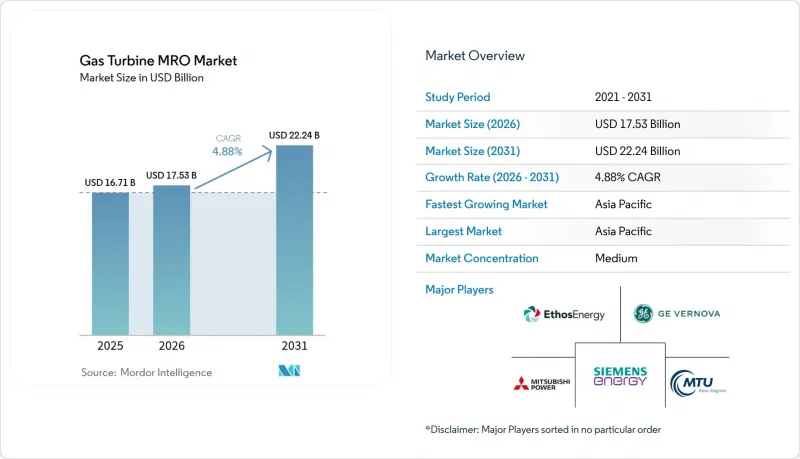
根據 Mordor Intelligence 預測,燃氣渦輪機MRO 市場規模將從 2025 年的 167.1 億美元成長到 2026 年的 175.3 億美元,然後在 2031 年達到 222.4 億美元,2026 年至 2031 年的複合成長率為 4.88%。
本報告按容量(30MW 以下、31-120MW、120MW 以上)、渦輪循環(聯合循環、開式/簡單迴圈)、服務類型(維護、修理、大修)、最終用戶行業(發電、石油和天然氣、工業及其他)和地區(北美、歐洲、亞太、南美、中東和非洲)進行分類。
全球燃氣渦輪機MRO市場趨勢與洞察
全球老化的渦輪機加速了定期進行大規模大修的需求。
全球約有7,000台GE Vernova燃氣渦輪機正接近其轉子延壽週期的終點,這導致高溫燃氣通道零件更換、控制系統升級和金屬化層大修的需求激增,這些改造可以將燃氣渦輪機的運作延長10至15年。在90年代北美和歐洲能源繁榮時期安裝的F級機組,如今為了彌補可再生能源的波動性,正以更高的容量利用率運作,這進一步加速了磨損。像EthosEnergy這樣的服務專家正在為GE的B/E/F系列機組和較老的西屋機組開發客製化的轉子重建方案,這凸顯了高度專業化技術的重要性。業主們越來越傾向於將大修視為能夠提高發電量的資本投資,而不僅僅是日常開支。這是因為效率的逐步提升可以在剩餘的生命週期中降低燃料消耗和排放。
為確保售後市場收入,OEM廠商需簽訂長期服務合約。
長期服務協議 (LTSA) 已發展成為為期 15 至 25 年的績效基本契約,涵蓋零件供應、人事費用、數位化監控和性能保證,約佔 GE Vernova 燃氣發電收入的 70%。 EthosEnergy 與法國電力公司 (EDF) 簽署的多年期契約,為法國及其屬地提供 20 台大型燃氣渦輪機,清晰地展示了一種機制,該機制使電力公司能夠對沖成本波動風險,同時確保原始設備製造商 (OEM) 獲得可預測的現金流。與當地通膨率掛鉤的遞增條款保障了利潤率,而基於雲端的分析技術則能夠實現早期故障檢測,從而減少 20% 至 30% 的停機時間。
由於天然氣價格波動,保養週期將會縮短。
2024年,TTF天然氣價格在歐洲主要交易所飆升至100歐元/兆瓦時以上,促使營運商降低燃氣發電廠的發電量並延長維護週期。結果,零件的即時需求下降,服務公司的收入也隨之延遲。目前,MRO(維護、維修和大修)服務提供者正在合約中加入靈活的數量條款,以緩解運轉率波動的影響。
細分市場分析
2025年,功率超過120兆瓦的大型燃氣渦輪機佔燃氣渦輪機MRO市場收入的57.60%。這主要是由於其複雜的高溫燃氣通道和較長的停機時間(有時超過50天)。這些機組是聯合循環發電系統的核心部件,由於效率每提高1個百分點就能顯著節省燃料,因此業主在檢修期間擴大採用最先進的塗層和葉尖間隙升級技術。同時,31-120兆瓦的燃氣渦輪機市場成長最快,複合年成長率達6.45%,這主要得益於資料中心和工業汽電共生專案對尖峰發電容量的需求不斷成長,這些專案優先考慮航空衍生機型的靈活性。在該市場,模組化更換策略可以將停機時間縮短至10天以內,但運作次數的增加也導致了更頻繁的檢查。
30兆瓦以下的小型燃氣渦輪機為離網採礦、偏遠油氣設施以及醫院和機場的備用電源提供支援。雖然單一設備的檢修成本不高,但龐大的機組數量卻帶來了龐大的整體工作量。 MRO(維修、維修和大修)服務商透過貨櫃式行動維修車間脫穎而出,這些車間避免了高成本的起重機運輸,並可在現場進行熱端零件更換。
到2025年,聯合循環設備將佔據燃氣渦輪機MRO市場佔有率的85.20%,這不僅反映了其龐大的機組數量,也反映了其多模組結構增加了每個電廠可維護資產的數量。聯合停機檢修作業的範圍,例如HRSG管束檢查、蒸氣渦輪閥門維修和冷凝器清洗,遠不止燃氣渦輪機的核心部件,通常需要同步專案管理以避免進度延誤。因此,服務供應商正在提供端到端的解決方案,並將分包商協調到一個負責電氣、機械和建築基礎設施(BOP)工作的單一實體下。
開式循環/簡單迴圈發電設施以5.65%的複合年成長率快速成長,在優先考慮快速啟動能力而非效率的情況下,可為電網調節和工業備用電源提供尖峰電力。其結構簡單,可減少停機時間,但高負載啟動會加劇熱應力。因此,維護、維修和大修 (MRO) 合約強調基於啟動次數和頻繁內視鏡檢查的壽命管理。
區域分析
亞太地區佔主導市場佔有率,主要得益於聯合循環發電廠的持續部署、工業電氣化以及政府旨在以低碳基本負載電源取代煤炭的政策。位於達曼、吉隆坡和上海的區域性原始設備製造商(OEM)倉庫儲備了關鍵的高溫氣體通道零件,顯著減少了海關延誤,並將平均停機時間縮短了10%。服務供應商也與國有電力公司合作,共同開發氫能先導計畫,確保在獲得脫碳資金時擁有先發優勢。
在北美,由於豐富的頁岩氣資源,燃料成本保持在較低水平,因此維修老舊渦輪機組而非除役是合理的。在美國,資料中心的高峰響應項目(其服務水準相當於飛機維護)進一步加劇了這種情況,其中包括保證在計劃外停機後四小時內做出回應。在加拿大一家液化天然氣出口終端,由壓縮機驅動的渦輪機暴露在海鹽空氣中,需要頻繁更換進氣過濾器。
在歐洲,天然氣價格波動不定,且嚴格的ESG(環境、社會和治理)法規正在實施。營運商正致力於提升設備效率以抵消碳排放稅負擔,因此延長設備壽命在經濟上至關重要。為此,原始設備製造商(OEM)將符合歐盟分類標準的燃燒器組件打包出售,以便於資金籌措,並認證其可使用高達50%的氫氣。現場服務人員短缺問題依然嚴峻,服務供應商正利用行動貨櫃式維修車間和遠端專家支援來補充人員,並在電網調整的緊迫時限內維持停機檢修計劃。
在中東,重點在於煉油廠和綜合性長期汽電共生計畫的擴建。這些電廠的運作負載率很高,因此每三年進行一次精心策劃的大規模停機檢修至關重要。原始設備製造商(OEM)正在建立現場高溫維修設施,以便進行維修,滿足本地化配額要求。在非洲快速成長但較為分散的市場中,重點是簡單迴圈尖峰負載和緊急發電機,並採用模組化更換策略來最大限度地減少備件庫存。
在南美洲,儘管天然氣資源的發現為新建燃氣複合循環發電廠提供了充足的能源,但仍有大量現有的小規模工業燃氣渦輪機需要維護。原始設備製造商(OEM)正在哥倫比亞和智利建立區域零件中心,以縮短前置作業時間並避免海關延誤,力爭實現一級零件24小時內出貨。
其他好處
- Excel格式的市場預測(ME)表
- 3個月的分析師支持
目錄
第1章:引言
- 研究假設和市場定義
- 調查範圍
第2章:調查方法
第3章執行摘要
第4章 市場狀況
- 市場概覽
- 市場促進因素
- 全球老化的渦輪機加速了定期進行大規模大修的需求。
- 簽訂長期OEM服務契約,以確保售後市場收入
- 新興國家聯合循環發電廠的擴張
- 利用飛機渦輪機的資料中心的高峰需求
- 氫燃料相容維修計畫正在加速零件升級。
- 人工智慧驅動的預測性維護正在推動服務使用量的增加。
- 市場限制因素
- 由於天然氣價格波動,檢查所需的運作時間縮短了。
- 可再生能源取代基本負載燃氣發電
- 全球認證GT服務技術人員短缺
- 關於氫燃料混合物的法規存在模糊之處,導致維修計畫延誤。
- 供應鏈分析
- 監理情勢
- 技術展望
- 波特五力模型
第5章 市場規模與成長預測
- 按產能
- 30兆瓦或以下
- 31~120MW
- 超過120兆瓦
- 通過渦輪循環
- 複合循環
- 開放式/簡單迴圈
- 按服務類型
- 維護
- 維修
- 大修
- 按最終用戶行業分類
- 發電
- 石油和天然氣(上游/中游/下游)
- 工業及其他
- 按地區
- 北美洲
- 美國
- 加拿大
- 墨西哥
- 歐洲
- 德國
- 英國
- 法國
- 義大利
- 北歐國家
- 俄羅斯
- 其他歐洲國家
- 亞太地區
- 中國
- 印度
- 日本
- 韓國
- 東南亞國協
- 其他亞太國家
- 南美洲
- 巴西
- 阿根廷
- 其他南美國家
- 中東和非洲
- 沙烏地阿拉伯
- 阿拉伯聯合大公國
- 南非
- 埃及
- 其他中東和非洲國家
- 北美洲
第6章 競爭情勢
- 市場集中度
- 策略趨勢(併購、聯盟、購電協議)
- 市場佔有率分析(主要公司的市場排名和佔有率)
- 公司簡介
- General Electric(GE Vernova)
- Siemens Energy
- Mitsubishi Power
- MTU Aero Engines
- EthosEnergy
- Kawasaki Heavy Industries
- Ansaldo Energia
- Solar Turbines
- Baker Hughes
- Sulzer
- Rolls-Royce
- RWG(Rolls-Wood Group)
- Patria
- Harbin Electric International
- Bharat Heavy Electricals
- MAN Energy Solutions
- Pratt & Whitney
- Vericor Power Systems
- Wood Group
- Taqa Arabia Services
第7章 市場機會與未來展望
According to Mordor Intelligence, the gas turbine MRO market size is expected to grow from USD 16.71 billion in 2025 to USD 17.53 billion in 2026 and is forecast to reach USD 22.24 billion by 2031 at 4.88% CAGR over 2026-2031.
This report is Segmented by Capacity (Below 30 MW, 31 To 120 MW, and Above 120 MW), Turbine Cycle (Combined Cycle and Open/Simple Cycle), Service Type (Maintenance, Repair, and Overhaul), End-User Industry (Power Generation, Oil and Gas, and Industrial and Other), and Geography (North America, Europe, Asia-Pacific, South America, and Middle East and Africa).
Global Gas Turbine MRO Market Trends and Insights
Aging Global Fleet Driving Scheduled Major Overhauls
Roughly 7,000 GE Vernova turbines worldwide are entering rotor-life extension windows, triggering an upsurge in hot-gas-path component swaps, control upgrades, and metallurgy overhauls that can add 10-15 years of service life. F-class units installed during the 1990s boom in North America and Europe now operate at higher capacity factors to support renewable variability, further accelerating wear. Service specialists such as EthosEnergy deploy bespoke rotor rebuild programs for GE B/E/F and legacy Westinghouse frames, underscoring the depth of niche expertise required. Owners are increasingly treating overhauls as capital investments tied to performance uprates, rather than routine expenses, because incremental efficiency gains reduce fuel burn and emissions over the remaining life cycle.
OEM Long-Term Service Agreements Ensuring Aftermarket Revenues
LTSAs have matured into 15 to 25-year, outcome-based pacts that bundle parts supply, labor, digital monitoring, and performance guarantees-representing about 70% of GE Vernova's gas-power revenue stream. EthosEnergy's multi-year master agreement with EDF, covering 20 heavy-duty turbines across France and its territories, illustrates how utilities hedge against cost volatility while OEMs lock in predictable cash flow. Escalator clauses keyed to local inflation protect margins, and cloud-based analytics enable early-fault detection, which trims outage duration by 20-30%.
Gas-Price Volatility Lowering Run-Hours Between Services
European hubs saw TTF gas spike above EUR 100/MWh in 2024, prompting operators to curtail gas-fired output and stretch maintenance intervals, which reduced immediate parts demand and deferred revenue for service firms. MRO providers now include flexible volume clauses in contracts to mitigate utilization fluctuations.
Other drivers and restraints analyzed in the detailed report include:
- Expansion of Combined-Cycle Plants in Emerging Economies
- Data-Center Peaker Demand for Aeroderivative Turbines
- Renewable-Energy Displacement of Baseload Gas Generation
For complete list of drivers and restraints, kindly check the Table Of Contents.
Segment Analysis
Large-frame machines, those above 120 MW, generated 57.60% of the 2025 gas turbine MRO market revenue, buoyed by complex hot-gas-path work scopes and extensive outage durations that can exceed 50 days. These units anchor combined-cycle blocks where every percentage-point efficiency gain drives significant fuel savings, encouraging owners to adopt cutting-edge coatings and tip-clearance upgrades during overhauls. The 31-120 MW bracket, however, is the fastest-growing segment at a 6.45% CAGR, driven by data-center peaker additions and industrial cogeneration projects that favor aeroderivative agility. Here, modular swap strategies trim downtime to under 10 days, but higher start counts inflate inspection frequency.
Smaller turbines, those below 30 MW, support off-grid mining, remote oil and gas facilities, and backup duties for hospitals and airports. Although the individual overhaul value is lower, fleet numbers generate meaningful aggregate work. MRO providers differentiate via containerized mobile workshops that execute hot-section exchanges on-site, sidestepping costly crane logistics.
Combined-cycle equipment captured 85.20% of the 2025 gas turbine MRO market share, reflecting both its extensive fleet footprint and the multi-module architecture that increases the number of serviceable assets per plant. HRSG tube inspection, steam-turbine valve refurbishment, and condenser cleaning compound outage scope extend beyond the gas-turbine core, often requiring synchronized project management to avoid schedule slips. Service providers thus package end-to-end solutions, coordinating subcontractors for electrical, mechanical, and balance-of-plant tasks under single-point accountability.
Open/simple-cycle sets, expanding at a 5.65% CAGR, provide grid-balancing peaking power and industrial back-up where quick-start capability outweighs efficiency. Their straightforward architecture lowers outage duration, but high-impact starts worsen thermal stress. MRO contracts, therefore, emphasize start-based life management and frequent borescopic inspections.
Complete Report Scope:
- By Capacity
- Below 30 MW
- 31 to 120 MW
- Above 120 MW
- By Turbine Cycle
- Combined Cycle
- Open/Simple Cycle
- By Service Type
- Maintenance
- Repair
- Overhaul
- By End-user Industry
- Power Generation
- Oil and Gas (Up-/Mid-/Down-stream)
- Industrial and Other
- By Geography
- North America
- United States
- Canada
- Mexico
- Europe
- Germany
- United Kingdom
- France
- Italy
- NORDIC Countries
- Russia
- Rest of Europe
- Asia-Pacific
- China
- India
- Japan
- South Korea
- ASEAN Countries
- Rest of Asia-Pacific
- South America
- Brazil
- Argentina
- Rest of South America
- Middle East and Africa
- Saudi Arabia
- United Arab Emirates
- South Africa
- Egypt
- Rest of Middle East and Africa
- North America
Geography Analysis
The Asia-Pacific's dominant share stems from the sustained rollout of combined-cycle power plants, industrial electrification, and government mandates that aim for lower-carbon baseload alternatives to coal. Regional OEM depots in Dammam, Kuala Lumpur, and Shanghai stock critical hot-gas-path parts, slashing customs delays and cutting average outage length by 10%. Service providers also align with state utilities to co-develop hydrogen-ready pilot projects, ensuring an early-mover advantage as decarbonization funds become available.
North America benefits from abundant shale gas, which keeps fuel costs low enough to justify refurbishing legacy frames rather than retiring them. The United States adds complexity through data-center peaker projects that adopt service levels akin to those in aviation maintenance, including a guaranteed four-hour maximum unscheduled-outage response. Canada's LNG export terminals rely on compressor-drive turbines that face marine-salt-laden air, necessitating aggressive inlet-filter replacement cycles.
Europe confronts volatile gas pricing and stringent ESG rules. Operators pivot toward high-efficiency upgrades to offset carbon tax exposure, making life extension work an economic imperative. OEMs thus bundle combustor kits certified for up to 50% hydrogen, aligning with EU taxonomy thresholds that unlock financing. Field-service staffing shortages remain acute; providers augment their crews with mobile container workshops and remote expert support to maintain outage schedules within tight grid-balancing windows.
The Middle East leans on long-term cogeneration complexes integrated with refinery expansions. These plants run at high load factors, dictating well-planned major outages every three years. OEMs open repair-capable hot-section workshops in-country to satisfy localization quotas. Africa's fast-growing but fragmented market focuses on simple-cycle peakers and emergency units where modular swap-out strategies minimize spares inventory.
South America capitalizes on natural-gas discoveries that feed new CCGTs yet retains a large legacy of smaller industrial turbines. OEMs establish regional parts hubs in Colombia and Chile to reduce lead times and circumvent customs bottlenecks, aiming for 24-hour shipping for Tier-1 items.
- General Electric (GE Vernova)
- Siemens Energy
- Mitsubishi Power
- MTU Aero Engines
- EthosEnergy
- Kawasaki Heavy Industries
- Ansaldo Energia
- Solar Turbines
- Baker Hughes
- Sulzer
- Rolls-Royce
- RWG (Rolls-Wood Group)
- Patria
- Harbin Electric International
- Bharat Heavy Electricals
- MAN Energy Solutions
- Pratt & Whitney
- Vericor Power Systems
- Wood Group
- Taqa Arabia Services
Additional Benefits:
- The market estimate (ME) sheet in Excel format
- 3 months of analyst support
TABLE OF CONTENTS
1 Introduction
- 1.1 Study Assumptions & Market Definition
- 1.2 Scope of the Study
2 Research Methodology
3 Executive Summary
4 Market Landscape
- 4.1 Market Overview
- 4.2 Market Drivers
- 4.2.1 Aging global fleet driving scheduled major overhauls
- 4.2.2 OEM long-term service agreements ensuring aftermarket revenues
- 4.2.3 Expansion of combined-cycle plants in emerging economies
- 4.2.4 Data-center peaker demand for aero-derivative turbines
- 4.2.5 Hydrogen-ready retrofit programs prompting part upgrades
- 4.2.6 AI-enabled predictive maintenance boosting service uptake
- 4.3 Market Restraints
- 4.3.1 Gas-price volatility lowering run-hours between services
- 4.3.2 Renewable-energy displacement of baseload gas generation
- 4.3.3 Global shortage of certified GT maintenance technicians
- 4.3.4 Regulatory ambiguity on H2 blends delaying overhaul plans
- 4.4 Supply-Chain Analysis
- 4.5 Regulatory Landscape
- 4.6 Technological Outlook
- 4.7 Porter's Five Forces
- 4.7.1 Bargaining Power of Suppliers
- 4.7.2 Bargaining Power of Consumers
- 4.7.3 Threat of New Entrants
- 4.7.4 Threat of Substitutes
- 4.7.5 Intensity of Competitive Rivalry
5 Market Size & Growth Forecasts
- 5.1 By Capacity
- 5.1.1 Below 30 MW
- 5.1.2 31 to 120 MW
- 5.1.3 Above 120 MW
- 5.2 By Turbine Cycle
- 5.2.1 Combined Cycle
- 5.2.2 Open/Simple Cycle
- 5.3 By Service Type
- 5.3.1 Maintenance
- 5.3.2 Repair
- 5.3.3 Overhaul
- 5.4 By End-user Industry
- 5.4.1 Power Generation
- 5.4.2 Oil and Gas (Up-/Mid-/Down-stream)
- 5.4.3 Industrial and Other
- 5.5 By Geography
- 5.5.1 North America
- 5.5.1.1 United States
- 5.5.1.2 Canada
- 5.5.1.3 Mexico
- 5.5.2 Europe
- 5.5.2.1 Germany
- 5.5.2.2 United Kingdom
- 5.5.2.3 France
- 5.5.2.4 Italy
- 5.5.2.5 NORDIC Countries
- 5.5.2.6 Russia
- 5.5.2.7 Rest of Europe
- 5.5.3 Asia-Pacific
- 5.5.3.1 China
- 5.5.3.2 India
- 5.5.3.3 Japan
- 5.5.3.4 South Korea
- 5.5.3.5 ASEAN Countries
- 5.5.3.6 Rest of Asia-Pacific
- 5.5.4 South America
- 5.5.4.1 Brazil
- 5.5.4.2 Argentina
- 5.5.4.3 Rest of South America
- 5.5.5 Middle East and Africa
- 5.5.5.1 Saudi Arabia
- 5.5.5.2 United Arab Emirates
- 5.5.5.3 South Africa
- 5.5.5.4 Egypt
- 5.5.5.5 Rest of Middle East and Africa
- 5.5.1 North America
6 Competitive Landscape
- 6.1 Market Concentration
- 6.2 Strategic Moves (M&A, Partnerships, PPAs)
- 6.3 Market Share Analysis (Market Rank/Share for key companies)
- 6.4 Company Profiles (includes Global level Overview, Market level overview, Core Segments, Financials as available, Strategic Information, Products & Services, and Recent Developments)
- 6.4.1 General Electric (GE Vernova)
- 6.4.2 Siemens Energy
- 6.4.3 Mitsubishi Power
- 6.4.4 MTU Aero Engines
- 6.4.5 EthosEnergy
- 6.4.6 Kawasaki Heavy Industries
- 6.4.7 Ansaldo Energia
- 6.4.8 Solar Turbines
- 6.4.9 Baker Hughes
- 6.4.10 Sulzer
- 6.4.11 Rolls-Royce
- 6.4.12 RWG (Rolls-Wood Group)
- 6.4.13 Patria
- 6.4.14 Harbin Electric International
- 6.4.15 Bharat Heavy Electricals
- 6.4.16 MAN Energy Solutions
- 6.4.17 Pratt & Whitney
- 6.4.18 Vericor Power Systems
- 6.4.19 Wood Group
- 6.4.20 Taqa Arabia Services
7 Market Opportunities & Future Outlook
- 7.1 White-space & Unmet-Need Assessment

 燃氣渦輪機MRO市場:按服務類型、供應商類型和地區分類
 亞太地區燃氣渦輪機維護、修理和大修 (MRO):市場佔有率分析、行業趨勢和統計數據、成長預測 (2026-2031)
 全球燃氣渦輪機MRO市場:市場規模、佔有率、成長率、產業分析、依類型、應用和地區劃分的分析、未來預測(2026-2034)
 燃氣渦輪機MRO市場-全球產業規模、佔有率、趨勢、機會及預測(依技術、最終用戶、地區及競爭格局分類,2021-2031年預測)
 燃氣渦輪機MRO市場規模、佔有率和成長分析(按產能、類型、技術、終端用戶產業和地區分類)-產業預測(2026-2033年)
 電力產業燃氣渦輪機MRO的全球市場
 2032 年燃氣渦輪機MRO 市場預測:按供應商類型、服務類型、產能、技術、最終用戶和地區進行的全球分析全球燃氣渦輪機MRO市場電力產業的燃氣渦輪機MRO:市場佔有率分析、產業趨勢與統計、成長預測(2025-2030 年)中東電力產業的燃氣渦輪機MRO:市場佔有率分析、產業趨勢與統計、成長預測(2025-2030 年)