


 |
市場調查報告書
商品編碼
1939039
亞太地區燃氣渦輪機維護、修理和大修 (MRO):市場佔有率分析、行業趨勢和統計數據、成長預測 (2026-2031)Asia-Pacific Gas Turbine MRO - Market Share Analysis, Industry Trends & Statistics, Growth Forecasts (2026 - 2031) |
||||||

※ 本網頁內容可能與最新版本有所差異。詳細情況請與我們聯繫。
2025年亞太地區燃氣渦輪機維護、修理和大修(MRO)市場價值為86.8億美元,預計到2031年將達到116.4億美元,高於2026年的91.1億美元。
預計在預測期(2026-2031 年)內,複合年成長率將達到 5.01%。
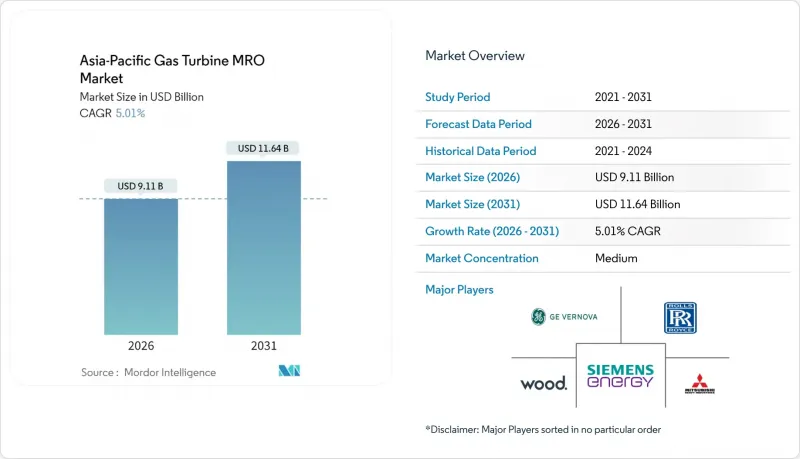
飛機老化導致的維修需求不斷成長、氫動力升級套件的快速普及以及大規模數位雙胞胎技術的部署,都支撐了近期的市場需求。獨立服務供應商正在擴大其零件製造商核准(PMA)範圍,從而降低面臨資金限制的營運商的維修成本。熱端鑄件供應鏈的瓶頸迫使電力公司尋求多個關鍵零件來源,推動了對區域鑄造產能的投資。同時,中國和印度的煤改氣政策促進了長期服務協議(LTSA)的簽訂,確保了多年的維護收入。最後,資料中心電力需求的激增顯著增加了航空衍生引擎的維修次數,並擴大了高可用性、快速啟動機組的服務覆蓋範圍。
亞太地區燃氣渦輪機MRO市場趨勢及展望
亞太地區老舊汽輪機機組達10萬小時大修里程碑
在2000年代業界繁榮時期安裝的數千台機組如今已達到10萬運作小時(EOH)里程碑,這是一個關鍵階段,需要對熱氣通道進行全面維修。中國和印度的業者面臨相當於新建設成本19%至33%的維修成本,這導致許多業者延後資本更換,並透過實施逆向工程和剩餘壽命延長技術來降低支出。隨著資產所有者尋求比原廠(OEM)方案更具成本效益的替代方案,專注於轉子壽命延長的獨立服務公司正在贏得新的訂單。
中國和印度的煤改氣推動了新的長期服務協議(LTSA)的簽訂。
儘管到2024年天然氣發電量僅佔中國總發電量的3%,但北京已簽署每年2700萬噸液化天然氣(LNG)的契約,以支持其能源轉型戰略。作為回應,電力生產商正在簽署6至12年的長期維護協議(LTSA),以穩定維護現金流,並確保電網日益成長的運轉率指標。印度也出現了類似的趨勢,隨著市場自由化,國有和私營電力公司都在轉向簽訂包含績效保證的綜合服務合約。
可再生能源的間歇性會減少基本負載運作時間
隨著太陽能和風能發電裝置容量的成長,聯合循環燃氣渦輪機正擴大從主要動力源轉向循環運作。頻繁的啟動停止會增加熱應力,加速零件疲勞。這導致燃燒室和密封件的更換需求相對高於使用壽命較長的旋轉設備。
細分市場分析
目前,120兆瓦以上的燃氣渦輪機佔亞太地區MRO(維護、維修和大修)支出的51.78%,並以每年5.52%的最快速度成長。業者看重這些大型機組的規模經濟和高熱效率,即使燃料價格波動,也能維持較低的單位電力成本。泰國的5,300兆瓦聯合循環發電廠(由8台M701JAC機組組成)是這一趨勢的例證,該電廠在運行10萬小時後仍保持著約64%的效率。 120兆瓦以下的燃氣渦輪機仍然很重要,尤其是在快速工業化的東南亞國協,它們在汽電共生、分散式發電和尖峰負載響應方面發揮重要作用,但其成長速度較慢。大型機組的檢修週期為每2.4萬至3萬小時,通常成本相當於新機價格的19%至33%。然而,營運商擴大透過訂購氫能升級改造來抵消這部分成本,這些改造既能保持效率,又能減少排放。
聯合循環電廠佔該地區維護、維修和大修 (MRO) 收入的 68.42%,預計到 2031 年將以每年 5.88% 的速度成長。其優點顯而易見:將燃氣渦輪機與蒸氣底循環結合,可將熱效率提升至 64% 以上,遠優於單循環設備。近期的一些建設案例,例如中國的光明計劃,表明這些電廠無需進行重大設計變更即可實現氫氣混燒,從而在支持脫碳計劃的同時,保持電網的柔軟性。單循環電廠仍然佔據著一定的市場地位,其快速啟動和低資本成本的優勢超過了燃料消耗,但長期業務收益有限。聯合循環電廠營運商主要依賴 6 至 12 年的服務契約,這些合約涵蓋零件、人事費用和性能保證,簡化了預算編制,並有助於實現運轉率目標。
亞太地區燃氣渦輪機MRO市場報告按容量(小於30兆瓦、31-120兆瓦和大於120兆瓦)、渦輪循環(聯合循環和開式/簡單迴圈)、服務類型(維護、修理和大修)、最終用戶行業(發電、石油和天然氣、工業和其他)以及地區(中國、印度、日本、韓國、東南亞國協、澳大利亞和其他地區進行其他細分國家)。
其他福利:
- Excel格式的市場預測(ME)表
- 3個月的分析師支持
目錄
第1章 引言
- 研究假設和市場定義
- 調查範圍
第2章調查方法
第3章執行摘要
第4章 市場情勢
- 市場概覽
- 市場促進因素
- 亞太地區老舊汽輪機機組接近10萬小時大修閾值
- 中國和印度的煤改氣推動了新的長期服務協議的簽訂。
- OEM的數位雙胞胎技術可將非計劃性停機時間減少15%以上
- 資料中心高峰需求激增導致航空衍生引擎維修車間訪問量增加
- 氫燃料相容升級套件便於進行中期檢查
- 市場限制
- 可再生能源的間歇性限制了基本負載運作時間
- 全球熱型材鑄件短缺導致備件前置作業時間延長
- 東協地區熟練工程師短缺問題日益嚴峻。
- PMA零件會損害OEM保固的經濟效益。
- 供應鏈分析
- 技術展望
- 監管環境
- 波特五力模型
- 供應商的議價能力
- 買方的議價能力
- 新進入者的威脅
- 替代品的威脅
- 競爭對手之間的競爭
第5章 市場規模與成長預測
- 按產能
- 小於30兆瓦
- 31~120MW
- 超過120兆瓦
- 通過渦輪循環
- 複合循環
- 開式循環/簡單循環
- 按服務類型
- 維護
- 維修
- 大修
- 按最終用戶行業分類
- 發電
- 石油和天然氣(上游/中游/下游)
- 工業及其他
- 按地區
- 中國
- 日本
- 印度
- 韓國
- 東南亞國協
- 澳洲和紐西蘭
- 亞太其他地區
第6章 競爭情勢
- 市場集中度
- 策略性舉措(併購、夥伴關係、購電協議)
- 市場佔有率分析(主要企業的市場排名和佔有率)
- 公司簡介
- General Electric(GE Vernova)
- Siemens Energy
- Mitsubishi Heavy Industries
- Rolls-Royce
- MTU Aero Engines
- John Wood Group
- EthosEnergy
- Ansaldo Energia
- Sulzer
- Doosan Enerbility
- Kawasaki Heavy Industries
- Harbin Electric
- Shanghai Electric
- Toshiba Energy Systems
- Bharat Heavy Electricals(BHEL)
- Power Machines
- Fluor
- Bechtel
- MAN Energy Solutions
- Wartsila
第7章 市場機會與未來展望
The Asia-Pacific Gas Turbine MRO Market was valued at USD 8.68 billion in 2025 and estimated to grow from USD 9.11 billion in 2026 to reach USD 11.64 billion by 2031, at a CAGR of 5.01% during the forecast period (2026-2031).
Heightened overhaul activity as fleets age, rapid adoption of hydrogen-ready upgrade kits, and large-scale digital twin roll-outs anchor near-term demand. Independent service providers are expanding parts-manufacturer-approval (PMA) portfolios, lowering overhaul costs for operators that face capital constraints. Supply-chain bottlenecks in hot-section castings are prompting utilities to dual-source critical components, spurring regional investments in foundry capacity. Meanwhile, switch-overs from coal to gas in China and India underpin long-term service-agreement (LTSA) signings, locking in multi-year maintenance revenues. Finally, exponential data-center electricity demand pushes aeroderivative shop visits sharply higher, widening the addressable service pool for high-availability, quick-start units.
Asia-Pacific Gas Turbine MRO Market Trends and Insights
Aging APAC turbine fleet approaching 100 k EOH overhaul threshold
Thousands of units installed during the 2000s industrial boom are now hitting the 100,000 EOH mark, a milestone that compels full hot-gas-path refurbishment. Operators in China and India face overhaul bills ranging between 19% and 33% of new-build cost, an outlay many curb by deploying reverse-engineering and remaining-life-extension techniques that postpone capital replacement. Independent service firms specialising in rotor life rebuilds secure new work as asset owners pursue cost-effective alternatives to OEM programs.
Coal-to-gas shift in China & India drives new LTSA signings
Although gas produced just 3% of China's 2024 power, Beijing inked 27 million t per year LNG contracts to underpin its transition strategy. Generators respond by locking in 6- to 12-year LTSAs that stabilise maintenance cash flows and guarantee availability metrics that grids increasingly demand. A parallel pattern emerges in India as market liberalisation pushes state-run and private utilities toward bundled service deals featuring performance guarantees.
Renewable intermittency curtails baseload run-hours
As solar and wind capacity climbs, combined-cycle gas turbines increasingly swing from baseload to cycling duty. Frequent start-stops elevate thermal stresses, amplifying component fatigue and reshaping spares demand profiles toward more combustor and seal replacements relative to long-life rotors.
Other drivers and restraints analyzed in the detailed report include:
- OEM digital twins slash unplanned outages by >15%
- Data-center peaker demand spikes aeroderivative shop visits
- Global hot-section casting shortage inflates spare-part lead times
For complete list of drivers and restraints, kindly check the Table Of Contents.
Segment Analysis
Gas turbines rated above 120 MW now account for 51.78 % of Asia-Pacific's MRO spend and are expanding fastest at 5.52 % a year. Operators value these big machines for their scale economies and high thermal efficiency, which keeps unit-cost electricity low even as fuel prices fluctuate. Thailand's 5,300 MW complex, built around eight M701JAC units, illustrates the trend; those machines have already logged 100,000 operating hours while holding efficiency near 64 %. Below-120 MW turbines still matter, especially for cogeneration, distributed generation, and peaking duty in rapidly industrializing ASEAN nations, but their growth pace lags. Overhauls on large units fall every 24,000-30,000 hours and typically cost 19 %-33 % of a new machine, yet operators increasingly offset that expense by ordering hydrogen-ready upgrades that preserve efficiency while cutting emissions.
Combined-cycle plants generate 68.42 % of regional MRO revenue and should rise 5.88 % annually through 2031. The draw is simple: pairing a gas turbine with a steam bottoming cycle pushes thermal efficiency beyond 64 %, far better than a simple-cycle setup. Recent builds, China's Guangming project among them, show how these plants can co-fire hydrogen without major design changes, supporting decarbonization plans while preserving grid flexibility. Simple-cycle units still fill niche roles where fast starts and lower capital cost outweigh fuel burn, but they attract less long-term service revenue. Combined-cycle operators lean heavily on six- to twelve-year service agreements that bundle parts, labor, and performance guarantees-arrangements that simplify budgeting and sharpen availability targets.
The Asia-Pacific Gas Turbine MRO Market Report is Segmented by Capacity (Below 30 MW, 31 To 120 MW, and Above 120 MW), Turbine Cycle (Combined Cycle and Open/Simple Cycle), Service Type (Maintenance, Repair, and Overhaul), End-User Industry (Power Generation, Oil and Gas, and Industrial and Other), and Geography (China, India, Japan, South Korea, ASEAN Countries, Australia and New Zealand, and Rest of Asia-Pacific).
List of Companies Covered in this Report:
- General Electric (GE Vernova)
- Siemens Energy
- Mitsubishi Heavy Industries
- Rolls-Royce
- MTU Aero Engines
- John Wood Group
- EthosEnergy
- Ansaldo Energia
- Sulzer
- Doosan Enerbility
- Kawasaki Heavy Industries
- Harbin Electric
- Shanghai Electric
- Toshiba Energy Systems
- Bharat Heavy Electricals (BHEL)
- Power Machines
- Fluor
- Bechtel
- MAN Energy Solutions
- Wartsila
Additional Benefits:
- The market estimate (ME) sheet in Excel format
- 3 months of analyst support
TABLE OF CONTENTS
1 Introduction
- 1.1 Study Assumptions & Market Definition
- 1.2 Scope of the Study
2 Research Methodology
3 Executive Summary
4 Market Landscape
- 4.1 Market Overview
- 4.2 Market Drivers
- 4.2.1 Aging APAC turbine fleet approaching 100k EOH overhaul threshold
- 4.2.2 Coal-to-gas shift in China & India drives new LTSA signings
- 4.2.3 OEM digital twins slash unplanned outages by >15 %
- 4.2.4 Data-center peaker demand spikes aeroderivative shop visits
- 4.2.5 Hydrogen-ready upgrade kits trigger mid-life inspections
- 4.3 Market Restraints
- 4.3.1 Renewable intermittency curtails baseload run-hours
- 4.3.2 Global hot-section casting shortage inflates spare-part lead times
- 4.3.3 Skilled?technician gap widens in ASEAN
- 4.3.4 PMA parts disrupt OEM warranty economics
- 4.4 Supply-Chain Analysis
- 4.5 Technological Outlook
- 4.6 Regulatory Landscape
- 4.7 Porter's Five Forces
- 4.7.1 Bargaining Power of Suppliers
- 4.7.2 Bargaining Power of Buyers
- 4.7.3 Threat of New Entrants
- 4.7.4 Threat of Substitutes
- 4.7.5 Intensity of Competitive Rivalry
5 Market Size & Growth Forecasts
- 5.1 By Capacity
- 5.1.1 Below 30 MW
- 5.1.2 31 to 120 MW
- 5.1.3 Above 120 MW
- 5.2 By Turbine Cycle
- 5.2.1 Combined Cycle
- 5.2.2 Open/Simple Cycle
- 5.3 By Service Type
- 5.3.1 Maintenance
- 5.3.2 Repair
- 5.3.3 Overhaul
- 5.4 By End-user Industry
- 5.4.1 Power Generation
- 5.4.2 Oil and Gas (Up-/Mid-/Down-stream)
- 5.4.3 Industrial and Other
- 5.5 By Geography
- 5.5.1 China
- 5.5.2 Japan
- 5.5.3 India
- 5.5.4 South Korea
- 5.5.5 ASEAN Countries
- 5.5.6 Australia and New Zealand
- 5.5.7 Rest of Asia-Pacific
6 Competitive Landscape
- 6.1 Market Concentration
- 6.2 Strategic Moves (M&A, Partnerships, PPAs)
- 6.3 Market Share Analysis (Market Rank/Share for key companies)
- 6.4 Company Profiles (includes Global level Overview, Market level overview, Core Segments, Financials as available, Strategic Information, Products & Services, and Recent Developments)
- 6.4.1 General Electric (GE Vernova)
- 6.4.2 Siemens Energy
- 6.4.3 Mitsubishi Heavy Industries
- 6.4.4 Rolls-Royce
- 6.4.5 MTU Aero Engines
- 6.4.6 John Wood Group
- 6.4.7 EthosEnergy
- 6.4.8 Ansaldo Energia
- 6.4.9 Sulzer
- 6.4.10 Doosan Enerbility
- 6.4.11 Kawasaki Heavy Industries
- 6.4.12 Harbin Electric
- 6.4.13 Shanghai Electric
- 6.4.14 Toshiba Energy Systems
- 6.4.15 Bharat Heavy Electricals (BHEL)
- 6.4.16 Power Machines
- 6.4.17 Fluor
- 6.4.18 Bechtel
- 6.4.19 MAN Energy Solutions
- 6.4.20 Wartsila
7 Market Opportunities & Future Outlook
- 7.1 White-Space & Unmet-Need Assessment

 燃氣渦輪機MRO:市場佔有率分析、行業趨勢和統計數據、成長預測(2026-2031年)
 燃氣渦輪機MRO市場:按服務類型、供應商類型和地區分類
 全球燃氣渦輪機MRO市場:市場規模、佔有率、成長率、產業分析、依類型、應用和地區劃分的分析、未來預測(2026-2034)
 燃氣渦輪機MRO市場-全球產業規模、佔有率、趨勢、機會及預測(依技術、最終用戶、地區及競爭格局分類,2021-2031年預測)
 燃氣渦輪機MRO市場規模、佔有率和成長分析(按產能、類型、技術、終端用戶產業和地區分類)-產業預測(2026-2033年)
 電力產業燃氣渦輪機MRO的全球市場
 2032 年燃氣渦輪機MRO 市場預測:按供應商類型、服務類型、產能、技術、最終用戶和地區進行的全球分析全球燃氣渦輪機MRO市場電力產業的燃氣渦輪機MRO:市場佔有率分析、產業趨勢與統計、成長預測(2025-2030 年)中東電力產業的燃氣渦輪機MRO:市場佔有率分析、產業趨勢與統計、成長預測(2025-2030 年)