


 |
市場調查報告書
商品編碼
1939579
越南農作物保護化學品:市場佔有率分析、產業趨勢與統計、成長預測(2026-2031)Vietnam Crop Protection Chemicals - Market Share Analysis, Industry Trends & Statistics, Growth Forecasts (2026 - 2031) |
||||||

※ 本網頁內容可能與最新版本有所差異。詳細情況請與我們聯繫。
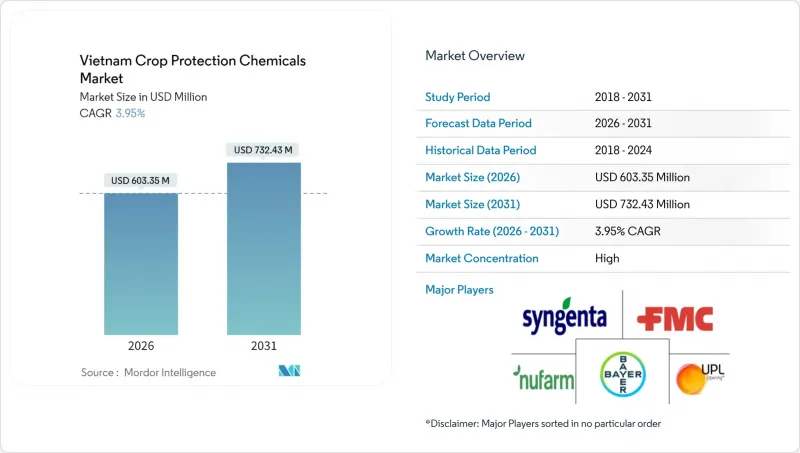
越南作物保護化學品市場預計將從 2025 年的 5.8042 億美元成長到 2026 年的 6.0335 億美元,預計到 2031 年將達到 7.3243 億美元,2026 年至 2031 年的複合年成長率為 3.95%。
出口機會的增加、農業的快速現代化以及氣候變遷導致的病蟲害壓力加劇,都在推動對傳統農藥和低殘留製劑的需求。全國範圍內向綜合蟲害管理(IPM)的轉變,即合成農藥與生物農藥的結合,促使知名品牌拓展產品線,而本土企業也在擴大其非專利產品線。同時,數位化合約農業平台透過簡化最後一公里配送、提高產品可追溯性以及將農民與品牌投入品連接起來,為越南農藥市場提供支援。儘管政府對米出口合規的補貼計劃、特色果園的擴張以及耐除草劑穀物種子的推廣都在擴大耕地面積,但假冒仿冒品產品貿易、更嚴格的殘留標準以及農村勞動力短缺等問題卻阻礙了市場成長。
越南農藥市場趨勢及分析
政府激勵措施以達到米出口品質標準
越南的農業出口策略正透過與品質掛鉤的財政獎勵推動農藥需求結構性轉變,這些措施獎勵符合國際標準的農民。農業與農村發展部發布的第01/2024/TT-BNNPTNT號通知規定,採用經認證的作物保護通訊協定的農民可獲得直接補貼,符合歐盟有機殘留標準的稻米可獲得高於市場價格15%的溢價。出口品質合規要求鼓勵採用生物和化學相結合的綜合蟲害管理通訊協定,從而為提供全面產品系列而非單一活性成分解決方案的公司拓展市場機會。
特色水果出口農場的快速擴張
特色水果種植正崛起為高附加價值產業,推動越南農業轉型。光是火龍果一項,預計到2024年出口額就將達28億美元,年增23%。中部高地和南部省份果園的擴張,催生了對專為熱帶水果生產客製化的殺菌劑和殺蟲劑的需求。在熱帶水果種植區,一次蟲害爆發就可能使價值數百萬美元的收成顆粒無收。中國、日本和韓國等高階水果出口市場嚴格的殘留標準要求精準把握噴灑時間和選擇合適的產品,迫使農民選擇價格更高、殘留更少的配方。從自給自足的農業生產轉向商業性果園管理的轉變,促使農民採用專業的作物保護方法,並傾向於選擇知名的國際品牌而非本地非專利。
假農藥貿易迅速成長
假農藥的湧入扼殺了合法市場的成長,它們以比正品低30%至50%的價格銷售劣質產品,造成不公平競爭,擠壓了整個產業的利潤空間。仿冒品的湧入在與中國和柬埔寨接壤的邊境地區尤為嚴重,跨境走私網路利用監管漏洞和執法資源匱乏牟利。仿冒品通常含有不準確的活性成分濃度或禁用物質,導致作物歉收,並削弱農民對化學農藥的信心。仿冒品的氾濫迫使合法生產商投入大量資金用於打擊仿冒品和農民教育項目,從而減少了可用於產品研發和市場拓展的資源。
細分市場分析
由於稻田持續潮濕,容易引發稻瘟病、紋枯病和葉斑病,預計2025年,殺菌劑將佔越南農藥市場價值的37.80%。儘管越南農藥市場中殺菌劑仍以三唑類和甲氧基丙烯酸酯類為主,但市場需求正轉向獲得出口核准的低殘留SDHI類複方製劑。受福壽螺引進越南15個新省份的推動,殺蝸牛劑將以6.48%的複合年成長率成長。為了在滿足殘留審核要求的同時保持藥效,農民擴大將甲醛替代品與生物餌劑結合使用。
殺線蟲劑雖然市佔率不大,但成長迅速,尤其在蔬菜種植區需求強勁,因為氣候變遷導致根結線蟲的危害日益嚴重。這種功能性產品組合反映了越南的作物結構,越南以水稻和特種作物為主,這些作物需要密集的病蟲害防治才能達到出口品質標準。由於根結線蟲的發生率不斷上升,小規模的細分市場,例如蔬菜種植區的殺線蟲劑,也正在作為利基市場擴張。作用機制輪替和抗性管理標籤方面的進步,為高價值多效製劑帶來了光明的前景。國際供應商主導取得專利的殺菌劑和殺蟲劑市場,而國內企業則在單效非專利除草劑市場蓬勃發展。
越南農藥市場報告按功能(殺菌劑、除草劑、殺蟲劑、殺螺劑等)、應用方法(化學灌溉、葉面噴布、燻蒸、種子處理等)和作物類型(經濟作物、水果和蔬菜、穀類、豆類和油籽等)進行細分。市場預測以價值(美元)和數量(公噸)為單位。
其他福利:
- Excel格式的市場預測(ME)表
- 3個月的分析師支持
目錄
第1章 引言
- 研究假設和市場定義
- 調查範圍
- 調查方法
第2章 報告
第3章執行摘要主要發現
第4章 主要產業趨勢
- 每公頃農藥用量
- 活性成分價格分析
- 法律規範
- 越南
- 價值鍊和通路分析
- 市場促進因素
- 政府激勵措施以達到米出口品質標準
- 為出口特色水果而迅速擴大果園規模
- 引進抗除草劑雜交稻米與玉米種子
- 合約農業平台的發展推動了投入品包裝的擴張
- 氣候變遷引發湄公河三角洲的蟲害壓力
- 利用數位科技的農業零售商網路
- 市場限制
- 假農藥貿易日益猖獗
- 歐盟和美國買家製定了嚴格的殘留標準
- 由於勞動力外流增加,農業勞動人口減少。
- 消費者對有機農產品的偏好日益成長
第5章 市場規模和成長預測(價值和數量)
- 功能
- 消毒劑
- 除草劑
- 殺蟲劑
- 殺軟體動物劑
- 殺線蟲劑
- 如何申請
- 化學灌溉
- 葉面噴布
- 燻蒸
- 種子處理
- 土壤處理
- 作物類型
- 經濟作物
- 水果和蔬菜
- 穀物和穀類
- 豆類和油籽
- 草坪和觀賞植物
第6章 競爭情勢
- 關鍵策略舉措公司
- 市佔率分析
- 公司概況
- 公司簡介
- BASF SE
- Bayer AG
- Corteva Agriscience
- FMC Corporation
- Nufarm Ltd
- Syngenta Group
- UPL Limited
- Wynca Group(Wynca Chemicals)
- Sumitomo Chemical Co.
- Albaugh LLC
- Loc Troi Group
- Hailir Group
- Nippon Soda Co., Ltd.
- Vietnam National Chemical Group-Vinachem
- Takeda Pharmaceutical Co.
第7章:CEO們需要思考的關鍵策略問題
The Vietnam crop protection chemicals market is expected to grow from USD 580.42 million in 2025 to USD 603.35 million in 2026 and is forecast to reach USD 732.43 million by 2031 at 3.95% CAGR over 2026-2031.
Mounting export opportunities, fast-modernizing farms, and climate-induced pest loads combine to propel demand for both conventional and low-residue formulations. A nationwide pivot toward integrated pest management that blends synthetic and biological solutions is encouraging established brands to widen portfolios while domestic players scale generic lines. In parallel, digital contract-farming platforms streamline last-mile delivery, improving product traceability and locking farmers into branded input packages that underpin the Vietnam crop protection chemicals market. Government subsidy programs for rice-export compliance, specialty fruit orchard expansion, and herbicide-tolerant grain seed adoption collectively enlarge addressable acres, while counterfeit trade, residue-limit tightening, and rural labor scarcity temper the growth curve.
Vietnam Crop Protection Chemicals Market Trends and Insights
Government Incentives for Rice-Export Quality Compliance
Vietnam's agricultural export strategy fundamentally reshapes crop protection demand through quality-linked financial incentives that reward farmers for meeting international standards. The Ministry of Agriculture and Rural Development's Circular 01/2024/TT-BNNPTNT establishes direct subsidies for farmers adopting certified crop protection protocols, with premium payments reaching 15% above market rates for rice meeting EU organic residue standards. Export quality compliance requirements drive adoption of integrated pest management protocols that combine biological and chemical solutions, expanding market opportunities for companies offering comprehensive product portfolios rather than single-active ingredient solutions.
Rapid Expansion of Specialty Fruit Export Orchards
Specialty fruit cultivation emerges as a high-value driver transforming Vietnam's agricultural landscape, with dragon fruit exports alone reaching USD 2.8 billion in 2024, representing 23% growth from previous year levels. Orchard expansion in the Central Highlands and southern provinces creates demand for specialized fungicides and insecticides tailored to tropical fruit production, where single pest outbreaks can destroy entire seasonal harvests worth millions of dollars. Premium fruit export markets in China, Japan, and South Korea enforce strict maximum residue limits that require sophisticated application timing and product selection, driving farmers toward higher-priced, low-residue formulations. The shift from subsistence farming to commercial orchard management introduces professional crop protection practices that favor established international brands over local generic products.
Escalating Counterfeit Pesticide Trade
Counterfeit pesticide infiltration undermines legitimate market growth by offering substandard products at prices 30-50% below authentic formulations, creating unfair competition that pressures profit margins across the industry. Border provinces with China and Cambodia experience particularly acute counterfeit penetration, where cross-border smuggling networks exploit regulatory gaps and limited enforcement resources. Counterfeit products often contain incorrect active ingredient concentrations or banned substances, leading to crop failures that damage farmer confidence in chemical crop protection methods. The proliferation of fake products forces legitimate manufacturers to invest heavily in anti-counterfeiting measures and farmer education programs, reducing resources available for product development and market expansion.
Other drivers and restraints analyzed in the detailed report include:
- Adoption of Herbicide-Tolerant Hybrid Rice and Corn Seeds
- Growth of Contract-Farming Platforms Driving Input Packages
- Stringent Residue Limits from European Union/United States Buyers
For complete list of drivers and restraints, kindly check the Table Of Contents.
Segment Analysis
Fungicides captured 37.80% of the 2025 value as perennial humidity in paddies breeds blast, sheath blight, and brown spot. The Vietnam crop protection chemicals market size for fungicides remains anchored by triazoles and strobilurins, yet demand migrates toward low-residue SDHI blends that win export approvals. Molluscicides, propelled by golden apple snail incursions into 15 new provinces, headline growth at 6.48% CAGR. Farmers increasingly integrate metaldehyde alternatives with biological baits to satisfy residue audits while preserving efficacy.
Nematicides represent a smaller but growing segment, particularly in vegetable production areas where root-knot nematode pressure intensifies under climate change conditions. The functional mix reflects Vietnam's crop portfolio emphasis on rice and specialty crops that require intensive disease and pest management to meet export quality standards. Minor segments, namely nematicides for vegetable zones, enjoy niche expansion as root-knot outbreaks rise. Advances in mode-of-action rotation and resistance-management labeling bolster prospects for premium multi-active packs. International suppliers dominate patented fungicide and insecticide niches, while local firms thrive in single-active herbicide generics.
The Vietnam Crop Protection Chemicals Market Report is Segmented by Function (Fungicide, Herbicide, Insecticide, Molluscicide, and More), Application Mode (Chemigation, Foliar, Fumigation, Seed Treatment, and More), and Crop Type (Commercial Crops, Fruits and Vegetables, Grains and Cereals, Pulses and Oilseeds, and More). The Market Forecasts are Provided in Terms of Value (USD) and Volume (Metric Tons).
List of Companies Covered in this Report:
- BASF SE
- Bayer AG
- Corteva Agriscience
- FMC Corporation
- Nufarm Ltd
- Syngenta Group
- UPL Limited
- Wynca Group (Wynca Chemicals)
- Sumitomo Chemical Co.
- Albaugh LLC
- Loc Troi Group
- Hailir Group
- Nippon Soda Co., Ltd.
- Vietnam National Chemical Group - Vinachem
- Takeda Pharmaceutical Co.
Additional Benefits:
- The market estimate (ME) sheet in Excel format
- 3 months of analyst support
TABLE OF CONTENTS
1 INTRODUCTION
- 1.1 Study Assumptions & Market Definition
- 1.2 Scope of the Study
- 1.3 Research Methodology
2 REPORT OFFERS
3 EXECUTIVE SUMMARY & KEY FINDINGS
4 KEY INDUSTRY TRENDS
- 4.1 Consumption Of Pesticide Per Hectare
- 4.2 Pricing Analysis For Active Ingredients
- 4.3 Regulatory Framework
- 4.3.1 Vietnam
- 4.4 Value Chain & Distribution Channel Analysis
- 4.5 Market Drivers
- 4.5.1 Government incentives for rice-export quality compliance
- 4.5.2 Rapid expansion of specialty fruit export orchards
- 4.5.3 Adoption of herbicide-tolerant hybrid rice and corn seeds
- 4.5.4 Growth of contract-farming platforms driving input packages
- 4.5.5 Climate-change-driven pest pressure in Mekong Delta
- 4.5.6 Digitally enabled last-mile agro-dealer networks
- 4.6 Market Restraints
- 4.6.1 Escalating counterfeit pesticide trade
- 4.6.2 Stringent residue limits from European Union/United States buyers
- 4.6.3 Rising labor migration shrinking farm labor pool
- 4.6.4 Increasing consumer preference for organic produce
5 MARKET SIZE AND GROWTH FORECASTS (VALUE AND VOLUME)
- 5.1 Function
- 5.1.1 Fungicide
- 5.1.2 Herbicide
- 5.1.3 Insecticide
- 5.1.4 Molluscicide
- 5.1.5 Nematicide
- 5.2 Application Mode
- 5.2.1 Chemigation
- 5.2.2 Foliar
- 5.2.3 Fumigation
- 5.2.4 Seed Treatment
- 5.2.5 Soil Treatment
- 5.3 Crop Type
- 5.3.1 Commercial Crops
- 5.3.2 Fruits & Vegetables
- 5.3.3 Grains & Cereals
- 5.3.4 Pulses & Oilseeds
- 5.3.5 Turf & Ornamental
6 COMPETITIVE LANDSCAPE
- 6.1 Key Strategic Moves
- 6.2 Market Share Analysis
- 6.3 Company Landscape
- 6.4 Company Profiles (Includes Global Level Overview, Market Level Overview, Core Business Segments, Financials, Key Information, Market Rank, Market Share, Products and Services, and Analysis of Recent Developments)
- 6.4.1 BASF SE
- 6.4.2 Bayer AG
- 6.4.3 Corteva Agriscience
- 6.4.4 FMC Corporation
- 6.4.5 Nufarm Ltd
- 6.4.6 Syngenta Group
- 6.4.7 UPL Limited
- 6.4.8 Wynca Group (Wynca Chemicals)
- 6.4.9 Sumitomo Chemical Co.
- 6.4.10 Albaugh LLC
- 6.4.11 Loc Troi Group
- 6.4.12 Hailir Group
- 6.4.13 Nippon Soda Co., Ltd.
- 6.4.14 Vietnam National Chemical Group - Vinachem
- 6.4.15 Takeda Pharmaceutical Co.
7 KEY STRATEGIC QUESTIONS FOR CROP PROTECTION CHEMICALS CEOS

 泰國作物保護化學品:市場佔有率分析、產業趨勢與統計及成長預測(2026-2031)
 作物保護化學品市場:2026-2032年全球市場預測(依產品類型、作物類型、施用方法、製劑形式及銷售管道)
 作物保護化學殺蟲劑市場預測至2034年-全球分析(按產品類型、產地、劑型、施用方法、作物類型、害蟲類型、通路和地區分類)永續作物保護市場預測至2034年—按產品類型、作物類型、應用、原料、最終用戶和地區分類的全球分析
 作物保護化學品市場機會、成長促進因素、產業趨勢分析及預測(2026-2035)作物保護化學品市場預測至2034年-按產品類型、作物類型、產地、配方、應用方法和地區分類的全球分析
 作物保護化學品市場規模、佔有率、趨勢和預測:按產品類型、產地、作物類型、劑型、應用方法和地區分類,2026-2034年
 農藥市場:依產地、類型、應用及地區分類
 作物保護化學品市場規模、佔有率和趨勢分析報告:按產品、應用、地區和細分市場分類(2026-2033 年)
 作物保護化學品市場規模、佔有率、成長率和全球市場分析:按類型、應用和地區分類,並預測至2026-2034年