


 |
市場調查報告書
商品編碼
2100748
亞太地區聚醚醚酮(PEEK):市場佔有率分析、產業趨勢與統計及成長預測(2026-2031)Asia-Pacific Polyether Ether Ketone (PEEK) - Market Share Analysis, Industry Trends & Statistics, Growth Forecasts (2026 - 2031) |
||||||

※ 本網頁內容可能與最新版本有所差異。詳細情況請與我們聯繫。
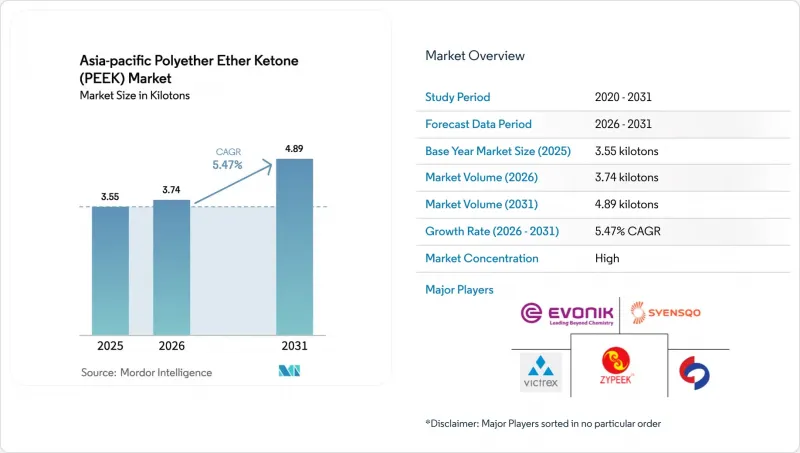
據 Mordor Intelligence 稱,2025 年亞太地區聚醚醚酮 (PEEK) 市場規模為 3.55 千噸,預計到 2031 年將從 2026 年的 3.74 千噸成長至 4.89 千噸,預測期(2026-2031 年)複合年成長率為 4.47%。
本報告按最終用戶產業(航太、汽車、電氣電子、工業機械及其他)、增強材料類型(未填充、玻璃纖維填充、碳填充及其他)和地區(中國、印度、日本、韓國、馬來西亞、澳洲及其他亞太地區)進行細分。市場預測以數量(噸)和價值(美元)兩種單位呈現。
亞太地區聚醚醚酮(PEEK)市場趨勢與洞察。
電子和半導體生產能力的快速擴張
在中國、韓國和日本的半導體晶圓廠,多條300毫米生產線正在興建中。每條生產線都需要消耗數噸超高純度PEEK材料,用於製造CMP固定環、晶圓托架和電漿蝕刻夾具。政府獎勵正在加速待開發區項目的推進,而晶圓廠設備製造商則因其在250 度C以上具有良好的熱穩定性以及在腐蝕性化學品環境下仍能保持尺寸不變而指定使用PEEK材料。 PEEK的介電性能也被用於汽車800V電動汽車逆變器的設計,進一步強化了汽車和半導體產業之間的協同需求。快速的運作計畫優先考慮本地樹脂供應,進一步加強了電子產業資本投資與亞太地區PEEK市場短期增產之間的連結。獲得無污染等級認證的材料供應商正在鞏固其認證地位,從而建立長期供應合約。
推動航太和汽車領域的減重
2023年,亞太地區的航空公司訂購了1,365架飛機,年增133%。每架單通道飛機的支架、管道和座椅結構中都使用了20-25公斤的PEEK材料,以降低油耗。中國、日本和韓國的電動車製造商正在使用碳纖維增強PEEK材料代替金屬,用於電池外殼和馬達絕緣,從而在不影響碰撞安全性的前提下,實現每輛車減重1-2公斤。據複合材料鋼板彈簧、熱失控防護罩和電力電子設備支架的標準材料,亞太地區的PEEK市場正向高利潤複合材料領域轉型。隨著亞洲航太產業保持兩位數成長,減重仍是推動產量持續成長的長期動力。
樹脂價格高昂,加工成本高昂
即使近期價格下降,未填充的PEEK樹脂的交易價格仍然是標準工程塑膠溢價的數倍。這是因為DFBP的合成需要高溫氟化和嚴格的濕度控制。射出成型成型商需將料筒溫度設定在400 度C以上,比聚醯胺注塑多消耗10-15%的能源。此外,改進的螺桿材料也增加了資本投資成本。價格敏感性阻礙了PEEK在通用外殼領域的應用,因此亞太地區的PEEK市場主要集中在性能和重量減輕足以抵消高成本的關鍵任務應用領域。產量較低的二級OEM廠商通常會等到樹脂價格波動穩定後再進行材料更換。雖然由於國內產量的增加,單位成本正在逐步下降,但成本仍然是阻礙PEEK廣泛替代其他材料的最緊迫因素。
細分市場分析
到2025年,工業和機械領域將以26.88%的市佔率佔據亞太地區PEEK市場的榜首。這主要得益於化學工廠維修和工廠自動化方面的投資,在這些領域,長壽命、自潤滑材料備受青睞。機器人、壓縮機密封件和離心式幫浦耐磨環等應用領域,停機成本遠高於樹脂本身較高的成本,是此類應用的典型例子。同時,預計到2031年,汽車零件將以5.99%的複合年成長率(CAGR)成為成長最快的領域。這是因為電動車動力傳動系統中的零件需要承受180°C至200°C的持續高溫以及高腐蝕性冷卻液,其性能遠超PPS和PA。 PEEK匯流排能夠承受800V的負載,同時保持輕盈和耐腐蝕性,而電池模組側板則能有效防止熱失控。
電子和半導體模具市場持續保持強勁的中個位數成長,為亞太地區PEEK市場奠定了堅實的基礎。航太領域依然是重要的策略立足點,而在醫療設備領域,諸如用於創傷螺絲的硫酸鋇複合PEEK等高利潤率特種產品的需求正在推動市場成長。在下游垂直市場,監管壁壘是主要障礙,樹脂造影與原始設備製造商(OEM)之間的緊密合作正在加速認證進程,以換取多年的獨家經銷權和穩定的EBITDA收入。在所有產業中,電氣化、自動化和永續性等主題的整合將持續拓展2031年後的目標業務機會。
其他福利
- Excel格式的市場預測(ME)表
- 3個月的分析師支持
目錄
第1章:引言
- 研究假設和市場定義
- 調查範圍
第2章:調查方法
第3章執行摘要
第4章 市場狀況
- 市場概覽
- 市場促進因素
- 推動航太和汽車產業的減重
- 電子和半導體產能快速成長
- 醫療植入和醫療設備的成長
- 由於中國國內產能的提高,成本正在下降。
- 中國對「新材料」在地化給予優惠待遇
- 市場限制因素
- 樹脂和加工成本上漲
- 醫療航太領域的嚴格認證
- DFBP原料供應不穩定
- 價值鏈分析
- 波特五力模型
- 監理情勢
- 澳洲
- 中國
- 印度
- 日本
- 馬來西亞
- 韓國
- 終端用戶領域的趨勢
- 航太(航太零件生產產生的銷售收入)
- 汽車(汽車生產)
- 建築與施工(新建建築占地面積)
- 電氣和電子(電氣和電子產品生產產生的銷售收入)
- 包裝(塑膠包裝數量)
第5章 市場規模與成長預測
- 按最終用戶行業分類
- 航太
- 車
- 電氣和電子
- 工業機械
- 其他
- 按類型加強
- 無需填充
- 玻璃填充
- 碳填充
- 其他
- 按地區
- 中國
- 印度
- 日本
- 韓國
- 馬來西亞
- 澳洲
- 其他亞太地區
第6章 競爭情勢
- 市場集中度
- 策略趨勢
- 市佔率和排名分析
- 公司簡介
- Arkema
- Celanese Corporation
- Ensinger
- Essentra Components
- Evonik Industries AG
- JiangSu JunHua HPP Co., Ltd.
- Jilin Joinature Polymer Co., Ltd.
- Kingfa Sci & Tech Co., Ltd.
- Pan Jin Zhongrun High Performance Polymer Co., Ltd.
- PBI Advanced Materials Co., Ltd.
- RTP Company
- Shandong Haoran Special Plastic Co., Ltd.
- Syensqo
- the Mitsubishi Chemical Group of companies
- TORAY INDUSTRIES, INC.
- Victrex plc
- Zhejiang Pfluon Technology Co., Ltd.
- Zhongyan High Performance Materials Co., Ltd.
- Zibo Bainaisi Chemical Co.,Ltd
第7章 市場機會與未來展望
第8章:執行長面臨的關鍵策略挑戰
According to Mordor Intelligence, the Asia-Pacific polyether ether ketone market size was valued at 3.55 kilotons in 2025 and estimated to grow from 3.74 kilotons in 2026 to reach 4.89 kilotons by 2031, at a CAGR of 5.47% during the forecast period (2026-2031).
This report is Segmented by End-User Industry (Aerospace, Automotive, Electrical and Electronics, Industrial and Machinery, and Others), Reinforcement (Unfilled, Glass-Filled, Carbon-Filled, and Other), and Geography (China, India, Japan, South Korea, Malaysia, Australia, and Rest of Asia-Pacific). The Market Forecasts are Provided in Terms of Volume (Tons) and Value (USD).
Asia-Pacific Polyether Ether Ketone (PEEK) Market Trends and Insights
Electronics and Semiconductor Capacity Boom
Semiconductor fabs across China, South Korea, and Japan add multiple 300 mm lines, each consuming several tonnes of ultra-high-purity PEEK for CMP retaining rings, wafer carriers, and plasma-etch fixtures. Government incentive packages accelerate greenfield projects, while fab toolmakers specify PEEK for thermal stability above 250 °C and dimensional retention under corrosive chemistries. On-board 800 V EV inverter designs also capitalize on PEEK's dielectric profile, reinforcing demand synergies between automotive and chip industries. Rapid commissioning timelines favor localized resin supply, tightening the link between electronic capital expenditure and near-term volume gains for the Asia-Pacific PEEK market. Materials suppliers that certify contamination-free grades capture sticky qualification positions, thereby embedding long-run offtake.
Lightweighting Push in Aerospace and Automotive
Asia-Pacific carriers ordered 1,365 aircraft in 2023, exceeding the prior year by 133%, and each single-aisle platform integrates 20-25 kg of PEEK across brackets, ducts, and seat structures to cut fuel burn. Electric vehicle makers in China, Japan, and South Korea substitute metal for carbon-filled PEEK in battery housings and e-motor insulation, shaving 1-2 kg per vehicle without compromising crash integrity. OEMs report that a 10% weight reduction in propulsion components can extend EV range by roughly 5%, enhancing regulatory compliance and consumer acceptance. Composite leaf springs, thermal-runaway shields, and power-electronics mounts now routinely specify PEEK, pushing the Asia-Pacific PEEK market toward higher-margin formulations. As aerospace recovery sustains double-digit growth in Asia, lightweighting remains a long-cycle catalyst for continuous volume escalation.
High Resin and Processing Cost
Even after the recent decline, unfilled PEEK resin trades at a premium multiple times that of standard engineering plastics because DFBP synthesis requires high-temperature fluorination and strict moisture control. Injection processors must run barrel temperatures above 400 °C, consuming 10-15% more energy than polyamide molding, and screw metallurgy upgrades add capital cost. Price sensitivity caps adoption in commodity housings, leaving the Asia-Pacific PEEK market focused on mission-critical applications that justify elevated cost through performance or weight savings. Tier-2 OEMs with low volume often delay material switchovers until resin price volatility stabilizes. Cost remains the most immediate brake on widespread substitution despite unit costs inching downward on domestic expansions.
Other drivers and restraints analyzed in the detailed report include:
- Growth in Medical Implants and Devices
- Local Chinese Capacity Expansions Lowering Cost
- Stringent Medical/Aerospace Certification
For complete list of drivers and restraints, kindly check the Table Of Contents.
Segment Analysis
The industrial and machinery segments led with a 26.88% share of the Asia-Pacific PEEK market in 2025, driven by chemical plant retrofits and factory automation investments that favor long-life, self-lubricating materials. Robotics, compressor seals, and centrifugal pump wear rings exemplify applications where downtime costs dwarf resin premiums. Yet automotive parts show the highest 5.99% CAGR to 2031 because EV powertrains expose components to 180 °C-200 °C continuous temperatures and aggressive coolants that exceed the capabilities of PPS or PA. Busbars made from PEEK carry 800 V loads while remaining lightweight and corrosion-free, and battery-module side plates insulate against thermal runaway.
Electronics and semiconductor tooling maintain strong single-digit expansion, adding stable baseline volume to the Asia-Pacific PEEK market. Aerospace remains a strategic beachhead, and medical devices absorb specialized high-margin grades such as radiopaque barium-sulfate-loaded PEEK for trauma screws. In downstream verticals where regulatory barriers loom, close teamwork between resin suppliers and OEMs accelerates qualification, but the payoff includes multi-year exclusivity and sticky EBITDA streams. Across sectors, convergence of electrification, automation, and sustainability themes keeps the addressable opportunity set expanding well past 2031.
Complete Report Scope:
- By End-User Industry
- Aerospace
- Automotive
- Electrical and Electronics
- Industrial and Machinery
- Other End-User Industries
- By Reinforcement
- Unfilled
- Glass-filled
- Carbon-filled
- Other
- By Geography
- China
- India
- Japan
- South Korea
- Malaysia
- Australia
- Rest of Asia-Pacific
List of Companies Covered in this Report:
- Arkema
- Celanese Corporation
- Ensinger
- Essentra Components
- Evonik Industries AG
- JiangSu JunHua HPP Co., Ltd.
- Jilin Joinature Polymer Co., Ltd.
- Kingfa Sci & Tech Co., Ltd.
- Pan Jin Zhongrun High Performance Polymer Co., Ltd.
- PBI Advanced Materials Co., Ltd.
- RTP Company
- Shandong Haoran Special Plastic Co., Ltd.
- Syensqo
- the Mitsubishi Chemical Group of companies
- TORAY INDUSTRIES, INC.
- Victrex plc
- Zhejiang Pfluon Technology Co., Ltd.
- Zhongyan High Performance Materials Co., Ltd.
- Zibo Bainaisi Chemical Co.,Ltd
Additional Benefits:
- The market estimate (ME) sheet in Excel format
- 3 months of analyst support
TABLE OF CONTENTS
1 Introduction
- 1.1 Study Assumptions and Market Definition
- 1.2 Scope of the Study
2 Research Methodology
3 Executive Summary
4 Market Landscape
- 4.1 Market Overview
- 4.2 Market Drivers
- 4.2.1 Lightweighting push in aerospace and automotive
- 4.2.2 Electronics and semiconductor capacity boom
- 4.2.3 Growth in medical implants and devices
- 4.2.4 Local Chinese capacity expansions lowering cost
- 4.2.5 China "New Materials" localisation incentives
- 4.3 Market Restraints
- 4.3.1 High resin and processing cost
- 4.3.2 Stringent medical/aerospace certification
- 4.3.3 Volatile DFBP feedstock supply
- 4.4 Value Chain Analysis
- 4.5 Porter's Five Forces
- 4.5.1 Threat of New Entrants
- 4.5.2 Bargaining Power of Suppliers
- 4.5.3 Bargaining Power of Buyers
- 4.5.4 Threat of Substitutes
- 4.5.5 Competitive Rivalry
- 4.6 Regulatory Landscape
- 4.6.1 Australia
- 4.6.2 China
- 4.6.3 India
- 4.6.4 Japan
- 4.6.5 Malaysia
- 4.6.6 South Korea
- 4.7 End-use Sector Trends
- 4.7.1 Aerospace (Aerospace Component Production Revenue)
- 4.7.2 Automotive (Automobile Production)
- 4.7.3 Building and Construction (New Construction Floor Area)
- 4.7.4 Electrical and Electronics (Electrical and Electronics Production Revenue)
- 4.7.5 Packaging(Plastic Packaging Volume)
5 Market Size and Growth Forecasts (Value and Volume)
- 5.1 By End-User Industry
- 5.1.1 Aerospace
- 5.1.2 Automotive
- 5.1.3 Electrical and Electronics
- 5.1.4 Industrial and Machinery
- 5.1.5 Other End-User Industries
- 5.2 By Reinforcement
- 5.2.1 Unfilled
- 5.2.2 Glass-filled
- 5.2.3 Carbon-filled
- 5.2.4 Other
- 5.3 By Geography
- 5.3.1 China
- 5.3.2 India
- 5.3.3 Japan
- 5.3.4 South Korea
- 5.3.5 Malaysia
- 5.3.6 Australia
- 5.3.7 Rest of Asia-Pacific
6 Competitive Landscape
- 6.1 Market Concentration
- 6.2 Strategic Moves
- 6.3 Market Share (%)/Ranking Analysis
- 6.4 Company Profiles (includes Global level Overview, Market level overview, Core Segments, Financials as available, Strategic Information, Market Rank/Share for key companies, Products and Services, and Recent Developments)
- 6.4.1 Arkema
- 6.4.2 Celanese Corporation
- 6.4.3 Ensinger
- 6.4.4 Essentra Components
- 6.4.5 Evonik Industries AG
- 6.4.6 JiangSu JunHua HPP Co., Ltd.
- 6.4.7 Jilin Joinature Polymer Co., Ltd.
- 6.4.8 Kingfa Sci & Tech Co., Ltd.
- 6.4.9 Pan Jin Zhongrun High Performance Polymer Co., Ltd.
- 6.4.10 PBI Advanced Materials Co., Ltd.
- 6.4.11 RTP Company
- 6.4.12 Shandong Haoran Special Plastic Co., Ltd.
- 6.4.13 Syensqo
- 6.4.14 the Mitsubishi Chemical Group of companies
- 6.4.15 TORAY INDUSTRIES, INC.
- 6.4.16 Victrex plc
- 6.4.17 Zhejiang Pfluon Technology Co., Ltd.
- 6.4.18 Zhongyan High Performance Materials Co., Ltd.
- 6.4.19 Zibo Bainaisi Chemical Co.,Ltd
7 Market Opportunities and Future Outlook
- 7.1 White-space and Unmet-Need Assessment
8 Key Strategic Questions for CEOs

 歐洲聚醚醚酮(PEEK):市場佔有率分析、行業趨勢和統計數據以及成長預測(2026-2031 年)北美聚醚醚酮(PEEK):市場佔有率分析、產業趨勢與統計及成長預測(2026-2031)
 2026年全球植入級聚醚醚酮(PEEK)聚合物加工服務市場報告
 全球PEEK市場(至2031年):依增強類型(玻璃纖維增強、碳纖維增強、未增強)、加工方法(擠出成型、射出成型)、最終用戶(電氣電子、航太、汽車、石油天然氣、醫療)和地區分類
 聚醚醚酮市場:按產品類型、應用和地區分類
 聚醚醚酮 (PEEK) 和 PAEK 樹脂市場:2026-2032 年全球市場預測(按產品類型、填料類型、產品形態、最終用途和分銷管道分類)聚醚醚酮(PEEK)植入全球市場報告(2026年)
 全球聚醚醚酮(PEEK)市場規模、佔有率、趨勢和成長分析報告(2026-2034年)
 聚醚醚酮(PEEK)市場規模、佔有率及成長分析(按類型、應用、最終用途和地區分類)-2026-2033年產業預測
 聚醚醚酮(PEEK)-全球市場佔有率和排名、總收入和需求預測(2025-2031年)