


 |
市場調查報告書
商品編碼
2100746
北美聚醚醚酮(PEEK):市場佔有率分析、產業趨勢與統計及成長預測(2026-2031)North America Polyether Ether Ketone (PEEK) - Market Share Analysis, Industry Trends & Statistics, Growth Forecasts (2026 - 2031) |
||||||

※ 本網頁內容可能與最新版本有所差異。詳細情況請與我們聯繫。
據 Mordor Intelligence 稱,北美聚醚醚酮 (PEEK) 市場規模預計在 2026 年達到 1.71 千噸,高於 2025 年的 1.62 千噸,預計到 2031 年將達到 2.24 千噸。
預計 2026 年至 2031 年的複合年成長率為 5.52%。
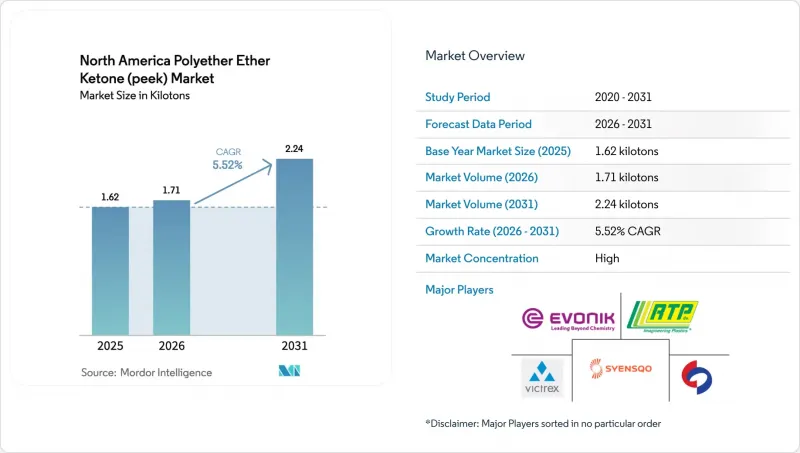
本報告按終端用戶產業(航太、汽車、電氣電子、工業機械及其他終端用戶產業)、增強材料類型(未填充、玻璃纖維填充、碳填充及其他)和地區(美國、加拿大和墨西哥)進行細分。市場預測以數量(噸)和價值(美元)表示。
北美聚醚醚酮(PEEK)市場趨勢與洞察
航太領域的輕量化與符合FST標準
美國聯邦航空管理局 (FAA) 制定的阻燃、低煙和低毒性基準值與減重目標一致,使聚醚醚酮 (PEEK) 成為內裝面板、燃油系統組件和線束等金屬的理想替代品。這種樹脂密度為 1.3 g/cm³,無需添加鹵素添加劑即可比鋁減輕 40% 的重量,從而簡化了認證流程。客製印刷備件可縮短維護週期並最大限度地降低庫存管理成本。此外,永續航空燃料的引入也增加了對耐化學腐蝕管材和閥門的需求。這些因素共同鞏固了北美航太業作為 PEEK 市場主要客戶的地位。
醫療植入生物相容性的需求
由於其具有類似骨骼的彈性模量、固有的滲透性以及符合ISO 10993細胞毒性標準,PEEK材料在脊椎融合器、顱骨板和創傷固定裝置中的應用日益廣泛。採用積層製造技術生產的FDA核准的3D Systems顱骨植入,與機械加工坯料相比,可節省高達85%的材料,同時也能實現針對患者最佳化的形態。隨著醫院列印中心的擴張,對無菌、MRI相容材料的需求不斷成長,這將推動PEEK材料的長期消費成長。
加工設施基礎有限,模具複雜
PEEK的射出成型和擠出成型需要使用鎳基合金、熱流道澆口,且模具溫度超過180 度C,這使得北美只有少數經驗豐富的加工商能夠涉足該領域。產能限制導致需求高峰前置作業時間延長,而航太和醫療行業的品管認證也進一步增加了准入門檻。
細分市場分析
預計到2025年,航太領域將佔據PEEK市場佔有率的55.34%。這主要得益於輕質材料帶來的經濟效益,抵消了其高昂的成本以及嚴格的監管合規性所帶來的挑戰。民航機製造商指定使用PEEK支架、密封件和電線絕緣層,以防止腐蝕並符合阻燃標準。醫療設備、石油和天然氣工具以及半導體晶圓處理系統是成長最快的「其他」類別,年複合成長率達5.90%。需求多角化有助於保護PEEK市場免受航太領域訂單週期波動的影響。
預計到2031年,引擎電氣化、燃料電池的研發以及創新無人機結構的進步將推動航太領域的持續成長。同時,美國脊椎融合手術數量的增加以及保險覆蓋範圍的擴大,也促進了醫療植入的消費。在整體這些應用領域,隨著價值中心從大規模模塑生產轉向小批量精密加工,市場規模都在不斷擴大,這鞏固了PEEK作為關鍵任務部件製造材料的地位。
其他福利
- Excel格式的市場預測(ME)表
- 3個月的分析師支持
目錄
第1章:引言
- 研究假設和市場定義
- 調查範圍
第2章:調查方法
第3章執行摘要
第4章 市場狀況
- 市場概覽
- 市場促進因素
- 航太領域的輕量化與FST合規性
- 醫療植入生物相容性的需求
- 電動車採用耐熱部件
- 按需積層製造備件
- 美墨加協定引發了區域PEEK供應鏈的回流。
- 市場限制因素
- 原料和加工成本上漲
- 處理器基礎設施和工具複雜性有限
- 不穩定二氟二苯甲酮前驅物的供應狀況
- 價值鏈分析
- 波特五力模型
- 監理情勢
- 美國
- 加拿大
- 墨西哥
- 終端用戶領域的趨勢
- 航太(航太零件生產產生的銷售收入)
- 汽車(汽車生產)
- 建築與施工(新建建築占地面積)
- 電氣和電子(電氣和電子產品生產產生的銷售收入)
- 包裝(塑膠包裝數量)
第5章 市場規模與成長預測
- 按最終用戶行業分類
- 航太
- 車
- 電氣和電子
- 工業機械
- 其他
- 按類型分類的加固材料
- 無需填充
- 玻璃填充
- 碳填充
- 其他
- 按地區
- 美國
- 加拿大
- 墨西哥
第6章 競爭情勢
- 市場集中度
- 策略趨勢
- 市佔率和排名分析
- 公司簡介
- Arkema
- Avient Corporation
- Celanese Corporation
- Drake Plastics
- Ensinger
- Ensinger
- Evonik Industries AG
- JiangSu JunHua HPP Co., Ltd.
- Jilin Joinature Polymer Co., Ltd.
- Oxford Performance Materials
- Pan Jin Zhongrun High Performance Polymer Co., Ltd.
- RTP Company
- SABIC
- Syensqo
- Victrex PLC
第7章 市場機會與未來展望
第8章:執行長面臨的關鍵策略挑戰
According to Mordor Intelligence, the North America polyether ether ketone market size in 2026 is estimated at 1.71 kilotons, growing from 2025 value of 1.62 kilotons with 2031 projections showing 2.24 kilotons, growing at 5.52% CAGR over 2026-2031.
This report is Segmented by End-User Industry (Aerospace, Automotive, Electrical and Electronics, Industrial and Machinery, and Other End-User Industries), Reinforcement (Unfilled, Glass-Filled, Carbon-Filled, and Other), and Geography (United States, Canada, and Mexico). The Market Forecasts are Provided in Terms of Volume (Tons) and Value (USD).
North America Polyether Ether Ketone (PEEK) Market Trends and Insights
Aerospace Lightweighting and FST Compliance
Federal Aviation Administration flame, smoke, and toxicity thresholds align with weight-reduction targets, positioning PEEK as a metal substitute for interior panels, fuel-system components, and wiring harnesses. The resin's 1.3 g/cm3 density yields 40% weight savings over aluminum without halogenated additives, simplifying certification workflows. On-demand printing of spare parts shortens maintenance cycles and minimizes inventory overhead, and sustainable aviation-fuel adoption further elevates demand for chemically resistant tubing and valves. These factors collectively reinforce North American aerospace as the anchor customer for the PEEK market.
Medical-Implant Biocompatibility Demand
A bone-like elastic modulus, inherent radiolucency, and ISO 10993 cytotoxicity compliance support growing use of PEEK in spinal cages, cranial plates, and trauma fixation devices. The 2024 FDA clearance of 3D Systems' additively manufactured cranial implant demonstrated up to 85% material savings versus machined blanks while enabling patient-specific geometries. As hospital-based printing centers proliferate, demand for sterilizable, MRI-compatible materials rises, reinforcing long-term consumption growth in the PEEK market.
Limited Processor Base and Tooling Complexity
Injection-molding and extrusion of PEEK demand nickel-based alloys, hot-runner gates, and mold temperatures above 180 °C, limiting participation to a handful of experienced North American processors. Capacity constraints inflate lead times during demand spikes, while aerospace and medical quality-management certification erects additional entry barriers.
Other drivers and restraints analyzed in the detailed report include:
- EV High-Temperature Component Adoption
- Additive-Manufacturing of On-Demand Spares
- Volatile Difluoro-Benzophenone Precursor Supply
For complete list of drivers and restraints, kindly check the Table Of Contents.
Segment Analysis
Aerospace accounted for 55.34% of PEEK market share in 2025, underpinned by high regulatory compliance hurdles and weight-reduction economics that offset material premiums. Commercial airframe builders specify PEEK brackets, seals, and wire insulation to eliminate corrosion and meet flame-retardant thresholds. Medical devices, oil and gas tooling, and semiconductor wafer-handling systems comprise the fastest-growing "other" category, advancing at a 5.90% CAGR. Demand diversification helps shield the PEEK market from aerospace order-cycle volatility.
Continued engine electrification, fuel-cell development, and novel drone architectures extend aerospace pull through 2031. In parallel, rising spinal fusion procedure volumes and broader insurance reimbursement in the United States propel medical implant consumption. Across these applications, the PEEK market size expands as value shifts from high-throughput molding to low-volume precision machining, reinforcing the material's position as an enabler of mission-critical components.
Complete Report Scope:
- By End-User Industry
- Aerospace
- Automotive
- Electrical and Electronics
- Industrial and Machinery
- Other End-User Industries
- By Reinforcement
- Unfilled
- Glass-filled
- Carbon-filled
- Other
- By Geography
- United States
- Canada
- Mexico
List of Companies Covered in this Report:
- Arkema
- Avient Corporation
- Celanese Corporation
- Drake Plastics
- Ensinger
- Ensinger
- Evonik Industries AG
- JiangSu JunHua HPP Co., Ltd.
- Jilin Joinature Polymer Co., Ltd.
- Oxford Performance Materials
- Pan Jin Zhongrun High Performance Polymer Co., Ltd.
- RTP Company
- SABIC
- Syensqo
- Victrex PLC
Additional Benefits:
- The market estimate (ME) sheet in Excel format
- 3 months of analyst support
TABLE OF CONTENTS
1 Introduction
- 1.1 Study Assumptions and Market Definition
- 1.2 Scope of the Study
2 Research Methodology
3 Executive Summary
4 Market Landscape
- 4.1 Market Overview
- 4.2 Market Drivers
- 4.2.1 Aerospace lightweighting and FST compliance
- 4.2.2 Medical-implant biocompatibility demand
- 4.2.3 EV high-temperature component adoption
- 4.2.4 Additive-manufacturing of on-demand spares
- 4.2.5 USMCA-led regional PEEK supply-chain reshoring
- 4.3 Market Restraints
- 4.3.1 High raw-material and processing cost
- 4.3.2 Limited processor base and tooling complexity
- 4.3.3 Volatile difluoro-benzophenone precursor supply
- 4.4 Value Chain Analysis
- 4.5 Porter's Five Forces
- 4.5.1 Threat of New Entrants
- 4.5.2 Bargaining Power of Suppliers
- 4.5.3 Bargaining Power of Buyers
- 4.5.4 Threat of Substitutes
- 4.5.5 Competitive Rivalry
- 4.6 Regulatory Landscape
- 4.6.1 United States
- 4.6.2 Canada
- 4.6.3 Mexico
- 4.7 End-use Sector Trends
- 4.7.1 Aerospace (Aerospace Component Production Revenue)
- 4.7.2 Automotive (Automobile Production)
- 4.7.3 Building and Construction (New Construction Floor Area)
- 4.7.4 Electrical and Electronics (Electrical and Electronics Production Revenue)
- 4.7.5 Packaging(Plastic Packaging Volume)
5 Market Size and Growth Forecasts (Value and Volume)
- 5.1 By End-User Industry
- 5.1.1 Aerospace
- 5.1.2 Automotive
- 5.1.3 Electrical and Electronics
- 5.1.4 Industrial and Machinery
- 5.1.5 Other End-User Industries
- 5.2 By Reinforcement
- 5.2.1 Unfilled
- 5.2.2 Glass-filled
- 5.2.3 Carbon-filled
- 5.2.4 Other
- 5.3 By Geography
- 5.3.1 United States
- 5.3.2 Canada
- 5.3.3 Mexico
6 Competitive Landscape
- 6.1 Market Concentration
- 6.2 Strategic Moves
- 6.3 Market Share (%)/Ranking Analysis
- 6.4 Company Profiles (includes Global level Overview, Market level overview, Core Segments, Financials as available, Strategic Information, Market Rank/Share for key companies, Products and Services, and Recent Developments)
- 6.4.1 Arkema
- 6.4.2 Avient Corporation
- 6.4.3 Celanese Corporation
- 6.4.4 Drake Plastics
- 6.4.5 Ensinger
- 6.4.6 Ensinger
- 6.4.7 Evonik Industries AG
- 6.4.8 JiangSu JunHua HPP Co., Ltd.
- 6.4.9 Jilin Joinature Polymer Co., Ltd.
- 6.4.10 Oxford Performance Materials
- 6.4.11 Pan Jin Zhongrun High Performance Polymer Co., Ltd.
- 6.4.12 RTP Company
- 6.4.13 SABIC
- 6.4.14 Syensqo
- 6.4.15 Victrex PLC
7 Market Opportunities and Future Outlook
- 7.1 White-Space and Unmet-Need Assessment
8 Key Strategic Questions for CEOs

 亞太地區聚醚醚酮(PEEK):市場佔有率分析、產業趨勢與統計及成長預測(2026-2031)歐洲聚醚醚酮(PEEK):市場佔有率分析、行業趨勢和統計數據以及成長預測(2026-2031 年)
 2026年全球植入級聚醚醚酮(PEEK)聚合物加工服務市場報告
 全球PEEK市場(至2031年):依增強類型(玻璃纖維增強、碳纖維增強、未增強)、加工方法(擠出成型、射出成型)、最終用戶(電氣電子、航太、汽車、石油天然氣、醫療)和地區分類
 聚醚醚酮市場:按產品類型、應用和地區分類
 聚醚醚酮 (PEEK) 和 PAEK 樹脂市場:2026-2032 年全球市場預測(按產品類型、填料類型、產品形態、最終用途和分銷管道分類)聚醚醚酮(PEEK)植入全球市場報告(2026年)
 全球聚醚醚酮(PEEK)市場規模、佔有率、趨勢和成長分析報告(2026-2034年)
 聚醚醚酮(PEEK)市場規模、佔有率及成長分析(按類型、應用、最終用途和地區分類)-2026-2033年產業預測
 聚醚醚酮(PEEK)-全球市場佔有率和排名、總收入和需求預測(2025-2031年)