


 |
市場調查報告書
商品編碼
2100747
歐洲聚醚醚酮(PEEK):市場佔有率分析、行業趨勢和統計數據以及成長預測(2026-2031 年)Europe Polyether Ether Ketone (PEEK) - Market Share Analysis, Industry Trends & Statistics, Growth Forecasts (2026 - 2031) |
||||||

※ 本網頁內容可能與最新版本有所差異。詳細情況請與我們聯繫。
據 Mordor Intelligence 稱,歐洲聚醚醚酮 (PEEK) 市場規模預計在 2026 年達到 3.22 千噸,高於 2025 年的 3.07 千噸,預計到 2031 年將達到 4.1 千噸。
預計 2026 年至 2031 年的複合年成長率為 4.92%。
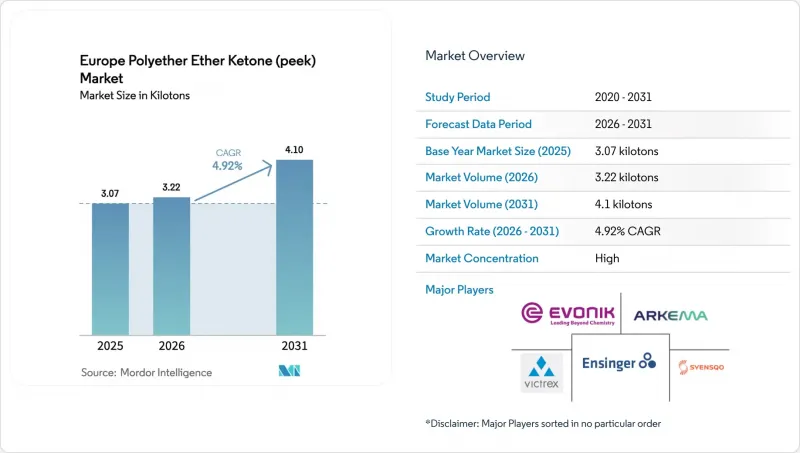
本報告按終端用戶產業(航太、汽車、電氣電子、工業機械及其他終端用戶產業)、增強材料類型(未填充、玻璃纖維填充、碳纖維填充及其他)和地區(德國、法國、英國、義大利、俄羅斯和其他歐洲國家)進行細分。市場預測以數量(噸)和價值(美元)為單位呈現。
歐洲聚醚醚酮(PEEK)市場趨勢與洞察
歐盟航太生產強勁復甦
歐洲原始設備製造商(OEM)已於2024年重啟了寬體和窄體飛機項目,熱塑性複合材料的訂單也創下歷史新高。空中巴士提高了A320neo的月產量目標,波音公司也已認證Syensqo公司的KetaSpire PEEK材料為輔助結構材料。由於每減輕一公斤重量都能降低油耗,飛機供應商現在紛紛指定使用PEEK材料製造支架、夾具和電氣絕緣系統。國防相關企業也緊跟在後,將PEEK材料應用於直升機旋翼零件和衛星子系統。這一趨勢正在推動德國和法國——歐洲最大的兩個航太中心——的需求復甦。
對輕量化電動車零件的需求正在加速成長。
歐洲2035年逐步淘汰內燃機的政策正加速輕量化零件的普及。贏創(Evonik)開發的高扭力PEEK齒輪與鋼製齒輪相比,可將傳動系統重量減輕60%。 Scienceco公司的「Ajedium」PEEK薄膜透過提高磁線絕緣層的槽填充率,提升了馬達的效率。電池外殼、匯流排和冷卻液歧管也正逐步採用PEEK材料,以承受電解和重複的充放電循環。德國汽車製造商佔據了這一成長的大部分佔有率,但法國和西班牙的工廠也在快速推動類似設計的認證工作。
歐盟 REACH 法規對高溫聚合物的複雜性。
關於聚合物微粒的法規提高了報告要求,使PEEK製造商的合規預算增加了15-20%。中小企業難以承擔毒理學文件的編制費用,進一步鞏固了老牌企業的優勢。隨著供應商在航太、醫療和電子等產業收集安全數據,OEM的設計週期也延長。儘管如此,由於PEEK不含鹵素,與含氟替代品相比,終端用戶更容易遵守物質法規。
細分市場分析
2025年,工業機械佔歐洲PEEK市場的34.88%。這反映了PEEK在泵浦、閥門和化學加工零件等領域的廣泛應用,這些零件需承受高達250 度C的流體溫度。該領域現有設備的持續使用推動了對替換零件的重複採購需求,從而支撐了整體銷售量。航太領域雖然規模較小,但由於原始設備製造商(OEM)為了提高燃油效率而將金屬卡扣和支架替換為PEEK複合材料,其複合年成長率(CAGR)最高,達到5.67%。在汽車應用領域,電池式電動車的普及勢頭強勁,PEEK齒輪和電力驅動軸承能夠延長高扭力下傳動系統的使用壽命。
隨著5G的部署,電子電氣產業的消費正在逐步擴大。醫療設備是一個快速成長的細分市場,以3D列印個人化植入為例,預計到2026年將在歐盟廣泛應用。由於醫院採購委員會優先考慮生物相容性和MRI成像清晰度,預計歐洲醫療設備用PEEK市場將進一步擴大。
其他好處:
- Excel格式的市場預測(ME)表
- 3個月的分析師支持
目錄
第1章:引言
- 研究假設和市場定義
- 調查範圍
第2章:調查方法
第3章執行摘要
第4章 市場狀況
- 市場概覽
- 市場促進因素
- 歐盟航太業生產強勁復甦
- 減輕電動車零件重量的努力正在加速進行。
- 高頻5G電子設備的微型化
- 向無金屬外科植入過渡
- 原始設備製造商 (OEM) 對耐化學腐蝕的製程線組件的需求
- 市場限制因素
- 歐盟關於高溫聚合物的 REACH 法規涉及複雜的程序。
- 氟代芳烴前驅物的價格波動很大。
- 新興的生物基PPS替代品
- 價值鏈分析
- 波特五力模型
- 監理情勢
- EU
- 法國
- 德國
- 義大利
- 俄羅斯
- 英國
- 終端用戶領域的趨勢
- 航太(航太零件生產產生的銷售收入)
- 汽車(汽車生產)
- 建築與施工(新建建築占地面積)
- 電氣和電子(電氣和電子產品生產產生的銷售收入)
- 包裝(塑膠包裝數量)
第5章 市場規模與成長預測
- 按最終用戶行業分類
- 航太
- 車
- 電氣和電子設備
- 工業機械
- 其他終端用戶產業
- 按類型加強
- 未填充
- 玻璃纖維增強
- 碳纖維型
- 其他
- 按地區
- 德國
- 法國
- 英國
- 義大利
- 俄羅斯
- 其他歐洲國家
第6章 競爭情勢
- 市場集中度
- 策略趨勢
- 市佔率和排名分析
- 公司簡介
- Arkema
- BARLOG Plastics GmbH
- Celanese Corporation
- Ensinger GmbH
- Essentra Components
- Evonik Industries AG
- Jilin Joinature Polymer Co., Ltd.
- Mitsubishi Chemical Group
- Pan Jin Zhongrun High Performance Polymer Co., Ltd.
- Rochling
- RTP Company
- SABIC
- Syensqo
- Toray Industries Inc.
- Victrex plc
- Zhejiang Pfluon Technology Co., Ltd.
第7章 市場機會與未來展望
第8章:執行長面臨的關鍵策略挑戰
According to Mordor Intelligence, Europe polyether ether ketone market size in 2026 is estimated at 3.22 kilotons, growing from 2025 value of 3.07 kilotons with 2031 projections showing 4.1 kilotons, growing at 4.92% CAGR over 2026-2031.
This report is Segmented by End-User Industry (Aerospace, Automotive, Electrical and Electronics, Industrial and Machinery, and Other End-User Industries), Reinforcement (Unfilled, Glass-Filled, Carbon-Filled, and Other), and Geography (Germany, France, United Kingdom, Italy, Russia, and Rest of Europe). The Market Forecasts are Provided in Terms of Volume (Tons) and Value (USD).
Europe Polyether Ether Ketone (PEEK) Market Trends and Insights
Robust EU Aerospace Production Resurgence
European OEMs restarted wide-body and narrow-body programs in 2024, fueling record orders for thermoplastic composites. Airbus raised monthly A320neo output targets, while Boeing qualified Syensqo's KetaSpire PEEK for secondary structures. Airframe suppliers now specify PEEK brackets, clamps, and electrical insulation systems because each kilogram trimmed translates to lower fuel burn. Defense contractors follow suit, adopting PEEK in helicopter rotor components and satellite subsystems. This trend revives demand across Germany and France, the region's twin aerospace hubs.
Accelerated EV Component Lightweighting Push
Europe's 2035 internal-combustion phase-out accelerates the use of lightweight parts. Evonik developed high-torque PEEK gears that cut drivetrain mass by 60% versus steel. Syensqo's Ajedium PEEK film boosts e-motor efficiency by enabling higher slot fill factors in magnet wire insulation. Battery housings, busbars, and coolant manifolds also migrate to PEEK to withstand electrolytes and repeated charge cycles. German automakers account for the bulk of this incremental volume, but French and Spanish plants are rapidly certifying similar designs.
EU REACH Red-tape for High-temperature Polymers
Polymer microparticle rules add reporting layers that lift compliance budgets 15-20% for PEEK producers. Smaller firms struggle to finance toxicological dossiers, cementing incumbent advantages. OEM design cycles also lengthen as suppliers compile safety data across aerospace, medical, and electronics contexts. Nonetheless, PEEK's halogen-free profile helps end-users meet substance restrictions more readily than fluorinated alternatives.
Other drivers and restraints analyzed in the detailed report include:
- Miniaturization in High-Frequency 5G Electronics
- Shift Toward Metal-free Surgical Implants
- Volatile Fluoro-aromatic Precursor Prices
For complete list of drivers and restraints, kindly check the Table Of Contents.
Segment Analysis
Industrial machinery represented 34.88% of the European PEEK market in 2025, reflecting widespread use in pumps, valves, and chemical-processing components that face 250 °C fluids. This segment's installed base creates repeat-purchase demand for replacement parts, anchoring overall tonnage. The aerospace category, although smaller, achieves the highest 5.67% CAGR as OEMs convert metallic clips and brackets to PEEK composites for fuel-efficiency gains. Automotive applications gain momentum from battery-electric models, with PEEK gears and e-axle bearings extending drivetrain life under high torque.
Electrical and electronics consumption scales gradually alongside 5G rollout. Medical devices contribute to a fast-growing niche, exemplified by 3D-printed patient-specific implants scheduled for wider EU adoption by 2026. The European PEEK market size for medical devices is poised to expand as hospital purchasing committees emphasize biocompatibility and MRI clarity.
Complete Report Scope:
- By End-User Industry
- Aerospace
- Automotive
- Electrical and Electronics
- Industrial and Machinery
- Other End-User Industries
- By Reinforcement
- Unfilled
- Glass-filled
- Carbon-filled
- Other
- By Geography
- Germany
- France
- United Kingdom
- Italy
- Russia
- Rest of Europe
List of Companies Covered in this Report:
- Arkema
- BARLOG Plastics GmbH
- Celanese Corporation
- Ensinger GmbH
- Essentra Components
- Evonik Industries AG
- Jilin Joinature Polymer Co., Ltd.
- Mitsubishi Chemical Group
- Pan Jin Zhongrun High Performance Polymer Co., Ltd.
- Rochling
- RTP Company
- SABIC
- Syensqo
- Toray Industries Inc.
- Victrex plc
- Zhejiang Pfluon Technology Co., Ltd.
Additional Benefits:
- The market estimate (ME) sheet in Excel format
- 3 months of analyst support
TABLE OF CONTENTS
1 Introduction
- 1.1 Study Assumptions and Market Definition
- 1.2 Scope of the Study
2 Research Methodology
3 Executive Summary
4 Market Landscape
- 4.1 Market Overview
- 4.2 Market Drivers
- 4.2.1 Robust EU aerospace production resurgence
- 4.2.2 Accelerated EV component light-weighting push
- 4.2.3 Miniaturisation in high-frequency 5G electronics
- 4.2.4 Shift toward metal-free surgical implants
- 4.2.5 OEM demand for chemical-resistant process line parts
- 4.3 Market Restraints
- 4.3.1 EU REACH red-tape for high-temperature polymers
- 4.3.2 Volatile fluoro-aromatic precursor prices
- 4.3.3 Emerging bio-based PPS substitutes
- 4.4 Value Chain Analysis
- 4.5 Porter's Five Forces
- 4.5.1 Threat of New Entrants
- 4.5.2 Bargaining Power of Suppliers
- 4.5.3 Bargaining Power of Buyers
- 4.5.4 Threat of Substitutes
- 4.5.5 Competitive Rivalry
- 4.6 Regulatory Landscape
- 4.6.1 EU
- 4.6.2 France
- 4.6.3 Germany
- 4.6.4 Italy
- 4.6.5 Russia
- 4.6.6 United Kingdom
- 4.7 End-use Sector Trends
- 4.7.1 Aerospace (Aerospace Component Production Revenue)
- 4.7.2 Automotive (Automobile Production)
- 4.7.3 Building and Construction (New Construction Floor Area)
- 4.7.4 Electrical and Electronics (Electrical and Electronics Production Revenue)
- 4.7.5 Packaging(Plastic Packaging Volume)
5 Market Size and Growth Forecasts (Value and Volume)
- 5.1 By End-User Industry
- 5.1.1 Aerospace
- 5.1.2 Automotive
- 5.1.3 Electrical and Electronics
- 5.1.4 Industrial and Machinery
- 5.1.5 Other End-User Industries
- 5.2 By Reinforcement
- 5.2.1 Unfilled
- 5.2.2 Glass-filled
- 5.2.3 Carbon-filled
- 5.2.4 Other
- 5.3 By Geography
- 5.3.1 Germany
- 5.3.2 France
- 5.3.3 United Kingdom
- 5.3.4 Italy
- 5.3.5 Russia
- 5.3.6 Rest of Europe
6 Competitive Landscape
- 6.1 Market Concentration
- 6.2 Strategic Moves
- 6.3 Market Share (%)/Ranking Analysis
- 6.4 Company Profiles (includes Global level Overview, Market level overview, Core Segments, Financials as available, Strategic Information, Market Rank/Share for key companies, Products and Services, and Recent Developments)
- 6.4.1 Arkema
- 6.4.2 BARLOG Plastics GmbH
- 6.4.3 Celanese Corporation
- 6.4.4 Ensinger GmbH
- 6.4.5 Essentra Components
- 6.4.6 Evonik Industries AG
- 6.4.7 Jilin Joinature Polymer Co., Ltd.
- 6.4.8 Mitsubishi Chemical Group
- 6.4.9 Pan Jin Zhongrun High Performance Polymer Co., Ltd.
- 6.4.10 Rochling
- 6.4.11 RTP Company
- 6.4.12 SABIC
- 6.4.13 Syensqo
- 6.4.14 Toray Industries Inc.
- 6.4.15 Victrex plc
- 6.4.16 Zhejiang Pfluon Technology Co., Ltd.
7 Market Opportunities and Future Outlook
- 7.1 White-space and Unmet-Need Assessment
8 Key Strategic Questions for CEOs

 亞太地區聚醚醚酮(PEEK):市場佔有率分析、產業趨勢與統計及成長預測(2026-2031)北美聚醚醚酮(PEEK):市場佔有率分析、產業趨勢與統計及成長預測(2026-2031)
 2026年全球植入級聚醚醚酮(PEEK)聚合物加工服務市場報告
 全球PEEK市場(至2031年):依增強類型(玻璃纖維增強、碳纖維增強、未增強)、加工方法(擠出成型、射出成型)、最終用戶(電氣電子、航太、汽車、石油天然氣、醫療)和地區分類
 聚醚醚酮市場:按產品類型、應用和地區分類
 聚醚醚酮 (PEEK) 和 PAEK 樹脂市場:2026-2032 年全球市場預測(按產品類型、填料類型、產品形態、最終用途和分銷管道分類)聚醚醚酮(PEEK)植入全球市場報告(2026年)
 全球聚醚醚酮(PEEK)市場規模、佔有率、趨勢和成長分析報告(2026-2034年)
 聚醚醚酮(PEEK)市場規模、佔有率及成長分析(按類型、應用、最終用途和地區分類)-2026-2033年產業預測
 聚醚醚酮(PEEK)-全球市場佔有率和排名、總收入和需求預測(2025-2031年)