


 |
市場調查報告書
商品編碼
2100708
液氫:市場佔有率分析、產業趨勢與統計、成長預測(2026-2031)Liquid Hydrogen - Market Share Analysis, Industry Trends & Statistics, Growth Forecasts (2026 - 2031) |
||||||

※ 本網頁內容可能與最新版本有所差異。詳細情況請與我們聯繫。
根據 Mordor Intelligence 估計,2025 年液氫市場規模為 176.45 千噸,2026 年將成長至 194.31 千噸,到 2031 年將成長至 314.58 千噸。
在預測期(2026-2031 年)內,預計年複合成長率為 10.12%,到 2031 年將達到 314.58 千噸。
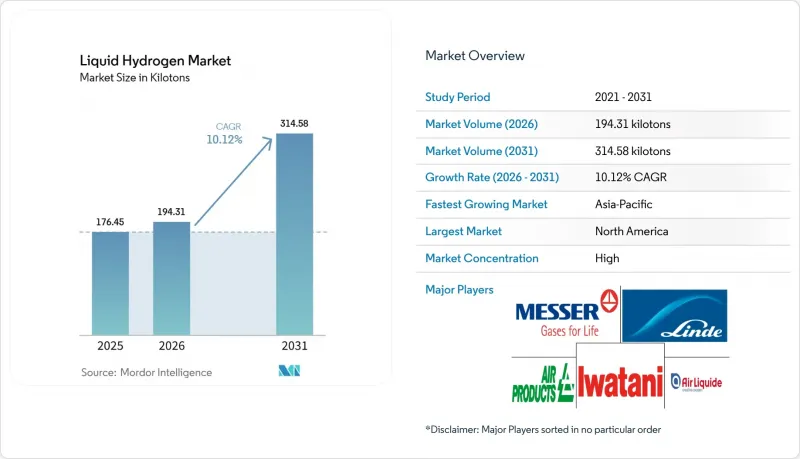
本報告按供應類型(低溫儲罐、高壓管束拖車)、終端用戶產業(航太(含外太空)、汽車、船舶及其他)和地區(亞太地區、北美地區、歐洲地區、南美地區以及中東和非洲地區)進行細分。市場預測以噸為單位。
全球液氫市場趨勢及洞察
阿爾忒彌斯計畫之後,發射頻率和月球探勘任務數量激增。
NASA的阿爾忒彌斯計畫重新定義了液體推進劑的物流,證明零蒸發技術可以將推進劑在太空儲存數月期間的損失降低98%。領先的航太產業公司目前正將這些成果融入衛星維護架構中,從而催生了對先進液氫系統的二次需求。歐洲太空總署(ESA)計劃在2027年月球門戶太空站實施類似的零蒸發框架,進一步擴大了地理需求。私人發射業者正在發射台附近建造液化設施,以避免供應風險,加速區域產能擴張。總體而言,私人和商業任務的激增正在鞏固液氫市場的長期前景。
商用燃料電池電動車卡車的引進需要大規模的液態氫加註站。
梅賽德斯-奔馳和空氣產品公司聯合開展的GenH2示範測試記錄了1000公里的續航里程和不到15分鐘的加氫時間,證明了液態氫在8級卡車中的優越性能。目前,歐洲車隊競標中強制要求配備大型液氫加氫站,TEAL Mobility計畫在2030年建成100座加氫站,每座加氫站都旨在實現高吞吐量加氫。隨著重型卡車運輸走廊的開發,對每日處理能力為20至40噸的液化設備的需求日益成長。由於液氫具有更高的質量能量密度,其總擁有成本(TCO)的降低為營運商在與柴油燃料競爭中提供了優勢。
小電站蒸發損失高
日處理能力低於200公斤的加氫站通常每天會有2-3%的蒸發損失,進而降低單位獲利能力。雖然存在無蒸發損失的設計方案,但其高昂的資本支出(CAPEX)對於客流量較低的加氫站而言是一個障礙。豐田的蒸氣回收系統可以緩解這個問題,但會增加營運複雜性。因此,開發商傾向於採用以集中式液化設施為中心的輻射型模式,但這限制了區域部署並增加了運輸成本,減緩了液態氫市場的短期成長。
細分市場分析
到2025年,低溫儲槽將主導液氫市場,佔60.62%的市場。這反映了其在航太領域的卓越性能以及新近驗證的零蒸發性能標準。該領域的成長得益於多層隔熱技術和複合材料外殼的進步,這些技術在降低滲透性的同時,可將重量減輕多達三分之一。對於營運商而言,固定式低溫倉儲設施被視為一項基礎性資產,因為它們能夠有效地滿足激增的加氫需求。真空夾套管路和主動溫度控管等技術升級,使低溫儲槽成為每日處理量超過5噸的液氫樞紐最具成本效益的選擇。
儘管高壓管束拖車目前市場佔有率較小,但預計到2031年將以11.05%的複合年成長率成長。這些拖車非常適合尚無法滿足固定儲槽區運輸量需求的早期運輸路線,為投資者提供低進入門檻和路線柔軟性的優勢。 Verne公司的低溫壓縮平台連接了這兩種運輸方式,其體積密度是標準700巴管束的兩倍,並且無需耗時的排氣循環即可實現連續裝載。 2026年至2027年間,有關車輛總重和符合ADR(歐洲危險貨物運輸法規)的法規協調將擴大該技術在州際貨運網路中的應用,從而進一步擴大液氫市場的潛在規模。
區域分析
到2025年,北美將佔全球總量的42.10%,這反映了NASA的採購週期、加州的低碳燃料標準(LCFS)積分以及美國能源部H2Hubs專案的資金支持。墨西哥灣墨西哥灣沿岸的多吉瓦級電解槽管路正與現有的石化基礎設施協同運作,提供鹽洞儲存方案,以補充地上低溫儲槽。該地區的液氫市場也受惠於聯邦機動車輛安全標準(FMVSS)的進一步推動,該標準於2025年7月生效,對液氫汽車進行了法規修訂,降低了原始設備製造商(OEM)生產計畫中的風險。
預計到2031年,亞太地區將以11.12%的複合年成長率實現最快複合成長,主要得益於中國安陽大型企劃和韓國投資78億美元的西海岸氫能帶專案。 HD KSOE和川崎重工正在開發的大型貨船正在開闢通往日本和新加坡的海上出口航線,從而形成良性循環的生態系統。政府主導的可再生能源電解氫氣上網電解補貼政策正在降低供應成本,而國內卡車製造商計劃在2029年生產2萬輛燃料電池汽車,進一步擴大了市場需求。這些趨勢共同推動全球液氫市場供給能力重心向東亞轉移。
歐洲的基礎建設以液化空氣集團投資1.1億歐元的ENHANCE項目和IPCEI Hy2Infra管道計畫為中心,旨在2029年建造一條2,700公里的氫能走廊。諸如RED III運輸配額和「Fit-for-55」目標等政策工具正在加速航空、航運和鋼鐵業的脫碳進程。儘管該地區在建設超大型液化工廠方面仍落後於其他國家,但憑藉其進口碼頭網路和氨製氫項目,歐洲已成為液氫行業的高需求市場。南美、中東和非洲仍在發展中,但潛力巨大,尤其值得關注的是阿曼對歐洲的出口計劃,該計劃得到了GasLog低溫運輸技術的支持。
其他好處:
- Excel格式的市場預測(ME)表
- 3個月的分析師支持
目錄
第1章:引言
- 研究假設和市場定義
- 調查範圍
第2章:調查方法
第3章執行摘要
第4章 市場狀況
- 市場概覽
- 市場促進因素
- 阿爾忒彌斯計畫和月球探勘計畫後,發射頻率激增
- 引進商用燃料電池電動車卡車需要一個規模龐大的液態氫加註設施。
- 亞太地區一座吉瓦級液化工廠已開始運作。
- 降低鄰對位催化劑轉化組件的成本
- 用於低溫環境的碳複合材料儲罐的技術突破
- 市場限制因素
- 小電站蒸發損失高
- 全球氦氣供應短缺,導致液態氫幫浦和密封件短缺
- 液化過程耗能巨大,導致綠色氫氣製取的 LCOH 成本增加。
- 價值鏈分析
- 波特五力模型
第5章 市場規模與成長預測
- 透過供應表格
- 低溫儲罐
- 高壓管拖車
- 按最終用戶行業分類
- 航太(包括外太空)
- 車
- 船
- 其他
- 按地區
- 亞太地區
- 中國
- 印度
- 日本
- 韓國
- 東南亞國協
- 其他亞太國家
- 北美洲
- 美國
- 加拿大
- 墨西哥
- 歐洲
- 德國
- 英國
- 法國
- 義大利
- 俄羅斯
- 北歐國家
- 其他歐洲國家
- 南美洲
- 巴西
- 阿根廷
- 其他南美國家
- 中東和非洲
- 沙烏地阿拉伯
- 南非
- 其他中東和非洲國家
- 亞太地區
第6章 競爭情勢
- 市場集中度
- 策略趨勢
- 市佔率和排名分析
- 公司簡介
- Air Liquide
- Air Products and Chemicals, Inc.
- Iwatani Corporation
- Kawasaki Heavy Industries, Ltd.
- Linde PLC
- MATHESON Tri-Gas, Inc.
- Messer SE and Co. KGaA
- NIPPON SANSO HOLDINGS CORPORATION
- Olin Corporation
- Plug Power Inc.
- Universal Industrial Gases
第7章 市場機會與未來展望
According to Mordor Intelligence, the liquid hydrogen market size was estimated at 176.45 kilotons in 2025 and is estimated to grow from 194.31 kilotons in 2026 to reach 314.58 kilotons by 2031, at a CAGR of 10.12% during the forecast period (2026-2031).
This report is Segmented by Distribution (Cryogenic Tanks and High-Pressure Tube Trailers), End-User Industry (Aerospace (including Outer Space), Automotive, Marine, and Other End-User Industries), and Geography (Asia-Pacific, North America, Europe, South America, and Middle East and Africa). The Market Forecasts are Provided in Terms of Volume (Tons).
Global Liquid Hydrogen Market Trends and Insights
Surging Launch Cadence and Lunar Mission Programs Post-Artemis
NASA's Artemis agenda has re-defined liquid propellant logistics by proving that zero-boil-off technology cuts propellant loss by 98% during multi-month storage in space. Aerospace primes now incorporate these findings into satellite-servicing architectures, creating a secondary pull for advanced liquid hydrogen systems. ESA aims to deploy a comparable zero-boil-off framework for its 2027 lunar gateway, broadening geographic demand. Private launch providers are co-locating liquefiers near pads to hedge supply risk, a move that accelerates regional capacity build-outs. Collectively, the surge in civil and commercial missions is anchoring long-term visibility for the liquid hydrogen market.
Commercial FCEV Truck Roll-Outs Needing Depot-Scale LH2 Refueling
Mercedes-Benz GenH2 trials with Air Products validated liquid hydrogen's superiority for Class 8 trucks by logging 1,000 km ranges and sub-15-minute refuels. Fleet tenders in Europe now stipulate depot-scale liquid hydrogen capability, while TEAL Mobility plans 100 refueling stations by 2030, each designed for high-throughput loading. Heavy-duty corridor build-outs are cascading into demand for 20-40 ton-per-day liquefaction skids. As operators chase diesel parity, the liquid hydrogen market benefits from total-cost-of-ownership gains linked to higher gravimetric energy density.
High Boil-Off Losses for Small-Footprint Stations
Throughputs below 200 kg/day typically suffer 2-3% daily boil-off, eroding unit economics. While zero-boil-off architectures exist, the CAPEX premium is prohibitive for low-traffic stations. Toyota's vapor-recycling system offers mitigation but adds operational complexity. As a result, developers favor hub-and-spoke models with centralized liquefaction, but that limits rural coverage and raises transport costs, muting near-term dispersion of the liquid hydrogen market.
Other drivers and restraints analyzed in the detailed report include:
- Asia-Pacific Gigawatt-Scale Liquefiers Coming Online
- Cost-Down in Ortho-Para Catalytic Conversion Packs
- Limited Global Helium Supply for LH2 Pumps and Seals
For complete list of drivers and restraints, kindly check the Table Of Contents.
Segment Analysis
Cryogenic tanks dominated the liquid hydrogen market size with 60.62% of total volume in 2025, reflecting their legacy use in spaceflight and newly validated zero-boil-off performance benchmarks. The segment's growth stems from multilayer insulation advances and composite shells that reduce weight by up to one-third while cutting permeation. Operators view stationary cryogenic depots as foundational assets because they scale efficiently with refueling demand spikes. Technological upgrades, including vacuum-jacketed lines and active thermal management, make cryogenic tanks the most cost-effective option for fleet hubs above 5 tons/day.
High-pressure tube trailers, though holding a smaller slice, are forecast to log an 11.05% CAGR through 2031. They attract early-stage corridors that lack the volumes needed for fixed tank farms, giving investors a lower entry cost and route flexibility. Verne's cryo-compressed platform bridges the two modalities, offering 2X the volumetric density of standard 700 bar tubes and enabling back-to-back loading without time-consuming vent cycles. Regulatory harmonization on gross vehicle mass and ADR compliance in 2026-2027 will widen adoption across interstate freight networks, widening the addressable surface for the liquid hydrogen market.
Complete Report Scope:
- By Distribution
- Cryogenic Tanks
- High-Pressure Tube Trailers
- By End-User Industry
- Aerospace (Including Outer Space)
- Automotive
- Marine
- Other End-user Industries
- By Geography
- Asia-Pacific
- China
- India
- Japan
- South Korea
- ASEAN Countries
- Rest of Asia-Pacific
- North America
- United States
- Canada
- Mexico
- Europe
- Germany
- United Kingdom
- France
- Italy
- Russia
- NORDIC Countries
- Rest of Europe
- South America
- Brazil
- Argentina
- Rest of South America
- Middle East and Africa
- Saudi Arabia
- South Africa
- Rest of Middle East and Africa
- Asia-Pacific
Geography Analysis
North America captured 42.10% of 2025 volume, reflecting NASA procurement cycles, California's LCFS credits, and Department of Energy H2Hubs funding. Multi-gigawatt electrolyzer pipelines along the Gulf Coast are pairing with existing petrochemical infrastructure, offering salt-cavern storage options that complement above-ground cryogenic tanks. The liquid hydrogen market in the region is additionally buoyed by the July 2025 FMVSS safety standard that codified LH2 vehicle regulations, de-risking OEM production planning.
Asia-Pacific is poised for the fastest compound lift at 11.12% CAGR to 2031, fueled by China's Anyang megaproject and Korea's USD 7.8 billion West Coast Hydrogen Belt. Large-scale carriers under development by HD KSOE and Kawasaki establish maritime export lanes to Japan and Singapore, creating a self-reinforcing ecosystem. Government-backed feed-in tariffs for renewable-powered electrolysis reduce delivered cost, while domestic truck OEMs plan 20,000 FCEV unit output by 2029, deepening offtake. These developments collectively re-balance global liquid hydrogen market capacity toward the East.
Europe's build-out centers on Air Liquide's EUR 110 million ENHANCE project and the IPCEI Hy2Infra pipeline plan that strings 2,700 km of hydrogen corridors by 2029. Policy levers such as RED III transport quotas and Fit-for-55 targets accelerate adoption across aviation, maritime, and steel decarbonization. Though the region trails in giga-scale liquefiers, a web of import terminals and ammonia-to-hydrogen cracking projects positions Europe as a high-demand sink for the liquid hydrogen industry. South America and the Middle East and Africa remain nascent but show promise, notably Oman-to-Europe export concepts backed by GasLog's cryogenic shipping technology.
- Air Liquide
- Air Products and Chemicals, Inc.
- Iwatani Corporation
- Kawasaki Heavy Industries, Ltd.
- Linde PLC
- MATHESON Tri-Gas, Inc.
- Messer SE and Co. KGaA
- NIPPON SANSO HOLDINGS CORPORATION
- Olin Corporation
- Plug Power Inc.
- Universal Industrial Gases
Additional Benefits:
- The market estimate (ME) sheet in Excel format
- 3 months of analyst support
TABLE OF CONTENTS
1 Introduction
- 1.1 Study Assumptions and Market Definition
- 1.2 Scope of the Study
2 Research Methodology
3 Executive Summary
4 Market Landscape
- 4.1 Market Overview
- 4.2 Market Drivers
- 4.2.1 Surging Launch Cadence and Lunar-Mission Programs Post-Artemis
- 4.2.2 Commercial FCEV Truck Roll-Outs Needing Depot-Scale LH2 Refuelling
- 4.2.3 Asia-Pacific Gigawatt-Scale Liquefiers Coming Online
- 4.2.4 Cost-Down in Ortho-Para Catalytic Conversion Packs
- 4.2.5 Cryogenic Carbon-Composite Tank Breakthroughs
- 4.3 Market Restraints
- 4.3.1 High Boil-Off Losses for Small-Footprint Stations
- 4.3.2 Limited Global Helium Supply for LH2 Pumps and Seals
- 4.3.3 Electro-Intensiveness of Liquefaction Inflates Green-H2 LCOH
- 4.4 Value Chain Analysis
- 4.5 Porter's Five Forces
- 4.5.1 Bargaining Power of Suppliers
- 4.5.2 Bargaining Power of Buyers
- 4.5.3 Threat of New Entrants
- 4.5.4 Threat of Substitutes
- 4.5.5 Degree of Competition
5 Market Size and Growth Forecasts (Volume)
- 5.1 By Distribution
- 5.1.1 Cryogenic Tanks
- 5.1.2 High-Pressure Tube Trailers
- 5.2 By End-User Industry
- 5.2.1 Aerospace (Including Outer Space)
- 5.2.2 Automotive
- 5.2.3 Marine
- 5.2.4 Other End-user Industries
- 5.3 By Geography
- 5.3.1 Asia-Pacific
- 5.3.1.1 China
- 5.3.1.2 India
- 5.3.1.3 Japan
- 5.3.1.4 South Korea
- 5.3.1.5 ASEAN Countries
- 5.3.1.6 Rest of Asia-Pacific
- 5.3.2 North America
- 5.3.2.1 United States
- 5.3.2.2 Canada
- 5.3.2.3 Mexico
- 5.3.3 Europe
- 5.3.3.1 Germany
- 5.3.3.2 United Kingdom
- 5.3.3.3 France
- 5.3.3.4 Italy
- 5.3.3.5 Russia
- 5.3.3.6 NORDIC Countries
- 5.3.3.7 Rest of Europe
- 5.3.4 South America
- 5.3.4.1 Brazil
- 5.3.4.2 Argentina
- 5.3.4.3 Rest of South America
- 5.3.5 Middle East and Africa
- 5.3.5.1 Saudi Arabia
- 5.3.5.2 South Africa
- 5.3.5.3 Rest of Middle East and Africa
- 5.3.1 Asia-Pacific
6 Competitive Landscape
- 6.1 Market Concentration
- 6.2 Strategic Moves
- 6.3 Market Share (%)/Ranking Analysis
- 6.4 Company Profiles (includes Global level Overview, Market level overview, Core Segments, Financials as available, Strategic Information, Market Rank/Share, Products and Services, Recent Developments)
- 6.4.1 Air Liquide
- 6.4.2 Air Products and Chemicals, Inc.
- 6.4.3 Iwatani Corporation
- 6.4.4 Kawasaki Heavy Industries, Ltd.
- 6.4.5 Linde PLC
- 6.4.6 MATHESON Tri-Gas, Inc.
- 6.4.7 Messer SE and Co. KGaA
- 6.4.8 NIPPON SANSO HOLDINGS CORPORATION
- 6.4.9 Olin Corporation
- 6.4.10 Plug Power Inc.
- 6.4.11 Universal Industrial Gases
7 Market Opportunities and Future Outlook
- 7.1 White-space and Unmet-Need Assessment

 2026-2034年全球電解氫市場規模、佔有率、趨勢和成長分析報告全球液氫市場規模、佔有率、趨勢和成長分析報告(2026-2034年)
 北美液氫市場:市場佔有率分析、產業趨勢與統計及成長預測(2026-2031)
 2026 年至 2035 年電解氫的市場機會、成長要素、產業趨勢與預測。液氫市場:商業機會、成長要素、產業趨勢分析及2026-2035年預測
 液氫市場規模、佔有率和趨勢分析報告:按生產方法、分銷方法、地區和細分市場預測(2026-2033 年)
 化學液氫市場規模、佔有率和成長分析:按純度、製造方法、儲存類型、應用、最終用戶和地區分類-2026-2033年產業預測
 液氫市場規模、佔有率及成長分析(依生產方式、分銷方式、終端用戶產業及地區分類)-2026-2033年產業預測
 全球煤炭氣化液氫市場全球電解液氫市場