


 |
市場調查報告書
商品編碼
2100618
MEMS:市場佔有率分析、產業趨勢和統計數據、成長預測(2026-2031)MEMS - Market Share Analysis, Industry Trends & Statistics, Growth Forecasts (2026 - 2031) |
||||||

※ 本網頁內容可能與最新版本有所差異。詳細情況請與我們聯繫。
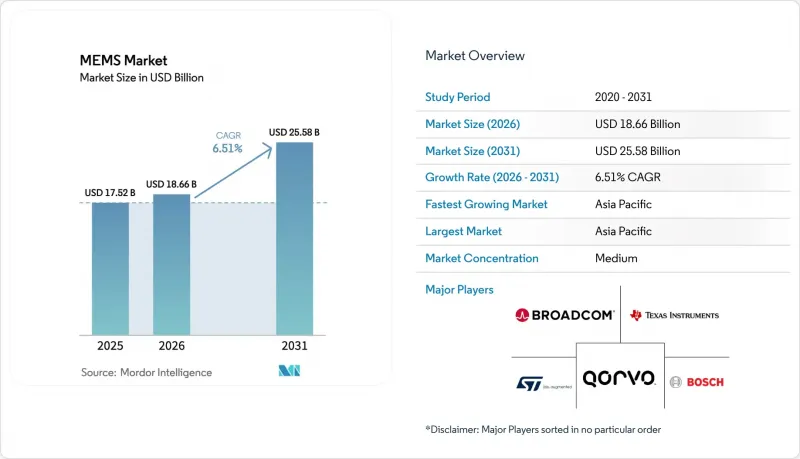
根據 Mordor Intelligence 預測,MEMS 市場規模將從 2025 年的 175.2 億美元成長到 2026 年的 186.6 億美元,然後在 2031 年達到 255.8 億美元,2026 年至 2031 年的複合年成長率為 6.51%。
本報告按裝置類別(感測器、執行器等)、感測器/執行器類型(慣性式、壓力式等)、應用領域(家用電子電器、汽車等)、製造流程(體相、表面等)、材料(矽、聚合物、壓電、金屬等)和地區(北美、南美、歐洲等)進行細分。市場預測以美元計價。
全球MEMS市場趨勢與洞察
物聯網邊緣節點中感測器數量的激增
邊緣閘道器現在整合了 5 到 8 個 MEMS 裝置,而三年前只有 2 到 3 個,這使得設備本身可以進行振動分析、氣體檢測和溫度監測。高通公司針對 2025 年推出的物聯網服務套件將 MEMS加速計與機器學習模型結合,可將誤報率降低 40%。以 RISC-V 微控制器為核心的感測器節點成本低於 20 美元,降低了准入門檻。智慧農業應用透過在本地傳輸來自土壤濕度和氣象感測器的過濾數據,然後再將其上傳到雲端,從而展現出規模經濟效益。韌體標準的差異持續減緩系統整合速度,並延長產品認證週期。
增加每輛電動車上安裝的MEMS裝置數量,以提高ADAS安全性。
為了符合 ISO 26262 的功能安全要求,L3 級自動駕駛轎車目前整合了 18 至 22 個 MEMS 裝置,比傳統汽車的 12 個裝置有所增加。 TDK 的 IAM-20685 模組整合了一個自診斷電路,可在 10 毫秒內偵測到漂移,滿足 Tier 1 故障運作要求。電子機械線控刹車系統需要高精度壓力感知器,取樣頻率為 1 kHz。同時,中國將於 2026 年實施的輪胎壓力法規預計每年將新增 2,500 萬個輪胎壓力感知器。然而,由於製造地集中在德國和日本,汽車製造商面臨供應鏈中斷的風險。
對專用製程生產線進行大量初始資本投資
2025年,Rogue Valley Microdevices投資1.8億美元,在一個200毫米的晶圓加工單元內安裝了深反應離子蝕刻和晶圓鍵合技術設備。與CMOS晶圓廠可以將成本分攤到各種晶片上不同,MEMS生產線僅限於少數幾個產品系列,從而限制了其多元化發展。儘管《晶片法案》和《歐洲晶片法案》為成熟的行業巨頭提供了補貼,但新創公司仍然面臨高達數千萬美元的准入門檻。汽車和醫療製程的重新認證可能需要長達18個月的時間,這使得代工廠不願意做出改變,阻礙了創新。
細分市場分析
到2025年,感測器將主導MEMS市場,佔據61.43%的市場佔有率,這主要得益於智慧型手機和汽車領域數十億個慣性感測器模組的出貨量。微流體晶片以7.23%的複合年成長率(CAGR)領先市場,分散式診斷依賴一次性墨盒,將檢查週期從數天縮短至數分鐘。雖然感測器的單位成本優勢有利於大規模生產,但晶片實驗室耗材的利潤率仍然很高,這激勵著多元化供應商提高微流體晶片代工廠的產能。噴墨印表機頭等執行器因其成熟的更換週期而成長受限,但微機電振盪器正受益於5G的時序同步需求。新興的能量採集器由於轉換效率低於10%,目前仍處於小眾市場,但在電池更換成本高昂的偏遠工業場所,其應用正在不斷成長。
微流體領域的蓬勃發展擴大了醫療保健產業的目標基本客群。隨著床邊血氣檢測在急診室的普及,雅培公司擴建位於伊利諾州的工廠,凸顯了市場對微流控晶片日益成長的需求。 FDA 510(k)核准流程的推進縮短了生物微機電系統(bioMEMS)產品的上市時間,進一步鞏固了成熟企業的優勢。同時,在面臨商品化壓力的感測器領域,供應商被迫轉向片上整合和機器學習技術,以證明其定價的合理性。這種對比鮮明的局面表明,微機電系統(MEMS)市場正在分化為兩個細分市場:“大規模生產的感測器”和“高利潤、特定應用的微流體”,二者需要不同的製造藍圖。
到2025年,慣性感測器將佔據42.53%的市場佔有率,其中加速計和陀螺儀將用於智慧型手機螢幕旋轉、健身追蹤和汽車穩定性控制。隨著語音助理從旗艦機型向中階設備擴展,MEMS麥克風預計將以8.31%的複合年成長率成長,實現70dB信噪比的遠距離語音指令。壓力感測器在輪胎壓力監測系統和人工呼吸器的需求仍然強勁,而隨著5G的普及,射頻MEMS組件的需求持續成長,儘管成本仍是市場關注的重點。光學MEMS則面向投影和LiDAR等細分市場,其性能優勢彌補了銷售上的不足。
歌爾科技的目標是到2025年出貨12億個麥克風,而諾爾斯科技則面臨成本和小型化上的挑戰。消費級加速計的平均售價低於0.5美元,供應商正擴大採用感測器融合引擎來提升自身競爭力。隨著Qorvo和博通等公司捍衛其專利組合,射頻微機電系統(RF-MEMS)供應商面臨累積的專利費,這提高了新進入者的進入門檻。通用慣性裝置和高價值麥克風的組合凸顯了微機電系統市場的細分以及不同領域創新促進因素的差異。
區域分析
預計亞太地區將引領市場,到2025年將佔全球銷售額的52.31%,並持續以7.13%的複合年成長率成長至2031年。中國強制性輪胎壓力監測系統每年將新增2,500萬個壓力感測器的需求,而日本和台灣分別專注於壓電薄膜和28奈米MEMS邏輯的整合。韓國為全球智慧型手機品牌提供垂直整合的中階,縮短了前置作業時間,並鞏固了其區域優勢。印度和東南亞是快速成長且對價格敏感的市場,中階慣性感測器設備的普及率正在提高,但諸如始終開啟的語音啟動等高階功能的推出卻有所延遲。
北美地區在汽車、國防和醫療叢集的支撐下,預計到2025年將佔全球銷售額的約23%。根據《晶片和工業產品法案》(CHIPS Act),美國政府已撥款520億美元用於扶持國內微機電系統(MEMS)生產線,其中羅格谷微元件公司(Rogue Valley Microdevices)獲得了7,500萬美元的補貼,用於擴大其在奧勒岡州的產能。美國食品藥物管理局(FDA)的510(k)核准流程使得醫療MEMS產品的商業化週期縮短至12個月,加速了其營收成長。儘管高昂的人事費用仍然意味著大規模生產的智慧型手機感測器主要在海外製造,但出於安全考慮,專用設備和國防慣性測量單元仍然在國內生產。
歐洲佔約18%的市場佔有率,主要由博世、英飛凌和大陸集團這三家德國汽車感測器巨頭主導。總額達430億歐元的「歐洲晶片法案」正在資助X-FAB公司升級至300毫米工藝,並支持將ADAS(高級駕駛輔助系統)加速計的單價降至2美元以下的目標。法國義法半導體為全球穿戴式裝置提供多感測器模組,而英國劍橋的產業叢集則致力於扶持用於雷射雷達和擴增實境(AR)顯示器的光學MEMS(微機電系統)新創公司。基於RoHS和REACH法規結構正在收緊含鉛材料和某些聚合物材料的認證標準,從而影響供應商的材料藍圖。南美洲和中東及非洲合計總合佔有率不足7%,主要受巴西汽車需求、阿拉伯聯合大公國智慧城市計畫以及南非礦業感測器需求的推動。然而,進口關稅和基礎設施不足制約了其成長。
其他好處:
- Excel格式的市場預測(ME)表
- 3個月的分析師支持
目錄
第1章:引言
- 研究假設和市場定義
- 調查範圍
第2章:調查方法
第3章執行摘要
第4章 市場狀況
- 市場概覽
- 市場促進因素
- 物聯網邊緣節點中感測器數量的激增
- 為了提高ADAS的安全性,每輛電動車安裝的MEMS數量將會增加。
- 5G 的普及推動了對射頻微機電系統濾波器和開關的需求。
- 向 300 毫米晶圓級 MEMS 製造過渡
- 用於即時診斷的微流體生物微機電系統的發展
- 用於穿戴式音訊裝置的超低功耗壓電MEMS揚聲器
- 市場限制因素
- 專業製程生產線需要較高的初始資本投入
- 缺乏鑄造級設計規則和標準
- 摻鈧氮化鋁及其他特殊材料的供應風險
- 射頻微機電系統知識產權的日益複雜化導致專利費上漲。
- 產業價值鏈分析
- 監理情勢
- 技術展望
- 宏觀經濟因素對市場的影響
- 波特五力分析
第5章 市場規模與成長預測
- 按設備類別
- 感應器
- 執行器
- 振盪器和定時
- 微流體晶片
- 用於供電/運動的微型發電機
- 按下感測器/執行器類型
- 慣性感測器
- 壓力感測器
- RF MEMS
- 光學MEMS
- 環境感測器
- MEMS麥克風
- 微測輻射熱計和紅外線檢測器
- 噴墨印字頭
- 其他類型的感測器/執行器
- 透過使用
- 家用電子產品
- 車
- 工業和機器人領域
- 醫療保健和醫療設備
- 通訊基礎設施
- 航太/國防
- 其他用途
- 透過製造程序
- 體微加工
- 表面微機械加工
- 深反應離子蝕刻(DRIE)
- 絕緣薄膜矽(SOI)微機電系統
- LIGA/X光光刻
- 先進的3D列印MEMS
- 材料
- 矽
- 聚合物
- 壓電材料(氮化鋁、壓電陶瓷)
- 金屬
- 化合物半導體
- 石英和玻璃
- 按地區
- 北美洲
- 美國
- 加拿大
- 墨西哥
- 南美洲
- 巴西
- 阿根廷
- 其他南美國家
- 歐洲
- 德國
- 英國
- 法國
- 義大利
- 西班牙
- 俄羅斯
- 其他歐洲國家
- 亞太地區
- 中國
- 日本
- 韓國
- 印度
- 澳洲
- 紐西蘭
- 其他亞太國家
- 中東
- 阿拉伯聯合大公國
- 沙烏地阿拉伯
- 土耳其
- 其他中東國家
- 非洲
- 南非
- 奈及利亞
- 肯亞
- 其他非洲國家
- 北美洲
第6章 競爭情勢
- 市場集中度
- 策略趨勢
- 市佔率分析
- 公司簡介
- Robert Bosch GmbH
- Broadcom Inc.
- STMicroelectronics NV
- Texas Instruments Inc.
- Qorvo Inc.
- TDK Corporation(InvenSense)
- Infineon Technologies AG
- NXP Semiconductors NV
- Knowles Electronics LLC
- Panasonic Corporation
- GoerTek Inc.
- Honeywell International Inc.
- Murata Manufacturing Co., Ltd.
- Analog Devices Inc.
- Alps Alpine Co., Ltd.
- Omron Corporation
- Sensata Technologies
- Silex Microsystems AB
- Teledyne MEMS
- Rogue Valley Microdevices Inc.
第7章 市場機會與未來展望
According to Mordor Intelligence, the MEMS market size is expected to grow from USD 17.52 billion in 2025 to USD 18.66 billion in 2026 and is forecast to reach USD 25.58 billion by 2031 at 6.51% CAGR over 2026-2031.
This report is Segmented by Device Class (Sensors, Actuators, and More), Sensor/Actuator Type (Inertial, Pressure, and More), Application (Consumer Electronics, Automotive, and More), Fabrication Process (Bulk, Surface, and More), Material (Silicon, Polymers, Piezoelectric, Metals, and More), and Geography (North America, South America, Europe, and More). Market Forecasts are Provided in Terms of Value (USD).
Global MEMS Market Trends and Insights
Sensor Proliferation in IoT Edge Nodes
Edge gateways now embed five to eight MEMS devices compared with two to three just three years ago, enabling on-device vibration analysis, gas detection, and temperature monitoring. Qualcomm's 2025 IoT services suite pairs MEMS accelerometers with machine-learning models that cut false alarms by 40%. Sub-USD 20 sensor nodes built around RISC-V microcontrollers lower adoption barriers. Smart-agriculture deployments illustrate scale benefits as soil-moisture and weather sensors relay filtered data locally before cloud upload. Fragmented firmware standards still slow system integration and extend product-qualification cycles.
Expanding MEMS Content per EV for ADAS Safety
Level-3 autonomous sedans now integrate 18-22 MEMS devices, up from 12 in conventional cars, to comply with ISO 26262 functional-safety mandates. TDK's IAM-20685 module embeds a self-test circuit that flags drift in 10 ms, satisfying Tier-1 fail-operational requirements. Electromechanical brake-by-wire systems require high-precision pressure sensors sampling at 1 kHz, while China's 2026 tire-pressure mandate adds 25 million units of annual demand. Regional fabrication concentration in Germany and Japan, however, exposes automakers to supply-chain disruptions.
High Up-Front Capex for Specialty Process Lines
Outfitting a single 200 mm bay with deep-reactive ion-etch and wafer-bond tools cost Rogue Valley Microdevices USD 180 million in 2025. Unlike CMOS fabs that amortize spend across diverse chips, a MEMS line supports narrow families, limiting diversification. CHIPS and European Chips Acts channel subsidies to established players, yet startups still face eight-figure entry costs. Requalifying automotive or medical processes can take 18 months, so foundries resist modifications, slowing innovation.
Other drivers and restraints analyzed in the detailed report include:
- 5G Adoption Boosting RF-MEMS Filters and Switches
- Transition to 300 mm Wafer-Level MEMS Manufacturing
- Lack of Foundry-Grade Design Rules and Standards
For complete list of drivers and restraints, kindly check the Table Of Contents.
Segment Analysis
Sensors dominated the MEMS market with a 61.43% share in 2025, as inertial modules shipped in billion-unit volumes for smartphones and vehicles. Microfluidic chips drive the fastest 7.23% CAGR because decentralized diagnostics rely on disposable cartridges that compress test cycles from days to minutes. Unit economics favor sensor volumes, yet margins on lab-on-chip consumables remain high, enticing diversified suppliers to add microfluidic foundry capacity. Actuators such as ink-jet heads see mature replacement cycles that limit growth, while MEMS oscillators benefit from 5G timing-synch requirements. Emerging power harvesters stay niche because conversion efficiencies sit below 10%, but adoption rises in remote industrial nodes where battery swaps are costly.
The expanding microfluidic segment widens the addressable healthcare customer base. Abbott's Illinois facility expansion underlines cartridge demand as emergency departments adopt bedside blood-gas tests. Regulatory pathways under FDA 510(k) clearance shorten time-to-market for incremental bio-MEMS, reinforcing incumbent advantages. Meanwhile, commoditization pressures sensors, pushing vendors toward on-chip fusion and machine learning to justify pricing. The contrast illustrates how the MEMS market bifurcates into volume-driven sensors and high-margin, application-specific microfluidics, each demanding distinct fabrication roadmaps.
Inertial sensors held a 42.53% share in 2025 as accelerometers and gyros underpin phone screen rotation, fitness tracking, and automotive stability control. MEMS microphones are projected to post an 8.31% CAGR as voice assistants migrate from flagship to mid-tier devices, with 70 dB signal-to-noise ratios enabling far-field commands. Pressure sensors maintain a steady demand for tire-pressure monitoring systems and ventilators, while RF-MEMS components continue to rise with the adoption of 5G, yet remain cost-sensitive. Optical MEMS address projection and LiDAR niches where performance premiums offset lower volumes.
GoerTek shipped 1.2 billion microphones in 2025, challenging Knowles in terms of cost and miniaturization. Average selling prices for consumer accelerometers slipped below USD 0.50, prompting suppliers to embed sensor-fusion engines for differentiation. RF-MEMS suppliers face royalty stacking as Qorvo and Broadcom defend patent estates, raising barriers for new entrants. The mix of commodity inertial devices and high-value microphones underscores the MEMS market's segmentation and varying innovation levers.
Complete Report Scope:
- By Device Class
- Sensors
- Actuators
- Oscillators and Timing
- Microfluidic Chips
- Power / Motion Micro-Generators
- By Sensor / Actuator Type
- Inertial Sensors
- Pressure Sensors
- RF MEMS
- Optical MEMS
- Environmental Sensors
- MEMS Microphones
- Micro-Bolometers and IR Detectors
- Ink-Jet Heads
- Other Sensor / Actuator Types
- By Application
- Consumer Electronics
- Automotive
- Industrial and Robotics
- Healthcare and Medical Devices
- Telecom Infrastructure
- Aerospace and Defense
- Other Applications
- By Fabrication Process
- Bulk Micromachining
- Surface Micromachining
- Deep-Reactive Ion Etch (DRIE)
- Silicon-on-Insulator (SOI) MEMS
- LIGA / X-ray Lithography
- Advanced 3-D-Printed MEMS
- By Material
- Silicon
- Polymers
- Piezoelectric (AlN, PZT)
- Metals
- Compound Semiconductors
- Quartz and Glass
- By Geography
- North America
- United States
- Canada
- Mexico
- South America
- Brazil
- Argentina
- Rest of South America
- Europe
- Germany
- United Kingdom
- France
- Italy
- Spain
- Russia
- Rest of Europe
- Asia Pacific
- China
- Japan
- South Korea
- India
- Australia
- New Zealand
- Rest of Asia Pacific
- Middle East
- United Arab Emirates
- Saudi Arabia
- Turkey
- Rest of Middle East
- Africa
- South Africa
- Nigeria
- Kenya
- Rest of Africa
- North America
Geography Analysis
Asia Pacific led with 52.31% of 2025 revenue and will advance at a 7.13% CAGR through 2031. China's tire-pressure mandate adds 25 million pressure sensors annually, while Japan and Taiwan specialize in piezoelectric thin films and 28 nm MEMS-logic co-integration, respectively. South Korea's vertically integrated microphone supply to global smartphone brands shortens lead times and reinforces regional dominance. India and Southeast Asia represent fast-growing, price-sensitive markets that increasingly adopt mid-tier devices with inertial sensors but defer premium features such as always-on voice activation.
North America contributed roughly 23% of 2025 turnover, underpinned by automotive, defense, and medical clusters. CHIPS Act subsidies of USD 52 billion earmark funds for domestic MEMS lines, with Rogue Valley Microdevices securing USD 75 million to expand Oregon capacity. FDA 510(k) pathways enable 12-month commercialization cycles for medical MEMS, accelerating revenue visibility. High labor costs still drive high-volume smartphone sensors offshore, but specialty devices and defense inertial units remain local for security reasons.
Europe held about 18% share, anchored by Germany's automotive sensor triad of Bosch, Infineon, and Continental. The EUR 43 billion European Chips Act funds 300 mm upgrades at X-FAB, supporting sub-USD 2 accelerometer goals for ADAS. France's STMicroelectronics supplies multi-sensor modules to global wearables, while the U.K.'s Cambridge cluster incubates optical MEMS startups for LiDAR and augmented-reality displays. Regulatory frameworks under RoHS and REACH raise qualification hurdles for lead-based and certain polymer materials, shaping supplier material roadmaps. South America, Middle East, and Africa collectively account for under 7%, driven by Brazil's automotive demand, UAE smart-city projects, and South Africa's mining sensors, yet growth is constrained by import tariffs and infrastructure gaps.
- Robert Bosch GmbH
- Broadcom Inc.
- STMicroelectronics N.V.
- Texas Instruments Inc.
- Qorvo Inc.
- TDK Corporation (InvenSense)
- Infineon Technologies AG
- NXP Semiconductors N.V.
- Knowles Electronics LLC
- Panasonic Corporation
- GoerTek Inc.
- Honeywell International Inc.
- Murata Manufacturing Co., Ltd.
- Analog Devices Inc.
- Alps Alpine Co., Ltd.
- Omron Corporation
- Sensata Technologies
- Silex Microsystems AB
- Teledyne MEMS
- Rogue Valley Microdevices Inc.
Additional Benefits:
- The market estimate (ME) sheet in Excel format
- 3 months of analyst support
TABLE OF CONTENTS
1 INTRODUCTION
- 1.1 Study Assumptions and Market Definition
- 1.2 Scope of the Study
2 RESEARCH METHODOLOGY
3 EXECUTIVE SUMMARY
4 MARKET LANDSCAPE
- 4.1 Market Overview
- 4.2 Market Drivers
- 4.2.1 Sensor Proliferation in IoT Edge Nodes
- 4.2.2 Expanding MEMS Content per EV for ADAS Safety
- 4.2.3 5 G Adoption Boosting RF-MEMS Filters and Switches
- 4.2.4 Transition to 300 mm Wafer-level MEMS Manufacturing
- 4.2.5 Growth of Microfluidic Bio-MEMS for Point-of-Care Dx
- 4.2.6 Ultra-Low-Power Piezo-MEMS Speakers for Hearables
- 4.3 Market Restraints
- 4.3.1 High Up-Front Capex for Specialty Process Lines
- 4.3.2 Lack of Foundry-Grade Design Rules and Standards
- 4.3.3 Supply Risk for Sc-Doped AlN and Other Niche Materials
- 4.3.4 RF-MEMS IP Thickets Escalating Royalty Costs
- 4.4 Industry Value Chain Analysis
- 4.5 Regulatory Landscape
- 4.6 Technological Outlook
- 4.7 Impact of Macroeconomic Factors on the Market
- 4.8 Porter's Five Forces Analysis
- 4.8.1 Threat of New Entrants
- 4.8.2 Bargaining Power of Suppliers
- 4.8.3 Bargaining Power of Buyers
- 4.8.4 Threat of Substitutes
- 4.8.5 Intensity of Competitive Rivalry
5 MARKET SIZE AND GROWTH FORECASTS (VALUE)
- 5.1 By Device Class
- 5.1.1 Sensors
- 5.1.2 Actuators
- 5.1.3 Oscillators and Timing
- 5.1.4 Microfluidic Chips
- 5.1.5 Power / Motion Micro-Generators
- 5.2 By Sensor / Actuator Type
- 5.2.1 Inertial Sensors
- 5.2.2 Pressure Sensors
- 5.2.3 RF MEMS
- 5.2.4 Optical MEMS
- 5.2.5 Environmental Sensors
- 5.2.6 MEMS Microphones
- 5.2.7 Micro-Bolometers and IR Detectors
- 5.2.8 Ink-Jet Heads
- 5.2.9 Other Sensor / Actuator Types
- 5.3 By Application
- 5.3.1 Consumer Electronics
- 5.3.2 Automotive
- 5.3.3 Industrial and Robotics
- 5.3.4 Healthcare and Medical Devices
- 5.3.5 Telecom Infrastructure
- 5.3.6 Aerospace and Defense
- 5.3.7 Other Applications
- 5.4 By Fabrication Process
- 5.4.1 Bulk Micromachining
- 5.4.2 Surface Micromachining
- 5.4.3 Deep-Reactive Ion Etch (DRIE)
- 5.4.4 Silicon-on-Insulator (SOI) MEMS
- 5.4.5 LIGA / X-ray Lithography
- 5.4.6 Advanced 3-D-Printed MEMS
- 5.5 By Material
- 5.5.1 Silicon
- 5.5.2 Polymers
- 5.5.3 Piezoelectric (AlN, PZT)
- 5.5.4 Metals
- 5.5.5 Compound Semiconductors
- 5.5.6 Quartz and Glass
- 5.6 By Geography
- 5.6.1 North America
- 5.6.1.1 United States
- 5.6.1.2 Canada
- 5.6.1.3 Mexico
- 5.6.2 South America
- 5.6.2.1 Brazil
- 5.6.2.2 Argentina
- 5.6.2.3 Rest of South America
- 5.6.3 Europe
- 5.6.3.1 Germany
- 5.6.3.2 United Kingdom
- 5.6.3.3 France
- 5.6.3.4 Italy
- 5.6.3.5 Spain
- 5.6.3.6 Russia
- 5.6.3.7 Rest of Europe
- 5.6.4 Asia Pacific
- 5.6.4.1 China
- 5.6.4.2 Japan
- 5.6.4.3 South Korea
- 5.6.4.4 India
- 5.6.4.5 Australia
- 5.6.4.6 New Zealand
- 5.6.4.7 Rest of Asia Pacific
- 5.6.5 Middle East
- 5.6.5.1 United Arab Emirates
- 5.6.5.2 Saudi Arabia
- 5.6.5.3 Turkey
- 5.6.5.4 Rest of Middle East
- 5.6.6 Africa
- 5.6.6.1 South Africa
- 5.6.6.2 Nigeria
- 5.6.6.3 Kenya
- 5.6.6.4 Rest of Africa
- 5.6.1 North America
6 COMPETITIVE LANDSCAPE
- 6.1 Market Concentration
- 6.2 Strategic Moves
- 6.3 Market Share Analysis
- 6.4 Company Profiles (includes Global Level Overview, Market Level Overview, Core Segments, Financials as Available, Strategic Information, Market Rank/Share for Key Companies, Products and Services, and Recent Developments)
- 6.4.1 Robert Bosch GmbH
- 6.4.2 Broadcom Inc.
- 6.4.3 STMicroelectronics N.V.
- 6.4.4 Texas Instruments Inc.
- 6.4.5 Qorvo Inc.
- 6.4.6 TDK Corporation (InvenSense)
- 6.4.7 Infineon Technologies AG
- 6.4.8 NXP Semiconductors N.V.
- 6.4.9 Knowles Electronics LLC
- 6.4.10 Panasonic Corporation
- 6.4.11 GoerTek Inc.
- 6.4.12 Honeywell International Inc.
- 6.4.13 Murata Manufacturing Co., Ltd.
- 6.4.14 Analog Devices Inc.
- 6.4.15 Alps Alpine Co., Ltd.
- 6.4.16 Omron Corporation
- 6.4.17 Sensata Technologies
- 6.4.18 Silex Microsystems AB
- 6.4.19 Teledyne MEMS
- 6.4.20 Rogue Valley Microdevices Inc.
7 MARKET OPPORTUNITIES AND FUTURE OUTLOOK
- 7.1 White-Space and Unmet-Need Assessment

 2026年全球高速光開關市場報告
 MEMS市場報告:趨勢、預測與競爭分析(至2035年)
 行動裝置用MEMS:市佔率分析、產業趨勢與統計及成長預測(2026-2031年)
 電子機械系統(MEMS)市場:按元件類型、製造材料、最終用戶和分銷管道分類-2026-2032年全球市場預測
 微機電系統(MEMS)市場:按類型、應用和地區分類
 微機電系統 (MEMS) 市場預測至 2034 年—按裝置類型、感測器類型、材料、製造技術、應用和地區分類的全球分析
 微加工設備市場規模、佔有率、成長率、全球產業分析、區域分析及未來預測(2026-2034)微機電系統 (MEMS) 市場預測至 2034 年—按感測器類型、執行器類型、製造方法、材料、最終用戶和地區分類的全球分析MEMS矽晶圓市場報告:趨勢、預測及競爭分析(至2035年)
 MEMS冷卻系統-2026年至2034年全球市佔率及排名、總收入及需求預測