


 |
市場調查報告書
商品編碼
2100533
歐洲汽車空氣濾清器:市場佔有率分析、行業趨勢和統計數據以及成長預測(2026-2031 年)Europe Automotive Air Filters - Market Share Analysis, Industry Trends & Statistics, Growth Forecasts (2026 - 2031) |
||||||

※ 本網頁內容可能與最新版本有所差異。詳細情況請與我們聯繫。
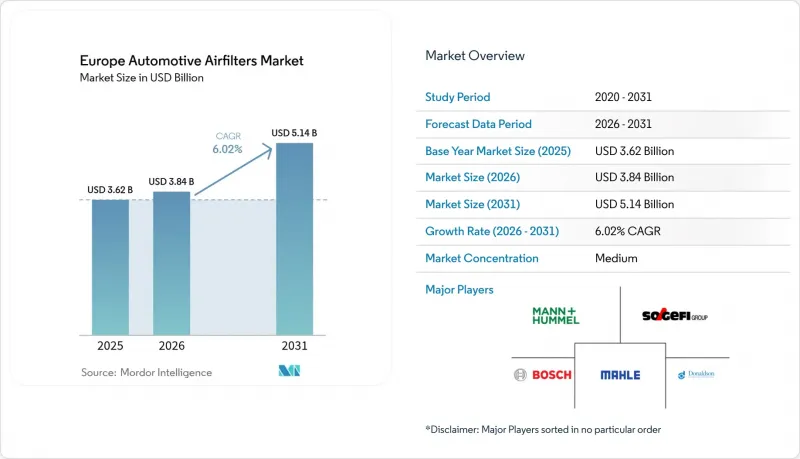
據 Mordor Intelligence 稱,2025 年歐洲汽車空氣濾清器市值為 36.2 億美元,預計到 2031 年將從 2026 年的 38.4 億美元成長至 51.4 億美元,預測期(2026-2031 年)的複合年成長率為 6.02%。
本報告按材料類型(紙本、紗布等)、過濾器類型(進氣過濾器、空調過濾器)、車輛類型(乘用車、輕型商用車等)、銷售管道(原廠配套、售後市場)和國家/地區進行分類。市場預測以美元計價。
歐洲汽車空氣濾清器市場的趨勢與洞察
車輛老化導致對獨立售後服務的需求不斷增加。
到2025年,西歐車輛的平均車齡將達到12年,而東歐車輛的平均車齡則在15至20年之間。舊式內燃機(ICE)車型需要頻繁更換進氣濾芯和空調濾芯,而獨立維修店憑藉其具有競爭力的價格和豐富的產品種類,在東歐售後市場佔據了相當大的佔有率。儘管電池式電動車(BEV)的普及將降低未來對進氣濾芯的需求,但剩餘的內燃機車型仍將保證長期的銷售量,預計歐洲汽車空氣濾芯市場至少還能維持一個完整的更換週期。為了因應這一趨勢,售後市場專家正透過以下方式積極應對:擴大舊款車型的產品種類,推出自有品牌的活性碳空調濾芯,並利用電商平台觸達偏遠地區的車主。
歐7和歐VI-D排放氣體法規加快了過濾器更換週期。
2024年5月,歐盟委員會宣布了歐盟7排放標準,對汽油車引入了10奈米的顆粒物排放閾值,並強制要求對廢氣和非廢氣顆粒物進行終身合規處理。由於車載診斷系統(OBD)現在可以監測濾芯的劣化,進氣濾芯和空調濾芯的性能必須比以往保持更長時間,而對於高里程車輛,實際使用條件下的更換週期必須盡可能縮短。因此,OEM級供應商透過獲得監管認證並銷售帶有內置RFID標籤的高利潤多層濾芯套裝,提高了單位利潤率,使得歐洲汽車空氣濾芯市場不再僅僅是可選的維護部件,而是實現合規的關鍵途徑。
電動車的日益普及降低了對引擎進氣過濾器的需求。
由於電池式電動車(BEV) 無需燃燒空氣過濾器,因此進氣過濾器的材料清單已從新車需求中剔除。在德國,2024 年電動車組裝為 135 萬輛,根據車隊平均二氧化碳排放法規,到 2025 年的目標是達到 167 萬輛。同時,在挪威的新車市場,純電動車已佔多數佔有率。因此,歐洲汽車空氣濾清器市場正面臨銷售結構性下滑的逆風,尤其是在電氣化進程最快的豪華車市場。另一方面,儘管每輛車的平均安裝數量呈下降趨勢,但車廂過濾器、電池組冷卻微型過濾器和空氣乾燥器濾芯的銷售量卻呈現成長態勢。中期來看,銷售受到的影響主要集中在高附加價值的進氣過濾器上,這些產品的利潤率歷來是研發預算的主要來源,這迫使供應商將業務轉向利基市場,例如使用複合材料的車廂過濾器和溫度控管相關產品。
細分市場分析
到2025年,紙質濾芯將佔據歐洲汽車空氣濾芯市場55.62%的佔有率,為所有量產乘用車提供可靠的氣流阻力和成本效益。幾十年來,這種傳統基材一直支撐著歐洲汽車空氣濾芯市場的規模,這得益於成熟的供應鏈和區域性的紙漿加工能力。然而,隨著消費者對在有限的車內空間內吸附揮發性有機化合物(VOCs)和中和過敏原的需求日益成長,活性碳和新興的複合材料正推動市場成長,預計到2031年,複合年成長率將達到6.32%。
原始設備製造商 (OEM) 正在開發混合型濾芯,這種濾芯在纖維素骨架上塗覆奈米纖維層,能夠捕獲 10 奈米顆粒,同時將壓降保持在 15 帕以下。紗布和泡沫濾芯仍然是性能調校和非公路用設備的利基選擇,其浸油層和較大孔徑適用於多塵環境。隨著歐盟 7 排放標準的實施,紙質濾芯的市場佔有率正在逐漸下降,但由於其可回收的特性和低生產能耗,它們仍然非常重要,預計在歐洲汽車空氣濾清器市場中,它們將與新型濾芯共存,而不是被完全取代。
到2025年,車廂空氣濾清器將佔歐洲汽車空氣濾清器市場60.78%的佔有率,這一地位將因疫情後人們對健康的擔憂、都市區霧霾的加劇以及過敏認證的市場吸引力而進一步鞏固。預計到2031年,該細分市場將以6.18%的複合年成長率成長,超過進氣濾清器,因為在污染嚴重的大都會圈,更換頻率可能高達每年兩次。汽車製造商正在手套箱後方設計濾芯更換通道,簡化使用者更換濾芯的過程,並促進獨立配件零售商的電商銷售。
剩餘的市場佔有率,即進氣過濾器,面臨著被純電動車(BEV)取代的挑戰,但仍服務於歐洲龐大的現有內燃機(ICE)汽車車隊。需求的波動迫使供應商將產品線多元化,開發出諸如車廂和空調顆粒過濾器等雙功能產品。在電動車中,車廂過濾器的選擇會影響空調系統的能耗,因此,先進的低壓損設計被廣泛採用,作為高利潤的原廠安裝零件。如今,聯網汽車儀表板會在顆粒物積聚激增時向駕駛員發出警告,提醒他們及時更換過濾器,從而維持歐洲汽車空氣過濾器市場高級產品的價值。
其他好處:
- Excel格式的市場預測(ME)表
- 3個月的分析師支持
目錄
第1章:引言
- 研究假設和市場定義
- 調查範圍
第2章:調查方法
第3章執行摘要
第4章 市場狀況
- 市場概覽
- 市場促進因素
- 隨著汽車老化,對獨立售後市場 (IAM) 服務的需求不斷成長。
- 歐7和歐VI-D排放氣體法規將加快過濾器更換週期。
- 消費者對車內空氣品質和過敏問題的關注度日益提高
- OEM廠商致力於利用超低壓損介質來最大限度地提高電動車續航里程。
- 歐洲城市層級低排放區(LEZ)的擴張
- 基於訂閱的OTA機上空氣品質服務透過過濾器產生持續收入。
- 市場限制因素
- 電動車的日益普及降低了對內燃機空氣濾清器的需求。
- 由於車輛小型化,過濾元件的數量減少了/它們的尺寸縮小了。
- 特種不織布和活性碳介質供應瓶頸
- 高階市場更廣泛地採用可清洗的高性能過濾器。
- 價值供應鏈分析
- 監理情勢
- 技術展望
- 波特五力模型
第5章 市場規模與成長預測
- 依材料類型
- 紙
- 紗布
- 發泡體
- 活性碳/複合材料
- 按篩選類型
- 進氣過濾器
- 空調濾芯
- 車輛類型
- 搭乘用車
- 輕型商用車
- 大型商用車輛和巴士
- 按銷售管道
- OEM
- 售後市場
- 國家
- 德國
- 英國
- 法國
- 義大利
- 西班牙
- 其他歐洲國家
第6章 競爭情勢
- 市場集中度
- 策略趨勢
- 市佔率分析
- 公司簡介
- MANN+HUMMEL
- MAHLE
- Sogefi
- Robert Bosch GmbH
- Donaldson
- Hengst SE
- Freudenberg Filtration Tech.
- Ahlstrom
- Cummins Inc.
- DENSO
- K&N Engineering
- Purolator Filters LLC
- Advanced Flow Engineering
- AIRAID
- S&B Filters
- AL Filters
- JS Automobiles
- Allena Group
- Wsmridhi Manufacturing
- UFI Filters
第7章 市場機會與未來展望
According to Mordor Intelligence, the Europe automotive air filters market size was valued at USD 3.62 billion in 2025 and estimated to grow from USD 3.84 billion in 2026 to reach USD 5.14 billion by 2031, at a CAGR of 6.02% during the forecast period (2026-2031).
This report is Segmented by Material Type (Paper, Gauze, and More), Filter (Intake Filters and Cabin Filters), Vehicle Type (Passenger Cars, Light Commercial Vehicles, and More), Sales Channel (OEM and Aftermarket), and Country. The Market Forecasts are Provided in Terms of Value (USD).
Europe Automotive Air Filters Market Trends and Insights
Ageing Car-Parc Expanding Independent Aftermarket Demand
Western Europe's average vehicle age reached 12 years in 2025, while Eastern European fleets stretch to 15-20 years. Older internal-combustion-engine (ICE) models require frequent intake and cabin filter swaps, and independent garages capture a considerable share of the regional aftermarket by offering competitive pricing and broad SKU coverage. Even as BEV penetration removes future intake filter demand, the residual ICE fleet guarantees long-dated volume, keeping the Europe automotive air filters market robust through at least one more full replacement cycle. Aftermarket specialists respond by widening SKU assortments for legacy platforms, introducing private-label activated-carbon cabin elements, and adopting e-commerce marketplaces to reach dispersed rural owners.
Euro 7 and Euro VI-D Emission Norms Accelerating Filter Replacement Cycles
The European Commission published Euro 7 rules in May 2024, introducing 10-nanometer particulate thresholds for gasoline vehicles and lifetime compliance for both tailpipe and non-exhaust particles. Because on-board diagnostics now monitor filter degradation, intake and cabin elements must sustain efficiency far longer than legacy, compressing real-world replacement to as low as possible in high-mileage fleets. OEM-grade suppliers therefore bundle higher-margin, multilayer elements that carry regulatory certificates and embedded RFID tags, lifting revenue per unit and reinforcing the Europe automotive air filters market as a critical compliance lever rather than a discretionary maintenance part.
BEV Adoption Shrinking Demand for Intake Engine Air-Filters
Battery-electric vehicles do not require combustion air filtration, removing entire intake filter bill-of-materials from new-vehicle demand. Germany assembled 1.35 million EVs in 2024 and is targeting 1.67 million units in 2025 under fleet-average CO2 rules, while Norway's new-car market reached majority of BEV share. The Europe automotive air filters market therefore confronts a structural volume headwind, chiefly in premium segments where electrification advances fastest. Counterbalancing growth arises in cabin filters, battery-pack cooling micro-filters, and air-drier cartridges-yet unit counts per vehicle fall on average. Medium-term revenue impact centers on high-value intake elements whose margins historically funded R&D budgets, compelling suppliers to pivot toward composite cabin and thermal-management niches.
Other drivers and restraints analyzed in the detailed report include:
- Heightened Consumer Focus on In-Cabin Air Quality and Allergies
- OEM Drive for Ultra-Low Pressure-Drop Media to Maximize EV Range
- Vehicle Downsizing Reducing Number/Size of Filter Elements
For complete list of drivers and restraints, kindly check the Table Of Contents.
Segment Analysis
Paper-based filters captured 55.62% of Europe automotive air filters market share in 2025, producing dependable airflow resistance and cost efficiency across high-volume passenger car lines. This traditional substrate underpinned Europe automotive air filters market size for decades, benefitting from mature supply chains and regional pulp processing capacity. Activated-carbon and emerging composite variants, however, are outpacing at 6.32% CAGR to 2031 as consumers demand volatile-organic-compound (VOC) adsorption and allergen neutralization within constrained cabin spaces.
OEMs are layering nanofibers atop cellulose backbones, creating hybrid sheets that trap 10-nanometer particles while holding pressure drops below 15 Pa. Gauze and foam remain niche options in performance tuning and off-highway equipment, respectively, where oil-impregnated layers or oversized pores suit dusty environments. As Euro 7 matures, paper's share erodes gradually but retains relevance due to recyclable composition and low embodied energy, ensuring coexistence rather than outright displacement inside the Europe automotive air filters market.
Cabin filters held 60.78% of the Europe automotive air filters market size in 2025, a position fortified by post-pandemic health concerns, urban smog episodes, and the marketing appeal of allergy certification. The segment grows at a 6.18% CAGR through 2031, outpacing intake filters, because replacement frequency can reach twice per year in polluted metropolitan zones. OEMs integrate filtration cartridge access behind glove boxes, simplifying do-it-yourself swaps and stimulating e-commerce sales by independent parts retailers.
Intake filters, covering the residual share, confront BEV substitution but still service Europe's large legacy ICE fleet. Turbulence in unit demand pushes suppliers to diversify toward dual-function cabin and HVAC micro-particle elements. Within EVs, cabin filter selection affects HVAC energy draw; thus, advanced low-pressure-drop designs win high-margin factory installs. Connected vehicle dashboards now alert drivers when particulate accumulation spikes, triggering timely replacements and preserving premium unit values across the Europe automotive air filters market.
Complete Report Scope:
- By Material Type
- Paper
- Gauze
- Foam
- Activated-carbon / Composite
- By Filter Type
- Intake Filters
- Cabin Filters
- By Vehicle Type
- Passenger Cars
- Light Commercial Vehicles
- Heavy Commercial Vehicles & Buses
- By Sales Channel
- OEM
- Aftermarket
- By Country
- Germany
- United Kingdom
- France
- Italy
- Spain
- Rest of Europe
List of Companies Covered in this Report:
- MANN+HUMMEL
- MAHLE
- Sogefi
- Robert Bosch GmbH
- Donaldson
- Hengst SE
- Freudenberg Filtration Tech.
- Ahlstrom
- Cummins Inc.
- DENSO
- K&N Engineering
- Purolator Filters LLC
- Advanced Flow Engineering
- AIRAID
- S&B Filters
- AL Filters
- JS Automobiles
- Allena Group
- Wsmridhi Manufacturing
- UFI Filters
Additional Benefits:
- The market estimate (ME) sheet in Excel format
- 3 months of analyst support
TABLE OF CONTENTS
1 Introduction
- 1.1 Study Assumptions & Market Definition
- 1.2 Scope of the Study
2 Research Methodology
3 Executive Summary
4 Market Landscape
- 4.1 Market Overview
- 4.2 Market Drivers
- 4.2.1 Ageing car-parc expanding independent aftermarket (IAM) demand
- 4.2.2 Euro 7 & Euro VI-D emission norms accelerating filter replacement cycles
- 4.2.3 Heightened consumer focus on in-cabin air quality & allergies
- 4.2.4 OEM drive for ultra-low pressure-drop media to maximise EV range
- 4.2.5 Expansion of city-level Low-Emission Zones (LEZs) across Europe
- 4.2.6 Subscription-based OTA cabin-air-quality services creating recurring filter revenue
- 4.3 Market Restraints
- 4.3.1 BEV adoption shrinking demand for intake engine air-filters
- 4.3.2 Vehicle downsizing reducing number/size of filter elements
- 4.3.3 Supply bottlenecks for specialty non-woven & activated-carbon media
- 4.3.4 Rising adoption of washable performance filters in premium segment
- 4.4 Value / Supply-Chain Analysis
- 4.5 Regulatory Landscape
- 4.6 Technological Outlook
- 4.7 Porter's Five Forces
- 4.7.1 Threat of New Entrants
- 4.7.2 Bargaining Power of Buyers/Consumers
- 4.7.3 Bargaining Power of Suppliers
- 4.7.4 Threat of Substitute Products
- 4.7.5 Intensity of Competitive Rivalry
5 Market Size & Growth Forecasts (Value (USD))
- 5.1 By Material Type
- 5.1.1 Paper
- 5.1.2 Gauze
- 5.1.3 Foam
- 5.1.4 Activated-carbon / Composite
- 5.2 By Filter Type
- 5.2.1 Intake Filters
- 5.2.2 Cabin Filters
- 5.3 By Vehicle Type
- 5.3.1 Passenger Cars
- 5.3.2 Light Commercial Vehicles
- 5.3.3 Heavy Commercial Vehicles & Buses
- 5.4 By Sales Channel
- 5.4.1 OEM
- 5.4.2 Aftermarket
- 5.5 By Country
- 5.5.1 Germany
- 5.5.2 United Kingdom
- 5.5.3 France
- 5.5.4 Italy
- 5.5.5 Spain
- 5.5.6 Rest of Europe
6 Competitive Landscape
- 6.1 Market Concentration
- 6.2 Strategic Moves
- 6.3 Market Share Analysis
- 6.4 Company Profiles (includes Global Level Overview, Market Level Overview, Core Segments, Financials as Available, Strategic Information, Market Rank/Share for Key Companies, Products and Services, SWOT Analysis, and Recent Developments)
- 6.4.1 MANN+HUMMEL
- 6.4.2 MAHLE
- 6.4.3 Sogefi
- 6.4.4 Robert Bosch GmbH
- 6.4.5 Donaldson
- 6.4.6 Hengst SE
- 6.4.7 Freudenberg Filtration Tech.
- 6.4.8 Ahlstrom
- 6.4.9 Cummins Inc.
- 6.4.10 DENSO
- 6.4.11 K&N Engineering
- 6.4.12 Purolator Filters LLC
- 6.4.13 Advanced Flow Engineering
- 6.4.14 AIRAID
- 6.4.15 S&B Filters
- 6.4.16 AL Filters
- 6.4.17 JS Automobiles
- 6.4.18 Allena Group
- 6.4.19 Wsmridhi Manufacturing
- 6.4.20 UFI Filters
7 Market Opportunities & Future Outlook
- 7.1 White-space & Unmet-need Assessment

 商用車空氣濾清器市場:全球市場預測,2026-2032年
 KN95 口罩市場規模、佔有率和成長分析:按產品類型、應用、過濾效率、分銷管道、最終用戶和地區分類-2026-2033 年產業預測汽車空氣濾清器市場:2026-2032年全球市場預測(濾材、車輛類型、濾清器類型、技術和最終用戶分類)
 北美汽車空氣濾清器市場:市佔率分析、產業趨勢與統計及成長預測(2026-2031)
 食品飲料產業空氣濾清器市場:市場機會、成長要素、產業趨勢分析及2026-2035年預測
 高效微粒空氣過濾器(HEPA)市場規模、佔有率和趨勢分析報告:按應用、分銷管道、過濾器類型、最終用途、地區和細分市場預測,2026-2033年
 汽車空氣濾清器市場-全球產業規模、佔有率、趨勢、機會和預測:按車輛類型、濾清器類型、濾材類型、銷售管道類型、地區和競爭格局分類,2021-2031年
 2026年全球空氣碳弧氣刨服務市場報告
 汽車空氣濾清器市場規模、佔有率、成長及全球產業分析:按類型、應用和地區的洞察,2026-2034年的預測高效能空氣微粒過濾器(HEPA)市場:按濾材類型、過濾器類型、過濾等級、應用、最終用戶和分銷管道分類,全球預測(2026-2032年)