


 |
市場調查報告書
商品編碼
2100514
北美汽車空氣濾清器市場:市佔率分析、產業趨勢與統計及成長預測(2026-2031)North America Automotive Air Filters - Market Share Analysis, Industry Trends & Statistics, Growth Forecasts (2026 - 2031) |
||||||

※ 本網頁內容可能與最新版本有所差異。詳細情況請與我們聯繫。
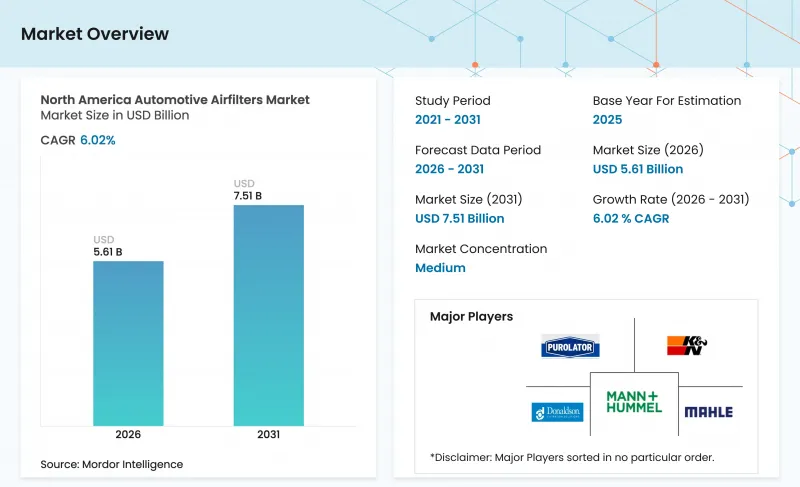
據 Mordor Intelligence 稱,2025 年北美汽車空氣濾清器市值為 52.9 億美元,預計到 2031 年將達到 75.1 億美元,而 2026 年成長率為 56.1 億美元,預測期(2026-2031 年)的複合年成長率為 6.02%。
本報告按材料類型(紙張/纖維素、合成紗線/棉等)、過濾器類型(進氣過濾器和空調過濾器)、車輛類型(乘用車、輕型商用車等)、銷售管道(原廠配套和售後市場)以及國家(美國、加拿大、墨西哥)進行細分。市場預測以價值(美元)和銷售量(單位)表示。
北美汽車空氣濾清器市場趨勢與洞察
美國和加拿大更嚴格的粒狀物和氮氧化物排放標準正在推動濾網更換週期縮短。
美國環保署 (EPA) 針對 2027 年至 2032 年款輕型和中型車輛制定的標準將車隊的平均二氧化碳排放目標提高至 85 克/英里,迫使汽車製造商採用高效的引擎和座艙濾材,以便在不阻礙氣流的情況下捕獲細顆粒物。加州於 2024 年 12 月批准的「先進清潔汽車 II」豁免計畫進一步收緊了區域標準,並將遲早波及整個北美汽車空氣濾芯市場。奈米纖維複合材料受益於此趨勢,因為它們能夠在低壓損的情況下實現所需的收集效率,並保持燃油效率。能夠證明其產品在更嚴格的 PM2.5基準值(9 微克/立方米) 下仍能保持過濾性能的供應商將擁有定價權,而傳統的纖維素產品線則面臨利潤率壓力。隨著大型車輛的新標準於 2027 年生效,耐用性和保固要求將會提高,長壽命過濾器將成為即使是小型汽車買家的標準配置,預計這將加強北美汽車空氣過濾器市場的高階細分市場。
野火季過後,人們對車內空氣品質的關注度迅速提升。
2024年,加州、奧勒岡州和不列顛哥倫比亞省遭遇了破紀錄的野火,持續數週肆虐,導致顆粒物濃度超過健康警示閾值,引發了消費者對高效空氣微粒過濾器(HEPA級)的汽車空氣清淨機需求激增。如今,各州修訂的政策強制要求暴露於煙霧中的建築物必須安裝高效能過濾。這種意識也蔓延到了汽車領域,通勤者將自己的車輛視為“移動避難所”,並要求安裝能夠去除病毒、過敏原和煙霧的過濾器。大眾汽車製造商紛紛回應,開始提供曾經僅在豪華車上才有的多層車廂空氣濾芯,而售後市場製造商則為舊款車型提供改裝套件。促銷宣傳活動強調世界衛生組織(WHO)關於PM2.5和兒童呼吸系統健康的指南,以此來提升銷售價格較高的產品。導航應用程式會顯示煙霧分佈圖,提示駕駛員開啟內循環,並提醒他們更換濾芯,這進一步強化了這種回饋循環。 Cabin Media 在故事敘述中對人類健康的關注,鞏固了其在北美汽車空氣濾清器市場的核心地位。
持久耐用、可水洗的棉紗過濾器正在蠶食替換過濾器市場。
高性能品牌銷售的可重複使用棉紗濾芯將使用壽命從12個月延長至近5年。愛好者們讚賞其更佳的透氣性和永續性,尤其是在沙漠地區,以往灰塵和沙粒導致濾芯需要頻繁更換。零售商重點訊息5萬英里保固和終身成本節省,從而將傳統紙質濾芯產品線的市場價值轉移出去。然而,較高的初始成本和繁瑣的注油過程(可能會污染空氣流量感測器)仍然阻礙了其在普通市場的廣泛應用。儘管如此,即使是較小的轉換率也正在降低北美汽車空氣濾芯市場的售後銷量。為了應對這項挑戰,製造商們正在推出具有抗菌襯裡的可清洗式空調濾芯,在恢復利潤的同時,也符合循環經濟的目標。
細分市場分析
儘管預計到2025年奈米纖維複合材料的市佔率仍然很小,但隨著監管機構將重點放在PM2.5的捕集上,其複合年成長率可望達到8.03%,成為所有材料中成長最快的。紙/纖維素濾芯目前仍佔北美汽車空氣濾清器市場42.88%的佔有率,但紙和纖維素濾芯難以在不增加阻礙氣流的褶皺厚度的情況下達到新的效率目標。靜電紡絲法生產的奈米纖維能夠以較低的壓損去除99.9998%的300至500奈米粒徑的顆粒。這項數據已在《大分子材料與工程》期刊的研究中得到證實。供應商正在將奈米纖維塗層與纖維素芯材結合使用,以將成本控制在合理水平並利用現有生產線。永續性的壓力進一步加劇了這一局面。隨著原始設備製造商(OEM)追求碳中和供應鏈,研發資金正投入植物來源聚合物和再生纖維素的研發。實驗室測試表明,氧化石墨烯增強的纖維素奈米纖維的捕獲率可達 99.98%,同時在土壤中可生物分解,為其未來的主流應用鋪平了道路。
聚丙烯和紙漿價格的波動對避險策略薄弱的中小型企業構成阻礙,迫使它們從事契約製造或進入專業細分市場。擁有紙漿人工林和樹脂廠的垂直整合型跨國公司享有成本優勢,並可嘗試熔噴、紡粘和靜電紡絲層相結合的混合結構。從2026年到2031年,奈米纖維的應用範圍將逐步從渦輪增壓汽油SUV擴展到輕型商用貨車,預計到本十年末,北美汽車空氣濾清器市場對這種材料的使用規模將從個位數成長到十幾個百分點。
車廂空氣濾清器目前已佔汽車空氣濾清器總銷量的54.62%。該產品與引擎進氣濾清器在銷售成長方面展開激烈競爭,這使其成為北美汽車空氣濾清器市場中一個罕見的例子,在這個市場中,提升舒適性的功能比動力傳動系統部件更為重要。受野火煙霧、疫情以及其作為高效空氣微粒過濾器(HEPA濾清器)的定位等因素的推動,車廂空氣濾清器的年複合成長率(CAGR)為7.29%。引擎濾清器對於內燃機汽車仍然至關重要,但由於電池式電動車(BEV)的普及,其更換週期延長,銷量也隨之下降。美國能源局研究制定了空氣清淨機的能源效率標準,間接鼓勵汽車工程師實現更高的潔淨空氣輸出率(CADR)目標。汽車車廂空氣濾清器開始借鏡家用空氣清淨機的行銷術語,特別強調多層顆粒物、活性碳和抗菌濾芯、智慧型手機控制的循環功能以及LED壽命指示燈。供應商透過在活性碳中浸漬銅離子或銀離子來凸顯自身優勢,聲稱可以在幾分鐘內去活化病毒。這一說法得到了ISO 18184測試的支持。這項技術變革鞏固了車廂空氣濾清器在北美汽車空氣濾清器市場經濟成長驅動力中的地位。
儘管人們對高效能空氣微粒過濾器(HEPA過濾器)的興趣日益濃厚,但大眾市場車輛仍配備著受成本限制的顆粒物空調過濾器。售後市場正在填補這一空白。到2025年,在線上銷售的替換空調過濾器中,30%將升級為活性碳或高效能空氣微粒過濾器。因此,隨著銷售量構成比的改變,經銷商的平均售價也隨之上漲,利潤率也隨之提高,即便純電動車(BEV)無需引擎過濾器。
其他好處:
- Excel格式的市場預測(ME)表
- 3個月的分析師支持
目錄
第1章:引言
- 研究假設和市場定義
- 調查範圍
第2章:調查方法
第3章執行摘要
第4章 市場狀況
- 市場概覽
- 市場促進因素
- 美國和加拿大更嚴格的粒狀物和氮氧化物排放標準(EPA Tier-3,CARB Level III)
- 野火季過後,人們對車內空氣品質的意識迅速提高
- 車齡超過 12.5 年的老舊輕型車(微型汽車)數量不斷增加,推高了售後市場需求。
- 採用專用HEPA車廂過濾器的EV/HV平台
- 將支援物聯網的智慧過濾器與更換時間預測應用程式整合。
- OEM廠商轉向使用低阻力奈米纖維引擎介質用於渦輪增壓汽油SUV
- 市場限制因素
- 持久耐用、可水洗的棉紗過濾器正在蠶食替換過濾器的需求。
- 隨著純電動車的廣泛普及,預計到 2035 年左右,對引擎進氣過濾器的需求將消失。
- 聚丙烯和纖維素紙漿的價格波動給利潤率帶來了壓力。
- 電子商務中打擊仿冒品的過濾機制日益普及,正在侵蝕品牌產品的市場佔有率。
- 價值/供應鏈分析
- 監理情勢
- 技術展望
- 波特五力模型
第5章 市場規模與成長預測
- 材料類型
- 紙張/纖維素
- 合成紗布/棉
- 發泡體
- 奈米纖維複合材料
- 其他(活性碳、金屬網)
- 按篩選類型
- 進氣(引擎)空氣濾清器
- 車廂空氣濾清器
- 車輛類型
- 搭乘用車
- 輕型商用車(LCV)
- 中型和重型商用車輛(MHCV)
- 按銷售管道
- OEM
- 售後市場
- 獨立售後市場
- 授權服務中心
- 線上零售
- 國家
- 美國
- 加拿大
- 墨西哥
- 其他北美國家
第6章 競爭情勢
- 市場集中度
- 策略趨勢
- 市佔率分析
- 公司簡介
- Mann+Hummel
- Donaldson Company
- Purolator Filters LLC
- K&N Engineering
- AIRAID(Truck Hero)
- S&B Filters Inc.
- Mahle GmbH
- Bosch Automotive Aftermarket
- Denso Corporation
- Cummins Filtration
- Fram Group
- Clarcor(Part of Parker-Hannifin)
- ACDelco(GM)
- AFE Power
- Wix Filters
- Sogefi Group
- H&V(Engineered Media)
- Roki Co., Ltd.
- Champion Laboratories
- Luber-finer
第7章 市場機會與未來展望
According to Mordor Intelligence, the North America automotive air filters market size was valued at USD 5.29 billion in 2025 and estimated to grow from USD 5.61 billion in 2026 to reach USD 7.51 billion by 2031, at a CAGR of 6.02% during the forecast period (2026-2031).
This report is Segmented by Material Type (Paper / Cellulose, Synthetic Gauze / Cotton, and More), Filter Type (Intake Filters and Cabin Filters), by Vehicle Type (Passenger Cars, Light Commercial Vehicles, and More), Sales Channel (OEMs and Aftermarket) and Country (United States, Canada, and Mexico). The Market Forecasts are Provided in Terms of Value (USD) and Volume (Units).
North America Automotive Air Filters Market Trends and Insights
Stricter U.S.-Canada PM & NOx Emission Norms Drive Filter Upgrade Cycles
U.S. EPA light- and medium-duty standards for model years 2027-2032 push fleet average CO2 targets to 85 g/mile, compelling automakers to specify higher-efficiency engines and cabin media that capture finer particulates without throttling airflow.California's Advanced Clean Cars II waiver, approved in December 2024, further tightens regional benchmarks that sooner or later cascade across the North American automotive air filters market. Nanofiber composites benefit by delivering the required capture efficiency with lower pressure drop, preserving fuel economy. Suppliers capable of documenting filtration performance under the tougher PM2.5 limit of 9 µg/m3 secure pricing power, whereas legacy cellulose lines suffer margin compression. Heavy-duty standards effective from 2027 raise durability and warranty thresholds, nudging light-duty buyers to perceive long-life filters as baseline value, reinforcing premium tiers within the North America automotive air filters market.
Rapid Cabin-Air Quality Awareness Post-Wildfire Seasons
Record wildfire smoke in 2024 blanketed California, Oregon, and British Columbia for weeks, pushing particulate readings above health-alert thresholds and igniting consumer demand for HEPA-grade cabin filters. State policy reviews now mandate high-efficiency filtration for buildings exposed to smoke plumes.That same mindset spills onto driveways: commuters treat vehicles as rolling shelters and seek filters with viral, allergen, and smoke removal claims. Mass-market OEMs respond by offering multi-layer cabin cartridges once limited to luxury trims, while aftermarket players package retrofit kits for older models. Promotional campaigns highlight World Health Organization PM2.5 guidance and children's respiratory health to justify a premium upsell. The feedback loop tightens as navigation apps overlay smoke maps, nudging drivers to activate recirculation and reminding them to change filters. This human-health narrative cements Cabin Media as the North American automotive air filter market's heartbeat.
Long-Life Washable Cotton Gauze Filters Cannibalizing Replacements
Reusable cotton-gauze filters marketed by performance brands extend service life from 12 months to nearly 5 years. Enthusiasts appreciate airflow gains and sustainability messaging, especially in desert states where dust traditionally forces frequent swaps. Retailers emphasize 50,000-mile warranties and lifetime cost savings, pulling value away from conventional paper lines. Mainstream uptake remains capped by a higher upfront price and the messy oil-recharge process that can foul mass-airflow sensors. Nevertheless, even modest conversion rates shave volumes in the aftermarket segment of the North America automotive air filters market. Manufacturers counter by launching drop-in washable cabin filters with antimicrobial linings, recapturing revenue while aligning with circular-economy goals.
Other drivers and restraints analyzed in the detailed report include:
- EV/HV Platforms Adopting Dedicated HEPA Cabin Filters
- Integration of IoT-Enabled Smart Filters With Predictive Replacement Apps
- BEV Adoption: Eliminating Engine-Intake Filter Demand By 2035
For complete list of drivers and restraints, kindly check the Table Of Contents.
Segment Analysis
Nanofiber composites held a modest slice in 2025 yet are on course for 8.03% CAGR, the fastest of any material, as regulators focus on PM2.5 capture. While Paper/Cellulose still accounts for 42.88% of the North American automotive air filters market, paper and cellulose struggle to meet new efficiency targets without thickening pleats that choke airflow. Electrospun nanofibers remove 99.9998% of 300-500 nm particles at low pressure drop, a metric validated in Macromolecular Materials and Engineering studies. Suppliers blend nanofiber coatings with cellulose cores to keep costs palatable and to use existing production lines. Sustainability pressures add complexity: plant-based polymers and recycled cellulose draw R&D funding as OEMs pursue carbon-neutral supply chains. Graphene-oxide-reinforced cellulose nanofibers delivered 99.98% capture in laboratory tests while biodegrading in soil, signaling pathways for future mainstream deployment.
Price volatility in polypropylene and pulp hampers smaller firms with weak hedging strategies, pushing them toward contract manufacturing or specialty niches. Vertically integrated multinationals with pulp plantations and resin plants enjoy cost leverage and can experiment with hybrid stacks mixing melt-blown, spunbond and electrospun layers. Over 2026-2031, nanofiber adoption trickles down from turbo-gasoline SUVs into light commercial vans, raising the North America automotive air filters market size captured by the material from single digits to mid-teens by decade's end.
Cabin filters already control 54.62% of revenue. They are fighting engine-intake filters for every incremental dollar, a rare instance where a comfort feature outranks a drivetrain component in the North America automotive air filters market. Cabin units grow 7.29% CAGR, boosted by wildfire smoke, pandemics, and HEPA positioning. Engine filters remain essential for sold internal-combustion vehicles but confront longer service intervals and gradual volume attrition as BEVs scale. Research from the U.S. Department of Energy sets energy factors for air cleaners, indirectly nudging automotive engineers toward higher CADR (clean air delivery rate) targets. Automotive cabins copy home-air-purifier marketing language: multi-layer particulate-carbon-antimicrobial stacks, smartphone-controlled recirculation, and LED life indicators. Suppliers differentiate by impregnating activated carbon with copper or silver ions, promising viral inactivation within minutes, a claim validated by ISO 18184 tests. This technology shift cements cabin filters as the North America automotive air filter market's economic growth engine.
Despite the glamour around HEPA, mass-market vehicles continue to ship with particulate-only cabin filters that comply with cost ceilings. The aftermarket fills the gap: 30% of replacement cabin filters sold online in 2025 carry carbon or HEPA upgrades. As a result, distributors watch average selling price climb while the volume mix changes, improving margin contribution even as BEVs delete engine filters.
Complete Report Scope:
- By Material Type
- Paper/Cellulose
- Synthetic Gauze/Cotton
- Foam
- Nanofiber Composite
- Others (Activated Carbon, Metal Mesh)
- By Filter Type
- Intake (Engine) Air Filters
- Cabin Air Filters
- By Vehicle Type
- Passenger Cars
- Light Commercial Vehicles (LCV)
- Medium and Heavy Commercial Vehicles (MHCV)
- By Sales Channel
- OEM
- Aftermarket
- Independent Aftermarket
- Authorized Service Centers
- Online Retail
- By Country
- United States
- Canada
- Mexico
- Rest of North America
List of Companies Covered in this Report:
- Mann+Hummel
- Donaldson Company
- Purolator Filters LLC
- K&N Engineering
- AIRAID (Truck Hero)
- S&B Filters Inc.
- Mahle GmbH
- Bosch Automotive Aftermarket
- Denso Corporation
- Cummins Filtration
- Fram Group
- Clarcor (Part of Parker-Hannifin)
- ACDelco (GM)
- AFE Power
- Wix Filters
- Sogefi Group
- H&V (Engineered Media)
- Roki Co., Ltd.
- Champion Laboratories
- Luber-finer
Additional Benefits:
- The market estimate (ME) sheet in Excel format
- 3 months of analyst support
TABLE OF CONTENTS
1 Introduction
- 1.1 Study Assumptions & Market Definition
- 1.2 Scope of the Study
2 Research Methodology
3 Executive Summary
4 Market Landscape
- 4.1 Market Overview
- 4.2 Market Drivers
- 4.2.1 Stricter U.S.-Canada PM & NOx emission norms (EPA Tier-3, CARB LEV III)
- 4.2.2 Rapid cabin-air quality awareness post-wildfire seasons
- 4.2.3 Ageing light-vehicle parc greater than 12.5 yrs fueling aftermarket volumes
- 4.2.4 EV/HV platforms adopting dedicated HEPA cabin filters
- 4.2.5 Integration of IoT-enabled smart filters with predictive replacement apps
- 4.2.6 OEM shift toward low-restriction nanofiber engine media for turbo-gasoline SUVs
- 4.3 Market Restraints
- 4.3.1 Long-life washable cotton gauze filters cannibalising replacements
- 4.3.2 BEV adoption eliminating engine-intake filter demand by ~2035
- 4.3.3 Polypropylene & cellulose pulp price volatility squeezing margins
- 4.3.4 Proliferation of counterfeit e-commerce filters undermining branded share
- 4.4 Value/Supply-Chain Analysis
- 4.5 Regulatory Landscape
- 4.6 Technological Outlook
- 4.7 Porter's Five Forces
- 4.7.1 Threat of New Entrants
- 4.7.2 Bargaining Power of Buyers
- 4.7.3 Bargaining Power of Suppliers
- 4.7.4 Threat of Substitutes
- 4.7.5 Competitive Rivalry
5 Market Size & Growth Forecasts (Value (USD) and Volume (Units))
- 5.1 By Material Type
- 5.1.1 Paper/Cellulose
- 5.1.2 Synthetic Gauze/Cotton
- 5.1.3 Foam
- 5.1.4 Nanofiber Composite
- 5.1.5 Others (Activated Carbon, Metal Mesh)
- 5.2 By Filter Type
- 5.2.1 Intake (Engine) Air Filters
- 5.2.2 Cabin Air Filters
- 5.3 By Vehicle Type
- 5.3.1 Passenger Cars
- 5.3.2 Light Commercial Vehicles (LCV)
- 5.3.3 Medium and Heavy Commercial Vehicles (MHCV)
- 5.4 By Sales Channel
- 5.4.1 OEM
- 5.4.2 Aftermarket
- 5.4.2.1 Independent Aftermarket
- 5.4.2.2 Authorized Service Centers
- 5.4.2.3 Online Retail
- 5.5 By Country
- 5.5.1 United States
- 5.5.2 Canada
- 5.5.3 Mexico
- 5.5.4 Rest of North America
6 Competitive Landscape
- 6.1 Market Concentration
- 6.2 Strategic Moves
- 6.3 Market Share Analysis
- 6.4 Company Profiles (includes Global level Overview, Market level overview, Core Segments, Financials as available, Strategic Information, Market Rank/Share for key companies, Products & Services, and Recent Developments)
- 6.4.1 Mann+Hummel
- 6.4.2 Donaldson Company
- 6.4.3 Purolator Filters LLC
- 6.4.4 K&N Engineering
- 6.4.5 AIRAID (Truck Hero)
- 6.4.6 S&B Filters Inc.
- 6.4.7 Mahle GmbH
- 6.4.8 Bosch Automotive Aftermarket
- 6.4.9 Denso Corporation
- 6.4.10 Cummins Filtration
- 6.4.11 Fram Group
- 6.4.12 Clarcor (Part of Parker-Hannifin)
- 6.4.13 ACDelco (GM)
- 6.4.14 AFE Power
- 6.4.15 Wix Filters
- 6.4.16 Sogefi Group
- 6.4.17 H&V (Engineered Media)
- 6.4.18 Roki Co., Ltd.
- 6.4.19 Champion Laboratories
- 6.4.20 Luber-finer
7 Market Opportunities & Future Outlook
- 7.1 White-space & Unmet-Need Assessment

 商用車空氣濾清器市場:全球市場預測,2026-2032年
 KN95 口罩市場規模、佔有率和成長分析:按產品類型、應用、過濾效率、分銷管道、最終用戶和地區分類-2026-2033 年產業預測汽車空氣濾清器市場:2026-2032年全球市場預測(濾材、車輛類型、濾清器類型、技術和最終用戶分類)
 歐洲汽車空氣濾清器:市場佔有率分析、行業趨勢和統計數據以及成長預測(2026-2031 年)
 食品飲料產業空氣濾清器市場:市場機會、成長要素、產業趨勢分析及2026-2035年預測
 高效微粒空氣過濾器(HEPA)市場規模、佔有率和趨勢分析報告:按應用、分銷管道、過濾器類型、最終用途、地區和細分市場預測,2026-2033年
 汽車空氣濾清器市場-全球產業規模、佔有率、趨勢、機會和預測:按車輛類型、濾清器類型、濾材類型、銷售管道類型、地區和競爭格局分類,2021-2031年
 2026年全球空氣碳弧氣刨服務市場報告
 汽車空氣濾清器市場規模、佔有率、成長及全球產業分析:按類型、應用和地區的洞察,2026-2034年的預測高效能空氣微粒過濾器(HEPA)市場:按濾材類型、過濾器類型、過濾等級、應用、最終用戶和分銷管道分類,全球預測(2026-2032年)