


 |
市場調查報告書
商品編碼
2083038
食品飲料產業空氣濾清器市場:市場機會、成長要素、產業趨勢分析及2026-2035年預測Food and Beverages Air Filters Market Opportunity, Growth Drivers, Industry Trend Analysis, and Forecast 2026 - 2035 |
||||||

2025年全球食品飲料空氣濾清器市場價值為15億美元,預計2035年將以6.4%的複合年成長率成長至29億美元。
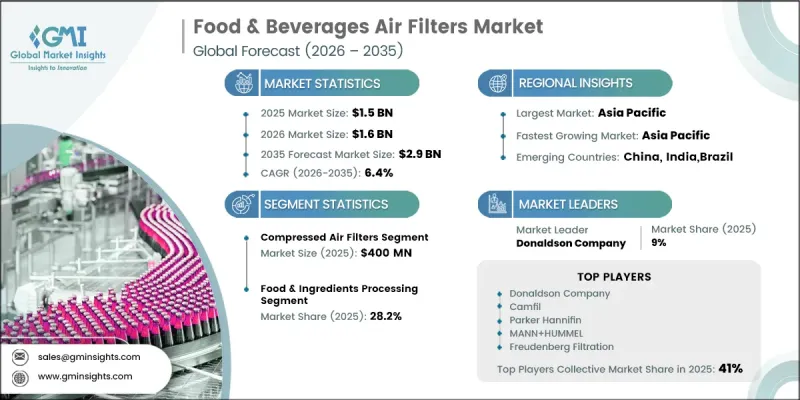
隨著食品飲料製造商日益重視產品品質、營運效率和衛生生產環境,該市場持續成長。隨著加工設施自動化程度的提高和產量的持續成長,保持潔淨可控的空氣不再只是輔助功能,而是基本要求。高效率的空氣過濾系統有助於提高生產一致性、最大限度地降低污染風險、增強生產可靠性,並確保加工作業不間斷。消費者對食品安全的日益重視,以及法律規範嚴格,促使製造商在其加工設施中全面部署先進的空氣過濾技術。企業也在投資最先進的過濾系統,以提高營運效率,同時加強對不斷發展的行業標準的遵守。此外,消費者對產品品質和生產透明度的期望不斷提高,也持續推動對高性能空氣過濾解決方案的需求。預計在整個預測期內,過濾技術的不斷進步和食品加工設施的持續現代化將為全球食品飲料空氣過濾器市場創造有利的成長機會。
| 市場範圍 | |
|---|---|
| 開始年份 | 2025 |
| 預測期 | 2026-2035 |
| 初始市場規模 | 15億美元 |
| 預計金額 | 29億美元 |
| 複合年成長率 | 6.4% |
隨著法律規範嚴格和消費者期望不斷提高,食品飲料生產商正加大對先進空氣過濾系統的投資。企業優先考慮營造更清潔的生產環境,以提高產品品質、保障生產流程並維持穩定的職場環境。此外,最新的過濾技術有助於提高營運效率,幫助工廠在滿足日益嚴格的監管要求的同時,達到更高的生產標準。隨著生產商升級加工設施,空氣過濾系統正成為提升營運績效、增強消費者對食品安全和品質信心的關鍵投資。
預計到2025年,壓縮空氣濾清器市場規模將達4億美元。由於壓縮空氣在食品飲料生產過程中仍然是必不可少的能源,因此該細分市場將持續推動市場成長。嚴格的空氣潔淨度標準和不斷提高的品質要求進一步刺激了對高性能壓縮空氣過濾系統的需求。這些系統能夠維持潔淨的空氣供應、提高製程可靠性並支持穩定的產品品質,因此在全球食品飲料產業中得到廣泛應用。
預計到2025年,食品和原料加工產業的市場佔有率將達到28.2%。該產業之所以能保持主導地位,主要得益於食品加工環境對空氣過濾的廣泛需求。製造商需要先進的過濾技術來維持可控的生產環境、提高產品品質並確保符合行業標準。全球食品製造企業數量的不斷成長,以及持續不斷的生產現代化投資,都持續推動該應用領域對空氣過濾系統的強勁需求。
預計到2025年,美國食品飲料產業空氣過濾器市場將佔據80%的市場佔有率,市場規模將達到2.76億美元。北美市場的整體成長持續受到嚴格的監管合規要求和食品安全標準的推動,促使製造商投資先進的過濾技術。不斷更新的監管要求預計將維持短期需求,尤其是在對空氣品質要求極高的壓縮空氣過濾系統領域。
目錄
第1章:調查方法
第2章執行摘要
第3章 行業洞察
- 產業生態系分析與價值鏈分析
- 原料供應商(過濾介質、濾框、活性碳)
- 過濾器製造商和原始設備製造商
- 銷售管道(直銷、銷售代理、系統整合商)
- 最終用途:食品和飲料加工商
- 影響產業的因素
- 市場促進因素
- 市場挑戰與陷阱
- 市場機遇
- 成長潛力分析
- 產業生態系分析
- 監理框架
- 美國:FDA食品安全現代化法案(FSMA)、OSHA空氣品質標準
- 歐盟:EC 1935/2004、EN 1822 HEPA 分類、ATEX 指令
- 亞太地區:中國的GB標準,印度的FSSAI指南
- 全球 ISO 8573壓縮空氣品質標準
- 價格分析
- 對過去價格趨勢的分析
- 依球員類型分類的定價策略(高級球員、超值球員、成本加成球員)
- 技術與創新展望
- 濾材(奈米纖維、ePTFE、靜電紡絲介質)的進展
- 智慧物聯網空氣過濾器監測系統
- 高效能低壓損過濾器設計
- 波特的分析
- PESTLE分析
- 貿易數據分析
- 空氣過濾設備的進出口量及進口額趨勢
- 主要貿易路線及關稅對食品飲料空氣濾清器市場的影響。
- 人工智慧和生成式人工智慧對市場的影響
- 人工智慧驅動的轉型:預測性維護和過濾器生命週期最佳化
- GenAI在食品飲料產業的應用案例與實施藍圖
- 食品級環境下人工智慧的風險、限制與監管考量
- 生產能力和生產情況
- 按地區和主要過濾器製造商裝置容量
- 運轉率和擴張計劃
第4章 競爭情勢
- 介紹
- 企業市佔率分析
- 北美洲
- 歐洲
- 亞太地區
- LATAM
- 中東和非洲
- 企業矩陣分析
- 主要市場公司的競爭分析
- 競爭定位矩陣
- 主要進展
- 併購
- 夥伴關係和聯盟
- 新產品發布
- 業務拓展計劃
第5章 市場估算與預測:依產品類型分類,2022-2035年
- 集塵機
- 筒式集塵機
- 袋式除塵器
- 旋風分離器/慣性分離器
- 集霧器
- EPA/HEPA/ULPA過濾器
- EPA過濾器(E10-E12)
- 高效能空氣過濾器(H13-H14)
- ULPA過濾器(U15-U17)
- 活性碳過濾器,用於控制異味和揮發性有機化合物。
- 壓縮空氣過濾器
- 粒狀物過濾器
- 聚結過濾器
- 滅菌/膜過濾器
- 其他
第6章 市場估計與預測:依應用領域分類,2022-2035年
- 乳製品
- 食品及配料加工
- 麵包糖果甜點
- 麵粉加工和穀物加工
- 香辛料和調味料的加工
- 瓶裝水
- 不含酒精的飲料
- 啤酒和酒精飲料
- 肉類/家禽加工
- 其他
第7章 市場估計與預測:依通路分類,2022-2035年
- 直銷
- 間接銷售
第8章 市場估計與預測:依地區分類,2022-2035年
- 北美洲
- 美國
- 加拿大
- 歐洲
- 德國
- 英國
- 法國
- 義大利
- 西班牙
- 荷蘭
- 亞太地區
- 中國
- 印度
- 日本
- 澳洲
- 韓國
- 拉丁美洲
- 巴西
- 墨西哥
- 中東和非洲
- 南非
- 沙烏地阿拉伯
- UAE
第9章:公司簡介
- 世界公司
- Solventum
- Pall Corporation(Danaher)
- Camfil Group
- Parker Hannifin Corporation
- Donaldson Company, Inc.
- MANN+HUMMEL Group
- Freudenberg Filtration Technologies
- AAF International
- 該地區的領先企業
- Porvair Filtration Group Ltd.
- Spirax-Sarco Engineering Plc.
- Nederman Holding AB
- Koch Filter Corporation(Atmus)
- APC Filtration, Inc.
- Hengst Filtration
- Micronics Engineered Filtration Group
- Niche/Specialist Players
- Nano Purification Solutions Ltd.
- Air Filters, Inc.
- Permatron Corporation
- Intensiv-Filter Himenviro GmbH
- TROX Group
- GVS Group SpA
- Oerlikon AM
The Global Food & Beverages Air Filters Market was valued at USD 1.5 billion in 2025 and is estimated to grow at a CAGR of 6.4% to reach USD 2.9 billion by 2035.
The market continues to gain momentum as food and beverage manufacturers place greater emphasis on maintaining high standards of product quality, operational efficiency, and hygienic production environments. As processing facilities become increasingly automated and production volumes continue to rise, maintaining clean and controlled air has become an essential requirement rather than a supporting function. Effective air filtration systems help improve manufacturing consistency, minimize contamination risks, enhance production reliability, and support uninterrupted processing operations. Rising awareness of food safety, coupled with stricter regulatory oversight, is encouraging manufacturers to adopt advanced air filtration technologies across processing facilities. Companies are also investing in modern filtration systems to improve operational performance while strengthening compliance with evolving industry standards. In addition, increasing consumer expectations regarding product quality and manufacturing transparency continue to support demand for high-performance air filtration solutions. Continuous advancements in filtration technologies and ongoing modernization of food processing facilities are expected to create favorable growth opportunities for the global food & beverages air filters market throughout the forecast period.
| Market Scope | |
|---|---|
| Start Year | 2025 |
| Forecast Year | 2026-2035 |
| Start Value | $1.5 Billion |
| Forecast Value | $2.9 Billion |
| CAGR | 6.4% |
Growing regulatory oversight and heightened consumer expectations are encouraging food and beverage manufacturers to increase investments in advanced air filtration systems. Companies are prioritizing cleaner production environments to improve product quality, protect manufacturing operations, and maintain consistent workplace conditions. Modern filtration technologies also support greater operational efficiency by helping facilities achieve higher production standards while complying with increasingly stringent regulatory requirements. As manufacturers continue upgrading processing facilities, air filtration systems are becoming an essential investment for strengthening operational performance and reinforcing consumer confidence in food safety and quality.
The compressed air filters segment accounted for USD 400 million in 2025. The segment continues to lead the market because compressed air remains a critical utility throughout food and beverage manufacturing operations. Strict air purity standards and increasing quality requirements have further strengthened demand for high-performance compressed air filtration systems. Their ability to maintain clean air supplies, improve process reliability, and support consistent production quality continues to drive widespread adoption across the global food and beverage industry.
The food & ingredients processing reached 28.2% share in 2025. This segment maintains its leading position due to the broad range of air filtration requirements associated with food processing environments. Manufacturers require advanced filtration technologies to maintain controlled production conditions, improve product quality, and ensure compliance with industry standards. The increasing number of food manufacturing facilities worldwide, combined with continued investments in production modernization, continues to support strong demand for air filtration systems across this application segment.
United States Food & Beverages Air Filters Market held an 80% share, generating USD 276 million in 2025. Market growth across North America continues to be supported by strong regulatory compliance requirements and strict food safety standards that encourage manufacturers to invest in advanced filtration technologies. Ongoing implementation of updated regulatory requirements is expected to sustain short-term demand, particularly for compressed air filtration systems requiring enhanced air quality performance.
Major companies operating in the global food & beverages air filters market include Solventum (formerly 3M Purification), Pall Corporation (Danaher), Camfil Group, Parker Hannifin Corporation, Donaldson Company, Inc., MANN+HUMMEL Group, Freudenberg Filtration Technologies, AAF International (American Air Filter), Porvair Filtration Group Ltd., Spirax-Sarco Engineering Plc., Nederman Holding AB, Koch Filter Corporation (Atmus), APC Filtration, Inc., Hengst Filtration, Micronics Engineered Filtration Group (Cleanova), Nano Purification Solutions Ltd., Air Filters, Inc., Permatron Corporation, Intensiv-Filter Himenviro GmbH, TROX Group, and GVS Group S.p.A. Companies operating in the food & beverages air filters market are strengthening their market position by investing in advanced filtration technologies that improve efficiency, durability, and compliance with evolving food safety regulations. Manufacturers are expanding research and development activities to introduce high-performance filtration systems capable of supporting increasingly automated production environments. Strategic collaborations with food processing companies and equipment manufacturers are helping suppliers broaden their customer base and strengthen long-term business relationships. Businesses are also enhancing manufacturing capabilities, optimizing supply chains, and expanding their global distribution networks to improve product availability and market reach.
Table of Contents
Chapter 1 Methodology
- 1.1 Research approach
- 1.2 Quality Commitments
- 1.2.1 GMI AI policy & data integrity commitment
- 1.2.1.1 Source consistency protocol
- 1.2.1 GMI AI policy & data integrity commitment
- 1.3 Research Trail & Confidence Scoring
- 1.3.1 Research Trail Components
- 1.3.2 Scoring Components
- 1.4 Data Collection
- 1.4.1 Partial list of primary sources
- 1.5 Data mining sources
- 1.5.1 Paid sources
- 1.5.1.1 Sources, by region
- 1.5.1 Paid sources
- 1.6 Base estimates and calculations
- 1.6.1 Base year calculation for any one approach
- 1.7 Forecast model
- 1.7.1 Quantified market impact analysis
- 1.7.1.1 Mathematical impact of growth parameters on forecast
- 1.7.1 Quantified market impact analysis
- 1.8 Research transparency addendum
- 1.8.1 Source attribution framework
- 1.8.2 Quality assurance metrics
- 1.8.3 Our commitment to trust
Chapter 2 Executive Summary
- 2.1 Industry snapshot
- 2.2 Business trends
- 2.3 Product type trends
- 2.4 Application trends
- 2.5 Distribution channel trends
- 2.6 Regional trends
Chapter 3 Industry Insights
- 3.1 Industry ecosystem and value chain analysis
- 3.1.1 Raw material suppliers (filter media, frames, activated carbon)
- 3.1.2 Filter manufacturers & OEMs
- 3.1.3 Distribution channels (direct, distributors, system integrators)
- 3.1.4 End-use food & beverage processors
- 3.2 Industry impact forces
- 3.2.1 Market Driver
- 3.2.2 Market challenges/pitfalls
- 3.2.3 Market opportunities
- 3.3 Growth potential analysis
- 3.4 Industry ecosystem analysis
- 3.5 Regulatory framework
- 3.5.1 U.S.: FDA food safety modernization act (FSMA), OSHA air quality standards
- 3.5.2 European Union: EC 1935/2004, EN 1822 HEPA classification, ATEX directives
- 3.5.3 Asia Pacific: China GB standards, India FSSAI guidelines
- 3.5.4 Global ISO 8573 compressed air quality standards
- 3.6 Pricing analysis (driven by primary research)
- 3.6.1 Historical price trend analysis (driven by primary research)
- 3.6.2 Pricing strategy by player type (premium / value / cost-plus) (driven by primary research)
- 3.7 Technology and innovation landscape
- 3.7.1 Advances in filter media (nanofiber, ePTFE, electrospun media)
- 3.7.2 Smart & IoT-enabled air filter monitoring systems
- 3.7.3 Energy-efficient & low-pressure-drop filter designs
- 3.8 Porter’s Analysis
- 3.9 PESTEL Analysis
- 3.10 Trade data analysis (driven by primary research)
- 3.10.1 Import/export volume & value trends: air filtration equipment (HS code 8421)
- 3.10.2 Key trade corridors & tariff impact on F&B air filter markets
- 3.11 Impact of AI and generative AI on the market
- 3.11.1 AI-driven disruption: predictive maintenance & filter lifecycle optimization
- 3.11.2 GenAI use cases & adoption roadmap by F&B segment
- 3.11.3 Risks, limitations & regulatory considerations for AI in food-grade environments
- 3.12 Capacity and production landscape (driven by primary research)
- 3.12.1 Installed capacity by region & key filter producer (driven by primary research)
- 3.12.2 Capacity utilization rates & expansion pipelines (driven by primary research)
Chapter 4 Competitive Landscape, 2025
- 4.1 Introduction
- 4.2 Company market share analysis
- 4.2.1 North America
- 4.2.2 Europe
- 4.2.3 APAC
- 4.2.4 LATAM
- 4.2.5 MEA
- 4.3 Company matrix analysis
- 4.4 Competitive analysis of major market players
- 4.5 Competitive positioning matrix
- 4.6 Key developments
- 4.6.1 Mergers & acquisitions
- 4.6.2 Partnerships & collaborations
- 4.6.3 New product launches
- 4.6.4 Expansion plans
Chapter 5 Market Estimates and Forecast, By Product Type, 2022 - 2035 ($ Billion)(Thousand Units)
- 5.1 Key trends
- 5.2 Dust collectors
- 5.2.1 Cartridge collectors
- 5.2.2 Baghouse filters
- 5.2.3 Cyclone / inertial separators
- 5.3 Mist collectors
- 5.4 EPA / HEPA / ULPA filters
- 5.4.1 EPA filters (E10-E12)
- 5.4.2 HEPA filters (H13-H14)
- 5.4.3 ULPA filters (U15-U17)
- 5.5 Activated carbon / odor & VOC control filters
- 5.6 Compressed air filters
- 5.6.1 Particulate filters
- 5.6.2 Coalescing filters
- 5.6.3 Sterile / membrane filters
- 5.7 Others
Chapter 6 Market Estimates and Forecast, By Application, 2022 - 2035 ($ Billion) (Thousand Units)
- 6.1 Key trends
- 6.2 Dairy
- 6.2.1 Food & ingredients processing
- 6.2.2 Bakery & confectionery
- 6.2.3 Flour milling & grain processing
- 6.2.4 Spices & seasonings processing
- 6.3 Bottled water
- 6.4 Non-alcoholic beverages
- 6.5 Brewery & alcoholic beverages
- 6.6 Meat & poultry processing
- 6.7 Others
Chapter 7 Market Estimates and Forecast, By Distribution Channel, 2022 - 2035 ($ Billion) (Thousand Units)
- 7.1 Key trends
- 7.2 Direct sales
- 7.3 Indirect sales
Chapter 8 Market Estimates and Forecast, By Region, 2022 - 2035 ($ Billion) (Thousand Units)
- 8.1 Key trends
- 8.2 North America
- 8.2.1 US
- 8.2.2 Canada
- 8.3 Europe
- 8.3.1 Germany
- 8.3.2 UK
- 8.3.3 France
- 8.3.4 Italy
- 8.3.5 Spain
- 8.3.6 Netherlands
- 8.4 Asia Pacific
- 8.4.1 China
- 8.4.2 India
- 8.4.3 Japan
- 8.4.4 Australia
- 8.4.5 South Korea
- 8.5 Latin America
- 8.5.1 Brazil
- 8.5.2 Mexico
- 8.6 Middle East and Africa
- 8.6.1 South Africa
- 8.6.2 Saudi Arabia
- 8.6.3 UAE
Chapter 9 Company Profiles
- 9.1 Global Players
- 9.1.1 Solventum
- 9.1.2 Pall Corporation (Danaher)
- 9.1.3 Camfil Group
- 9.1.4 Parker Hannifin Corporation
- 9.1.5 Donaldson Company, Inc.
- 9.1.6 MANN+HUMMEL Group
- 9.1.7 Freudenberg Filtration Technologies
- 9.1.8 AAF International
- 9.2 Regional Champions
- 9.2.1 Porvair Filtration Group Ltd.
- 9.2.2 Spirax-Sarco Engineering Plc.
- 9.2.3 Nederman Holding AB
- 9.2.4 Koch Filter Corporation (Atmus)
- 9.2.5 APC Filtration, Inc.
- 9.2.6 Hengst Filtration
- 9.2.7 Micronics Engineered Filtration Group
- 9.3 Niche/Specialist Players
- 9.3.1 Nano Purification Solutions Ltd.
- 9.3.2 Air Filters, Inc.
- 9.3.3 Permatron Corporation
- 9.3.4 Intensiv-Filter Himenviro GmbH
- 9.3.5 TROX Group
- 9.3.6 GVS Group S.p.A.
- 9.3.7 Oerlikon AM

 商用車空氣濾清器市場:全球市場預測,2026-2032年
 KN95 口罩市場規模、佔有率和成長分析:按產品類型、應用、過濾效率、分銷管道、最終用戶和地區分類-2026-2033 年產業預測汽車空氣濾清器市場:2026-2032年全球市場預測(濾材、車輛類型、濾清器類型、技術和最終用戶分類)
 北美汽車空氣濾清器市場:市佔率分析、產業趨勢與統計及成長預測(2026-2031)歐洲汽車空氣濾清器:市場佔有率分析、行業趨勢和統計數據以及成長預測(2026-2031 年)
 高效微粒空氣過濾器(HEPA)市場規模、佔有率和趨勢分析報告:按應用、分銷管道、過濾器類型、最終用途、地區和細分市場預測,2026-2033年
 汽車空氣濾清器市場-全球產業規模、佔有率、趨勢、機會和預測:按車輛類型、濾清器類型、濾材類型、銷售管道類型、地區和競爭格局分類,2021-2031年
 2026年全球空氣碳弧氣刨服務市場報告
 汽車空氣濾清器市場規模、佔有率、成長及全球產業分析:按類型、應用和地區的洞察,2026-2034年的預測高效能空氣微粒過濾器(HEPA)市場:按濾材類型、過濾器類型、過濾等級、應用、最終用戶和分銷管道分類,全球預測(2026-2032年)