


 |
市場調查報告書
商品編碼
2100040
北美醫藥塑膠包裝:市場佔有率分析、產業趨勢與統計及成長預測(2026-2031)North America Pharmaceutical Plastic Packaging - Market Share Analysis, Industry Trends & Statistics, Growth Forecasts (2026 - 2031) |
||||||

※ 本網頁內容可能與最新版本有所差異。詳細情況請與我們聯繫。
據 Mordor Intelligence 稱,2025 年北美醫藥塑膠包裝市場價值為 182.5 億美元,預計到 2031 年將達到 259.3 億美元,而 2026 年為 193.5 億美元,預測期(2026-2031 年)複合年成長率為 6.03%。
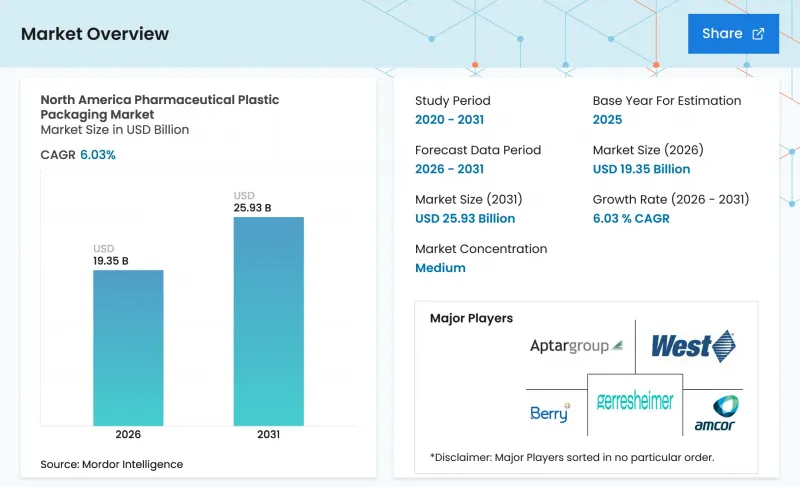
本報告按原料(例如聚丙烯)、產品類型(例如固態口服液瓶、液體口服液瓶)、包裝類別(例如初級包裝容器)、給藥途徑(例如口服、注射、眼用)、最終用戶(例如品牌藥、學名藥)和國家細分。市場預測以美元計價。
北美醫藥塑膠包裝市場趨勢與洞察
生物製藥用無菌預灌封製劑需求激增
生物製藥生產商越來越傾向於使用預滅菌塑膠包裝,這種包裝可以縮短填充線,並在低溫運輸運輸過程中保護高價值活性成分。在美國,簡化的生物製藥監管流程推動了對諸如賽默飛世爾科技的灌裝解決方案等系統的需求,該方案透過氦氣測試最大限度地提高藥物回收率並確保包裝袋的密封性。 West Pharmaceutical Services 的 Ready Pack™ 套件透過免去現場滅菌和最大限度減少廢棄物,為早期研發專案增添了價值。這些平台的快速普及正在加快溫度敏感型治療藥物的上市速度,並增強北美製藥塑膠包裝市場的競爭力。
從玻璃到輕質防碎塑膠的過渡。
與玻璃瓶相比,聚丙烯瓶的重量可減輕高達 60%,有助於減少運輸過程中的排放氣體,並降低因破損導致的召回率。聚丙烯管瓶採用吹塑-填充-密封技術製造,目前正逐漸取代玻璃瓶用於大容量注射劑,提高了耐化學性並降低了顆粒物污染的風險。根據《藥品塑膠》雜誌報道,越來越多的客戶出於降低成本和提高安全性的考慮而轉向使用塑膠瓶。因此,北美醫藥塑膠包裝市場擁有得天獨厚的優勢,能夠最大限度地降低物流成本並提高病患安全。
新型藥物中活性藥物成分與塑膠之間的化學不相容性
新興療法,例如高活性生物製藥和mRNA疫苗,對常見的聚合物添加劑非常敏感,這使得容器的選擇變得複雜。美國藥典(USP)<661.1>和<661.2>的修訂進一步收緊了萃取物的標準。如果合規數據不足,小規模的生技公司的產品上市可能會延遲6-12個月,這正在減緩北美醫藥塑膠包裝市場的成長。
細分市場分析
複合年成長率:優質環烯烴共聚物滿足生物製藥領域對低萃取率的要求。新興的消費後回收 (PCR) 產業在快速發展的同時,也面臨供應限制,這反映了加拿大生產者延伸責任制 (EPR) 的最後期限。
新興的生物基PET等級可望進一步加速PET的普及應用。供應商正著重推廣經過遷移測試的母粒,以確保萃取物符合美國藥典(USP)基準值。到2025年,原生PET和再生PET之間的價格差距將縮小,進而提高專案投資報酬率。隨著製藥公司確保食品接觸級rPET的長期供給能力,策略採購合作關係日益普遍。 HDPE加工商正透過輕量化創新和繫繩式瓶蓋解決方案來應對這項挑戰,以維持其在北美醫藥塑膠包裝市場的銷售量。
受過敏、偏頭痛和急診醫學領域新產品上市的推動,市場正以7.26%的複合年成長率快速擴張。定量給藥精度的提高以及患者對針頭的恐懼,都促進了產品的普及。預灌封注射器和藥筒的目標使用者是糖尿病患者和自行注射GLP-1受體激動劑的患者。雖然管瓶和小瓶在醫院的注射藥物應用中仍然發揮著重要作用,但為了防止破損,聚丙烯容器正擴大取代玻璃容器。瓶蓋和瓶塞均採用RFID標籤密封,以符合《藥品供應鏈安全法案》(DSCA)的要求。
人口老化和乾眼症藥物處方量的增加推動了眼藥水注射器的需求成長。單劑量包裝袋便於醫院分發藥物,並能降低微生物污染的風險。製造商採用多層塗層來防止氧氣進入對過氧化物敏感的藥物。隨著監管機構對序列化智慧包裝的日益關注以及產品類型的多樣化,北美醫藥塑膠包裝市場預計將保持穩定成長的勢頭。
其他好處:
- Excel格式的市場預測(ME)表
- 3個月的分析師支持
目錄
第1章:引言
- 研究假設和市場定義
- 調查範圍
第2章:調查方法
第3章執行摘要
第4章 市場狀況
- 市場概覽
- 市場促進因素
- 兒童處方藥對兒童安全瓶蓋的需求
- 從玻璃到輕質防碎塑膠的過渡。
- 生技藥品無菌預灌封製劑需求激增
- 居家照護/自我治療的發展
- 採用聚合反應結晶(PCR)和生物基樹脂來實現ESG目標
- 擴大數位印刷智慧包裝的使用範圍,旨在防止假冒偽劣產品
- 市場限制因素
- 新藥中活性藥物成分與塑膠之間的化學不相容性
- 美國和加拿大複雜的生產者責任延伸制度和回收義務
- 醫用rPET和HDPE供應鏈供不應求。
- 通貨膨脹導致樹脂價格波動
- 產業價值鏈分析
- 監理情勢
- 技術展望
- 產業吸引力—五力分析
- 供應商的議價能力
- 買方的議價能力
- 新進入者的威脅
- 替代品的威脅
- 競爭公司之間的競爭
- 宏觀經濟因素對市場的影響
第5章 市場規模與成長預測
- 按成分
- 聚丙烯(PP)
- 聚對苯二甲酸乙二醇酯(PET)
- 高密度聚苯乙烯(HDPE)
- 低密度聚乙烯(LDPE)
- 環烯烴共聚物(COC)
- 回收塑膠(PCR)
- 依產品類型
- 瓶裝 -固態口服藥物
- 瓶裝液體
- 病毒安瓿
- 預填充式注射器和藥筒
- 鼻噴霧裝置
- 滴管和眼藥水容器
- 小袋和小袋
- 蓋子和頂蓋
- 按包裝類型
- 主容器
- 次要部件(蓋子、襯墊)
- 三級包裝與保護系統
- 透過行政途徑
- 口服
- 腸外
- 眼科
- 鼻腔/吸入
- 外用/經皮
- 最終用戶
- 品牌藥品
- 學名藥
- 生物技術和細胞/基因治療公司
- 合約研發生產組織(CDMO)
- 國家
- 美國
- 加拿大
- 墨西哥
第6章 競爭情勢
- 市場集中度
- 策略趨勢
- 市佔率分析
- 公司簡介
- Amcor PLC
- Gerresheimer AG
- AptarGroup Inc.
- West Pharmaceutical Services Inc.
- Silgan Holdings Inc.
- Schott Pharma AG & Co. KG
- Comar LLC
- Tekni-Plex Inc.
- Drug Plastics & Glass Company Inc.
- Pretium Packaging LLC
- Bormioli Pharma SpA
- Placon Corporation
- Alpla Werke Alwin Lehner GmbH
- Wipak Oy
- Plastipak Holdings Inc.
- O.Berk Company, LLC
- DWK Life Sciences GmbH
- Plastek Group
第7章 市場機會與未來趨勢
- 評估閒置頻段和未滿足的需求
According to Mordor Intelligence, the North America pharmaceutical plastic packaging market size was valued at USD 18.25 billion in 2025 and estimated to grow from USD 19.35 billion in 2026 to reach USD 25.93 billion by 2031, at a CAGR of 6.03% during the forecast period (2026-2031).
This report is Segmented by Raw Material (Polypropylene, and More), Product Type (Bottles - Solid-Oral, Bottles - Liquid, and More), Packaging Category (Primary Containers, and More), Drug-Delivery Route (Oral, Parenteral, Ophthalmic, and More), End-User (Branded Pharma, Generic Pharma, and More), and Country. The Market Forecasts are Provided in Terms of Value (USD).
North America Pharmaceutical Plastic Packaging Market Trends and Insights
Surge in Sterile, Ready-to-Fill Formats for Biologics
Biologic manufacturers increasingly favor pre-sterilized plastic packaging that shortens filling lines and protects high-value actives throughout cold-chain movement. Regulatory pathways for biologics have streamlined in the United States, propelling demand for systems such as Thermo Fisher's Fill Finish Solution, which maximizes drug recovery and ensures helium-tested bag integrity. West Pharmaceutical Services' Ready Pack(TM) kits add value for early-stage programs by eliminating on-site sterilization steps and minimizing waste. Rapid uptake of these platforms is trimming time-to-market for temperature-sensitive therapies and reinforcing the competitiveness of the North America pharmaceutical plastic packaging market.
Shift from Glass to Lightweight, Shatter-Proof Plastics
Weight savings of up to 60% versus glass translate into lower freight emissions and fewer breakage-related recalls. Polypropylene vials produced via blow-fill-seal technology now replace glass in large-volume parenterals, improving chemical resistance and reducing particulate risk. Drug Plastics reports growing customer migration to plastic bottles for both cost and safety gains. The North America pharmaceutical plastic packaging market is therefore positioned to capitalize on lower logistics costs and enhanced patient safety profiles.
API/Plastic Chemical Incompatibilities in Novel Drugs
Highly active biologics and emerging modalities such as mRNA vaccines display sensitivity to common polymer additives, complicating container selection. Revisions to USP <661.1> and <661.2> underscore tougher extractables standards. Small biotech firms face six-to-twelve-month launch delays when compatibility data are insufficient, tempering growth in the North America pharmaceutical plastic packaging market.
Other drivers and restraints analyzed in the detailed report include:
- Growth of Home-Care/Self-Administration Therapies
- Adoption of PCR and Bio-Based Resins to Meet ESG Targets
- Shortage of Medical-Grade rPET/HDPE Supply Chains
For complete list of drivers and restraints, kindly check the Table Of Contents.
Segment Analysis
HDPE contributed 34.78% of revenue in 2025, owing to chemical inertia and affordability. PET, bolstered by 7.47% CAGR, is favored for transparency and high moisture-barrier performance. The North America pharmaceutical plastic packaging market benefits as PET's recyclability supports ESG scorecards. Polypropylene remains indispensable for high-temperature sterilization, whereas LDPE satisfies flexible dropper needs. Premium cyclic olefin copolymers address low-extractables requirements in biologics. The nascent PCR stream shows rapid but supply-constrained uptake, reflecting EPR deadlines in Canada.
Emerging grades of bio-based PET could further accelerate PET adoption. Suppliers emphasize migration-tested masterbatches to keep extractables within USP limits. Price differentials between virgin and recycled PET narrowed during 2025, improving project ROIs. Strategic procurement alliances are increasingly common as drug firms secure long-term capacity for food-contact-grade rPET. HDPE converters respond with lightweighting innovations and tethered cap solutions to retain volumes within the North America pharmaceutical plastic packaging market.
Liquid bottles delivered 39.72% of 2025 sales, reflecting steady prescription and OTC cough remedies. However, nasal spray devices are advancing at 7.26% CAGR, capturing allergy, migraine, and rescue-therapy launches. Enhanced metered-dose accuracy, combined with patient aversion to needles, spurs adoption. Prefillable syringes and cartridges capture self-injecting diabetics and GLP-1 users. Vials and ampoules stay relevant for hospital injectables, though polypropylene formats steadily displace glass to cut breakage. Closures and lids integrate RFID-enabled seals that aid Drug Supply Chain Security Act compliance.
Demand for ophthalmic droppers benefits from aging demographics and dry-eye formulation growth. Unit-dose pouches support hospital compounding and reduce microbial contamination risk. Producers add multi-layer coatings to prevent oxygen ingress in peroxide-sensitive drugs. With regulatory appetite for serialized smart packs intensifying, product-type diversification will keep the North America pharmaceutical plastic packaging market on a robust upward track.
Complete Report Scope:
- By Raw Material
- Polypropylene (PP)
- Polyethylene Terephthalate (PET)
- High-density Polyethylene (HDPE)
- Low-density Polyethylene (LDPE)
- Cyclic Olefin Copolymer (COC)
- Post-consumer Recycled (PCR) Plastics
- By Product Type
- Bottles - Solid-oral
- Bottles - Liquid
- Vials and Ampoules
- Prefillable Syringes and Cartridges
- Nasal Spray Devices
- Dropper and Ophthalmic Containers
- Pouches and Sachets
- Closures and Lids
- By Packaging Category
- Primary Containers
- Secondary Components (closures, liners)
- Tertiary and Protective Systems
- By Drug-delivery Route
- Oral
- Parenteral
- Ophthalmic
- Nasal/Inhalation
- Topical/Transdermal
- By End-user
- Branded Pharma
- Generic Pharma
- Biotech and Cell-/Gene-therapy Firms
- Contract Development and Manufacturing Orgs (CDMOs)
- By Country
- United States
- Canada
- Mexico
List of Companies Covered in this Report:
- Amcor PLC
- Gerresheimer AG
- AptarGroup Inc.
- West Pharmaceutical Services Inc.
- Silgan Holdings Inc.
- Schott Pharma AG & Co. KG
- Comar LLC
- Tekni-Plex Inc.
- Drug Plastics & Glass Company Inc.
- Pretium Packaging LLC
- Bormioli Pharma S.p.A.
- Placon Corporation
- Alpla Werke Alwin Lehner GmbH
- Wipak Oy
- Plastipak Holdings Inc.
- O.Berk Company, L.L.C.
- DWK Life Sciences GmbH
- Plastek Group
Additional Benefits:
- The market estimate (ME) sheet in Excel format
- 3 months of analyst support
TABLE OF CONTENTS
1 INTRODUCTION
- 1.1 Study Assumptions and Market Definition
- 1.2 Scope of the Study
2 RESEARCH METHODOLOGY
3 EXECUTIVE SUMMARY
4 MARKET LANDSCAPE
- 4.1 Market Overview
- 4.2 Market Drivers
- 4.2.1 Demand for child-resistant closures in pediatric Rx drugs
- 4.2.2 Shift from glass to lightweight, shatter-proof plastics
- 4.2.3 Surge in sterile, ready-to-fill formats for biologics
- 4.2.4 Growth of home-care/self-administration therapies
- 4.2.5 Adoption of PCR and bio-based resins to meet ESG targets
- 4.2.6 Expansion of digital-printed smart packs for anti-counterfeit
- 4.3 Market Restraints
- 4.3.1 API/plastic chemical incompatibilities in novel drugs
- 4.3.2 Complex U.S.-Canada EPR and recycling mandates
- 4.3.3 Shortage of medical-grade rPET/HDPE supply chain
- 4.3.4 Inflation-driven resin price volatility
- 4.4 Industry Value Chain Analysis
- 4.5 Regulatory Landscape
- 4.6 Technological Outlook
- 4.7 Industry Attractiveness - Porter's Five Forces Analysis
- 4.7.1 Bargaining Power of Suppliers
- 4.7.2 Bargaining Power of Buyers
- 4.7.3 Threat of New Entrants
- 4.7.4 Threat of Substitutes
- 4.7.5 Intensity of Competitive Rivalry
- 4.8 Impact of Macroeconomic Factors on the Market
5 MARKET SIZE AND GROWTH FORECASTS (VALUES)
- 5.1 By Raw Material
- 5.1.1 Polypropylene (PP)
- 5.1.2 Polyethylene Terephthalate (PET)
- 5.1.3 High-density Polyethylene (HDPE)
- 5.1.4 Low-density Polyethylene (LDPE)
- 5.1.5 Cyclic Olefin Copolymer (COC)
- 5.1.6 Post-consumer Recycled (PCR) Plastics
- 5.2 By Product Type
- 5.2.1 Bottles - Solid-oral
- 5.2.2 Bottles - Liquid
- 5.2.3 Vials and Ampoules
- 5.2.4 Prefillable Syringes and Cartridges
- 5.2.5 Nasal Spray Devices
- 5.2.6 Dropper and Ophthalmic Containers
- 5.2.7 Pouches and Sachets
- 5.2.8 Closures and Lids
- 5.3 By Packaging Category
- 5.3.1 Primary Containers
- 5.3.2 Secondary Components (closures, liners)
- 5.3.3 Tertiary and Protective Systems
- 5.4 By Drug-delivery Route
- 5.4.1 Oral
- 5.4.2 Parenteral
- 5.4.3 Ophthalmic
- 5.4.4 Nasal/Inhalation
- 5.4.5 Topical/Transdermal
- 5.5 By End-user
- 5.5.1 Branded Pharma
- 5.5.2 Generic Pharma
- 5.5.3 Biotech and Cell-/Gene-therapy Firms
- 5.5.4 Contract Development and Manufacturing Orgs (CDMOs)
- 5.6 By Country
- 5.6.1 United States
- 5.6.2 Canada
- 5.6.3 Mexico
6 COMPETITIVE LANDSCAPE
- 6.1 Market Concentration
- 6.2 Strategic Moves
- 6.3 Market Share Analysis
- 6.4 Company Profiles (includes Global level Overview, Market level overview, Core Segments, Financials as available, Strategic Information, Market Rank/Share for key companies, Products and Services, and Recent Developments)
- 6.4.1 Amcor PLC
- 6.4.2 Gerresheimer AG
- 6.4.3 AptarGroup Inc.
- 6.4.4 West Pharmaceutical Services Inc.
- 6.4.5 Silgan Holdings Inc.
- 6.4.6 Schott Pharma AG & Co. KG
- 6.4.7 Comar LLC
- 6.4.8 Tekni-Plex Inc.
- 6.4.9 Drug Plastics & Glass Company Inc.
- 6.4.10 Pretium Packaging LLC
- 6.4.11 Bormioli Pharma S.p.A.
- 6.4.12 Placon Corporation
- 6.4.13 Alpla Werke Alwin Lehner GmbH
- 6.4.14 Wipak Oy
- 6.4.15 Plastipak Holdings Inc.
- 6.4.16 O.Berk Company, L.L.C.
- 6.4.17 DWK Life Sciences GmbH
- 6.4.18 Plastek Group
7 MARKET OPPORTUNITIES AND FUTURE TRENDS
- 7.1 White-Space and Unmet-Need Assessment

 全球醫藥塑膠包裝市場-按材料、產品類型、地區和競爭格局分類的產業規模、佔有率、趨勢、機會和預測(2021-2031年)
 歐洲醫藥塑膠包裝:市場佔有率分析、產業趨勢與統計、成長預測(2026-2031)醫藥塑膠包裝:市場佔有率分析、產業趨勢與統計、成長預測(2026-2031)
 醫藥塑膠包裝市場,依產品類型、應用、最終用戶、國家及地區分類-2025 年至 2032 年全球產業分析、市場規模、市場佔有率及預測中東和西非的藥用塑膠包裝:市場佔有率分析、產業趨勢和成長預測(2025-2030)
 醫藥塑膠包裝市場機會、成長動力、產業趨勢分析及 2025 - 2034 年預測